DTCTCO40WT - Detector NEDIS - Free user manual and instructions
Find the device manual for free DTCTCO40WT NEDIS in PDF.



User questions about DTCTCO40WT NEDIS
0 question about this device. Answer the ones you know or ask your own.
Ask a new question about this device
Download the instructions for your Detector in PDF format for free! Find your manual DTCTCO40WT - NEDIS and take your electronic device back in hand. On this page are published all the documents necessary for the use of your device. DTCTCO40WT by NEDIS.
USER MANUAL DTCTCO40WT NEDIS
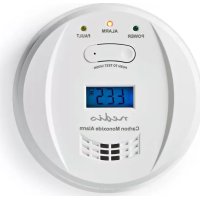
Carbon Monoxide Detector
With display and low-battery alert
DTCTCO40WT
EN
Quick start guide 7

Kurzanleitung 13
FR
For more information see the extended manual online:ned.is/dtctco40wt
Intended use
This product is intended to detect Carbon Monoxide build-up in residential environments.
The product is intended for indoor use only.
Other uses or changes to the product constitute improper use and carry serious risk of accidents.
This product is not intended for commercial use.
Any modification of the product may have consequences for safety, warranty and proper functioning.
Specifications
| Product Carbon Monoxide | Detector |
| Article number DTCTCO40WT | |
| Dimensions (l x w x h) 122 x 122 x 39 mm | |
| Battery type Alkaline 2x AA LR6 (PAIRDEER) | |
| Battery lifespan Up to 5 years | |
| Operating temperature -10 °C - 40 °C | |
| Sensor lifespan Up to 10 years | |
| Alarm volume >85 dB @ 3 m | |
| Alarm output Visual and audible indication | |
| Warm-up period Approximately 100 seconds | |
| Mounting method Wall mounting or ceiling mounting | |
| Test/Hush button Yes | |
| Low-battery alert Yes | |
| Detectable ppm 20 – 999 ppm | |
| Operating humidity 0% – 95% (RH) non-condensing | |
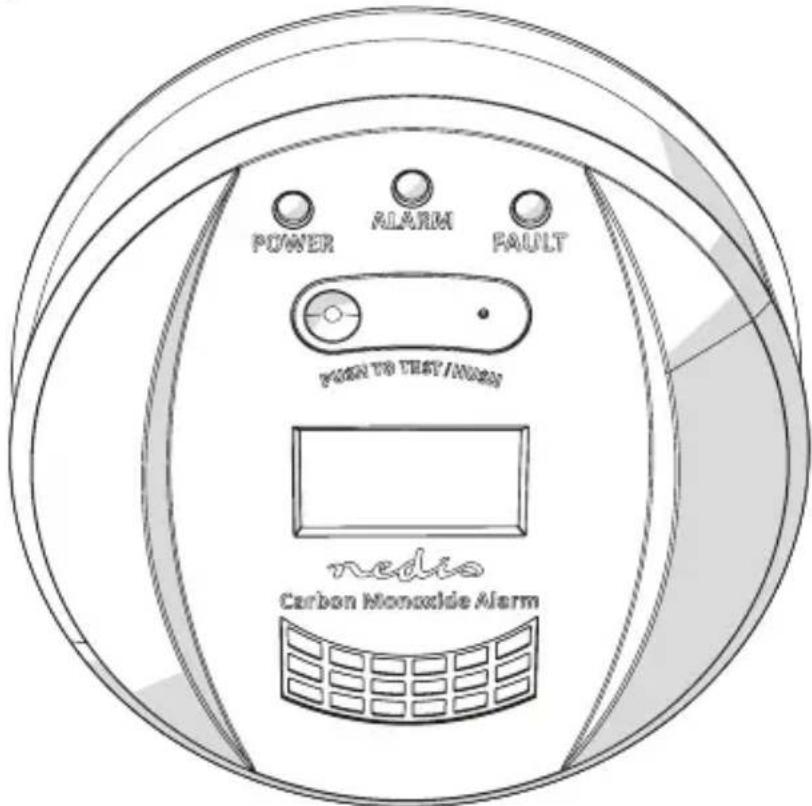
Main parts (image A)
Alarm indicator
2 Power indicator
3 Test/Hush button
4 Display
5 Alarm
6 Bracket
7 Fault indicator
8 Batteries (2x)
9 Screws (2x)
10 Plugs (2x)
Safety instructions
WARNING
- Ensure you have fully read and understood the instructions in this document before you install or use the product. Keep the packaging and this document for future reference.
Only use the product as described in this document. - Do not use the product if a part is damaged or defective. Replace a damaged or defective product immediately.
- Do not drop the product and avoid bumping.
- Do not expose the product to water, rain, moisture or high humidity.
- Test the product once per week to ensure proper operation.
- Do not paint the product.
- Do not use this product in a dusty or smoky ambience.
-
Do not use the product for outdoor uses, the product is designed for indoor use.
-
Replace the product under conditions of malfunction, end of life or low-battery.
- This product may only be serviced by a qualified technician for maintenance to reduce the risk of electric shock.
- Do not use aerosols (air fresheners, hair spray, paint) near the product.
- Do not replace the batteries. This product is only tested with the provided batteries. Discard the product when the batteries are empty.
- The CO detector will not trigger an alarm for other hazards such as gas leaks, fires or explosions. A CO detector is no substitute for smoke, fire, heat or other gas detectors.
- Assist children and/or people with mobility limitations in event of an emergency.
Always check your home and appliances for potential problems after an alarm. - Consult a qualified appliance technician to check your appliances if the alarm reactivates within 24 hours.
- Always notify the manufacturer if a problem with an appliance is identified.
- The product is intended for use in household environments for typical housekeeping functions. The product is not suitable for commercial or industrial applications nor for use on recreational or commercial vehicles.
- The installation of the product should not be used as a substitute for proper installation, use and maintenance of fuel fired facilities, including appropriate ventilation and exhaust systems.
- Do not dismantle, open or shred batteries.
- Do not expose batteries to heat or fire. Avoid storage in direct sunlight.
- Do not short-circuit a battery.
- Do not store cells or batteries haphazardly in a box
or drawer where they may short-circuit each other or be short-circuited by other metal objects.
- Do not subject cells or batteries to mechanical shock.
- In the event of a battery leaking, do not allow the liquid to come in contact with the skin or eyes. If contact has been made, wash the affected area with copious amounts of water and seek medical advice.
- Only use the battery type(s) recommended in this document.
- Keep cells and batteries clean and dry.
- Retain the original product literature for future reference.
- When possible, remove the battery from the product when not in use.
- Do not remove a cell or battery from the original packaging until required for use.
- Do not use any cell or battery that is not designed for use with the product.
- Use only the cell or battery in the application for which it was intended.
- Wipe the cell or battery terminals with a clean dry cloth if they become dirty.
- Battery usage by children should be supervised.
- Observe the plus (+) and minus (-) marks on the cell, battery and equipment and ensure correct use.
- Dispose of the cell or battery properly.
- Seek medical advice immediately if a cell or a battery has been swallowed.
Angers of Carbon Monoxide
Exposure to Carbon Monoxide (CO) is very dangerous. CO is a colourless, odourless and tasteless gas that deprives oxygen from the area. This can be fatal. CO is generated by combustion of carbonaceous materials, mainly when not enough oxygen is available. This can occur for example by malfunctioning or misuse
of appliances used for heating and cooking or by vehicle engines, blocked chimneys, fireplaces, boilers, stoves and any other fuel burning appliance within a confined area.
CO is a toxin that is bound in blood where it prevents the transport of oxygen, which can cause death by suffocation.
Everyone is susceptible but experts agree that unborn babies, pregnant women, senior citizens and people with heart or respiratory problems are especially vulnerable to the dangers of CO.
Combustion appliances should always be installed by a qualified professional. Initial carbon monoxide poisoning symptoms are similar to the flu with no fever and can include:
- dizziness
- severe headaches
- nausea
vomiting
disorientation
If symptoms of CO poisoning are experienced, seek medical attention immediately, CO poisoning can be determined by a carboxyhaemoglobin test.
The following symptoms are related to CO poisoning and should be discussed with all members of the household:
- Mild exposure: slight headache, nausea, vomiting, fatigue (often described as flu-like symptoms).
- Medium exposure: severe throbbing headache, drowsiness, confusion, fast heat rate.
- Extreme exposure: unconsciousness, convulsions, cardiorespiratory failure, death.
The product will not trigger an alarm for other hazards such as gas leaks, fires or explosions. A CO detector is no substitute for smoke, fire, heat or other gas detectors.
The product is intended for use in household
environments for typical housekeeping functions. It is not suitable for commercial or industrial applications or for use on recreational or commercial vehicles.
installation of the product should not be used as a substitute for proper installation, use and maintenance of fuel fired facilities, including appropriate ventilation and exhaust systems.
This detector is intended to protect persons from the acute effects of CO.
This detector can not provide people with special medical properties complete security. If in doubt you should consult a physician.
A appliances/equipment should be installed by trained personnel only. Keep the devices/equipment in good mechanical condition and have them checked regularly
The danger of CO levels:
| Concentration of CO in air. (ppm = parts per million) | Symptoms |
| 50ppm The maximum allowable concentration for healthy adults to be exposed to in a 8-hour period. | |
| 200ppm Within 2-3 hours of exposure: -slight headache -fatigue -dizziness -nausea | |
| 400ppm Within 1-2 hours of exposure: -frontal headaches WARNING: 3 hours of exposure will result in death. | |
| 800 – 999 ppm Within 45 minutes of exposure: -dizziness -nausea -convulsions -unconsciousness WARNING: 2-3 hours of exposure will result in death. | |
product is designed to protect users against the acute effects of CO poisoning. The product does not ensure complete protection for people with medical issues.
Installing the batteries (image B)
- Turn the alarm A 5 counter clockwise to remove it from the bracket A6
- Insert the batteries into the battery compartment. Make sure that the battery polarity (+/-) matches the polarity markings inside the battery compartment.
- Turn 5 clockwise to attach it to A 6
Constant exposure to high or low humidity may reduce battery life.
Mounting the product (image C + D )
- Turn 5 counterclockwise to remove it from A6
- Place 6 in the desired location.
Follow steps 3-5 for stone/concrete surfaces. Continue to step 6 for wood surfaces.
- Use 6 to mark the drill locations with a pencil.
- Drill two 05mm holes.
- Insert the plugs A 10 into the holes.
- Fasten the mounting bracket with the screws A 9.
- Turn 5 clockwise to attach it to A6.
Make sure the arrow on the bracket is pointing upwards when installing to the wall.
Keep the product in a dust free area when drilling. Do not overtighten the screws, this will deform the bracket.
Choosing a location (image E + F )
For safe use, it is recommended to install the product in the following locations:
- Every sleeping area.
- Both ends of a hallway longer than 12 m .
- Every room where multiple people spend several consecutive hours.
- Install at least one product on each floor of a multi-level home.
- Every room where a furnace, a heat source and/or other burning devices are located.
- If there is a basement in the house: At the top of the basement stairs.
The product only indicates the presence of CO near the sensor. CO may be present in other areas.
In areas with a source of combustion
On the ceiling:
- At least 1 - 3 m away from the CO-source. The optimal distance is 6 m.
- At least 30cm away from surrounding walls.
- At a central point in the room.
- Not in turbulent air (near windows, ceiling fans or air conditioners).
In areas without a source of combustion
In sleeping areas:
- On breathing level.
- Not in turbulent air (near windows, ceiling fans or air conditioners).
- Not behind objects (curtains or closets).
Other areas:
- On breathing level. Depending on the activities in the room the product should be installed on sitting or standing height.
- Not in turbulent air (near windows, ceiling fans or air conditioners).
- Not behind objects (curtains or closets).
Do not install the product:
- in dirty, greasy or dusty areas.
- in temperatures below -10^ .
- in temperatures above +40^ .
- in turbulent air (near ceiling fans, air conditioners or open windows).
within 3 meters of a high humidity source.
within 1.5 meters of kitchen appliances. - within 1.5 meters of a furnace or fuel burning heat sources. The optimal distance is 6 meters.
- behind objects like curtains or closets.
- in direct sunlight.
Always remove the product from the area when the following maintenance is performed to prevent damage to the product:
scouring or stripping wooden floors.
painting.
- wallpapering.
using adhesives or aerosols.
The following substances and gasses can cause false
alarms or permanently damage the detector: methane, propane, iso-butane, ethylene, ethanol, alcohol, isopropanol, benzene, toluene, ethylacetate, acid, ether, hydrogen, hydrogen sulphate, hepatic gas, sulphur dioxide, aerosol, propellant, alcohol preparation, paint, thinner, dissolvent, bonding agents, shampoo, aftershave balm, perfume and certain cleaning agents.
Response time of the product
| Concentration of CO in air. (ppm = parts per million) | Response time of the product |
| 30ppm 120 minutes | |
| 50ppm 60 - 90 minutes | |
| 100ppm 10 - 40 minutes | |
| 300ppm 3 minutes |
When the alarm goes off
When the alarm beeps quickly and the red LED blinks continuously:
- Immediately go outside.
- Call the local emergency services (Fire department).
- Do not go back into the building until emergency services tell you it is safe.
Aver ignore an alarm.
Do not press the Hush/test button in case of an alarm.
Assist children and/or people with mobility limitations in event of an emergency.
The product cannot protect people with special medical conditions.
Always check your home and appliances for potential problems after an alarm.
Consult a qualified appliance technician to check your appliances if the alarm reactivates within 24 hours.
Always notify the manufacturer if a problem with an appliance is identified.
The product only measures CO in the area where it is located.
Individuals with medical conditions that may make them more sensitive to CO may consider using warning devices which provide audible and visual signals for CO concentrations under 30 ppm. For additional information on Carbon Monoxide and your medical condition contact your physician.
Hush mode
In hush mode, the product does not detect CO for 12 hours.
The hush mode must be activated manually.
- Press the test/hush button A ③ shortly to activate hush mode. The alarm indicator blinks every 30 seconds
After 12 hours, the product goes back into standby mode.
Only use the hush mode when the product is in line of sight.
The product status is indicated through the display A4 and LED lights A1, A2 and A7. An overview of the different statuses and indications is shown in the table below.
| Information LED indicator | Sound alarm Display | |||
| Power up and warm up mode | Check Installation to power the product. Warm up lasts approximately 100 seconds. | A①, A②and A⑦ blink alternately. | One short beep. | 888° |
| Standby mode After warm up, the product will activate standby automatically. | A②blinks green every 30 seconds. | Off None | ||
| Hush mode | Press A③ shortly to enter hush mode. | A⑦ blinks yellow every 30 seconds. | Off | Lb° |
| Silenced alarm | Press A③ shortly to silence an unwanted alarm. | A① blinks red continuous. | Off | 999!Any number between 25 - 999. |
| Test | Press and release A③ to test the product. | A① blinks red 4 times. | four beeps. | EES° |
| Low battery condition | Replace the product immediately. | A⑦ blinks yellow every 30 seconds. | A beep every 30 seconds. | Lb° |
| Malfunction The product is malfunctioning. Contact Nedis. | A⑦ blinks yellow twice every 30 seconds. | Two beeps every 30 seconds. | Err |
| End-of-life Replace the product immediately. | A⑦ blinks yellow twice every 30 seconds. | One long beep and one short beep every 30 seconds. | End |
| Alarm Presence of Carbon Monoxide. | A① blinks red continuous. | Continuous beeping. | 999 Any number between 25 - 999. |
Troubleshooting
| Problem Possible solution | |
| The product does not respond when you press the test button. | Make sure the batteries are installed properly. |
| A⑦blinks and the alarm sounds every 30 seconds. | Battery is low. Replace the product immediately. |
| A⑦blinks twice and the alarm sounds every 30 seconds. | The product is malfunctioning. Contact Nedis. |
Declaration of Conformity
We, Nedis B.V. declare as manufacturer that the product DTCTCO40WT from our brand Nedis, produced in China, has been tested according to all relevant CE standards and regulations and that all tests have been passed successfully. This includes, but is not limited to the RED 2014/53/EU regulation.
The complete Declaration of Conformity (and the safety datasheet if applicable) can be found and downloaded via:
nedis.com/DTCTCO40WT#support
For additional information regarding the compliance, contact the customer service:
Web: www.nedis.com
Nedis B.V., de Tweeling 28
5215 MC's-Hertogenbosch, the Netherlands