MBS 900 D - Sander Meister Craft - Free user manual and instructions
Find the device manual for free MBS 900 D Meister Craft in PDF.

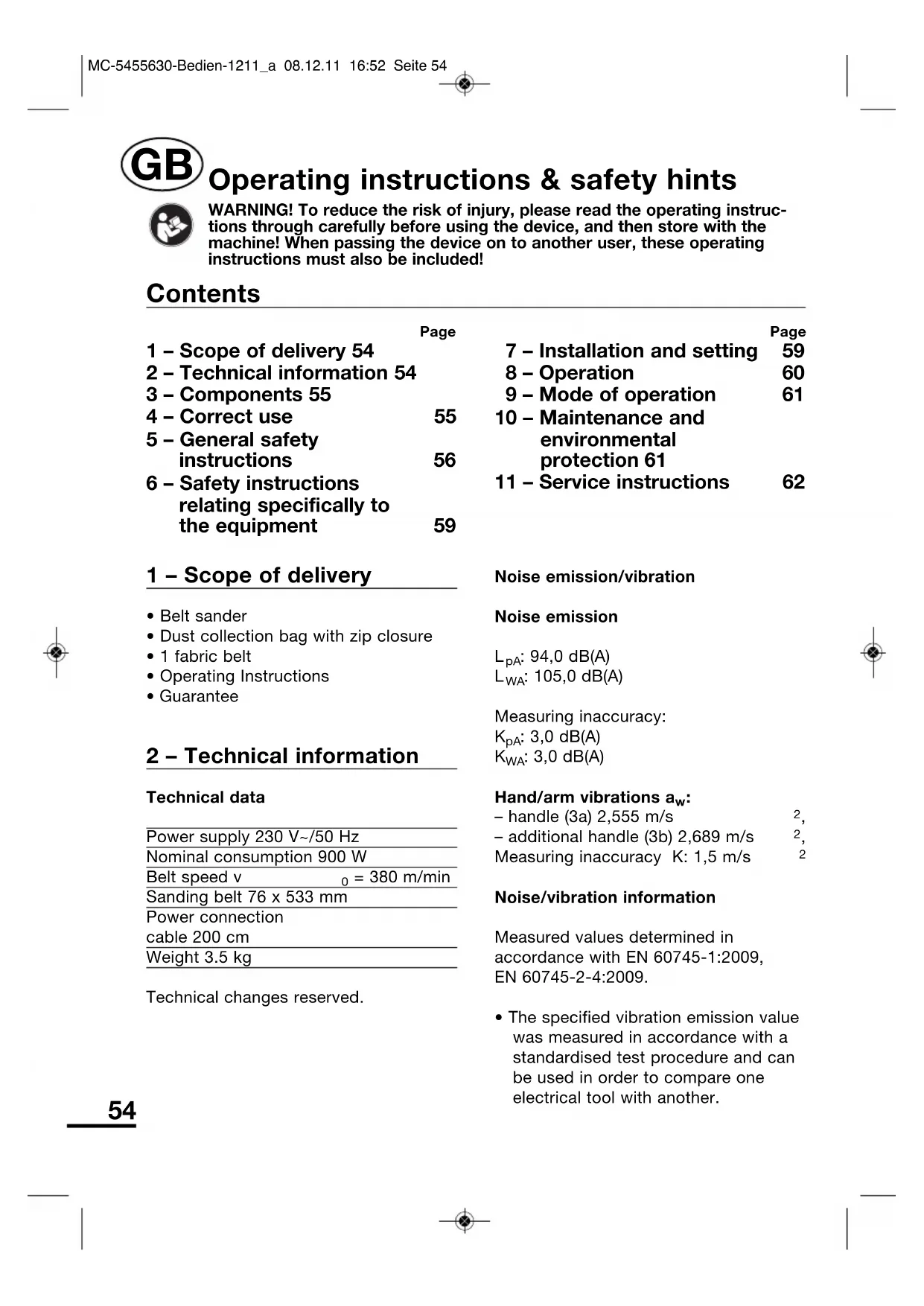


| Product type | Belt sander |
| Brand | Meister Craft |
| Model | MBS 900 D |
| Category | Sander |
| Power supply | 230 V ~ / 50 Hz |
| Rated power | 900 W |
| Belt speed (no load) | 380 m/min |
| Sanding belt size | 76 x 533 mm |
| Power cable length | 200 cm |
| Weight | 3.5 kg |
| Sound pressure level (LpA) | 94.0 dB(A) |
| Sound power level (LWA) | 105.0 dB(A) |
| Vibration main handle | 2.555 m/s² |
| Vibration auxiliary handle | 2.689 m/s² |
| Usage | Dry sanding of wood, metal and plastic |
| Dust collection device | Dust bag with zipper closure |
| Continuous operation function | Yes, with stop button |
| Belt tracking adjustment | Adjustment screw for straight tracking |
| Insulation | Double insulation |
| Maintenance | Cleaning ventilation slots, replacing carbon brushes and belt |
Frequently Asked Questions - MBS 900 D Meister Craft
User questions about MBS 900 D Meister Craft
0 question about this device. Answer the ones you know or ask your own.
Ask a new question about this device
Download the instructions for your Sander in PDF format for free! Find your manual MBS 900 D - Meister Craft and take your electronic device back in hand. On this page are published all the documents necessary for the use of your device. MBS 900 D by Meister Craft.
USER MANUAL MBS 900 D Meister Craft
natural_image
Black industrial machine labeled 'meister M1 CRAFT' with visible cooling fan and mounting bracket (no additional text or symbols)Service
text_image
30-240 40-120 100-280 Abb. 2 3b 2 3a 9 7 1 1 10 5 13 14 12 MIS-340 SOMENZENBERG 200mm x 200mm x 200mm x 200mm x 200mm x 200mm x 200mm x 200mm x 200mm x 200mm x 200mm x 200mm x 200mm x 200mm x 200mm x 200mm x 200mm x 200m3

natural_image
Exterior view of a vacuum cleaner with labeled component 12, shown on a wooden surface (no text or symbols beyond labels)natural_image
Black-and-white photo of a vacuum cleaner with labeled component '12' and inset diagram showing top-down arrows (no readable text or symbols)| LpA: 94,0 dB(A) |
| LWA: 105,0 dB(A) |
Nejistota měření:
natural_image
Exterior view of a vacuum cleaner with labeled component 12, no readable text or symbols beyond labelstext_image
obr. 6 a b c
| LpA: 94,0 dB(A), |
| LWA: 105,0 dB(A). |
natural_image
Product photo of a vacuum cleaner with labeled component 12, shown in black and white (no text or symbols on main subject)natural_image
Black-and-white photo of a vacuum cleaner and a mechanical device on a surface, with no visible text or symbols.Operating instructions & safety hints

WARNING! To reduce the risk of injury, please read the operating instructions through carefully before using the device, and then store with the machine! When passing the device on to another user, these operating instructions must also be included!
Contents
| Page | Page | ||
| 1 – Scope of delivery 54 | 7 – Installation and setting | 59 | |
| 2 – Technical information 54 | 8 – Operation | 60 | |
| 3 – Components 55 | 9 – Mode of operation | 61 | |
| 4 – Correct use | 55 | 10 – Maintenance and environmental protection 61 | |
| 5 – General safety instructions | 56 | ||
| 6 – Safety instructions relating specifically to the equipment | 59 | 11 – Service instructions | 62 |
1 - Scope of delivery
- Belt sander
- Dust collection bag with zip closure
- 1 fabric belt
- Operating Instructions
- Guarantee
2 - Technical information
Technical data
| Power supply 230 V~/50 Hz |
| Nominal consumption 900 W |
| Belt speed v 0 = 380 m/min |
| Sanding belt 76 x 533 mm |
| Power connection cable 200 cm |
| Weight 3.5 kg |
Technical changes reserved.
Noise emission/vibration
Noise emission
L_pA : 94,0 dB(A)
L_WA : 105,0 dB(A)
Measuring inaccuracy:
Hand/arm vibrations a_w :
- handle (3a) 2,555 m/s ^2 ,
- additional handle (3b) 2,689 m/s ^2 ,
Measuring inaccuracy K: 1,5 m/s ^2
Noise/vibration information
Measured values determined in accordance with EN 60745-1:2009, EN 60745-2-4:2009.
- The specified vibration emission value was measured in accordance with a standardised test procedure and can be used in order to compare one electrical tool with another.
- The specified vibration emission value can also be used for an introductory evaluation of the exposure.
- The vibration emission value may fluctuate from the specified value during actual use of the power tool. These fluctuations will depend on the way in which the power tool is used.
- All parts of the operating cycle must be taken into account for this purpose, for example, also including times in which the power tool is switched off and times in which it is switched on, but is running without load.
In order to prevent the risks of vibrations,
- wear gloves when operating the tool;
- limit working times and shorten the actual operating times.
Safety measures must be taken in order to protect the operator. As a result, the evaluation of the influence must be made whilst taking account of the actual conditions of use. (All parts of the operating cycle must be taken into account for this purpose. This also includes times in which the power tool is switched off and times in which it is switched on, but is running without load.)
CAUTION! A certain amount of noise is unavoidable when using this device. Ensure you carry out noise-intensive work during permitted times. Maintain the quiet periods and limit your work to the absolute minimum.
CAUTION! The effects of noise may cause damage to the hearing. Only ever work with suitable
ear defenders. Anybody else in the vicinity should thus also wear ear defenders.
3 - Components
1 On/Off switch
2 Locking button for continuous operation
3a/3b Handles
4 Wall stopper
5 Belt adjuster
6 Sanding belt guide
7 Dust collection mechanism
8 Sanding belt tensioning lever
9 Power cable
10 Sanding belt
11 Sanding disc
12 Dust exhaust outlet
13 Drive belt cover
14 Housing screws
4 - Correct use
This belt sander only operates in dry sanding mode. In conjunction with suitable sanding belts, it is designed for surface sanding large, even surfaces made of wood, metal and plastic in a domestic setting. All other applications including the use as stationary equipment, are expressly forbidden.
This unit may not be used by people (including children) with reduced physical, sensory or mental capacities, with a lack of experience and without the appropriate knowledge, unless they are supervised by someone who is responsible for their safety or have been instructed by such a person with regard to how the unit is to be operated. Children should be supervised to ensure that they do not play with the device.
The machine is intended only for use in the household.
Improper use of the product
All applications carried out with the device that are not listed in the "Proper use" chapter will be considered improper use.
Uses for which the tool is not designed may cause risks and injury. Do not use accessories that are not intended specifically for this electrical tool.
Just because you can affix an accessory to your electrical tool, there is no guarantee it is safe to use.
The permitted revolutions of the tool insert must be at least as high as the highest value specified on the electrical tool. Accessories that turn faster than is permitted may break and fly off.
There is a risk of injury. The user of the device is liable for all property and personal damages occurring as the result of incorrect use.
If other components or non-original components are used with the machine, the manufacturer guarantee is voided.
Remaining risks:
The operating instructions for this electrical tool contains comprehensive tips for the safe handling of electrical tools. However, every electrical tool has a certain level of remaining risks which cannot be excluded by the protective mechanisms on the device. Only operate electrical tools always with necessary care.
Remaining risks may be, for example:
- Touching rotating parts or tools.
- Injury caused by flying tools or tool parts.
- Risk of fire with insufficient ventilation of the motor.
- Adverse effects on the hearing caused by working without ear defenders.
The ability to work safely is dependant on the familiarity of the operator when it comes to handling the given electrical tool. Appropriate knowledge of the machinery and careful behaviour when working help to minimise the remaining risks.
WARNING! During operation, this power tool generates an electro - magnetic field. This field may, under certain circumstances, influence active or passive medical implants. In order to reduce the risk of serious or deadly injuries, we recommend persons with such a medical implant to consult their doctor and the manufacturer of the medical implant before using the power tool.
5 – General safety instructions for handling power tools
WARNING! Read all safety warnings and all instructions.
Failure to follow the warnings and instructions may result in electric shock, fire and/or serious injury.
Save all warnings and instructions for future reference.
The term "power tool" in the warnings refers to your mains operated (corded)
power tool or battery-operated (cordless) power tool.
1 Work area
a Keep work area clean and well lit. Cluttered and dark areas invite accidents.
b Do not operate power tools in explosive atmospheres, such as in the presence of flammable liquids, gases or dust. Power tools create sparks which may ignite the dust or fumes.
c Keep children and bystanders away while operating a power tool.
Distractions can cause you to lose control.
2 Electrical Safety
a Power tool plugs must match the outlet. Never modify the plug in any way. Do not use any adapter plugs with earthed (grounded) power tools. Unmodified plugs and matching outlets will reduce risk of electric shock.
b Avoid body contact with earthed or grounded surfaces, such as pipes, radiators, ranges and refrigerators. There is an increased risk of electric shock if your body is earthed or grounded.
c Do not expose power tools to rain or wet conditions. Water entering a power tool will increase the risk of electric shock.
d Do not abuse the cord. Never use the cord for carrying, pulling or unplugging the power tool. Keep cord away from heat, oil, sharp edges or moving parts. Damaged or
entangled cords increase the risk of electric shock.
e When operating a power tool outdoors, use an extension cord suitable for outdoor use. Use of a cord suitable for outdoor use reduces the risk of electric shock.
If it is not possible to avoid using the electrical tool in a damp environment, use a residual current circuit-breaker. The use of a residual current circuit-breaker reduces the risk of an electrical shock.
3 Personal safety
a Stay alert, watch what you are doing and use common sense when operating a power tool. Do not use a power tool while you are tired or under the influence of drugs, alcohol or medication. A moment of inattention while operating power tools may result in serious personal injury.
b Use personal protective equipment. Always wear eye protection.
Protective equipment such as dust masks, non-skid safety shoes, hard hat, or hearing protection used for appropriate conditions will reduce personal injuries.
c Prevent unintentional starting. Ensure the switch is in the off-position before connecting to power source and/or battery pack, picking up or carrying the tool. Carrying power tools with your finger on the switch or energising power tools that have the switch on invites accidents.
d Remove any adjusting key or wrench before turning the power tool on. A
wrench or a key left attached to a rotating part of the power tool may result in personal injury.
e Do not overreach. Keep proper footing and balance at all times. This enables better control of the power tool in unexpected situations.
f Dress properly. Do not wear loose clothing or jewellery. Keep your hair, clothing and gloves away from moving parts. Loose clothes, jewellery or long hair can be caught in moving parts.
g Keep handles dry, clean and free from oil and grease. Slippery handles do not allow for safe handling and control of the tool in unexpected situations.
h If devices are provided for the connection of dust extraction and collection facilities, ensure these are connected and properly used. Use of these devices can reduce dust related hazards.
4 Power tool use and care
a Do not force the power tool. Use the correct power tool for your application. The correct power tool will do the job better and safer at the rate for which it was designed.
b Do not use the power tool if the switch does not turn it on and off. Any power tool that cannot be controlled with the switch is dangerous and must be repaired.
c Disconnect the plug from the power source before making any adjustments, changing accessories, or storing power tools. Such
preventive safety measures reduce the risk of starting the power tool accidentally.
d Store idle power tools out of the reach of children and do not allow persons unfamiliar with the power tool or these instructions to operate the power tool. Power tools are dangerous in the hands of untrained users.
e Maintain power tools. Check for misalignment or binding of moving parts, breakage of parts and any other condition that may affect the power tool's operation. If damaged, have the power tool repaired before use. Many accidents are caused by poorly maintained power tools.
f Keep cutting tools sharp and clean. Properly maintained cutting tools with sharp cutting edges are less likely to bind and are easier to control.
g Use the power tool, accessories and tool bits etc. in accordance with these instructions, taking into account the working conditions and the work to be performed. Use of the power tool for operations different from those intended could result in a hazardous situation.
5 Service
a Have your power tool serviced by a qualified repair person using only identical replacement parts. This will ensure that the safety of the power tool is maintained.
b To avoid hazards, damaged power leads must be replaced by the manufacturer or his customer service representative.
6 – Safety instructions relating specifically to the equipment
- Use for dry sanding tasks only.
- Do not use in stationary operation.
- Before each use, check the machine and sanding belt for damages.
- Breathing in sanding dust is dangerous, for example, when sanding paint that contains lead or some varieties of wood, i.e. oak, or metal dust. Thus, always work with the dust collection mechanism attached.
- Do not process materials containing asbestos.
- Do not bend the sanding belts.
- Never process both wood and metal with the same belt.
- Wear a dust mask and protective goggles when sanding.
• We also recommend wearing ear defenders.
- Secure the piece you are working on to make sure it cannot slip, for example, with a vice.
- Only use sanding belts with the specified dimensions.

Caution! Before changing the belt, unplug the power cord!
- When working, hold the machine tightly and guide it with both hands.
- Observe the general safety notes with regard to operating electrical tools.
- If connection cables are damaged, they must – in order to reduce the risks – be replaced by the manufacturer or by their customer service representative.
Safety marking
The symbols on the housing mean the following:

Do not dispose of with domestic waste!

Important! Observe operating instructions!

„Tested Safety“ voluntary quality mark

CE Mark (conformity to European safety standards)

Safety standard mark for Croatia

Housing is double insulated
7 - Installation and setting
Changing the sanding belt (Figure 3)

Caution! Unplug from the power source!
Pull the sanding belt tensioning lever (8) out of the sanding belt guide. This relaxes the belt and allows it to be removed from the guide rollers and replaced with a new one.

text_image
Fig. 3 8 11Caution! Ensure that the sanding belt is free of bends!
When changing the belt, ensure that the direction of the arrow on the inside of the sanding belt matches the one on the housing of the unit. The sanding belt must sit flush with the right-hand edge of the sanding disc (11). Return the tensioning lever back to position. Operate the belt adjuster (5) to adjust the belt run. Turning the adjuster screw left or right with the machine running allows you to exactly set the belt to run straight parallel to the right-hand edge of the sanding disc (11). If you do not perform this adjustment, the sanding belt will be damaged. Sanding belts that show considerable wear should be replaced.
Dust collection mechanism

The electrical tool has a mechanism that enables you to collect or vacuum the sanding
dust.
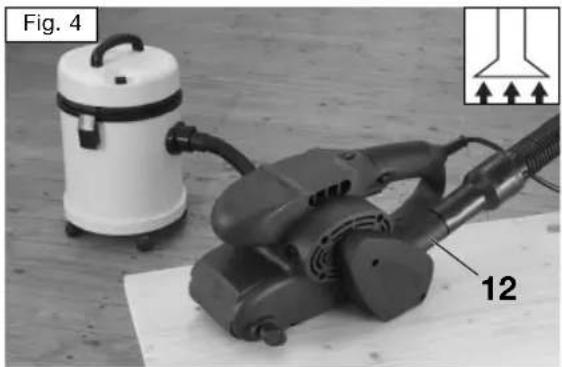
- Slide the dust collection bag opening as far as it will go onto the exhaust opening (12) on the housing. The bag is closed using a zip. Emptying the bag frequently increases the exhaust performance.
natural_image
Product photo of a vacuum cleaner with labeled component 12, shown in a lab setting (no text or symbols on main subject)- Household vacuums are also suitable for use. You may need to obtain a connection element that fits in order to do so.
Caution! Wood dust is dangerous! Thus, always work with the dust collection mechanism attached.
8 - Operation
Switching on
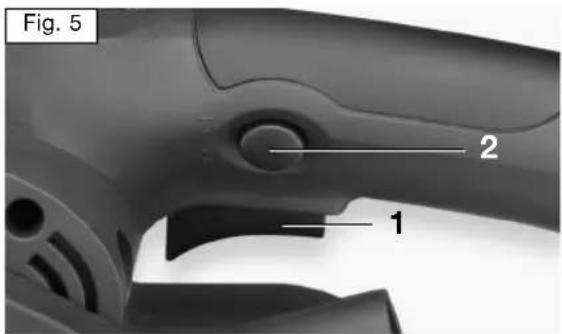
Press down switch (1) and hold (Figure 5).
Switching off
Release switch (1).
text_image
Fig. 5 2 1Switching on continuous operation
Press the switch (1) down, press the button (2), release the switch (1) (Figure 5).
Switching off continuous operation
Press and release switch (1).
9 - Mode of operation
Working with the belt sander
Hold the machine with both hands parallel to the surface. Switch on before making contact with the material. Carefully place on the surface to be sanded and move backwards and forwards. Do not apply excess pressure, the weight of the machine itself is sufficient. Applying too much pressure will worsen the results of the sanding process and damage the engine. The construction of the machine enables you to work close to the edges. Always process wood in the direction of the grain. As long as the machine is in contact with the work piece, do not switch the machine off. When carrying out several sanding processes using different granulations, always start with the coarsest. Ensure that no bends are introduced into the belt when sanding. Never use the same belt to process different types of material. When changing materials, for example, from metal to wood, always fit a new sanding belt.
10 - Maintenance and environmental protection
Keep the ventilation slots free and remove dust regularly with a brush. Clean the housing with a damp cloth only - do not use solvents! Then dry well. After completing work, wash the emptied dust collection bag in mild, hand-hot, soapy water and allow to dry well.
Changing the carbon brushes
If the carbon brushes are worn, the motor does not run evenly, will stop or is difficult to start.
The carbon brushes may only be changed by an authorised specialist.
Changing the drive belt

Caution! Unplug from the power source!
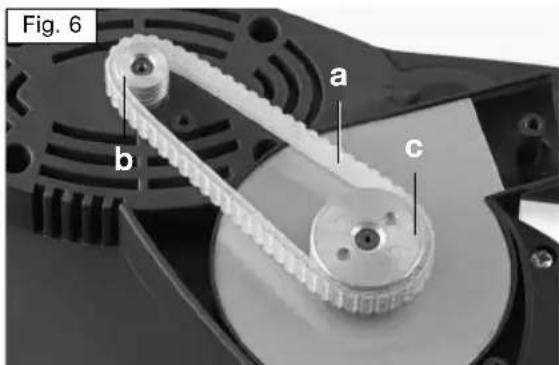
Remove the drive belt cover (13) from the machine housing. To do this, undo the housing screws (14) (Figure 2). No tools are required to change the drive belt. Take the drive belt (a) from the drive shaft (b) and then remove from the wheel (c) (Figure 6). Mount a new drive belt in reverse order and tightly screw the drive belt cover back onto the housing.
text_image
Fig. 6 a b cCAUTION! Electrical and battery operated units that no longer work should not be disposed of in the household waste! They are to be collected separately, in accordance with
the 2002/96 EC directive for the disposal of electrical and electronic waste, and sent for proper and environ mentally-friendly recycling.

Please discard power tools no longer usable at a local collection point. Collection and disposal of packaging materials separately by types complying with local rules and regulations. For details, please contact your municipal authority concerned.
11 - Service instructions
- Store the machine, operating instructions and where necessary the accessories in the original packaging. In this way you will always have all the information and parts ready to hand.
- MeisterCRAFT devices are to a large extent maintenancefree, a damp cloth being sufficient to clean the casing. Do not drop electrical machines in water. Please note additional hints given in the operating instructions.
- MeisterCRAFT devices are subject to stringent quality control. If however a functional fault should occur, send the device to our servicing address. The repairs will be carried out in a short time.
- A brief description of the defect speeds up the faulttracing and repair time. If within the guarantee period,
please enclose the guarantee document and the proof of purchase.
- In so far as a repair under guarantee is not concerned, we will charge the repair costs to your account.
PLEASE NOTE! Opening of the device invalidates the guarantee claim.
IMPORTANT! We point out expressly that in accordance with the Product Liability Act we do not take responsibility for any damage caused by our appliances, in so much that said damage is caused by improper repair, or original parts or parts released by us not being used when parts are changed, or repairs not being conducted by Meister Werk zeuge GmbH, Customer Service or an authorised specialist! The same applies analogously to the accessories used.
- Pack the device well or use the original packaging in order to avoid transit damage.
- Even after the expiry of the guarantee period, we would like to help you and carry out any repairs at a favourable price.

text_image
Elk. 3 8 11natural_image
Exterior view of a vacuum cleaner with labeled component '12' and technical diagram inset (no readable text or symbols)text_image
Elk. 6 a b c72
natural_image
Product photo of a vacuum cleaner with labeled parts (slika 4 and 12), no readable text or symbols beyond labels- U tu svrhu se mogu koristiti i univerzalni usisivači. Možebitno se za priključak treba nabaviti odgovarajući priključni komad.
| LpA: 94,0 dB(A) |
| LWA: 105,0 dB(A) |
natural_image
Product photo of a vacuum cleaner with labeled component 12, shown on a wooden surface (no text or symbols on the device itself)natural_image
Black-and-white photo of a vacuum cleaner and a handheld device on a wooden surface, with no visible text or symbols.natural_image
Black-and-white photo of a vacuum cleaner and a handheld tool on a wooden surface, with no visible text or symbols.natural_image
Black-and-white photo of a vacuum cleaner and a handheld device on a wooden surface, with no visible text or symbols.natural_image
Black-and-white photo of a vacuum cleaner with attached hose and labeled component (12), no visible text or symbols on the main subject.natural_image
Exterior view of a vacuum cleaner with labeled parts (12 and sl. 4), no readable text or symbols beyond labelsnatural_image
Exterior view of a vacuum cleaner and a handheld tool on a wooden surface, with no visible text or symbols.... is herewith declared to conform with the following guidelines:
GB - Storage of the technical documentation: