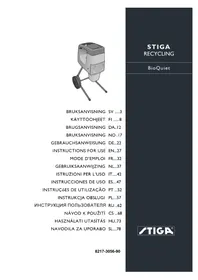
BioQuiet - Mechanical chipper STIGA - Free user manual and instructions
Find the device manual for free BioQuiet STIGA in PDF.



| Product type | Mechanical chipper (shredder) |
| Brand | STIGA |
| Model | BioQuiet |
| Power supply | 230-240 V AC single-phase, 10 A (slow-blow fuse), grounded |
| Motor protection | Overload protection device with reset button |
| Disconnector | Automatically cuts the main switch in case of power loss |
| Maximum branch diameter | 35 mm (dry and hard materials), 40 mm (fresh and soft materials) |
| Use | Private, grinding plant residues, twigs, branches |
| Safety | Gloves, goggles, hearing protection mandatory; emergency stop (red button) |
| Maintenance | Spray biodegradable oil on the helical blade after each use; check screws and nuts |
| Cleaning | Brush the blade; body with damp cloth and mild detergent; do not clean under running water |
| Spare parts | Use only original parts; contact an authorized service center |
| Warranty | Material defects and manufacturing faults (according to legal provisions); excludes normal wear and parts such as blades, belts |
| Compliance | CE; Low Voltage, EMC, Machinery, Noise Directives; standards EN 13683, EN 292-2, EN ISO 3744 |
| Safety symbols | Warning: read the instruction manual, projection of objects, rotating blades, disconnect before maintenance, do not use in rain |
| Transport | Lift by the feet near the chassis, do not lift by the casing |
| Recycling | Do not dispose with household waste; hand over to a recycling service (WEEE directive) |
| Assembly | Base frame, axle, wheels and hopper to assemble; tools provided |
| Rotation change | Stop the engine, wait for it to stop, turn the switch (H) to the desired position, then restart |
Frequently Asked Questions - BioQuiet STIGA
User questions about BioQuiet STIGA
0 question about this device. Answer the ones you know or ask your own.
Ask a new question about this device
Download the instructions for your Mechanical chipper in PDF format for free! Find your manual BioQuiet - STIGA and take your electronic device back in hand. On this page are published all the documents necessary for the use of your device. BioQuiet by STIGA.
USER MANUAL BioQuiet STIGA
INSTRUCTIONS FOR USE EN...27
MODE D'EMPLOI FR....32
GEBRUKSAANWJZING NL...37
ISTRUZIONI PER L'USO IT....42
INSTRUCCIONES DE USO ES....47
JUSTERING AF MODHOLD / KNIV
This symbol indicates WARNING. Personal injury and/or damage to property may result if the instructions are not followed carefully.
GENERAL
- Study the warning stickers on the machine. Replace damaged or illegible warning stickers.
- Please read through these instructions carefully. Learn all the controls and the correct use of the machine. Keep these instructions.
- Never use the machine if others, particularly children or animals, are in the vicinity. Anyone who is not aware of these regulations may not use the machine. Never let children use the machine.
- The user is responsible for accidents that happen to other people or their property.
PREPARATIONS
- Wear protective gloves, protective glasses and hearing protectors. Avoid loose clothing.
- Always stand steadily and in balance. Do not stretch towards the machine. Never stand at a higher level than the machine during use.
- During use, the machine should be flat and on a firm surface.
- Ensure that all screws and nuts are properly tightened before use.
- Only use the machine in dry conditions and never outdoors when it is raining.
- Never use the machine with damaged safety devices or without protection.
USING THE MACHINE
- Hard objects such as stones, bottle, cans or pieces of metal must not be fed into the feeding hopper. This can cause damage to the machine.
- If the machine becomes blocked, stop the motor and disconnect the plug. Pull out any objects and check for damage.
- Do not tug on the connection cable. Do not hold the cable taught. This can cause damage in the plugs or in the cable's insulation. Such damage is invisible but can be dangerous.
-
Always keep the connection cable away from the machine. Disconnect the plug from the electric socket and check the cable regularly for signs of damage or ageing. Do not use the machine with a damaged connection cable.
-
If the cable is damaged, it must be replaced by an authorised service dealer in order to avoid a hazard.
- If the fuse blows or if the overload protection is triggered, this is a sign that the machine is overloaded and/or that two many appliances are connected to the same lead. Check the cause and remedy. Do not install a more powerful fuse.
- Keep hands, other parts of your body and clothing away from the feeding hopper and the discharge chute. Never wear loose clothing or clothes with belts or straps when using the machine.
- Keep away from the discharge zone when starting the motor.
- Do not allow the pile of processed material to build up inside the discharge chute. This blocks new material and can cause the machine to change its direction of rotation.
- Keep your face and the rest of your body away from the feeding hopper.
- Never move the machine by pulling the cable. The machine must not be moved with the motor running.
- Do not leave the machine unsupervised, but first switch off the motor and disconnect the plug.
MAINTENANCE AND STORAGE
- During cleaning and maintenance, wear protective gloves to avoid injury.
- Switch off the motor and disconnect the plug before carrying out checks or maintenance on the machine.
- If a foreign object comes into contact with the spiral cutter or if the machine produces an abnormal noise level or abnormal vibrations, switch off the motor immediately. Disconnect the plug and check for any damage.
- The manufacturer's obligations and liability (according to the Product Liability Act) only apply on the condition that only spare parts approved by the manufacturer or spare parts of at least the same quality are used.
- Store the machine in a dry place.
- When, after many years of service, your machine needs to be replaced or is no longer required, we recommend that the machine is returned to your distributor for recycling.
GENERAL

This symbol indicates WARNING. Serious personal injury and/or damage to property may result if the instructions are not followed carefully.

You must read these instructions for use and its SAFETY INSTRUCTIONS carefully, before starting up the machine.
SYMBOLS
The following symbols appear on the machine. They are there to remind you of the care and attention required during use and maintenance.
This is what the symbols mean:

Warning! Read the instruction manual and the safety instructions before using the machine.

Warning!
Keep spectators away. Beware of objects being flung out.

Warning! Do not put hands or feet under the cover of the machine when it is running.
Warning - rotating blades!
The blades will continue to rotate after the machine has been switched off.
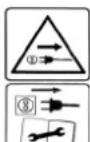
Warning! Remove the plug from the wall socket before carrying out any kind of maintenance.

Warning! Only use the machine in dry conditions and never outdoors when it is raining.

Warning! Wear safety gloves, safety goggles and hearing protection.
ASSEMBLY
- Open the box and unpack all the parts.
- Turn the grinder upside down on a soft under lay.
- See fig. 2. Install the legs (B) using the following parts:
4 s c r e w s
4 spring washers
- 4 flat washers
- See fig. 3. Assemble the shaft (C) onto the legs. Use two screws and two nuts. Tighten the nuts with the tool supplied.
- Push the wheels onto the shaft ends.
- Assemble the plugs (E) at the axle ends. Knock in the plugs with use of a hammer.
- See fig. 4. Install the hopper by pressing it in the holes in the grinder. The grinder cannot be started if the hopper is not installed.
USING THE MACHINE
GENERAL
This machine is only intended for private use, not to be used professionally.
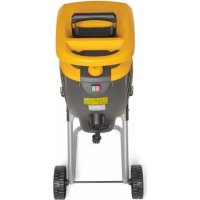
The compost grinder is designed to grind organic material such as dry plant residue, twigs, sticks and branches.
TRANSPORT
Take great care during transport and when the machine is to be lifted. Lift the machine by taking a firm grip of the legs by the mounting to the motor housing, under the compost grinder, and lift carefully. Never lift the machine using the cover.
ELECTRICAL CONNECTION
Connect the machine to a 230-240 VAC single phase electric socket with a protective conductor (earth). The electric circuit should be fused with a 10A inert fuse.
Always use a protectively earthed rubber connection cable. The cable should be of good quality, intended for outdoor use.
The cable's cross-section should be at least 3 × 1.5 mm^2 .
The connector (female contact) must be moistureproof.
You are recommended to use an earth leakage circuit breaker which interrupts the current in the event of something happening to the machine or connection cable.
If a portable earth leakage circuit breaker is used, it should always be placed between the electric socket and the connection cable.
Even if an earth leakage circuit breaker is used, safety cannot be guaranteed. Always follow the safety instructions provided. Ideally wear shoes with thick rubber soles.
Test the operation of the earth leakage circuit breaker before each use.
In the event of unfavourable electrical mains conditions, brief voltage drops can occur when you start the apparatus which can affect other appliances (e.g. causing lights to flicker).
With a mains impedance of Z_max < 0.41 ohm, such disturbances are unlikely.
STARTING AND STOPPING THE MOTOR

Ensure that the grinder is empty before starting the motor.
The motor rotation must be completely terminated before the motor is allowed to be restarted.
- Check that the twist switch (H) in fig. 5 not is located in its centre position.
Note! The twist switch (H) has three positions. Only the two outer positions are used. If the switch is in its centre position, the grinder cannot be started. - Stop the motor by pushing the red stop button (G) in fig. 5.
CHANGING DIRECTION OF ROTATION

Never turn the twist switch (H) when the motor is running!
Change the direction of rotation as below.
- Stop the motor by pushing the red stop button (G) in fig. 5.
- Wait until the spiral cutter has stopped.
- Set the twist switch (H) in the desired position.
Note! The twist switch (H) has three positions. Only the two outer positions are used. If the switch is in its centre position, the grinder cannot be started.
- Push and hold the green start button (F) until the jammed material is refeeded.
- Wait until the spiral cutter has stopped.
- Reset the switch (H) and continue the grinding.
MOTOR PROTECTION
The grinder is equipped with a built-in motor protection (I) which prevents the motor being overloaded.
In the event of jamming, the current will switch off after a few seconds and the motor will stop.
Measures at overloading:
- Wait at least on minut.
- Reset the motor protection (I) by pushing its reset button.
- Feed out the jammed material according to 3-6 above.
EMERGENCY STOP
In order to emergency stop the machine, press the red pushbutton (G).
DISCONNECT SWITCH
The machine is equipped with a disconnect switch. This means that the main switch is automatically disconnected in the event of a loss of current. The machine can be started again by reconnecting the plug and turning on the main switch.
GRINDING
The following types of material can be ground in the compost grinder:
- twigs and branches
- waste from cutting bushes.
- waste from hedge-trimming.
- plant parts and other garden waste which is suitable for grinding.
Examples of materials which are not suitable for grinding include:
glass, metal, plastic bags, stones, fabric, earth-covered roots.
- waste that does not have a firm consistency, e.g. kitchen waste.
To prevent damage to the machine, you are recommended not to exceed the following maximum sizes of twigs and branches:
< 35mm diameter for dry, hard material
< 40 mm diameter for fresh, soft material.
Feel free to stand the grinder on a tarpaulin or similar before grinding. This will catch the ground material and make removal easier.
The material that is to be ground is fed into the feeding hopper and, assuming it is not too bulky, automatically pulled down through the slowly rotating spiral cutter to the blades.
Branches and twigs should be ground shortly after being cut. They become extremely hard when they dry out, and the maximum diameter of what can be ground is reduced.
A large proportion of garden waste contains a lot of water and therefore sticks easily. Such material should be allowed to dry for a few days before being processed.
Store the grinder indoors in a dry place.
COMPOSTING
The processed material can be composted in various ways:
- The material can be placed in a heap directly on the ground (cold composting).
- The material can be placed in a plastic container, wooden crate, skeleton container or similar (cold composting).
- The material can be placed in an insulated compost holder. The heat is then held for longer and the rotting process also continues during the winter. This method produces faster results (warm composting).
- The material can be spread directly onto the garden (surface composting).
ADJUSTMENT OF COUNTERHOLD/ BLADE
The cutting mechanism comprises a rotating blade and a counterhold. For optimum grinding, the gap between blade and counterhold should be 0mm
The gap is adjusted during manufacture and does not need to be adjusted when the machine is used for the first time.
If the grinding results deteriorate after a period of use, the counterhold can be adjusted as described below.

The engine should always be running when adjusting the counterc hold. The machine should always be feeding downwards when adjusting the counterc hold.
Adjusting the counterhold:
- Start the machine.
- Use the supplied allele key and turn the screw (J)
slowly clockwise.
- Stop turning when a scraping sound starts to become audible and fine aluminium shavings drop out through the discharge opening.
- The gap between blade and counterhold is now 0mm again and optimum grinding results will be achieved.
MAINTENANCE

Always disconnect the plug from the electric socket before any maintenance. Always wear protective gloves to avoid injury.
Generally speaking, compost grinders require very little maintenance. In order to maintain the efficiency of the machine and to achieve a long service life, observe the following:
- keep the air openings clean and free of obstructing material.
- check the customer-installed nuts and screws (tighten if necessary).
- spray the spiral cutter after each use with an environmentally-friendly, biodegradable spray oil to protect against corrosion.
CLEANING
Always clean the compost grinder after each use.

Never use a high-pressure washer or running water when cleaning the grinder!
Brush away dirt and plant residue which may be caught in the spiral cutter. Wipe clean the outside of the grinder with a cloth which has been moistened with a mild detergent and water.
SERVICE
Authorised service stations carry out repairs and servicing. They use genuine spare parts.

Under no circumstances may parts other than genuine spare parts be used. This is a requirement stipulated by the Testing Authority. The machine is approved and tested with these parts.
If the machine requires servicing, repairs or maintenance which entail dismantling of the cover, this must be performed by an authorised service station.
The manufacturer reserves the right to make alterations to the product without prior notification.
PURCHASE TERMS
A full warranty is issued against manufacturing and material defects. The user must carefully follow the instructions given in the enclosed documentation.
Warranty period
According to relevant laws.
Exceptions
The guarantee does not cover damage due to:
- Neglect by the user to acquaint themselves with accompanying documentation
- Carelessness
- Incorrect and non-permitted use or assembly
- The use of non-genuine spare parts
- The use of accessories not supplied or approved by the manufacturer
Neither does the guarantee cover:
- wearing components such as blades, belts, wheels and cables
- Normal wear
- Motors. These are covered by the motor manufacturer's warranties, with separate terms and conditions.
The purchaser is covered the national laws of each country. The rights to which the purchaser is entitled with the support of these laws are not restricted by this warranty.
RECYCLING
Waste handling according to the WEEE Directive (2002/96/EC)


Protect the environment!
Not allowed to be disposed of among household waste!
This product contains electric and electronic components to be recycled.
Hand over the product for recycling at advised place, e.g. municipal recycling station.
RÉGLES DE SECURITÉ

ACCENSIONE ARRESTO DEL MOTORE

IpeIyIpexKJeHHe!
IpeI pa6oToi c MaHHoH n3yHTe
pyKOBOCTBO IIO 9KcJIlyaTaHH H npaBHJa
TexHNKn 6eOHaCHOCTH.

IpeIyIpEeJHHe! YJaJIte IIOCTOpOHnX! OcTepeaITecb BHe3aIIHO BbIbpaCbBaHHa!

IpeyipexKdHne! OiaacHOCTb - IIOIIaHHe KOHeuHocTei IOI KpbIku paOtaIOJIe MaHHbI!

IpeIyIpeKJcHHe!BpaIaIOIInecs Hoxn! Hoxn BpaIaIOTcno IHePnnn IocJIe BbIKIOUChN MaIIHHbI!
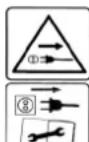
IpeIyIpexKJeHHe!
IpeBbIIIOJIHeHHem JIO6bIX pa6OT IO
TEXHNueCKOMY 06cJyXHBaHHIO
H3BJIeKHTe IIITeI1ceJIbHyIO BnIKy H3
po3eTKH.

IpeIyIpeKJHeHne! MaIIHa paccHTaHa Ha 3KcJIyatauHIO TOJIbKO B cyHXX ycIOBnx - 3aIpeIaeTcR paOta MaIIHHbI BHe IOMeIeHn BO IOxJ.

IpeIynpexKJeHne!
HaIeBaIte pa6Oue pyKaBnIbI,
3aIIHTbIe OUKN cpeIcTbA 3aIIHTbI
opraHOB cJyxa.
CEOPKA
- PaKpoIe yIIaKOBky I BbIbTe I3 Hee BCE JTeTajIN.
- IpeBepHnTe Ipo6NJIky H IOJIOKHTe ee Ha MRAKyIO IIOJKJaIKy.
- Cm. pnc. 2. YcTaHOBHTe onOpB (B) npn HOMOIIH cJIeDyIOIIx IetaJIeI:
4 BHHTa
4 npyKHHbIe ⅢaH6bl
4 IIOCKHe IaI6bI
- CM. pHcyHOK 3. YcTaHOBHTb BaJI (C) Ha cTOnKn. HcIOJIb3OBaTb IBa 6OJIra N IBe rAaKN. 3aTAYt b RaIKN IIpr NHOMOIIN IOCTaBJIeMOro HHCTpyMeHTa.
- HacaIITb KOJIeca Ha KOHIIb BaJa.
- YcTaHOBHTb IPO6KN (E) Ha KOHIbIO cH. B6HTb IPO6KN IIpH IOMOUIH MOJOTka.
- CM. pnc. 4. YcTaHOBHTe 6yHkep IIyTeM 3aIIpeccOBKn eRO B OTBepCTnA Ipo6NJKN. Ipo6NJka He MoKeT 6bITb 3aIyJHeHa, ecJH 6yHkep He ycTaHOBJieH.
3KcPJIyATAUmaHbI
OBUINEYKA3AHNIA
TaMaHHHa IIpeHnHa3HaueHa TOJIbKO JINJINHOrIOIIOJB3OBAHn H He IIOJIeKHT IpOMbIIJIcHHoJKCIJIyataHn.
H3MeJIbHTeJIb KOMIOCTa IIpeIIHa3IHaueH IJIa H3MeJIbUeHnOpraHHueckHX MaTePnaJIOB, TaKHX KaK OCTaTK paCTeHn, IIaIKN n cyb.
TPAHCNOPTNPOBKA
ByIbTe oO6eHNO ocToPOKHBIO BVPem TaPcHcPiOpTHPOBKN H IOJIbeMa MaIIHHbI. IIOHNMaIte MaIIHHy aKKypaTHo, IpOuHO 3aXBaTbIBaA ONOpbI H B3RAIBINcB 3a KOKyX IBnIaTeJIa IOI N3MeJIbHTeJIeM KOMIOCTa. 3aIIpeIaaeTcra IOHNMaTb MaIIHHy 3a KpbIIIKy.
3JEKTPNueCKOE COEINHEHNE
IoiKJIIOHuaTe MaHHHy K OJHOa3HOI 3JIeKTPnueckoP03eTke Ha 230-240 B\~ c 3aIIHTbIM IPOBOIHNKOM (3emJIeH).
3JIeKtpnuecka IIeIb IOJXHa 6bITb 3aIIHIIeHa IacCHBHBIM IIJaBKM INpeIOxpaHHTeJEM Ha 10 A.
O63aTeJIbHo HcIIOJIb3yIte pe3HOBbI coeHHHTeJIbHbI Ka6JIb c 3aIHITbIM 3a3cMIIEHHcM. Ka6JIb DOJIIXeH 6bITb XOpOIIErO KaueCTBa, IIpeJHa3HaueHHbIM IJIa HapyKHOI OIIpHMeHeHHI.
Пошерное сеони Кабл - He MeHee 3 x 1,5 MM2.
Pa3bem (OXBaTBiBAIOIIH YAcTb) IOJIKeH 6bITb BJIaTOHEIIpOHIIaEMbIM.
PekomeHnyeTc npHMHeTb aBTOMaTHueckn BbIKJIOHaTeJIb, cpa6aTBiBAHOIIIN IIpN yTeYKe Ha 3emJIO, KOTOpBn pa3pbIbAE TIIIB B CJIyae HEnCIIpaBHOCTN MaIIHHbI HJIN DeΦeKTA COeINHHTeJIbHOFO Ka6JIra.
EcJIN HCIOJIb3yeTcI NOpTaTHBHi ABTOMATHueckn BbIKJIOUaTeJIb IJIa 3aIHTbI OT yTeKHa 3eMJIIO, o63aTeJIbHO IOJKJIOuaHe eRO MeKJy 3JIeKTpHueckO IIITeIcEJIbHOI pO3eTKoI H COeIHINTeJIbHbIM Ka6eJIem.
JaKe IpiH HcIOJIb3OBAHH aBTOMaTHueCKOBOBbIKJIOHaTeJI, 3aIIINIIaIOIIeI OYteKN Ha3EMJIIO, 6e3OIIaIacHOCTb He MoKet 6bITb rapaHTnpoBaHa. CToPOco6JIIOaIte IIpHIaRaEMbIe IpaBnJIa TeXHHKn 6e3OIIaIacHOCTH. JyUHe Bcero HaJeBaTb 06yBB c ToIcToI pe3HHOBOH IOIOIBOi.
BcKn pa3 nepeI pa60ToC mAHHoH IpoBepaHTe HcIIpaBHOCTb aBTOMaTHueCKOTo BbIKIOHaTeJI, 3aIIHuaIOUeTO OT yTeuKN Ha 3eMJIIO.
IIpn He6JiaRopnTHbIX npaMeTpax HcToHHKa 3JIeKTPoHTAHHMOKeT IPOHCXODHTB KpaTKOBpeMeHHoe IIaJeHHe HAIIpJKeHHN IIpn 3aIyCke aIpeRaTa, KOtOpoe MOKeT BJIINrTb Ha IpyTne 3JIeKTPnueckHe IIpN6Opbl (HaIIpHmep, 3acTabJIra MnraTb JAmIOuKN).
Пи ИМпeДанс eнсToчнКa ZmKc. < (0,41) OмТаКн e BO3MyIeHЯ MaJIOBepoTHBi.
O6pa6aTbIBaEmbI MaTePHaJI MoKeT KOMIOCTHpOBaTbCra pa3HbIMN cIOc06amH:
MaTePnaJI MoKeT cBaJIINBaTbC8 B KyUy IprMo Ha 3eMJIe (XOJIIOHOC KOMIOCTnpoBaHHe).
- MaTePHaJI MoKeT IOMeIIaTbc8 B IIJaCTHkoBbI KOHTeIHep, IepeBraHHbI aIIHK, peIIeTuAtbI KOHTeIHep HIIIOIo6HyTO Tapy (XOJOIOHOc KOMIOCTHPOBaHHe).
MaTepeHaJI MoKeT IOMeIIaTbC8 B RepMeTHHyO eMKocTB IIJI KOMIOCTa. TaKHM O6pa3OM paccenBaHHe TeIJIa 3aMeJIAeTcR, H IPOUeCC IpeERHHBaHnI IpoIoJIkaeTcR 3HMoI. 3TO T MeToI yCKOpAeT IpiHrTOBJIeHHe KOMIOCTa (TeIIIOe KOMIOCTnPoBaHne).
- MaTePnaJI MoKeT pacIpeJrIbCn HeIOcpeIcTBeHNO Ha IIOvBe (IOBepXHOCTHOe KOMIOCTHPOBaHne).
PEГУЛПОВКAKOHTPУПОРAP/ PE3LA
PekyIIm MexaHH3M COCTOHT H3 BpaIIaIOIeOcpe3ua H KOHTpyIopa. IJIra OITHMajbHOroIIIINΦOBAHN 3a3Op MEKJy pe3IOM KOHTPpyIopom IOJIKeH COCTaBJTb 0 MM.
3a3op peryInpyeTcB IIpoIeCC H3rOToBJIeHn I Tpe6yET KoppeKTHPOBKN B TeueHne
IepBOHaayJbHOrO IepNoJa 3KcIIlyaTaUHN CTaHka.
EcIN IocJIe HeKOtOporo IepNoJa 3KcIIlyaTaUHN KaueCTBO IIIINΦOBAHN yXyIⅢaETcR, Heo6xOJIMBO BblIOJHHTb peRyInpOBKy KOHTpyIopa, KaK OIIHCaHO HIXKe.

Bo Bpem peryInpoBKN KOHTpyHopa
BnHaTeJIb BceIa DoJIkeH pa6oTaTb.
Bo Bpem peryInpoBKN KOHTpyHopa
ctAhOK BceIa DoJIkeH 6bITb
yCTaHOBJen 3aIpy3K0H BHH3.
PeryIINpOBka KOHTpyIopa:
1.3aIyCTHTb cTahOK.
2. HcnoJIb3yra TOpIOBbI KJIIOU, MeJIeHHO BpaaTb BNHT (J) IO YacoBOI cTpeJIke.
3.OCTaHOBHTb BpaIeHne BNHTa, KOrIa 6yJeT cJIbIIIEH cKpeKeIuYIuN 3ByK, H TOHKa aJIOMHHHeBa CTpyKKa BBIIaTe H3 pa3rpy3OuHOro OTBepCTHa.
4. Teinepb 3a3op MeJy pe3uom H KOHTpyIIOpOM cHOBa COCTaJIeT O MM, H 6yIyT O6ecIeueHbI OITHMajbHbIe pe3yJIbTaTbI IJIINΦOBaHHa.
TEXHNUECKOE OBCJUYKINBAHNE

IpeBbHIOJIHeHHemTexHHueckoro
06cJyKHaHnBceTda BbHHMaHTe
HTeIcEJIbHyIO BHJKy H3
3JEKTpHuEcKO pO3eTKn.Bo
H36eKaHn TpaBM HaJeBaHTe pa6oUHe
pyKaBnbl.
Kak npabHIO, H3MeJIbHTeJIN KOMIOCTa
IpaKTnueckn He Tpe6yOT TexHHueCKOro
06cJIyXHBAHN. JIA coxpaHeHH
IPOH3BOINTeJIbHOCTM MaIHHHbI N DOCTHXCHN
JIInTeJIbHO CpOKa CJyKbI COBJIoJaTte
CJIeJyUOHe peKOMeHNaUN:
IpeIOxpaHnTe OTBepCTHg OT 3aKyPiOpHBaHHn H 3acopeHHN O6pa6aTbIBaembIM MaTepHaJIOM.
IPOBepaTe HaJIuHHe H 3aTJkKy Raek H BHTOB, yCTaHaBJIbBaMbIX 3aKa3HkOM (IIpH Heo6XoHNMOCTn 3aTJHNTe).
J3aHHTbOT Koppo3HN C6pb3HBAbTpe3Bb 3KOJIOrHueckn 6e3BpeINbIM 6Hopa3JaRaIOHMcM MacIOM JIA paHbJIeHHN IOCJIc KaKIOTO HIOJIb3OBAHH.
CHCTKA
KaKbIpa3,3aKoHcNb pa6Otu,08aTeJIbHO BbIOJIHNTE YNCTKY N3MeJIbHTeJI KOMIOCTa.

Ipn Ynctke H3MeIbYHTeJIa 3aIIpeIaetcI IpHMeHrTb MoeHbIe MaIIHHb BbICOKOTo DaBJeHHa HJIN IpTOUHyIO BOy!
YdaJIHTe IIEKoiIgR3bHpaCTHeJIbHbIeOcTaTKN, KOToPbIE MOrYT 3acTpeBaTB B HOJax. HauHcTO IIpoTpHe N3MeJIbHHTeJIb ChapyKn, HcIOJIb3yra TKaHb, yBJIAxHHeHHyIO MArIKHM MOIOIHMM CpeIcTBOM H BOIOH.
OBCJIYXINBAHNE
YIOJIHOMOeHHbI IyHKtBI O6cJyKHBaHH BbIOJIHIOPTpeMOHT N Texo6JyKHBaHHe. IIpN 3TOM yIOITpe6JIaOTcA HpMeHHbIE 3aIIacHbIe Yactn.

Hn np KaKx 06ctOaTeJbCTBax He
doynycKaetc npmeHeHne 3aIacnbix
yacte ctopounnx H3rotobnteJe. 3to
tpe6oBaHne npdbjBJeTc npraHaMn
TexHHueckoiattcctaHH
60pyoBaHHa.MaHHa npouJa
HCIIbITAHn H COOTBeCTBycET
tpe6oBaHHm npu yIOtpe6JIeHH
hnpMeHHbx 3aIacnbix qactei.
PaobtI no npophiJiaKTHke, pemOnTy H TexHnueckomy 06cJyKHBaHHIO MaHHbI, KOTOpBle CB3aHbIC ydaJIeHHem K0KxHa, JoJHKbI BbIIIOIHHTbcr YIOJHOMOeHHbIM IIYHKTOM 06cJyKHBaHH.
H3rOHTeJIb OCTaBJIeT 3a co60I npaBO Ha H3MeHeHHn H3JeJIIN 6e3 IIpeBapHTeJIbHO rYBeIOOMJIeHHN.
UCIOBNA IPNOBPETEHNA
BbIaETcIIOJIHaIraPaHTnIOTHOCTeJIbHO IeΦEKTOB H3ROTOBJEHHN MaTePNaJIOB.
IIOJIb3OBAteJIb 06a3aH TIIaTeJIbHO CO6JIIOaTb HHCtpyKUnn, CoIEpKaUINecB IIpnJIaRaemOn JOKyMeHTaUN.
TapaANTHbI IepHoI
Corlaicho COOTBETCTBYIOIHMM 3aKoHaM.
NckJIIOueHn
IapaHTHnHbIe 06a3aTeJIbCTBa He
pacIIpOcTpaHraHOTcHa IIOBpeKdEHHa BCJIeIcTBHe:
- Ipehe6pekeHHIIOJIb3OBaTeJIeM 3HaKOMCTBOM c coIIpoBOJNTeJIbHOJ IOKUMeHTaUNHei
- Heoctopokhoctn
- HehaJIeXaIeRo n hepA3peIIeHHO IppHMcHeHHn c6OpKn
- IcnoJb3OBAHHn HeΦnPMeHHbIX 3aIIacHbIX YacteN
- HcnoJIb3OBAHnI pINHaJIeJxHocTeH, He IIOCTaBJIeMbIX NJIH He OIO6peHHbIX H3rTOBHtJIb.
Kpome toro, rapaHTnHbIe o6aTeJIbCTBa He pacnpooctpaHIOITcHa:
- H3HaIIINBaIOIIHecc KOMIOHOHTbI, TaKHe KaK HOJN, peMHN, KOJIeCa N Ka6JIH
-HopMaJIbHbIIN3HOC - IBHrataJIH. Ha IBHrataJIH pacipnpoctpaHIOrca rapaHTnHHbIe 063aTeJIbCTBa H3ROTOBHTJIg IBHrataJIc OTJeJIbHbIMN IIOJOKeHHaMn H ycJIOBHaMn.
HaIOkyIaTeJIpaCIIpOcTpahIOTc coOTBeTCTByIOUHe 3aKOHb KaJIOI CTpaHbI.
IIpaBa, KOTOpbIMN 06JIaJaET IOKyIaTeJIb cOrJIaCHO 3THM 3aKoHAM, He ORpaHHuHbAOTcraHHoH rapaHTnei.
YTNIN3AUJN
O6paueHne c OTXoDAMN B COOTBETCTBnC DInpeKTHBOI WEEE (2002/96/EC)


Bepertte OKpykaIOyIO cpey! He IOnyckaIte yTHJIN3aIIHH o6OpYIOBaHn BMeCTe C 6bITOBbIMN OTXoJAMn!
JaHHoe H3JIeJIne coJIepKHT
3JIeKTPnueckHe H 3JIeKTPoHHbIe
KOMHOHEnTbI, KOTOpBie
IOJIeJKaT BTOpHHoH
IIpepa60TKe.
IpeaBaIte H3JIeJIne IJIa CnEuaJIbHOy yTHJIN3aUNH Ipepa6OTKN,HaIPmEpB, B IyHKtBIcOpaYTHJIbcbIpB.
BEZPECNOSTNI POKNY

EC conformity declaration
This product conforms to
-
Low Voltage Directive 73/23/EEC, 93/68/EEC
-
Electromagnetic Compatibility Directive 89/336/EEC
-
Machinery Directive 98/37/EEC with special reference to appendix 1 of the directive regarding essential health and safety requirements in conjunction with manufacturing
-
Noise Emission Directive 2000/14/EC
This product has been developed and manufactured in conformance with the following standards:
- EN 13683, EN 292-2, EN ISO 3744, EN ISO 11201
Certification Manage
Certification Manager

- JUSTERING AF MODHOLD / KNIV
- GENERAL
- PREPARATIONS
- USING THE MACHINE
- MAINTENANCE AND STORAGE
- SYMBOLS
- ASSEMBLY
- TRANSPORT
- ELECTRICAL CONNECTION
- STARTING AND STOPPING THE MOTOR
- CHANGING DIRECTION OF ROTATION
- MOTOR PROTECTION
- EMERGENCY STOP
- DISCONNECT SWITCH
- GRINDING
- COMPOSTING
- ADJUSTMENT OF COUNTERHOLD/ BLADE
- The engine should always be running when adjusting the counterc hold. The machine should always be feeding downwards when adjusting the counterc hold.
- MAINTENANCE
- Always disconnect the plug from the electric socket before any maintenance. Always wear protective gloves to avoid injury.
- CLEANING
- Never use a high-pressure washer or running water when cleaning the grinder!
- SERVICE
- Under no circumstances may parts other than genuine spare parts be used. This is a requirement stipulated by the Testing Authority. The machine is approved and tested with these parts.
- PURCHASE TERMS
- Warranty period
- Exceptions
- RECYCLING
- Waste handling according to the WEEE Directive (2002/96/EC)
- RÉGLES DE SECURITÉ
- ACCENSIONE ARRESTO DEL MOTORE
- CEOPKA
- 3KcPJIyATAUmaHbI
- OBUINEYKA3AHNIA
- TPAHCNOPTNPOBKA
- 3JEKTPNueCKOE COEINHEHNE
- PEГУЛПОВКAKOHTPУПОРAP/ PE3LA
- TEXHNUECKOE OBCJUYKINBAHNE
- CHCTKA
- OBCJIYXINBAHNE
- UCIOBNA IPNOBPETEHNA
- YTNIN3AUJN
- O6paueHne c OTXoDAMN B COOTBETCTBnC DInpeKTHBOI WEEE (2002/96/EC)
- BEZPECNOSTNI POKNY
Brand : STIGA
Model : BioQuiet
Category : Mechanical chipper