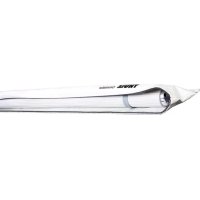
Omnistor 1200 - Camping THULE - Free user manual and instructions
Find the device manual for free Omnistor 1200 THULE in PDF.



| Brand | Thule |
| Model | Omnistor 1200 |
| Product type | Motorhome awning |
| Use | Camping, leisure vehicle |
| Material | UV-resistant polyester fabric |
| Length | 2.5 to 5 m (depending on version) |
| Depth | 2.5 m |
| Approximate weight | 15–25 kg depending on length |
| Power supply | Manual (crank) / Motorized optional |
| LED option | 12V DC LED strip optional |
| Warranty | 2 years |
| Installation | By a recommended professional |
| Maintenance | Clean with water and soft cloth, avoid high-pressure cleaner |
| Safety | Do not use while driving, retract in case of strong wind or snow |
| Spare parts | Thule genuine parts only |
| Operating temperature | Avoid extreme temperatures |
| Vehicle compatibility | Leisure vehicles with suitable roof |
| Manual contents | Safety instructions, installation, use, maintenance |
Frequently Asked Questions - Omnistor 1200 THULE
User questions about Omnistor 1200 THULE
0 question about this device. Answer the ones you know or ask your own.
Ask a new question about this device
Download the instructions for your Camping in PDF format for free! Find your manual Omnistor 1200 - THULE and take your electronic device back in hand. On this page are published all the documents necessary for the use of your device. Omnistor 1200 by THULE.
USER MANUAL Omnistor 1200 THULE
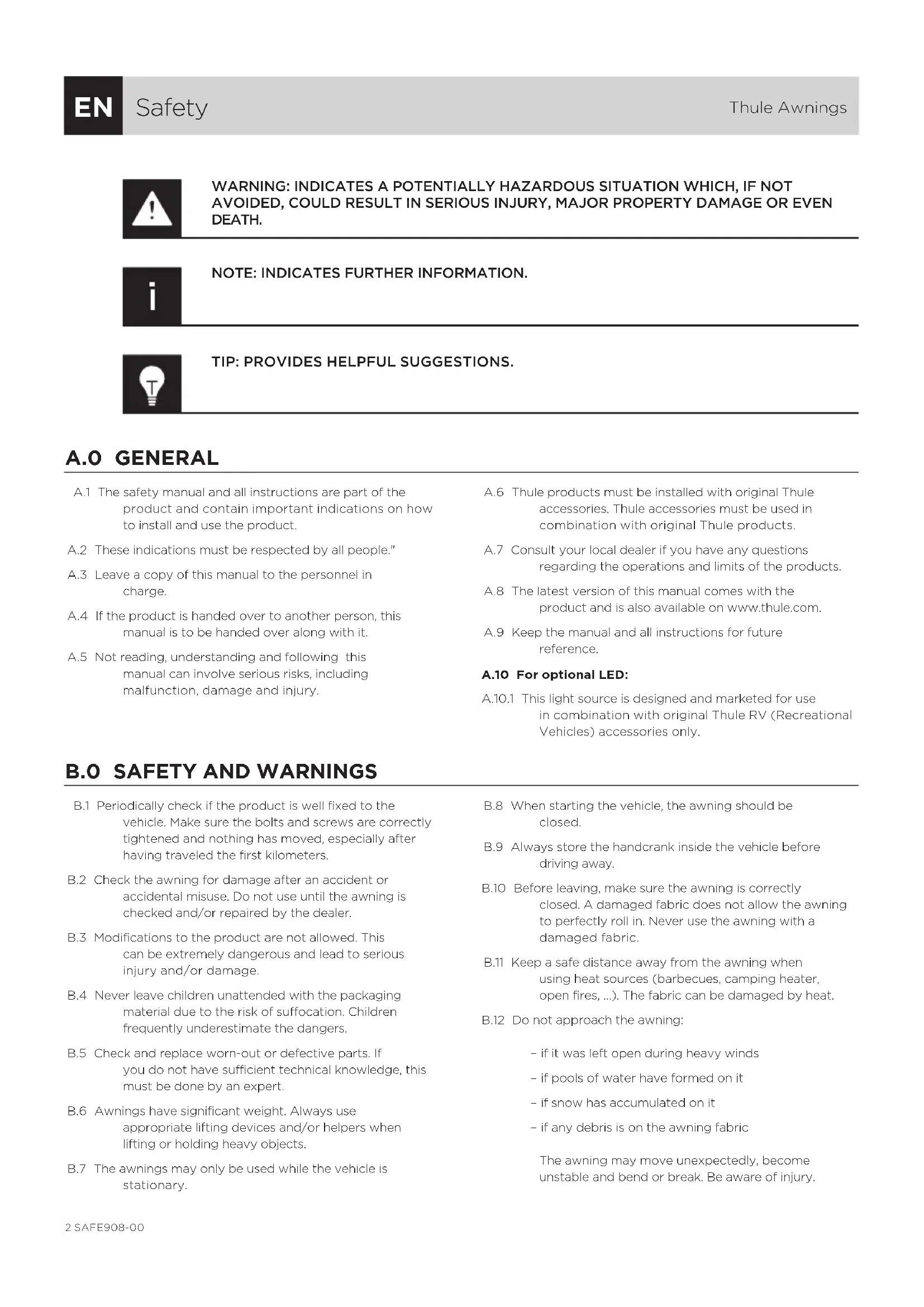
A.1 The safety manual and all instructions are part of the product and contain important indications on how to install and use the product.
A.2 These indications must be respected by all people."
A.3 Leave a copy of this manual to the personnel in charge.
A.4 If the product is handed over to another person, this manual is to be handed over along with it.
A.5 Not reading, understanding and following this manual can involve serious risks, including malfunction, damage and injury.
A.6 Thule products must be installed with original Thule accessories. Thule accessories must be used in combination with original Thule products.
A.7 Consult your local dealer if you have any questions regarding the operations and limits of the products.
A.8 The latest version of this manual comes with the product and is also available on www.thule.com.
A.9 Keep the manual and all instructions for future reference.
A.10 For optional LED:
A.10.1 This light source is designed and marketed for use in combination with original Thule RV (Recreational Vehicles) accessories only.
B.O SAFETY AND WARNINGS
B.1 Periodically check if the product is well fixed to the vehicle. Make sure the bolts and screws are correctly tightened and nothing has moved, especially after having traveled the first kilometers.
B.2 Check the awning for damage after an accident or accidental misuse. Do not use until the awning is checked and/or repaired by the dealer.
B.3 Modifications to the product are not allowed. This can be extremely dangerous and lead to serious injury and/or damage.
B.4 Never leave children unattended with the packaging material due to the risk of suffocation. Children frequently underestimate the dangers.
B.5 Check and replace worn-out or defective parts. If you do not have sufficient technical knowledge, this must be done by an expert.
B.6 Awnings have significant weight. Always use appropriate lifting devices and/or helpers when lifting or holding heavy objects.
B.7 The awnings may only be used while the vehicle is stationary.
B.8 When starting the vehicle, the awning should be closed.
B.9 Always store the handcrank inside the vehicle before driving away.
B.10 Before leaving, make sure the awning is correctly closed. A damaged fabric does not allow the awning to perfectly roll in. Never use the awning with a damaged fabric.
B.11 Keep a safe distance away from the awning when using heat sources (barbecues, camping heater, open fires, ...). The fabric can be damaged by heat.
B.12 Do not approach the awning:
- if it was left open during heavy winds
- if pools of water have formed on it
- if snow has accumulated on it
- if any debris is on the awning fabric
The awning may move unexpectedly, become unstable and bend or break. Be aware of injury.
B.13 In case of rain, put one side of the awning lower so that the water can easily drain off.
B.14 Retract the awning if strong winds, heavy rain or snowfall are imminent.
B.15 Use a strap kit and a tension rafter on the awning before tightening the tent completely.
B.16 Do not open the awning in strong winds, heavy rain or snowfall.
B.17 Always place the struts after ± 1 meter opening to avoid car damage.
B.18 Only position the struts on solid ground. Secure the struts from slipping.
B.19 Do not hang any objects on the awning, on the lead rail or the awning arms. Except the Thule accessories designed for this use!
B.20 For motorized awnings:
B.20.1 If the connection cable of the awning is damaged, it must be replaced by an expert.
B.20.2 Disconnect the power supply by means of the on/off switch before you clean the vehicle near the awning or the awning itself.
B.20.3 Electrical devices are not toys. Keep out of the reach of children. Prevent children from playing with the switch.
B.20.4 Do not use electrical equipment if you are lacking in concentration or awareness, or are under the influence of drugs, alcohol or medication. Even a short moment of inattentiveness can lead to serious accidents and injuries when using electrical equipment.
B.20.5 Unplug the bike rack during electrical storms, or when not in use.
B.21 For optional LED:
B.21.1 Never cut the led strip out of the indicated points.
B.21.2 Do not light the LED strip when it is rolled up. If not correctly disseparated, it is allowed to turn the POWER ON for 10 seconds to check if the LED strip
C.O DRIVING PROP. & REGULATIONS
C.1 The vehicle's driving characteristics, braking behaviour and its vulnerability to side-winds can change when a product is installed.
C.2 Note that the vehicle's total dimensions may increase when installing a product.
C.3 The vehicle's speed must always be adjusted to the current driving conditions, such as the road type, road quality, wind conditions, traffic intensity and applicable speed limits. Applicable speed limits and other traffic regulations must always be observed.
D.O INSTALLATION
D.1 We recommend that the installation is carried out by qualified personnel and in compliance with current local regulations. Improper installation can lead to damage and/or serious injury.
works. Only use SELV power supply, as for current regulations. Do not use chemical products, glue, solvent or acid for cleaning the LED strip surface. It can damage or corrode the LED strip or the LED surface and it can modify the CCT or the working life of the LED strip.
B.21.3 Do not connect the LED strip to the line voltage.
B.21.4 Do not POWER ON before the LED strip is connected.
B.21.5 Do not cover the LED strip.
B.21.6 Do not hang up or fix objects to the LED strip.
B.21.7 Do not look directly towards the LED strip when it's turned on.
B.21.8 To avoid damage to the LED lamps or the internal circuit, do not mechanically stress or curve the LED strip more than a diameter of 60~mm do not bend the LED strip.
B.21.9 Do not twist the LED strip.
B.21.10 To obtain the maximum performance, each 5 meters must be connected to a proper power supply or a controller. Several LED strips connected by a series circuit can be affected by light drop.
B.21.11 Static electricity (ESD) may damage the LED strip. It is recommended to use a wristband or anti-electrostatic glove for handling the LED strip. It is also recommended to take proper measures to avoid surge voltage in the equipment where the LED strip is placed.
B.21.12 Do not pull the connection cable after placing the LED strip to avoid damage to the electrical connection.
B.21.13 The inverse polarity is dangerous for the LED strip. Please pay attention at the connection positive and negative and do not invert them.
B.21.14 It is recommended to use a good quality power supply to avoid extra voltage or surge which can damage the LED strip.
C.4 Drive slowly over speed bumps.
C.5 For optional LED:
C.5.1 Driving around with shining LEDs is illegal.
C.5.2 It is mandatory to install the LED strip in such a way that it cannot be used with running vehicle engine.
D.2 Carefully follow the installation instructions and/or user instructions step by step. Do not attempt to fit the product in any other way than the way shown in the mounting instructions.
D.3 Before installation, check with the assembly instructions that all the necessary parts are present.
D.4 Check all parts of the product for surface damage, cuts, scratches or other damage before and after installation by qualified personnel. Cuts, scratches or other damage that is reported afterwards, will not be accepted as production- / material errors and will be excluded from warranty.
D.5 Before installation, ensure compatibility with the vehicle on which the product will be installed. A full check that the wall is sufficiently solid and suitable for guaranteeing the resistance of the anchoring points is always mandatory.
D.6 Mind the difference between LHD (left hand drive) and RHD (right hand drive) installations.
D.7 Before installation, check by positioning the product, if there are no obstructions with items on the vehicle such as: rooflights, lift roofs, trunks, doors, chimneys
D.8 Before installation, make sure there are no obstacles such as: cables, cabinets, gaspipes ... that can be damaged while drilling.
D.9 Do not install the product near places with gas or fuel vapor substances.
D.10 Before installation, clean the vehicle and those parts of the product that come into contact with the vehicle.
D.11 The adapters must be positioned at het awnings spring arms or at the indicated distances from the end of the awning for a correct and stable mounting. If this is not possible, use a full length adapter.
D.12 When installing the product, make sure the adapters are perfectly aligned to avoid a bad fitting.
D.13 When drilling in vehicles with a steel structure, make sure to treat the holes to avoid corrosion. Apply anti-corrosion coating according to the prescription of the supplier.
D.14 When drilling in any vehicle surface, make sure to use sealant for a watertight installation. SIKA 522 or a product with the same properties should be used. Apply SIKA or the equivalent product according to the prescriptions of the supplier.
D.15 Before gluing, use a primer and light sandpaper to roughen the surfaces. Use SIKA Activator 205 or a equivalent to make the glue adhere properly. Apply SIKA or the equivalent product according to the prescriptions of the supplier.
Roughen with light sandpaper depends of the kind of surface. Surfaces such as anodized surfaces and lacquered or powder coated surfaces.
E.O ELECTRICAL INSTALLATION
E.1 For safety reasons, we advice to make the electric connections as indicated on the provided diagram in the manual of the product or accessory.
E.2 Only permit a qualified electrician to connect the product to the electrical power.
- Anodized surface: do not roughen (with sandpaper)!
- Powder or lacquer coated surface: roughen with very fine (P120) sandpaper!"
D.16 Use SIKA 552 AT or equivalent. Apply according to the prescriptions of the supplier!
D.17 When gluing, use the glue in moderation, Do not overuse.
D.18 To avoid moisture buildup and water pockets:
- apply parallel diagonal glue lines on large flat surfaces
- use sealant where applicable
D.19 The glue curing process requires contact with air:
- only apply glue to the indicated surfaces (glue channels)
- add interruptions in long glue lines
D.20 Let the glue cure, if applicable make sure to leave the awning 5cm open to prevent torque from deforming the awning adapter.
D.21 Wait 48h to let the glue cure before applying any force on the adapter/awning.
D.22 Make sure to leave the awning 5cm open to prevent torque from deforming the awning before fastening it to the adapters. This prevents the front rail from not closing properly after installing.
D.23 When using fasteners, use the appropriate torque when indicated.
D.24 Give the end user a detailed explanation and demonstration on how to use the product.
D.25 Do not operate the product or leave it unattended, before it has been fastened to the adapter.
D.26 Always use the awning support legs according to the awning instructions to avoid damage to the awning adapter and vehicle.
D.27 If there is insufficient space above the door after the awning is mounted, the door must remain closed when retracting or extending to avoid the door making contact with the (spring) arms, fabric or the front rail. The required space depends on the design of the door (door width, swing or sliding door) as well as the set angle of inclination of the awning.
D.28 Do not place the product under extreme temperatures.
E.3 Instructions and Safety manual relating to danger emanating from electrical currents or voltage: failure to observe these instructions can cause material damage or personal injury and impair the proper functioning of the device. The manufacturer will not be held liable for claims related to damage, resulting from the following:
-Faulty assembly or connection
- Damage to the appliance resulting from mechanical influences and excess voltage
- Alterations to the device without express permission from the manufacturer
- Use for purposes other than those described in the operating manual.
E.4 To prevent short circuits, always disconnect the negative terminal of the electrical system before working on the vehicle. If the vehicle has an additional battery, its negative terminal should also be disconnected.
E.5 To avoid shock hazard and/or accidental system shorting, always disconnect the vehicle battery and electrical sources before working with electrical wiring and components.
E.6 Always check which power supply the awning should be connected to. Battery supply (12V DC or 24V DC) or mains voltage of 230V. If necessary, use an inverter.
E.7 Electrical components must be installed in accordance with the prescribed specifications of these components.
E.8 During installation, fix the wiring in such a way that it can't be pinched between parts or pulled out of the connections.
E.9 Do not route the wires over sharp edges or heat sources that can cut or fray the wires or wire insulation. Damage as a result of improper routing will avoid warranty.
E.10 Choose the shortest installation route for the power cable. Reduce the length of the power cable as needed. However, make sure that the electric cables have some extra length to avoid making turns too tight!
E.11 Use the correct cable sections according to voltage, ampere and length.
E.12 Use the correct fuse to the connection with the vehicle's power supply according the wiring diagram and according to EN 1648-1 & EN 1648-2.
E.13 Only use cable clips that are suitable for the diameter of the power cable for the connection to the fuse box, terminal block or battery. If the wrong terminals are used, it could cause a voltage drop and increase heat formation at the terminal.
E.14 If the length of the supplied power cable is not sufficient, the connection cable must be replaced with a new connection cable with a larger cable diameter. If the wrong cable diameter is used, it could cause excessive heating, a voltage drop and/or fire.
E.15 For safety reasons, install the wall switch/remote control at a suitable location inside the vehicle, out of direct sunlight. Place the wall switch/remote control in that way that the movements of the awning are visible by operating and avoid children to play with.
E.16 Check the device and cable for any damage before use. If there is any visible damage, a strong odour or excessive overheating of components, unplug all the connections immediately and stop using the device.
E.17 When the ignition key is turned, the relay (supplied or as option) or control unit cuts off the current to the electric motor, to avoid any accidental opening of the awning when the vehicle is moving. Check immediately after installation if this function works correctly!
E.18 In case of engine failure, follow the manual override steps indicated in the manual of the device.
E.19 Unplug the device during electrical storms. If not, it could cause fire or malfunction. Unplug the accessory when not in use, to avoid a low battery.
E.20 For optional LED:
E.20.1 Before installation, ensure compatibility with the awning on which the LED will be installed.
E.20.2 Before installation, check with the assembly instructions that all the necessary parts are present.
E.20.3 Before installation, check if nothing has been damaged or deformed during transport.
E.20.4 Before placing the LED strip, make sure that the contact surface is clean, free of dust and grease.
E.20.5 Operate LED strips with 12V DC only. Always check the power supply. If necessary, use an inverter.
E.20.6 Thule N.V. recommends to connect the power cable to the fuse box or terminal block and not directly to the battery.
E.20.7 Installing the wrong fuse can cause cable fire in case of a short circuit or malfunction!
E.20.8 Avoid heat generation close to the LED strip. It can cause the LED junction to burn due to excessive heating.
E.20.9 Thermal design of the end product is most important. Please consider the heat generation of the LED strip and take the correct measures to dissipate it. Intense heat generation must be avoided. Operation of the LED strip is only allowed within the maximum ambient temperatures, as specified.
E.20.10 The LED strip can be cut to a desired length. Cut only when the LED strip is disconnected and on the indicated lines. Seal the cut-off edge with silicone or shrink wrap.
E.20.11 Remove the protective sheet from the back of the strip and position the LED strip.
E.20.12 Do not put high pressure on the LED strip. This can cause damage.
E.20.13 Do not make a serial connection between different LED strips. The length of the LED-strip is limited to max. 6m.
E.20.14 Do not use tools (e.g. hammer) to fix the LED strip onto a surface because it can damage the LED strip. Push gently with a finger or a smooth tool.
E.20.15 Do not place the product under extreme temperatures.
F.O MAINTENANCE
F1 Risk of damage!
- Never clean the product with a high-pressure cleaner.
- Do not use abrasive cleaning agents or hard objects during cleaning, as these can damage the product. Use only a soft cloth or soft brush.
F.2 Do not use oil-based cleaners or any caustic, granulated, or abrasive type cleaners on your Thule product.
F.3 Remove any debris (twigs, leaves or similar) lying on the awning fabric to prevent abrasions, stains and mildew. The awning can also get damaged when it is retracted.
F.4 Mildew is a fungus growth that looks like dirt. Awning fabrics are mildew resistant. Under ordinary conditions, mildew will not appear. However, in areas where high temperature and humidity are common, mildew can be a problem and require the material to be washed more frequently. Thoroughly rinse the fabric with clean water and allow to air dry completely before rolling up the awning.
F.5 If required, lubricate the joints of the product with silicone spray.
F.6 Check the product regularly for any imbalance and wear, as well as damage to major parts.
F.7 Only retract the awning if it is wet for safety reasons. Extend it again as soon as possible. Otherwise, mildew or stains can form or the colour may fade.
F.8 If you lose parts of the product or parts of the product wear out, only use genuine Thule spare parts as replacements. Spare parts can be purchased from your dealer or manufacturer.
F.9 To ensure that you receive the spare parts quickly and to avoid time-consuming queries, please provide the relevant product details and the serial number when placing an order or making an inquiry.
F.10 The awning may only be cleaned by hand, using a soft (microfiber) cloth and water, to extend the life of the product.
F.11 For motorized awnings:
F.11.1 Disconnect the power supply by means of the on/off switch before you clean the vehicle near the awning or the awning itself.
G.O ENVIRONMENT
G.1 If the product is still in good working condition, you might like to donate it to charity, a community group or an organisation.
G.2 If your product is beyond repair, recycle the metal/ plastic/or other parts by disassembling the product. Check with your local Recycling Centre.
G.3 For packaging:
G.3.1 The recycling symbols indicate that the packaging shall not be treated as unsorted municipal waste and needs to be collected separately.
G.3.2 Place the packaging material in the appropriate recycling waste bins wherever possible. If you wish to finally dispose the product, ask your local recycling centre or specialist dealer for details about how to do this in accordance with the applicable disposal regulations.
H.O WARRANTY
H.1 What is (not) covered by the warranty?
H.1.1 The warranty covers replacement of parts arising from defects and from the inability of the product to perform its intended function.
H.1.2 The warranty does not apply if the product has been:
- installed or handled improperly
- used for purposes other than those described in the instructions, guidelines or safety text
G.4 For motorized devices and/or electrical accessories:
G.4.1 By disposing the device in the proper manner, you help to avoid environmental damage and risk to public health. The recycling of materials contributes to the conservation of natural resources.
G.4.2 The WEEE symbol on the device, the accessories or packaging indicates that this device shall not be treated as unsorted municipal waste and must be collected separately!
- Within the EU: Dispose of the device via a collection point for the recycling of waste electrical and electronic equipment.
-
Outside EU: follow local guidelines or separate collection systems for disposal of waste electrical and electronic equipment.
-
altered in any way without permission from the manufacturer repaired by unqualified persons
- used with non-original accessories
- inadequately maintained or neglected
showing defects, which in our judgment occur from misuse, negligence, accident or conditions beyond Thule's control
showing defects, which in our judgment occur from the materials and specific work processes (such as little imperfections, marks or light deformations on paint, plastics, aluminium profiles ...)
- In the case of damaging, product guarantee decays automatically.
Thule N.V. will not be responsible for damages caused by incorrect installation.
H.1.3 The warranty does not cover damage to the user's vehicle, cargo, or to any other person or property whether direct, indirect or incidental.
H.1.4 No other warranty is given and no Thule representative is authorised to give any warranty or assume liability on Thule's behalf by words or action under any warranty other than that is contained herein. This warranty is expressly in lieu of any other expressed or implied warranty of whatever nature and expressly excludes any other or further liability.
H.2 What to do in case of defect or warranty claim?
H.2.1 In case of a defect or warranty claim, consult your dealer with original invoice.
H.2.2 The warranty for this Thule product to the end consumer is two years from date of invoice.
H.2.3 Returned goods should be clean and preferably in original packaging.
H.2.4 Only use replacement parts supplied or recommended by Thule. Replacement parts are available at your local Thule dealer.
H.3 How will Thule cover the warranty?
H.3.1 If the product falls under the terms of the warranty, Thule reserves the right to:
- provide spare parts for repair
- replace the product if the damage or defect cannot be repaired
offer a similar product of comparable value, or refund the price paid, if the product cannot be replaced with the same model
H.3.2 Repairing or exchanging the product does not renew, nor extend its warranty term.
H.4 Your rights and this limited warranty
H.4.1 This Limited Warranty gives you specific legal rights. You may also have other legal rights that vary by country or jurisdiction. Similarly, some of the limitations in this limited warranty may not apply in certain countries or jurisdictions. The terms of this limited warranty apply to the extent permitted by applicable law. For a full description of your legal rights you should refer to both this limited warranty and the laws applicable in your jurisdiction.
I.O TROUBLESHOOTING
1.1 In case of problems please contact your local Thule dealer indicating the data on the label that can be found on the product.
1.2 Consult our website for the latest version of this manual and/or spare parts drawings: www.thule.com
1.3 Contact Thule directly via this site: support.thule.com/s/contactsupport

Sicherheit
Thule Markisen

WARNING: EINE MÖGLICHE GEFAHRENSITUATION, DIE, WENN SIE NICT VERMIEDEN WIRD, ZU ERNSTHAFTEN VERLETZUNGEN, ERHEBLICHEN SACHSCHÄDEN ODER SOGAR ZUM TOD Führren KANN.

OPMERKING: GEEFT VERDERE INFORMATIE AAN

TIP: BIEDT NUTTIGE SUGGESTIES
A.O ALGEMEEN
CONSEIL:FOURNIT DES SUGGESTIONS UTILES