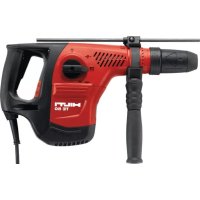
USER MANUAL TE 50 HILTI
2.7 Active Vibration Reduction (nur TE 50-AVR)
Head of BA Quality and Process Management
Business Area Electric Tools & Acces
series 01/20
Jan Doongaji
Executive Vice President
Business Unit Power
Tools & Accessories 01/2012
It is essential that the operating instruct are read before the power tool is open the first time.
Always keep these operating instructions gather with the power tool.
Ensure that the operating instructions a with the power tool when it is given persons.
Contents Page
1 General information 14
2 Description 15
3 Insert tools, accessories 17
4 Technical data 17
5 Safety instructions 19
6 Before use 21
7 Operation 21
8 Care and maintenance 23
9 Troubleshooting 24
10 Disposal 25
11 Manufacturer's warranty - tools 25
12 EC declaration of conformity (original) 26
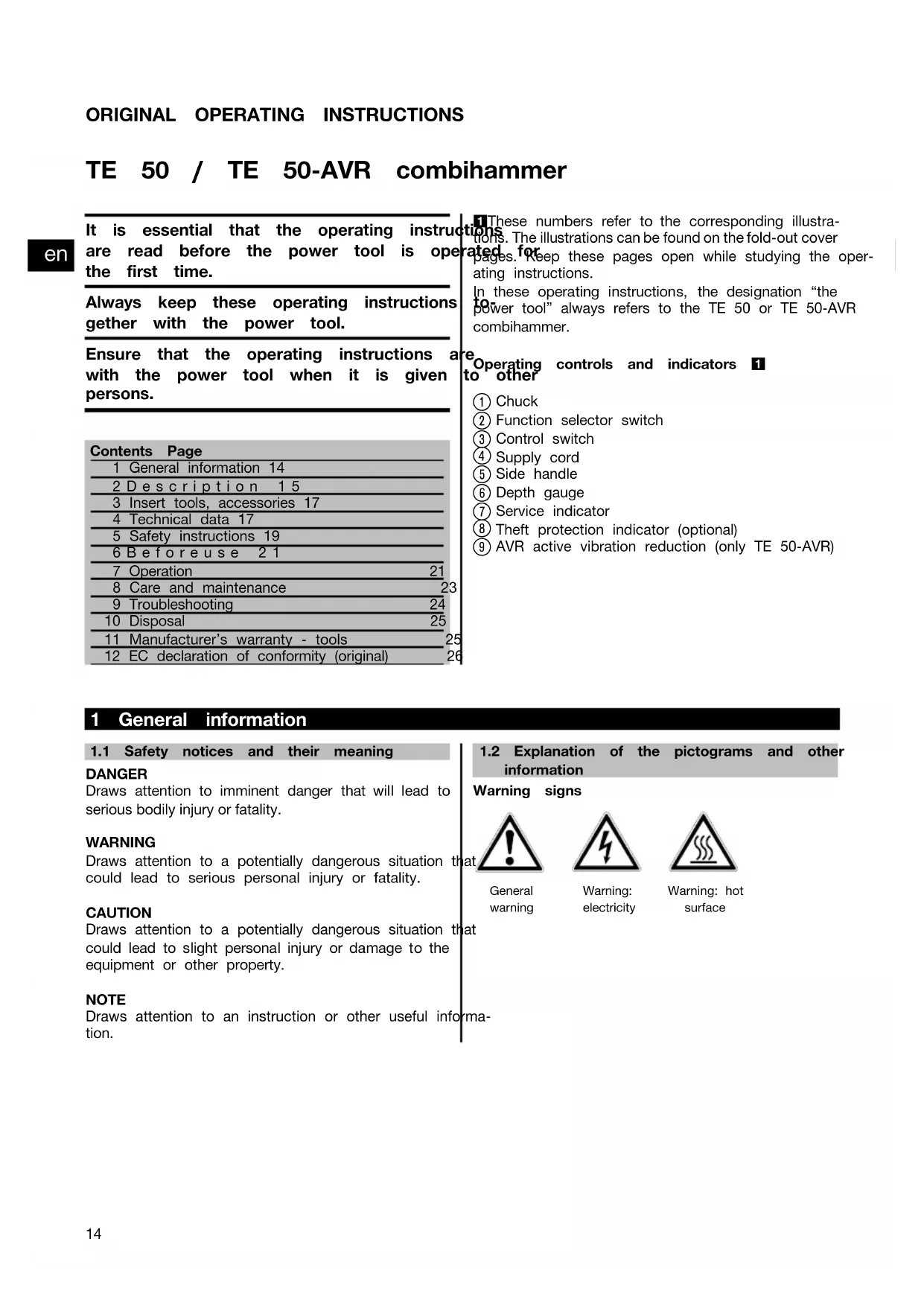
These numbers refer to the corresponding illustrations. The illustrations can be found on the fold-out cover
ated for pages. Keep these pages open while studying the operating instructions.
In these operating instructions, the designation "the power tool" always refers to the TE 50 or TE 50-AVR combihammer.
e Operating controls and indicators to other
① Chuck
(2) Function selector switch
(3) Control switch
④ Supply cord
⑤ Side handle
6 Depth gauge
⑦ Service indicator
⑧ Theft protection indicator (optional)
⑨ AVR active vibration reduction (only TE 50-AVR)
1.1 Safety notices and their meaning
DANGER
Draws attention to imminent danger that will lead to serious bodily injury or fatality.
WARNING
Draws attention to a potentially dangerous situation could lead to serious personal injury or fatality.
CAUTION
Draws attention to a potentially dangerous situation that could lead to slight personal injury or damage to the equipment or other property.
NOTE
Draws attention to an instruction or other useful information.
1.2 Explanation of the pictograms and other information
Warning signs

General warning

Warning: electricity

Warning: hot surface
Obligation signs

Wear eye protection

Wear a hard hat

Wear ear protection

Wear protective gloves

Wear breathing protection
Symbols

Read the operating instructions before use

Return waste material for recycling.

Drilling without hammering

Hammer drilling

Chiseling Chisel

position adjustment

Volts Amps

2 Description
2.1 Use of the product as directed
The power tool is an electrically-powered combihammer with pneumatic hammering mechanism.
The power tool is intended for drilling in concrete, masonry, metal and wood.
The power tool can also be used for light to medium-duty chiseling work on masonry and for surface finishing on concrete.
Working on materials hazardous to the health (e.g. asbestos) is not permissible.
Nationally applicable industrial safety regulations must be observed.
The power tool is designed for professional use and may be operated, serviced and maintained only by trained, authorized personnel. This personnel must be informed of any special hazards that may be encountered. The power tool and its ancillary equipment may present hazards when used incorrectly by untrained personnel or when used not as directed.
The working environment may be as follows: construction site, workshop, renovation, conversion or new construction.
The power tool may be used only in a dry environment.
Do not use the power tool where there is a risk of fire or explosion.
The power tool may be operated only when connected to a power supply providing a voltage and frequency in compliance with the information given on its type identification plate.
Modification of the power tool or tampering with its parts is not permissible.
To avoid the risk of injury, use only genuine Hilti accessories and insert tools.
Observe the information printed in the operating instructions concerning operation, care and maintenance.

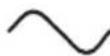


Watts Alternating
current
Hertz Rated speed
under no load


Diameter Double insulated
Equipped with theft protection system
Revolutions per minute

Lock symbol
The type designation and serial number can be found on the type identification plate on the machine or tool. Make anote of this data in your operation and always refer to it when making an enquiry to your Hilti representative or service department.
Type:
Serial no.:
2.2 Chuck
TE-Y chuck (SDS-max)
2.3 Switches
Speed control switch for smooth starting
Function selector switch:
Hammer drilling
Drilling without hammering
Chiseling
Chisel position adjustment (12 positions)
2.4 Grips
Vibration-absorbing, pivotable side handle
Vibration-absorbing grip
2.5 Protective device
Mechanical slip clutch
Electronic restart interlock to prevent the power tool starting unintentionally after an interruption in the electric supply (see section 9 "Troubleshooting").
2.6 Lubrication
Oil lubrication
2.7 Active vibration reduction (only TE 50-AVR)
The power tool is equipped with an AVR active vibration reduction system which reduces vibration significantly compared to power tools without active vibration reduction.
2.8 TPS theft protection system (optional)
The power tool may be equipped with the TPS theft protection system as an option. If the power tool is equipped with this feature, it can be unlocked and made ready for operation only through use of the corresponding TPS key.
2.9 LED indicators
Service indicator LED (see section "Care and maintenance")
Theft protection system indicator (optional) (see section "Operation")
2.10 Items supplied as standard
1 Power tool with side handle
1 Hilti toolbox
1 Operating instructions
1 D e p t h g a u g e
1 Cleaning cloth
1 Grease
2.11 Using extension cords
Use only extension cords of a type approved for the application and with conductors of adequate cross section. The power tool may otherwise loose performance and the extension cord may overheat. Check the extension cord for damage at regular intervals. Replace damaged extension cords.
Recommended minimum conductor cross section and max. cable lengths
| Conductor cross section | 1.5 mm² 2 mm² | 2.5 mm² 3.5 | mm² | |
| Mains voltage 100V 30 m 50 m | | | | |
| Mains voltage 110-120 V 20 m | 30 m | | 40 m | |
| Mains voltage 220-240 V 30 m | | | 75 m | |
2.12 Using extension cords outdoors
When working outdoors, use only extension cords that are approved and correspondingly marked for this application.
This power tool may be powered by a generator or transformer when the following conditions are fulfilled: The unit must provide a power output in watts of at least twice the value printed on the type identification plate on the power tool. The operating voltage must remain within +5% and -15% of the rated voltage at all times, frequency must be in the 50 - 60Hz range and never above 65Hz , and the unit must be equipped with automatic voltage regulation and starting boost.
Never operate other power tools or appliances from the generator or transformer at the same time. Switching other power tools or appliances on and off may cause undervoltage and / or overvoltage peaks, resulting in damage to the power tool.
| Designation Item number, description |
| TPS Theft Protection System with Company Card, 206999, optionalCompany Remote and TPS-K key |
| Chuck TE-Y |
| Setting tool Setting tool with TE-Y connection end |
| Quick-release chuck Keyless chuck for wood and metal drill bits with smoothor hex. shank, Chuck holder |
| Dust removal system TE DRS-S |
| Designation | Description |
| Hammer drill bits | ∅ 12...32 mm |
| Breach bits | ∅ 30...32 mm |
| Percussion core bits | ∅ 45...90 mm |
| Chisels Pointed, flat and shaped chisels with TE-Y connection end |
| Wood drill bits | ∅ 6...35 mm |
| Metal drill bits | ∅ 6...13 mm |
4 Technical data
Right of technical changes reserved.
NOTE
The power tool is available in various voltage ratings. Please refer to the type identification plate for details of the power tool's voltage and power rating.
| Power tool | TE 50 / TE 50-AVR |
| Rated power input | 1,050 W |
| Rated voltage / rated current | Rated voltage 100 V: 12.8 A
Rated voltage 110 V: 12.6 A
Rated voltage 120 V: 12.7 A
Rated voltage 220 V: 5.7 A
Rated voltage 230 V: 5.8 A
Rated voltage 240 V: 5.8 A |
| Power tool TE 50 / TE 50-AVR | |
| Mains frequency 50...60 Hz | |
| Weight in accordance with EPTA procedure 01/2003, TE 50 | 5.7 kg |
| Weight in accordance with EPTA procedure 01/2003, TE 50-AVR | 5.8 kg |
| Dimensions (L x W x H) 462 mm x 113 mm x 243 mm | |
| Speed under no load 550/min | |
| Single impact energy in accordance with EPTA proc-ure 05/2009 | £.2 J |
| Drilling dia. range in concrete/masonry (hammer drilling) | Ø 12...32 mm |
| Breach bits Ø 30...32 mm | |
| Percussion core bits Ø 45...90 mm | |
| Drilling dia. range in wood (solid) Ø 6...35 mm | |
| Drilling dia. range in metal (solid) Ø 6...13 mm | |
NOTE
The vibration emission level given in this information sheet has been measured in accordance with a standardised test given in EN 60745 and may be used to compare one tool with another. It may be used for all of exposure. The declared vibration emission level represents the main applications of the tool. However if the tool is used for different applications, with different accessories or poorly maintained, the vibration emission may differ. This may significantly increase the exposure level over the total working period. An estimation of the level of exposure vibration should also take into account the times when the tool is switched off or when it is running but not actually doing the job. This may significantly reduce the exposure level over the total working period. Identify additional safety measures to protect the operator from the effects of vibration such as: maintain the tool and the accessories, keep the hands warm, organisation of work patterns.
Noise and vibration information (measured in accordance with EN 60745-1 ):
| Typical A-weighted sound power level, TE 50-AVR 104 dB (A) |
| Typical A-weighted sound power level, TE 50 | 106 dB (A) |
| Typical A-weighted emission sound pressure level, TE93 dB (A) |
| 50-AVR |
| Typical A-weighted emission sound pressure level, TE95 dB (A) |
| 50 |
| Uncertainty for the given sound level | 3 dB (A) |
| Triaxial vibration value for the TE 50-AVR (vibration vmeasured in accordance with EN 60745-2-1 prAA: tor sum) | 2005 |
| Drilling in metal, h(a) | < 2.5 m/s2 |
| Triaxial vibration value for the TE 50-AVR (vibration vmeasured in accordance with EN 60745-2-6 prAB: tor sum) | 2005 |
| Hammer drilling in concrete, h(a) | 11.4 m/s2 |
| Chiseling, (a, cheq) | 8.1 m/s2 |
| Triaxial vibration value for the TE 50 (vibration vector Measured in accordance with EN 60745-2-1 prAA: sum) | 2005 |
| Drilling in metal, h(a) | < 2.5 m/s2 |
| Triaxial vibration value for the TE 50 (vibration vector Measured in accordance with EN 60745-2-6 prAB: sum) | 2005 |
| Hammer drilling in concrete, h(a) | 16.1 m/s2 |
| Chiseling, (a, cheq) | 11.3 m/s2 |
| Uncertainty (K) for triaxial vibration value | 1.5 m/s2 |
5 Safety instructions
a) Warning
Read all safety warnings and all instruction to follow the warnings and instructions may in electric shock, fire and/or serious injury. Save warnings and instructions for future referer The term "power tool" in the warnings refers to your mains-operated (cored) power tool or batte operated (cordless) power tool.
5.1.1 Workarea safety
a) Keep work area clean and well lit. Clutter areas invite accidents.
b) Do not operate power tools in explosive spheres, such as in the presence of flame liquids, gases or dust. Power tools create sp which may ignite the dust or fumes.
c) Keep children and bystanders away while ing a power tool. Distractions can cause you control.
5.1.2 Electrical safety
a) Power tool plugs must match the outlet. modify the plug in any way. Do not use apter plugs with earthed (grounded) power Unmodified plugs and matching outlets will reduce risk of electric shock.
b) Avoid body contact with earthed or grounded surfaces, such as pipes, radiators, ranges refrigerators. There is an increased risk of elect shock if your body is earthed or grounded.
c) Do not expose power tools to rain or wet tions. Water entering a power tool will increase the risk of electric shock.
d) Do not abuse the cord. Never use the c carrying, pulling or unplugging the power Keep cord away from heat, oil, sharp ed moving parts. Damaged or entangled cords in the risk of electric shock.
e) When operating a power tool outdoors, use extension cord suitable for outdoor use. Use a cord suitable for outdoor use reduces the risk of electric shock.
f) If operating a power tool in a damp loc unavoidable, use a residual current device protected supply. Use of an RCD reduces the of electric shock.
5.1.3 Personal safety
a) Stay alert, watch what you are doing and common sense when operating a power to
as.
not use a power tool while you are tired the influence of drugs, alcohol or medication. A moment of inattention while operating power tools may result in serious personal injury.
b) Use personal protective equipment. Always wear eye protection. Protective equipment such as dust mask, non-skid safety shoes, hard hat, or hearing protection used for appropriate conditions will reduce personal injuries.
c) Prevent unintentional starting. Ensure the switch is in the off-position before connecting to power source and/or battery pack, picking up or carrying the tool. Carrying power tools with your finger on the switch or energising power tools that have the switch on invites accidents.
atmo Remove any adjusting key or wrench before tu mable ing the power tool on. A wrench or a key left at- tached to a rotating part of the power tool may result in personal injury.
not overreach. Keep proper footing and balance at all times. This enables better control of the power tool in unexpected situations.
f) Dress properly. Do not wear loose clothing or jewellery. Keep your hair, clothing and gloves Never away from moving parts. Loose clothes, jewellery any oring hair can be caught in moving parts.
tools devices are provided for the connection of c extraction and collection facilities, ensure these are connected and properly used. Use of dust collection can reduce dust-related hazards.
and
a) Do not force the power tool. Use the correct power tool for your application. The correct power tool will do the job better and safer at the rate for which it was designed.
b) Do not use the power tool if the switch does not turn it on and off. Any power tool that cannot be controlled with the switch is dangerous and must be repaired.
c) Disconnect the plug from the power source, and/or the battery pack from the power tool. Use of before making any adjustments, changing of accessories, or storing power tools. Such preventive safety measures reduce the risk of contamination starting the power tool accidentally.
(R) Store idle power tools out of the reach of children and do not allow persons unfamiliar with the power tool or these instructions to operate the power tool. Power tools are dangerous in the hands of untrained users.
osMaintain power tools. Check for misalignment or pol. Bading of moving parts, breakage of parts and
C
d) When working outdoors with an electric tool check to ensure that the tool is connect to the electric supply by way of a ground fault interrupter (RCD) with a rating of max. 30 (stripping current). Use of a ground fault circuit interrupter reduces the risk of electric shock.
e) Use of a ground fault circuit interrupter (residual current device) with a maximum current of 30 mA is recommended.
f) In case of an interruption in the electric switch the power tool off and unplug the cord. This will prevent accidental restarting when electric power returns.
5.3.4 Workarea safety
a) Ensure that the workplace is well lit.
b) Ensure that the workplace is well ventilated, posture to dust at a poorly ventilated workplace in result in damage to the health.
(c) If the work involves breaking right through, take and ttheappropriate safety measures at the opposite circusite. Parts breaking away could fall out and / or fall mAdown and injure other persons.
5.3.5 Personal protective equipment
RCD
ript

supply the




en
d.Thex-user and any other persons in the vicinity may wear suitable eye protection, a hard hat, ear protection, protective gloves and breathing protection while the tool is in use.
6 B efo re u se

6.1 Fitting and adjusting the side handle 2
CAUTION Remove the depth gauge from the side handle in order to avoid injury.
-
Disconnect the supply cord plug from the power outlet.
-
Release the side handle clamping band by turning the handle counterclockwise.
- Slide the side handle clamping band over the chuck and onto the cylindrical section at the front end of the power tool.
- Pivot the side handle into the desired position.
- Secure the side handle by turning the grip clockwise.
6.2 Unlocking the power tool
See section "Operation"
6.3 Use of extension cords and generators or transformers
Please refer to section 2 "Description".
7 Oper at ion



CAUTION
In accordance with the applications for which it is designed, the power tool produces a high torque. Always use the side handle and hold the power to hands. The user must be prepared for sudden stick and stalling of the insert tool.
CAUTION
Use clamps or a vice to hold the workpiece
CAUTION
The collar at the front end of the gearing not to be used as a gripping surface.
CAUTION
Check the insert tool for damage or uneven wear each time before use.
7.1 Preparing for use
CAUTION
Wear protective gloves when changing insert tools the.insert tools get hot during use. with both
7.1.1 Adjusting the depth gauge 3
- Release the side handle clamping band by turning the handle counterclockwise.
2.seciry.the side handle into the desired position.
-
Attach the clamp with the depth gauge to the clamping band at the desired position.
actionRelease the screw at the depth gauge.
-
Adjust the depth gauge to the desired drilling depth
- Tighten the screw at the depth gauge firmly.
- Tighten the side handle securely by turning the grip section. This also clamps the depth gauge position.
- Disconnect the supply cord plug from the power outlet.
- Check that the connection end of the insert tool is clean and lightly greased. Clean it and grease it if necessary.
- Check that the sealing lip of the dust shield is clean and in good condition. Clean the dust shield if necessary or have it replaced if the sealing lip is damaged.
- Push the insert tool into the chuck and rotate it while applying slight pressure until it engages in the guide grooves.
- Push the insert tool further into the chuck until it heard to engage.
- Check that the insert tool has engaged correctly by pulling it.
- Disconnect the supply cord plug from the power outlet.
- Open the chuck by pulling back the insert tool lo ing sleeve.
- Pull the drill bit out of the chuck.
7.2 Operation

CAUTION
Working on the material may cause it to splinter. We eye protection and protective gloves. Wear by protection if no dust removal system is used tering material presents a risk of injury to the eyes a body.
CAUTION
The work generates noise. Wear ear protectors.
ure to noise can cause hearing loss.
CAUTION
Improve the blood circulation in your fingers laxing your hands and exercising your fingers breaks between working.
7.2.1 TPS theft protection system (optional)
NOTE
The power tool may be equipped with the optional TPS protection system. If the power tool is equipped with a feature, it can be unlocked and made ready for operation only through use of the corresponding TPS key.
- Plug the supply cord into the power outlet. The yellow theft protection indicator LED blinks. The power tool is now ready to receive the signal from the TPS key.
- Hold the TPS key or the TPS watch strap buckle against the lock symbol. The power tool is unlocked as soon as the yellow theft protection indicator LED no longer lights.
NOTE If, for example, the electric supply is briefly interrupted due to a power failure or disconnected when moving to a different workplace, the power tool remains ready for operation for approx. 20 minutes. In the event of a longer interruption, the TPS key must be used again to unlock the power tool.
isNOTE
Further detailed information on activation and use of the theft protection system can be found in the operating instructions for the theft protection system.
7.2.2 Drilling without hammering (A) 7
- Turn the function selector switch until it engages in the "Drilling without hammering" position. Do not operate the function selector switch while the motor is running.
- Bring the side handle into the desired position and check that it is fitted correctly and secured.
- Plug the supply cord into the power outlet.
- Position the power tool and drill bit at the point where the hole is to be drilled.
- Press the control switch slowly (drill at a low speed until the drill bit centers itself in the hole).
- Press the control switch fully to continue drilling with full power.
a7. Do not apply excessive pressure. This will not increase the power tool's drilling performance. Lower Pressure extends the life of the insert tool.
7.2.3 Hammer drilling (B) 7
NOTE
Working at low temperatures: The hammering mech-Exprism works only when the power tool has reached a minimum operating temperature. Bring the tip of the drill bit or chisel into contact with the workpiece and allow the power tool to run under no load until it reaches the minimum operating temperature. If necessary, repeat during procedure until the hammering mechanism begins to operate.
- Turn the function selector switch until it engages in the "Hammer drilling" position. Do not operate the function selector switch while the motor is running. This Bring the side handle into the desired position and check that it is fitted correctly and secured.
-
Plug the supply cord into the power outlet.
-
Position the power tool and drill bit at the point where the hole is to be drilled.
- Press the control switch slowly (drill at a low speed until the drill bit centers itself in the hole).
- Press the control switch fully to continue drilling full power.
- Do not apply excessive pressure. This will increase the power tool's hammering performance. Lower pressure extends the life of the insert too.
- Reduce drilling speed shortly before breaking through in order to avoid damage to the surface the rear side.
7.2.4 Chiseling
NOTE
The chisel can be adjusted to 12 different positions (in 30^ increments). This ensures that flat chisels and shaped chisels can always be set to the optimum w position.
7.2.4.1 Adjusting the chisel (C) 7
CAUTION
Do not operate the power tool when the selector switch is set to "Chisel adjustment".
- Turn the function selector switch until it engages in
I no then "Chisel adjustment" position. Do not operate the function selector switch while the motor is running
- Bring the side handle into the desired position and check that it is fitted correctly and secured.
- Rotate the chisel to the desired position.
7.2.4.2 Locking the chisel (D) 7
Turn the function selector switch until it engages in the "Chiseling" position. Do not operate the function selector switch while the motor is running.
Working 2.4.3 Chiseling(D) 71
- Plug the supply cord into the power outlet.
- Position the tip of the chisel at the point where chiseling is to begin.
- Press the control switch fully.
8 Care and maintenance
CAUTION
Disconnect the mains plug from the power
Clean off dirt and dust deposits adhering to the inset tools and protect them from corrosion by wiping the insert tools from time to time with an oil-soaked rag.
CAUTION
Keep the power tool, especially its grip surface clean and free from oil and grease. Do not ing agents which contain silicone.
The outer casing of the power tool is made from impact-put resistant plastic. Sections of the grip are made from a synthetic rubber material.
Never operate the power tool when the ventilation slots are blocked. Clean the ventilation slots carefully using a dry brush. Do not permit foreign objects to enter the interior of the power tool. Clean the outside of the power tool at regular intervals with a slightly damp cloth. Do not use a spray, steam pressure cleaning equipment or running water for cleaning. This may negatively affect the electrical safety of the power tool.
es, use clean-
8.3 Service indicator
NOTE
The power tool is equipped with a service indicator.
| Indicator | Constant red light | End of service interval - servicing is due.
After the lamp lights for the first time,
the power tool may continue to be used
for several hours before the automatic
cut-out is activated. To ensure that the
power tool is always ready for use, it
should be returned to Hilti for servicing
in good time. |
| Blinking red light | See section “Troubleshooting”. |
8.4 Maintenance
WARNING
Repairs to the electrical section of the power be carried out only by trained electrical spec
Check all external parts of the power tool for damage at regular intervals and check that all controls operate faultlessly. Do not operate the power tool if parts are damaged or when the controls do not function faultlessly.
If necessary, the power tool should be repaired by Service.
t8.5 Checking the power tool after care and maintenance
After carrying out care and maintenance work on the power tool, check that all protective and safety devices are fitted and that they function faultlessly.
en
9 Troubleshooting
| Fault Possible cause Remedy |
| The power tool doesn't start. | Interruption in the electric supply. Plug in another electric appliance and check whether it works. |
| The supply cord or plug is defective. Have it checked by a trained electrical specialist and replaced if necessary. |
| Generator with sleep mode. Apply a load to the generator by connecting another appliance (e.g. a lamp). Subsequently switch the power tool off and on again. |
| Other electrical fault. Have it checked by a trained electrical specialist. |
| The electronic restart interval switches the power tool off and on again. |
| No hammering action. The power tool is too cold. Allow the power tool to warm up to the minimum operating temperature. See section: 7.2.3 Hammer drilling (B) |
| The power tool doesn't start and the LED blinks red. | A fault has occurred in the power tool. If necessary, the power tool should be repaired by Hilti Service. |
| The power tool doesn't start and the LED lights red. | The carbon brushes are worn. Have it checked by a trained electrical specialist and replaced if necessary. |
| The power tool doesn't start and the indicator lamp blinks yellow. | The power tool has not been unlocked (power tools with optional thefttool. Use the TPS key to unlock the power protection system). |
| The power tool doesn't achieve full power. | The extension cord is too long or itsUse an extension cord of an approved length and / or of adequate gauge. |
| The voltage provided by the electric supply is too low. Connect the power tool to a different power source. |
| The drill bit doesn't rotate. | The function selector switch is not When the motor has stopped, move engaged or is in the "Chiseling" or "Chisel adjustment" position. the function control switch to the "Drilling without hammering" or "Hammer drilling" position. |
| The drill bit / chisel can't be leased from the chuck. | reThe chuck is not pulled back fully. Pull the chuck back as far as it will go and remove the insert tool. |
| The side handle is not fitted correctly. Release the side handle and refit it correctly so that the clamping band and side handle engage in the groove. |
10 Disposal

Most of the materials from which Hilti power tools or appliances are manufactured can be recycled. The materials must be correctly separated before they can be recycled. In many countries, Hilti has already made arrangements for taking back your old power tools or appliances for recycling. Please ask your Hilti customer service department or Hilti representative for further information.

For EC countries only
Disposal of electric tools together with household waste is not permissible.
In observance of the European Directive on waste electrical and electronic equipment and its implementation in accordance with national law, electrical appliances that have reached the end of their life must be collected separately and returned to an environmentally compatible recycling facility.
Hilti warrants that the tool supplied is free of defect material and workmanship. This warrant as the tool is operated and handled correctly, clean and serviced properly and in accordance with the Hill Operating Instructions, and the technical system is m tained. This means that only original Hilti consumable components and spare parts may be used in the tool
This warranty provides the free-of-charge repair or replacement of defective parts only over the entire life of the tool. Parts requiring repair or replacement as a result of normal wear and tear are not covered by the warranty.
Additional claims are excluded, unless stringent national indices prohibit such exclusion. In particular, H is not obligated for direct, indirect, incidental or c sequential damages, losses or expenses in connection with, or by reason of, the use of, or inability to use the tool for any purpose. Implied warranties or merchantability or fitness for a particular purpose is specifically excluded.
For repair or replacement, send the tool or related parts immediately upon discovery of the defect to the address of the local Hilti marketing organization provided.
This constitutes Hilti's entire obligation with regard to warranty and supersedes all prior or contemporaneous comments and oral or written agreements concerning warranties.
Designation: Combihammer
Type: TE 50 / TE 50-AVR
Year of design: 2006
We declare, on our sole responsibility, that this product complies with the following directives and standards: 2006/42/EC, 2004/108/EC, 2011/65/EU, EN 60745-1, EN 60745-2-6, EN ISO 12100.
Technical documentation filed at:
Head of BA Quality and Process Man
agement
Business Area Electric Tools & Ac
cessories
01/2012 01/2012
Executive Vice President
Business Unit Power
Tools & Accessories
TE 50 / TE 50-AVR Marteau combiné
Poignée anti-vibration
7.2.2 Perçage sans percussion (A) 7
Head of BA Quality and Process Mana
gement
Business Area Electric Tools & Acces
series
01/2012
Jan Doongaji
Executive Vice President
Business Unit Power
Tools & Accessories
01/2012
2.7 Active Vibration Reduction (solo TE 50-AVR)
Head of BA Quality and Process Mana
gement
Business Area Electric Tools & Acces
series
01/2012
Jan.
Executive Vice President
Business Unit Power
Tools & Accessories
01/2012
Martello combinato TE 50 / TE 50-AVR
2.7 Active Vibration Reduction (solo TE 50-AVR)
Head of BA Quality and Process Mana
gement
Business Area Electric Tools & Acces
sories
01/2012
Executive Vice President
Business Unit Power
Tools & Accessories
01/2012
TE 50 / TE 50-AVR Combihamer
2.7 Active Vibration Reduction (alleen TE 50-AVR)
Head of BA Quality and Process Mana
gement
Business Area Electric Tools & Acces
sories
01/2012
Jan Doongaji
Executive Vice President
Business Unit Power
Tools & Accessories
01/2012
TE 50 / TE 50-AVR Kombihammer
Head of BA Quality and Process Mana
Executive Vice President
gement
Business Area Electric Tools & Acces
sories
01/2012 01/2012
2.7 Active Vibration Reduction (bare TE 50-AVR)
7.2.4.2 Lase measelen (D) 7
Head of BA Quality and Process
Management
Business Area Electric Tools & Access
ories
01/2012
Jan Doongaji
Executive Vice President
Business Unit Power
Tools & Accessories
01/2012
TE 50 / TE 50-AVR Kombihammare
Head of BA Quality and Process Mana
Executive Vice President
gement
Business Area Electric Tools & Acces
series
01/2012 01/2012
Teknisk dokumentation vid:
Head of BA Quality and Process Management
Business Area Electric Tools & Accessories
01/2012 01/2012
Executive Vice President
Business Unit Power
Tools & Accessories
Martelo combinado TE 50 / TE 50-AVR
Mandril TE-Y (SDS max.)
2.3 Interruptor
4 Caracteristicas techniques
Tip: TE 50 / TE 50-AVR
Anode fabrico: 2006
Declaramos sob{nossa exclusiva responsabilitad que este produits cumpre as seguintes normas ou documeros normativos:2006/42/CE,2004/108/CE,2011/65/UE, EN 60745-1,EN 60745-2-6,EN ISO 12100.
Hilti Corporation, Feldkircherstrasse 100, FL-9494 Schaan
Paolo Luccini Jan Doongaji
Head of BA Quality and Process Mana
gement
Business Area Electric Tools & Acces
sories
01/2012
Executive Vice President
Business Unit Power
Tools & Accessories
01/2012
biαβατε TIC oyniec xngns

AioeotetaoToppiu
yiaovakukawon

△atpnn
xomega
Kpouon

Kpouotikn
diatpnon

Σμiλειση Pθμιση
0eans kaaiou

Volt Ampere

2 Pnepiyrhoq
2.1 Kαταλληλ xριση
To epyaaleio evai eva nekpiko niatoletoe ne venuoipokouanc.
To epyaaleio npoopiciotai yia epyaies c diatpnoans oetov, toixonoiie, etaalkai Eua.
To epyaieo mopei va xpnaiomointhetai eminpocotg taia anae cwcuogduokoliaac epyaoies aileuongc toixonoiies kai epyaoies bcwians ae nTov.
EITpETeTai n ETEEepyoxia eTIPaBw yia Tnv uyeia uikov (n.x. aiaavtoq).
PpoeEe enians Tc eVikc aanitnaic PPOoTaoia cKaTaNv Epyaia.
To epyaaleio npoopicietai yia tov enayyelaatia xpnotn kai o xeiipiaoc, n ouvtnponkai n emiokun Tou etiptetai
mvo ano Eouaiobotnevo, evnepwveo npoawntko. To npoawntko auto npentei va exeivnuepwothe iida
touc kivouoc tou evexetai va npouiaotouv. Anto T epyaaleio kai ta bonntikao tou meoav evdexetai v
tpokanbouv kivouoi, otav o xeiipiaoc tou yiveai uekataaalno tponto ano un ektaieuveo poowniko n otav
dev xpnoiomoiouvtai ue kataaanlo tponto.
To epyaleio unopei va xnpoiopoine i: epyotexia, ouvpeyia, avanaiwaeic, etatponec kai veekataaekuec. To epyaleio emtpentetai va xnpoiopoinei tai mvo oTeyv oepiaalov.
Mn xpnoiunoeite to epyaleio, onou utapxei kivduvoC npkayioC n EkphEewv.
EITpeTaeV a eitoupyei mOvo me Tnv ovuaotikn taon kai ouxvotnta Tpofooboaia c nou axapeptai otnv tivakidax Tumou.
11tpenovtai oipaoaoinaeis noi eTatpone cto epyaiaio.
W

Hz

Watt Evαλλσ
oouevo 0u
Hertz Ovoaataiko
αριβμος
στροφων
xwpi c qopto
/min



Tpoepc ova AETTO
Aixepoc 11nns oovon
EvEiyn yia tvn avtikAeTTIK npootaoia

Σuβoλo kεiδαριας
Enueio avaypaoqic oToixeiow avayvwoioc oTo epya
H Tepiypaxn tuou kai o kwdiok osipac piaokovta el Nivaikda toun tou epyalou aoc. AvtpaTe auta ta Otoxieia otic oyies xphons kai avapepete navra auta ta otoxieia otav aneuovote OTnv avinpooenieia paC n tooepis
Tunoc:
Ap. σειρας;
Tia v aiofouyte kivduvouc tpaumaiou, xnoiopooinote mvo ynvia aEosouap kai Eapntmuata Tc Hilti. Akoalouhnte oaa avapepovtai otic obnyie c xponc yia tn Ieitoupyia, tn povrtida kai tn ouvtnpn.
2.2 Took
Took TE-Y (SDS
2.3 AikokntTec
2.7 Active Vibration Reduction (μovo TE 50-AVR)
To epyaaleio eivai eonaiouevo eEv aoutnua "Active Vibration Reduction" (AVR), to onolo eiwv i nauTKa Touk Kpaabauooc oexon m TnV Tiun Tou epyaesiou wpiC "Active Vibration Reduction".
2.8 Avtikkntik npoatai TPS (npoapetik)
To epyaleio mopei vα ΕoIaiotei npaoipetikα μe tn λeIToupyia "avTKaETTikn ppoTaeia TPS". Eov to epyaleio evai eonlqevo μe autiv tn λeIToupyia, mopei vα Eeklaedωθει καιν ατθει σλeIToupyia móvo μe to oxetiko kλeidi evepyoinan.
2.9 Evoiieic qtwevo an
EvEiEg eepis eWTeiv o nua (BETe KEPAAIO "PovTiδa kai auVTipnAn") EvEiEg aVTIKAENTTikc npoTaiaoc (diAtiTEaI pOaipetikx) (BETe KEPAAIO "Xeipiaoc")
AnouvOeTo to qic aTnTnv npizc.
8.1ΦpovriαTωv EεαρημαTωv
Anopakpuve TIC aKoBaoieC Nou exouv EIKaHoei IPOATATEyTE TIV ENIPOVEIA Tuv EApTNUoTAV OAC AT DlAβpwon, TPIBOVTOCTNv TAKTIKa E eva Navi KαBap Oou eunotioevo e Aoi.
Head of BA Quality and Process
Management
Business Area Electric Tools &
Accessories
01/2012 01/2012
Executive Vice President
Business Unit Power
Tools & Accessories
Texvikntekunpiomegaotnv:
2.7 Active Vibration Reduction (tikai TE 50-AVR)
Iekarta ir aprikota ar sistemu "Active Vibration Reduction" (AVR), kas ieverojami samazina vibraciju salidzinajumar vibracijas parametriem bez "Active Vibration Reduction" sistemas.
Head of BA Quality and Process Management
Business Area Electric Tools & Accessories
01/2012 01/2012
Executive Vice President
Business Unit Power Tools & Accessories

TE 50 / TE 50-AVR Kombinuotas plaktukas
Pries pradedami naudotis atidziai perskait kite naudiojimo instrukcija.
Head of BA Quality and Process Management
Business Area Electric Tools & Accessories
01/2012 01/2012
Executive Vice President
Business Unit Power
Tools & Accessories
ALGUPÄRANE KASUTUSJUHEND
Puurvasar TE 50 / TE 50-AVR
Head of BA Quality and Process Mana
Executive Vice President
gement
Business Area Electric Tools & Acces
series
01/2012
Business Unit Power
Tools & Accessories
01/2012
Tehnilised dokumendid saadaval:
Hitti = registered trademark of Hitti Corp., Schaan
W3254|0613|00-Pos.1|1
Printed in Germany © 2013
Right of technical and programme changes reserved S.E.&O