USER MANUAL KRC 4323 CD AEG
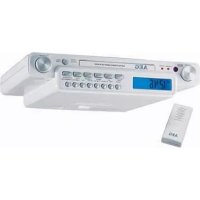
Under Counter Kitchen Clock Radio with CD
Overview of the Components ......Page 3
Instruction Manual Page 46
Technical Data Page 51
Język polski
Spis treści
D-47906 Kempen/Germany
natural_image
Diagram of a device with a mounted sensor or antenna connected to a central display (no text or symbols visible)
Afbeelding C
16 Touche minutes (MIN)
18 Français
22 Touche F.FWD ▶▶▶I (recherche avant)
23 Touche STOP
24 Touche PLAY/PAUSE (lecture/pause)
Télécommande
25 Touche PLAY/PAUSE (lecture/pause)
26 Touches SKIP/SEARCH I ◀◀ / ▶▶I
(recherche
arrière/avant)
natural_image
Diagram of a device with a mounted sensor or antenna connected to a control panel (no text or symbols visible)
Illustration C
i REMARQUE: DISQUES COMPACTS
.....AM / AM 530 \~ 1611 kHz
natural_image
Diagram of a device with a mounted sensor or antenna connected to a central display (no text or symbols visible)
Imagen C
natural_image
Diagram of a device with a mounted sensor or antenna connected to a control panel (no text or symbols visible)
Figura C
natural_image
Diagram of a device with a mounted sensor or antenna connected to a central display (no text or symbols visible)
Immagine C
.....AM / AM 530 \~ 1611 kHz
General Safety Instructions
Read the operating instructions carefully before putting the appliance into operation and keep the instructions including the warranty, the receipt and, if possible, the box with the internal packing. If you give this device to other people, please also pass on the operating instructions.
- To avoid the risk of fire or an electric shock, you should not expose the device to rain or moisture. Consequently, do not use the device in the immediate vicinity of water - for example near a bath tub, a swimming pool or in a damp cellar.
- Use the device only for the intended purpose.
- Only connect the device at a properly installed plug socket. Pay attention that the specified voltage corresponds to the voltage of the plug socket.
- When using external mains supply, pay attention to the correct polarity and voltage. Always place the batteries in the correct direction.
- Assemble the device in such a way that the available ventilation openings are not covered.
- Never open the housing of the device. Incorrect repairs can constitute a considerable risk for the user. Should the device become damaged, in particular the mains supply cable, do not operate the device any longer, but rather have it repaired by an expert. Check the mains supply cable regularly for damage.
- For safety reasons a broken or damaged mains lead may only be replaced by an equivalent lead from the manufacturer, our customer service department or a similar qualified person.
- If the device is not used for a longer period, remove the plug connector from the plug socket or take out the batteries.
These symbols may be found on the machine and are intended to indicate the following:

The lightning symbol should advise the user of parts in the inside of the device which carry dangerously high voltage levels.

The symbol with an exclamation mark should advise the user of important operation or maintenance instructions in the accompanying documentation.

Devices bearing this symbol work with a „class 1 laser“ for tracing the CD. The built-in safety switches should prevent the user being exposed to dangerous laser light, which is invisible to the human eye, when the CD compartment is opened.
Under no circumstances should these safety switches be bypassed or manipulated, as this could result in a danger of exposure to the laser light.
Children and Frail Individuals
- In order to ensure your children's safety, please keep all packaging (plastic bags, boxes, polystyrene etc.) out of their reach.

WARNING!
Caution! Do not allow small children to play with the foil as there is a danger of suffocation!
- In order to protect children or frail individuals from the hazards of electrical equipment, please ensure that this device is only used under supervision. This device is not a toy. Do not allow small children to play with it.
Symbols in these Instructions for Use
Important information for your safety is specially marked. It is essential to comply with these instructions in order to avoid accidents and prevent damage to the machine:

WARNING:
This warns you of dangers to your health and indicates possible injury risks.

CAUTION:
This refers to possible hazards to the machine or other objects.

NOTE: This highlights tips and information.
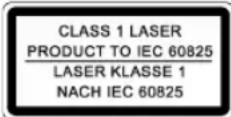
This device works with a class 1 laser.
Overview of the Components
1 VOLUME (volume control)
2 IR Sensor for the remote control
3 AUX control lamp
4 STEREO control lamp
| 5 | CD | compartment |
| 6 | OPEN/CLOSE | (open/close) |
| CD | compartment |
| 7 | TUNING | control |
8 AUX IN input sockets
9 Battery compartment
10 Function button (STANDBY/AL. OFF)
11 Function button (FUNCTION)
12 BASS ON/OFF button
13 Alarm time control button (AL SET)
14 Time setting function key (TIME SET)
15 AL ON/OFF button
16 Set minutes (MIN)
17 Hour function key (HOUR)
18 LCD display
19 PROG button (memory)
20 REP button
21 I◀◀ REW button (reverse search)
22 F.FWD ▶▶I button (forward search)
23 STOP button
24 PLAY/PAUSE button (play/pause)
Remote
Control
25 PLAY/PAUSE button (Play/Pause)
26 SKIP/SEARCH I ◀◀ / ▶▶ | buttons
(reverse search/forward search)
27 REPEAT button (repeat)
28
STOP
button
Installation Instructions for Bottom-Mounted Devices

CAUTION:
Make sure that the plug is not inserted when assembling the device.
- Remove all objects from the cupboard and anything which is fragile in the adjacent cupboards.
- For the installation the cupboard must fulfil the following conditions:
Thickness of the cupboard floor between 16 mm and 20 mm.
- The wall mounting of the cupboard must be stable and anchored firmly in the wall with at least 2 screws.
- Important! Do not install the device above a cooker!
- When installing the device it must be ensured that there is a power socket within reach.
- The mains socket must be within easy reach, so that the plug can be quickly removed in an emergency.
- Important! Do not connect the device to the mains power supply until after installation!
- The device cannot be installed under cupboards under which there is a lighting strip.
- For installation you may require the following items: a drill with 6 mm drill bit, gimlet or nail, screwdriver, measuring tape, adhesive tape, scissors, safety goggles.
Installation Accessories
| Item. | Designation Number | | |
| 1 | 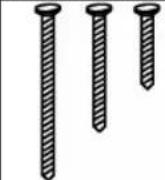 | Screws 3 each | |
| 2 | 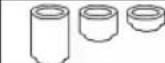 | Spacer 3 each | |
| 3 | 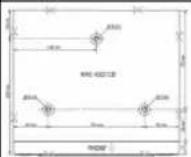 | Drilling template 1 | |

CAUTION:
- Please adhere to the dimensions stated in the installation instructions.
- You should use only the installation accessories supplied.

WARNING:
If screws are inserted too deeply (screws too long) this may damage the device or represent a hazard to the user or others.
Installation
| A | Illustration A |
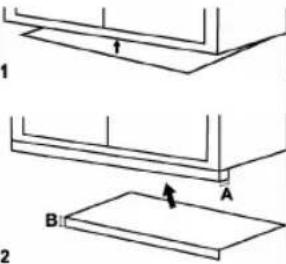 | Cut the drilling template out along the line.In the case of cupboards with an overhang you should measure the thickness of the overhang by bending the template along the dashed line. The arrow points to the front of the lower cupboard (Fig. 1-3).Adhere the template firmly under the cup-board with adhesive tape. With the help of a gimlet or nail pierce the crosses at the attachment points and use it to mark the holes.Remove the template and drill the holes into the wall cupboard. |
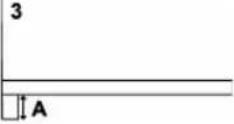 |
| B | Illustration BSelect the corresponding spacers according to the decorative strip. Insert the spacer into the holes provided on the device.△CAUTION:The thickness of the cupboard floor must be between 16 mm and 20 mm. |
 |
| NOTE:Sufficient ventilation is only guaranteed with a spacer. |
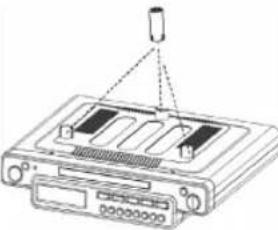
C Illustration C
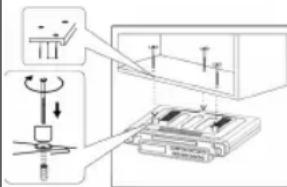
- Select the corresponding screws according to the spacers.
Countersink the screws into the holes in the cupboard.
- Using the 3 screws and the spacers, attach the kitchen radio to the bottom of the cupboard.
- Tighten the screws with a screwdriver until they are hand tight.
CAUTION:
You should use a hand screwdriver and not a battery-driven one.
Start-up of the device / Introduction
- Read the operating instructions thoroughly before the start-up!
- Make sure that the device is adequately ventilated!
- Insert the plug into a properly installed 230 V, 50 Hz power socket. The display lights up in blue and the time appears. Please ensure that the mains voltage corresponds to the information on the type plate.
Inserting the batteries (not supplied)
If there is a power cut or the mains plug has been removed from the power socket, the settings will be retained if the power reserve batteries are inserted.
- Open the battery compartment (9) on the rear of the device.
- Insert 2 batteries of type R03 „AAA“ 1,5 V. Ensure that the polarity is correct (see the floor of the battery compartment)!
- Close the battery compartment again.
- If the device is not used for a prolonged period of time, please take the batteries out in order to prevent leakage of battery acid.
△ CAUTION:
- Different battery types or new and used batteries must not be used together.
- Batteries are not to be disposed of together with domestic wastes. Dispose of the used batteries at the relevant collection bin or at your dealer's.
WARNING:
Do not expose the batteries to high temperatures or direct sunlight. Never throw batteries into the fire. There is a danger of explosion!
Remote Control Batteries (not supplied)
- Open the lid of the battery compartment on the back of the remote control.
- Insert 2 batteries of type R03 „AAA“ 1,5 V. Ensure that the polarity is correct (see the floor of the battery compartment)!
- Close the battery compartment again.
- If the remote control is not used for a prolonged period, remove the batteries in order to prevent battery acid leaking.
CAUTION:
- Different battery types or new and used batteries must not be used together.
- Batteries are not to be disposed of together with domestic wastes. Dispose of the used batteries at the relevant collection bin or at your dealer's.
WARNING:
Do not expose the batteries to high temperatures or direct sunlight. Never throw batteries into the fire. There is a danger of explosion!
Switching the Device on/off (10)
Switch the device to the standby mode with the STAND-BY/AL.OFF button (the time is displayed). If this button is pressed once more, the device switches on again.
Infrared remote control
For operating the music centre from a distance of up to 5 metres without a lead. If the range of the remote control is reduced, the batteries have to be replaced. During operation ensure that there is nothing blocking the direct line between the remote control and the sensor (2) on the machine.
BASS ON/OFF (12)
To increase or decrease the bass output. Press the BASS ON/OFF button to switch this function on and off.
To connect analogue replay devices. With these sockets you can also hear the sound from other playback devices such MP3 players, CD players etc through the loudspeakers.
- Please connect the external device with an appropriate cinch cable (2x RCA) to the AUX IN R/L sockets.
- Press the FUNCTION button (11) repeatedly until the AUX (3) control lamp lights up.
- Through the loudspeakers you will now hear the sound from the external device. You can adjust the volume with the VOLUME control (1).
- For the remaining procedure please see the operating instructions of the external sound source.
i NOTE:
Adjust the volume of the external device to a comfortable level.
Setting of the Clock (24 h) (in Standby Mode)
- Press the TIMESET button (14) and the HOUR or MIN button simultaneously.
Hours: Press the HOUR (17) button.
Minutes: Press the MIN. (16) button.
- The time is stored automatically. The time is then shown in the display.
Radio station tuning
- Press the FUNCTION button (11) repeatedly until FM or AM appears in the display.
- Select a station by turning the TUNING control (7).
FM (MHz) = FM (frequency modulation), AM (kHz) = medium wave.
- The STEREO control lamp (4) only lights up if the selected station is being received in stereo quality. If reception is too weak and there is noise on the station being received, this lamp will fl icker. Try to improve reception by turning and bending or twisting and altering the length of the antenna.
- An aerial is integrated into the device for the reception of AM stations.
- The desired volume can be sent using the VOLUME regulator (1).
Setting the Alarm Time (24 h) (in Standby Mode)
As follows:
- Switch the device to the standby mode with the STANDBY/AL.OFF button (the time is displayed).
- Press the AL SET button (13) and the HOUR (17) or MIN button (16) simultaneously.
i NOTE:
Press the AL SET button to see the set time in the display.
- Press the AL ON/OFF button (15) to activate the alarm time. The "💡" symbol appears in the display.
- When the alarm time is reached the device switches on with the last mode and volume that has been set.
i NOTE:
If the device is switched on when the alarm time is reached, the device changes to standby mode.
In order to switch off the alarm until the following day please press the STANDBY/AL.OFF button.
If you would like to completely deactivate the alarm, press the AL ON/OFF button. The "symbol" disappears from the display.
Alarm Time with Radio
- After you have set the alarm time and selected a radio station, turn the device off with the STANDBY/ALOFF button (10).
- As soon as the alarm time is reached, the radio is switched on. The selected radio station plays at the set volume.
Alarm Time with CD
- If you would like to be woken up by an inserted CD, press the FUNCTION button (11) repeatedly until „- -” appears in the display. Turn the device off with the STANDBY/ALOFF button (10).
- As soon as the set alarm time is reached the CD player switches on automatically. Playback is started at the set volume.
i NOTE:
The CD compartment can only be opened in CD mode by pressing the OPEN/CLOSE button (6).
Playing CDs
Proceed as follows in order to listen to a CD
- Press the FUNCTION button (11) repeatedly until "-" appears in the display.
- In order to open the CD compartment (5), press the OPEN/CLOSE button (6).
- Insert a CD with the printed side facing upwards into the CD compartment and press the OPEN/CLOSE button again in order to re-close the CD compartment. "-" fl ashes in the display, followed by the number of tracks and the time. Press the PLAY/PAUSE button (24/25) to play back the CD.
- Playback begins automatically with the first track on the CD. The current song and the word PLAY are shown in the display, e.g. PLAY 02.
- To remove a CD, press the STOP key (23/28), open the CD deck with the OPEN/CLOSE key nd take out the CD carefully.
- The desired volume can be sent using the VOLUME regulator (1).
i NOTE:
Please note these instructions for playing back CDs and CDRs in MP3 format! The device is not able to play back MP3 fi les. The CD begins to turn, but the sound cannot be heard.
Always keep the CD deck closed.
50 English
i NOTE:
- If you have inserted a disc the wrong way round, or there is no disc inserted, "--" fl ashes initially and then the word "no" appears.
- Playback of CDs produced by the user cannot be guaranteed due to the large variety of software and CD media available.
PLAY/PAUSE (24/25)
When pressed once, this button briefly interrupts playback. The word „PLAY“ fl ashes in the display.
I◀◀ REW / SKIP/SEARCH (21/26)
Press once = This starts the current track again from the beginning.
Press twice = This jumps back to the previous track.
Press three times = This plays the song before etc. If the button is kept pressed down, the machine starts to search through the tracks.
F.FWD ▶▶▶ I / SKIP/SEARCH (22/26)
With this button you can jump to the following track or the next track but one etc. If the button is kept pressed down, the machine starts to search through the tracks.
STOP (23/28)
The CD is stopped.
REP(EAT) (20/27)
Only with a CD running:
Press once: The current song is repeated continually. (REP1 lights up in the display).
Press twice: The entire CD is repeated continually. (REP ALL lights up in the display).
Press three times: The function is deactivated and the CD is played in the normal mode.
Programmed Play
This can be used to program any desired sequence of tracks.
- Press the STOP key (23/28).
- Press the PROG key (19). „01" (storage location) fl ashes in the display together with the word PROG. Use the F.FWD ▶▶I / I◀◀ REW (SKIP/SEARCH) buttons (21/22/26) to select the desired track and then press the PROG button again
- Select the next track with the F.FWD ▶▶I / I◀◀ REW (SKIP/SEARCH) key and press the PROG key again. Repeat the procedure until all the desired tracks are selected.
- Press the PLAY/PAUSE key (24/25). The playback starts. PROG. lights up in the display and the selected track numbers are shown in order. The word "PLAY" fl ashes in the display.
- The device stops automatically once the entire sequence of programmed tracks is completed. The word PROG goes off, but the programme is retained.
- Press once the STOP key to stop the playback while retaining the program.
- To resume the playback of the program press first the PROG key once and then the PLAY/PAUSE key.
- To delete the program, press the STOP key twice. The PROG control lamp goes out.
It is also possible to combine the programmed tracks with the REPEAT function. After you have programmed and started the device, please press the REP(EAT) button (20/27) up to three times and then you can use the functions as described under „REP(EAT)”.
Please note:
There are a number of different recording and compression methods, as well as quality differences between CDs and self-recorded CDs.
Furthermore, the music industry does not adhere to fixed standards (copy protection).
For these reasons it is possible that in rare cases there are problems with the playback of CDs and MP3 CDs. This is not a malfunction of the device.
Cleaning
- Remove the plug before cleaning.
- Clean the appliance with a slightly humid cloth without any additives.
- Do not dip the appliance in water.
i NOTE: COMPACT DISKS
- This device is able to play CDs with a diameter of 8 cm and 12 cm.
i NOTE:
Only place one disc in the CD compartment at a time.
- Only audio CDs, CD-R and CD-RW disks can be played on this machine.
- Always place the CD into the CD compartment with the label facing upwards. Compact discs can only be played on one side.
- Fingerprints and dust should be carefully removed from the recorded side of the CD (the side without the label) with a soft cloth. Wipe off in straight lines from the centre to the edge.
- After being played, CDs should be returned to their case so that they do not become scratched.
- Do not expose CDs to direct sunlight, high humidity levels or prolonged high temperatures in order to prevent them from warping.
- Do not adhere any paper to the CD or write on it.
- Do not spray any cleaning agents or antistatic sprays on to the CD as in the case of phonographs.
Technical Data
Model: KRC 4323 CD
Power supply: 230 V, 50 Hz
Power consumption: 15 W
Protection class:....II
Battery power reserve:....2X 1,5 V, TYP AAA/RO3
Net weight: 1,75 kg
Radio section:
Frequency ranges: ....UKW / FM 87,5 \~ 108 MHz
.....AM / AM 530 \~ 1611 kHz
This device has been tested according to all relevant current CE guidelines, such as electromagnetic compatibility and low voltage directives, and has been constructed in accordance with the latest safety regulations.
Subject to technical changes without prior notice!

Meaning of the "Dustbin" Symbol
Protect our environment: do not dispose of electrical equipment in the domestic waste.
Please return any electrical equipment that you will no longer use to the collection points provided for their disposal.
This helps avoid the potential effects of incorrect disposal on the environment and human health.
This will contribute to the recycling and other forms of reutilisation of electrical and electronic equipment.
Information concerning where the equipment can be disposed of can be obtained from your local authority.
52 Język polski
natural_image
Diagram of a device with a suspended object and connecting wires, no text or symbols present
natural_image
Diagram of a device with a sensor or antenna connected to a central display unit (no text or symbols visible)
Рисунок В
Рисунок С