
MyFridge MF 5M - Refrigerator DOMETIC - Free user manual and instructions
Find the device manual for free MyFridge MF 5M DOMETIC in PDF.
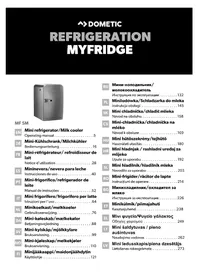


| Product type | Portable refrigerator |
| Brand | Dometic |
| Model | MyFridge MF 5M |
| Capacity | 5 liters |
| Dimensions (L x W x H) | 28 x 18 x 25 cm |
| Weight | 2.5 kg |
| Power supply | 12 V (cigarette lighter) or 230 V via mains adapter |
| Power consumption | Approx. 30 W |
| Temperature range | Up to 20 °C below ambient temperature |
| Cooling type | Compressor |
| Climate class | N (ambient temperature up to 32 °C) |
| Material | ABS plastic |
| Main functions | Cooling food and drinks, keeping cool |
| Care and cleaning | Clean with a damp cloth and mild soap; defrost manually |
| Safety | Reverse polarity protection; built-in fuse |
| Spare parts and repairability | Repairability index not provided; parts available from manufacturer |
| General information | Ideal for travel, camping, or mobile use |
Frequently Asked Questions - MyFridge MF 5M DOMETIC
User questions about MyFridge MF 5M DOMETIC
0 question about this device. Answer the ones you know or ask your own.
Ask a new question about this device
Download the instructions for your Refrigerator in PDF format for free! Find your manual MyFridge MF 5M - DOMETIC and take your electronic device back in hand. On this page are published all the documents necessary for the use of your device. MyFridge MF 5M by DOMETIC.
USER MANUAL MyFridge MF 5M DOMETIC
MF 5M
EN
Mini refrigerator/Milk cooler
Operating manual ....5
DE
© 2023 Dometic Group. The visual appearance of the contents of this manual is protected by copyright and design law. The underlying technical design and the products contained herein may be protected by design, patent or be patent pending. The trademarks mentioned in this manual belong to Dometic Sweden AB. All rights are reserved.


3 A B
4

Please read these instructions carefully and follow all instructions, guidelines, and warnings included in this product manual in order to ensure that you install, use, and maintain the product properly at all times. These instructions MUST stay with this product.
By using the product, you hereby confirm that you have read all instructions, guidelines, and warnings carefully and that you understand and agree to abide by the terms and conditions as set forth herein. You agree to use this product only for the intended purpose and application and in accordance with the instructions, guidelines, and warnings as set forth in this product manual as well as in accordance with all applicable laws and regulations. A failure to read and follow the instructions and warnings set forth herein may result in an injury to yourself and others, damage to your product or damage to other property in the vicinity. This product manual, including the instructions, guidelines, and warnings, and related documentation, may be subject to changes and updates. For up-to-date product information, please visit documents.dometic.com.
Contents
1 Explanation of symbols....5
2 Safety instructions....6
3 Scope of delivery 9
4 Accessories....10
5 Intended use ....10
6 Intended use ....10
7 Technical description ..... 11
8 Operation 11
9 Cleaning and maintenance....13
10 Troubleshooting....13
11 Warranty ....14
12 Disposal....14
13 Technical data....15
1 Explanation of symbols

WARNING!
Safety instruction: Indicates a hazardous situation that, if not avoided, could result in death or serious injury.

CAUTION!
Safety instruction: Indicates a hazardous situation that, if not avoided, could result in minor or moderate injury.

NOTICE!
Indicates a situation that, if not avoided, can result in property damage.

NOTE
Supplementary information for operating the product.
2 Safety instructions

DANGER! Failure to obey these warnings will result in death or serious injury.
Electrocution hazard
- On boats: If the device is powered by the mains, ensure that the power supply has a residual current device (RCD), a residual current circuit breaker (RCCB), or a ground fault circuit interrupter (GFCI). Installation, especially in potentially damp areas, must be in accordance with all applicable installation regulations.
- Do not touch exposed cables with your bare hands. This applies especially when operating the device from the AC mains.
- Before starting the device, ensure that the power supply line and the plug are dry.

WARNING! Failure to obey these warnings could result in death or serious injury.
Electrocution hazard
- Do not operate the cooling device if it is visibly damaged.
- If this cooling device's power cable is damaged, it must be replaced by the manufacturer, a service agent or a similarly qualified person in order to prevent safety hazards.
- If the cooling device's power cable is damaged, it must be replaced with a suitable power cable or assembly available from the manufacturer or its service agent to prevent safety hazard.
- This cooling device may only be repaired by qualified personnel. Improper repairs can lead to considerable hazards.
- Plug the device into sockets that ensure proper connection, especially when the device needs to be earthed.
Fire hazard
- When positioning the device, ensure the supply cord is not trapped or damaged.
- Do not locate multiple portable socket-outlets or portable power supplies at the rear of the device.
- The refrigerant in the refrigerant circuit is highly flammable and in the event of a leakage, combustible gases could build up if the appliance is in a small room.
In the event of any damage to the refrigerant circuit:
- Keep naked flames and potential ignition sources away from the refrigerator.
- Ventilate the room well.
- Switch off the refrigerator.
For cooling devices with R600a refrigerant:
- The refrigeration circuit contains a small quantity of an environmentally friendly but flammable refrigerant. It does not damage the ozone layer and does not increase the greenhouse effect. Any leaking refrigerant may ignite.
- Keep the ventilation openings on the device housing or in installations free of obstructions.
- Do not use any mechanical objects or other means to speed up the defrosting process, unless they have been recommended by the manufacturer for this purpose.
- Do not open or damage the refrigerant circuit.
- Do not use electrical devices inside the cooling device unless they are recommended by the manufacturer for that purpose.
Health hazard
This device can be used by children aged 8 years and above and persons with reduced physical, sensory or mental capabilities or lack of experience and knowledge if they have been given supervision or instruction concerning use of the device in a safe way and understand the hazards involved.
This device is not intended for use by persons (including children) with reduced physical, sensory or mental capabilities, or lack of experience and knowledge, unless they have been given supervision or instruction concerning use of the device by a person responsible for their safety.
Children aged from 3 to 8 years are allowed to load and unload cooling devices.
Children must be supervised to ensure that they do not play with the device.
Cleaning and user maintenance must not be carried out by unsupervised children.
Explosion hazard
Do not store any explosive substances such as spray cans with a flammable propellant in the cooling device.

CAUTION! Failure to obey these cautions could result in minor or moderate injury.
Electrocution hazard
- Before starting the cooling device, ensure that the power supply line and the plug are dry.
- Disconnect the cooling device from the power supply
- Before each cleaning and maintenance
- After every use
Health hazard
To avoid contamination of food, observe the following instructions:
- Check if the cooling capacity of the device is suitable for storing the food to be cooled.
- Food may only be stored in its original packaging or in suitable containers.
- Opening the cooling device for long periods of time can cause significant increase of the temperature in the compartments of the device.
- Clean regularly surfaces that can come in contact with food and accessible drainage systems.
- If the device is left empty for long periods:
- Switch off the device.
- Defrost the device. – Clean and dry the device.
- Leave the lid open to prevent mold developing within the device.

NOTICE! Damage hazard
- Check that the voltage specification on the data plate corresponds to that of the energy supply.
- Only connect the cooling device as follows:
- With the DC connection cable to a DC power supply in the vehicle
- Or with the AC connection cable to an AC power supply
- Never pull the plug out of the socket by the cable.
- If the cooling device is connected to a DC outlet, disconnect the cooling device and other power consuming devices from the battery before connecting a quick charging device.
- If the cooling device is connected to a DC outlet, disconnect the cooling device or switch it off when turning off the engine. Otherwise the battery may be discharged.
- The cooling device is not suitable for transporting caustic materials or materials containing solvents.
- Do not place the cooling device near naked flames or other heat sources (heaters, direct sunlight, gas ovens etc.).
- Risk of overheating!
Ensure at all times that there is a minimum of 50 mm ventilation on all sides of the cooling device. Keep the ventilation area free of any objects that could obstruct the air flow to the cooling components. Do not use or store the cooling device in closed compartments or areas with none or minimal air flow.
- Do not fill the inner container with ice or fluids.
- Never immerse the cooling device in water.
- Protect the cooling device and cables against heat and moisture.
- The device shall not be exposed to rain.
3 Scope of delivery
No. in fig. 1, page 3
Quantity Description
11 Refrigerator
21 Cable for 230 V~ connection
- 1 Milk supply tube (approx. 40 cm)
- 1 Operating manual
4 Accessories
Available as accessory (not included in scope of delivery):
Part designation
Connection cable for 12 V--- connection
5 Intended use
The refrigerator is suitable for use as a milk cooler for coffee makers. Supply tubes for espresso and coffee makers can be fed through the holes in the sides of the appliance.
The cooling device is also suitable for cooling and heating foodstuffs. There is a switch to change between heating and cooling modes.
The cooling device is suitable for camping use.
The device shall not be exposed to rain.
6 Intended use
The cooling device is suitable for cooling food. The cooling device is designed to be operated from a DC on-board power supply of a vehicle or boat, from a DC auxiliary battery or from an AC power supply.
The cooling device is suitable for camping use.
The cooling device is intended to be used in household and similar applications such as
- Staff kitchen areas in shops, offices and other working environments
- Farm houses
- Clients in hotels, motels and other residential type environments
- Bed and breakfast type environments
- Catering and similar non-retail applications
The appliance usually runs on the 230 V AC mains. With the 12 V cable available as an accessory you can run it from a 12 V supply such as a cigarette lighter.
The refrigerator can cool products to a maximum of 20 °C under the ambient temperature (temperature restriction at approx. +1 °C) or warm them to a maximum of 65 °C. A partition can be used to separate foodstuffs, such as drinks and fruit.
7 Technical description
The device has an integrated mains adapter with a priority circuit. The device switches automatically to mains operation when the device is connected to a 230 V AC mains supply even if the 12 V connection cable is still connected.
Its cooling system is a non-wearing Peltier cooling system with the heat discharged by a fan.
7.1 Description of the device
Connection sockets and control panel (rear of the device):
| No. in2, page 3 | Description |
| 1 230 V AC socket | |
| 2 12 V DC socket | |
| 3 Mode switch | |
| 4 “HOT” LED (red): indicates heating mode | |
| 5 “COLD” LED (green): indicates cooling mode | |
8 Operation

NOTE
Before starting your refrigerator for the first time, you should clean it inside and outside with a damp cloth for hygienic reasons (see also chapter "Cleaning and maintenance" on page 13).
8.1 Saving energy
- Choose a well ventilated location which is protected from direct sunlight.
- Allow warm food to cool down first before placing it in the cooling device to keep cool.
- Do not open the cooling device more often than necessary.
- Do not leave the cooling device open for longer than necessary.
- If the cooler has a basket: For optimal energy consumption, position the basket according to its position on delivery.
- On a regular basis, make sure the lid seal still fits properly.
8.2 Using the cooling device

NOTICE!
- When using the refrigerator as a milk cooler, also see the instructions in the customer documentation of your coffee maker.
- Like every refrigerator, your cooler must be properly ventilated so that any heat created can dissipate. Otherwise, it may not work properly.

NOTE
Seal the opening on the side of the appliance with the plug if you have not fed a tube inside (fig. 3 A, page 4).
Place the refrigerator on a firm base.
Ensure that the ventilation slots are at least 10 cm away from the wall so that the heat generated during operation can be dissipated.

NOTE
For use as a milk cooler for coffee makers only, the refrigerator has holes on both sides, sealed with a black plug (fig. 3 A, page 4). Remove the plug (fig. 3 B, page 4) and push the supplied milk tube into the appliance. The coffee maker can then draw cold milk directly from a suitable vessel inside the refrigerator.
Insert the flat plug of the 230 V cable (fig. 1 2, page 3) into the socket (fig. 2 1, page 3) on the appliance and insert the power plug into the 230 V socket.
or
Insert the flat plug of the 12 V cable (accessory) into the DC socket (fig. 2 2, page 3) and connect it to the cigarette lighter socket or a 12 V socket in your car. Push the switch (fig. 3 3, page 4) on the control panel to "HOT" or "COLD" to switch the device on. The refrigerator starts cooling/heating the interior and the appropriate LED lights up.

NOTICE!
Ensure that the objects placed in the refrigerator are suitable for cooling or heating to the selected temperature.
When you stop using the refrigerator, set the switch (fig. 2 3, page 3) to "OFF".
Unplug the connection cable.

NOTE
If you are not going to use the refrigerator for a long time, leave the door slightly ajar to prevent unpleasant odours building up.
9 Cleaning and maintenance

NOTICE!
When using the refrigerator as a milk cooler, also see the instructions in the customer documentation of your coffee maker.

NOTICE! Damage hazard
- Never clean the cooling device under running water or in dish water.
- Do not use abrasive cleaning agents or hard objects during cleaning as these can damage the cooling device.
▶ Occasionally clean the cooling device interior and exterior with a damp cloth. ▶ Make sure that the air inlet and outlet vents on the device are free of any dust and dirt, so that heat can be released and the device is not damaged.
10 Troubleshooting
Fault Possible cause Suggested remedy
| Device does not function, LED does not glow. | There is no voltage flowing from the 12 V socket (cigarette lighter) in your vehicle. | The ignition must be switched on in most vehicles to supply current to the cigarette lighter. |
| No voltage present in the AC voltage socket. | Try using another plug socket. | |
| The integrated mains adapter is defective. | This can only be repaired by an authorised repair centre. | |
| The device does not cool (plug is inserted, LED glows). | The inner fan or the cooling element is defective. | This can only be repaired by an authorised repair centre. |
Fault Possible cause Suggested remedy
| When operating from the 12 V socket (cigarette lighter): The ignition is on but the device is not working and the LED is not lit. Pull the plug out of the socket and make the following checks. | The cigarette lighter socket is dirty. This results in a poor electrical contact. | If the plug of your refrigerator becomes very warm in the cigarette lighter socket, either the socket must be cleaned or the plug has not been assembled correctly. |
| The fuse of the 12 V plug has blown. | Replace the fuse (5 A) in the 12 V plug (fig. 4 1, page 4). | |
| The vehicle fuse has blown. | Replace the vehicle's 12 V socket fuse (usually 15 A). Please refer to the operating manual of your vehicle. |
11 Warranty
The statutory warranty period applies. If the product is defective, please contact your retailer or the manufacturer's branch in your country (see dometic.com/dealer).
For repair and warranty processing, please include the following documents when you send in the product:
• A copy of the receipt with purchasing date - A reason for the claim or description of the fault
Note that self-repair or non-professional repair can have safety consequences and might void the warranty.
12 Disposal
Recycling products with non-replaceable batteries, rechargeable batteries or light sources

If the product contains any non-replaceable batteries, rechargeable batteries or light sources, you don't have to remove them before disposal. If you wish to finally dispose of the product, ask your local recycling center or specialist dealer for details about how to do this in accordance with the applicable disposal regulations. The product can be disposed free of charge.
Recycling packaging material

Place the packaging material in the appropriate recycling waste bins wherever possible.
13 Technical data
| MyFridge MF5M | |
| Ref. no.: 9600000598 | |
| Capacity: 5 l | |
| Voltage: 12 V--- | 230 V~, 50 Hz |
| Power consumptionCold mode:Hot mode: | 33 W29 W |
| Cooling capacity: max. 20 °C under ambient temperatureSwitch-off at approx. +5 °C | |
| Dimensions (W x H x D): 190 x 313 x 281 mm | |
| Weight: 3.3 kg | |
| Inspection/certification: | CE |
7 Description technique 34
7 Description technique
dometic.com/sales-offices
- MF 5M
- CONTENTS
- EXPLANATION OF SYMBOLS
- WARNING
- CAUTION
- NOTICE
- NOTE
- SAFETY INSTRUCTIONS
- DANGER! FAILURE TO OBEY THESE WARNINGS WILL RESULT IN DEATH OR SERIOUS INJURY
- ELECTROCUTION HAZARD
- WARNING! FAILURE TO OBEY THESE WARNINGS COULD RESULT IN DEATH OR SERIOUS INJURY
- FIRE HAZARD
- HEALTH HAZARD
- EXPLOSION HAZARD
- CAUTION! FAILURE TO OBEY THESE CAUTIONS COULD RESULT IN MINOR OR MODERATE INJURY
- NOTICE! DAMAGE HAZARD
- RISK OF OVERHEATING
- SCOPE OF DELIVERY
- NO. IN FIG. 1, PAGE
- QUANTITY DESCRIPTION
- ACCESSORIES
- PART DESIGNATION
- INTENDED USE
- TECHNICAL DESCRIPTION
- DESCRIPTION OF THE DEVICE
- OPERATION
- SAVING ENERGY
- USING THE COOLING DEVICE
- CLEANING AND MAINTENANCE
- TROUBLESHOOTING
- WARRANTY
- DISPOSAL
- RECYCLING PRODUCTS WITH NON-REPLACEABLE BATTERIES, RECHARGEABLE BATTERIES OR LIGHT SOURCES
- RECYCLING PACKAGING MATERIAL
- TECHNICAL DATA
- DESCRIPTION TECHNIQUE
Brand : DOMETIC
Model : MyFridge MF 5M
Category : Refrigerator