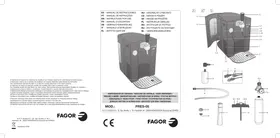
USER MANUAL PRES-05 FAGOR
The manufacturer reserves the right to modify the models described in this User's Manual
For example, the temperature of the water is 30°C and the temperature of the water in the atmosphere is 12°C.
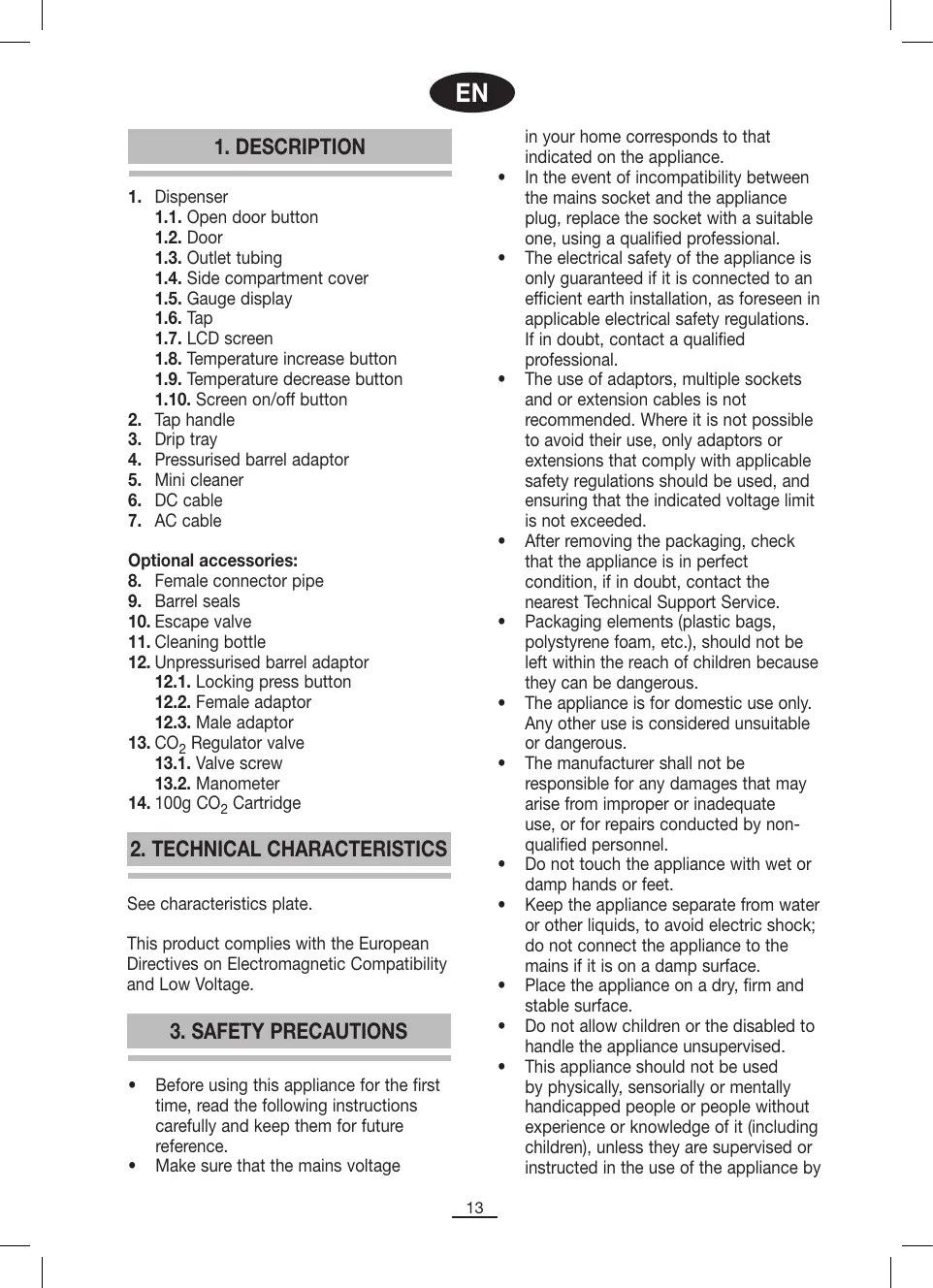
- Pressurised barrel adaptor
- Mini cleaner
- DC cable
- AC cable
Optional accessories:
- Female connector pipe
- Barrel seals
- Escape valve
- Cleaning bottle
- Unpressurised barrel adaptor
12.1. Locking press button 12.2. Female adaptor 12.3. Male adaptor
- CO2 Regulator valve
13.1. Valve screw 13.2. Manometer
- 100g CO2 Cartridge
2. TECHNICAL CHARACTERISTICS
See characteristics plate.
This product complies with the European Directives on Electromagnetic Compatibility and Low Voltage.
3. SAFETY PRECAUTIONS
- Before using this appliance for the first time, read the following instructions carefully and keep them for future reference. Make sure that the mains voltage
in your home corresponds to that indicated on the appliance.
- In the event of incompatibility between the mains socket and the appliance plug, replace the socket with a suitable one, using a qualified professional.
- The electrical safety of the appliance is only guaranteed if it is connected to an efficient earth installation, as foreseen in applicable electrical safety regulations. If in doubt, contact a qualified professional.
- The use of adaptors, multiple sockets and or extension cables is not recommended. Where it is not possible to avoid their use, only adaptors or extensions that comply with applicable safety regulations should be used, and ensuring that the indicated voltage limit is not exceeded. After removing the packaging, check that the appliance is in perfect condition, if in doubt, contact the nearest Technical Support Service.
- Packaging elements (plastic bags, polystyrene foam, etc.), should not be left within the reach of children because they can be dangerous.
- The appliance is for domestic use only. Any other use is considered unsuitable or dangerous.
- The manufacturer shall not be responsible for any damages that may arise from improper or inadequate use, or for repairs conducted by nonqualified personnel.
- Do not touch the appliance with wet or damp hands or feet.
- Keep the appliance separate from water or other liquids, to avoid electric shock; do not connect the appliance to the mains if it is on a damp surface.
- Place the appliance on a dry, firm and stable surface.
- Do not allow children or the disabled to handle the appliance unsupervised.
- This appliance should not be used by physically, sensorially or mentally handicapped people or people without experience or knowledge of it (including children), unless they are supervised or instructed in the use of the appliance by
a person responsible for their safety.
Children should be watched to ensure they do not play with the appliance. - For greater protection, we recommend installing a residual current device (RCD) with an operational residual current not exceeding 30mA. Ask your installer for advice. - Do not leave the appliance unattended when it is turned on because it can be dangerous. - When removing the plug never pull on the cable. - Unplug the appliance before cleaning or maintenance. - In the event of fault or malfunction where the appliance is not to be used, turn off the appliance and do not attempt to repair. If a repair is required, contact a Technical Assistance Service authorised by the manufacturer and request the use of original spare parts. - If the cable for this appliance is damaged, contact an authorised Technical Assistance Service for it to be replaced. - Do not leave the appliance exposed to the elements (rain, sun, ice, etc.). - Do not use or let any part of the appliance come into contact or near hot surfaces (kitchen gas or electric hobs or ovens). - Do not use detergents or abrasive sponges to clean the appliance. - Do not touch the hot surfaces. Use the handles. - Do not let the cable come into contact with the hot parts of the appliance. - Use the appliance at a room temperature of between 12°C (54°F) and 26°C (80°F). - When installing the appliance, make sure that there is a gap of at least 10cm at the sides and at the back of the appliance. This will allow for adequate ventilation. - Do not move the appliance when the barrel is inside. - Do not immerse the appliance or the power cable in water or in any other kind of liquid. - Do not place anything on top of the appliance. - Do not insert anything into the air vents.
- Do not put the beer barrel into the freezer. This could affect the quality of the beer and the barrel could explode.
SAFETY WARNINGS FOR THE CO2 CYLINDER
- Pressurised cylinder: use with caution and do not expose it to sunlight or temperatures higher than 50°C.
- Store the CO2 cylinders well away from heat, in a cool, dry place.
- Keep well out of reach of children.
- The cylinders contain compressed gas. Do not puncture or squeeze or alter the cylinder in any way.
- The cylinder can only be used once. It cannot be reused.
- Connect the regulator to the cylinder by screwing it in firmly with your hand, and only your hand.
- Do not apply oil or grease inside the cylinder connection. DO NOT REFILL IT!
- To dispose of the cylinder, you must follow the relevant waste disposal procedure. For further information on this subject, contact the local authorities.
Instructions for use: Connect or screw the control valve to the cylinder without overtightening it. If the gas does not come out, screw and unscrew the control valve several times. After use, unscrew the control valve from the cylinder: The seal is automatic.
CAREFUL: Do not use a spanner or any other tool to connect the cylinder to the control valve. The connection must be made only by using your hands.
4. PREPARING THE APPLIANCE
- Place the appliance on a dry, firm and stable surface.
- Leave a gap of around 10cm at the sides and at the back of the appliance. This will allow for adequate ventilation.
- Place the drip tray (3) into the slots at
the front of the dispenser (fig. B).
- Screw the tap handle (2) onto the tap (fig. C) and plug in the appliance with the DC (6) or AC (7) power cable.
- Before installing the barrel, make sure that the barrel has settled long enough to prevent any froth from coming out through the ventilation opening.
- CHILL THE BEER IN THE FRIDGE FOR A FEW HOURS (APPROX. 6 TO 12 HOURS). CHILLED BEER PRODUCES LESS FROTH THAN WARM BEER.
Warning: Do not put the barrel into the freezer. This could affect the quality of the beer and the barrel could explode.
INSTALLING THE BARREL
There are two types of barrel:
- pressurised barrel: beer barrel with CO2
- Type B pressurised keg: Keg of beer with CO2 incorporated, non-standard. To dispense beer using this device you should acquire the Fagor CO2 accessories as detailed in the description (8 - 14). Standard barrel: beer barrel without CO2. To dispense beer with this appliance you must purchase the Fagor CO2 accessories, as detailed in the description, from 8 to 14.
Decide which type of barrel you are going to use and then install it.
PRESSURISED KEG
The pressurised beer keg compatible with the FAGOR dispenser and with nozzle type as shown in fig. D already contains CO2 and it is therefore not necessary to acquire the optional CO2 accessories. This type of keg does not require installation of the tap or the nozzle provided with the keg for installing on the beer dispenser. Proceed as follows to install the pressurised keg:
- Press the open door button (1.1) and insert the outlet tubing (1.4) into the pressurised barrel adaptor (4) until it is fully locked in, as shown in figure D.
- Install the pressurised barrel adaptor (4) into the nozzle of the barrel as shown in figure E.
- Insert the barrel into the dispenser by turning the barrel so that the tubing is
not bent and the flow of the beer is not obstructed (fig. F). Close the door of the dispenser.
TYPE B PRESSURISED KEG
This type of barrel is fitted with the combined cap or ventilation cap (Fig. H). To install this type of barrel, you must purchase Fagor CO2 accessories (ref. REG CO2), as detailed in description 8 to 14.
Before installing a type B pressurized barrel you must release the excess pressure from the barrel. Rotate the cap a 1/4 turn allowing the pressure to leave the barrel, then remove the cap with the help of some pliers and replace it with one of the barrel gaskets (9). Be careful not to bend the metal around the cap, as this could cause air to escape. It is normal for the cap or part of the cap to fall into barrel; this will not affect the taste of the beer.
Once the excess gas has been released from the barrel follow the steps outlined in the section "Connecting the CO2 unit."
PRESSURELESS CASK
These barrels are fitted with rubber caps (fig. G). To install this type of barrel you must purchase Fagor CO2 accessories (ref. REG- CO2), outlined in description 8 to 14.
For the installation of CO2 accessories follow the steps outlined in the section "Connecting the CO2 unit."
5. CONNECTING THE CO2 UNIT
Once you have purchased the optional CO2 Fagor accessories, proceed as follows:
- Insert the non-pressurised barrel adapter (12) into the barrel (fig. 1). In case of a non-pressurised barrel, the centre of the cap must be pulled into the inside of the barrel. Lock the adapter by moving the adapter lock button (12.1) to one side. The clips will move and be secured to the barrel, and the adapter will then be properly fitted to the barrel.
- Press the open door button (1.1) and open the door. Move the side compartment cover (1.4) of the dispenser downwards and remove the cover. Insert the inlet tubing (8) into the hole in the side compartment as shown in Figure J.
- Insert the outlet tubing (1.3) into the adapter socket (12.2). Insert the inlet tubing (8) into the adapter pin (12.3). (See figure K).
- Insert the barrel into the dispenser by turning the barrel so that the tubing is not bent and the flow of beer is not obstructed.
- Turn the CO2 regulating valve screw (13.1) counter-clockwise as far as it will go (Fig. E). Only then is the valve sure to be closed.
- Insert the inlet tubing (8) in the right hole of the regulating valve (fig. M). When you wish to disconnect the inlet tubing (8) press the ring that surrounds the tube while pulling the tube.
- Screw the 100 gram CO2 canister (14) into the CO2 regulating valve as shown in figure N.
- Open the valve by slowly turning the CO2 regulating valve (13.1) clockwise, (figure. N) to select the proper pressure. The pressure should be between 0.5 and 1 bar so that the flow of beer is adequate and does not create too much foam.
- Once the CO2 unit has been assembled insert it into the side compartment of the dispenser aligning the gauge (13.2) with the gauge of the dispenser so you can see the pressure (Fig. O).
- Put the side compartment lid (1.4) back in place.
6. ADJUSTING THE TEMPERATURE
The beer dispenser has a temperature range of between 3°C (38°F) and 12°C (54°F) for selecting the desired temperature.
- Press the temperature increase button (1.8) or the temperature decrease button (1.9) down for three seconds.
- Press the temperature increase and
decrease buttons (1.8 and 1.9) until the desired temperature has been reached.
- If you wish to change the temperature format from °C to °F or vice versa, press the temperature increase button (1.8) down for three seconds.
To turn the LCD screen light on and off, press the screen's on/off button (1.10) down for three seconds.
7. OPERATING INSTRUCTIONS
- It is always advisable to use clean glasses rinsed with cold water at the time of serving the beer. Impurities prevent froth from forming in the glass.
- Hold the clean glass under the tap of the dispenser. Make sure that the nozzle of the tap (1.6) is not in contact with the glass.
- Pull the tap handle (2) towards you as you hold the glass at an angle. The beer will begin to be dispensed into the glass until you release the tap handle.
- The amount of froth will depend on the angle of the glass. Place the glass vertically as the level of the beer rises.
- Release the tap handle (2) when the froth reaches the edge of the glass to stop the beer from coming out.
8. CLEANING
Once the barrel is empty, you must clean the dispenser (1) thoroughly before fitting another barrel. If you have a pressureless cask installed proceed as follows:
- Move the side compartment cover (1.4) of the dispenser downwards and remove the cover.
- Extract the CO2 unit and turn the regulating valve tap (13.1) anti-clockwise to close it completely.
- Place a recipient under the tap (1.6) and pull the tap handle (2) towards you. Beer will be dispensed until the barrel is completely empty.
- You can now proceed with the following instructions.
Once all the beer has been
extracted, press the open door button (1.1), open the door and take out the barrel with the tubing connected. - Disconnect the inlet (8) and outlet (1.3) tubing by pressing the relevant white button whilst pulling the tubes. - Empty out the remaining gas by inserting the escape valve (10) into each adaptor (fig. P). - Remove the adaptor from the barrel. - You must now clean the dispenser.
There are 2 ways of cleaning the dispenser:
- Fill the mini cleaner (5) with hot water and a little detergent.
- Insert the mini cleaner (5) into the outlet tubing (fig. R). Whilst pulling the tap handle (2) towards you, press the mini cleaner at intervals several times. The pressure will force the soapy water through the system.
- Repeat the same operation again just with water, without detergent of any kind.
- If you have purchased the optional Fagor CO2 accessories, you can clean the dispenser (1) as follows:
- Fill the cleaning bottle (11) halfway with hot water and a little detergent.
- Insert the standard barrel adaptor (12) into the cleaning bottle (11) and connect the inlet tubing (8) to the adaptor pin (12.3) and the outlet tubing (1.4) to the adaptor socket (12.2) (fig. Q).
- Turn the regulating valve knob (13.1) clockwise.
- Pull the tap handle (2) towards you and let the soapy water pass through the system for around 5 seconds.
- Repeat the same operation again just with water, without detergent of any kind.
If you have a pressurised keg compatible with the Fagor dispenser, proceed as follows:
- Move the side compartment cover (1.4) of the dispenser downwards and remove the cover.
- Extract the CO2 unit and turn the
regulating valve tap (13.1) anti-clockwise to close it completely.
- Place a recipient under the tap (1.6) and pull the tap handle (2) towards you. Beer will be dispensed until the barrel is completely empty.
- You can now proceed with the following instructions.
- Once all the beer has been extracted, press the open door button (1.1), open the door and take out the barrel with the tubing connected.
- Remove the adaptor from the barrel.
- Disconnect the inlet (1.3) and outlet (1.4) tubing by pressing the relevant white button whilst pulling the tubes.
- You must now clean the dispenser.
To clean the dispenser for this type of keg, follow the instructions given in point 1 for the pressuredless cask.
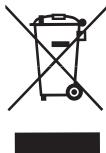
At the end of its working life, the product must not be disposed of as urban waste. It must be taken to a special local authority differentiated waste collection centre or to
a dealer providing this service. Disposing of a household appliance separately avoids possible negative consequences for the environment and health deriving from inappropriate disposal and enables the constituent materials to be recovered to obtain significant savings in energy and resources.
To remind you that you must collaborate with a selective collection scheme, the symbol shown appears on the product warning you not to dispose of it in traditional refuse containers.
For further information, contact your local authority or the shop where you bought the product.
1. DESCRIPTION (Fig. A)
1. Housing
6. TEMPERATURE SETTING
The beer dispenser has a temperature range between 3°C (38°F) and 12°C (54°F), so that the desired temperature can be selected:
6. TEMPERATURE SETTING
The beer dispenser has a temperature range between 3°C (38°F) and 12°C (54°F), so that the desired temperature can be selected:
- Press and hold for three seconds the button to increase temperature (1.8) or the button to decrease temperature (1.9).
- Press the buttons to increase and decrease temperature (1.8 and 1.9) until you reach the desired temperature.
- To change the temperature units from °C to °F or vice versa, press the temperature increase button (1.8) for three seconds. To turn on or off the LCD screen backlight, press the screen on/off button (1.10) for 3 seconds.
7. OPERATION
It is always recommended to use clean glasses, rinsed with water, for beer tapping. Impurities prevent foam formation in the glass. - Hold a clean glass under the tap. Make sure the tap nozzle (1.6) is not in contact with the glass. - Push the lever (2) towards you and hold the glass tilted. Beer will start flowing into the glass until you release the lever. The amount of foam will depend on the tilt angle of the glass. Return the glass to an upright position as the beer level rises. Release the lever (2) when the foam reaches the rim of the glass to stop the beer flow.
8. CLEANING
Improper or unintended use of the device, as well as repairs performed by unqualified personnel, are not covered by the warranty.
Do not touch the device with wet or damp hands or feet. To avoid electric shock, keep the device away from water or other liquids. Do not plug the device into the mains if it is installed on a wet surface. Install the device on a dry, solid, and stable surface. Do not allow children or untrained persons to use the device without supervision. This appliance is not intended for use by persons with reduced physical, sensory, or mental capabilities (including children), or by persons lacking experience and knowledge, unless they are supervised or instructed by a person responsible for their safety. Children must not play with the appliance. To increase safety, it is recommended to install a residual current device (RCD) with a rated residual operating current not exceeding 30 mA. Follow the electrician's advice. Do not leave the appliance plugged in and unattended, as it may become a source of danger. When unplugging the appliance, never pull the power cord. Disconnect the appliance from the mains before any cleaning or maintenance. In case of malfunction or incorrect operation, stop using the appliance, turn it off, and do not attempt to repair it. If repair is necessary, contact exclusively a service center certified by the manufacturer, requesting replacement with original parts. If the power cord is damaged, contact the certified service center.
for replacement.
Do not expose the device to weather conditions (such as rain, sun, etc.). Do not use or place any part of this device on hot surfaces (gas or electric burners or stoves). Do not use abrasive cleaners or rough cloths to clean the device. Do not touch hot surfaces. Use handles or knobs. Do not allow the power cord to touch hot parts of the device. Use the device at an ambient temperature between 12°C (54°F) and 26°C (80°F). When installing the appliance, ensure that there is a gap of at least 10 cm between the walls and its side and rear panels. This is necessary for proper ventilation. Do not move the appliance with the water tank installed. Do not immerse the device or its power cord in water or other liquids. Do not place any objects on top of the device. Do not place any objects in front of the ventilation grilles. Do not put the water tank with water into the freezer. This may damage the tank and cause it to burst.
Safety recommendations for using the cylinder with liquefied gas.
The cylinder contains gas under pressure. Therefore, it must be handled with care and not stored in sunlight at temperatures above 50°C. The cylinder should be stored in a dry, cool place, away from heating devices. Store out of reach of children. The cylinder contains gas. Do not pierce, deform, or modify its construction.
- The cylinders are disposable. Their reuse is not allowed.
- Screw the regulator onto the cylinder valve by hand until it stops. The use of auxiliary tools is not allowed. Do not allow oil or grease to enter the cylinder valve connection. DO NOT OVER-TIGHTEN!
- Disposal of the cylinder is carried out in accordance with the applicable regulations for the disposal of cylinders. For more detailed information on this issue, contact local waste disposal authorities.
Method of use: connect or screw the pressure regulator valve onto the cylinder without applying force. If gas does not flow, it is necessary to unscrew and screw the pressure regulator valve several times. After using the cylinder, the pressure regulator valve is unscrewed. The cylinder closes automatically.
WARNING: Do not use keys or other tools to connect the cylinder to the pressure regulator valve. Connect them only by hand.
4. PREPARATION FOR WORK
- Install the device on a stable, durable, dry surface.
- Make sure that between the walls and the side and rear walls of the device there is a gap of at least 10 cm. This is necessary to ensure proper ventilation. Insert the funnel (3) into the opening on the top of the device (Fig. B).
- Screw the tap (2) to the faucet (Fig. C) and connect the device to the power supply with the cord (6) for direct current (7) or alternating current.
- Before installing the keg, make sure it is sufficiently full and at rest, otherwise when opened it may spray. LEAVE THE KEG IN THE REFRIGERATOR FOR
SEVERAL HOURS (APPROXIMATELY 6-12 HOURS). COLD BEER FOAMS LESS THAN WARM BEER.
WARNING: Do not place the keg in the freezer. This can damage the beer and lead to the keg exploding.
INSTALLING THE KEG
The kegs come in two types:
- Keg under pressure: a keg with beer where CO2 is already included under pressure type A. A keg with beer with CO2 included is non-standard. To dispense beer using this appliance, you must purchase additional accessories for CO2 production from Fagor, indicated in the description (items 8-14). Standard keg: a keg with beer without CO2. To dispense beer using this appliance, you must purchase accessories for the CO2 tap from Fagor, marked with numbers 8-14 in fig. A.
Depending on the type of keg that will be installed, follow the corresponding installation instructions.
Keg under pressure
Keg of beer under pressure, compatible with the FAGOR dispensing device, with a tap of type fig. D already contains CO2, so there is no need to purchase optional accessories for CO2. This type of keg does not require the installation of valves or taps, which are supplied with the keg for installation in the dispensing device. To install the keg under pressure, perform the following steps:
- Press the door opening button (1.1) and insert the connector plug with the hose (1.4) into the fitting for the keg under pressure (4) until it stops, as shown in figure D. 2. Connect the fitting for the keg under pressure (4) to the keg valve, as shown in figure E.
- Install the keg in the appliance, turning it so that the hose does not get pinched.
Check the seal (fig. F). Close the appliance door.
Keg under pressure type B. For this type of keg, a combined valve and vent plug is provided (fig. H). To install this type of keg, you must purchase additional equipment for CO2 production from Fagor (model REG- CO2), listed in the description, see items 8-14.
Before installing the keg under pressure type B, you must reduce the pressure in the keg. To do this, turn the plug 1/4 turn to reduce the pressure in the keg. Then remove the plug with a wrench and replace it with one of the plugs (9). Make sure that the metal around the plug does not deform, to avoid air leaks. There will be no problems if the plug or part of it falls into the keg, as this does not affect the taste of the beer.
After removing the excess pressure from the keg, follow the instructions given in the section "Filling the CO2 module".
Keg without pressure