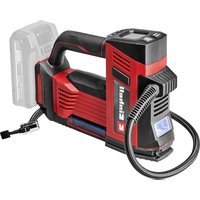
CE-CC 18/23 D Li-Solo - Compressor EINHELL - Free user manual and instructions
Find the device manual for free CE-CC 18/23 D Li-Solo EINHELL in PDF.


| Product type | Wireless car compressor |
| Brand | Einhell |
| Model | CE-CC 18/23 D Li-Solo |
| Max. operating pressure | 1.10 MPa (11 bar) |
| Air flow at 0 bar | 23 l/min |
| Air flow at 4 bar | 12 l/min |
| Air flow at 7 bar | 9 l/min |
| Compressed air hose length | 70 cm |
| Weight (without battery) | 1.2 kg |
| Power supply | 18 V DC (Li-Ion Power-X-Change battery) |
| Protection class | III |
| Display type | LCD |
| Work light | Integrated LED |
| Main functions | Inflating tires, balls, sports equipment; automatic and manual modes; pressure memory (M1-M4); auto shut-off; deflating |
| Included accessories | Valve adapter, bicycle valve adapter, balloon nozzle, storage drawer |
| Sound pressure level | LpA = 87.4 dB(A), uncertainty K=3 dB |
| Sound power level | LWA = 95.4 dB(A), guaranteed 97 dB(A) |
| Vibration (handle) | a = ≤ 2.5 m/s², K=1.5 m/s² |
| Max. continuous operating time | 10 minutes, then 10 min cooling |
| Operating temperature | +5 °C to +40 °C |
| Maintenance and cleaning | Clean with a damp cloth and mild soap; no internal parts requiring maintenance |
| Safety | Auto shut-off in automatic mode; overheat protection; use only with Power-X-Change Li-Ion batteries |
| Spare parts and repairability | Wear parts: battery; after-sales service Einhell (www.Einhell-Service.com) |
| Storage | Dark, dry, frost-free place, between 5 and 30 °C |
| Warranty | According to Einhell conditions (see manual) |
Frequently Asked Questions - CE-CC 18/23 D Li-Solo EINHELL
User questions about CE-CC 18/23 D Li-Solo EINHELL
0 question about this device. Answer the ones you know or ask your own.
Ask a new question about this device
Download the instructions for your Compressor in PDF format for free! Find your manual CE-CC 18/23 D Li-Solo - EINHELL and take your electronic device back in hand. On this page are published all the documents necessary for the use of your device. CE-CC 18/23 D Li-Solo by EINHELL.
USER MANUAL CE-CC 18/23 D Li-Solo EINHELL
GB Original operating instructions Cordless car compressor
natural_image
Exterior view of a portable electronic device with labeled component C (no text or symbols on body)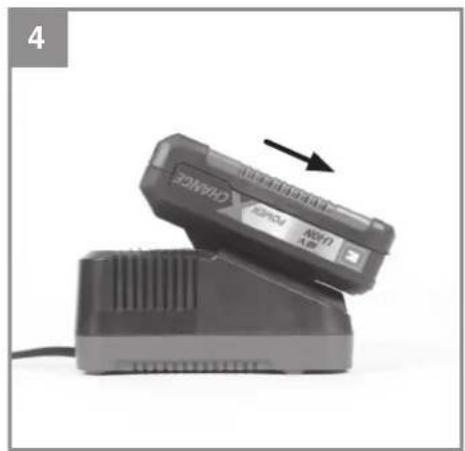
-3-


D
Gefahr!
When using the equipment, a few safety precautions must be observed to avoid injuries and damage. Please read the complete operating instructions and safety regulations with due care. Keep this manual in a safe place, so that the information is available at all times. If you give the equipment to any other person, hand over these operating instructions and safety regulations as well. We cannot accept any liability for damage or accidents which arise due to a failure to follow these instructions and the safety instructions.
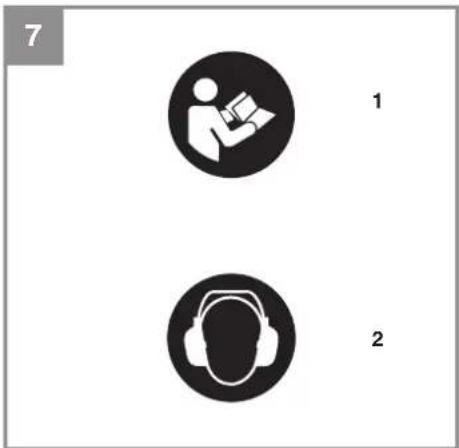
Explanation of the symbols used (see Fig. 7)
-
Danger! - Read the operating instructions to reduce the risk of injury.
-
Caution! Wear ear-muffs. The impact of noise can cause damage to hearing.
1. Safety regulations
The corresponding safety information can be found in the enclosed booklet.
Warning!
Read all the safety information, instructions, illustrations and technical data provided on or with this power tool. Failure to adhere to the following instructions may result in electric shock, fi re and/or serious injury.
Keep all the safety information and instructions in a safe place for future use.
This appliance is not intended for use by persons (including children) with reduced physical, sensory or mental capabilities, or lack of experience and knowledge, unless they have been given supervision or instruction concerning use of the appliance by a person responsible for their safety. Children should be supervised to ensure that they do not play with the appliance.
2. Layout and items supplied
2.1 Layout (Fig. 1/2)
-
LED work light
-
Holder for compressed air hose
-
Compressed air hose
4a. Valve connection
4b. Fastening lever
-
Drawer for valve adapters
-
Battery mount
-
Pressure relief pushbutton
-
Carry-handle
9. LCD
- Bicycle valve adapter
- Ball needle
- Valve adapter
2.2 Items supplied
Please check that the article is complete as specified in the scope of delivery. If parts are missing, please contact our service center or the sales outlet where you made your purchase at the latest within 5 working days after purchasing the product and upon presentation of a valid bill of purchase. Also, refer to the warranty table in the service information at the end of the operating instructions.
- Open the packaging and take out the equipment with care.
- Remove the packaging material and any packaging and/or transportation braces (if available).
- Check to see if all items are supplied.
- Inspect the equipment and accessories for transport damage.
- If possible, please keep the packaging until the end of the guarantee period.
Danger!
The equipment and packaging material are not toys. Do not let children play with plastic bags, foils or small parts. There is a danger of swallowing or suffocating!
• Cordless car compressor
Ball needle
- Valve adapter
• Bicycle valve adapter
• Original operating instructions
- Safetyinstructions
3. Proper use
This device is intended for inflating car tires, motorcycle tires, bicycle tires and small-volume infl atable leisure, sports and beach articles. This device is not suitable for tires with very large volumes such as truck tires, nor is it suitable for high-volume infl atable articles such as rubber dinghies.
The equipment is to be used only for its prescribed purpose. Any other use is deemed to be a case of misuse. The user / operator and not the manufacturer will be liable for any damage or injuries of any kind caused as a result of this.
GB
Please note that our equipment has not been designed for use in commercial, trade or industrial applications. Our warranty will be voided if the machine is used in commercial, trade or industrial businesses or for equivalent purposes.
4. Technical data
Rated voltage: 18V DC
Protection class: ....III
Max. working pressure: .....1.10 MPa (11 bar)
Automatic mode pressure min.: 20 kPa (0.20 bar)
Automatic mode pressure max.: ....
1.10 MPa (11 bar)
ON time max.: 10 min
Output for compressed air at 0 bar .....23 l/min
Output for compressed air at 4 bar .....12 l/min
Output for compressed air at 7 bar .....9 l/min
Compressor idling speed ....5000 min ^-1
Length of compressed air hose approx.: ....70 cm
Approx. weight without battery: 1,2 kg
Danger!
Sound and vibration
The noise emission values were measured in accordance with EN 62841.
L_pA sound pressure level 87.4 dB(A)
K_pA uncertainty 3 dB
L_WA sound power level 95.4 dB(A)
K_WA uncertainty 1.88 dB
Guaranteed sound power level L_WA ..... 97 dB(A)
Wear ear-muff s.
The impact of noise can cause damage to hearing.
Caution!
The equipment is supplied without batteries and without a charger and is allowed to be used only with the lithium-ion batteries of the Power-X-
Change series!
The lithium-ion batteries of the Power-X-Change series are allowed to be charged only with Power-X chargers.
Total vibration values (vector sum of three directions) determined in accordance with EN 62841.
Handle
Vibration emission value a_n = ≤ 2.5 m/s^2
K uncertainty = 1.5 m/s²
The stated vibration emission levels and stated noise emission values were measured in accordance with a set of standardized criteria and can be used to compare one power tool with another.
The stated vibration emission levels and stated noise emission values can also be used to make an initial assessment of exposure.
Warning:
The vibration and noise emission levels may vary from the level specified during actual use, depending on the way in which the power tool is used, especially the type of workpiece it is used for.
Keep the noise emissions and vibrations to a minimum.
- Only use appliances which are in perfect working order.
• Service and clean the appliance regularly.
• Adapt your working style to suit the appliance.
• Do not overload the appliance. - Have the appliance serviced whenever necessary.
- Switch the appliance off when it is not in use.
Caution!
Residual risks
Even if you use this electric power tool in accordance with instructions, certain residual risks cannot be rules out. The following hazards may arise in connection with the equipment's construction and layout:
- Damage to hearing if no suitable ear protection is used.
- Health damage caused by hand-arm vibrations if the equipment is used over a prolonged period or is not properly guided and maintained.
GB
5. Before using the equipment
This product is supplied without batteries and without a charger and is allowed to be used only with the lithium-ion batteries of the Power-X-Change series!
- Check the equipment for damage which may have occurred in transit. Report any damage immediately to the transport company which was used to deliver the compressor.
- Make sure that the intake air is dry and dust-free.
- Do not install the compressor in a damp or wet room.
- The compressor may only be used in suitable rooms (with good ventilation and an ambient temperature from +5 °C to 40 °C). There must be no dust, acids, vapors, explosive gases or inflammable gases in the room.
- The compressor is designed to be used in dry rooms. It is prohibited to use the compressor in areas where work is conducted with sprayed water.
- Do not clean your clothes with compressed air.
- Keep all the air vents free of foreign bodies.
- Do not place the equipment on a heated surface.
Warning! When using the equipment to inflate objects, check the information and safety instructions provided by the manufacturer of these objects.
5.1 Fitting the battery (Fig. 3)
Push the battery into the battery mount provided. When the battery is positioned as in Fig. 3, make sure that the pushlock button (C) latches in place! To remove the battery, proceed as described in section 5.2.
5.2 Charging the lithium-ion battery pack (Fig. 3, 4)
- Pull the battery pack out of the handle, pressing the pushlock button (C) downwards while you do so.
- Check that your mains voltage is the same as that marked on the rating plate. Insert the power plug of the charger into the socket outlet. The green LED will then begin to fl ash.
- Push the battery pack onto the battery charger.
In section 10 (Charger indicator) you will find a table with an explanation of the LED indicator on the charger.
If the battery pack fails to charge, check for the following:
• voltage at the power socket
- whether there is good contact at the charging contacts of the charging unit.
If the battery pack still fails to charge, send
• the charger and charging adapter
• and the battery pack
to our customer service center.
To ensure that items are properly packaged and delivered when you send them to us, please contact our customer service or the point of sale at which the equipment was purchased.
When shipping or disposing of batteries and cordless tools, always ensure that they are packed individually in plastic bags to prevent short circuits and fi res.
To ensure that the battery pack provides long service, you should take care to recharge it promptly. You must recharge the battery pack when you notice that the performance of the device drops. Never allow the battery pack to become fully discharged. This will cause it to develop a defect.
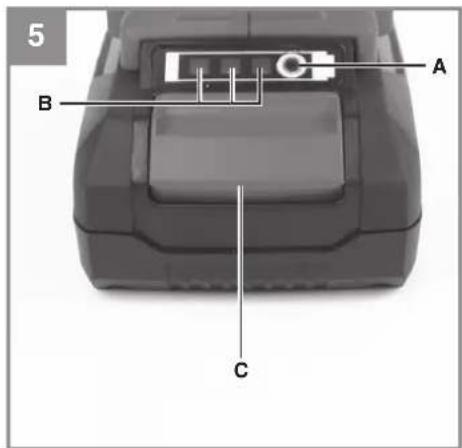
5.3 Battery capacity indicator (Fig. 5)
Press the button for the battery capacity indicator (A). The battery capacity indicator (B) will indicate the charge status of the battery by means of 3 LEDs.
All 3 LEDs are lit:
The battery is fully charged.
2 or 1 LED(s) are lit:
The battery has an adequate remaining charge.
1 LED blinks:
The battery is empty, recharge the battery.
All LEDs blink:
The battery temperature is too low. Remove the battery from the equipment, keep it at room temperature for one day. If the fault reoccurs, this means that the rechargeable battery has undergone exhaustive discharge and is defective. Remove the battery from the equipment. Never use or
GB
charge a defective battery.
6. Operation
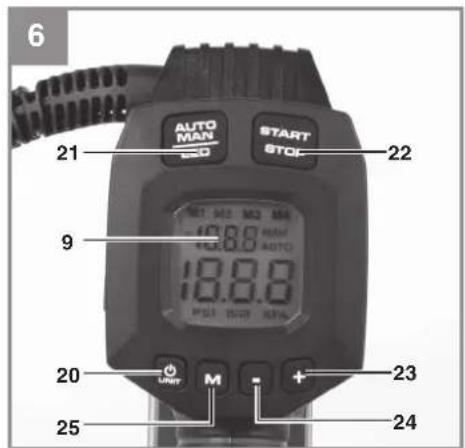
6.1 Button functions (Fig. 6)
Item 20: ON/OFF - Units in BAR, KPA, PSI Item 21: Automatic - Manual - LED Item 22: START/STOP compressor Item 23: Increase set value (+) Item 24: Decrease set value (-) Item 25: Memory (M1 – M4)
6.2 Switching the equipment On/Off (Fig. 6) a) Switching on
When you press the button (Item 20), the display lights up. After it is switched on, the equipment starts in automatic mode (AUTO appears on the display).
b) Switching off
Press the button (Item 20) for approx. 3 seconds until the display switches off. The equipment switches off automatically after approx. 5 minutes of non-use.
6.3 Units (Fig. 6)
After switching the equipment on, press the button (Item 20) several times to select the desired units: BAR, KPA or PSI.
6.4 Automatic mode (Fig. 6)
Note: This function is available at or above 0.4 bar. If it is not already set, press the button (Item 21) briefy to select automatic mode (AUTO will appear on the display). Press the "+" / "-" buttons (Items 23 / 24) to set the cut-out pressure value. When you press the "START/STOP" button (Item 22), the compressor will pump until the set pressure is reached and then it will shut off.
6.5 Memory (Fig. 6)
Four memory values (M1 – M4) are available in automatic mode, to set four different cut-out pressure values. When you press the "M" button (Item 25), "M1" will appear on the display. Press the "+" / "-" buttons (Items 23 / 24) to increase or decrease the set value. To save the value, press the "M" button (Item 25) for a few seconds until the value fl ashes 2x on the display and is saved. To save more values, press the "M" button (Item 25) again and repeat the process.
6.6 Manual mode (Fig. 6)
Brief y press the button (Item 21) to select "manual mode" (MAN will appear on the display). When you press the "START/STOP" button (Item 22), the compressor will start and the compressor will stop when you let go of the button.
6.7 LED work light (Fig. 6)
CAUTION! Do not look directly at the LED work light (Fig. 1 / Item 1)! Press the button (Item 21) for approx. 3 seconds to switch on the LED work light. Press the button (Item 21) again for approx. 3 seconds to switch off the LED work light. When the equipment is not in use, the LED work light will switch off automatically after 5 minutes.
6.8 Pressure relief button (Fig. 1)
- To release pressure when the equipment is switched on, press the button (Item 7) and hold it until the desired air pressure is reached.
6.9 Compressor compressed air mode
- Fit the valve connection (Fig. 1 / Item 4a) of the compressed air hose on the object you wish to inflate. Flip over the fastening lever (Fig. 1 / Item 4b) to secure the valve connection on the valve or the valve adapter.
- Depending on what you are inflating, also use the adapters (10, 11, 12) or other adapters available from retail stores. The supplied adapters are located in the drawer (Fig. 2 / Item 5).
- Switch on the equipment and consult section 6.3 – 6.7 to adapt the settings to suit your needs.
- Warning! Note that in manual mode the compressor does not switch off automatically but will continue inflating the connected object until the maximum pressure is reached or the object bursts.
- Warning! Observe the information supplied by the tire manufacturer and the vehicle manufacturer relating to the recommended tire pressure.
- Warning! This equipment is not calibrated! For a calibrated measurement value, after you have inflated the tires, check the actual tire pressure using a suitable gauge, e.g. at a petrol station.
- Allow the compressor to cool down for about 10 minutes after every 10 minutes of operation in order to prevent overheating.
GB
7. Cleaning, maintenance and ordering of spare parts
Danger!
Always take the battery out of the equipment and pull out the power plug before starting any cleaning work.
7.1 Cleaning
- Keep all safety devices, air vents and the motor housing free of dirt and dust as far as possible. Wipe the equipment with a clean cloth or blow it with compressed air at low pressure.
We recommend that you clean the device immediately each time you have finished using it. - Clean the equipment regularly with a moist cloth and some soft soap. Do not use cleaning agents or solvents; these could attack the plastic parts of the equipment. Ensure that no water can seep into the device. The ingress of water into an electric tool increases the risk of an electric shock.
7.2 Maintenance
There are no parts inside the equipment which require additional maintenance.
7.3 Ordering spare parts and accessories
Please provide the following information when ordering spare parts:
- Type of unit
• Article number of the unit
• ID number of the unit
- Spare part number of the required spare part For our latest prices and information please go to www.Einhell-Service.com
8. Disposal and recycling
The equipment is supplied in packaging to prevent it from being damaged in transit. The raw materials in this packaging can be reused or recycled. The equipment and its accessories are made of various types of material, such as metal and plastic. Never place defective equipment in your household refuse. The equipment should be taken to a suitable collection center for proper disposal. If you do not know the whereabouts of such a collection point, you should ask in your local council offices.
9. Storage
Store the equipment and accessories in a dark and dry place at above freezing temperature. The ideal storage temperature is between 5 and 30 °C. Store the electric tool in its original packaging.
The pressure hose can be attached to the housing (Fig. 1).
GB
10. Charger indicator
| Indicator status Explanations and actions | ||
| Red LED Green LED | ||
| Off | Flashing | Ready for useThe charger is connected to the mains and is ready for use; there is no battery pack in the charger |
| On Off Charging | The charger is charging the battery pack in quick charge mode. The charging times are shown directly on the charger.Important! The actual charging times may vary slightly from the stated charging times depending on the existing battery charge. | |
| Off | On | The battery is charged and ready for use. (READY TO GO)The unit then changes over to gentle charging mode until the battery is fully charged.To do this, leave the rechargeable battery on the charger for approx. 15 minutes longer.Action:Take the battery pack out of the charger. Disconnect the charger from the mains supply. |
| Flashing Off | Adapted charging | The charger is in gentle charging mode.For safety reasons the charging is performed less quickly and takes more time. The reasons can be:- The rechargeable battery has not been used for a very long time.- The battery temperature is outside the ideal range.Action:Wait for the charging to be completed; you can still continue to charge the battery pack. |
| Flashing Flashing Fault | Charging is no longer possible. The battery pack is defective.Action:Never charge a defective battery pack.Take the battery pack out of the charger. | |
| On On Temperature fault | The battery pack is too hot (e.g. due to direct sunshine) or too cold (below 0^ ).Action:Remove the battery pack and keep it at room temperature (approx. 20^ ) for one day . | |
GB
Disposal
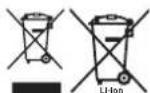
Power tools, rechargeable batteries, accessories and packaging should be sorted for environmental-friendly recycling.
Do not dispose of power tools and batteries/rechargeable batteries into household waste!
Only for EU countries:
According to the Directive 2012/19/EU on waste electrical and electronic equipment and its transposition into national law, power tools that are no longer usable, and, according to the Directive 2006/66/EC, defective or drained batteries must be collected separately and disposed of in an environmentally correct manner.
If disposed incorrectly, waste electrical and electronic equipment may have harmful effects on the environment and human health, due to the potential presence of hazardous substances.
Only for United Kingdom:
According to The Waste Electrical and Electronic Equipment Regulations 2013 (SI 2013/3113) (as amended) and the Waste Batteries and Accumulators Regulations 2009 (SI 2009/890) (as amended), products that are no longer usable must be collected separately and disposed of in an environmentally friendly manner.
The reprinting or reproduction by any other means, in whole or in part, of documentation and papers accompanying products is permitted only with the express consent of the Einhell Germany AG.
Subject to technical changes
GB
Service information
We have competent service partners in all countries named on the guarantee certificate whose contact details can also be found on the guarantee certificate. These partners will help you with all service requests such as repairs, spare and wearing part orders or the purchase of consumables.
Please note that the following parts of this product are subject to normal or natural wear and that the following parts are therefore also required for use as consumables.
| Category Example | |
| Wear parts* Battery | |
| Consumables* | |
| Missing parts |
* Not necessarily included in the scope of delivery!
In the effect of defects or faults, please register the problem on the internet at www.Einhell-Service.com. Please ensure that you provide a precise description of the problem and answer the following questions in all cases:
• Did the equipment work at all or was it defective from the beginning?
• Did you notice anything (symptom or defect) prior to the failure?
• What malfunction does the equipment have in your opinion (main symptom)?
Describe this malfunction.
F
Danger!
Negotovost K_pA .....3 dB
Nivo zvočne moči L _WA 95,4 dB (A)
Negotovost K_WA .....1,88 dB
Zajamčena raven zvočne moči L _WA ..... 97 dB (A)
X 2006/42/EC
Annex IV
Notified Body:
Reg. No.:
X 2000/14/EC_2005/88/EC
Annex V
X Annex VI
Noise: measured L_w = 95,4 dB (A); guaranteed L_w = 97 dB (A)
P = kW; L/∅ = cm
Notifi ed Body: TÜV SÜD Industrie Service GmbH (NB0036)
2012/46/EU_(EU)2016/1628 Emission No.:
Standard references: EN 62841-1; EN 1012-1; EN IEC 55014-1; EN IEC 55014-2
Subject to change without notice
Archive-File/Record: NAPR029693
Documents registrar: Landauer Josef
Wiesenweg 22, D-94405 Landau/Isar
* SB Cordless car comprensor - F Compressor de voiture sans fl. - i Compressors auto e batterie; JKN Alku-autompressor - S Betterlitten von konspromer - CZ Alkumulatorov automprecer - SK Akumulatorov automobilevni. Accu autocompressor - E Compressor malamenco para FIN Akuckdyttönen autokompressor - SLO Akumulatorsk samodigrihl H Akkus-Autos kompressor - AO Compresor penha maingui ou GB Juinizměrné cyruštvý, na PC Compressor sem lic para HRBBH Izotropski automoistik kompressor - RS Akumulatorsk kompressor za auto - FL Akumulatorov kompressor - AL Akumulatorov automprecer - LV Akumulatorov automprecer - CT Akumulatoris kompressor BG Akumulatorkom kompressor - UKP Akuminatorim konprecer - MKI Komprecer na železin

Declaration of conformity
We, Einhell UK Ltd
Champions Business Park, First Floor Unit 10, Arrowe Brook Rd, Upton, Wirral CH49 0AB, United Kingdom
declare the conformity to UK standards and legislation was assessed for:
Cordless Car Air Compressor CE-CC 18/23 D Li (Einhell)
UK legislation
□ Simple Pressure Vessels (Safety) Regulation
□ Electrical Equipment (Safety) Regulation
□ Radio Equipment Regulation
□ Personal Protective Equipment Regulation
☐ The Ecodesign for Energy-Related Products and Energy Information Regulation
X The Restriction of the Use of Certain Hazardous Substances in Electrical and Electronic Equipment Regulation
X Noise Emission in the Environment by Equipment for use Outdoors Regulation
X Electromagnetic Compatibility Regulation
□ Measuring Instruments Regulation
☐ Pressure Equipment (Safety) Regulation
Annex V
X Annex VI
Noise:measuredLWA=95.4 dB (A); guaranteed LWA=97 dB (A)
P = kW; L/∅ = cm
Approved Body: TÜV SÜD Industrie Service GmbH (NB0036)
X Supply of Machinery (Safety) Regulation
□ Annex IV
UK Approved Body:
UKTE Certifi cate No.:
Standards: EN 62841-1; EN 1012-1; EN IEC 55014-1; EN IEC 55014-2
Wirral, 2025.03.11
Tom Chambers, Managing Director Einhell UK Ltd.
Archive-File/Record: NAPR029693
Article Number: 20.710.25 I.-No.: 21014
Subject to change without notice Wiesenweg 22, 94405 Landau/Isar, Germany
Documents registrar: Landauer Josef
EH 05/2025 (01)