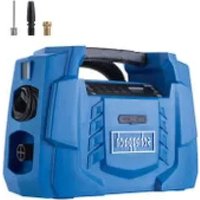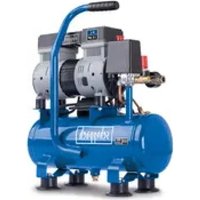
HC08Si - Compressor SCHEPPACH - Free user manual and instructions
Find the device manual for free HC08Si SCHEPPACH in PDF.


| Brand | Scheppach |
| Model | HC08Si |
| Product type | Air compressor |
| Power supply | 230 V ~ 50 Hz |
| Motor power | 1100 W |
| Operating mode | S1 (continuous operation) |
| Compressor speed | 2850 min⁻¹ |
| Tank volume | 6 litres |
| Service pressure | 8 bar |
| Theoretical intake capacity | 162 L/min |
| Theoretical output capacity | 100 L/min |
| Protection class | IP30 |
| Sound power level | 85 dB(A) |
| Sound pressure level | 67.4 dB(A) |
| Device weight | 11.7 kg |
| Main functions | Generation of compressed air for pneumatic tools (up to 100 L/min), inflation, painting, blow-off |
| Maintenance and cleaning | Drain condensation water after each use; clean air filter every 300 hours |
| Safety | Safety valve (test every 30 h or 3 times/year), overload protection, residual current circuit breaker recommended |
| Spare parts and repairability | Air filter (wear part); repairs by a qualified electrician |
| General information | Indoor use only, ambient temperature +5°C to +40°C, max altitude 1000 m |
Frequently Asked Questions - HC08Si SCHEPPACH
User questions about HC08Si SCHEPPACH
0 question about this device. Answer the ones you know or ask your own.
Ask a new question about this device
Download the instructions for your Compressor in PDF format for free! Find your manual HC08Si - SCHEPPACH and take your electronic device back in hand. On this page are published all the documents necessary for the use of your device. HC08Si by SCHEPPACH.
USER MANUAL HC08Si SCHEPPACH
Günzburger Straße 69
D-89335 Ichenhausen
Verehrter Kunde
Homepage: https://www.scheppach.com/de/service
Explanation of the symbols on the product
Symbols are used in this manual to draw your attention to potential hazards. The safety symbols and the accompanying explanations must be fully understood. The warnings themselves will not rectify a hazard and cannot replace proper accident prevention measures.
| Warning - Read the operating manual to reduce the risk of injury. | |
| Wear hearing protection. Excessive noise can result in a loss of hearing. | |
| Wear a dust protection mask. When machining wood and other materials, harmful dust may be generated. Do not machine material containing asbestos! | |
| Wear safety goggles. Sparks created during work or fragments, chippings and dust ejected by the device can cause sight loss. | |
| Warning - Hot surfaces! | |
| Warning against electrical voltage. | |
| Warning! The device is equipped with an automated start-up control. Keep third-parties away from the working range of the device! | |
| Observe warning and safety instructions! | |
| Do not expose the machine to rain. The device may only be stationed, stored and operated in dry ambient conditions. | |
| Specification of the sound power level in dB. | |
| Specification of the sound pressure level in dB. | |
| The product complies with the applicable European directives. | |
| △ Attention! | We have marked points in this operating manual that impact your safety with this symbol. |
Table of contents: Page:
- Introduction 22
- Device description (Fig. 1 - 5) 22
- Scope of delivery 22
- Proper use 22
- General safety instructions 23
- Residual risks 26
- Technical data 26
- Unpacking 27
9.Before commissioning 27 - Assembly and operation 27
- Electrical connection 28
- Cleaning, maintenance and storage 28
- Transport (Fig. 3) 29
- Disposal and recycling 30
- Troubleshooting 31
- Declaration of conformity 247
1. Introduction
Manufacturer:
Scheppach GmbH
GünzburgerstraBe 69
D-89335 Ichenhausen
Dear Customer
We hope your new device brings you much enjoyment and success.
Note:
In accordance with the applicable product liability laws, the manufacturer of this device assumes no liability for damage to the device or caused by the device arising from:
- Improper handling
Non-compliance with the operating manual - Repairs carried out by third parties, unauthorised specialists
- Installing and replacing non-original spare parts
- Improper use
- Failure of the electrical system in the event of the electrical regulations and VDE provisions 0100, DIN 57113 / VDE 0113 not being observed
Note:
Read the whole text of the operating manual before assembly and commissioning.
This operating manual should help you to familiarise yourself with your device and to use it for its intended purpose.
The operating manual includes important instructions for safe, proper and economic operation of the device, for avoiding danger, for minimising repair costs and downtimes, and for increasing the reliability and extending the service life of the device.
In addition to the safety instructions in this operating manual, you must also observe the regulations applicable to the operation of the device in your country.
Keep the operating manual at the device, in a plastic sleeve, protected from dirt and moisture. They must be read and carefully observed by all operating personnel before starting the work.
The device may only be used by personnel who have been trained to use it and who have been instructed with respect to the associated hazards.
The required minimum age must be observed.
In addition to the safety instructions in this operating manual and the separate regulations of your country, the generally recognised technical rules relating to the operation of such machines must also be observed.
We accept no liability for accidents or damage that occur due to a failure to observe this manual and the safety instructions.
2. Device description (Fig. 1 - 5)
- Air filter
1a. Screw (air filter)
1b. Filter element - Transport handle
- On/off switch
- Pressure switch
- Pressure regulator
- Safety valve
- Quick coupling (regulated compressed air)
- Pressure gauge (set pressure can be read off)
- Foot
9a. Screw (foot)
9b. Nut (foot) - Drain screw for condensate
- Pressure vessel
3. Scope of delivery
- 1x air filter (pre-installed)
- 4x foot
1x assembly material - 1x operating manual
4. Proper use
The compressor is designed to generate compressed air for compressed-air driven tools which can be driven with an air volume of up to approx. 100 l/min (e.g. tire inflator, blow-out pistol and paint spray gun). Due to the limited air output it is not possible to use the compressor to drive tools with very high air consumption (for example orbital sanders, die grinders and hammer screwdrivers).
The compressor may only be operated in a dry and well ventilated indoor space.
The machine may only be used in the intended manner. Any use beyond this is improper.
The user/operator, not the manufacturer, is responsible for damages or injuries of any type resulting from this.
Please note that our equipment was not designed with the intention of use for commercial or industrial purposes. We assume no guarantee if the device is used in commercial or industrial applications, or for equivalent work.
5. General safety instructions
WARNING - Read all safety information, instructions, illustrations and technical data for this electric tool.
Failure to follow all instructions listed below may result in electric shock, fire and/or serious injury.
Save all warnings and instructions for future reference.
The term "electric tool" used in the safety instructions refers to mains-powered electrical tools (with a mains cable) and battery-powered electrical tools (without a mains cable).
Work area safety
a. Keep your work area clean and well-lit. Cluttered or dark areas invite accidents.
b. Do not operate power tools in explosive atmospheres, such as in the presence of flammable liquids, gases or dust. Power tools create sparks which may ignite the dust or fumes.
c. Keep children and bystanders away while operating a power tool. Distractions can cause you to lose control.
Electrical safety
a. Power tool plugs must match the outlet. Never modify the plug in any way. Do not use any adapter plugs with earthed (grounded) power tools. Unmodified plugs and matching outlets will reduce risk of electric shock.
b. Avoid body contact with earthed or ground- ed surfaces, such as pipes, radiators, ranges and refrigerators. There is an increased risk of electric shock if your body is earthed or grounded.
c. Do not expose power tools to rain or wet conditions. Water entering a power tool will increase the risk of electric shock.
d. Do not use the cable for another purpose, for example, carrying or hanging the power tool or pulling the plug out of the socket. Keep the cable away from heat, oil, sharp edges or moving device parts. Damaged or coiled cables increase the risk of an electric shock.
e. If you work with an electric tool outdoors, only use extension cables that are also suitable for outdoor use. Use of a cord suitable for outdoor use reduces the risk of electric shock. Only use approved and appropriately identified extension cables for use outdoors. Only use cable reels in the unrolled state.
f. If operating a power tool in a damp location is unavoidable, use a residual current circuit breaker with a trigger current of 30mA or less to protect the power supply. Use of an RCD reduces the risk of electric shock.
Personal safety
a. Stay alert, watch what you are doing and use common sense when operating a power tool. Do not use a power tool while you are tired or under the influence of drugs, alcohol or medication. A moment of carelessness when using electrical tools can result in serious injuries.
b. Wear personal protective equipment and always safety goggles. Protective equipment such as a dust mask, non-skid safety shoes, safety helmet or hearing protection used for appropriate conditions will reduce personal injuries.
c. Prevent unintentional starting. Ensure the switch is in the off-position before connecting to power source and/or rechargeable battery, picking up or carrying the tool. Carrying electric tools with your finger on the switch or connecting power tools to the power supply when they are already switched on invites accidents.
d. Remove any adjusting tools or spanners/keys before turning the power tool on. A tool or spanner that is located in a rotating device part may result in injuries.
e. Avoid abnormal postures. Keep proper footing and balance at all times. This enables better control of the power tool in unexpected situations.
f. Dress properly. Do not wear loose clothing or jewellery. Keep hair, clothing and gloves away from moving parts. Loose clothes, jewellery or long hair can be caught in moving parts. When working outdoors, rubber gloves and anti-slip footwear is recommended. Tie long hair back in a hair net.
g. If dust extraction and collection devices can be mounted, make sure that they are connected and used properly. Use of dust extraction can reduce dust-related hazards.
h. Do not let familiarity gained from frequent use of tools allow you to become complacent and ignore tool safety principles. A careless action can cause severe injury within a fraction of a second.
Power tool use and care
a. Do not overload the device. Use the correct power tool for your application. The correct power tool will do the job better and safer at the rate for which it was designed.
b. Do not use the power tool if the switch does not turn it on and off. Any power tool that cannot be controlled with the switch is dangerous and must be repaired.
c. Disconnect the plug from the power source and/or remove the battery pack, if detachable, from the power tool before making any adjustments, changing accessories, or storing power tools. These precautionary measures will prevent the electric tool from starting unintentionally.
d. Store idle power tools out of the reach of children. do not allow persons unfamiliar with the power tool or these instructions to operate the power tool. Power tools are dangerous in the hands of untrained users. Unused electric tools should be stored in a dry, elevated or closed location out of the reach of children.
e. Maintain power tools and attachments. Check whether moving parts function properly and do not get stuck and whether parts are broken or are damaged and thus adversely affect the electric tool function. If damaged, have the power tool repaired before use. Many accidents are caused by poorly maintained power tools.
f. Keep cutting tools sharp and clean. Properly maintained cutting tools with sharp cutting edges are less likely to bind and are easier to control.
g. Use the power tool, accessories and tool bits etc. in accordance with these instructions. Take into account the working conditions and the work to be performed. Use of the power tool for operations different from those intended could result in a hazardous situation.
h. Keep handles and grasping surfaces dry, clean and free from oil and grease. Slippery handles and grasping surfaces do not allow for safe handling and control of the tool in unexpected situations.
Service
a. Only have your power tool repaired by qualified specialists and only with original spare parts. This ensures that safety of the electric tool is maintained.
Safety instructions for compressors
Attention! The following basic safety measures must be observed when using this compressor for protection against electric shock, and the risk of injury and fire.
Read and observe these instructions before using the device.
Safe work.
-
Take care of your tools
-
Keep your compressor clean in order to work well and safely.
- Follow the maintenance instructions.
- Check the connection cable of the electric tool regularly and have it replaced by a recognised specialist when damaged.
-
Check extension cables regularly and replace them when damaged.
-
Pull the connector out of the socket
-
When the electric tool is not in use or prior to maintenance and when replacing tools such as saw blades, drills, cutters.
-
Check the electric tool for potential damage
-
Protective devices or other parts with minor damage must be carefully inspected to ensure that they function correctly and as intended prior to continued use of the electric tool.
- Check whether the moving parts function faultlessly and do not jam or whether parts are damaged. All parts must be correctly mounted and all conditions must be fulfilled to ensure fault-free operation of the electric tool.
- Damaged protective devices and parts must be properly repaired or replaced by a recognised specialist workshop, insofar as nothing different is specified in the operating manual.
-
Do not use any faulty or damaged connection cables.
-
Attention!
-
For your own safety, only use accessories and additional equipment that are indicated in the operating manual or have been recommended or indicated by the manufacturer.
- Use of other tools or accessories that those recommended in the operating manual or in the catalogue could represent a personal danger to you.
- Inflating tyres
- Check the tyre pressure immediately after filling using a suitable pressure gauge, e.g. at a petrol station.
- Street-legal compressors in construction site operation
- Ensure that all hoses and fixtures are suitable for the maximum permissible working pressure of the compressor.
- Set-up location
- Only set up the compressor on a flat surface.
- It is recommended to equip the feed hoses with a safety cable in cases where the pressure is above 7 bar, e.g. using a wire cable.
- Avoid over-stressing the piping system by using flexible hose connections to prevent kinking.
ADDITIONAL SAFETY INSTRUCTIONS
Observe the corresponding operating manuals of the respective compressed air tools / compressed air attachments! The following general instructions must also be observed:
Safety instructions for working with compressed air and air blow guns
- Ensure there is sufficient distance to the product, at least 2.50m , and keep the compressed air tools / compressed air attachments away from the compressor during operation.
- Compressor pump and lines reach high temperatures during operation. Touching them will cause burns.
- The air drawn in by the compressor must be kept free of impurities that can cause fires or explosions in the compressor pump.
- When disconnecting the hose coupling, hold the coupling piece of the hose firmly with your hand. This will ensure that you avoid injuries caused by the hose recoiling.
-
Wear safety goggles when working with the air blow gun. Foreign objects or blown off parts can easily cause injuries.
-
Wear safety goggles and a respirator when working with the compressed air pistol. Dusts are harmful to health! Foreign objects or blown off parts can easily cause injuries.
- Do not blow on people or clean clothing whilst on the body with the air blow gun. Danger of injury!
Safety instructions when using spraying attachments (e.g. paint sprayers):
- Keep the spray attachment away from the compressor when filling so that no liquid comes into contact with the compressor.
- Never spray in the direction of the compressor when using the spraying attachments (e.g. paint sprayers). Moisture can lead to electrical hazards!
- Do not process any paints or solvents with a flash point below 55^ C. Risk of explosion!
- Do not heat up paints or solvents. Risk of explosion!
- If harmful liquids are processed, filter devices (face masks) are required for protection. Also observe the information on protective measures provided by the manufacturers of such substances.
- The information and labelling of the hazardous substances ordinance affixed to the outer packaging of the processed materials must be observed. If necessary, take additional protective measures, in particular wear suitable clothing and masks.
- Do not smoke during the spraying process or in the working area. Risk of explosion! Paint vapours are also highly flammable.
- Fireplaces, naked flames lights or sparking machinery must not be present or operated.
- Do not store or consume food or drinks in the work area. Paint fumes are harmful to health.
- The working area must be larger than 30m^3 and sufficient air exchange must be ensured during spraying and drying.
- Do not spray into the wind. Always observe the regulations of the local police authorities when spraying flammable or hazardous spraying materials.
- Do not use media such as white spirit, butyl alcohol and methylene chloride in conjunction with the PVC pressure hose.
- These media destroy the pressure hose.
- The work area must be separated from the compressor so that it cannot come into direct contact with the working medium.
Operation of pressure vessels
- Anyone who operates a pressure vessel must keep this in good working order, operate and monitor it correctly, perform the necessary maintenance and servicing works immediately and implement safety measures as required according to the circumstances.
- The regulatory authority can instruct necessary monitoring measures in individual cases.
- A pressure vessel must not be operated if it exhibits a defect that poses a danger to personnel or third parties.
- Check the pressure vessel for rust and damage each time before use. The compressor shall not be operated if the pressure vessel is damaged or rusty. If you discover damage, please contact the customer service workshop.
Warning! This power tool generates an electromagnetic field during operation. This field can impair active or passive medical implants under certain circumstances. In order to prevent the risk of serious or deadly injuries, we recommend that persons with medical implants consult with their physician and the manufacturer of the medical implant prior to operating the power tool.
Store the safety instructions safely.
6. Residual risks
The machine has been built according to the state-of-the-art and the recognised technical safety requirements. However, individual residual risks can arise during operation.
- Health hazard due to electrical power, with the use of improper electrical connection cables.
- Furthermore, despite all precautions having been met, some non-obvious residual risks may still remain.
- Residual risks can be minimised if the "Safety Instructions" and the "Intended Use" together with the operating manual as a whole are observed.
- Avoid accidental starting of the machine: the operating button may not be pressed when inserting the plug in an outlet. Use the tool that is recommended in this operating manual. This is how to ensure that your machine provides optimum performance.
- Keep your hands away from the working area when the machine is in operation.
7. Technical data
| Mains power connection 230 V~ 50Hz | |
| Engine output 1100 W | |
| Operating mode S1 | |
| Compressor speed 2,850 rpm | |
| Pressure vessel volume approx. 6 l | |
| Operating pressure approx. 8 bar | |
| Theo. Suction capability approx. 162 l/min | |
| Theo. Power output approx. 100 l/min | |
| Protection category IP 30 | |
| Device weight approx. 11.7 kg | |
| Max. installation altitude (above sea level) | 1000 m |
Subject to technical changes!
Noise and vibration
Warning: Noise can have serious effects on your health. If the machine noise exceeds 85 dB, please wear suitable hearing protection.
Noise data
| Sound power level LWA | 85 dB |
| Sound pressure level LPA | 67.4 dB |
| Uncertainty Kwa/pA | 3 dB |
The noise emission values have been determined in accordance with EN ISO 3744:1995.
Note: The total vibration emission values specified and the device emissions values specified have been measured in accordance with a standardised test procedure and can be used for comparison of one electric tool with another.
Note: The total vibration emission values specified and the device emissions values specified can also be used for an initial estimation of the load.
Warning: The vibration values and noise emission values can vary from the specified values during the actual use of the electric tool, depending on the type and the manner in which the electric tool is used, and in particular the type of workpiece being processed.
Warning: It is necessary to determine the safety measures for the protection of the operator based on an assessment of the vibration load during the actual conditions of use (In doing so, all parts of the operating cycle must be taken into account such as times in which the electric tool is switched off or times in which it is switched on, but is not running under a load).
8. Unpacking
- Open the packaging and carefully remove the device.
- Remove the packaging material, as well as the packaging and transport safety devices (if present).
- Check whether the scope of delivery is complete.
- Check the device and accessory parts for transport damage. In the event of complaints the carrier must be informed immediately. Later claims will not be recognised.
- If possible, keep the packaging until the expiry of the warranty period.
- Familiarise yourself with the device by means of the operating manual before using for the first time.
- With accessories as well as wearing parts and replacement parts use only original parts. Spare parts can be obtained from your specialist dealer.
- When ordering please provide our article number as well as type and year of manufacture for your equipment.
WARNING!
The device and the packaging material are not children's toys! Do not let children play with plastic bags, films or small parts! There is a danger of choking or suffocating!
9. Before commissioning
- Before connecting the machine, make certain that the data on the type plate matches with the mains power data.
- Check the device for transport damage. Report any damage immediately to the transport company which was used to deliver the compressor.
- The compressor must be installed close to the consumer.
- Long air lines and supply cables (extension cable) should be avoided.
- Ensure that the intake air is dry and dust-free.
-
Do not install the compressor in a damp or wet room.
-
The compressor may only be used in suitable rooms (with good ventilation and an ambient temperature from +5^ to 40^ ). There must be no dust, acids, vapours, explosive gases or inflammable gases in the room.
- The compressor is suitable for use in dry rooms. It must not be used in areas where splashed water is present.
- The compressor may only be used outdoor briefly when the ambient conditions are dry.
- The compressor must always be kept dry and must not be left outdoors after work is complete.
10. Assembly and operation
Attention!
Always make sure the device is fully assembled before commissioning!
10.1 Mounting the foot (Fig. 4)
- Fit the foot (9) provided as shown in.
10.2 Installing the air filter (fig. 5)
- Fit the air filter (1) provided as shown in.
10.3 Mains power connection
- The compressor is equipped with a mains cable with an earthed plug. This can be connected to any 220 - 240V 50Hz protective contact socket, with fuse protection of at least 16 A.
- Before you use the machine, make sure that the mains voltage is the same as the operating voltage and the machine power on the rating plate.
- Long supply cables, extensions, cable reels, etc. cause a drop in voltage and can impede motor startup.
- At low temperatures below +5^ , sluggishness may make starting difficult or impossible.
10.4 On/Off switch (fig. 1)
- Pull the on/off switch (3) upwards to switch on the compressor.
- Press the on/off switch (3) down to switch off.
10.5 Adjusting the pressure (fig. 1)
- The pressure at the manometer (8) is adjusted with the pressure regulator (5).
- The adjusted pressure can be drawn from the quick coupling (7).
10.6 Setting the pressure switch (fig. 1)
- The pressure switch (4) is set at the factory. Cut-in pressure approx. 6 bar
- Switch-off pressure approx. 8 bar
10.7 Fitting the compressed air hose (fig. 1)
- Connect the plug-in nipple of the compressed air hose (not included in the scope of delivery) to one of the quick-connect couplers (7). Then connect the compressed air tool to the quick coupling of the compressed air hose.
11. Electrical connection
The electrical motor installed is connected and ready for operation. The connection complies with the applicable VDE and DIN provisions. The customer's mains connection as well as the extension cable used must also comply with these regulations.
When working with spray attachments and during temporary use outdoors, the device must be connected to a residual current circuit breaker with a trigger current of 30mA or less.
11.1 Important information
In the event of overloading, the motor will switch itself off. After a cool-down period (time varies) the motor can be switched back on again.
11.2 Damaged electrical connection cable
The insulation on electrical connection cables is often damaged.
This may have the following causes:
- Pressure points, where connection cables are passed through windows or doors.
- Kinks where the connection cable has been improperly fastened or routed.
- Places where the connection cables have been cut due to being driven over.
Insulation damage due to being ripped out of the wall outlet. - Cracks due to the insulation ageing.
Such damaged electrical connection cables must not be used and are life-threatening due to the insulation damage.
Check the electrical connection cables for damage regularly. Ensure that the connection cables are disconnected from electrical power when checking for damage.
Electrical connection cables must comply with the applicable VDE and DIN provisions. Only use connection cables of the same designation.
The printing of the type designation on the connection cable is mandatory.
11.3 AC motor
The mains voltage must be 220 - 240V 50Hz
- Extension cables up to 25m long must have a cross-section of 1.5mm^2
Connection type X
If the mains connection cable of this product is damaged, it must be replaced by a specially prepared mains connection cable which can be obtained from the manufacturer or its service department.
12. Cleaning, maintenance and storage
Attention!
Pull out the mains plug before carrying out any cleaning or maintenance work! Danger of injury due to electric shocks!
Attention!
Wait until the device has cooled down completely! Danger of burning!
Attention!
Depressurise the device before carrying out any cleaning or maintenance work! Danger of injury!
12.1 Cleaning
- Keep the device as free of dust and dirt as possible. Rub the device clean with a clean cloth or blow it off with compressed air at low pressure.
- We recommend that you clean the device directly after every use.
- Clean the device at regular intervals using a damp cloth and a little soft soap. Do not use aggressive cleaning agents or solvents; they could attack the plastic parts of the device. Make sure that no water can penetrate the device interior.
- The hose and injection tools must be disconnected from the compressor before cleaning. The compressor must not be cleaned with water, solvents or similar.
12.2 Maintaining the pressure vessel (fig. 1)
Attention!
To ensure a long service life for the pressure vessel (11), drain off the condensate after each use by opening the drain screw (10).
Release the vessel pressure beforehand (see 12.6.1). The drain screw (10) is opened by turning it counterclockwise (when looking at the screw on the bottom of the compressor) so that the condensate can be completely drained out of the pressure vessel (11).
Then close the drain screw (10) again (turn clockwise). Check the pressure vessel (11) for rust and damage each time before use.
The compressor shall not be operated if the pressure vessel (11) is damaged or rusty.
If you discover damage, please contact the customer service workshop.
Instructions on the disposal of condensate:
Dispose of the condensate in accordance with local and national environmental regulations. Ensure that it is not discharged into the wastewater system.
12.3 Safety valve (Fig. 2)
The safety valve (6) is set to the maximum permissible pressure of the pressure vessel (11). It is not permitted to adjust the safety valve (6) or to remove the connection lock (6b) between the drain nut (6a) and its cap (6c). Actuate the safety (6) valve every 30 operating hours but at least 3 times a year to ensure that it works when required.
Turn the perforated exhaust nut (6a) anti-clockwise to open it and use your hands to pull the valve rod outwards over the perforated exhaust nut (6a) to open the outlet of the safety valve (9). Now, the valve audibly releases air. Then, tighten the exhaust nut (6a) clockwise again.
12.4 Cleaning the air filter (Fig. 5)
The air filter (1) prevents dust and dirt being sucked in. It is essential to clean this air filter (1) after at least every 300 hours in service. A blocked air filter (1) significantly reduces the compressor power.
Remove the screw (1a) on the air filter (1) to remove it. You can now remove the filter insert (1b). Carefully knock out the air filter insert (1b). These components must then be blown out with compressed air (approx. 3 bar) and reassembled in reverse order.
12.5 Service information
With this product, it is necessary to note that the following parts are subject to natural or usage-related wear, or that the following parts are required as consumables.
Wearing parts*: Air filter
- may not be included in the scope of delivery!
Connections and repairs
Connections and repair work on the electrical equipment may only be carried out by electricians.
Please provide the following information in the event of any queries:
Type of current for the motor
Machine data - type plate
- Motor data - type plate
Spare parts and accessories can be obtained from our Service Centre. To do this, scan the QR code on the front page.
12.6 Storage
Attention!
Disconnect the mains plug, vent the device and all connected compressed air tools.
Store the compressor in such a way that it cannot be used by unauthorised persons.
Attention!
Store the compressor only in dry locations that are inaccessible for unauthorized persons. Do not tilt the unit, only store it upright!
12.6.1 Releasing excess pressure
Release overpressure in the compressor by switching off the compressor and using up the compressed air still in the pressure vessel (11), e.g. with a compressed air tool running at idle or with an air blow gun.
13. Transport (Fig. 3)
Use the transport handle (2) for transport.
When lifting the compressor, note its weight (see Technical data).
Ensure that the load is well secured when transporting the compressor in a motor vehicle.
14. Disposal and recycling
Notes for packaging


The packaging materials are recyclable. Please dispose of packaging in an environmentally friendly manner.
Notes on the electrical and electronic equipment act [ElektroG]
![SCHEPPACH HC08Si - Notes on the electrical and electronic equipment act [ElektroG] - 1](/content/2026/04/728785/images/0eca75ebe7bd381c2a7adbf3a6a5b67c46e1e18b244909b51f5fa4de6e5ac64e.jpg)
Waste electrical and electronic equipment does not belong in household waste, but must be collected and disposed of separately!
- Used batteries or rechargeable batteries that are not installed permanently in the old device must be removed non-destructively before disposal! Their disposal is regulated by the battery act.
- Owners or users of electrical and electronic devices are legally obliged to return them after use.
- The end user is responsible for deleting their personal data from the old device being disposed of!
- The symbol of the crossed-out dustbin means that waste electrical and electronic equipment must not be disposed of with household waste.
-
Waste electrical and electronic equipment can be handed in free of charge at the following places:
-
Public disposal or collection points (e.g. municipal works yards).
- Points of sale of electrical appliances (stationary and online), provided that dealers are obliged to take them back or offer to do so voluntarily.
- Up to three waste electrical devices per type of device, with an edge length of no more than 25 centimetres, can be returned free of charge to the manufacturer without prior purchase of a new device from the manufacturer or taken to another authorised collection point in your vicinity.
Further supplementary take-back conditions of the manufacturers and distributors can be obtained from the respective customer service.
- If the manufacturer delivers a new electrical device to a private household, the manufacturer can arrange for the free collection of the old electrical device upon request from the end user. Please contact the manufacturer's customer service for this.
These statements only apply to devices installed and sold in the countries of the European Union and which are subject to the European Directive 2012/19/EU. In countries outside the European Union, different regulations may apply to the disposal of waste electrical and electronic equipment.
15. Troubleshooting
The following table shows fault symptoms and describes remedial measures in the event of your machine failing to work properly. If you cannot localise and rectify the problem with this, please contact your service workshop.
| Fault Possible cause Remedy | ||
| The compressor does not start. | Mains voltage not present. Check cable, | mains plug, fuse and socket. |
| Mains voltage too low. | Avoid extension cables that are too long. Use extension cables with sufficient conductor cross-section. | |
| Outdoor temperature too low. | Do not operate at outside temperatures below +5°C. | |
| Motor is overheated. | Allow the motor to cool down. If necessary, remedy the cause of the overheating. | |
| The compressor starts but there is no pressure. | The safety valve leaks. | Contact your local service centre. Only allow qualified personnel to carry out repairs. |
| The seals are damaged. | Replace the seals, have defective seals replaced at a specialist workshop. | |
| Drain screw for condensate leaking. | Tighten the screw by hand. Check the seal on the screw and replace if necessary. | |
| Compressor running, pressure shown on the manometer, but tools are not running. | Hose connections leaking. | Check compressed air hose and tools, replace if necessary. |
| Quick-coupler leaking. | Contact your local service centre. Only allow qualified personnel to carry out repairs. | |
| Pressure set too low at pressure regulator. | Turn up the pressure regulator further. | |
13. Transport (afb. 3)
Günzburger Straße 69
D-89335 Ichenhausen
Vázéný zákazníku,
Günzburger Straße 69
D-89335 Ichenhausen
Vázenzý zákaznik,
13. Transport (sl. 3)
Za transport rabite transportnu rucku (2).
Prilikom podizanja kompressora vodite računa o njego-voj masi (vidi tehníčke podatke).
Prilikom transporte kompressora u motornim vozilimadobro osigurajte teret.
14. Zbrinjavanje i recikliranje
Napomene o ambalaži


Ambalažni materijali mogu se reciklirati. Molimo zbrinite ambalažu na ekoloski način.
Napomene o Zakonu o elektricnim i elektronickim uredajima (ElektroG)
Otpadni elektrichi i elektronicki ureadi ne spadaju u kućanski OTPad,argo ih valja od-nijeti na odvojeno mesto prikupljanja i zbrinjavanja!
- Stare baterije ili akumulatore koji nisu fiksno ugradeni u otpadni uredaj potrebno je prije predaje izvaditi takdo da se ne uniste! Njihovo zbrinjavanje regulirano je zakonom o baterijama.
Vlasnici i korisnici elektrichni i elektronickih uredaja zakonom su obvezni vratiti ih nakon uporabe.
Krajnji korisnik iskljucivo je odgovoran za brisanje osobnih podataka na opbadnom uredaju koji treba zbrinuti! - Simbol prekrižene kante za opstad znači da opadne elektricne i elektronicke uredaje nije dopusteno zbrinjavati u kućni opad.
-
Otpadne elektricne i elektronicke uredaje moguce je besplatno predati na sljedeca mjesta:
-
Javno-pravna mjesta za zbrinjavanje i prikupljanje (npr. komunalna dvorišta).
-Mjesta prodaje elektricnih uredaja (stacionarna i internetska),ako su trgovci obvezni preuzeti ih ili akobesplatno nude tu uslugu. - Do tri otpadna elektricna uredaja po svakovj vrsti uredaja, s duljinom rubova od maksimalno 25 centimetara, mozte bez prethodne nabavenovog uredaja besplatno predati proizvodauc ili nekom drugom obliznjem ovlastenom sabiraliistu.
- Dodatne dopunske uvjete povrata od proizvodača i distributera možete saznati od servisne službe.
U slučaju isporuke novog elektricnog uredaja od proizvodača privatnom kucanstvu on moze omoguciti besplatno preuzimanje opadnog elektricnog uredaja na zahtjev krajnjeg korisnika. U vezi s tim obratite se servisnoj sluzbi proizvodača.
- Ove izjave vrijede samo za uredeaje koji se montiraju i prodaju u drzavama Europske unije i koji podljeezu Europskoj direktivi 2012/19/EU. U drzavama izvan Europske unije mogu vrijediti drukciji propisi za zbrinjavanje oppadnih elektrcnih i elektronickih uredaja.
Negotovost Kwa/pA 3 dB
Vrednesti emisij hrupa so bile ugotovljene v skladu zen ISO 3744 1995.
13. Transport (sl. 3)
Günzburger Straße 69
D-89335 Ichenhausen, Tyskland
Kare kunde
EU Declaration of Conformity
Standard references:
EN 62841-1:2015/A11:2022; EN 1012-1:2010; EN IEC 61000-6-1:2019; EN IEC 61000-6-3:2021;
EN IEC 63000:2018
This declaration of conformity is issued under the sole responsibility of the manufacturer.
The object of the declaration described above fulfils the regulations of the directive 2011/65/EU of the European Parliament and Council from 8th June 2011, on the restriction of the use of certain hazardous substances in electrical and electronic equipment.
Subject to change without notice
Documents registrar: Ann-Katrin Bloching Gunzburger Str. 69, D-89335 Ichenhausen
EU Declaration of Conformity
Standard references:
EN 62841-1:2015/A11:2022; EN 1012-1:2010; EN IEC 61000-6-1:2019; EN IEC 61000-6-3:2021; EN IEC 63000:2018
This declaration of conformity is issued under the sole responsibility of the manufacturer.
The object of the declaration described above fulfils the regulations of the directive 2011/65/EU of the European Parliament and Council from 8th June 2011, on the restriction of the use of certain hazardous substances in electrical and electronic equipment.
Subject to change without notice
Documents registrar: Ann-Katrin Bloching
Günzburger Str. 69, D-89335 Ichenhausen
EU Declaration of Conformity
Standard references:
EN 62841-1:2015/A11:2022; EN 1012-1:2010; EN IEC 61000-6-1:2019; EN IEC 61000-6-3:2021;
EN IEC 63000:2018
This declaration of conformity is issued under the sole responsibility of the manufacturer.
The object of the declaration described above fulfils the regulations of the directive 2011/65/EU of the European Parliament and Council from 8th June 2011, on the restriction of the use of certain hazardous substances in electrical and electronic equipment.
Subject to change without notice
Documents registrar: Ann-Katrin Bloching
Günzburger Str. 69, D-89335 Ichenhausen
Garantie DE
Apparent defects must be notified within 8 days from the receipt of the goods. Otherwise, the buyer's rights of claim due to such defects are invalidated. We guarantee for our machines in case of proper treatment for the time of the statutory warranty period from delivery in such a way that we replace any machine part free of charge which provably becomes unusable due to faulty material or defects of fabrication within such period of time. With respect to parts not manufactured by us we only warrant insofar as we are entitled to warranty claims against the upstream suppliers. The costs for the installation of the new parts shall be borne by the buyer. The cancellation of sale or the reduction of purchase price as well as any other claims for damages shall be excluded.
Garantie FR
Apparent defects must be notified within 8 days from the receipt of the goods. Otherwise, the buyer's rights of claim due to such defects are invalidated. We guarantee for our machines in case of proper treatment for the time of the statutory warranty period from delivery in such a way that we replace any machine part free of charge which provably becomes unusable due to faulty material or defects of fabrication within such period of time. With respect to parts not manufactured by us we only warrant insofar as we are entitled to warranty claims against the upstream suppliers. The costs for the installation of the new parts shall be borne by the buyer. The cancellation of sale or the reduction of purchase price as well as any other claims for damages shall be excluded.
Zaruka CZ
Apparent defects must be notified within 8 days from the receipt of the goods. Otherwise, the buyer's rights of claim due to such defects are invalidated. We guarantee for our machines in case of proper treatment for the time of the statutory warranty period from delivery in such a way that we replace any machine part free of charge which provably becomes unusable due to faulty material or defects of fabrication within such period of time. With respect to parts not manufactured by us we only warrant insofar as we are entitled to warranty claims against the upstream suppliers. The costs for the installation of the new parts shall be borne by the buyer. The cancellation of sale or the reduction of purchase price as well as any other claims for damages shall be excluded.