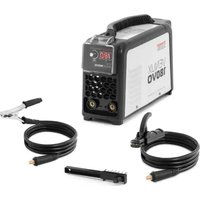
VENUX 180VO - Welding machine Stamos - Free user manual and instructions
Find the device manual for free VENUX 180VO Stamos in PDF.


| Product type | MMA/TIG welding machine |
| Brand | Stamos |
| Model | VENUX 180VO |
| Dimensions (L x D x H) | 37 x 13 x 27 cm |
| Weight | 4.85 kg |
| Supply voltage | 230 V ~ / 50 Hz |
| MMA welding current | 20 - 180 A |
| TIG welding current | 20 - 180 A |
| Duty cycle (MMA) | 60% at 180 A |
| Duty cycle (TIG) | 60% at 180 A |
| Open circuit voltage | 62 V |
| Cooling | Fan |
| Protection rating | IP21S |
| Insulation class | F |
| Compliance standard | EN IEC 60974-1 |
| Main functions | MMA and TIG welding, voltage compensation, stable arc, overload protection |
| Maintenance and cleaning | Regular dusting with dry compressed air |
| Safety | Overvoltage, overcurrent, overheating protection; requires grounding |
| Spare parts and repairability | Available from the manufacturer; repair by qualified personnel |
| General information | Industrial use, emits radio waves, may interfere with medical devices |
Frequently Asked Questions - VENUX 180VO Stamos
User questions about VENUX 180VO Stamos
0 question about this device. Answer the ones you know or ask your own.
Ask a new question about this device
Download the instructions for your Welding machine in PDF format for free! Find your manual VENUX 180VO - Stamos and take your electronic device back in hand. On this page are published all the documents necessary for the use of your device. VENUX 180VO by Stamos.
USER MANUAL VENUX 180VO Stamos
This User Manual has been translated for your convenience using machine translation. Reasonable efforts have been made to provide an accurate translation; however, no automated translation is perfect nor is it intended to replace human translators. The official User Manual is the English version. Any discrepancies or differences created in the translation are not binding and have no legal effect for compliance or enforcement purposes. If any questions arise related to the accuracy of the information contained in the User Manual, please refer to the English version of those contents which is the official version.
Technical data
| Parameter description | Parameter value | ||
| Product name | MMA Welding Machine | ||
| Model | VENUX 140MINI | VENUX 180VO | VENUX 200VO |
| Rated voltage [V~] / frequency [Hz] | 230 / 50 230 / 50 | 230 / 50 | |
| Type of welding | MMA / TIG | MMA / TIG | MMA / TIG |
| Duty cycle [%] | MMA: 60TIG: 60 | MMA: 60TIG: 60 | MMA: 60TIG: 60 |
| Welding current [A] | MMA: 20-140TIG: 20-140 | MMA: 20-180TIG: 20-180 | MMA: 20-200TIG: 20-200 |
| Welding current in 100% duty cycle [A] | MMA: 108TIG: 108 | MMA: 139TIG: 139 | MMA: 155TIG: 155 |
| Welding current in 60% duty cycle [A] | MMA: 140TIG: 140 | MMA: 180TIG: 180 | MMA: 200TIG: 200 |
| Idle voltage [V]. | 60 | 62 | 62 |
| Compliance with the standard | EN IEC 60974-1 | EN IEC 60974-1 | EN IEC 60974-1 |
| Case cooling | Fan | Fan | Fan |
| Insulation class | F | F | F |
| Protection rating IP | IP21S | IP21S | IP21S |
| Dimensions (width x depth x height) [cm] | 26x11x22 | 37x13x27 | 37 x 13 x 23 |
| Weight [kg] | 3 | 4.85 | 4.9 |
Safety information

During the welding or cutting process, there is always the possibility of injury. Therefore, always prioritize safety and take protective measures during operation.
Electric shock – Can lead to death
- Set the earth fitting according to the applicable standards.
- Do not touch electric parts or the electrode with bare skin, wet gloves, or wet clothing.
- Ensure proper insulation from the ground and the workshop at all times.
• Always maintain a safe position when operating the welding machine.
Gas – May be harmful to health
- Avoid inhaling gas by keeping your head away from the welding fumes.
- When arc welding, use an air extractor or ventilation system to prevent breathing in harmful gases.
Arc radiation – Harmful to your eyes and skin
- Wear a suitable helmet with the appropriate light filter to protect your eyes, and use protective clothing to shield your skin from burns.
- Use helmets or curtains to protect bystanders from arc radiation.
Fire hazard
- Welding sparks can cause fires. Ensure that the welding area is clear of flammable materials or tinder.
Noise – Extreme noise can harm your ears
• Use ear protection to safeguard your hearing.
- Warn others in the vicinity that loud noise during welding can be harmful to hearing, and provide ear protection for onlookers if necessary.
Malfunction – Consult professionals in case of issues
- If you encounter problems during installation or operation, refer to the instruction manual to troubleshoot the issue.
- If you are unable to fully understand the manual or resolve the issue, contact the supplier or service center for professional assistance.

CAUTION!
Creepage-protecting switch should be added when using the machine!
Machine Overview
The welding machine is a rectifier that adopts advanced inverter technology to improve performance and efficiency. The development of inverter arc welding equipment is made possible by advancements in inverter power supply theory and components. This machine utilizes a high-power monotube IGBT (Insulated Gate Bipolar Transistor) to convert standard 50/60 Hz input frequency to 50 kHz. The inverter then reduces the voltage, rectifies it, and delivers high-power output using Pulse Width Modulation (PWM) technology. This reduces the weight and volume of the main transformer significantly, increasing efficiency by 30%. The introduction of inverter welding technology is seen as a revolutionary advancement in the welding industry.
With continuous improvements in IGBT technology, the power density of monotube IGBTs has become significantly higher than that of MOSFET (Metal-Oxide-Semiconductor Field-Effect Transistor) tubes. As a result, one monotube IGBT can replace multiple MOSFETs, further reducing the size of inverter welding machines while improving their performance. These improvements have been recognized by experts as a second revolution in inverter welding technology.
Key features of the welding machine:
1) Enhanced arc control: The welding power source delivers a stronger, more focused, and more stable arc. The system responds quickly when the stick and workpiece short, making it
easier to design machines with varied dynamic characteristics. The arc characteristics can be adjusted to be softer or harder based on the specific application.
2) Efficiency and power savings: The machine is highly efficient, conserving power while delivering excellent welding performance.
3) Compact and lightweight: The welding machine is compact in size and light in weight, making it easier to transport, install, and operate.
4) Versatile welding capabilities: This machine is capable of welding a wide range of metals, including stainless steel, alloy steel, carbon steel, copper, and other non-ferrous metals. It supports electrodes of various specifications and materials, including acidic, basic, and cellulose electrodes.
5) Adaptability: The machine can be used in diverse environments, including high-altitude areas, outdoor locations, and for both indoor and outdoor decoration projects.
6) Stable arc and good welding pool: The machine ensures a stable arc with a well-formed welding pool, allowing for high-quality welds.
7) High no-load voltage: It features a high no-load voltage, which helps in maintaining a stable arc and improving the overall welding process.
8) Good force compensation: The machine provides excellent compensation for changes in force, making it adaptable to a variety of welding conditions.
Applications:
This inverter welding machine is suitable for a range of applications, including welding stainless steel, carbon steel, copper, and other colored metals. It is compatible with a variety of electrodes and is ideal for use in diverse environments, from high-altitude locations to both indoor and outdoor projects. Additionally, the machine is easier to install and operate compared to similar products from domestic and international manufacturers.

CAUTION!
This welding machine is primarily intended for industrial use. It emits radio waves during operation, which may pose potential risks. Therefore, workers must take the following protective measures:
- Ensure proper shielding: Use protective equipment designed to minimize exposure to radio waves.
- Maintain a safe distance: Workers should maintain a safe distance from the machine during operation unless necessary for the task.
- Electronic devices: Be cautious if using or wearing electronic medical devices (such as pacemakers), as radio waves may interfere with their functioning.
- Follow safety standards: Always adhere to the safety guidelines established for environments with radio wave emissions.
Installation
The welding machine is equipped with power voltage compensation technology, which allows it to operate normally when the input voltage fluctuates within ±15% of the rated voltage. For best
performance, especially when using long cables, follow the guidelines below to prevent voltage drops and maintain system efficiency.
Step-by-step installation:
1) Ensure proper ventilation:
o Confirm that the air intake of the machine is not blocked or covered. This is essential for the cooling system to function properly and prevent overheating.
2) Ground the machine:
Use a grounding cable with a cross-sectional area of at least 6mm2 to connect the machine's housing to the ground. Attach the grounding cable from the ground-connection screw at the back of the machine to an appropriate earth device.
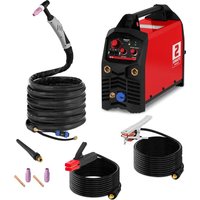
3) Connect the arc torch or holder:
- Refer to the machine's sketch to connect the arc torch or electrode holder correctly.
- Ensure the cable, holder, and fastening plug are securely connected to the ground.
Insert the fastening plug into the fastening socket on the “-” (negative) polarity terminal, and fasten it by turning clockwise.
4) Connect the workpiece clamp:
Insert the fastening plug of the cable into the fastening socket on the "+" (positive) polarity terminal on the front panel, and tighten it clockwise.
- Attach the earth clamp at the opposite end of the cable to the workpiece.
5) Check polarity connection:
○ Pay close attention to the connecting polarity. The welding machine offers two connection methods: positive connection and negative connection.
- Positive connection: The electrode holder connects to the “-” (negative) polarity, while the workpiece connects to the “+” (positive) polarity.
- Negative connection: The workpiece connects to the “-” (negative) polarity, and the holder connects to the “+” (positive) polarity.
○ Choose the correct connection type based on your specific welding needs. An incorrect polarity setup may cause an unstable arc, excessive spatter, and electrode sticking. If these problems occur, swap the polarity of the fastening plug.
6) Connect the power supply:
○ Match the power cable to the appropriate power supply box according to the input voltage rating of the machine. Ensure the connection is correct and that the voltage is within the permissible range.
Once these steps are complete, the installation process is finished, and the machine is ready for welding operations.

CAUTION!
If the distance between the workpiece and the machine is too far (50-100 meters), and the cables (torch cable and earth cable) are too long, please use cables with a larger cross-sectional area. This will help to minimize voltage drop and maintain optimal welding performance.
Using cables that are too thin over long distances can result in reduced voltage, affecting the quality of the weld and potentially damaging the machine.
Operation
Follow these steps to operate the welding machine efficiently:
1) Power on the machine:
Turn on the power switch. The display screen will show the set current level, and the cooling fan will start to operate.
2) Adjust welding parameters:
Use the adjustment knobs to set the welding current and the arc-striking force according to your welding requirements. Ensure that the settings align with the material and electrode type being used.
3) Recommended welding current settings:
- The appropriate welding current depends on the diameter of the welding electrode. Use the following table as a guide to set the current:
| Electrode Specification | Welding Current |
| φ 2.5 mm | 60–100A |
| φ 3.2 mm | 80–140A |
| φ 4.0 mm | 140–220A |
| φ 5.0 mm | 220–250A |
Ensure that the current is adjusted within the specified range for the electrode being used to achieve optimal welding performance.

WARNING! Before connecting operation, please make sure all the power is turned off. The right order is to connect the welding cable and ground cable to the machine first, and make sure they are firmly connected and then put the power plug to the power source.
Notes and Preventive Measures
1. Environmental considerations:
1) Humidity: The machine can operate in dry environments with a maximum humidity level of 90%.
2) Temperature: Ensure that the ambient temperature is between -10°C and 40°C for optimal performance.
3) Sunlight and water exposure: Avoid using the machine in direct sunlight or areas exposed to water, such as drips or rain.
4) Air quality: Do not use the machine in environments polluted with conductive dust or corrosive gases, as this can cause damage to the internal components.
5) Airflow: Avoid welding in environments with strong airflow, as it can interfere with gas shielding during welding.
2. Safety norms:
The welding machine is equipped with protection circuits to safeguard against overvoltage, overcurrent, and overheating. When the machine exceeds the rated voltage, current, or temperature, it will automatically shut off to prevent damage. To avoid issues, follow these preventive measures:
1) Ensure adequate ventilation:
The welding machine generates high currents and requires efficient cooling. Ensure the workspace is well-ventilated, as natural airflow is insufficient for cooling.
- Keep at least 0.3 meters of clearance between the machine and surrounding objects.
○ Make sure the air intake is not blocked, as this affects performance and longevity.
2) Do not overload the machine:
- Always operate within the machine's maximum duty current, which corresponds to the selected duty cycle.
Exceeding the rated duty cycle can lead to machine damage or failure. Monitor the welding current and avoid exceeding the maximum allowable current for the duty cycle.
3) Prevent overvoltage:
- Refer to the machine's technical data to know the allowable power voltage range.
While the machine is equipped with an automatic voltage compensation circuit, exceeding the allowable voltage limits can still damage internal components. Operators should take preventive measures to keep the voltage within the safe range.
4) Ground the machine:
There is a grounding screw with a grounding marker located at the back of the machine.
- Connect a grounding cable with a cross-section of at least 6 mm 2 to ensure proper grounding. This prevents static electricity buildup and protects against electrical leakage.
5) Overheating protection:
- If the machine exceeds its duty cycle limit, it will automatically shut down to prevent overheating.
When this occurs, the temperature control switch will activate, and the red indicator light will turn on.
Do not disconnect the power. Allow the built-in fan to cool the machine. Once the red light turns off and the temperature returns to normal, the machine can be used again.
Common issues encountered during welding and solutions
Welding performance can be affected by factors such as fittings, welding materials, environmental conditions, and power supply issues. To ensure optimal results, users should strive to improve their welding environment. Below are common problems and their possible solutions:
A. Difficulty striking the arc or frequent interruptions
1) Check the quality of the electrode:
○ Make sure you are using high-quality electrodes to achieve stable arc-striking.
2) Ensure the electrode is dry:
If the electrode is damp, it can lead to an unstable arc, increased welding defects, and reduced weld quality. Dry the electrode properly before use.
3) Reduce cable length:
○ Using an excessively long cable reduces the output voltage, making arc-striking more difficult. Shorten the cable to prevent voltage drops.
B. Output current not reaching the rated value
- If the power supply voltage deviates from the rated value, the output current may not match the expected level. When the input voltage is lower than the rated value, the maximum output current will also be lower than the rated value.
C. Unstable current during operation
This can result from the following factors:
1) Fluctuating power supply voltage:
- Changes in the electrical grid voltage can cause instability in the output current.
2) Electrical interference:
- Harmful interference from other equipment or fluctuations in the power grid may cause unstable current. Check the power network for potential sources of interference.
D. Excessive spatter during MMA welding
1) Current too high for the electrode size:
- If the welding current is too high for the diameter of the electrode, excessive spatter will occur. Ensure the current is appropriate for the electrode size.
2) Incorrect polarity connection:
In most cases, for manual metal arc (MMA) welding, the electrode holder should be connected to the negative polarity, and the workpiece to the positive polarity. If the polarity is reversed, excessive spatter can occur. Swap the polarity of the connections to the correct configuration.
Maintenance
Regular maintenance is crucial to ensure the longevity and efficient operation of the welding machine. Follow these steps for proper upkeep:
1) Regular dust removal:
- Use dry and clean compressed air to remove dust from the machine regularly.
- If the machine operates in an environment with heavy smoke or polluted air, it is recommended to remove dust daily.
2) Proper air pressure:
- Ensure that the pressure of the compressed air is within a reasonable range to prevent damage to small internal components.
3) Check internal circuits:
- Regularly inspect the internal circuits of the welding machine to ensure all cables and connectors are properly connected and securely fastened, especially the insert connectors and components.
- If any scaling or loose connections are found, polish the connectors and reconnect them tightly.
4) Prevent water and steam entry:
- Avoid allowing water or steam to enter the machine. If moisture does get inside, dry the interior thoroughly and check the insulation of the machine before using it again.
5) Long-term storage:
- If the welding machine will not be used for an extended period, store it in its original packaging in a dry environment to prevent moisture and dust accumulation.
Troubleshooting
| Indicator of power switch is not lit, fan is not working, and there is no welding output. | A. Ensure the power switch is “on.”B. Verify the input cable is properly connected to the power source. |
| Power indicator is lit, fan does not work, and there is no welding output. | A. If the 220V power is unstable (input cable may be too thin) or the input cable is connected to an electrified wire net, the machine may enter protection mode. Increase the section of the input cable and tighten the connector securely. Turn off the machine for 5-10 minutes, then restart it.B. The power switch may have been opened and closed too quickly, triggering the protection circuit. Turn off the machine and wait 5-10 minutes before restarting.C. Check for loose cables between the power switch and the power source board. Tighten any relaxed connections. |
| Fan is working, but the welding current is unstable or outside regulation (current fluctuates). | A. The 1K regulation resistance may be broken. Replace it.B. The terminal of the output may have a broken circuit or poor connection. Check and fix it. |
| Fan is working abnormally, and there is no welding output. | A. Check for poor connections in the components.B. Ensure the output terminal connector is not broken or poorly connected.C. Measure the voltage between the power source board and the MOS board (VH-07). It should be around 308V DC.D. If the green indicator is not lit on the assistant power of the MOS board, contact the seller or manufacturer for replacement.E. If there is an issue with the control circuit, contact the seller or manufacturer for assistance and replacement. |
| Fan is working abnormally, the indicator is lit, but there is no welding output. | A. Over-current protection may be active. Turn off the machine, wait for the abnormal indicator to turn off, and then restart the machine.B. Overheated protection may be triggered. Wait 5-10 minutes for the machine to cool down before resuming use.C. The inverter circuit may have a fault:1) The IGBT may be damaged. Inspect and replace if necessary.2) A secondary rectifier tube in the transformer may be damaged. Check and replace the rectifier tube if needed.D. The feedback circuit may be malfunctioning. Inspect and repair as necessary. |
Important Notes:
- Any operation involving the inspection or repair of the machine must be performed by qualified personnel who are certified in electrical safety and hold the relevant expertise.
- Before performing maintenance or repairs, it is recommended to contact the manufacturer or authorized service provider for guidance and approval.

C. Ustabil strøm under drift
C. Ustabil strøm under drift
C. Instabil ström under drift
Şoc electric – Poate duce la moarte
For the disposal of the device please consider and act according to the national and local rules and regulations.
CONTACT
expondo Polska sp. z o.o. sp. k.
- SAFETY INFORMATION
- ELECTRIC SHOCK – CAN LEAD TO DEATH
- GAS – MAY BE HARMFUL TO HEALTH
- ARC RADIATION – HARMFUL TO YOUR EYES AND SKIN
- FIRE HAZARD
- NOISE – EXTREME NOISE CAN HARM YOUR EARS
- MALFUNCTION – CONSULT PROFESSIONALS IN CASE OF ISSUES
- CAUTION
- MACHINE OVERVIEW
- KEY FEATURES OF THE WELDING MACHINE
- APPLICATIONS
- INSTALLATION
- STEP-BY-STEP INSTALLATION
- ENSURE PROPER VENTILATION
- GROUND THE MACHINE
- CONNECT THE ARC TORCH OR HOLDER
- CONNECT THE WORKPIECE CLAMP
- CHECK POLARITY CONNECTION
- CONNECT THE POWER SUPPLY
- OPERATION
- POWER ON THE MACHINE
- ADJUST WELDING PARAMETERS
- RECOMMENDED WELDING CURRENT SETTINGS
- NOTES AND PREVENTIVE MEASURES
- ENVIRONMENTAL CONSIDERATIONS
- SAFETY NORMS
- ENSURE ADEQUATE VENTILATION
- DO NOT OVERLOAD THE MACHINE
- PREVENT OVERVOLTAGE
- OVERHEATING PROTECTION
- COMMON ISSUES ENCOUNTERED DURING WELDING AND SOLUTIONS
- DIFFICULTY STRIKING THE ARC OR FREQUENT INTERRUPTIONS
- OUTPUT CURRENT NOT REACHING THE RATED VALUE
- UNSTABLE CURRENT DURING OPERATION
- EXCESSIVE SPATTER DURING MMA WELDING
- INCORRECT POLARITY CONNECTION
- MAINTENANCE
- REGULAR DUST REMOVAL
- PROPER AIR PRESSURE
- CHECK INTERNAL CIRCUITS
- PREVENT WATER AND STEAM ENTRY
- LONG-TERM STORAGE
- TROUBLESHOOTING
- IMPORTANT NOTES
- USTABIL STRØM UNDER DRIFT
- INSTABIL STRÖM UNDER DRIFT
- ŞOC ELECTRIC – POATE DUCE LA MOARTE
- CONTACT
Brand : Stamos
Model : VENUX 180VO
Category : Welding machine