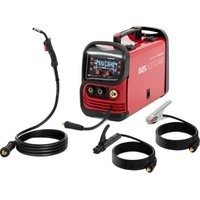
S-MIG 350H - Welding machine Stamos - Free user manual and instructions
Find the device manual for free S-MIG 350H Stamos in PDF.


User questions about S-MIG 350H Stamos
0 question about this device. Answer the ones you know or ask your own.
Ask a new question about this device
Download the instructions for your Welding machine in PDF format for free! Find your manual S-MIG 350H - Stamos and take your electronic device back in hand. On this page are published all the documents necessary for the use of your device. S-MIG 350H by Stamos.
USER MANUAL S-MIG 350H Stamos
This User Manual has been translated for your convenience using machine translation. Reasonable efforts have been made to provide an accurate translation; however, no automated translation is perfect nor is it intended to replace human translators. The official User Manual is the English version. Any discrepancies or differences created in the translation are not binding and have no legal effect for compliance or enforcement purposes. If any questions arise related to the accuracy of the information contained in the User Manual, please refer to the English version of those contents which is the official version.
1. Symbols
| Read the operating instructions. | |
| Recyclable product. | |
| CE | The product meets the requirements of relevant safety standards. |
| Wear protective clothing that protects the entire body | |
| Caution! Wear protective gloves. | |
| Wear protective glasses. | |
| Wear protective footwear. | |
| Caution! Hot surface can cause burns! | |
| Caution! Risk of fire or explosion. | |
| Caution! Harmful vapors, danger of poisoning. Gases and fumes can be hazardous to your health. Welding process gives off welding gases and fumes. Inhalation of these substances can be hazardous to health. | |
| Use a welding mask with an appropriate filter shade. | |
| CAUTION! Harmful radiation from the welding arc | |
| Do not touch live parts. |

CAUTION! The figures in this manual are illustrative only and may vary in some details from the actual appearance of the product.
- Technical data
| Product name | MIG MAG welding machine |
| Product model | S-MIG 350H |
| Nominal input voltage [V] / Frequency [Hz] | 400~/ 50 |
| Type of welding | MIG / MAG | MMA |
| Welding current range [A] | 40-350 (MIG) 20-350 (MMA) |
| Idle voltage [V]. | 65 - MIG / MAG | MMA |
| Rated duty cycle [%] | 60 |
| Welding current in 100% duty cycle [A] | 250 (MIG) 250 (MMA) |
| Welding current in 60% duty cycle [A] | 350 (MIG) 350 (MMA) |
| Wire diameter [mm] | Ø 0.8 - 1.2 |
| Hot start | YES |
| Cooling | Fan |
| Insulation class | F |
| Degree of protection of the housing | IP21S |
| Ambient temperature during operation [°C] | -20 ~ 40 |
| Dimensions [mm] | 560x450x330 |
| Weight [kg] | 46.9 |
3. General Description
The manual is intended to assist in safe and reliable use. The product is designed and manufactured strictly according to technical specifications using the latest technology and components and maintaining the highest quality standards.
CAREFULLY READ AND UNDERSTAND THIS MANUAL BEFORE STARTING THE WORK.
To ensure the long and reliable operation of the device, make sure to operate and maintain it properly in accordance with the guidelines in this instruction manual. The technical data and specifications in this manual are up-to-date. The manufacturer reserves the right to make changes in order to improve the quality. Taking the technical progress and the possibility of reducing noise into account, the unit is designed and built in such a way that risks resulting from noise emissions are reduced to the lowest possible level.
4. Safety of use

CAUTION! Read all safety warnings and instructions. Failure to follow the warnings and instructions may result in electric shock, fire and/or serious injury or death.
The term "device" or "product" in the warnings and the description of the instructions refers to
4.1. General
Take care of your own safety and the safety of bystanders by carefully reading and following the instructions in the unit manual.
Only qualified personnel should be allowed to start up, use, service and repair the unit.
- Do not misuse the unit.
4.2. Guidelines for securing fire hazardous work
Preparing the building and rooms for fire hazardous works consists in:
- cleaning the rooms or places where the work will be carried out of any flammable materials and contamination:
- moving all flammable and non-flammable objects in flammable packaging away to a safe distance:
- securing materials that cannot be removed, e.g. welding spatter, by covering them with e.g. sheet metal, gypsum boards, etc;
- checking whether materials or objects susceptible to ignition in adjacent rooms do not require local protection:
sealing with non-combustible materials all installation and ventilation openings, etc., in the vicinity of the work site: - protecting electrical and gas cables with flammable insulation against welding splashes or mechanical damage, if they are located within the risk range of fire hazardous work:
- make sure that painting or other work with flammable substances is not being carried out at the location where the work is to be done.
Sparks may cause fires
Welding sparks can cause fires, explosions and burns to unprotected skin. Wear welding gloves and protective clothing when welding. Remove or secure all flammable materials and substances from the work area. Do not weld closed containers or tanks that have contained flammable liquids. Such containers or tanks should be flushed before welding to remove flammable liquids. Do not weld near flammable gases, vapors or liquids. Fire fighting equipment (fire blankets and powder or snow extinguishers) should be located near the work area in a visible and easily accessible location.
Cylinders can explode
Use only approved gas cylinders and a properly functioning regulator. Cylinders should be transported, stored and positioned upright. Protect cylinders from heat, tipping and mechanical damage. Keep all parts of gas installation in good condition: cylinder, hose, fittings, regulator.
Welded materials can cause burns
Never touch welded parts with unprotected body parts. Always wear welding gloves and pliers when touching or moving welded material.
4.3. Preparation of the workplace for welding
Caution! Welding can cause a fire or explosion.
- Observe the health and safety regulations for welding work and equip the workplace with an appropriate fire extinguisher
- Welding in places where flammable materials can ignite is forbidden.
-
Welding in an atmosphere containing an explosive mixture of flammable gases, vapors, mists or dusts with air is forbidden.
-
Remove all flammable materials within a radius of 12m from the welding site and, if this is impossible, cover the flammable materials with a non-flammable cover.
- Take precautionary measures against sparks and glowing metal particles.
- Note that sparks or hot metal splinters can penetrate through slots or openings in protective caps, covers or screens.
- Do not weld tanks or barrels that contain or have contained flammable substances. Do not weld in their vicinity either.
- Do not weld pressurized tanks, pressure lines or pressure tanks.
Always provide sufficient ventilation. - Make sure you are in a stable position before starting to weld.
4.4. Personal protective equipment
Caution! Arc radiation can damage the eyes or skin of the body.
- When welding, wear clean, oil-free protective clothing made of non-flammable and non-conductive material (leather, thick cotton), leather gloves, high boots and a protective hood.
- Before welding, get rid of any flammable or explosive items such as propane-butane lighters and matches.
- Use face protection (helmet or shield) and cover the eyes with a shade matching the welder's eyesight and welding current. The safety standards suggest a No. 9 (minimum No. 8) tint for any amperage below 300 A. Lower shield tints may be used if the arc is covered by the workpiece.
- Always use approved safety glasses with a side shield under the helmet or other shield.
- Use workplace shields to protect others from glare or spatter.
- Always wear earplugs or other hearing protection against excessive noise and to prevent spatter from entering your ears.
- Warn bystanders against looking at the electric arc.
4.5. Protection against shock
Caution! Electric shock can be fatal.
-
Plug the power cord into the nearest outlet and route it in a practical and safe way. Avoid spreading the cable carelessly around the room on an unstudied surface, which may result in electric shock or fire.
-
Contact with electrically charged parts can cause an electric shock or severe burns.
- The electric arc and the working area are electrically charged when the current flows.
- The input circuit and the internal circuitry of the unit are also live when the power is on.
- Do not touch the live components.
- Wear dry, lint-free, insulated gloves and protective clothing.
- Use insulating mats or other insulating coatings on the floor that are large enough to prevent contact between the body and the object or the floor.
- Do not touch the electric arc.
- Turn off the power supply before handling, cleaning or replacing the electrode.
- Make sure the grounding cable is properly connected and that the plug is properly inserted into the grounded outlet. Improper grounding of the unit may result in a risk to life or health.
- Regularly check the power cables for damage or lack of insulation. A damaged cable should be replaced. Careless repair of insulation may result in death or personal injury.
- Turn off the device when not in use.
- The cable must not be wrapped around the body.
- The workpiece must be properly grounded.
- Only accessories that are in good condition may be used.
- Damaged parts of the device must be repaired or replaced. Use safety belts when working at heights.
-
All equipment and safety items should be stored in one place.
-
Keep the tip of the handle away from the body when the trigger is activated.
- Attach the ground cable to the workpiece or as close to it as possible (e.g. to the workbench).
Caution! The machine may still be live when the power cord is disconnected.
- After turning off the unit and disconnecting the voltage cable, check the voltage on the input capacitor and make sure that the voltage value is zero, otherwise do not touch the unit components.
4.6. Gases and fumes
Caution! Gas can be hazardous to health or lead to death!
- Always keep a distance from the gas outlet.
- When welding, pay attention to the exchange of air, avoiding gas inhalation.
- Remove chemical substances (greases, solvents) from the surface of the workpieces as they burn under high temperature, giving off poisonous fumes.
- Welding galvanized parts is allowed only with efficient extraction with filtration and a supply of clean air. Zinc vapors are very toxic, and the symptom of poisoning is the so-called zinc fever.
5. Instructions for use
5.1. General
- Use the equipment for its intended purpose, observing the safety regulations and restrictions resulting from the data on the rating plate (IP degree, duty cycle, supply voltage, etc.).
- The unit must not be opened, as this will void the warranty. In addition, exploding naked parts may cause personal injury.
- The manufacturer is not responsible for technical changes to the unit or material damage resulting from such changes.
In case of malfunction contact the service department. - Do not block the ventilation slots of the unit - position the welding machine at a distance of 30cm from surrounding objects.
- Do not hold the welding machine under your arm or close to your body.
- The unit must not be installed in rooms with aggressive environment, high dust and near units with high electromagnetic field emission.
5.2. Storage of the device
- Protect the unit from water and moisture.
- The welder must not be placed on a heated surface.
- Store the machine in a dry and clean room.
5.3. Connecting the unit
5.3.1. Electrical connection
- The unit should be connected by a qualified person. In addition, a person with the necessary qualifications should check that the earthing and electrical installation including protection system complies with safety regulations and is functioning properly.
- Place the unit near the work area.
- Avoid excessively long wires to connect the unit.
- Single-phase welding machines should be connected to an outlet equipped with a grounding pin.
- Welders supplied from 3-phase mains are delivered without a plug, you should obtain one yourself and have it installed by a qualified person.
CAUTION! The device may only be operated if connected to installation with a functional fuse.
5.3.2. Gas connection
- Place the gas cylinders away from the object to be welded and secure them against falling.
- The gas connection of the welding machine must be connected to the gas cylinder or to the gas supply system with a suitable hose and a regulator with a gas flow control. Caution! It is not allowed to use network regulators for gas cylinders and vice versa. Such interchange may result in reducer damage and personal injury.
Economical use of gas prolongs the welding time.
6. Product overview
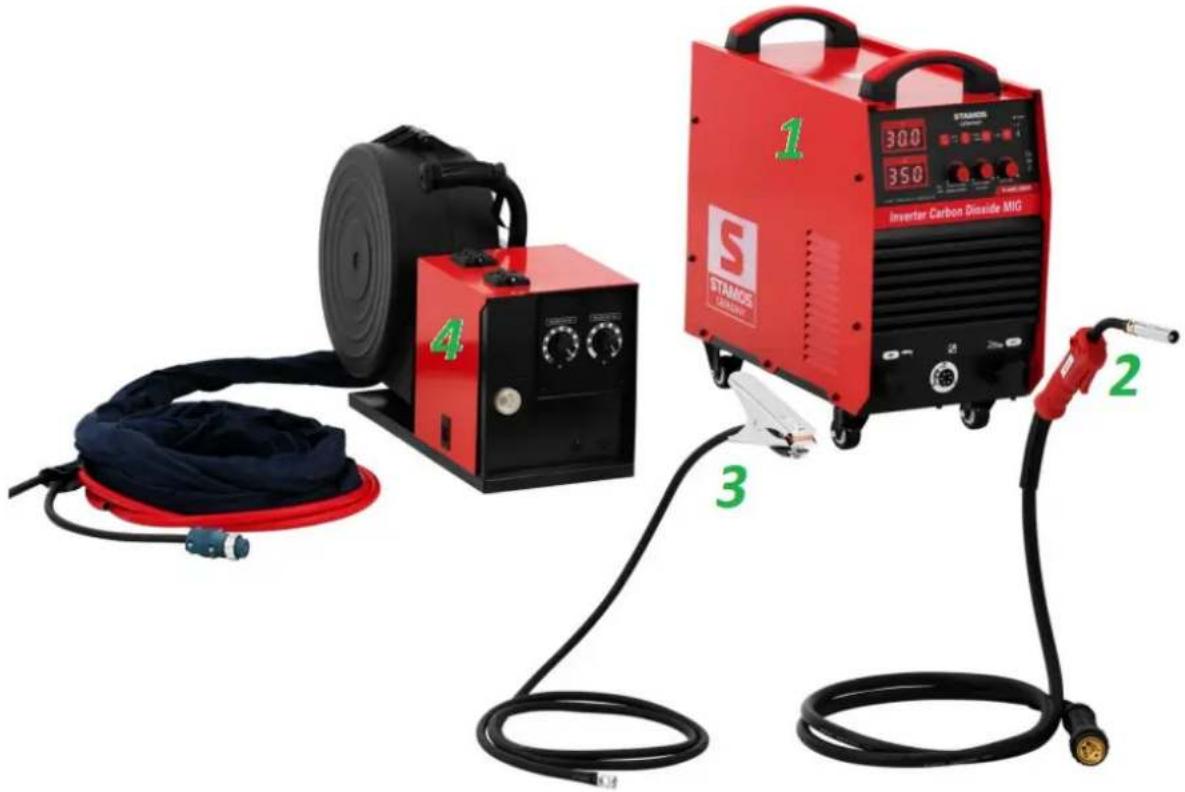
1-MIG/MAG welding machine
2 - MIG / MAG welding holder with cable
3 - ground cable with clamp
4 - wire feeder
Welding machine control panel:
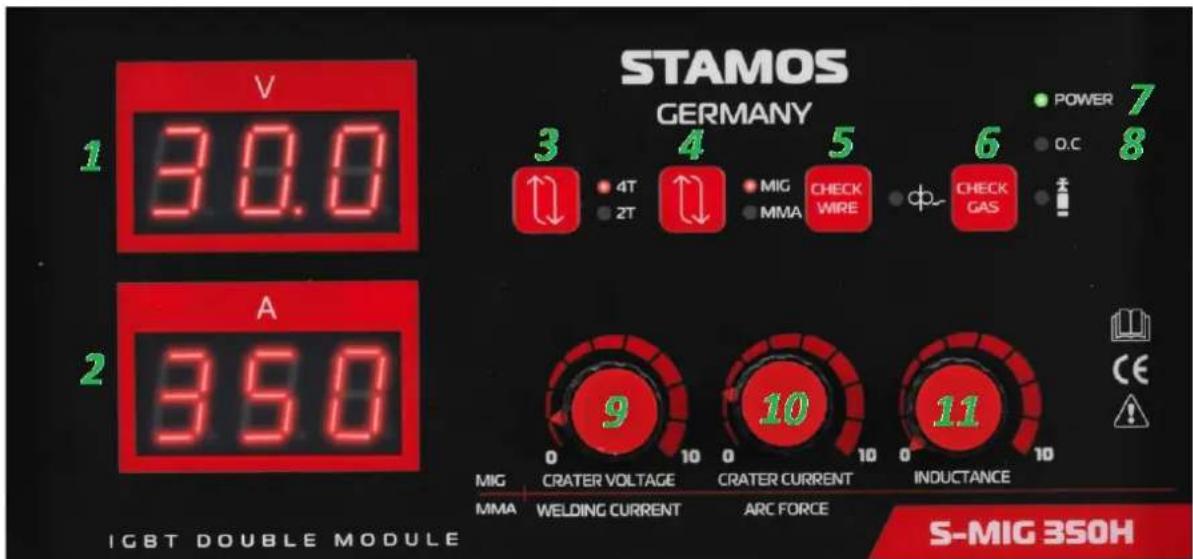
| 1. | Welding voltage display. |
| 2. | Welding current display. |
| 3. | Welding function selection: 2T / 4T for MIG / TIG: · 2T - pressing the button on the welding torch initiates the process of welding/cutting the metal and releasing the button ends the process. · 4T - pressing the button on the welding torch initiates the process of welding/cutting the metal, releasing the button does not end the process. Pressing and releasing the button again completes the metal welding process. |
| 4. | Welding mode selection: MIG / MAG or MMA |
| 5. | CHECK WIRE - wire feed button |
| 6. | CHECK GAS - shielding gas flow check button |
| 7. | POWER - power indicator |
| 8. | OC - thermal overload indicator light - when the device overheats, this light turns on and the device turns off. Do not try to restart welding by leaving the machine with the fans running. The indicator will automatically turn off when the device cools down. Pay attention to the rated duty cycle. |
| 9. | Adjustment knob: · welding current for MMA welding · final welding voltage for MIG / MAG welding |
| 10. | Adjustment knob: · ARC FORCE (arc dynamics control) for MMA welding · final welding current for MIG / MAG welding |
| 11. | Inductance adjustment knob for MIG / MAG welding |
Welding machine connection sockets:
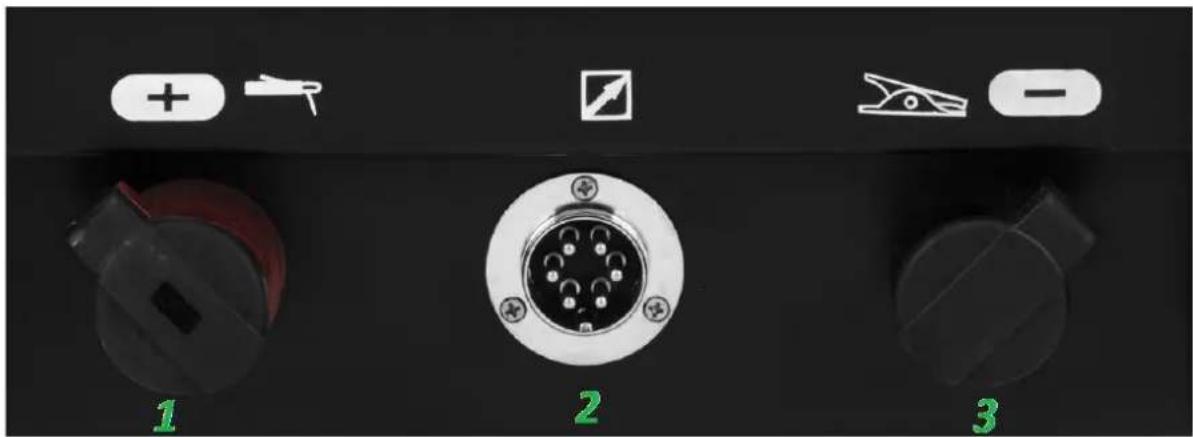
1 - Cable socket (positive pole) - MMA welding
2 - Wire feeder control cable socket - MIG / MAG welding
3 - Cable socket (negative pole) - MIG / MAG welding | MMA
Wire feeder panel:
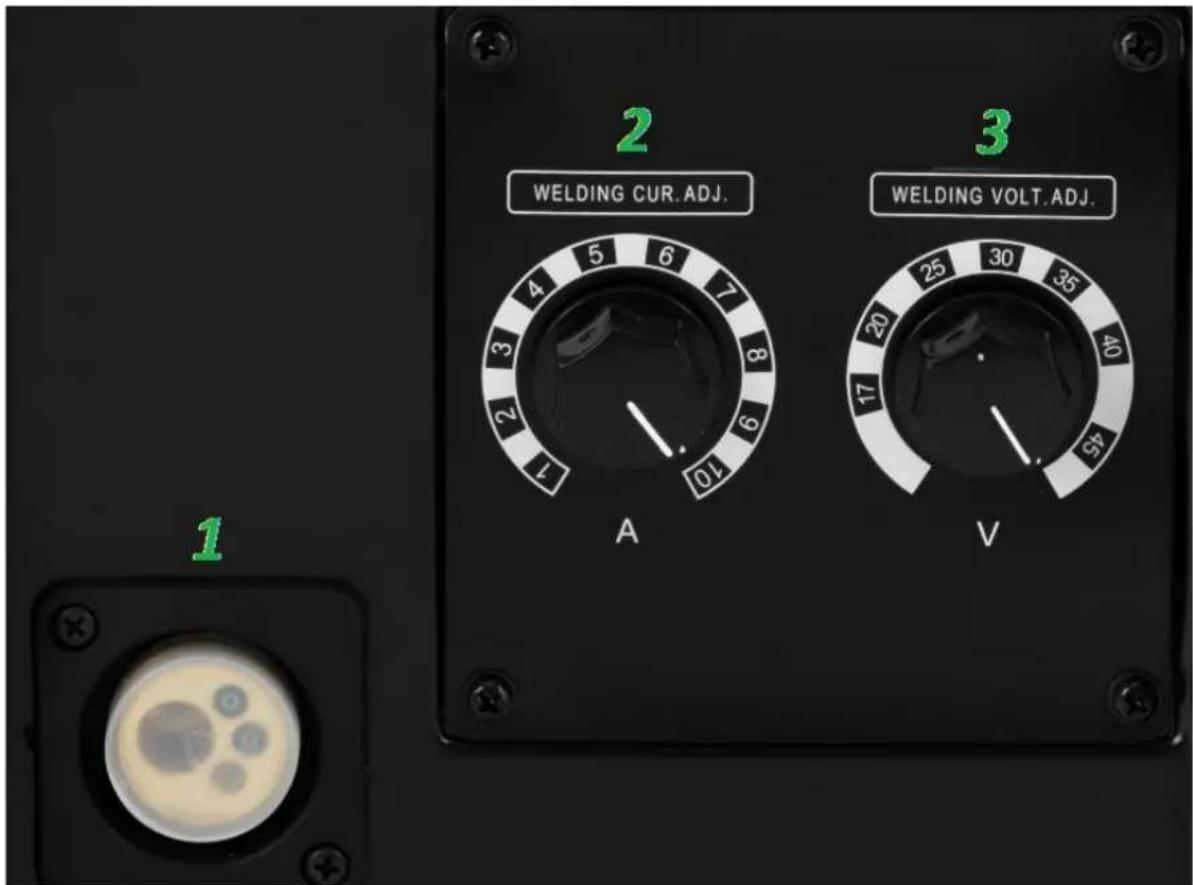
1 - MIG / MAG welding cable connection socket
2 - Welding current adjustment knob
3 - Welding voltage adjustment knob
7. Connecting the wires
CAUTION! The electrical installation to which the machine would be connected should be equipped with an overcurrent fuse.
If an extension cord is used, its cross-section should be at least the same as that of the power cord.
CAUTION! Connecting the cables to the device must be done with the power supply disconnected and the device turned off.
Welding using the MIG/MAG method
1) Insert the welding gun cable plug into the Euro MIG/MAG output socket on the front panel of the machine and tighten it.
2) Insert the ground wire plug into the terminal marked "-" on the front panel of the welding machine and tighten it clockwise.
3) Make sure that the correct welding wire is installed in the machine.
4) Connect the shielding gas cylinder with a pressure reducer to the gas inlet on the rear panel of the machine using a gas hose.
5) Plug the power cord into an electrical outlet and start the machine. After connecting the mass cable to the workpiece, work can begin.
MMA welding
1) Connect the welding gun cable to the connector marked with a "-" sign and twist the cable plug to secure the connection.
2) Connect the ground cable to the connector marked with a "+" sign and twist the cable plug to secure the connection.
Caution! Cable polarity may vary! All polarity information should be described on the packaging provided by the electrode manufacturer!
3) Plug the power cord into an electrical outlet and start the machine. After connecting the mass cable to the workpiece, work can begin.
8. Replacing the drive roller groove
CAUTION! All maintenance, replacement of parts, repairs or adjustments should be carried out with the power supply disconnected from the device.
If you need to change the wire diameter, also replace the drive roller or adjust the position of the drive roller.
Be aware of the different types of rolls depending on the welding wire used:
Rollers with a "V" groove.
Rollers with a "U" groove.
Rollers with a knurled groove.
The most popular are rollers with a V-shaped groove. Such rollers are designed for the most popular welding wires. In the case of aluminum wires, rollers with a U-shaped groove are used. This is due to the fact that the aluminum wire is more prone to crushing, so that the wire does not deform, it is necessary to use an appropriate roller. A separate narrow group of feeder rollers are knurled rollers for cored wire (FCAW).
9. Replacing the welding wire
CAUTION! All maintenance, replacement of parts, repairs or adjustments should be carried out with the power supply disconnected from the device.
- Open the spool housing by pressing the opening buttons and install the spool so that it rotates counterclockwise.
- Secure the spool with the spool lock.
- Unfasten the end of the wire from the spool and hold it in your hand at all times to prevent the spool from unwinding.
- Straighten the end of the wire for about 20cm and cut off the bent part.
- Open the pressure adjustment lever that opens the feeding mechanism.
- Guide the wire through the rear wire guide to the welding gun wire guide.
- Close the feeding mechanism and secure it with the pressure adjustment lever. Make sure that the wire runs in the groove of the drive roll.
- Adjust the pressure of the lever, but do not exceed half of the scale. Too much pressure can damage the wire. On the other hand, if the pressure is too weak, the wire will slide in the feed mechanism and the wire will not move smoothly.
- Make sure that the contact tip suitable for the installed welding wire is inserted into the welding gun. If necessary, replace the contact tip.
- Press the trigger of the welding gun and wait for the wire to come out.
CAUTION! Getting the wire out of the burner requires applying power to the unit. Do not touch any earthed objects with the torch; otherwise, an electric arc may form.
- Close the spool housing cover.
CAUTION! When inserting the wire into the gun, do not point the gun at yourself or at other people. Do not place your hand, e.g., in front of the tip, as the cut end of the wire is very sharp. Also, keep your fingers away from the feed roller, as this may cause your fingers to be pinched between the rollers.
10. Disposal of the packaging
Please keep all packaging material (cardboard, plastic strips and polystyrene foam) to ensure that the unit is protected during shipment, should it become necessary to send it to a service center!
11. Transport and storage
When transporting the unit, protect it from shocks and tipping over, and do not place it "upside down". Store the unit in a well-ventilated room where dry air is present and corrosive gases are not present.
12. Cleaning and maintenance
- Before each cleaning, and also when the device is not in use, disconnect the power plug and let the device cool down completely.
- Remove the spatter from the tip of the welding gun and check the condition of the parts. Damaged parts must be replaced immediately.
- Use only non-corrosive cleaning agents for cleaning surfaces.
- Do not spray the unit with a stream of water or immerse it in water.
- Make sure that no water enters through the ventilation openings in the casing.
- Clean the ventilation openings with a brush and compressed air.
After each cleaning, all the parts should be dried well before the unit is used again. -
Store the unit in a dry and cool place protected from moisture and direct sunlight.
-
Remove dust regularly with dry and clean compressed air.
13. Regular inspection of the device
- Check the unit regularly for damage. If this is the case, stop using the unit. Please contact your dealer immediately for repair.
NOTE: Never open the device without consulting customer service. This can lead to loss of warranty.

For the disposal of the device please consider and act according to the national and local rules and regulations.
CONTACT
expondo Polska sp. z o.o. sp. k.