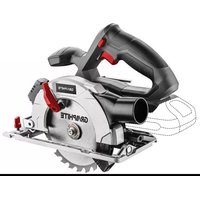
58G008 - Saw Graphite - Free user manual and instructions
Find the device manual for free 58G008 Graphite in PDF.


| Brand | Graphite |
| Model | 58G008 |
| Product Type | Cordless Circular Saw |
| Power Supply | 18 V DC Battery |
| No-Load Speed | 4200 min⁻¹ |
| Max. Outer Blade Diameter | 150 mm |
| Blade Bore | 10 mm |
| Max. Cutting Depth (90°) | 48 mm |
| Max. Cutting Depth (45°) | 36 mm |
| Bevel Cutting Range | 0° to 45° |
| Weight | 2.475 kg |
| Protection Rating | IPX0 |
| Laser Guide | Yes (Class 2, ≤1 mW, 650 nm) |
| Sound Pressure Level | 79.2 dB(A) (K=3 dB) |
| Sound Power Level | 90.2 dB(A) (K=3 dB) |
| Vibration (Main Handle) | 1.29 m/s² (K=1.5) |
| Plunge Cutting Capacity | Yes |
| Parallel Guide Included | Yes |
| Dust Extraction Port | Yes |
| Lower Guard | Yes, with return spring |
| Safety | Switch lock, anti-kickback protection |
| Motor | Permanent magnet commutator (brushed) |
| Maintenance | Cleaning with brush or compressed air; do not use liquids |
| Blade Replacement | Yes, hex key provided |
| Recommended Use | Wood and wood-based materials, DIY and workshop |
Frequently Asked Questions - 58G008 Graphite
User questions about 58G008 Graphite
0 question about this device. Answer the ones you know or ask your own.
Ask a new question about this device
Download the instructions for your Saw in PDF format for free! Find your manual 58G008 - Graphite and take your electronic device back in hand. On this page are published all the documents necessary for the use of your device. 58G008 by Graphite.
USER MANUAL 58G008 Graphite
natural_image
Black-and-white photo of a GRAPHITE industrial cutting tool with visible blade and base plate (no text or symbols on the device itself)58G008
10 ^* LAT
DOSTĘPNOŚCI
CZEŚCI ZAMIENNYCH

EN TRANSLATION (USER) MANUAL
CORDLESS CIRCULAR SAW
58G008
NOTE: BEFORE USING THE APPLIANCE, PLEASE READ THIS MANUAL CAREFULLY AND KEEP IT FOR FUTURE REFERENCE.
SPECIFIC SAFETY PROVISIONS
SPECIAL REGULATIONS FOR THE SAFE OPERATION OF CIRCULAR SAWS WITHOUT RIVING KNIFE
NOTE!
- The battery supplying the unit must be removed before carrying out any adjustment, operation (replacement of the cutting disc) or repair work.
- Keep hands away from the cutting area and the cutting disc. Keep the other hand on the auxiliary handle or on the motor housing. If you hold the saw with both hands, you reduce the risk of injury from the cutting disc.
- Do not reach underneath the workpiece with your hand. The guard cannot protect you from the rotating cutting disc below the workpiece.
- Set the depth of cut appropriate to the thickness of the workpiece. It is recommended that the cutting disc extends below the material to be cut to less than tooth height.
- Never hold the workpiece to be cut in your hands or on your leg. Fix the workpiece to a solid base. Good clamping of the workpiece is important to avoid the danger of contact with the body, jamming of the rotating cutting disc or loss of cutting control.
- Hold the saw by the insulated surfaces intended for this purpose during operation where the rotating cutting wheel may come into contact with live wires. Contact with "live wires" of metal parts of the machine may cause electric shock to the operator.
- Always use a slitting guide or edge guide when slitting. This improves cutting accuracy and reduces the possibility of jamming of the rotating cutting disc.
- Always use a cutting disc with the correct size of mounting holes. Cutting discs that do not fit into the mounting slot may run eccentrically, causing a loss of work control.
- Never use damaged or inappropriate washers or screws to secure the cutting disc. The washers and bolts securing the cutting disc have been specially designed for the saw to ensure optimum function and safety in use.
DISCARDING, CAUSES OF DISCARDING AND PREVENTION OF DISCARDING
- Rear kickback is the sudden lifting and retraction of the saw towards the operator in the line of cut, caused by an uncontrolled cut by a snagged, clamped or improperly guided saw blade;
- When the saw blade is snagged or clamped in a slot, the blade stops and the motor reaction causes the saw to move rapidly backwards towards the operator;
- If the saw is twisted or misaligned in the workpiece to be cut, the teeth of the saw, on exiting the material, can strike the upper surface of the material being cut causing the saw to lift and kick back towards the operator.
- CAUTION: Rear kickback is the result of improper use of the chainsaw or improper procedures or operating conditions and can be avoided by taking the appropriate precautions below
- Hold the saw with both hands firmly, with the arms positioned to withstand the force of rear kickback. Assume a body position on one side of the saw, but not in the line of cut. Rear kickback can cause the saw to move violently backwards, but the force of the rear kickback can be controlled by the operator if proper precautions are taken.
-
When the cutting disc jams or when it stops cutting for some reason, release the switch button and hold the saw stationary in the material until the cutting disc stops completely.
-
Never attempt to remove the cutting disc from the cut material or pull the saw backwards as long as the cutting disc is moving can cause rear kickback. Investigate and take corrective action to eliminate the cause of the cutting disc jamming.
- When restarting the saw in the workpiece, centre the cutting disc in the cut and check that the teeth of the cutting disc are not jammed in the material. If the cutting disc jams when the saw is restarted, it may slide out or cause backlash against the workpiece.
- Support large slabs to minimise the risk of clamping and rear kickback of the saw. Large slabs tend to bow under their own weight. Supports should be placed under the slab on both sides, near the cutting line and close to the edge of the slab.
- Do not use dull or damaged cutting discs. Unsharpened or misaligned cutting disc teeth create a narrow cut causing excessive friction, jamming of the cutting disc and rear kickback.
- Set the cutting depth and tilt angle clamps securely before making the cut. If the saw settings change during the cut this can cause jamming and rear kickback.
- Be particularly careful when making plunge cuts in partitions. The cutting disc may cut other objects not visible from the outside, causing rear recoil.
FUNCTIONS OF THE LOWER PROTECTIVE COVER
- Check the bottom guard before each use to ensure that it is correctly retracted. Do not use the saw if the bottom guard does not move freely and does not come off immediately. Never attach or leave the bottom guard in the open position. If the saw is accidentally dropped, the bottom guard may be bent. Lift the bottom guard using the pull-back handle and ensure that it moves freely and does not touch the cutting blade or any other part of the machine for each angle and depth of cut setting.
- Check the function of the bottom guard spring. If the guard and spring are not working properly, they should be repaired before use. Poor operation of the bottom guard can be slowed down by damaged parts, sticky deposits, or build-up of waste.
- Manual withdrawal of the bottom guard is only permitted for special cuts such as "plunge cuts" and "compound cuts". Raise the bottom guard with the pull-back handle and when the cutting disc penetrates the material, the bottom guard should be released. For all other cuts, it is recommended that the bottom guard operates automatically.
- Always observe that the bottom guard covers the cutting disc before putting the saw down on the workbench or floor. An uncovered, rotating cutting disc will cause the saw to move backwards cutting anything in its path. Consider the time it takes for the cutting disc to stop after switching off.
ADDITIONAL SAFETY INSTRUCTIONS
- Do not use cutting discs that are damaged or deformed.
- Do not use abrasive discs.
- Only use cutting discs recommended by the manufacturer that meet the requirements of EN 847-1.
- Do not use cutting discs that do not have carbide-tipped teeth.
- Dusts from certain wood species can be a health hazard. Direct physical contact with the dusts can cause allergic reactions and/or respiratory diseases of the operator or people nearby. Oak or beech dusts are considered carcinogenic, especially when combined with wood treatment substances (wood preservatives).
Use personal protective equipment such as:
- hearing protectors to reduce the risk of hearing loss;
- eye protection;
- respiratory protection to reduce the risk of inhaling harmful dust;
- gloves for handling cutting discs and other rough and sharp materials (cutting discs should be held by the hole whenever possible);
Connect a dust extraction system when cutting wood.
- It is important to select a cutting disc according to the type of material to be cut.
- Do not use the chainsaw to cut materials other than wood or wood-like materials.
-
Do not use the chainsaw without the guard or when it is blocked.
-
The floor in the area where the machine is working should be well maintained with no loose material or protrusions.
- Adequate lighting of the work area must be provided.
- The employee operating the machine should be properly trained in the use, operation and handling of the machine.
- Pay attention to the maximum speed marked on the cutting disc.
- Ensure that the parts used comply with the manufacturer's recommendations.
- If the saw is equipped with a laser, replacement with another type of laser is not permitted and repairs should be carried out by a service centre.
Do not use the unit stationary. It is not suitable for use with a sawing table.
SAFETY RULES FOR THE LASER DEVICE
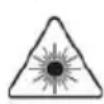
- The laser device used in the construction of the saw is class2, with a maximum power of <1 mW, at a radiation wavelength of = 650 nm. Such a device is not dangerous to the eyesight, but one must not look directly in the direction of the radiation source (risk of temporary blindness).
- WARNING! Do not look directly into the laser light beam. There is a risk of danger. Observe the following safety rules.
- Use the laser device in accordance with the manufacturer's recommendations.
- Never intentionally or unintentionally direct the laser beam towards people, animals or an object other than the work material.
- The laser beam must not be accidentally directed towards the eyes of bystanders and animals for more than 0.25 seconds, for example by directing the light beam through mirrors.
- It is always necessary to ensure that the laser light is directed at a material that has no reflective surfaces.
- Shiny sheet steel (or other materials with a reflective surface) does not allow the use of laser light, as this could then result in dangerous reflections towards the operator, third parties or animals.
- Do not replace the laser unit with another type. All repairs should be carried out by the manufacturer or an authorised person.
ATTENTION! Adjustments other than those specified in this manual involve a risk of exposure to laser radiation!
ATTENTION: The device is intended for indoor operation. Despite the inherently safe design, the use of safety measures and additional protective measures, there is always a risk of residual injury during operation.
Explanation of the used pictograms

1
6

2

7

3
8
4
9
5

10
1. Note: Take special precautions!
-
Read the operating instructions, observe the warnings and safety conditions contained therein!
-
Use personal protective equipment (safety goggles, ear protection, dust mask).
-
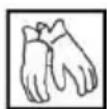
Use protective gloves.
-
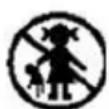
Keep children away from the tool.
-
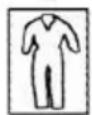
Use protective clothing.
-
Protect the unit from moisture.
-
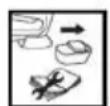
Remove the battery from the device before adjusting or cleaning the
-
Caution: Laser radiation!
-
Caution: sharp elements!
CONSTRUCTION AND PURPOSE
The circular saw is a battery-powered power tool. It is driven by a permanent magnet DC commutator motor together with a gearbox. This type of power tool is widely used for sawing wood and wood-based materials. It should not be used for sawing firewood. Attempts to use the saw for purposes other than those specified will be considered inappropriate use. Use the circular saw only with suitable carbide-tipped saw blades. The circular saw is designed for light work in service workshops and for all work in the area of independent amateur activity (DIY).
WARNING! Do not misuse the power tool.
DESCRIPTION OF THE GRAPHIC PAGES
The numbering below refers to the components of the unit shown on the graphic pages of this manual.
- Dust discharge nozzle
2.Top cover
3.Switch lock button
4.Switch
5.Bottom cover lever
6.Front handle - Laser
- Cutting disc
9.Flange washer
10.Cut-off wheel fastening screw - Bottom cover
- Cutting depth guide
13.Basic handle
14.Battery attachment socket
15.Spindle lock button
16.Foot
17.Foot setting lock knob - Cutting line indicator for 45°
- Cutting line indicator for 0°
- Parallel guide lock screw
- Cutting depth lock knob
22.Parallel guide
* There may be differences between the drawing and the product.
EQUIPMENT AND ACCESSORIES
-
Parallel guide - 1 pc.
-
Hexagonal spanner - 1 pc.
PREPARATION FOR WORK
SETTING THE CUTTING DEPTH
The cutting depth at right angles can be adjusted from 0 to 48 mm.
Loosen the depth of cut lock knob (21).
Set the desired cutting depth (using the scale).
Lock the depth of cut lock knob (21) (fig. A).
INSTALLATION OF PARALLEL CUTTING GUIDE
The parallel cutting guide can be mounted on the right or left side of the machine foot.
- Loosen the parallel guide lock screw (20).
- Insert the parallel guide bar into the holes in the footplate(16), set the desired distance (using the graduations) and fix by tightening the parallel guide locking screws (20) (fig. B).
NOTE: The guide bar of the parallel guide should face downwards.
The parallel guide (22) can also be used for bevel cutting from 0^ to 45^0 .
CAUTION: Never allow your hand or fingers to be behind the running saw. If recoil occurs, the saw may fall on your hand and cause serious injury.
HINGING BOTTOM COVER
The bottom guard (11) of the cutting disc (8) automatically pushes back as it comes into contact with the material to be cut. To remove it manually, move the lower guard lever (5).
DUST EXTRACTION
The circular saw is equipped with a dust extraction port (1) for extracting the chips and dust generated during cutting.
WARNING! Hold the chainsaw with both hands when starting, as the torque of the motor may cause the power tool to rotate uncontrollably. Be aware that after the saw has been switched off, its moving parts are still spinning for some time.
- The device is equipped with a safety switch to prevent accidental activation. The safety button is located on both sides of the housing.
- Switching on:
- Press one of the switch lock buttons (3) and hold it in this position (Fig. C).
- Press the on/off button (2) (Fig. D).
- Once the unit has been started, the switch lock button (3) can be released.
Switching off:
Releasing pressure on the on/off button (4) stops the unit.
LASER ACTION
WARNING! Never look directly into the laser beam or its reflection from a mirrored surface and never point the laser beam towards any person.
- Each time the switch lock button (3) is pressed, the laser (7) is illuminated. The light from the laser beam allows better control of the line of cut obtained. The laser generator (7) supplied with the saw is designed for use in precision cutting.
- Press the switch lock button (3) and the switch (4).
- The laser will begin to emit a red line, visible on the material.
- The cut should be made along this line.
ATTENTION: Cutting dust can dull the laser light, so the laser projector lens must be cleaned from time to time.
CUTTING
- The cutting line is determined by the cutting line indicator (18) for an angle of 45^ or (19) for an angle of 0^ (Fig. E).
- When starting work, always hold the saw securely with both hands using both handles.
- The saw must only be switched on when it is away from the material to be cut.
- Do not push the saw with excessive force, apply moderate, continuous pressure.
- Allow the cutting disc to come to a complete stop when cutting is complete.
- If the cut is interrupted before it is intended to be completed, when continuing, first wait until the saw has reached its maximum speed after starting and then carefully guide the cutting disc into the cut material.
- When cutting across the fibres of the material (wood), sometimes the fibres have a tendency to rise up and tear off (moving the saw at low speed minimises this tendency).
- Ensure that the bottom guard reaches the end position in its movement.
- Always ensure that the depth of cut lock knob and saw foot setting lock knob are properly tightened before cutting.
- Only cutting discs with the correct outer diameter and bore diameter of the cutting disc seat must be used with the saw.
- The material to be cut should be immobilised securely.
- The wider part of the saw foot should be placed on the part of the material that is not being cut.
ATTENTION: If the dimensions of the material are small, the material must be restrained with carpenter's clamps. There is a
danger of kickback if the saw blade does not slide over the material but is raised.
WARNING! Adequate restraint of the material to be cut and a firm grip on the saw ensure full control of the power tool, thus avoiding the danger of personal injury. Do not attempt to support short pieces of material by hand.
FOOT ADJUSTMENT FOR ANGLED CUTTING
- The adjustable saw foot allows for angled cuts from 0^ to 45^ .
- Loosen the foot setting lock knob (17) (fig. F).
- Adjust the foot (16) to the desired angle (from 0^ to 45^ ) using the scale.
- Tighten the foot setting lock knob (17).
NOTE: When cutting at an angle, there is a greater risk of kickback (greater possibility of jamming the saw blade), so make sure the saw blade is fully engaged with the workpiece. Cut in a smooth motion.
CUTTING BY CUTTING INTO THE MATERIAL
- Set the desired depth of cut corresponding to the thickness of the material to be cut.
- Tilt the saw so that the front edge of the foot (16) of the saw is against the material to be cut and the marker for perpendicular cuts is on the line of the intended cut.
- Once the saw has been positioned at the start of cutting, raise the bottom guard (11) using the bottom guard lever (5) (saw blade raised above the material).
- Start the power tool and wait for the cutting disc to reach full speed.
- Gradually lower the saw by plunging the cutting disc into the material (during this movement, the front edge of the saw foot should be in contact with the surface of the material).
- When the cutting disc starts cutting, release the bottom guard.
- When the saw foot rests on the material with its entire surface, continue cutting by moving the saw forward.
- Never reverse the saw with a rotating cut-off wheel, as there is a risk of back kickback.
- Complete the cut in the reverse manner to its start by rotating the saw around the line of contact between the front edge of the saw foot and the workpiece.
- Allow its cutting disc to come to a complete stop before pulling the saw out of the material when the saw is switched off.
- If necessary, the corner bevels should be finished using a circular saw or handsaw.
CUTTING OR SEVERING LARGE PIECES OF MATERIAL
ATTENTION: When cutting larger boards or planks, support them properly to avoid possible jerking of the cutting disc (recoil phenomenon) due to the disc jamming in the cut.
WARNING! Remove the battery from the unit before performing any installation, adjustment, repair or operation.
MAINTENANCE AND STORAGE
- It is recommended to clean the device immediately after each use.
- Do not use water or other liquids for cleaning.
- The unit should be cleaned with a brush or blown with low-pressure compressed air.
- Do not use any cleaning agents or solvents, as these may damage the plastic parts.
- Clean the ventilation slots in the motor housing regularly to prevent the unit from overheating. Do not clean the ventilation slots by inserting sharp items such as screwdrivers or similar objects into the slots.
- During normal operation, the cutting disc becomes dull after some time. A sign of dulling of the cutting disc is the need to increase the pressure when moving the saw during cutting.
- If the cutting disc is found to be damaged, it must be replaced immediately.
- The cutting disc should always be sharp.
- Always store the device in a dry place out of the reach of children.
- Store the device with the battery removed.
REPLACEMENT OF THE CUTTING DISC
- Using the spanner provided, unscrew the screw holding the cutting disc (10) by turning counterclockwise.
- To prevent the saw spindle from rotating, lock the spindle with the spindle lock button (15) (fig. G) when unscrewing the cut-off wheel fixing screw.
- Remove the outer flange washer (9).
- Using the lower guard lever (5), move the lower guard (11) so that it retracts as far as possible into the upper guard (2) (at this time, check the condition and function of the lower guard retraction spring).
- Extend the cutting disc (8) through the slot in the saw foot (16).
- Set the new cutting disc in a position where the alignment of the teeth of the cutting disc and the arrow on it are fully in line with the direction shown by the arrow on the lower and upper guard.
- Insert the cutting disc through the slot in the saw foot and mount it on the spindle so that it is pressed against the surface of the inner flange and centred on its undercut.
- Fit the outer flange washer (9) and tighten the cutting disc fixing screw (10) by turning clockwise.
- Always place the hexagonal spanner in the storage area after completing the cutting disc replacement operation
NOTE: Take care to mount the cutting disc with the teeth aligned in the correct direction. The direction of rotation of the power tool spindle is shown by an arrow on the saw housing. Take special care when gripping the cutting disc. Protective gloves must be used to protect your hands from contact with the sharp teeth of the cutting disc.
Any defects should be rectified by the manufacturer's authorised service department.
TECHNICAL SPECIFICATIONS
RATING DATA
| Parameter | Value | |
| Battery voltage | 18 V DC | |
| Speed (no load) | 4200 min ^-1 | |
| Diagonal cutting range | 0° ÷ 45° | |
| Max. outside diameter of cutting disc | 150 mm | |
| Inner diameter of the cutting disc | 10 mm | |
| Max. cutting depth | At a 90° angle | 48 mm |
| At a 45° angle | 36 mm | |
| IP degree of protection | IPX0 | |
| Protection class | III | |
| Laser class | 2 | |
| Laser power | P≤1 mW | |
| Radiation wavelength | Λ=650 nm | |
| Mass | 2,475 kg | |
| Year of production | ||
| NOISE AND VIBRATION DATA | ||
| Sound pressure level | LPA=79.2 dB(A), K=3 dB(A) | |
| Sound power level | LWA=90.2 dB(A), K=3 dB(A) | |
| Vibration acceleration value main handle | ah=1.29 m/s ^2 K=1.5 m/s ^2 | |
| Vibration acceleration value auxiliary handle | ah=2.02 m/s ^2 K=1.5 m/s ^2 | |
Information on noise and vibration
The noise emission level of the equipment is described by: the emitted sound pressure level LpA and the sound power level LwA (where K denotes the measurement uncertainty). The vibrations emitted by the equipment are described by the vibration acceleration value ah (where K denotes the measurement uncertainty).
The sound pressure emission level LpA, the sound power level LwA and the vibration acceleration value ah given in these instructions have been measured in accordance with EN 62841-1:2015. The vibration level ah given can be used to compare equipment and to make a preliminary assessment of vibration exposure.
The vibration level quoted is only representative of the basic use of the unit. If the unit is used for other applications or with other work tools, the vibration level may change. Higher vibration levels will be influenced by insufficient or too infrequent maintenance of the unit. The reasons given above may result in increased vibration exposure during the entire working period.
In order to accurately estimate vibration exposure, it is necessary to take into account periods when the unit is switched off or when it is switched on but not used for work. When all factors are accurately estimated, the total vibration exposure may be significantly lower.
In order to protect the user from the effects of vibration, additional safety measures should be implemented, such as cyclical maintenance of the machine and working tools, securing an adequate hand temperature and proper work organisation.
ENVIRONMENTAL PROTECTION
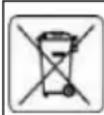
Electrically-powered products should not be disposed of with household waste, but should be taken to the appropriate disposal facilities. Contact your product dealer or local authority for information on disposal. Waste electrical and electronic equipment contains environmentally inert substances. Equipment that is not recycled poses a potential risk to the environment and human health.
"Grupa Topex Spółka z ograniczoną odpowiedzialnością" Spółka komandytowa with its registered office in Warsaw, ul. Pograniczna 2/4 (hereinafter: "Grupa Topex") informs that all copyrights to the content of this manual (hereinafter: "Manual"), including, among others. Its text, photographs, diagrams, drawings, as well as its composition, belong exclusively to Grupa Topex and are subject to legal protection under the Act of 4 February 1994 on Copyright and Related Rights (Journal of Laws 2006 No. 90 Poz. 631, as amended). Copying, processing, publishing, modification for commercial purposes of the entire Manual and its individual elements, without the consent of Grupa Topex expressed in writing, is strictly prohibited and may result in civil and criminal liability.
EC Declaration of Conformity
Manufacturer: Grupa Topex Sp. z o.o. Sp.k., Pograniczna 2/4 02-285 Warszawa
Product: Cordless circular saw
Model: 58G008
Trade name: GRAPHITE
Serial number: 00001 ÷ 99999
This declaration of conformity is issued under the sole responsibility of the manufacturer.
The product described above complies with the following documents:
Machinery Directive 2006/42/EC
Electromagnetic Compatibility Directive 2014/30/EU
RoHS Directive 2011/65/EU as amended by Directive 2015/863/EU
And meets the requirements of the standards:
EN 62841-1:2015; EN 62841-2-5:2014;
EN 55014-1:2017+A11:2020; EN 55014-2:2015;
EN IEC 63000:2018
Notified body:
No. 0598; SGS FIMKO OY; P.O. Box 30 (Särkiniementie 3); 00211 HELSINKI; Finland
EC type-examination certificate no:
GS/19/HEL/11006
This declaration relates only to the machinery as placed on the market and does not include components
added by the end user or carried out by him/her subsequently.
Name and address of the EU resident person authorised to prepare the technical dossier:
Signed on behalf of:
Grupa Topex Sp. z o.o. Sp.k.
TOPEX GROUP Quality Officer
Warsaw, 2023-11-30
ĎALŠIE BEZPEČNOSTNÉ POKYNY
1.Paralleelsed juhised - 1 tk.
2.Kuuekantvötmed - 1 tk.
TÖÖKS ETTEVALMISTAMINE
LÖIKAMISSÜGAVUSE SEADMINE
DODATNE SIGURNOSNE UPUTE
- Ne koristite diskove za rezanje koji su oštećeni ili deformirani.
- Ne koristite abrazivne diskove.
- Koristite samo rezne diskove koje preporučuje proizvođač, a koji zadovoljavaju zahtjeve norme EN 847-1.
- Ne koristite diskove za rezanje koji nemaju zube s vrhom karbida.
- Prašine iz određenih vrsta drva mogu biti opasne po zdravlje. Izravan fizički kontakt s prašinom može uzrokovati alergijske reakcije i/ili bolesti dišnog sustava operatera ili osoba u blizini. Hrastove ili bukove prašine smatraju se kancerogenima, osobito u kombinaciji s tvarima za obradu drva (konzervansi za drvo).
Koristite osobnu zaštitnu opremu kao što su:
TAPA INFERIOR ABATIBLE
VERTALING (GEBRUIKERS)HANDLEIDING
ACCUCIRKELZAAG
58G008
LET OP: LEES DEZE HANDLEIDING ZORGVULDIG DOOR VOORDAT U HET APPARAAT GEBRUIKT EN BEWAAR HEM ZODAT U HEM LATER KUNT RAADPLEGEN.
SPECIFIEKE VEILIGHEIDSVOORSCHRIFTEN
SPECIALE VOORSCHRIFTEN VOOR VEILIG GEBRUIK VAN CIRKELZAGEN ZONDER SPONNINGMES
OPMERKING!
REPLACEMENT DU DISQUE DE COUPE
DONNÉES D'ÉVALUATION
Directive Machines 2006/42/CE


- EN TRANSLATION (USER) MANUAL
- CORDLESS CIRCULAR SAW
- NOTE: BEFORE USING THE APPLIANCE, PLEASE READ THIS MANUAL CAREFULLY AND KEEP IT FOR FUTURE REFERENCE.
- SPECIFIC SAFETY PROVISIONS
- SPECIAL REGULATIONS FOR THE SAFE OPERATION OF CIRCULAR SAWS WITHOUT RIVING KNIFE
- NOTE!
- DISCARDING, CAUSES OF DISCARDING AND PREVENTION OF DISCARDING
- FUNCTIONS OF THE LOWER PROTECTIVE COVER
- ADDITIONAL SAFETY INSTRUCTIONS
- Connect a dust extraction system when cutting wood.
- SAFETY RULES FOR THE LASER DEVICE
- Note: Take special precautions!
- CONSTRUCTION AND PURPOSE
- DESCRIPTION OF THE GRAPHIC PAGES
- EQUIPMENT AND ACCESSORIES
- PREPARATION FOR WORK
- SETTING THE CUTTING DEPTH
- INSTALLATION OF PARALLEL CUTTING GUIDE
- HINGING BOTTOM COVER
- DUST EXTRACTION
- Switching off:
- LASER ACTION
- CUTTING
- FOOT ADJUSTMENT FOR ANGLED CUTTING
- CUTTING BY CUTTING INTO THE MATERIAL
- CUTTING OR SEVERING LARGE PIECES OF MATERIAL
- MAINTENANCE AND STORAGE
- REPLACEMENT OF THE CUTTING DISC
- TECHNICAL SPECIFICATIONS
- ENVIRONMENTAL PROTECTION
- EC Declaration of Conformity
- GS/19/HEL/11006
- ĎALŠIE BEZPEČNOSTNÉ POKYNY
- TÖÖKS ETTEVALMISTAMINE
- LÖIKAMISSÜGAVUSE SEADMINE
- DODATNE SIGURNOSNE UPUTE
- TAPA INFERIOR ABATIBLE
- VERTALING (GEBRUIKERS)HANDLEIDING
- ACCUCIRKELZAAG
- OPMERKING!
- REPLACEMENT DU DISQUE DE COUPE
Brand : Graphite
Model : 58G008
Category : Saw