LBSE - Multitools PROXXON - Free user manual and instructions
Find the device manual for free LBSE PROXXON in PDF.



| Product type | Long-neck industrial grinder-drill |
| Brand | PROXXON |
| Model | LBSE (LBS/E) |
| Category | Multifunction tools |
| Length | Approx. 300 mm |
| Weight | Approx. 630 g |
| Input voltage | 230 V, 50/60 Hz |
| Power consumption | 100 W max |
| Speed | 5,000 to 22,000 rpm |
| Sound level | ≤ 70 dB(A) |
| Hand-arm vibration | ≤ 2.5 m/s² |
| Adapter diameter | 20 mm |
| Neck length | 75 mm |
| Chuck type | Collet chucks (non-interchangeable chuck) |
| Collets included | 6 pieces: 1.0 / 1.5 / 2.0 / 2.4 / 3.0 / 3.2 mm |
| Workable materials | Steel, non-ferrous metals, glass, wood, minerals, ceramics |
| Main functions | Drilling, milling, grinding, polishing, brushing, rust removal, engraving, chiseling, cutting |
| Recommended use | Treatment of hollow spaces, deep bores, inner surfaces of tubes |
| Maintenance | Clean after each use with a soft cloth or brush; do not use solvents |
| Cleaning | Mild soap or suitable cleaning product; avoid gasoline and alcohols |
| Safety instructions | Wear safety goggles and dust mask; unplug before tool change |
| Repairs | Only by qualified personnel; use original PROXXON spare parts |
| Approvals | CE (EMC 2014/30/EU, Machinery 2006/42/EC) |
| Warranty | Contact dealer; excludes overload, external damage, and normal wear |
| Recommended accessories | Drill stand, universal stand (refer to PROXXON catalog) |
Frequently Asked Questions - LBSE PROXXON
User questions about LBSE PROXXON
0 question about this device. Answer the ones you know or ask your own.
Ask a new question about this device
Download the instructions for your Multitools in PDF format for free! Find your manual LBSE - PROXXON and take your electronic device back in hand. On this page are published all the documents necessary for the use of your device. LBSE by PROXXON.
USER MANUAL LBSE PROXXON
natural_image
Exterior view of a precision electric tool with attached coiled cable (no visible text or symbols)Manual
Deutsch
Fold out the picture pages when reading the user instructions.
Français
Vibration am Griff: ≤ 2.5 m/s ^2
text_image
Handwritten signature or scribble on white background, possibly a signature or nameGB Translation of the Original Operating Instructions PROXXON LBS/E
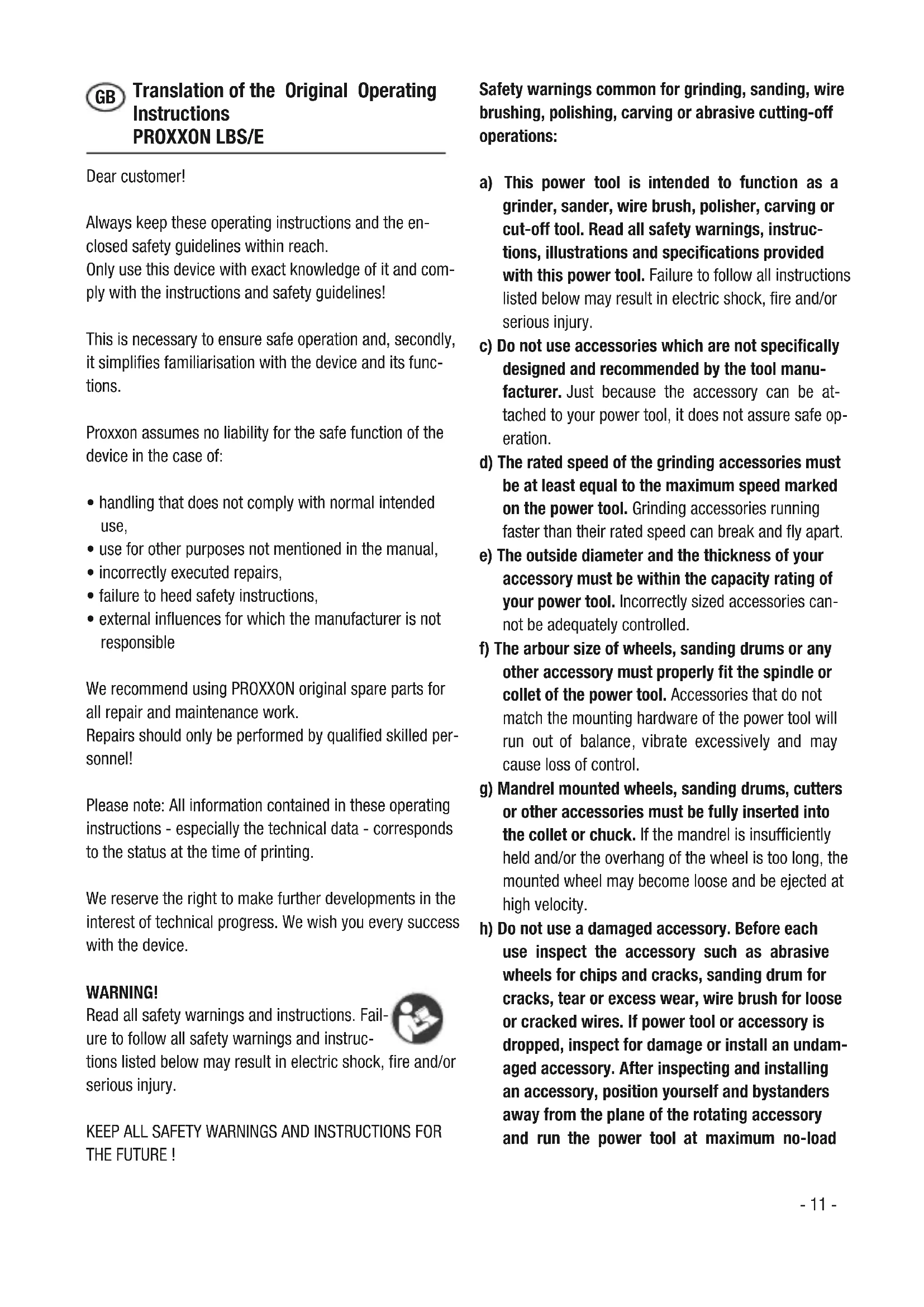
Dear customer!
Always keep these operating instructions and the enclosed safety guidelines within reach.
Only use this device with exact knowledge of it and comply with the instructions and safety guidelines!
This is necessary to ensure safe operation and, secondly, it simplifies familiarisation with the device and its functions.
Proxxon assumes no liability for the safe function of the device in the case of:
- handling that does not comply with normal intended use,
- use for other purposes not mentioned in the manual,
- incorrectly executed repairs,
- failure to heed safety instructions,
- external influences for which the manufacturer is not responsible
We recommend using PROXXON original spare parts for all repair and maintenance work.
Repairs should only be performed by qualified skilled personnel!
Please note: All information contained in these operating instructions - especially the technical data - corresponds to the status at the time of printing.
We reserve the right to make further developments in the interest of technical progress. We wish you every success with the device.
WARNING!
Read all safety warnings and instructions. Failure to follow all safety warnings and instructions listed below may result in electric shock, fire and/or serious injury.
KEEP ALL SAFETY WARNINGS AND INSTRUCTIONS FOR THE FUTURE!
Safety warnings common for grinding, sanding, wire brushing, polishing, carving or abrasive cutting-off operations:
a) This power tool is intended to function as a grinder, sander, wire brush, polisher, carving or cut-off tool. Read all safety warnings, instructions, illustrations and specifications provided with this power tool. Failure to follow all instructions listed below may result in electric shock, fire and/or serious injury.
c) Do not use accessories which are not specifically designed and recommended by the tool manufacturer. Just because the accessory can be attached to your power tool, it does not assure safe operation.
d) The rated speed of the grinding accessories must be at least equal to the maximum speed marked on the power tool. Grinding accessories running faster than their rated speed can break and fly apart.
e) The outside diameter and the thickness of your accessory must be within the capacity rating of your power tool. Incorrectly sized accessories cannot be adequately controlled.
f) The arbour size of wheels, sanding drums or any other accessory must properly fit the spindle or collet of the power tool. Accessories that do not match the mounting hardware of the power tool will run out of balance, vibrate excessively and may cause loss of control.
g) Mandrel mounted wheels, sanding drums, cutters or other accessories must be fully inserted into the collet or chuck. If the mandrel is insufficiently held and/or the overhang of the wheel is too long, the mounted wheel may become loose and be ejected at high velocity.
h) Do not use a damaged accessory. Before each use inspect the accessory such as abrasive wheels for chips and cracks, sanding drum for cracks, tear or excess wear, wire brush for loose or cracked wires. If power tool or accessory is dropped, inspect for damage or install an undamaged accessory. After inspecting and installing an accessory, position yourself and bystanders away from the plane of the rotating accessory and run the power tool at maximum no-load
speed for one minute. Damaged accessories will normally break apart during this test time.
i) Wear personal protective equipment. Depending on application, use face shield, safety goggles or safety glasses. As appropriate, wear dust mask, hearing protectors, gloves and workshop apron capable of stopping small abrasive or workpiece fragments. The eye protection must be capable of stopping flying debris generated by various operations. The dust mask or respirator must be capable of filtrating particles generated by your operation. Prolonged exposure to high intensity noise may cause hearing loss.
j) Keep bystanders a safe distance away from work area. Anyone entering the work area must wear personal protective equipment. Fragments of workpiece or of a broken accessory may fly away and cause injury beyond immediate area of operation.
k) Hold power tool by insulated gripping surfaces only, when performing an operation where the cutting accessory may contact hidden wiring or its own cord. Cutting accessory contacting a “live” wire may make exposed metal parts of the power tool “live” and could give the operator an electric shock.
I) Always hold the tool firmly in your hand(s) during the start-up. The reaction torque of the motor, as it accelerates to full speed, can cause the tool to twist.
m) Use clamps to support workpiece whenever practical. Never hold a small workpiece in one hand and the tool in the other hand while in use. Clamping a small workpiece allows you to use your hand(s) to control the tool. Round material such as dowel rods, pipes or tubing have a tendency to roll while being cut, and may cause the bit to bind or jump toward you.
n) Position the cord clear of the spinning accessory. If you lose control, the cord may be cut or snagged and your hand or arm may be pulled into the spinning accessory.
o) Never lay the power tool down until the accessory has come to a complete stop. The spinning accessory may grab the surface and pull the power tool out of your control.
p) After changing the bits or making any adjustments, make sure the collet nut, chuck or any other adjustment devices are securely tightened. Loose adjustment devices can unexpectedly shift, causing loss of control, loose rotating components will be violently thrown.
q) Do not run the power tool while carrying it at your side. Accidental contact with the spinning accessory could snag your clothing, pulling the accessory into your body.
r) Regularly clean the power tool's air vents. The motor's fan will draw the dust inside the housing and excessive accumulation of powdered metal may cause electrical hazards.
s) Do not operate the power tool near flammable materials. Sparks could ignite these materials.
t) Do not use accessories that require liquid coolants. Using water or other liquid coolants may result in electrocution or shock.
Further safety instructions for all operations
Kickback and related warnings
Kickback is a sudden reaction to a pinched or snagged rotating wheel, sanding band, brush or any other accessory. Pinching or snagging causes rapid stalling of the rotating accessory which in turn causes the uncontrolled power tool to be forced in the direction opposite of the accessory's rotation.
For example, if an abrasive wheel is snagged or pinched by the workpiece, the edge of the wheel that is entering into the pinch point can dig into the surface of the material causing the wheel to climb out or kick out. The wheel may either jump toward or away from the operator, depending on direction of the wheel's movement at the point of pinching. Abrasive wheels may also break under these conditions.
Kickback is the result of power tool misuse and/or incorrect operating procedures or conditions and can be avoided by taking proper precautions as given below.
a) Maintain a firm grip on the power tool and position your body and arm to allow you to resist
kickback forces. The operator can control kickback forces, if proper precautions are taken.
b) Use special care when working corners, sharp edges etc. Avoid bouncing and snagging the accessory. Corners, sharp edges or bouncing have a tendency to snag the rotating accessory and cause loss of control or kickback.
c) Do not attach a toothed saw blade. Such blades create frequent kickback and loss of control.
d) Always feed the bit into the material in the same direction as the cutting edge is exiting from the material (which is the same direction as the chips are thrown). Feeding the tool in the wrong direction causes the cutting edge of the bit to climb out of the work and pull the tool in the direction of this feed.
e) When using rotary files, cut-off wheels, high-speed cutters or tungsten carbide cutters, always have the work securely clamped. These wheels will grab if they become slightly canted in the groove, and can kickback. When a cut-off wheel grabs, the wheel itself usually breaks. When a rotary file, high-speed cutter or tungsten carbide cutter grabs, it may jump from the groove and you could lose control of the tool.
Safety warnings specific for grinding and abrasive cutting-off operations:
a) Use only wheel types that are recommended for your power tool and only for recommended applications. For example: do not grind with the side of a cut-off wheel. Abrasive cut-off wheels are intended for peripheral grinding, side forces applied to these wheels may cause them to shatter.
b) For threaded abrasive cones and plugs use only undamaged wheel mandrels with an unrelieved shoulder flange that are of correct size and length. Proper mandrels will reduce the possibility of breakage.
c) Do not "jam" a cut-off wheel or apply excessive pressure. Do not attempt to make an excessive depth of cut. Overstressing the wheel increases the loading and susceptibility to twisting or snagging of
the wheel in the cut and the possibility of kickback or wheel breakage.
d) Do not position your hand in line with and behind the rotating wheel. When the wheel, at the point of operation, is moving away from your hand, the possible kickback may propel the spinning wheel and the power tool directly at you.
e) When wheel is pinched, snagged or when interrupting a cut for any reason, switch off the power tool and hold the power tool motionless until the wheel comes to a complete stop. Never attempt to remove the cut-off wheel from the cut while the wheel is in motion otherwise kickback may occur. Investigate and take corrective action to eliminate the cause of wheel pinching or snagging.
f) Do not restart the cutting operation in the workpiece. Let the wheel reach full speed and carefully re-enter the cut. The wheel may bind, walk up or kickback if the power tool is restarted in the workpiece.
g) Support panels or any oversized workpiece to minimize the risk of wheel pinching and kick-back. Large workpieces tend to sag under their own weight. Supports must be placed under the workpiece near the line of cut and near the edge of the workpiece on both sides of the wheel.
h) Use extra caution when making a “pocket cut” into existing walls or other blind areas. The protruding wheel may cut gas or water pipes, electrical wiring or objects that can cause kickback.
Safety warnings specific for wire brushing operations:
a) Be aware that wire bristles are thrown by the brush even during ordinary operation. Do not overstress the wires by applying excessive load to the brush. The wire bristles can easily penetrate light clothing and/or skin.
b) Allow brushes to run at operating speed for at least one minute before using them. During this time no one is to stand in front or in line with the brush. Loose bristles or wires will be discharged during the run-in time.
c) Direct the discharge of the spinning wire brush away from you. Small particles and tiny wire fragments may be discharged at high velocity during the use of these brushes and may become imbedded in your skin.
Protection class II device
Wear safety glasses!
Use indoors only
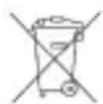
Please do not dispose off the machine!



Description of the machine
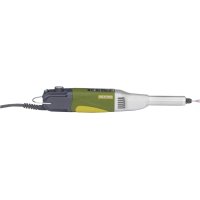
The PROXXON LBS/E long-necked drill/grinder is the ideal device for micro drilling, milling, grinding, polishing, brushing, rust removal, engraving, chasing and separating. You can work on steel, non-ferrous metals, glass, wood, minerals and ceramics.
With its long neck the device is especially suitable for machining in difficult to access hollows, such as for the inside of pipes, deep drill holes and cavities.
The drill spindle is arranged free from play through the precision ball bearing in the aluminium die casting housing. A quiet, permanently excited special motor with electronic speed control ensures maximum performance at minimum size. Compact housing made of fibre-glass reinforced nylon with 20 mm fit at the aluminium housing. With the 20 mm fit across the entire neck length (75 mm), the device can be clamped, for example, in an upright of sensitive drill and can be entirely pushed through. The resulting free length enables best accessibility even for complicated tasks.
The supplied steel collet chuck makes it easy to exchange the tools and offers a much higher truth of running than a drill chuck.
Legend
- Speed control button
- ON-OFF - switch
- Hanger
- Mains supply cable
- Locking button
- Spigot nut with steel clamp jaw
- Fitting collar for drill stand (∅ 20 mm)
- Steel clamping jaws
- Chuck key
Technical data
Length: approx. 300 mm
Weight: approx. 630 g
Collar: ∅ 20 mm
Motor
Voltage: 230 V, 50/60 Hz
Rotary speed: 5,000 - 22,000 rpm
Power consumption: max. 100 W
Noise development: ≤ 70 dB (A)
Vibration in the handle: ≤ 2,5 m/s ^2
Please note that the sound and vibration measurements in particular have been performed with Proxxon bits and cutters. When using third-party brands we cannot guarantee compliance with the statements given here!
Scope of delivery
1 pc. LBS/E long-neck professional drill/grinder
1 pc. Storage case
1 pc. Operating instructions
1 pc. Safety guidelines
1 pc. Key
6 pcs. Collets (1.0-1.5-2.0-2.4-3.0 and 3.2 mm)
Operating instructions
Important!
- Never press the lock button while the device is operating.
- Depending on the collet size, bits and cutters may have a shaft diameter of max. 3.2 mm.
- Insert the tools are far as possible when clamping. Ensure that the shaft of the tool does not stand out more than 30 mm from the collet. Excessively protruding shafts can bend easily and contribute to poor concentricity.
- Do not in any case use bits and cutters with an arbour length of more than 55 mm!
- When using collets, always make sure that the collet chuck and the utilised tool have the same shaft diameter! The arbour of the tool must be seated firmly and securely in the collet!
- Do not work with damaged, bent or worn bits and cutters! Make sure the tools are in perfect condition. Damaged or worn tools can break and cause injuries!
- When storing the bits and cutters, make sure they are reliably protected from damage!
Clamping, changing the tool
Attention!
Pull the mains plug out before changing tools.
- Turn the spigot nut 1 (fig. 2) slightly and press the locking button at the same time, until it engages. Loosen the nut for a few turns and change the tool. If the union nut sticks, use the enclosed chuck key.
The drill grinder LBS/E has an ergonomically design, so that it can be easily guided at the fitting collar. The thread for the clamping jaw nut is lowered into the machine housing. The use of a drill chuck ist therefore not possible.
Working with the machine
Attention:
- Never work without safety glasses.
- Wear a protective mask if large amounts of dust or harmful dusts accumulate.
-
A correct and consistent speed achieves a high grinding performance, not excessive contact pressure!
-
By tendency: Bits and cutters with smaller diameters require higher speeds than those with a larger diameter.
-
Attention: You absolutely must observe the permissible maximum speed of the bits and cutters! The tool can break when the maximum permissible speed is exceeded. Flying parts can cause damage and severe injuries!
-
To activate, operate switch 2 (Fig. 1) and set the right speed for the work on rotational speed adjusting knob 1 (Fig. 1). Applicable in principle, tools with smaller diameters must be operated at higher speeds, and tools with greater diameters at lower speeds in order to achieve optimal results.
- If you would like to guide the device by hand while working, hold it like a ballpoint pen whilst milling or engraving. Do not cover the ventilation slots (Fig. 3). For coarser work, hold the device like the shaft of a hammer (Fig. 4).
- An ideal working environment is achieved if the device is clamped by its 20 mm fit into a drill stand, a universal holder or comparable mechanism.
- A diversity of additional fields of application develop when combining your professional grinder LBS/E with other machines and devices!
Maintenance, cleaning and care
Attention:
Disconnect the mains plug prior to every adjustment, maintenance measure or repair!
Note:
Every device is dirtied by dust when working. Cleaning is therefore essential. To ensure a long service life, however, the machine should be cleaned with a soft cloth or brush after each use.
Mild soap or other suitable cleaning agent may be used in this context. Solvents or cleaning agents containing alcohol (e.g. petrol, cleaning alcohols, etc.) should be avoided, since these can attack plastic casings.
The apertures required for cooling the motor must always be kept free of dust and dirt.
Accessories
For more detailed information on accessories, please request our device catalogue from the address specified on the last page in the warranty information.
Please note in general:
Proxxon bits and cutters have been designed to work with our machines, which makes them optimal for their use.
We will not assume any liability whatsoever for the safe and proper function of our devices when using third-party bits and cutters!
Service note
Please note: The mains power input may only be replaced by our Proxxon Service Department or a qualified specialist!
Disposal
Please do not dispose of the device in domestic waste! The device contains valuable substances that can be recycled. If you have any questions about this, please contact your local waste management enterprise or other corresponding municipal facilities.
EC Declaration of Conformity
Name and address:
PROXXON S.A.
6-10, Härebierg
L-6868 Wecker
Product designation:LBS/E
Article No.: 28485
In sole responsibility, we declare that this product conforms to the following directives and normative documents:
EU EMC Directive 2014/30/EC
EU Machinery Directive
2006/42/EC
DIN EN 60745-1 / 01.2010
DIN EN 60745-2-23/11.2013
Date: 14.06.2016
text_image
Handwritten signature or scribble in cursive scriptMachine Safety Department
The CE document authorized agent is identical with the signatory.
Cher client, chère cliente !
text_image
Handwritten signature or scribble on white background, possibly a signature or nametext_image
Handwritten signature or scribble on white background, possibly a signature or artistic markIng. Jörg Wagner
PROXXON S.A.
text_image
Handwritten signature or scribble on white background, possibly a signature or nametext_image
Handwritten signature or scribble on white background, possibly a signature or artistic marknatural_image
Pure icons representing home, person, and trash bin (no text or symbols)text_image
Handwritten signature or scribble on white background, possibly a signature or nameDipl.-ing. Jörg Wagner
PROXXON S.A.
text_image
Handwritten signature or scribble in cursive scriptDipl-ing Jörg Wagner
PROXXON S.A.
TYTO POKYNY DOBŘE USCHOVEJTE!
Hlučnost: ≤ 70 dB (A)
Vibrace rukojeti: ≤ 2,5 m/s ^2
text_image
Handwritten signature or scribble in cursive scripttext_image
Handwritten signature or scribble on white background, possibly a signature or nameMüh. Jörg Wagner
PROXXON S.A.
text_image
Handwritten signature or scribble in cursive scripttext_image
Handwritten signature or scribble on white backgroundtext_image
Exploded view diagram of a handheld device with numbered parts for identificationET-Nr.: Benennung
| 28485 - 01 | Überwurfmutter | / | Swivel nut |
| 28485 - 02 | Spannzange (Zubehör) | / | Collet (accessory) |
| 28485 - 04 | Sicherungsring | / | Locking ring |
| 28485 - 05 | Kugellager | / | Ball bearing |
| 28485 - 08 | Motorbefestigungsschrauben | / | Motor fastening screws |
| 28485 - 10 | Schalter | / | Switch |
| 28485 - 11 | Regelknopf | / | Regulating knob |
| 28485 - 12 | Gehäuseschraube | / | Housing screw |
| 28485 - 15 | Arretierknopf | / | Lock button |
| 28485 - 16 | Zentrierring | / | Centring ring |
| 28485 - 19 | Platine | / | Board |
| 28485 - 21 | Gerätebügel | / | Device bracket |
| 28485 - 22 | Netzleitung incl. Stecker und Tülle | / | Supply cable with plug and support sleeve |
| 28485 - 23 | Schlüssel | / | Wrench |
| 28485 - 24 | Motorritzel | / | Motor pinion gear |
| 28485 - 25 | Mortorgehäuse | / | Motor housing |
| 28485 - 26 | Motor incl. Ritzel | / | Motor with pinion |
| 28485 - 27 | Stützing | / | Bearing ring |
| 28485 - 28 | Hintere Gehäusekappe | / | Rear housing cap |
| 28485 - 29 | Mutter | / | Nut |
| 28485 - 30 | Wellscheibe | / | Wave washer |
| 28485 - 31 | Welle | / | Shaft |
| 28485 - 32 | Gehäusekopf mit Arretierknopf | / | Housing front part with lock button |
| 28485 - 33 | Lüfter | / | Fan |
| 28485 - 97 | Artikelverpackung (ohne Abb.) | / | Article packaging |
| 28485 - 99 | Bedienungsanleitung und Sicherheitshinweise | / | Operating instructions incl. Safety instructions |
PROXXON
All PROXXON products are thoroughly inspected after production. Should a defect occur nevertheless, please contact the dealer from whom you purchased the product. Only the dealer is responsible for handling all legal warranty claims which refer exclusively to material and manufacturer error.
Improper use, such as capacity overload, damage due to outside influences and normal wear are excluded from the warranty.
You will find further notes regarding "Service and Spare Parts Management" at www.proxxon.com.