Classic 250 - Water filter EHEIM - Free user manual and instructions
Find the device manual for free Classic 250 EHEIM in PDF.



User questions about Classic 250 EHEIM
0 question about this device. Answer the ones you know or ask your own.
Ask a new question about this device
Download the instructions for your Water filter in PDF format for free! Find your manual Classic 250 - EHEIM and take your electronic device back in hand. On this page are published all the documents necessary for the use of your device. Classic 250 by EHEIM.
USER MANUAL Classic 250 EHEIM
IMPORTANT SAFETY INSTRUCTIONS
WARNING! RISK OF ELECTRIC SHOCK! This pump has not been investigated for use in swimming pools areas! DO NOT RUN DRY!
WARNING - To guard against injury, basic safety precautions should be observed, including the following.
a) READ AND FOLLOW ALL SAFETY INSTRUCTIONS.
b) DANGER - To avoid possible electric shock, special care should be taken since water is employed in the use of aquarium equipment. For each of the following situations, do not attempt repairs by yourself; return the appliance to an authorized service facility for service or discard the appliance.
1) If the appliance falls into the water, DON'T reach for it! First unplug it and then retrieve it. If electrical components of the appliance get wet, unplug the appliance immediately.
2) If the appliance shows any sign of abnormal water leakage, immediately unplug it from the power source.
3) Carefully examine the appliance after installation. It should not be plugged in if there is water on parts not intended to be wet.
4) Do not operate any appliance if it has a damaged cord or plug, or if it is malfunctioning or has been dropped or damaged in any manner.
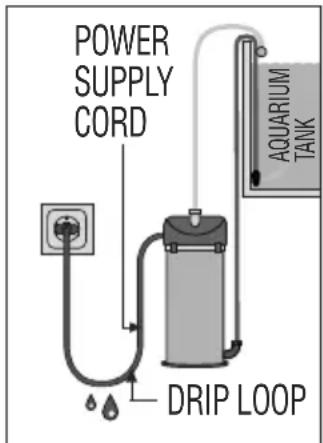
5) To avoid the possibility of the appliance plug or receptacle getting wet, position aquarium stand and tank to one side of a wall-mounted receptacle to prevent water from dripping onto the receptacle or plug.
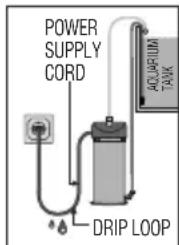
A "drip loop", shown in the figure, should be arranged by the user for each cord connecting an aquarium appliance to a receptacle. The "drip loop" is that part of the cord below the level of the receptacle, or the connector if an extension cord is used, to prevent water traveling along the cord and coming in contact with the receptacle.
If the plug or socket does get wet, DON'T unplug the cord. Disconnect the fuse or circuit breaker that supplies power to the appliance. Then unplug and examine for presence of water in the receptacle.
c) Close supervision is necessary when any appliance is used by or near children.
d) To avoid injury, do not contact moving parts or hot parts such as heaters, reflectors, lamp bulbs, and the like.
e) Always unplug an appliance from an outlet when not in use, before putting on or taking off parts, and before cleaning. Never yank cord to pull plug from outlet. Grasp the plug and pull to disconnect.
f) Do not use an appliance for other than intended use. The use of attachments not recommended or sold by the appliance manufacturer may cause an unsafe condition.
g) Do not install or store the appliance where it will be exposed to the weather or to temperatures below freezing.
h) Make sure an appliance mounted on a tank is securely installed before operating it.
i) Read and observe all the important notices on the appliance.
j) If an extension cord is necessary, a cord with a proper rating should be used. A cord rated for less amperes or watts than the appliance rating may overheat. Care should be taken to arrange the cord so that it will not be tripped over or pulled.
1) "SAVE THESE INSTRUCTIONS".
Translation of the original operating manual Aquarium exterior filters classic 250 (Type 2213)
1. General user instructions

Information on using the operating manual
Before using the appliance for the first time, the operating manual must be read fully and understood. Consider the operating manual as part of the product and keep in a safe and accessible location. Enclose this operating manual if passing the appliance on to a third party.
Symbol explanation
The following symbols are used on the appliance:

The appliance must only be used indoors, and exclusively for aquariums.

The appliance is of protection class II.
IP X4
The symbol advises that the device is protected against splashed water.

The appliance is certified according to the relevant national regulations and directives, and conforms to EU standards.
The following symbols and signal words are used in this operating manual:

DANGER!
The symbol indicates imminent danger from electric shock that can result in death or serious injury.

DANGER!
The symbol indicates imminent danger that can result in death or serious injury.

WARNING!
The symbol indicates imminent danger that can result in moderate to minor injury or a health risk.

CAUTION!
The symbol indicates the danger of material damage.

Note with useful information and tips.
Typographical conventions:
A Reference to a figure; in this case, reference to figure A.
You are prompted for an action.
2. Application
The appliance and all parts included in the scope of delivery are intended for private use and must only be used:
- For the cleaning of aquarium water in fresh and salt water aquariums.
- indoors
- in compliance with the technical data.
The following limitations apply to the appliance:
- do not use for commercial or industrial purposes.
- the water temperature may not exceed 35^ .
Corrosive, highly flammable, aggressive or explosive substances, foodstuffs and drinking water must not be conveyed.
- never operate without a water flow.
3. Safety instructions
Risks for persons and property can arise from this appliance if the appliance is improperly used or not used as intended or if the safety instructions are not heeded.
For your safety

- Do not let the appliance packaging and small parts get into the hands of children or people who are unaware of how to handle them, as hazards can arise (danger of suffocation!). Keep away from animals.
- Only for EU countries:
This appliance can be used by children from the age of 3 and by persons with reduced physical, sensory or mental capabilities or lack of experience and/or knowledge if they are supervised and have been instructed in the safe use of the appliance and have understood the resulting dangers. Children must not play with the appliance. Cleaning and user maintenance must not be carried out by children unless they are supervised.
- This equipment is not intended for use by persons (including children) with limited physical, sensory or mental abilities or for persons with no experience or knowledge unless they are supervised by a person respond for safety or unless they have received from such a person instructions on how to use the equipment. Children should be supervised to ensure that they do not play with the equipment.

- Before use, carry out a visual inspection to ensure that the appliance, especially the mains cable and plug, are undamaged.
- Do not use the device if it does not function properly or if it is damaged.
- Never use the appliance with a damaged mains cable or power supply unit.
- The power cable of this device can not be replaced. When the line is damaged, the device must no longer be used.
- Repairs must only be carried out by an EHEIM service centre.
- Do not carry the appliance by the mains cable, and to disconnect from the mains, always pull on the plug and not on the cable or appliance.
- Protect the mains cable against heat, oil and sharp edges.
- Only carry out the work described in these instructions.
- Never make technical modifications to the appliance.
- Only use original spare parts and accessories for the appliance.

- The device should be protected by means of a residual current protective device with a maximum rated residual current of 30mA . Ask your electrician.
- If they are not being used, always disconnect all devices in the aquarium from the power supply before you install/remove any parts and before all cleaning and maintenance work.
- Protect the mains socket and mains plug against moisture. It is recommended to form a drip loop with the mains cable to prevent any water running along the cable to the mains socket.
- The electrical data of the power supply must match the data of the power mains. This data is found on the type plate of power supply, the packaging and in these instructions.
4. Delivery scope and component overview (see I)
① Pump head ② Filter canister ③ pressure side hose connection ④ suction side hose connection ⑤ Filter insert ⑥ intake pipe ⑦ suction basket ⑧ suction cups with clips ⑨ outlet elbow ⑩ outlet pipe.
5. Preparation (See II and III)
1 Check that all parts are present.
II. 1. Connect the suction basket to the intake pipe.
- Cut a piece of hose (min. 1.5 cm) from the enclosed hose 12/16 mm and use it to connect the outlet elbow to the outlet pipe.
- Close the end of the outlet pipe with the plug.
- Connect the clamp and the suction cup and clip them (2x each) onto the intake and outlet pipes.
III. 1. Open all 4 spring clips and remove the pump head from the filter canister.
- Take out the filter insert by the handle and open the cover by turning it to the left.
- Remove all filter mats and loose filter material (not supplied) and gently rinse under running water.
- Place the filter media back into the filter insert as shown in Figure 4.1: ⑤ 5 filter mats blue, ⑥ filter fleece white, ⑥ carbon fleece black as the top layer, and close the lid.
The carbon fleece is used to adsorb possible dissolved pollutants in the water when setting up a new aqua- rium. aquarium. After a running-in period of approx. 2 - 4 weeks, carbon fleece should be removed.
- Put the pump head back on the filter canister.

Make sure that the sealing ring is correctly positioned in its guide and is not damaged or dirty.
- Lock all 4 spring clips.
6. Installation
A Place the filter under the aquarium - at least the pump head must be at least 10 cm below the aquaum water level.

- When choosing a location for the unit, pay attention to the installation height. In order to achieve optimum functional reliability, there must be a maximum of 180cm between the water surface and the bottom of the filter.
- Always operate the filter in an upright position.
Mount the outlet pipe by pressing it firmly against a side window.
Place the outlet pipe so that it is approx. 1 cm below the water surface and the pipe are aligned parallel to the surface.
Fix the intake pipe in the rear corner of the same side window with the suction cups.
E 1. Cut the hoses according to the distance between the filter and the aquarium. Connect the suction side on the filter canister to the intake pipe and the pressure side on the pump head to the outlet pipe.
2. Secure all hose connections with the union nuts.

Keep hose lengths as short as possible to prevent loops and kinks and minimise flow resistance.
7. Start up
F 1. Disconnect the connection between the outlet elbow and the outlet pipe on the pressure side.
2. Suction at the end of the outlet elbow until the filter system automatically fills with water.
3. Once the water circuit has been established, reconnect the outlet elbow to the outlet pipe.
4. Insert the power cable into the mains socket.
8. Cleaning
-
Unplug the mains plug from the socket.
-
Open all 4 clamping brackets and remove the pump head from the filter canister.
- Take out the filter insert by the handle and open the lid by turning it to the left.
- Remove all filter mats and rinse them gently under running water.
- Place the filter media back into the filter insert as shown in Figure 4.1 or 4.2 and close the lid.
- Put the pump head back on the filter container.

Make sure that the sealing ring is correctly positioned in its guide and is not damaged or dirty.
- Close all 4 spring clips.
- Restore the water circuit. When the filter system is completely filled with water, put the appliance into operation by plugging in the mains plug.
9. Maintenance

G
- Pull out the mains plug and remove the pump head as described in chapter 8. cleaning point 1 - 2.
- Open the locking part and remove the pump cover.
- Carefully remove the pump wheel from the pump chamber.
- Use a small screwdriver to carefully lever the blade out of the cooling channel.
- Clean all parts under running water with a brush.

Caution Risk of breakage: The axle of the pump wheel is made of ceramic.
- It is best to clean the pump chamber with the 4009560 cleaning brush.
- Assemble all pump parts in reverse order.
10. Decommissioning and disposal
Storage

- Uninstall the device from the aquarium.
- Clean the appliance.
- Store the appliance in a frost-proof place.
Disposal
When disposing of the appliance, heed the respective statutory regulations. Information on the disposal of electrical and electronic appliances in the European Union: Within the European Union, disposal of electrically operated appliances is governed by national regulations that are based on the EU Directive 2012/19/EU on waste electrical and electronic equipment (WEEE). The appliance may no longer be disposed of with the municipal or household waste. The appliance will be accepted free of charge at municipal collection points or recycling centres. The product packaging is made up of recyclable materials. Dispose of them in an environmentally respon-anner and take them for recycling.
12. Technical data
See page??
Convention de presentation:
A
Élimination/destruction
IPX4 CmB0JyKa3bIaEeT,TOyCTPOINCTBO3aUuHcEOOTBOyHBx6pb13r.

YcTpoiCTBO pa3peSeHc K IcNoIb3OBAHnIO COrIaCHO COOTBeTCTByUoIIM HaIIOHaJIbHbIM IpEJaNCAHnAM N DInPeKTnBam N COOTBetCTByET CTaNapTaM EC

YcTpoCTBO COOTBETCTByeI npIMeHmMbIM Tpe6oBaHnM 6e3oNaCHOCTN INTexHnHeCKm peRnAmEHTam Ebpa3nCKOrO 3KOHOMuHeCKORO c0HO3a.
B daHOM pyKOBODCTBE no 06cnyKbAHIO nCIOJIb3yIOCT CneIyIOUIe CNMBOJI b i CmHaJIbHbIE CNOBA:

OTACHOCTb!
CIMBOI yka3bIaBET HA rpoKAIouyIO cnaHOCt b yapa TOKOM, KOtopa MoKet NOBLey 3a cO6o CmepTb NIN TRAKeJIbe TpaBMbl.

OTIACHOCTb!
CIMBOI yka3bIaBaeT h a yrpoXiaUyio onaHocTb, KOtopa MoKet NOBLey 3a cOob CMept bnn TAKKeIbe TpaMbI.

PNEpyNPEXKDEHNE!
CmBbI yka3bIbaeT ha yrpoXaIooI OAnchocTB, KOtopaM MoKet NObNeYb 3a cObo TpaMbI IerKoN i CpeHne TJeecTN nn pNCK dIy 3doOpOBra.

OCTOPOXHO!
CmB0n yka3bIbaeT ha onaChocTh MaTePnaIbHOro yuepe6a.

Yka3aHaMe C noJIe3HOHnHOpMaJne H COBETAM.
PpHnHunbI OTo6paXKeHnA:

CcbIka Ha n3o6paXeHne, 3deCb CcbIka Ha pncyHok A.

Yka3aHHe Na BbINOJIHHeHne DeIcTBnA.
2. 06naCTb npImeHnna
YcTpoICTBO IN BCE DeTALIN, BXOJHUNE B KOMPJIeKT IIOCTABKN, IIpeDyCMOTpeHbI DnI IIPIMHeHNB YCACTHOINMOrY INCIOJIb3OBaTBCH NCKIIOHITELBHO:
-ДЛА OЧИСТКI BОДБIВ ПЕСHОВДнБИХ И МОРСКИX АКВAPиМAX
B TIOMEUeHIN
- npn co6nIOeHn TeHNuecknx daHHbIX.
Y6eHNTecb, YTO yIIOHTHeBHO KOBuO npabNtBHO yCTaHO B CBOe HnPaBnHOe, He NOpeXKeHO n He 3arPn3HeHO.
- 3akpoIe BCE 4 3axmHbIe ckobI.
6. yctahOBka
A UctaHOBInTe fIbTp Iod aKBapNymom - rOIOBka HAcOca DoJXHa HaxoITbcr He MeHee Yem Ha 10 cm HIXKe yPOBnBn BObl B aKBapNyme.

- Pn BbIbope MeCTa yCTaHOBKn np6bopa cIeMyET 6oPaTb BHNMaHne Ha BbICOTy yCTaHOBKn. IIN DOCTNXEHN ONTMaJIbHOH FyHKUHOHaJIbHOH HAdExKHOCTN MaKcImaJIbHOe pacCTOARHe MEXdY NOBepXHOCTbIO BOdBi IN OCHOBAHEm FInbTpA He DoJXHO npeBbIwaTb 180 cm.
Bcerda 3Kcnnyatnpyte HnIbtp B BeptkakbHOM NOLOXeHHN.
区 B YcTaHOBInTe COIIIOByTOpy6y,IIIOTHO pINKAB ee K 60KObOMy DNCKy.
C PaonoloxnTe Tpy6y C opcyHKamn TaK, YTO6bI OHa HaxoDnlaocb npIMepHO Ha 1 cm HIXKe NOBepxHocTN BoDbI, a pOp-cyHKn 6bln napaJIeJIbHbI NOBepxHocTN.
区 D PnKpeHne BCacbIbAoua Tpy6a B 3aDHeM yrIy TORO JKe 60KOBOrO OKHa c NOMOsbIO npncocok.
E 1. Otpexb uHaHn B COOTBETCTBn C paCCTOHNEM MEXdy fNlbTpOM n AKBapHyMOM. IOnKIOHn BCacbIaIoUcTOpOHy Ha KOHTeHHepe fNlbTpa K BCacbIbAOuSei Tpy6Ke, a HAnOpHyO CTOpOHy Ha TOnOBKe HAcoca - K Tpy6Ke C opcyHKamn.
2.3akpennteBce coeHHeHnIaHrOB HAKINHBIMrKaMn

Динанда должна 6bItb kaK MOxHOMeHbIe, YTO6bl N36ExaTb Oba3OBaHnЯ NeTeIb n nepeRn6OB u CBeCTN K MInHmMy CoPOTuBJIeHne NOTOKy.
7. BBOB 3Kcnpnyatauio
F 1. OTcoeINHnTe CoeINHeHne MeKdy BbIXoHNbIM KOleHOM n Tpy6o fOpCyHKn CO CTopoHbI daBnEHa
- KpaTKOBpeMeHHo BCaCbBaIte BOy B KOHc E BbIXOHoro I3rN6a, NOKa CnCTema qnlbTpaun aBTOMaTHueckn He 3aONHHTCA BOIOI.
- Nocne co3daHnBa BOHaHOro KOHTpya CHOba NOcOeINHInTe BbIXoHNoe KOneHO K Tpy6e fOpcyHKN.
4.Поdkлioчи сетевои кабьк розтke..
8. Ovnctka
- BbTaun CTeByu BNJky n3 po3eTKn.
- OtkpoTe BCE 4 3axmHbIe CkObI u N3BNeKITe rOIOBky HAcOca uN3 cInIbTpuyoJero KOHTeHepa.
3.ИЗВЕКИТЕФИNBTPUОПДЭЛЕМENT3a pyuKу NOTKpoIe KpbIuKу, NOBepHyB ee npoTb YacOBoY CTpeJIKN.
4.ИЗБЕКТЕВСЕФИБТРУОПЕ NOДЮЖКИ АKKUPATHO ПOMОЛТЕ IX NOД ПОTOHON BOДОI. - IomeCTnTe fNbTpYIOuM MaTePnaI O6paTHo B fNbTpYIOU M BkNaDbIi, KaK noka3aHO Ha pncyHke 4.1 uIN 4.2, n 3akpoTKe KpbIiKy.
- Setzen Sie den Pumpenkopf wieder auf den Filterbehälter auf.

Y6eHITecb, yTO yNIOHTHeIbHOe KOJIbO npaBnIbHO yCTaHO B CBOe HApBaBnIOUe, He NOBpeXDeHO n He 3arpa3HeHO.
- 3aKpoTe Bce 4 3axmHbIe CkO6bl.
- BocctaHOBtE BOJHOI KOHTyp. KOrda CnCTema cHbTpaun 6ydt NOnHOCTbIO 3aONHeHa BOIO, BKIOHTe npi-6op B pa6Oy, BCTaBnB BNkY B po3ETky.
9. 06cnykBaHne

G 1. OTKJIIOHTe CeTeBoi CHIMITE roJIOBky HAcOca, KaK OINCAHO B rIabe 8 NyHKtbi ONUCTkn 1-2.
- OtkpoTe 3anopHyu qactb n CHIMnTe KpbIswky Haocca.
- Octopoxho n3BneKeNTe HacOCHoe KOJECo n3 HAcOCHoi KamepbI.
- IcnoIb3yI He6oIbIyIO OTBepTKy, UTO6bi AkkypaTHO BBIECTN Ie3BNE IKAHJIa OXJaXKeHnA.
- OuHCTIe BCE DeTann PpOToHOBoDc NOMOsbIO TckN.

BHHMaHHe: BaI pa6Oyero KoIeca HAcOca N3rOToBJeH 3 KepaMKn.
- OuNTky kamepbHacoca lyuwe BCero npou3BOIDt b c nOMOBIO ueTKn Ira OuNCTK4 4009560.
- Co6epnte BCE tetaH hacoca B o6paTHOM npHKe.
10. BbIbO n3 3KcPnyataaunn yTnIn3aunr
XpahneHne

1.ИЗВLEЧБ рпбориЗ akВарума
2.OuHCTMte yCTPOnCTBO.
3.XpaHInTe yCTPOINCTBO B MecTe,3aAUNIeHHOM OT MPO3OB.
YTNIN3aIIN
B clyae ytnin3aun yctpoiCTBa CO6IouaTe COOTBcTcByOuue npabOBle npedncaHn. HΦopmaun 6 oy tynin3aun nJektpnuecknx n 3eKTPoHHbIX np6bOpB B Ebponeickom Co03e: B Ebponeickom Co03e ytnin3aun yctpoiCTB c 3eKTPoPnboDom perlanemntpyeTCN HaunohnbIMn npabINAMn, KOtObie OCHOBbIAOTcH Na DinekTMBx EC 2012/19/EC 60fNkmbNX 3eKTPoHHbIX np6bopax (WEEE). PToTMy yctpoiCTBO Heh3r ytnin3nupoBaTB MceTe C 6bITOBIMn OTXdAMn. YctpoiCTBO 6ecTIaTHO npINHMaETC NHTKtAMn C6opa KOMMyHAJIbX Cnyk6 IINI NYKTAMn C6opa BTOCBpIy. YnaKOBKa COCTOITN 3npiroDhbIX nIpepeaboTKN IN BTOPHORO NcNOB3OBAHn MaTePNaIOB. Ee cIeNyEt ytnin3nupoBaTdoNyCTMbIMn C 3KOLOTNNECKO ToKN 3peHn CnOCbAMn HappaBnTb Ha nepepa60Ky.
11. TexHnueckne daHHbIe
Cm. cTpaHnuy 103
原版操作说明书的译本
Reproduction or copying - even parts thereof - only with the express permission of the producer.