LZR1 - Laser level BLACK & DECKER - Free user manual and instructions
Find the device manual for free LZR1 BLACK & DECKER in PDF.



| Product type | Laser level with stud finder |
| Brand | Black & Decker |
| Model | LZR1 |
| Category | Laser level |
| Intended use | Project laser lines and detect studs in drywall (domestic use) |
| Power supply | 1 9V battery (type 6LR61) |
| Laser class | II (EN 60825-1) |
| Operating temperature | 0 °C to 40 °C |
| Weight | 0.45 kg |
| Dimensions (L x W x H) | Approximately 15 x 8 x 5 cm (estimate) |
| Main functions | Projection of horizontal and vertical laser lines, detection of wood/metal studs (max 18 mm drywall) |
| Display | LED indicators (red and green) |
| Included accessories | Marking adapter, keyhole adapter, extension adapter, drywall needle |
| Maintenance and cleaning | Clean with a dry cloth; do not use solvents; keep handles and switches clean |
| Safety | Do not look directly into the laser beam; wear safety glasses; keep out of reach of children |
| Spare parts and repairability | Repairs by authorized technician only; use original parts; recycling via Black & Decker network (www.2helpU.com) |
| Warranty | 24 months against material or workmanship defects (domestic use) |
| Certifications | CE (98/37/CEE, 89/336/CEE, 73/23/CEE) |
Frequently Asked Questions - LZR1 BLACK & DECKER
User questions about LZR1 BLACK & DECKER
0 question about this device. Answer the ones you know or ask your own.
Ask a new question about this device
Download the instructions for your Laser level in PDF format for free! Find your manual LZR1 - BLACK & DECKER and take your electronic device back in hand. On this page are published all the documents necessary for the use of your device. LZR1 by BLACK & DECKER.
USER MANUAL LZR1 BLACK & DECKER
natural_image
Line drawing of a person installing or adjusting a wall-mounted device, no text or symbols present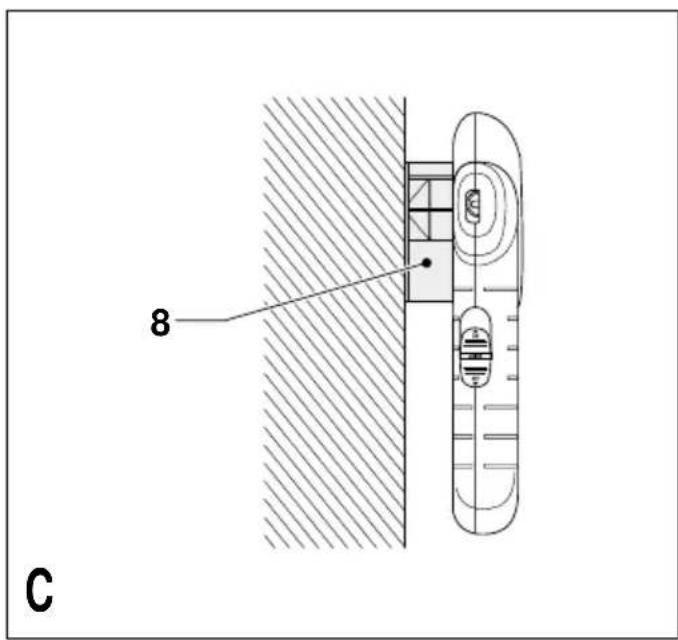
D
natural_image
Line drawing showing a handheld device with a circular dial and a hand holding a circular dial (no text or symbols)E
ENGLISH
Intended use
This Black & Decker tool has been designed to project laser lines to aid in DIY applications and to detect studs covered by wall boards. This tool is intended for consumer use only.
Safety instructions
- Warning! When using battery-powered tools, basic safety precautions, including the following, should always be followed to reduce the risk of fire, leaking batteries, personal injury and material damage.
◆ Read all of this manual carefully before operating the tool.
◆ Retain this manual for future reference.
Keep work area clean
Cluttered areas and benches can cause accidents.
Consider work area environment
Do not expose the tool to rain. Do not use the tool in damp or wet conditions. Keep the work area well lit. Do not use the tool where there is a risk of causing fire or explosion, e.g. in the presence of flammable liquids and gases.
Keep children away
Do not allow children, visitors or animals to come near the work area or to touch the tool.
Dress properly
Do not wear loose clothing or jewellery, as these can be caught in moving parts.
Preferably wear rubber gloves and non-slip footwear when working outdoors. Wear protective hair covering to keep long hair out of the way.
Personal protection
Always use safety glasses. Use a face or dust mask whenever the operations may produce dust or flying particles. Wear ear protection whenever the sound level seems uncomfortable.
Do not overreach
Keep proper footing and balance at all times.
Stay alert
Watch what you are doing. Use common sense.
Do not operate the tool when you are tired.
Secure workpiece
Use clamps or a vice to hold the workpiece. It is safer and it frees both hands to operate the tool.
Use appropriate tool
The intended use is described in this instruction manual.
Do not force small tools or attachments to do the job of a heavy-duty tool. The tool will do the job better and safer at the rate for which it was intended. Do not force the tool.
Warning! The use of any accessory or attachment or performance of any operation with this tool other than those recommended in this instruction manual may present a risk of personal injury.
Check for damaged parts
Before use, carefully check the tool for damage. Check for misalignment and seizure of moving parts, breakage of parts, damage to guards and switches and any other conditions that may affect its operation. Ensure that the tool will operate properly and perform its intended function. Do not use the tool if any part is damaged or defective. Do not use the tool if the switch does not turn it on and off. Have any damaged or defective parts repaired or replaced by an authorised repair agent. Never attempt any repairs yourself.
Avoid unintentional starting
Do not carry the tool with a finger on the on/off switch.
Store idle tools
When not in use, tools and batteries should be stored in a dry, locked up or high place, out of reach of children.
Maintain tools with care
Keep cutting tools sharp and clean for better and safer performance. Follow the instructions for maintenance and changing accessories. Keep handles and switches dry, clean and free from oil and grease.
Repairs
This tool complies with relevant safety requirements.
Repairs should only be carried out by qualified persons using original spare parts; otherwise this may result in considerable danger to the user.
Additional safety instructions for lasers
This laser complies with class 2 according to EN 60825-1:1994+A11. Do not replace a laser diode with a different type. If damaged, have the laser repaired by an authorised repair agent.
◆ Do not use the laser for any purpose other than projecting laser lines.
◆ An exposure of the eye to the beam of a class 2 laser is considered safe for a maximum of 0.25 seconds.
Eyelid reflexes will normally provide adequate protection.
At distances over 1 m, the laser complies with class 1 and thus is considered completely safe.
◆ Never look into the laser beam directly and intentionally.
◆ Do not use optical tools to view the laser beam.
◆ Do not set up the tool at a position where the laser beam can cross any person at head height.
◆ Do not let children come near the laser.
Additional safety instructions for non-rechargeable batteries
◆ Never attempt to open for any reason.
◆ Do not store in locations where the temperature may exceed 40 °C.
- When disposing of batteries, follow the instructions given in the section "Protecting the environment". Do not incinerate the batteries.
◆ Under extreme conditions, battery leakage may occur. When you notice liquid on the batteries, proceed as follows:
- Carefully wipe the liquid off using a cloth. Avoid skin contact.
Features
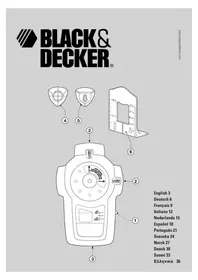
- On/off switch (laser)
- On/off switch (stud finder)
- Battery cover
- LED indicators
- Insert holder
- Marking/hanging insert
- Keyhole insert
- Spacer insert
- Laser apertures
Assembly
Fitting the battery (fig. A)
◆ Depress the release button (10) and slide the battery cover (3) off the tool.
◆ Connect the battery to the connector. The larger battery terminal connects to the smaller connector terminal.
◆ Refit the cover and let it click into place.
Fitting and removing inserts
The marking/hanging insert is used to make a mark on the level line or to hang the tool on a drywall board using the drywall pin supplied. The keyhole insert is used to hang the tool on other types of wall using a screw or nail. The spacer insert is used to extend the laser line.
Fitting
◆ Place the insert into the holder from the back of the tool.
◆ Align the notches on the insert with the recesses in the insert holder.
◆ Let the insert click into place.
Removing
◆ Keep the notches on the insert depressed.
◆ Push the insert out of the holder.
Use
Using the laser level function (fig. B)
◆ Place the tool flat against the wall as shown.
◆ Push the on/off switch (1) up to switch the tool on.
◆ Move the tool as necessary to position the laser lines.
◆ If necessary, hang the unit on the wall using the appropriate insert.
Note: the laser lines will only be level if the tool is kept within 5^ from vertical.
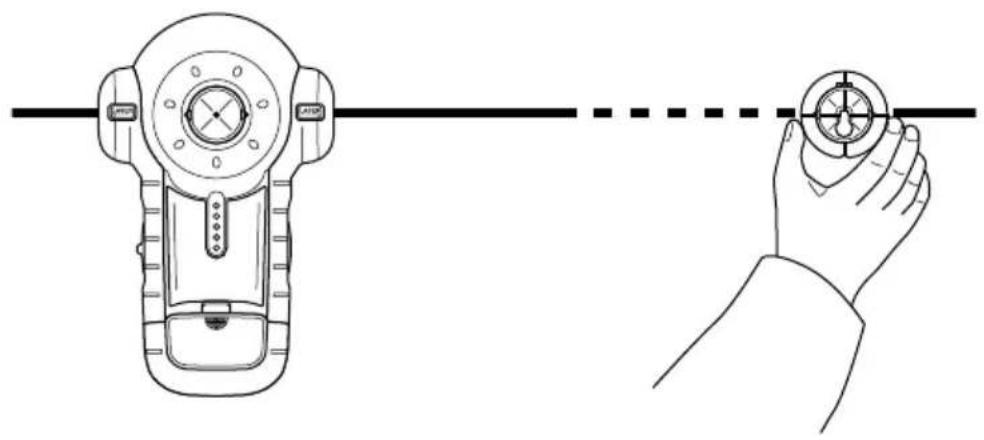
Using the spacer insert (fig. C)
If you need to extend the laser line, use the spacer insert as shown.
Note: the stud sensor cannot be used with the spacer insert fitted.
Enhancing the visibility of the beam (fig. D)
If because of the lighting conditions it is difficult to see the laser line, you can use one of the inserts as shown to enhance the line.
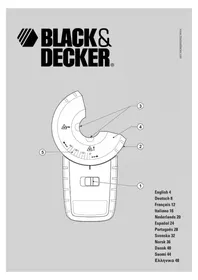
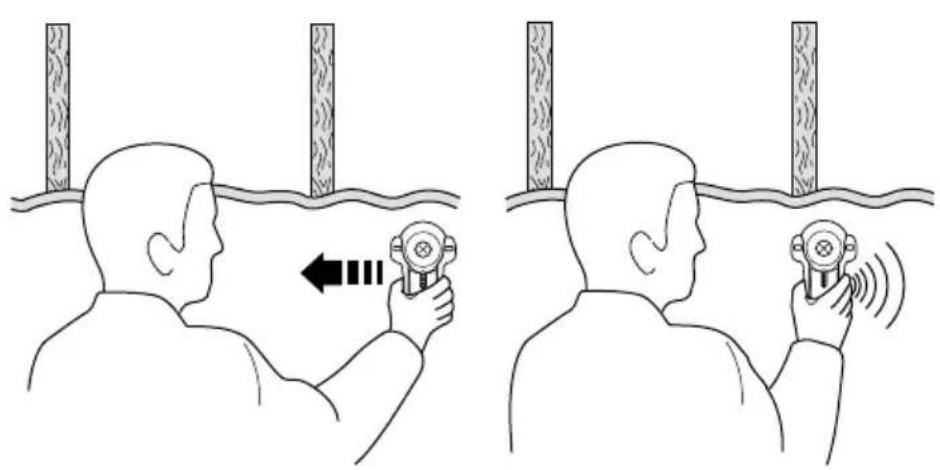
Using the stud finder function (fig. E)
You can use this function to find wooden or metal studs through drywall boards up to 18 mm thick.
◆ Fit the marking insert (6).
◆ Place the tool flat against the wall as shown.
◆ Keep the on/off switch (2) depressed.
The red LED indicator (4) will light up and the tool will beep once while it is calibrating. When this is completed:
- Slowly slide the tool in a horizontal direction. Make sure not to tilt or lift the tool.
When the red LED indicator (4) lights up, slow down and slide the tool further until the tool beeps and the top green LED indicator is lit.
This indicates the position of one edge of the stud.
◆ Mark this position through the hole in the marking insert (6).
◆ Move the unit further until the LED indicators go out.
◆ While still keeping the on/off switch (2) depressed, move the tool in the opposite direction.
When the red LED indicator (4) lights up, slow down and slide the tool further until the tool beeps and the top green LED indicator is lit.
This indicates the position of the other edge of the stud.
◆ Mark this position through the hole in the marking insert (6). The centre of the stud is between the two marks.
Protecting the environment
Tools

Should you find one day that your tool needs replacement, or if it is of no further use to you, think of the protection of the environment. Black & Decker repair agents will accept old Black & Decker tools and ensure that they are disposed of in an environmentally safe way.
Battery

If you want to dispose of the tool yourself, the battery must be removed as described above and disposed of in accordance with local regulations.
Place the battery in a suitable packaging to ensure that the terminals cannot be short-circuited. Take the batteries to a local recycling station.
Technical data
LZR1
Voltage V 9
Battery size 6LR61
Laser class II
Operating temperature °C 0 - 40
Weight kg 0.45
EC declaration of conformity
LZR1
Black & Decker declares that these products conform to: 98/37/EC, 89/336/EEC, 73/23/EEC, EN 50144, EN 55014, EN 50260

Peter Holmes, Director of Engineering
BDCI, 4/F, 2 Dai Wang Street
Tai Po Industrial Estate
Tai Po NT, Hong Kong
Guarantee
Black & Decker is confident of the quality of its products and offers an outstanding guarantee. This guarantee statement is in addition to and in no way prejudices your statutory rights. The guarantee is valid within the territories of the Member States of the European Union and the European Free Trade Area.
If a Black & Decker product becomes defective due to faulty materials, workmanship or lack of conformity, within 24 months from the date of purchase, Black & Decker guarantees to replace defective parts, repair products subjected to fair wear and tear or replace such products to ensure minimum inconvenience to the customer unless:
◆ The product has been used for trade, professional or hire purposes;
◆ The product has been subjected to misuse or neglect;
◆ The product has sustained damage through foreign objects, substances or accidents;
◆ Repairs have been attempted by persons other than authorised repair agents or Black & Decker service staff.
To claim on the guarantee, you will need to submit proof of purchase to the seller or an authorised repair agent. You can check the location of your nearest authorised repair agent by contacting your local Black & Decker office at the address indicated in this manual. Alternatively, a list of authorised Black & Decker repair agents and full details of our after-sales service and contacts are available on the Internet at:
www.2helpU.com.
Peter Holmes, Director of Engineering BDCI, 4/F, 2 Dai Wang Street Tai Po Industrial Estate Tai Po NT, Hong Kong
Garantie
♦ Extrayez le raccord du support.
Utilisation
Peter Holmes, Director of Engineering BDCI, 4/F, 2 Dai Wang Street Tai Po Industrial Estate Tai Po NT, Hong Kong
Garantie
Peter Holmes, Director of Engineering
BDCI, 4/F, 2 Dai Wang Street
Tai Po Industrial Estate
Tai Po NT, Hong Kong
Garanzia
Peter Holmes, Director of Engineering
BDCI, 4/F, 2 Dai Wang Street
Tai Po Industrial Estate
Tai Po NT, Hong Kong
Garantie
Peter Holmes, Director of Engineering BDCI, 4/F, 2 Dai Wang Street Tai Po Industrial Estate Tai Po NT, Hong Kong
Garantía
Peter Holmes, Director of Engineering BDCI, 4/F, 2 Dai Wang Street Tai Po Industrial Estate Tai Po NT, Hong Kong
Garantia
Peter Holmes, Director of Engineering BDCI, 4/F, 2 Dai Wang Street Tai Po Industrial Estate Tai Po NT, Hong Kong
Reservdelar / reparationer
Peter Holmes, Director of Engineering BDCI, 4/F, 2 Dai Wang Street Tai Po Industrial Estate Tai Po NT, Hong Kong
Peter Holmes, Director of Engineering BDCI, 4/F, 2 Dai Wang Street Tai Po Industrial Estate Tai Po NT, Hong Kong
Reservedele / reparationer
Peter Holmes, Director of Engineering BDCI, 4/F, 2 Dai Wang Street Tai Po Industrial Estate Tai Po NT, Hong Kong
Peter Holmes, Director of Engineering BDCI, 4/F, 2 Dai Wang Street Tai Po Industrial Estate Tai Po NT, Hong Kong
Εγγύηση
informative went to ontvangen.
◆ Data protection act: Tick the box if you prefer not to receive further information ◆ Bitte

Cat. no.:

[NO TEXT]
[NO TEXT]
[NO TEXT]
[NO TEXT]
[NO TEXT]
◆ GUARANTEE CARD ◆ GARANTIEKARTE ◆ CARTE DE GARANTIE ◆ TAGLIANDO DI GARANZIA ◆ GARANTIEKAART ◆ TARJETA DE GARANTÍA ◆ CARTÃO DE GARANTIA ◆ GARANTIBEVIS ◆ GARANTI KORT ◆ GARANTI KORT ◆ TAKUUKORTTI ◆ KAPTA EΓΓΥΗΣΗΣ
[Non-Text]
English Please complete this section immediately after the purchase of your
tool and send it to Black & Decker in your country. If you live in Australia or New Zealand, please register by using the alternative
guarantee card supplied.