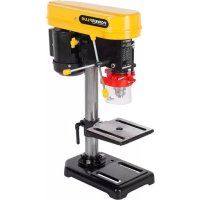
POWX153 - Drill PowerPlus - Free user manual and instructions
Find the device manual for free POWX153 PowerPlus in PDF.



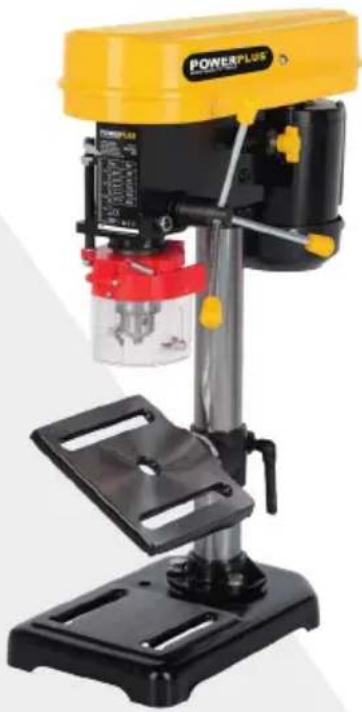
| Product type | Drill press |
| Brand | PowerPlus |
| Model | POWX153 |
| Power consumption | 350 W |
| Mains voltage | 230 V ~ 50 Hz |
| No-load speed | 580 - 2650 rpm |
| Number of speeds | 5 |
| Max. drilling capacity | 13 mm |
| Spindle travel | 50 mm |
| Spindle taper | B16 |
| Table dimensions | 160 x 160 mm |
| Base dimensions | 312 x 198 mm |
| Weight | 13 kg |
| Protection class | Class I (grounded) |
| Duty cycle | S2 - 15 minutes |
| Warranty | 36 months |
| Drillable materials | Steel, cast iron, bronze, aluminum, plastic, wood |
| Included accessories | 3-jaw chuck, chuck key, chuck guard, 3 feed handles, column, table, base |
| Maintenance | Clean with soft cloth, lubricate every 3 months, check screws |
Frequently Asked Questions - POWX153 PowerPlus
User questions about POWX153 PowerPlus
0 question about this device. Answer the ones you know or ask your own.
Ask a new question about this device
Download the instructions for your Drill in PDF format for free! Find your manual POWX153 - PowerPlus and take your electronic device back in hand. On this page are published all the documents necessary for the use of your device. POWX153 by PowerPlus.
USER MANUAL POWX153 PowerPlus
10 PROBLEEMOPLOSSING
21/01/2021, Lier - Belgium
21/01/2021, Lier - Belgium
1 APPLICATION 3
2 DESCRIPTION (FIG. 1) 3
3 PACKAGE CONTENT LIST 3
4 SYMBOLS 3
5 GENERAL POWER TOOL SAFETY WARNINGS 4
5.1 Work area 4
5.2 Electrical safety 4
5.3 Personal safety 4
5.4 Power tool use and care 5
5.5 Service 5
6 ADDITIONAL SAFETY INSTRUCTIONS FOR BENCH DRILLS....5
7 ASSEMBLY 6
7.1 Mounting the base plate (Fig. 3) (optional)
7.2 Fitting the column (Fig. 4)
7.3 Fitting the table (Fig. 5). 7
7.4 Fitting the head stock and motor (Fig. 6)
7.5 Fitting the hand feed handles (Fig. 7)
7.6 Fitting the chuck guard (Fig. 8)
7.7 Fitting the 3 jaw chuck (Fig. 9-10)
7.8 Connection to the power supply 8
8 OPERATION 8
8.1 Using a machine vice (vice not supplied) (Fig. 11). 8
8.2 Using the 3 jaw chuck (Fig. 12) 9
8.3 Switching on and off (Fig. 13)
8.4 Feed depth adjustment (Fig. 14) 9
8.5 Changing the spindle speed (Fig. 15) 9
8.6 Drill speed chart 9
8.7 Belt tension (Fig. 17) 10
8.8 General guidelines for drilling 10
9 CLEANING AND MAINTENANCE 11
9.1 Cleaning 11
POWERPLUS HIGH QUALITY TOOLS
POWX153 EN
9.2 Lubrication 11
9.3 Spindle play (Fig. 18) 11
9.4 General inspection (Fig. 19) 11
9.5 Power cord 11
10 TROUBLE SHOOTING 11
11 TECHNICAL DATA 12
12 NOISE 12
13 SERVICE DEPARTMENT 13
14 STORAGE 13
15 WARRANTY 13
16 ENVIRONMENT 13
17 DECLARATION OF CONFORMITY 14
BENCH DRILL 350 WPOWX153
1 APPLICATION
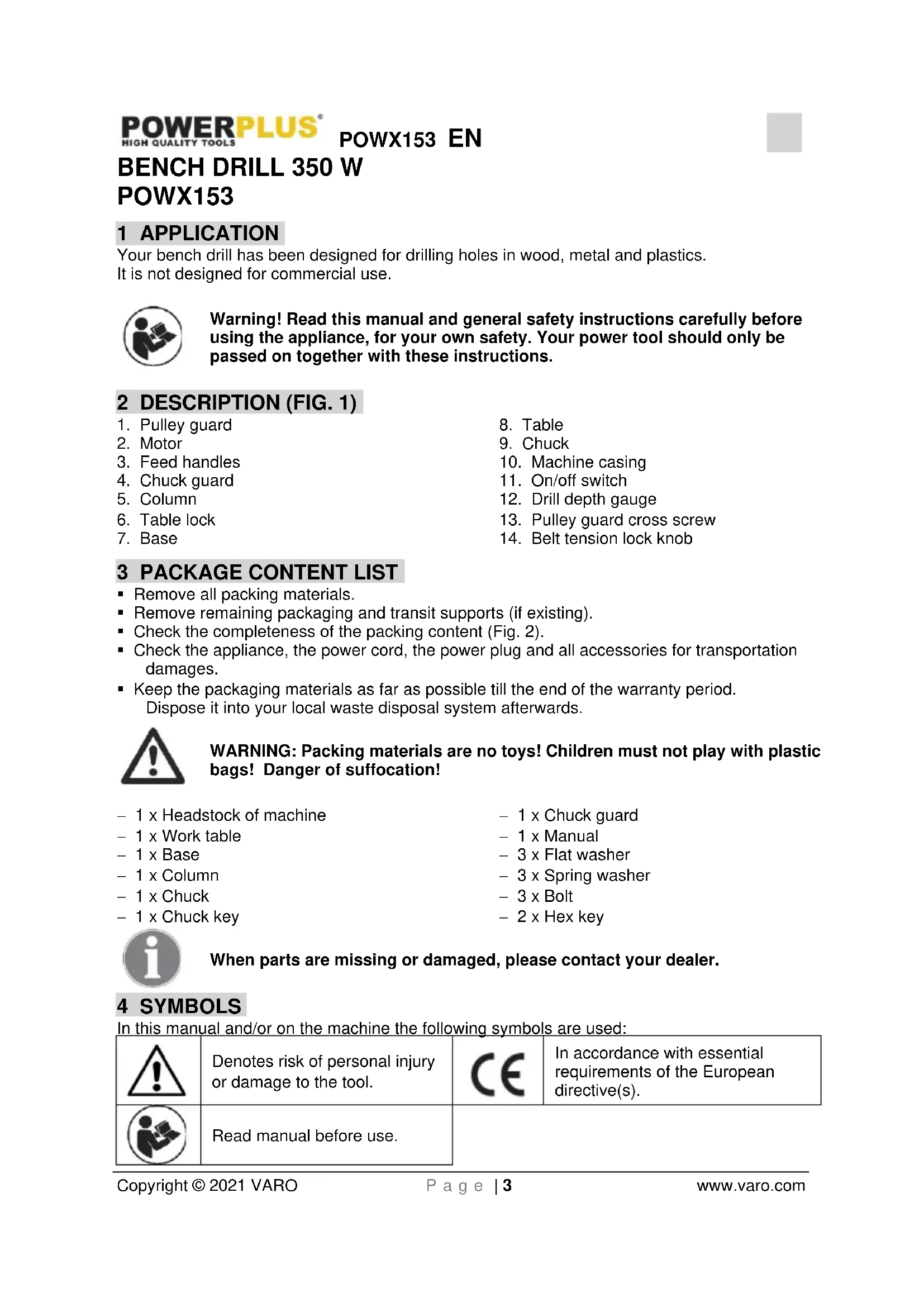
Your bench drill has been designed for drilling holes in wood, metal and plastics. It is not designed for commercial use.

Warning! Read this manual and general safety instructions carefully before using the appliance, for your own safety. Your power tool should only be passed on together with these instructions.
2 DESCRIPTION (FIG. 1)
- Pulley guard
- Motor
- Feed handles
- Chuck guard
- Column
- Table lock
-
Base
-
Table
- Chuck
- Machine casing
- On/off switch
- Drill depth gauge
- Pulley guard cross screw
- Belt tension lock knob
3 PACKAGE CONTENT LIST
- Remove all packing materials.
- Remove remaining packaging and transit supports (if existing).
- Check the completeness of the packing content (Fig. 2).
- Check the appliance, the power cord, the power plug and all accessories for transportation damages.
- Keep the packaging materials as far as possible till the end of the warranty period. Disposet it into your local waste disposal system afterwards.

WARNING: Packing materials are no toys! Children must not play with plastic bags! Danger of suffocation!
- 1 x Headstock of machine
-1xWork table
-1xBase
-1xColumn - 1 x Chuck
-
1 x Chuck key
-
1 x Chuck guard
-1xManual - 3 x Flat washer
- 3 x Spring washer
-3xBolt - 2 x Hex key

When parts are missing or damaged, please contact your dealer.
4 SYMBOLS
In this manual and/or on the machine the following symbols are used:
| ! | Denotes risk of personal injury or damage to the tool. | CE | In accordance with essential requirements of the European directive(s). |
| Read manual before use. | |||
5 GENERAL POWER TOOL SAFETY WARNINGS
Read all safety warnings and all instructions. Failure to follow all warnings and instructions may result in electric shock, fire and/or serious injury. Save all warnings and instructions for future reference. The term "power tool" in the warnings refers to your mains operated (corded) power tool or battery operated (cordless) power tool.
5.1 Work area
- Keep work area clean and well lit. Cluttered and dark areas invite accidents.
- Do not operate power tools in explosive atmospheres, such as in the presence of flammable liquids, gases or dust. Power tools create sparks which may ignite the dust or fumes.
- Keep children and bystanders away while operating a power tool. Distractions can cause you to lose control.
5.2 Electrical safety

Always check that the power supply corresponds to the voltage on the rating plate.
- Power tool plugs must match the outlet. Never modify the plug in any way. Do not use any adapter plugs with earthed (grounded) power tools. Unmodified plugs and matching outlets will reduce risk of electric shock.
- Avoid body contact with earthed or grounded surfaces such as pipes, radiators, ranges and refrigerators. There is an increased risk of electric shock if your body is earthed or grounded.
- Do not expose power tools to rain or wet conditions. Water entering a power tool will increase the risk of electric shock.
- Do not abuse the cord. Never use the cord for carrying, pulling or unplugging the power tool. Keep cord away from heat, oil, sharp edges or moving parts. Damaged or entangled cords increase the risk of electric shock.
- When operating a power tool outdoors, use an extension cord suitable for outdoor use. Use of a cord suitable for outdoor use reduces the risk of electric shock.
- If operating a power tool in a damp location is unavoidable, use a residual current device (RCD) protected supply. Use of an RCD reduces the risk of electric shock.
5.3 Personal safety
- Stay alert, watch what you are doing and use common sense when operating a power tool. Do not use a power tool while you are tired or under the influence of drugs, alcohol or medication. A moment of inattention while operating power tools may result in serious personal injury.
- Use safety equipment. Always wear eye protection. Safety equipment such as dust mask, non-skid safety shoes, hard hat, or hearing protection used whenever conditions require will reduce personal injuries.
- Avoid accidental starting. Ensure the switch is in the off position before plugging in. Carrying power tools with your finger on the switch or plugging in power tools that have the switch on invites accidents.
- Remove any adjusting key or wrench before turning the power tool on. A wrench or a key left attached to a rotating part of the power tool may result in personal injury.
- Do not overreach. Keep proper footing and balance at all times. This enables better control of the power tool in unexpected situations.
- Dress properly. Do not wear loose clothing or jewellery. Keep your hair, clothing and gloves away from moving parts. Loose clothes, jewellery or long hair can be caught in moving parts.
If devices are provided for the connection of dust extraction and collection facilities, ensure these are connected and properly used. Use of these devices can reduce dust related hazards.
5.4 Power tool use and care
- Do not force the power tool. Use the correct power tool for your application. The correct power tool will do the job better and safer at the rate for which it was designed.
- Do not use the power tool if the switch does not turn it on and off. Any power tool that cannot be controlled with the switch is dangerous and must be repaired.
- Disconnect the plug from the power source before making any adjustments, changing accessories, or storing power tools. Such preventive safety measures reduce the risk of starting the power tool accidentally.
- Store idle power tools out of the reach of children and do not allow persons unfamiliar with the power tool or these instructions to operate the power tool. Power tools are dangerous in the hands of untrained users.
- Maintain power tools. Check for misalignment or sticking of moving parts, breakage of parts and any other condition that may affect the power tool's operation. If damaged, have the power tool repaired before use. Many accidents are caused by poorly maintained power tools.
- Keep cutting tools sharp and clean. Properly maintained cutting tools with sharp cutting edges are less likely to stick and are easier to control.
- Use the power tool, accessories and tool bits etc., in accordance with these instructions and in the manner intended for the particular type of power tool, taking into account the working conditions and the work to be performed. Use of the power tool for operations different from intended could lead to a hazardous situation.
5.5 Service
- Have your power tool serviced by a qualified repair person using only identical replacement parts. This will ensure that the safety of the power tool is maintained.
6 ADDITIONAL SAFETY INSTRUCTIONS FOR BENCH DRILLS
- Only connect the machine to an earthed mains supply. Only use tree-core extension cords.
- This machine must be firmly secured to a suitable workbench or other stable work surface when selecting a suitable location for mounting this machine consideration must be given to the maximum length of the material to be drilled or machined and the position of the operator.
- Before starting the machine ensure that drills and other recommended cutting tools are fitted correctly and that all the securing bolts are tight. Check all guards are fitted and operating correctly and that the chuck key and any other adjustment tools have been removed.
- Keep hands well away from rotating drills and other cutting tools at all times.
- When drilling use the correct cutting lubricant/coolant for the material being drilled. Use only sufficient to prevent the drill from overheating and make sure that it is kept well away from electrical components. Never use water as a coolant. Keep drills and other cutters sharp and in good condition. This will improve cutting and reduce the load on the machine ensuring a longer life of the cutting tools and the machine.
- Use only drill bits, cutters and other accessories recommended by the manufacturer. Select the correct spindle speed for the size of drill being used. See instruction manual. Do not attempt to modify the machine or its accessories in any way.
- Use approved safety glasses or goggles at all times and a face mask and ear defenders when using for prolonged periods.
-
Do not force the machine, let the machine do the work. This will reduce the wear on the machine and cutter and increase its efficiency and operating life.
-
When drilling long lengths of material ensure that there is adequate support at both ends of the material.
-
Never use the machine without the safety guards in position and operating correctly.
-
When drilling wood and wood type materials, ensure that the work piece is free from any nails or other foreign objects that could damage the drills and other cutting tools.
Always secure the workpiece in a suitable drill vice.
- Do not wear gloves, ties or loose clothing.
While drilling, never hold the workpiece by hand, but firmly tighten it to the drilling table using a vice e.g. Never keep your fingers on a place where they could touch the drill in case the workpiece should move unexpectedly.
-
Be aware that swarf can be very sharp and hot and can fly of the rotating drill. When handling swarf always wear suitable gloves. Swarf should not be disposed of with domestic waste, it should be disposed of at a recycling centre.
-
Never leave the machine running while unattended. If you are interrupted when operating the drill, complete the process and switch off before looking up.
-
Always allow the machine to come to a complete stop and disconnect from the power supply before leaving the unit unattended.
-
Never use your hands to remove dust, chips or waste close by the drill bit.
-
Do not use the machine until it has been mounted and installed completely according to the instructions.
-
Do not switch on the machine while moving the head relative to the table or vice versa. Do not switch on the machine until having checked that head and table have been tightened firmly to the pillar.
-
Do not use the machine if a part is damaged or badly functioning.
-
Adjust the table or depth stop to prevent the drill from entering the table. Do not perform any design, assembly or construction activities on the table while the machine is switched on.
-
Make sure that the chuck key (if applicable) has been removed before switching on the machine.
-
Before switching on the machine, make sure the chuck has been mounted correctly, the drill has been mounted into the chuck firmly and the safety guard has been shut.
-
In operation, use the recommended speed for the drilling accessories and the material.
-
Switch off the power, remove the drill and clean the table before leaving the machine.
-
Lock the on/off switch when leaving the machine.
-
Even when the tool is used as prescribed it is not possible to eliminate all residual risk factors. The following hazards may arise in connection with the tools construction and design:
-
Contact with the drill bit.
-
Kickback of work piece and parts of workpiece.
-
Bit fracture.
-
Catapulting of bit pieces.
-
Damage to hearing if effective ear defenders are not worn. Wear ear defenders.
-
Damage to lungs if effective breathing protection is not worn in operations in which dust is produced. Wear breathing mask.
-
Damage to sight if effective eye protection is not worn. Wear goggles.
7 ASSEMBLY
- The bench drill comes partially assembled for packaging purposes. Lay the parts on the bench and check against the parts list (Fig. 2).
- Remove the anti-corrosive oil on the uncovered metal parts using a cloth and a little paraffin oil. Proceed with greasing the parts with machine lubricating oil.
- You will need:
- Suitable personal protective equipment (not supplied).
Philips head screwdriver (not supplied).
- 3 × M8 × 20 mm bolts, washers and nuts for workbench mounting (not supplied).
- Chuck and chuck key.
- 4 mm hex key.
7.1 Mounting the base plate (Fig. 3) (optional)
- Select a suitable location for the drill on a workbench. Be aware of table legs and anything which might reduce access to the underneath of the workbench. A suitable mains supply socket must also be accessible for the plug.
- Locate the base plate (7) in the selected position.
- Select two suitable length bolts, washers and nuts (not supplied).
- Using the base plate (7) as a template drill two holes through the workbench.
- Bolt the base plate (7) to the bench. Do not over tighten as this could crack the cast base plate (Fig. 3).
7.2 Fitting the column (Fig. 4)
- Place column (5) on the base (7) and align holes in the column with holes in the base.
- Attach using bolt washer and spring washer hole through the column and into the base (Fig. 4).
7.3 Fitting the table (Fig. 5)
- Lower the table assembly onto the column (5). The assembly will slide easily into position so do not use force. Make sure the table assembly will rotate 360°
- Tight the table lock to secure the table assembly into position (Fig. 5).
7.4 Fitting the head stock and motor (Fig. 6)
- Locate the two grab screws in the side of the head stock and motor assembly. Using a hexagonal key slacken the two grab screws.
- Lift the head stock and motor assembly and lower it onto the column. Make sure that it slides down and locates fully on the column.
- Position the head stock and motor assembly ensuring it is aligned with the base plate (7).
- Tighten the two grab screws to secure the head stock and motor assembly into place (Fig. 6).
- Retain the hexagonal keys for future adjustments.
7.5 Fitting the hand feed handles (Fig. 7)
- Locate and install the three hand feed handles (3).
- Simply screw the handles (3) into the three threaded holes located in the feed shaft boss. Make sure that all three handles (3) are tight (Fig. 7).
7.6 Fitting the chuck guard (Fig. 8)
- Warning: never attempt to use the machine without the chuck guard (4) fitted.
- The telescopic chuck guard (4) is partially assembled onto the machine.
- Remove three cross head screws just below the hinge on the red collar.
- Position the transparent plastic shield into the red collar and secure in place with the three small cross head screws (Fig. 8).
- The chuck guard (4) is spring loaded and on a hinge which allows the guard (4) to be moved upwards to expose the chuck (9) for drill installations and removal.
- Always return the guard (4) to cover rotating parts. Simply unscrew the wing nuts and the two piece guard will extend vertically up or down.
- Chuck guard (4) is adjustable to varying depths to give more protection (Fig. 8).
7.7 Fitting the 3 jaw chuck (Fig. 9-10)
- This machine is supplied with a taper stub shaft fitted into the spindle.
-
To fit the chuck (9), clean the protective film from the chuck (9) internal taper and the stub shaft external taper with white spirit.
-
Place chuck (9) onto the exposed stub shaft.
- Place a piece of wood onto the drill table.
- Using feed handles (3) lower the chuck (9) onto the wood.
- Gently apply pressure to engage the taper and then let the spindle raise to its upper position (Fig. 9-10).
The drill is now fully assembled and secured in position. The following adjustments and setting up instruction must be carried out before connecting the machine to the mains supply.

Before inserting or removing a drill, always pull the plug from the wall socket.
7.8 Connection to the power supply
- Make sure the on/off switch (11) is in its off position.
- Connect the plug with a suitable socket.
- Warning: check the voltage! The voltage must comply with the information on the rating label!
Your product is now ready to be used.
Check that you have noted all the following instructions:
Before starting you must have fully read and understood the entire instruction manual.
- Working with this product is demanding; therefore ensure you are physically and mentally fit to complete the job safely.
- Ensure that you have all the accessories and tools needed for assembly and operation.
- Make sure that you wear suitable personal protective equipment.
- Ensure that no unauthorized people especially children, and pets are nearby or could enter the working area.
- Ensure that the product is free from damage and that it is not worn.
- Make sure that safety devices and accessories are correctly fixed.
- Double check that all assembly tools have been removed from the product before use.
- Undertake periodic structural checks of this product; do not use it if you have any doubts about its suitability for its intended purpose.
8 OPERATION
- Use waste material to practice your skills and to learn operating the machine first.
- When drilling through, adjust the table to make sure that the drill is aligned with the opening in the centre of the table. If required, mark the position on the front side of pillar and table in case the table should be set in the same position at a later time. Securely tighten the workpiece. Toppling, turning or sliding not only results in a rough drilling hole, it also increases the risk of the drill breaking off.
- Use a piece of waste wood as a backup to reduce the risk of the workpiece splintering and to protect the drill tip.
- Place flat workpieces on a wooden underground and clamp securely to the table to prevent them from turning. Support workpieces that are irregular of shape and cannot be put flat onto the table.
Use the lift handles to bring the drill lift downwards. Slowly feed the drill into the workpiece. - Drill slowly when the drill is about to break through the workpiece to prevent splintering.
8.1 Using a machine vice (vice not supplied) (Fig. 11)
- Warning: The drill should never be used without the work piece being securely held in a machine vice or clamped directly to the drill table (8).
-
The drill table (8) is designed to accept a variety of machine vice which can be fastened directly to the drill table (8).
Always secure the vice tot the table (8) with bolts, washer and nuts. -
If the drill jams into the work piece an unsecured machine vice will spin out of control causing the drill to snap and possibly injure the operator (Fig. 11).
8.2 Using the 3 jaw chuck (Fig. 12)
- Select the drill bit required.
- Open the jaws and insert the drill shank centrally into the chuck (9).
- Rotate the chuck (9) by hand until the jaws grip the drill bit.
- The chuck (9) has three holes around the chuck body. Locate the chuck key and using an even torque move from each hole location until all three holes have been covered. Continue with the steady torque until tight.
- Do not over tighten otherwise you will have difficulty removing the drill bit (Fig. 12).
NOTE: remove the chuck key before use. - Different drill bits and chisels can be used with this product depending on the workpiece material and application required.
8.3 Switching on and off (Fig. 13)
-
This machine is fitted with a "No Volts Switch". In the event of a mains power failure or if the mains plug is removed from the mains supply socket before the machine is switched off. The machine will not restart without warning when the mains supply is restored or the mains plug is reconnected to the mains supply, until the machine is switched ON at the ON//OFF switch (11) fitted to the machine.
-
To start the machine press the green ON button.
- To stop the machine, press the red OFF button (Fig. 13).
8.4 Feed depth adjustment (Fig. 14)
- This facility is useful if a number of uniform depth holes are required in a work piece.
- Set the work piece to be drilled in your machine vice.
- Insert the drill required into the chuck (9). Bring the drill bit into contact with the work surface.
- Using the depth stop nuts and the depth scale, set the depth of hole required, secure the depth stop nuts. The drill will stop at the required depth every time (Fig. 14).
NOTE: always stop feeding while the depth stop nuts stops, otherwise the red plastic collar might be damaged.
8.5 Changing the spindle speed (Fig. 15)
- Warning: always ensure that the tool is switched off and unplugged from the power supply before making any adjustments or changing a drill bit.
- Unscrew the cross head screw (13) securing the pulley guard (1) and lift open the pulley guard (1) to expose the pulley system.
- Determine the spindle speed required.
- Identify the pulley arrangement that gives the nearest spindle speed to that required by referring to the drill speed chart (Fig. 15).
8.6 Drill speed chart
| Belt setting | Spindle speed (min-1) |
| 1 | 580 |
| 2 | 850 |
| 3 | 1220 |
| 4 | 1650 |
| 5 | 2650 |

- Slacken the belt tension locking knob. This will allow the tension on the drive belt to be released.
- The motor assembly is hinged to allow tensioning of the drive belt. To move the drive belt to the desired pulley arrangement push the belt on the largest drive spindle pulley towards the next smallest pulley and at the same time rotate the drive spindle, by hand until the drive belt locates onto the next smallest pulley.
- Repeat this procedure on the motor pulley until the desired pulley arrangement has been achieved (Fig. 16).
NOTE: do not cross the belt to give intermediate speeds, this will cause damage to the machine.
Duty cycle (S2): this product has a rated duty cycle of S2. This product must only be run continuously for a maximum of 15 minutes. It must be then switched off and allowed to cool down to room temperature before being run again for 15 minutes.
Small diameter drills require a higher speed and as the drill diameter increases the slower the speed required. The following drilling speed chart is a guide only and only covers the more common materials, drill diameters and speeds.
| Drilling speed chart (guide only) | ||||||
| Material to be drilled | ||||||
| Drill dia mm | Steel | Cast Iron | Gun metal | Aluminum | Plastics | Wood |
| Drill speed (min-1) | ||||||
| 3 | 2500 | 2500 | 2500 | 2500 | 2500 | 2500 |
| 4 | 2500 | 2500 | 2500 | 2500 | 2500 | 2500 |
| 5 | 1900 | 2500 | 2500 | 2500 | 2500 | 2500 |
| 6 | 1900 | 2500 | 2500 | 2500 | 2500 | 2500 |
| 7 | 1400 | 1900 | 2500 | 2500 | 2500 | 2500 |
| 8 | 1400 | 1900 | 2500 | 2500 | 2500 | 2500 |
| 9 | 890 | 1400 | 1900 | 2500 | 2500 | 2500 |
| 10 | 890 | 1400 | 1900 | 1900 | 2500 | 2500 |
| 11 | 500 | 890 | 1400 | 1900 | 1900 | 2500 |
| 12 | 500 | 890 | 1400 | 1400 | 1900 | 1900 |
| 13 | 500 | 500 | 890 | 1400 | 1400 | 1900 |
8.7 Belt tension (Fig. 17)
- When the desired pulley arrangement has been achieved tension the drive belt.
- To check that the correct tension has been achieved, press your finger onto the centre of the drive belt. The drive belt should move approximately 13mm .
Retighten the belt tension locking knob (Fig. 17).
8.8 General guidelines for drilling
- Always centre punch the position for drilling. A centre punch is a pointed tool that marks the material to be drilled with a small indent. It stops the drill bit moving from the desired position.
- Always start by drilling a small pilot hole and gradually progress in drill diameter.
-
When drilling metal, lubricate the drill tip with oil.
-
Warning: Never cool with water or water based lubricant otherwise an electric shock could occur. DO NOT use oil when drilling copper or brass. Care should be taken when drilling copper and brass as the drill bit will be prone to jamming.
9 CLEANING AND MAINTENANCE

Attention! Before performing any work on the equipment, pull the power plug.
9.1 Cleaning
- Always wear sturdy gloves when handling or changing bits and cutters as they can be very sharp.
- Wear safety glasses to protect your eyes whilst cleaning.
- Keep the ventilation slots of the machine clean to prevent overheating of the engine.
- Regularly clean the machine housing with a soft cloth, preferably after each use.
- Keep the ventilation slots free from dust and dirt.
- If the dirt does not come off use a soft cloth moistened with soapy water.

Never use solvents such as petrol, alcohol, ammonia water, etc. These solvents may damage the plastic parts.
9.2 Lubrication
- Turn the drill shaft to the maximum drilling depth once per 3 months and grease it slightly with oil.
9.3 Spindle play (Fig. 18)
- Locate the spindle play adjustment set screw.
- Loosen the lock nut and finger-tighten the grab screw.
- Hold the grub screw into position with a hex key and tighten the lock nut (Fig. 18).
9.4 General inspection (Fig. 19)
- Regularly check that all the fixing screws are tight. They may vibrate loose over time.
If the supply cord requires replacing, the task must be carried out by the manufacturer, the manufacturers agent, or an authorized service centre to avoid a safety hazard (Fig. 19).
9.5 Power cord
- If the power cord is damaged, it must be replaced by the manufacturer, its service agent or similarly qualified persons in order to avoid a safety hazard.
10 TROUBLE SHOOTING
Suspected malfunctions are often due to causes that the users can fix themselves. Therefor check the product using this section. In most cases the problem can be solved quickly.
| Problem | Possible cause | Solution |
| 1. Noisy operation | 1.1 Incorrect belt tension 1.2 Loose spindle pulley 1.3 Loose motor pulley | 1.1 Adjust tension 1.2 Tighten the pulley insert nut 1.3 Tighten the screws |
| 2. Drill bit gets excessively hot | 2.1 Incorrect speed 2.2 Chips not coming out of hole 2.3 Dull drill bit 2.4 Feeding too slow | 2.1 Adjust the speed 2.2 Retract drill bit frequently to clear chips 2.3 Re-sharpen drill bit 2.4 Feed fast enough, allow drill bit to cut |
| 2.5 Drill bit not being allowed to cool down or not lubricated in use | 2.5 Lubricate drill bit when cutting. Follow S2 duty cycle time | |
| 3. Wood splinters on underside | 3. No back-up material under workpiece | 3. Use back-up material |
| 4. Drill bit binds | 4.1 Not supported or clamped properly 4.2 Improper belt tension | 4.1 Support workpiece or clamp workpiece 4.2 Adjust tension |
| 5. Excessive drill bit runout or wobble | 5.1 Bent drill bit 5.2 Worn spindle bearing 5.3 Chuck not properly installed | 5.1 Change drill bit 5.2 Change bearing 5.3 Install chuck properly |
| 6. Quill returns too slow or too fast | 6. Spring has improper tension | 6. Adjust spring tension |
| 7. Chuck falls off when attached to spindle, falls off when trying to install it | 7. Dirty, crease or oil on tapered inside surface of chuck or on the spindles tapered surface | 7. Clean it |
| 8. Pulley sliding | 8. Belt is not tight | 8. Tighten belt |

Attention! Only perform the steps described within these instructions! All further inspection, maintenance and repair work must be performed by an authorised service centre or a similarly qualified specialist if you cannot solve the problem yourself!
11 TECHNICAL DATA
| POWX153 | |
| Mains voltage | 230 V |
| Mains frequency | 50 Hz |
| Power input | 350 W |
| No-load speed | 580-2650 min-1 |
| Spindle taper | B16 |
| Spindle travel | 50 mm |
| Number of drilling speeds | 5 |
| Max drilling capacity | Ø13 mm |
| Table dimensions | 160 x 160 mm |
| Base size | 295 x 190 mm |
| Weight | 11 kg |
| Protection class | Class I |
12 NOISE
Noise emission values measured according to relevant standard. (K = 3)
| Acoustic pressure level LpA | 69 dB(A) |
| Acoustic power level LwA | 82 dB(A) |

ATTENTION! Wear hearing protection when sound pressure is over 85 dB(A).
13 SERVICE DEPARTMENT
Damaged switches must be replaced by our after-sales service department. If the connecting cable (or mains plug) is damaged, it must be replaced by a particular connecting cable which is available from our service department. Replacement of the connecting cable must only be carried out by our service department (see last page) or by a qualified person (qualified electrician).
14 STORAGE
Thoroughly clean the whole machine and its accessories.
Store it out of the reach of children, in a stable and secure position, in a cool and dry place, avoid too high and too low temperatures.
15 WARRANTY
- This product is warranted for a 36-month period effective from the date of purchase by the first user.
- This warranty covers all material or production flaws excluding: batteries, chargers, defective parts subject to normal wear & tear such as bearings, brushes, cables, and plugs, or accessories such as drills, drill bits, saw blades, etc.; damage or defects resulting from maltreatment, accidents or alterations; nor the cost of transportation
- Damage and/or defects resulting from inappropriate use also do not fall under the warranty provisions.
We also disclaim all liability for any bodily injury resulting from inappropriate use of the tool. - Repairs may only be carried out by an authorised customer service centre for Powerplus tools.
- You can always obtain more information at the number 00 32 3 292 92 90.
- Any transportation costs shall always be borne by the customer, unless agreed otherwise in writing.
- At the same time, no claim can be made on the warranty if the damage of the device is the result of negligent maintenance or overload.
- Definitely excluded from the warranty is damage resulting from fluid permeation, excessive dust penetration, intentional damage (on purpose or by gross carelessness), inappropriate usage (use for purposes for which the device is not suitable), incompetent usage (e.g. not following the instructions given in the manual), inexpert assembly, lightning strike, erroneous net voltage. This list is not exhaustive.
- Acceptance of claims under warranty can never lead to the prolongation of the warranty period nor commencement of a new warranty period in case of a device replacement.
Devices or parts which are replaced under the warranty therefore remain the property of Varo NV. - We reserve the right to reject a claim whenever the purchase cannot be verified or when it is clear that the product has not been properly maintained. (Clean ventilation slots, carbon brushes serviced regularly, etc.).
- Your purchase receipt must be kept as proof of date of purchase.
- Your appliance must be returned undismantled to your dealer in an acceptably clean state, (in its original blow-moulded case if applicable to the unit), accompanied by proof of purchase.
16 ENVIRONMENT
Should your appliance need replacement after extended use, do not discard it with the household rubbish but dispose of it in an environmentally safe way. Waste produced by electrical machine items should not be handled like normal household rubbish. Please recycle where recycle facilities exist. Check with your Local Authority or retailer for recycling advice.
VARO N.V. -Vic. Van Rompuy N.V.- Joseph Van Instraat 9 - BE2500 Lier - BELGIUM, declares that,
product: Bench drill 350 W
trade mark: POWERplus
model:POWX153
is in conformity with the essential requirements and other relevant provisions of the applicable European Directives, based on the application of European harmonized standards. Any unauthorized modification of the apparatus voids this declaration.
European Directives (including, if applicable, their amendments up to the date of signature):
2011/65/EU
2014/30/EU
2006/42/EC
European harmonized standards (including, if applicable, their amendments up to the date of signature):
EN62841-1:2015
EN62841-3-13:2017
EN55014-1:2017
EN55014-2:2015
EN61000-3-2:2014
EN61000-3-3:2013
Keeper of the Technical Documentation: Philippe Vankerkhove, VARO - Vic. Van Rompuy N.V. The undersigned acts on behalf of the company CEO,
Philippe Vankerkhove
Regulatory Affairs - Compliance Manager
21/01/2021, Lier - Belgium
21/01/2021, Lier - Belgium
Regulatory Affairs - Compliance Manager
21/01/2021, Lier - Belgium
21/01/2021, Lier - Belgium
1 BRUKSOMRADE 3
2 BESKRIVELSE (FIG. 1) 3
3 PAKKENS INNHOLD 3
4 SYMBOLFORKLARING 3
5 GENERELLE SIKKERHETSADVARSLER 4
5.1Arbeidsplassen 4
5.2 Elektrisk sikkerhet 4
5.3 Personsikkerhet 4
5.4 Vær noyaktig og omhyggelig nár du omgås elektroverktoy... 5
5.5 Service 5
6YTTERLIGERE SIKKERHETSINSTRUKSJONER FOR SOYLEBORMASKINER 5
7 MONTASJE 7
7.1 Montere foten (Fig. 3)(valgfritt)
7.2 Montere soylen (Fig. 4)
7.3 Montere bordet (Fig. 5)
7.4 Montere borhodet og motoren (Fig. 6)
7.5 Montere matehandtaket (Fig. 7)
7.6 Montere beskyttelsesskjernen for kjoksen (Fig. 8)
7.7 Montere kjoksen med 3 kjever (Fig. 9-10). 8
7.8 Koble til strom 8
8 BRUK. 8
8.1 Bruke en maskinskruestikke (folger称之 med) (Fig. 11) 9
8.2 Bruke kjoksen med 3 kjever (Fig. 12)
8.3 Sla pa og av (Fig. 13) 9
8.4 Dybdejustering for mating (Fig. 14) 9
8.5 Endre spindelhastigheten (Fig. 15) 9
8.6 Tabell over borhastighet.. 10
8.7 Reimspanning (Fig. 17) 10
8.8 Generelle retningslinjer for boring 11
9 RENGJØRING OG VEDLIKEHOLD 11
POWERPLUS HIGH QUALITY TOOLS
POWX153 NO
9.1 Rengjoring 11
9.2 Smoring 11
9.3 Spindelvandring (Fig. 18) 11
9.4 Generell inspeksjon (Fig. 19) 11
9.5 Stromledning 11
10 FEILSOKING 12
11 TEKNISKE DATA 12
12 STOY 13
13 SERVICEAVDELING. 13
14 OPPBEVARING 13
15 GARANTI 13
16 MILJ0 14
17 SAMSVARSERKLÅERING 14
SØYLEBORMASKIN 350 WPOWX153
1 BRUKSOMRADE
Bruk alltid donne fremgangsmåten i riktig reckefolge nár du setter sammen maskinen. Apparatet mA kun brukes til privat bruk.

ADVARSEL! Av sikkerhetshensyn bør du lese dette veiledningen nøye før maskinen tas iBruk. Hvis man leverer apparatet til en tredjeperson mæ man levere bruksanvisningen videre øgså.
2 BESKRIVELSE (FIG. 1)
-
Reimdeksel
-
Bord
-
Motor
-
Kjoks
-
Matehändtak
-
Motorhus
-
BeskytTELSSKjerm for kjoks
-
På/av-bryter
-
Søyle
-
Dybdemaler
-
Bordlås
-
Krysshodeskrue for reimdeksel
-
Fot
-
Laseknapp for reimspenning
3 PAKKENS INNHOLD
1 x borhode for maskinen
8.4 Dybdejustering for mating (Fig. 14)
9 RENGJØRING OG VEDLIKEHOLD

21/01/2021, Lier - Belgium
21/01/2021, Lier - Belgium
1 ANVÄNDNINGSOMRÄDE 3
2 BESKRIVNING (FIG. 1) 3
3 FÖRPACKNINGSINNEHÄLL 3
4 SYMBOLER 3
5 ALLMÄNNA SÄKERHETSANVISNINGAR FÖR ELEKTRISKA VERKTYG
17 KONFORMITETSDEKLARATION


VARO N.V. - Vic. Van Rompuy N.V.- Joseph Van Instraat 9 - BE2500 Lier - Belgien, deklarerar harmed att.
Produkt: Pelarborrmaskin 350 W
21/01/2021, Lier - Belgium
21/01/2021, Lier - Belgium
1 EΦAPMOrH 3
2 KATAAIOFOEAPTHMATQN 3
3 ΛΙΣΤΑ έπΕΠΕXΟΜΕΝΟύN ΣΥΣΚΕYΑΣΙΑΣ 3
4 SYMBOA 4
5 TENIKEΣ ΣYMBOYΛΕΣ ΓΙA THN AΣΦΑΛΕΙA 4
5.1 XwpoC epyaia
5.2 Hekrtipikn aovapaaia 4
5.3 Atojikn aovapaa 5
5.4 NpooektikocxepiooCkXpnonTwv nEeptipikw epyaieiw 5
5.5 6
6 ΠΝΟΣΘΕTEΣΟΔΗΓΙΕΣΑΣΦΑΛΕΙΑΣ ΓΙΑΚΑΚΟΥΦΑ ΔΡΑΠΑΝΑ
7 IPOESOHS 7
7.1 Torotheon ng nks naakac baonc (Eik. 3) (npoaipetiko).. 8
7.2 Torothe ton ng koawvac (EK. 4)
7.3 Torotheonrou rpaneiou (Eik. 5) 8
7.4 Tonoetno n ts atpakrou epaoncs kai tou kivtnnpa (EK.6) 8
7.5 Tonooetnoon xiepoaalawv rpoopooiaac (Eik. 7) 8
7.6 Torotheon rou npootateutikoU (EIK. 8)
7.7 Torotheonr rou rook 3 siaywvw (EK.9-10)
7.8 2uv6oan rou unxavmuo oTo pEu .9
8 AEITOYPIIA 10
8.1 Xpno nmuevnns uxavn (ev npexetai) 11
8.2 Xpnon rou rook 3 oaywvwv (EK. 12) 10
8.3 Ekkivonkai aeevepyotoinon (1K. 13) 10
8.4 Puroiog β aouc rpooosiae (14) 11
8.5 Aaayn nrs raxtntac arpakrou (Eik. 15) 11
8.6 IVakac tauxntwv rpunaviou 11
8.7 Taon ipavra (EK. 17) 12
8.8 12
9 KAOAPIEMOe KAI SYNTHPHsH 12
POWERPLUS HIGH QUALITY TOOLS
POWX153 EL
9.1 Kaθαρισμα 12
9.2 Ainavon 13
9.3 Tcfoos afova (Eik. 18) 13
9.4 13
9.5 KaIomega pEuaToc 13
10 ANTIMETQNIIEH PPOBAHMATQN 13
11 TEXNIKA XAPAKTHPIETIKA 14
12 0OPYBOs 14
13 TMHMA ΣEPBIS 15
14 ANOOHKEYE H 15
15 ERTYHsH 15
16 IEPIBAAON 16
17 HΛΩΣH ΣYMMOPΦΩΣH
KATAKOPYΦO ΔPAPANO 350WPOWX153
1 EΦAPMθH
AutoTo katakopuo dpantavo exei oxediaotei yia Tn diatponon otiwv oE uAo, metaaloo kaI IAAOTIKa.
Δ δ α γ xpnon.

IPOEIAOIOIHsH! Napakaloue diaaote TpoeKTikto EYxepidio XpnoCnTn XpnoKai qualeTo yia va avatpeXeTe o' auto 0To µ λ ν .Eav melaBaoetc auto to nAekptko epyaleio, npadwotc mazi kai TIC odnyie Cxphons.
2 KATAANOEGAPTHMATQN
- PPOOTATEUTIKo TPOXaIac
- MoTeP
- Aαβες Χειροκίνητης τροφόδοσαις
- PooTATEUTIKO TOOK
- Koλóva
- Kλειδί τραπεζιό
- Bao
-
Tpaπει
-
Took
-
Iepiβλημα μnxavns
- DiakóTTnC On/off
- Odyoc baouc tpuannou
- Bida TPOOATEUIKOU TPOXALIAC µ OTAUPOEIDN EYKOTNI
- DiakóTTns puθμiαns taαns iμavTa
21/01/2021, Lier - Belgium
1 PRIMJENA 3
2 OPIS (SLIKA 1) 3
3 POPIS SADRZAJA PAKETA 3
4 SIMBOLI 3
5 OPÇA UPOZORENJA O SIGURNOSTI RUKOVANJA
ELEKTRICNIM ALATIMA 4
5.1 Radno mesto 4
5.2 Elektricna sigurnost 4
5.3 Osobna sigurnost 4
5.4 Uporaba i odrzavanje elektricnog alata 5
5.5 Servis 5
6 DODATNE UPUTE O SIGURNOSTI ZA STOLNE BUSILICE ....5
7 SKLAPANJE 7
7.1 Postavljanje osnovne ploce (slika 3)(dodatno)
7.2 Postavljanes tupa (slika 4)
7.3 Postavljanje radne podloge (slika 5)
7.4 Postavljanje sklopa glave i motora (slika 6)
7.5 Postavljanje ručki za ručno voděnje (slika 7)
7.6 Postavljanje stitnika stezne glave (slya 8)
7.7 Postavljanje stezne glaves 3 celjusti (slike 9 - 10)
7.8 Priključivanje na napajanje 8
8 RAD 8
8.1 Korištenje škripca stroja (škripac nije isporučen) (slika 11) 9
8.2 Korištenje stezne glaves 3Čeljusti (slika 12) 9
8.3 Uključivanje i isključivanje (sika 13) 9
8.4 Podešavanje dubine voděnja (slika 14) 9
8.5 Promjena brzine vretena (sika 15) 9
8.6 Tablica brzina svrdla 10
8.7 Zategnutost remena (sika 17) 11
8.8 Opce smjernice za busenje 11
9 CiScENJE I ODRZAVANJE 11
9.1 Cijscenje 11
9.2 Podmazivanje 11
9.3 Slobodan hod vretena (sika 18). 11
9.4 Opci pregled (slika 19) 11
9.5 Kabel za napajanje 11
10 RJEŠAVANJE PROBLEMA 12
11 TEHNICKI PODACI 13
12 BUKA 13
13 SERVIS 13
14 SKLADISTENJE 13
15 JAMSTVO 14
16 OKOLIS 14
17 IZJAVA O SUKLADNOSTI 15
STOLNA BUSILICA 350 WPOWX153
1 PRIMJENA
21/01/2021, Lier - Belgium
1 PRIMENA 3
2 OPIS (SL. 1) 3
3 SPISAK SADRZAJA PAKOVANJA 3
4 SIMBOLI 3
5 OPŠA BEZBEDNOSNA UPUTSTVA ZA ELEKTRICNE ALATE.4
5.1 Radna oblast 4
5.2 Elektricna bezbednost 4
5.3 Lična bezbednost 4
5.4 Korisćenje i odžavanje elektrichnog alata 5
5.5 Servisiranje 5
6 DODATNA BEZBEDNOSNA UPUTSTVA ZA STONE BUSILICE .5
7 SKLAPANJE 7
7.1 Montaza podnozne ploce (SI. 3) (opcione)
7.2 Montaža stuba (Sl. 4)
7.3 Montaza radne ploce (SI. 5)
7.4 Montaza nosaça vretena i motora (SI. 6)
7.5 Montaza ručica za ručno pamicanje (SI. 7)
7.6 Montaža Šitnika stezne glave (SI. 8)
7.7 Montaza 3-zube stezne glave (SI. 9-10)
7.8 Prikljucivanje na izvor napajanja elektrichnom strujom 8
8 RAD 9
8.1 Upotreba masinske stege (stega se ne isporucije) (Sl. 11)
8.2 Upotreba 3-zube stezne glave (Sl. 12) 9
8.3 Ukljucivanje i iskljucivanje (SI. 13) 9
8.4 Podesavanje dubine pomicanja (SI. 14) 10
8.5 Promena brzine vretena (Sl. 15) 10
8.6 Tabela brzina bušilice 10
8.7 Zategnutost kaiša (Sl. 17) 11
8.8 Opste smernice za buşenje 11
9 CiScENJE I ODRZAVANJE 11
9.1 Cijscenje 11
9.2 Podmazivanje 12
9.3 Mrtvi hod vretena (SI. 18) 12
9.4 Generalni pregled (Sl. 19) 12
9.5 Napojni kabl. 12
10 DIJAGNOZA IOTKLANJANE KVAROVA 12
11 TEHNICKI PODACI 13
12 BUKA 13
13 SERVISNO ODELJENJE 13
14 ODLAGANJE 13
15 GARANCIJA 14
16 ZIVOTNA SREDINA 14
17 IZJAVA O USKLADENOSTI 15
STONA BUSILICA 350 WPOWX153
1 PRIMENA
Vasa stona busilica je dizajnirana za busenje rupa u drvetu, metalu i plasticnim materijalima. Ovaj alat nije predviden za komercijalnu upotrebu.

21/01/2021, Lier - Belgium
1 OBLASTPOUZITIA 3
2 POPIS (OBR. 1) 3
3 OBSAH BALENIA 3
4 VYSVETLENIE SYMBOLOV 3
5 VŠEOBECNÉ BEZPEČNOSTNÉ UPOZORNENIA PRE ELEKTRICKÉ NÁRADIE 4
21/01/2021, Lier - Belgium
1 DOMENII DE UTILIZARE 3
2 DESCRIERE (FIG. 1) 3
3 CONTINUTUL PACHETULUI 3
4 IMBOLURI 3
5 AVERTISMENTE GENERALE DE SIGURANÁ PRIVIND
APARATUL ELECTRIC 4
5.1 Zona de lucru 4
5.2 Siguranta electrica 4
5.3 Sigurantha personala 4
5.4 Folosirea 山 intretnerea aparatului electric.. 5
5.5 Service 5
6 INSTRUCTION DE SIGURAN T A SUPLIMENTARE PENTRU MAŞINILE DE GÜRIT DE BANC 5
7 MONTAREA 7
7.1 Montarea postamentului (Fig. 3) (optional) 7
7.2 Montarea coloanei (Fig. 4)
7.3 Montarea mesei (Fig. 5)
7.4 Fixarea capului de antrenare a masinii si a motorului (Fig. 6)
7.5 Montarea manerelor de avans manual (Fig .7) 8
7.6 Montarea aparatorii de mandrina (Fig. 8) 8
7.7 Montarea mandrinei cu 3 falc (Fig. 9-10) 8
7.8 Racordarea la alimentarea cu energia electrica.. 8
8 MOD DE UTILIZARE 9
8.1 Utilizarea unei menghine (menghina nu este furnizata) (Fig. 11). 9
8.2 Utilizarea mandrinei cu 3 falic (Fig. 12) 9
8.3 Pornirea 日 oprirea (Fig. 13). 10
8.4 Reglarea adancimii de avans (Fig. 14) 10
8.5 Modificarea turatiei axului (Fig. 15) 10
8.6 Tabel de turatii ale burghiului 10
8.7 Tensionarea curelei (Fig. 17) 11
8.8 Indrumari generale pentru gaurire 11
9 CURATAREA I INTRETINEREA 11
9.1 Curataea 11
9.2 Lubrifierea 12
9.3 Jocul axului (Fig. 18) 12
9.4 Inspectia generala (Fig. 19) 12
9.5 Cablul de alimentare 12
10 DEPANAREA 12
11 DATE TEHNICE 13
12 ZGOMOT 13
13 DEPARTMENTUL DE SERVICE 14
14 DEPOZITAREA 14
15 GARANTIE 14
16 MEDIU 15
17 DECLARATIA DE CONFORMITATE 15
MAŞINA DE GÜRIT DE BANC 350W POWX153
1 DOMENII DE UTILIZARE
13 DEPARTMENTAL SERVICE
21/01/2021, Lier - Belgium
ASZTALI FÜRÖGÉP 350 W POWX153
1 ALKALMAZÁS
21/01/2021, Lier - Belgium
1 OBJACTb PIPMEHEHn3
2 ONICAHNE 3
3 CODEPJKMoe YNAKOBKN 3
4 YCJIOBHBIE OBO3HAUeHnra 4
5 OБшая ИНСТРУКЦИ NO TEXHIKE BE3ОПАСHОCTN ПРИ PABOTE C ЗЛЕКТPOИHСТРУМЕHTOM 4
5.1 Pa6ooye mecmo 4
5.2 3neKmpo6e30nachocmb...4
5.3 Lluyna 6e3oNaChocmb 5
5.4 3Kcnnyamaua u yxod 3a 3JekmpouHcmpymHomom 5
5.5 06cnykuhaue 6
6ДОПОЛНТЕЛьнtie INHCTPyKUIN NO TEXHNIKE БE3ОПАСHOCTN ДЯ HACTOЛьнbIX CBEPЛINьнbIX CTAHKOB
7 CEOPKA 8
7.1 MoHmax nIumbl ochoaHa (Puc. 3) (OnuohalbHo) 8
7.2 YcmaHoKa KOJOhHbI (Puc. 4) 8
7.3 YcmaHoKa cmoJa (Puc. 5) 8
7.4 YcmaHOeKa unuHdeIbHo 6a6ku u 3JeKmpodeuaameJra (Puc. 6)....8
7.5 YcmaHOeKa pyKoMaK pUHoi nOaYu (Puc. 7) 9
7.6 YcmaHOeKa 3auumHo2o KoKxya nampoHa (Puc. 8) 9
7.7 YcmaHOeKa mpexkynauKoEso nampoHa (Puc. 9-10) 9
7.8 Iodknoyehue K ucmouhky numaHua 9
8 3KcPJIyATAUra 10
8.1 IcnoJIb3OeHaue cmaHOyHbIX mucKoe (mucku He exOjam o6bem nocmaaKu) (Puc. 11). 10
8.2 IcnoJIb3OeAue mpexkynaKo8o npmaHa (Puc. 12) 10
8.3 BknoeHue u ebiknoeHue (Puc. 13) 11
8.4 PeaynupoeKa aIy6uHb i nodaU (Puc. 14) 11
8.5 3meHeue ckopocmu epaueHua uunhdela (Puc. 15) 11
8.6 Ta6nua o6opomoe ceeepla 11
8.7 HamxueHue pemn (Puc. 17) 12
8.8 06uue yka3aHua no ceepeHuio 12
9 OBCJIyXINBAHNEI YNCTKA 13
9.1 Yucmka 13
9.2 Cma3ka 13
9.3 Iioom unuHdeTn (Puc. 18) 13
9.4 O6uaa npoeepka (Puc. 19) 13
9.5 Ka6eIb numaHua 13
10 INA HOCHTNKA HENCINPABHOCTEI 14
11 TEXHnueCKNE DAHHbIE 15
12 15
13 OTdEIOBcIyXINBAHn 15
14 XPAHEHNE 15
15 TAPAHTNA 16
16 OKPYKAIOLA CPEA 16
17 DEKJIAPAUJIO COOTBETCTBNI 17
HACTOJIbHbI CBEPJIINbHbI CTAHOK 350BTPOWX153
1 OBJACTb ПРIMEHEHnA
HactobhblcBepnIbHbI cTahok npedHa3haeH dna CBepneHn OTBepCTn B depeBe, MetanJIe nPiactMacce.
Oh He npedha3haueH JI KOMMepeCKo IcnoJb3ObaHn.

IPEyPExEHNIE! IaBaeJ NHyHO63OnacHocTn, TuaTeNbHO 03HaKoMbTeCb C DaHHbIM pyKOBoDCTBOM N O6uMm Yka3aHnMaN No TexHnke 63OnacHocTn nepeTem, KaN pNcTynTb K pa6Ote C HnCTpyMeHToM. Pn nepeDaue 3TORO 3NeKtpnueckoro INcTpymeHTa DnA NOJIb3OBaHnA dpyrM nUcaM 68aTeNbHO npNuOxNte daHHbIe HHCTpyKcun.
2 OПИСАНЕ
- 3auntbI KoxyX pemeHHoI nepeDaH
- 3neKtpoDburatelb
- RykoTkn noDaun
- 3aunTHbIKoKyx NaTpoHa
- KonoHna
- RykoRTka 3axima cTona
-
OchoBaHne
-
Cton
- NaTPOH
- CtaHnHa cTaHka
- BbIKIOaTeNb BKn/BbIKN
- Yka3aTeIb Iny6nHbI CbePJIeHnIa
- BnHT 3aunTHoro KOkUxa peMeHHoI nepeDaun
- Puyka Фик calин淘汰хеня ремня
3 CODEPXMOE YNAKOBKN
- YdaIInTe BCE ynaKOBOHybIe MaTePnAbI.
- YdaIInTe OCTaTKn ynaKOBKn n peKNaMhBle JnCTKn-BkJaNbBiWi (ecnn ectb).
- PpOBepbTe nonHOTy KOMnneKta nocTabKn(Pnc. 2).
- Пюверьтpe annapaT, синоов Кабел, Stentceь И ВспнадлжхocTu Ha npeMet NOBpeKdHn npu TpaHCnpTpObKe.
XpaHnTe ynaKOBOHyIe MaTePnAJIbI NO BO3MOxHOCTN Do IcTeueHnraPaHTmHOro cpoKa. Pocne 3tOrO n36aBbTEcB OT HIX, NcNoJIb3yR MeCTHyIO CnCTEmy yTUN3aunn 6blTOBbIX OTXODOB.

ПЕДУПЕХДЕНЕ: Унakовочи MaTeрналы - 3To He nrgyшк! He nO3BOJnTe DeTЯm nrgpTaB C ПlaCTNKOBbIMn naketam! Ectb onaChocTB ydyuweHn!
1xuHHdJIbHa 6a6ka cTaHka
1x3aunTHbIKoKxyNaTpoHa
1 x pa6o7n cToJ
1xpykoBOdCTBO NO 3KcnnyaTaun
1xOCHOBaHne
3xnpocnxwaib
1xKoJOnHHa
3x npyjNHHbIXwaib6bl
1xnatpoH
3x6oJTa
1xKIOu naTPOHa
Ecnn Detann OTCyTCTByOT nnn noBpeJdeHbI, o6paNTecb K CBOemy dInlepy.
4 YCJIOBHBIE O6O3HAUeHnIa
B daHOM pykoBOcTbe n/nn Ha camo MaunHe NCNoJb3yOTc CJeDyUOune CmBOJIbI
OTpeMOHTnPOBaTb. MHOKeCTBO HeCuaCThBix CnyaEB BbI3BaHO NcNoJIb3OBAHNEM 3NeKtponHCTpyMeHTOB, C KOTOpbIMN He ObaaJINCb HaJIeJkaUIM O6pa3OM.
Copejnte pexyune HnctpymeHTbIO cTpbIMN uHCTbIMN. PpaBnIbHO o6cnyknaebMie pekyune nHCTpyMeHTbIC OCTpbIMN pexyum KpOMKaMn Mehbs 3aeJaoT N erue ynpabJIOTcR.
IcnoJIb3yIte 3JektpOHnHCTpyMeHT, npHaIeXHOCTN, pexyIe INHCTpyMeHTbI N.T.I. B COOTBeTCTBmC DaHHbIMn IHCTpyKUaMn H a3HaueHHe M KOHKpeTHOrO TnPa 3JektpOHnHCTpyMeHTa, npHIma BO BHImaHne ycNOBna I xapaKTep BblONHReMo pa60tI. IcnoJIb3ObaHne 3JektpOHnHCTpyMeHTa He No Ha3HaueHIO MoKet npNBecTNI K NOTEHuaJIbHO OAnCHbIM CNTVAuYAM.
5.5 06cnyxuehaue
BaW 3eKtpOnHCTpyMeHT DoJKeH O6cIyXnBaTbC KBAJIINOpuOBaHHbIM CneuaNCTOM, KOtOpBm INcNoB3yET TObKO CTaHApTHbIE 3aNaChbIe YacTN. 3TO oBeCneuNT COOTBETCTBNE Tpe6yEmbIM CTaHdApTAM 6eONaCHOCTN.
6ДОПОЛНТЕЛьнtie ИНСТPyКци NO TEXHnKEBE3ONACHOCTNДЯ HACTOLbHbIX CBEPЛьнБыX CTAHKOB
- POnKnHouaTe CTaHOK TOnbKO K 3a3eMJIeHHOMy NcToUHky NITaHna. IcNoJb3yIte TOnbKO ToExXuNbHbIe YdNInHTeNbHbIe Ka6eHN.
BcerdaHaedeBaIte 3aunTHbIe OcKn I CETKY DJIaINHHbIX BOJIOC. - ΘTOT cTahOK dOJIKeH 6bITb KpeNko npKpeNHe K NOxOJaIeMy BepCTaKy IIN dpyroYcToUHBoB pa6oey nobepxHOctn. PnB bIbope nOxOJaIeRO MeCTa IIN yCTaHOBKn3TOrO cTahKa Heo6XoJIMo yuHTbIBaTB MaKcImaJIbHyIO DIIHy IpocBepJIbBaEMOrO IIN 6bpa6aTbIBaEMORo MATEpNaIa N IONoJHe OIepaTopa.
- Ipeed 3anyckom ctaHka y6eintecb, YTO CBePna n Dpyrne peKomeHdyembIe pexuyne IHCTpymeHTbl yCTaHOBLeHbI npABnJbHO n YTO BCE KpeNEXHbIe 6oNTbl pIoTHO 3aTAYtbl. IpoBepbTe, YTO BCE 3aunTHbIe KOxynx yCTaHOBLeHbI n FyHKUHOHpyOT npABnJbHO n YTO VdaJeHbI KIOU NaTPOHa N IIObIe Dpyrne peVNIPOBOOHbIe IHCTpymeHTbl.
Bcerda depknte pykn Ha doctatoHOM ydaJIeHNOT BpaauoXcra Cbepl n dpynx peKVIJHX HCTOYMEHTOB.
-Писберлени Испьзуг Te NOxOДУ Cma3OчHO-OxJaXdAоUy JxNkOcTb ДЯ npocBepnBaemOr MaTePnana.Испьзуг Te TOnbKO KOnIYeCTBO JxNkOcTn, DOCTaTOHoe DЯnpEDOTBpaUeHЯ NpePerpeBa CBepNa,И yBeIITeCB B ee DOCTaTOHOM ydaJIeHn OT 3NeKtpnuecknx KOMNoHErTOB.HNKOrDa He NCpONb3yIte BOy B KaYeCTBe OXJaxJaIOuSei JxNkOcTn.ДерЖITE CBepNa IpyRne peKyuSNe IHCTpyMeHTbl OCTpbIMN B XopoWEM COCToHnN.3To yUnyIHT pe3Ky I Chn3NT Harpy3Ky Ha CTaHOK,ОБecneuHBAJ BoJee dINTEJbHbI CPOK cNYK6blpeKyuIXN HICTpyMeHTOB n CTaHka.
IcnoJb3yIte TOLbKO CBepJa,peKyuIe IHCTpyMeHTbI IN dpYrIe npHaadJIeXHOCTN, peKOMeHIOBaHHbIe IPOIN3BOIDTeIeM. Bbl6epIte IpaBnIbHyIO CKOpOCTb IINHdJIeIa PA3Mepa IcNoJb3yeMOrO CBepJa.CM.pyKOBoDCTBO IO 3KcIIpyatauH. He nbTaTecb MOINΦUHPOBaTb CTaHOK IIINero OCHAcTKy KaKM-JINO O6pa3OM.
Bcerda nCnoNb3yIte yTBePjDeHHbIe 3aUHTbIe OCKn I Macky dIg 3aUHTbI JNuca, a TaKke cpeCDtBa 3aUHTbI opraHOB cIyxa npi pa6Ote B TeueHne dIITebHbIX nepNooB BpeMeH.
He neperpykaite ctaHok, daite ctaHky BbINOHNrB pa6Oty. 3To yMeHbNt N3HOC cTaHka n peKyuIeIO HCTpyMeHTa I NOBbICNT erO 3oΦeKTINBHOCTb IN CPOK CNYK6bl. - Pn CBepeHm MaTePnana 60JIbIOW dINHbI y6eIITcB, YTO NMeETcR IOCTaTOHAR Onpa Ha obox KOHuaX MaTePnana.
HnKOrda He nCnoJb3yIe CTaHOK 6e3 yCTaHOBJIeHHbIX Ha MeCTe I npaBnJIbHO FvHKUHOHPyUOxN 3aUNTHbIX KOxyXOB.
POWX153 RU
- Пи CBepнн ДрЕвсны И ДрЕвсньх MaTeРnaIOB yBeIITecb, YTO Ha 3aROTOBKe HET rBO3dE INn DpyrNx NOCTOPOHnX INpeDMeTOB, KOTOpbIe MOryT NOBpeIITb CBepNa IN dpyrIne peKyuSne INHcTpymEnTbl.
Bcerda 3akpennne 3arotobky B noXoJxxCbepnIbHbIX TnCKaX.
He naeBaTe nepaTkn, rajctykn nnn npocToPhyO oJekdy. - Пи CBepJIeHn HNKOrIa He DepeXitte O6pa6aTbIbAemyO 3aTOBky pyKo, a KpeIko 3akpeIte ee Ha CBepJIINbHOM CToIe, HanpImep, c NOMOu bTO TnCKOB. HNKorJa He DepeXitte NaIbUcI B MeCTe, rDe OHN MOrYT CoPnKacatbcra CO CBepIOM B Cnyuae HEoXnDaHHORO CMeUeHn 3aTOBKn.
- YUHTTE, UTO CTPyKKa MOKeT 6bITb OChEh OCTpOu I TOpRueH N MOKeT pa3JIeTaTBcAOT BpaUaIOUeOcra CBepNa. Pn o6paUeHm co CTPyKoB BceRa HAdEBAIte NOxOJaUne nepuATKn. CTPyKky HeJb3a BbIbPaCbIBaTb C 6bITOBbIMN OTXoJam, ee cJeDyET yTNIN3INPOBaTb B CEHTpe YTuIN3aCmN.
HnkOrda He octabnIte pa6oTaOuI CTaHOK 6e3 npncMoTpa. EcnBbl npepbBaTe pa60Ty co CBePnIbHbIM CTaHKOM, 3aBePunTe pa6oUH pOueCC N BbIKIOHTe cTAHOK nepeD TeM, KAK NOdHrTb rna3a. - PpeXe Yem OCTaBJIbTcAHOK 6e3 npncMoTpa, Bcerda DOxJNTecb erO NOHOn OCTaHOBKn IOTcoEduHInTe erO OT NCTOuHnka 3IeKtpoNtAHn.
Hikorda He nCnoB3yTe pyKn dIy ydaIeHn Ibln, cTpykN nn OTXoIOB no6JIn3OCTn OT CBePna.
He pa6oTaIe Ha cTaNKe, noka OH nOJIHOCTbIO He CMOHTnPOBaH n He yCTaHOBJIeH B NOJHOM COOTBETCTBUN C INHCTpyKUJRMN.
He BkHouaIte cTahOK npn DnBxKeHN nCBepINJBHOI rOIOBKn OTHOCHTeNBHO CTJNa IHaobopOT. He BkHouaIte cTahOK, He y6eDnBwncb, YTO CBePInJBHra TOnOBKa I CTON KpeNko 3akpenJIeHb Ha KOJOhHe.
He pa6oTaIe Ha cTaNKe, ecn KaKaJ-Ni6o erO yAcTb NOBpeXdHa nn nNoxo cyHKcnoHnpyET.
Otperynnpyte ctoI nn orpaHnHTeIb rnybHb CBepneHna I npedotBpaueHn nonaHa n CbePnHa cToI. He BblonHnTe HnKaNX KOHCTpyKTopcknx, c6opouhbx nn MOHTaXhBix pa60t Ha cToJIe cTahKa, eCNI cTahOK BKIOUeH. - Ipeep BkIIOueHHeM cTaHka y6eIITecb, yTO ydaJIeH KIOU dIra 3aXIMHO rNaTPOHa (ecnn npImeHReTcR).
- IpepeBkJIIOUeHHeM CTAHka y6eIITecb, YTO 3aXIMHOI NaTPOH npABINbHO yCTaHOBJIeH, CBepINO KpENKO 3aKaTo B nATpoHE N 3aKpbIT 3aUNTHBI KOKxY.
- Ppi pa6oTe nCnOJb3yIe peKOMeHdyemyIO CKOPocTb dIa CBepJIINbHbIX npHaJNeXHOCTeN o6pa6aTbIBaEMOro MaTePnAna.
- ПрждчemпкдаТь стснok,OTKЛIOHTe 3JIeKTPoNTaHne,ydaNTe CBepNo n OCHNTe cTOn.
- TOKnda cTaHok, 3a6JOKpyIe BBKIOUaTeJIb BKn/BBIKJ.
-Даже ecн CTaHOK nCNoJb3yEtCЯ NO Ha3HaueHnIO, HeBO3MOxHO NCKJIIOuHTb BCE octaToUHbIe paKTopbI pncKa. MoryT Bo3HnKaTb CneDyUOuNe IcTOUHnKn OnaCHOCTN, CB83aHHbIe c KOHCTpyKUnei UYCTPOIcTBOM CTaHka:
i. KOHTAKT CO CBEPJOM.
ii. O76paCbIBaHHe 06pa6aTbIBaEMo3aTOBKn NJIu YAcTei 3aTOBKN.
iii. Поломka CBepna.
iv. OTo6paCbIbAHne YaCTeN CBeprna.
v. Поврждение oprанов слуха, ecn He nCNoIb3yOTc
ФффektINBblcpeICTBa 3aunITbIoprANOB clyxa.HaDeBaIte
cpeICTBa 3aunITbIoprANOB clyxa
vi. Поврждениягкх, ecн He ИспльзуOTсаффektNBhIE cpeДТВа 3aитbl opraHOB дыхань пи onepaunx, CB3aHHbIX C obpa3OBaHnem nbIn. HadeBaIte pecnPapotp.
vii. Поврждение 3реня, ecn He nCnoJb3yeTc 3ФфektNBHoe cpeDCTBO dЯ 3aunTbI rna3. HadeBaIte 3aunTHbIe OUKN.
7 CBOPKA
HactoIbHbI CBePnIbHbI CTAHOK NOCTaBJeTcY aCtTuHO cO6paHHbIM dIyIeJ ynaKOBKn. Pa3IOXKeTe DeTaII Ha BepCTake I npOBepbTe Ha COOTBeTCTBne CneUΦnKaun (Pnc. 2).
- YdaIInTe npOTnBOKOPPO3NOHHyO Cma3Ky, HaHeceHHyHO Ha He3aKpbItbIe MeTaJIINueckne
YactN, IcNoIb3yR BeToUb H He6oJbUoe KOJIuYeCTBO KepocHa. CmaXbTe DeTaN n CTaHka
Cma3OuHbIM MaclOM.
Bam notpe6yTc:
i. POnxOJaIe CpeIcTbA INHINBnDyalbHOJ 3aunTbI (He BXoJrB Oobem NoCTaBKn).
ii. Kpectoo6pa3na OTBepTKa (He BxOoNT B o6bem nocTaBKN).
iii. 360nta M8 x 20 MM, wai6bI rAknДЯ yCTaHOBKn Ha Bepctak (He BXOJrT B O6bEm NOCTaBKn).
iv. 3axmmbn npToH nKIOU npToHa.
V. ⅦeCTnIrpaaHbI KJIIOU 4 MM.
7.1 Mohmax nIumbi ochoaHua (Puc. 3) (onuohalho)
Bb6epnte noDxOJaee MeTo Ha Bepctake JIa CBepnIbHoro CTAHa. IOMHnte O HOKkax CTOna n O TOM, YTO MOKeT yMeHbWITb DOCTyn K IpocTpahCTBy, HaxOJaIeMycr NOd BepctakOM. TaXke DoJnxHa 6bItb DOCTynHa PO3eTKa 3JIeKTpocETn, NoDxOJaIaI dIy BUNKn Ka6eIra.
- YcTaHOBnte NInrty OCHOBaHnra (7) B BBbIpaHHOM NOIOXKeHN.
BbI6epnte Dba 6oTt a noDxOJauei nnHb, uai6bl n raikn (He BXoJr T B o6bem noCTaBkn).
- IcnoIb3yI pIHTy OCHOBaHnA (7) B KaueCTBe 7a6NoHa, npocBepJIte DBA OTBepCTnB BepCTake.
- PnKpeNte nnIy OCHOBANr (7) K Bepctaky 6oITamn. He 3aTaNBAHTe CNIuKOM cnIbHO, TAK KAK 3TO MOKeT nPnBeCTn K paCTpeCKNBAHIO JInTOI NNITBI OCHOBANr (Pnc. 3).
7.2 YcmaHO8Ka KOIOHHbI (Puc. 4)
PacnoJoxKte KOJHOHy (5) Ha OCHOBaHn (7) n cUeHTpPyIe OTBepCTnB KOJIOHHe C OTBepCTnMn B OCHOBaHn.
- PnKpeNte c nOmoIbI 7aI6bl 6oNTa n npyXHHoI 7aI6bl Yepe3 OTBepCTne B KOIOHHe N B OCHOBAHnn (Pnc. 4).
7.3 YcmaHo8ka cmoJa (Puc. 5)
Onyctnte y3en cTona Ha koJohHy (5). C6opouhBn y3en JERKO nepemecTITcB noJoxKeHne, noToMn He npunaraTe ycJIn. Y6eNTecb, YTO y3en cTona nobopaunBaetcHa 360°
3aTHe pyKoTky 3axmMa cToJa, yTo6bI 3akpeNtB y3eJl cToJa B 3aHaHOM NOIOKeHH (Pnc.5).
7.4 YcmaHO6ka unHdJIbHOu 6a6ku u 3neKpOdeUameJ (Puc. 6)
- HainTe Dba yctaHObHbIX BnHTa Ha CTOpOHe y3na ⅢINHdJIbHOJ 6a6Kn I 3JIeKTPoDBrIaTeIb B c6ope. IcnoJIb3yJ 8ecTnRpaHHbI KInOu, Ocna6bTe DBA yCTaHOBcHbIX BnHTa.
IIOHNMTe y3eJ IUNHdEhOB 6a6Kn NJIeKToDnBraTeN B c6ope n onyCTnte ero Ha KOJHOHy. Y6eINTEcB, YTO OH nepemeUaETcR BHN3 IN NOJHOCTbIO paCNOJARaeTcR Ha KOJIOHHe. - PacnoIoxnTe y3eI IINHdIbHO 6a6K n 3JIeKtpoDBuRaTeI B c6ope, o6ecneuBaI erO ceHTpnpOBaHne C pIITOn OCHOBaHna (7).
POWX153 RU
3aTHeBa yCTaHOBOHyBx BnHTa dJa KpeNneHna Ha MecTe y3Ja UnnHdeNbHO 6a6Kn n 3JIeKtpoDburatena B c6ope (Pnc. 6).
- CoxpaHnte WectnIpaHHbIe KInOuN dIa BbINOnHeHn6yDyUnx peRynIpOBok.
7.5 YcmaHO6ka pyKo8mok pyHou nodaTu (Puc. 7)
- HainTe n yctaHOBnTe Tpr pyKoTKn pyHoi noaun (3).
- PpocTo BkpyTnTe pykoTkn (3)В Tpr pe3b60BbIX OTBepCTnA, pacnoJoxeHHbIe ByTOJIuHEnBaIaNoaun. Y6eIITecb, YTO BCE Tpr pykoTkn (3) NIOTHO 3aTAYtBi (Pnc 7).
7.6 YcmaHO8ka 3auumHOoKOxyxamnpoHa (Puc. 8)
- PpeDynpexKdHHe: HNKOrda He nbItaTeCb NcNoJb3OBaTb CtaHOK 6e3 yCTaHOBNeHHoro 3aunTHoro Koxyxa naTpoHa (4).
TeNECKOINueckn 3aunTHbIK KOxy NaTPOHa (4) YACTNUHO c6paH Ha CTaHKe.
CHIMITE TPN BINTA C KpctTOO6pa3HbIM 7JIuCEm HEnOCpeIcTBeHHo NOD 7apHnPOM Ha KPACHOH BTyJKe.
- IomeCTnTe npo3paHbI nlaCTNKOBbl KOKyX Ha KpaCHyIO BTyIKy 3aKpeNITe Ha MeCTe TpeM He6OJIbUIMN BNHTAMn C KpeTOO6pa3HbIM UJIncem (Pnc.8).
3aunthbikox (4) no npyHHe H 3akpennHa 7apHne, yTO n03BOJAre nepemecntb koxyx (4) BBepx, TTo6blpackpbItb naTPOH (9) dJa yCTaHOBKn uYdaJIeHn cBepna.
Bcerda BepnTe 3aunTHbI KOxUx (4), UTO6bl 3akpbItb BpaauouneCyaCTN. PpocTo oTKpyTnte bapaKOBbie raIKN, n COcToaun I3 DByX uacte 3aunTHbI KOxUx Bydet paunrpTbcr BepTnKaJIbHO BBePx IIN BHN3.
3aunthbik koxyx naTPOHa (4) ABnETCpeynpyembIM nIg I3MeHnra rIy6nHbI, TTo6bl 0eocneuhtb 6oNbwe 3auNTbI (Pnc.8).
7.7 YcmaHo8ka mpexkylauKo8o zo nampoha (Puc. 9-10)
3TOT cTaHOK OCHAeH KOHuecko WeiKO Bana, yCTaHOBJIeHHOB WnHdeJe.
- Ytoby yctahOBNTb naTPOH (9), ouhCTnTE yaT-CnPITOM 3aunTHyIO nneHKy C BHTpeHHero KOhyca naTPOHa (9) uBHeuHero KOHyCa ueKNBana.
- Iomectnte natpoH (9) Ha packpbityu ueky bana.
- PomeCTnTe DepeBHHbI 6pycOK Ha CBepnJIbHbI CToJ.
- IcnoIb3y pykoTkn noaun (3), onyctnte naTPOH (9) Ha dpBeBecnHy.
Cnerka npinoKte daBHeHne, yTo6bl BBecTu B 3auePHeHne KOHyc, n 3aTeM daTe WnHdeIIO NOHrTbCBAero BepxHee noLoKeHne (Pnc. 9-10).
Tenepb CBepnHbHbI cTaHOK nonHocTbIO co6paH n 3aKpePJIeH B 3aHaHHOM noLoXeHm. IpeE nOdkJluOHeHem cTaHka K 3JeKtpocetn Heo6xOdIMo BblINOHNtB cJeDyUoune perynnpOBKn n HnCtpyKcNn no HacTpOKe.

Ipepe yctaHOBko Hn ydaJIeHHeM CBepJa BcerJa BbITACKBaITe BNkY n3 CteHHo pO3eTKN.
7.8 NodKIOUeHue K ucmOHykny numHa
- Y6eintecb, yTO BBKJIIOuATEIb BkJI/BBIKI (11) haxoINTcB nOJIOXeHn «BbIKI».
- PóndcoeúnHnte BnIky Ka6eŋ K noDxOJaIeŋ po3etke.
IpeynpejdeHne: npOBepbTe HanpJxHHe! HanpJxHHe DOJXHO COOTBeTCTBOBaTb DaHHbIM, yka3aHHbIM Ha nacnoptHo T6Jnue!
Tenepb Bawe yctpOCTBO rTOBO K NcNoJb3OBaHnO.
y6eIntecb, yTO Bbl 6paTnBHNMaHHe Ha cJeDyUoIue yka3aHn:
Ipe3anyckOM Heo6xOIMO NOHOCbIO pOHTaTb I NOHrTaCOpEJaHne BCero pyKOBOIDCTBa No 3KcNpyatau.
POWX153 RU
Pa6oTa c 3Tm yCtpoiCTBOM Tpydoemkaj; no3TOMy y6eHITecb, YTO Bbl qn3nueckn UymCTBeHHO npucnooc6JeHbI dJa 6e3onacHOro BblONHeHnra pa6oTbI.
- Y6eIITecb, yTO y BAC ecTb BCE npHAnEKNHOCTn INHCTpyMeHTbl, Heo6xOIMBIE dIa c6opKn n 3KcNpyataun.
- y6eINTEcB, yTO BbI HaJeJN IOXOJaune CpeCDBa HNDNBnDaYalbHOH 3aunTbI.
Cneinte 3a tem, TTO6bI NOCTOPOHHe Jnca, OCO6eHNO DeTn, N DOMaUHHe XNBOTBHe HaxoDInncb No6Jn3OCTn H He MoRJN BOITn B pa6oyu 30Hy.
- Y6eIntecb, yTO yCTpoNcTBO He IMeET NOBpeKdEHN I He I3HOseHO.
- Y6eHITecb, yTO npaBnIbHO 3akpenIeHbI 3aunTHbIe yCTpOHTBa I npHaJNEXKHOCTN.
IpeepncnoJIb3OBAHnEM y6eIntecb, yTO C yCTpOJCTBa ydaJIeHbI BCE MOHTaXHbIE HNCTpyMeHTbl.
BbInoJHnIe nepnoDnueckne KOHCTpyKTHBHe IpoBepKn 3TOrO yCTpOiCTBa; He nCNoJIb3yIte erO, ecn y Bac eCTb COMHeHnO OTHOCHTeJIbHO erO npIrOdHOCTn NO Ha3HaueHnIO.
8 3KcPJIyATAUIN
- YTo6bI nonpaKTIKOBaTbcra N HayuHTbcra pa60TaTb Ha cTaHKe, Chauana IcNoJIb3yIte OTXODbl MaTePnAna.
- Ppi CKB03HOM CBepHeHH OtperyIpyuTe CBepHbHbI CTOn, YTO6bI y6eINtbcra, YTO CBepNo yCTaHOBJIeHO COOCHO C OTBepCTnEM B CEHTpe CTOna. Ppi Heo6xOJIMOCTH, NometbTe NOLOXeHne Ha nepeDHeN CTOpOHe KOLOHNbI N CTOna B CNYae, ECNI CTOn HJXHO 6yDet YCTaHOBnTb N03dHeE B TOM Je NOLOXeHn. HAdexHo 3axMITE 3aOTOBky. OnpOKnDbIbAHne, NOBOPOT INN CMeUeHne 3aROTOBKn Daet B pe3yNbTaTe He TOnbKO rpy6oe CBepHeHne OTBepCTnA, HO IN NOBbIaAET pNCK n3lOMa CBepJa.
B kaueCTBe 3aMeHbI nCNoIb3yIe KycOK OTXoOB DpeBecnHb IINr CHNXeHn pNcKa packaIbBaHnra 3aROTOBKn IINr IpeOxpaHeHn RaKOHeuHnKa CBepNa.
PacnonaraTe nnockne 3arotOBKn Ha depeBHHo NODnOxke Hn HAdExHOb KcnpyTe Ha cTone dI npedotbpaueHn I NobopoTa. NOpdepkBaIte 3arotOBKn, KOtOpbIe IMeOT He npabNbHyO fOpMy n He MoryT 6bItb poBHO yCTaHOBJIeHb HA cTone. - IcnoJIb3yIte noIbemHbIe pyuK, YTO6bl npINBeCTn BHN3 MAXOBNK NOaCh CBepna. MeDneHNO noIdaBaIte CbpNo Ha 3arOTOBky.
BbInonHnIte CBepeHne MeIeHNO IJI npEIOTBpaueHn paKaNbIBaHn 3arOTOBKn npN BbIXOe CBePna nIpoCbePeHHoro OTBepCTn.
8.1 IcnoIb3o6aHue cmaHoYhIx muckoe (mucku He exoam e o6bem nocmaeku) (Puc. 11)
- PpeynpeXeHne: CBePnIbHbI CTaHOK HNkOrda He DOJIkeH NcNOb3OBaTbcra, ecnn 3aTOBka He yIepKINBaETcRa HAdEJHO B CTAHOyHbIX TnCKax INn He 3aXIMaeTcR HeNoCpeCTBeHHo Ha CBePnIbHOM CToIe (8).
CbePnHbHbI cToI (8) npEHa3HaueH IJI npHeMa pa3NHybIX CTaHOHybIX TnCKOB, KOtOpBle MOryT KpeNITbcra HeNoCeIcTBeHHO K CbePnHbHOMy cToIy (8).
Bcerda 3akpenIte TnCKHa CTone (8) c NOMOu6oTob, IaIb n raeK. - Ecnn CBepno 3aueemnreTcB 3arotOBke, He3aKpeHHeHbIe CTAHOHyIe TnCKN BbIyT n3- IOd KOHTpOJIa, YTO MOKeT PnIBecTI K pa3lOMy CBepNa I TpaBMnPOBaHnIO OnepaTopa (Pnc. 11).
8.2 IcnoIb3o8aHue mpexKyJaUauKo8o npmaPora (Puc. 12)
BbI6epnte HxKHoe CBepeNo.
- OtkpoTe KynaUKN BCTaBBTe XBOCTOBNK CBepNa NO ueHTpy B NaTPOH (9).
- ПовернITE natpoH (9) руко, поka Клачи He 3axMyT CBepIIO.
- ΠaTPOH (9) IMeET TPN OTBepCTnI NO OKpyxHocTn KOpnyca nATpOHa. YcTaHObIte KInou H a, INcNoJIb3yra paBHomePbHbI KpyTAnMOMeHT, nepeCTaBnIte erO B KaJdoe OTBepCTne, NOKa He 6yDyT OxbaueHbI BCE TPN OTBepCTnI. IpoDoJIkaIte 3aTARnBaTb C IOCToHHbIM KpyTAnM MOMeHTOM Do yNopa.
POWX153 RU
He 3aTayBaIe CInuKOM CInbHO, INaue Bam 6vTe TpydHO ydaNtB cBePJo (Pnc. 12).
- IPNMEUAHNE: ydaHte KIOu NaTOHa nepeN cNoB3OBAHNEM.
C 3TNUM yCTPOINCTBOM MOXHO IcNoIb3OBaTb pa3NHyHbe CBePJa N DOJOTA B 3aBNCIMOCTN OT MaTePnAJa 3aROTOBKn Tpe6yEMORIpnmeHeHn.
8.3 BkIIOueHue u eblKIOueHue (Puc. 13)
3TOT cTaHOK OCHaUeH «BbIKIIOuATEJeM 6e3 HapPaeHnra. OH nCNoJIb3yETcB Cnyuae OTKa3a CeTeBOrO 3JIeKTPoNITAHnRA, INI ECIN BUNKA ceTeBOrO Ka6eNA OTCoEINHeHa OT PO3eTKI 3JIeKTPoCetNIpeD BbIKIIOueHnEM cTAHka. CtaHOK He 6yDet NOBTOPO 3anyCKaTbcra 6e3 npedynpeJxHnRA pR NBOcCTaHOBNEHN 3JIeKTPoNITAHnRA INI NOBTOPHOM NOkJIIOUeHnBUNKN CEteBOrO Ka6eNA Do Tex NOP, noka OH He 6yDet BKNIOUeH BbIKIIOUaTeMe BKJI//BbIKJI (11), yCTaHOBNeHHbIM Ha cTaHKe.
-Дязanycka cTaHka HaxMnte 3eJIeHyO KhoNky BKJ.
-Дя OCTaHOBKN CTaHka HaxMnte KpaCHyO KHONKy BblKI (Pnc. 13).
8.4 Peaylupoeka eJy6uHbI nodaYu (Puc. 14)
3TaФyHKUINCNOJb3yETcR,ecnB 3aROTOBKe Tpe6yETcR BblONHHTb pIq OTBepCTN OINHAKOBOI IIVbHbl
YCTAHOBYTE 3aTOTOBKVIIINGBEPENBRACTAHOHbIE TUCKN
BCTaBbTe Tpe6yemoe CBePNO B naTPOH (9). PnPBEdNTe CBePNO B KOHTaKT C NOBepxHOCTbHO 3aTOBKN.
- IcnoIb3yra raKn orpaHnHTeY rny6HbI uKany rny6HbI CBepneHna, yctaHOBtTe Tpe6yeMyIO rny6HbY OTBepCTHIA, 3akpenITE raKn orpaHnHTeY rny6HbI. CBePJIbHbI CTaHOK 6yJeT KaXdbI pa3 octaHaBnBaTbCpN Tpe6yeMoI rny6Hne (Pnc.14).
- PIPMEUAHNE: Bcerda npekpaaTe noauy, KOrda ocTaHaBnBaHTcraKn OrpaHnHTeTgVbHbI, HNaYe MoKet 6bITb NOBpeXDeHa Kpachar pNactIKOBaB BTVJka.
8.5 N3meHeHue ckopocmu epaueHua wunHDen (Puc. 15)
- PpeynpejdeHne: nepeB BbINOHeHem IIO6bIX peryJnpoBOK nI 3aMeHOcBepna Bcerda y6eHTecb, YTO CTaHOK BbIKIOueH N OTcoeDInHeH OT HCTOuHHKa 3JIeKTPoNTAHN.
OTKpyTHTe BnHT C KpeCToo6pa3HbIM 13), Kpe7aun 3aunTHbIK KOxy peMeHHoI nepeDaun (1), n OTkpoTe IodbeMOM 3aunTHbIK KOxy (1), yTO6bl paKpbITcNCTEmy - OnpeJeIte Tpe6yEmVIO CKOpocTb BpaueHnI nnHdJIa.
- OnpeJeHne paCnoJoxHeNe uKnBa, KOtOpoe daeT ckopoCTb BpaUeHna UHHdJIa, 6JnxKaIyIO K Tpe6yEmoN CKOpOCTu, O6pATNBUnCb K Ta6JInue o6opOTOB CBepNa (Pnc. 15).
8.6 TaBnua o6opomoe ceepna
| Belt setting | Spindle speed (min-1) |
| 1 | 580 |
| 2 | 850 |
| 3 | 1220 |
| 4 | 1650 |
| 5 | 2650 |

POWX153 RU
Ocna6bTe pyky fikcaun HaTjKeHnpeMHr. 3To o6ecneuT ocna6JeHne HaTjKeHnHa npBODHom peMHe.
3NeKtpoBnraTeIb C6ope 3akpenHe Ha WapHnpax, YTo6bl ObecneuTb HATJxHeHpe npBOHO pEmHa. YTo6bl Nepemecntb npBOHO pEmeHb K XeJaEMOMy paCNOLOXeHNIO WKINBA, PpOdBnHbTe pEmeHb Ha cAMOM 60JIbWOM 6KNBE npBOHO rnnHdEa HA CNeDyUoiu CamBi MaJeHbKn IIKNB ONDHO BPeMeHHO NOBOPaUNBaTe npBOHO uNNHdEpb ykoN, NOKa npBOHO pEmeHb He 6ydt HaxOHTbcr Ha CJeDyUoIeM, CAMOM MaJeHbKOM 6KNBe.
- IOBTOPNE 3Ty npoceDpy Ha uKnBe DniratEn, noka He 6ydt DoCTnHyTo XeJaEMoe pacnoJIOXeHne uKnBa (Pnc.16).
- ПРИМЕЧАНЕ: He nepekeшваite peMeHB ДЯ NOJUeHnЯ npOMexyTochbIX CKOpOCTeB BpaSeHnA, 3TO MOKeT pNIBeCTN K NOBpeXdEHnO CTaHka.
Pexm pa60bI (S2): 3TO yCTpoiCtBO HMeet HomHaBHBn peXm pa60bI S2. 3To yCTpoiCtBO DOJXHO HenpepbIBHO pa6OtaTb TOJbKO B TeueHne MaKcMym 15 MnHyT. 3aTeM eRO Heo6xOdmo BBIKIOHTb N IpeE IOBTOpHbIM 3aNyCKOM DaTb OXJaNTbcra Do KOMHaTHOH TempepaTypbI B TeueHne 15 MnHyT.
Дя Севл малоу Даметра Tpebyetсь БОпee ВсOCКа SCOKOCTь BPAseHЯ, a C yВeичehнem Даметра Севл Tpebyetсь БОпee MeДЛЕннай SCOKOCTь BPAseHЯ. Cnéduюшая Tabица СКОРСТь BPAseHЯ рп СевлелуявгЯТСЯ ПИБьpyKOBODCTBOM И OXBATbIBAeT Han6OJIeо obUne MaTePnaJIbl, ДамETpbI N CCKOPTN BPAseHЯ CBepla.
| Таблиca скорости вразшипri Сверлени (Толък руховodстvo) | ||||||
| Матерnam дя сөрлени | ||||||
| ДиаметрSBерламMМ | Сталь | Чугун | Оловянно-цинковая бронзa | Алюминь | Пл actмасca | Дepeво |
| Схорostь вразшипя сөрла (об/Min) | ||||||
| 3 | 2500 | 2500 | 2500 | 2500 | 2500 | 2500 |
| 4 | 2500 | 2500 | 2500 | 2500 | 2500 | 2500 |
| 5 | 1900 | 2500 | 2500 | 2500 | 2500 | 2500 |
| 6 | 1900 | 2500 | 2500 | 2500 | 2500 | 2500 |
| 7 | 1400 | 1900 | 2500 | 2500 | 2500 | 2500 |
| 8 | 1400 | 1900 | 2500 | 2500 | 2500 | 2500 |
| 9 | 890 | 1400 | 1900 | 2500 | 2500 | 2500 |
| 10 | 890 | 1400 | 1900 | 1900 | 2500 | 2500 |
| 11 | 500 | 890 | 1400 | 1900 | 1900 | 2500 |
| 12 | 500 | 890 | 1400 | 1400 | 1900 | 1900 |
| 13 | 500 | 500 | 890 | 1400 | 1400 | 1900 |
8.7 HamxkeHue pemH (Puc. 17)
Pn DoCTNKeHm JeJaemOro pacNoJoxeHn shKnBa HaTaNHTe npINBOHOH peMeHb.
- YTO6bl npOBepntb, yTO DoCTnHyTo npaBnIbHoe HaTaeHne, HaxMITE naIbIeM Ha ceHTp npIBoDHorO peMHra. PpIBoDHOH peMeHb DOJXeH nepeMeCTITbcra pPIMepHO Ha 13 MM.
- CHOBA 3aTaNHTe pyky fukcaun HaTaeHn peMn (Pnc. 17).
8.8 06uue yka3aHua no ceepeHuO
Bcerda HakepHnte no3nIO dIy cBepHeHna. KepHep npedctabJrEeT co6oN octpOKOHeHbI nHCTpyMeHT, KOtOpbI pa3Meaet MaTePnA1 dJIra CBepeHna He6oJIbIoH naceKo. OHa npedOTbpaaET nepemeueHne cBepNa n3 JeJaemOro nOIOKeHna.
BcerHaauHnHaTe CO CBePHeHn He6OJbUoro HAnpaBIAUoero OTBepCTna, nocneDoBaTeIbHO yBeJIuYNBaI dNaMeTp CBePa.
- Pn CBePHeHm MeTAna Cma3bBaIe HakoHeuHK CBepNa MaclOM.
POWX153 RU
- PpeDynpexKdHne: HNKOrda He OXJaXdAaTe BDOOn nNcMa3KOHa BOHOJ OCHOBe, B npOTnBHom cIyuae MoKeT npOn3OHTn ydAp 3JeKtpnueckm TokOM. HE NCNoJIb3yInTe MacNo npn CBepHeHH MeDi nNn NaTyHN. CJeDeYe Tco6JIIODaTb OCTOpOXHOCtB npn CBepHeHH MeDi nNn NaTyHN, TaK KaK CBePINO NMeet CKIoHOHOCtB K 3aUeMJIeHHIO.
9 OBCJIyJXUBAHNE N UNTKA

BHHMaHHe! Npeed BbINOJHHeHem IIO6bIX pa6OT Ha 06OpyIDoBaHm BBHMaTe WTeNcJIbHyO BuIky n3 po3eTKn.
9.1 Yucmka
BcerdaHaedeBaTe npouhIe nepaTkn pni o6paueHn c 6ntamn nnpexkyumn HCTpyMeHTAmn nn nx 3ameHe, TAK OHN MOryt 6bItb OyeHb OCTpbIMN.
HaedeBaIte 3aunTHbIe OcKN IJIa 3aunTbI BaUNx Ipa3 np YnCTKe.
Coepknte BHTnnaHOBHe OTBepCTMaunHb IB NcTote npeoTbaueHnneperpeBa DBuratela.
PeryIpaHO ouHuaTe KOpNc MaunHbI MraKoT prnKo,KeNaTeJbHO nocJe KaJdoRo NCIOJIb3OBAHnA.
He donyckaTe nonadaHnBbIn nIrp3N BBeHTNJrOHHbE OTBepCTnA.
- EcJIN rpa3b He OTOXoIIT, INCIOJIb3yIte MRAKYIO TkaHb, CMOeHHHyIO BMbIJIbHOI BOJe.

HnkOrda He nCnoIb3yIte TaKHe pactBOpHTeN, KaK 6eH3uH, CnnpT, aMMNaUHa Boda N T.I. 3TN pactBOpHTeN MOrYT NOBpeDITb PnactMaccoBbie DeTaN.
9.2 Cma3Ka
Pa3B3 MecaIa npOBepHnTe BaJI CBePNa Ha MaKcImaIbHyIO rIy6uHy CBePJIeHnI n CnerKa CMAKbTe erO MaclOM.
9.3 Iioom unundejra (Puc. 18)
HaHnTe yCTaHOBOHyB BINT peryIuPOBKn IIOoTa 7nnHdeJra.
Ocna6bTe cTOnOPHyIO raIKy n 3aTHIte OT PYKN yCTaHOBOHbI BNHT.
- YdepnBaIte yCTaHOBOHyBn BnHT B NOLOXeHN WecTnRpaHHbIM KNoOyOM N 3aTAHNTcTONOPHyIO raKy (Pnc. 18).
9.4 O6uaJ npoeepka (Puc. 19)
PeryIpaHNO npOBepaTe, yTO nIOTHO 3aTAYbI BCE kpeNEXHbIe BnHTbI. C TeueHneM BpemEH NOn MOrYT Ocna6HyTB N3-3a BN6paun.
- Ecni nOtpe6yeTcra 3aMeHa Ka6eJn NItaHn, 3Ta 3aDaHa DoJXHa BbINOHNrTbcr npOn3BOoNTeJIeM, dIInepOM IIN aBTOpN3OBaHHbIM CepBnCHbIM cHTpOM BO n36exaHne yro03bl 6e3oNaChocTn (Pnc.19).
9.5 Ka6eJb numaHua
- Ecni Ka6eIb NITaHnI NOBpeXJeH, BO N36exHaHne yrpo3bl 6e30nacHOCTN OH DOJXeH 6bITb 3aMeHeH IPOUN3BOIDTeJIeM, eO CEPBnCHbIM CEHTpOM INI JINUOM, IMeIOuIM COOTBETCTBYUQyU KBaINΦnKaUIO.
10ДИАГHOCTИКА HENСПAPBHOCTE
IpeiNoIraeMbIe HEnCnPaBHOCTN qacto CBa3aHbI C npuHAMN, KOTOpBIE NOIb3OBaTeJI MOryT yCTaHOBtB cam. IOnrOmy npOBepbTe yCTpOcTB O c NOMoUb DaHOrO pa3dena. B 60JIbShHCTBe clyaEB npObJeMy moXHo peWITb 6blcTpo.
11 TEXHnueCKNE DAHHbIE
HnKeNoDnncabWmncr DeIcTByeT O T mEHN IcnoNHTeJbHoro DnpeKTopa KOMnaHnn,

21/01/2021, Lier - Belgium
DonyoNncaHnT DeiCTBa OT IMeTo Ha N3nblHInTeHnI DaPeKTop Ha KOMnaHnTa,

Philippe Vankerkhove
PerynaHnBbnpocm-MeHHXkbp NO CbOTBeTCTBnraTa
21/01/2021, Lier - Belgium
1 PAREDZETAIS PIELIETOJUMS 3
2 APRAKSTS (1. ATT.) 3
3 IEPAKOJUMA SATURA SARAKSTS 3
4 APZIMEJUMI 4
5 VISPÄRIGI DARBARIKA DROŠIBAS BRIDINÄJUMI 4
5.1 Darba vieta 4
5.2 Elektrodrosiba 4
5.3 Personala drošiba 4
5.4 Darbarika lietosana unapkopsana 5
5.5 Apkopes serviss 5
6 PAPILDU DROŠIBAS NORÄDIJUMI GALDA URBJMAŠINU LIETOSANAI 5
7 MONTAZA 7
7.1 Pamatnes plaksnes montaza (3. att.) (neobligats) 7
7.2 Kolonnas uzstadisana (4. att.) 7
7.3 Galdvirtmas uzstadisana (5. att.) 7
7.4 Iericeskorpusunaun motora uzstadisana(6.att.) 7
7.5 Rokas padeves rokturu uzstadisana (7. att.) 7
7.6 Patronas aizsarga uzstadišana (8. att.) 8
7.7 3 skavu patronas uzstadisana (att. 9-10) 8
7.8 Pieslegsana pie stravas 8
8 LIETOSANA 9
8.1 Mašinu skruvspilu lietosana (spiles nav iekjautas) (11. att.) 9
8.2 3 skavu patronas lietosana (12. att.) 9
8.3 leslegsana un izslegsana (13. att.) 9
8.4 Padeves dziluma regulëšana (14. att.) 9
8.5 Varpstas atruma regulësana (15. attëls) 10
8.6 Urbansa atruma tabula 10
8.7 Siksnas spriegosana (17. att.) 11
8.8 Visparejas urbsanas vadlinijas 11
9 TIRISANA UN KOPSANA 11
9.1 Tirisana 11
9.2 Ellośana 11
9.3 Varpstas brivkustiba (18. att.) 11
9.4 Visparejinaspekija (19. att.) 12
9.5 Elektribas kabelis 12
10 PROBLEMU NOVER'SANA 12
11 TEHNISKIE DATI 13
12 TROKSNIS 13
13 SERVISA NODALA 13
14 UZGLABASANA 13
15 GARANTIJA 13
16 VIDES AIZSARDZIBA 14
17 ATBILSTIBAS DEKLARACIJA 15
1 PAREDZÉTAIS PIELIETOJUMS
Galda urbjmasina ir paredzeta urbsanai kokā, metala un plastmasa.
lerice nav paredzeta komercialai izmantošanai.

BRIDINAJUMS! Pirms lietojat ieri, drosibas nolukos rupigi izlaset so rokasgramatu un visparigas drosibas instrukcijas. Darbariku drikst nodot citam lietotajam tikai kopar sininstrukcijam.
2 APRAKSTS (1. ATT.)
- Trisa aizsargs
- Motors
- Padeves rokturi
- Patronas aizsargs
- Kolonna
- Galdvirsmas fiksators
-
Pamatne
-
Galdvirsma
- Patrona
- Mašinas korpuss
- lesl./Izsl. sledzis
- Urbja dzilummerns
- Trisa aizsarga skruve
- Siksnas spriegotaja fiksatorskruve
3 IEPAKOJUMA SATURA SARAKSTS
10 PROBLEMU NOVERŠANA
Biezakie darbibas traucejumi ir tadi, ko lietotajs var noverst pats. Tadel veiciet izstradajuma pbaraudi, ieverojot saja sadala noradito. Vairuma gadijumu traucejumi ir atrnoversmi.
21/01/2021, Lier - Belgium
Vario
WWW.VARO.COM
DESIGNED AND MARKETED BY VARO
©copyright by varo
VARO - VIC. VAN ROMPUY nv
JOSEPH VAN INSTRAAT 9 - 2500 LIER - BELGIUM
OFFICES:
IBERICA BRICOLAGE S.L. - ESPANA
ASIA PACIFIC HONG KONG Ltd / SHANGHAI PRC
AUSTRALIA Pty Ltd





- 10 PROBLEEMOPLOSSING
- POWERPLUS HIGH QUALITY TOOLS
- POWX153 EN
- BENCH DRILL 350 WPOWX153
- 1 APPLICATION
- 2 DESCRIPTION (FIG. 1)
- 3 PACKAGE CONTENT LIST
- 4 SYMBOLS
- 5 GENERAL POWER TOOL SAFETY WARNINGS
- 5.1 WORK AREA
- 5.2 ELECTRICAL SAFETY
- ALWAYS CHECK THAT THE POWER SUPPLY CORRESPONDS TO THE VOLTAGE ON THE RATING PLATE
- 5.3 PERSONAL SAFETY
- 5.4 POWER TOOL USE AND CARE
- 5.5 SERVICE
- 6 ADDITIONAL SAFETY INSTRUCTIONS FOR BENCH DRILLS
- 7 ASSEMBLY
- 7.1 MOUNTING THE BASE PLATE (FIG. 3) (OPTIONAL)
- 7.2 FITTING THE COLUMN (FIG. 4)
- 7.3 FITTING THE TABLE (FIG. 5)
- 7.4 FITTING THE HEAD STOCK AND MOTOR (FIG. 6)
- 7.5 FITTING THE HAND FEED HANDLES (FIG. 7)
- 7.6 FITTING THE CHUCK GUARD (FIG. 8)
- 7.7 FITTING THE 3 JAW CHUCK (FIG. 9-10)
- BEFORE INSERTING OR REMOVING A DRILL, ALWAYS PULL THE PLUG FROM THE WALL SOCKET
- 7.8 CONNECTION TO THE POWER SUPPLY
- 8 OPERATION
- 8.1 USING A MACHINE VICE (VICE NOT SUPPLIED) (FIG. 11)
- 8.2 USING THE 3 JAW CHUCK (FIG. 12)
- 8.3 SWITCHING ON AND OFF (FIG. 13)
- 8.4 FEED DEPTH ADJUSTMENT (FIG. 14)
- 8.5 CHANGING THE SPINDLE SPEED (FIG. 15)
- 8.7 BELT TENSION (FIG. 17)
- 8.8 GENERAL GUIDELINES FOR DRILLING
- 9 CLEANING AND MAINTENANCE
- 9.1 CLEANING
- 9.2 LUBRICATION
- 9.3 SPINDLE PLAY (FIG. 18)
- 9.4 GENERAL INSPECTION (FIG. 19)
- 9.5 POWER CORD
- 10 TROUBLE SHOOTING
- 11 TECHNICAL DATA
- 12 NOISE
- 13 SERVICE DEPARTMENT
- 14 STORAGE
- 15 WARRANTY
- 16 ENVIRONMENT
- POWX153 NO
- SØYLEBORMASKIN 350 WPOWX153
- 1 BRUKSOMRADE
- 2 BESKRIVELSE (FIG. 1)
- 3 PAKKENS INNHOLD
- 8.4 DYBDEJUSTERING FOR MATING (FIG. 14)
- 9 RENGJØRING OG VEDLIKEHOLD
- 17 KONFORMITETSDEKLARATION
- POWX153 EL
- KATAKOPYΦO ΔPAPANO 350WPOWX153
- 1 EΦAPMΘH
- 2 KATAANOEGAPTHMATQN
- STOLNA BUSILICA 350 WPOWX153
- 1 PRIMJENA
- STONA BUSILICA 350 WPOWX153
- 1 PRIMENA
- 9 CURATAREA I INTRETINEREA 11
- MAŞINA DE GÜRIT DE BANC 350W POWX153
- 1 DOMENII DE UTILIZARE
- 13 DEPARTMENTAL SERVICE
- ASZTALI FÜRÖGÉP 350 W POWX153
- 1 ALKALMAZÁS
- HACTOJIBHBI CBEPJIINBHBI CTAHOK 350BTPOWX153
- 1 OBJACTB ПРIMEHEHNA
- 2 OПИСАНЕ
- 3 CODEPXMOE YNAKOBKN
- 4 YCJIOBHBIE O6O3HAUEHNIA
- 5.5 06CNYXUEHAUE
- 6ДОПОЛНТЕЛЬНTIE ИНСТPYКЦИ NO TEXHNKEBE3ONACHOCTNДЯ HACTOLBHBIX CBEPЛЬНБЫX CTAHKOB
- POWX153 RU
- 7 CBOPKA
- 7.1 MOHMAX NIUMBI OCHOAHUA (PUC. 3) (ONUOHALHO)
- 7.2 YCMAHO8KA KOIOHHBI (PUC. 4)
- 7.3 YCMAHO8KA CMOJA (PUC. 5)
- 7.4 YCMAHO6KA UNHDJIBHOU 6A6KU U 3NEKPODEUAMEJ (PUC. 6)
- 7.5 YCMAHO6KA PYKO8MOK PYHOU NODATU (PUC. 7)
- 7.6 YCMAHO8KA 3AUUMHOOKOXYXAMNPOHA (PUC. 8)
- 7.7 YCMAHO8KA MPEXKYLAUKO8O ZO NAMPOHA (PUC. 9-10)
- 7.8 NODKIOUEHUE K UCMOHYKNY NUMHA
- TENEPB BAWE YCTPOCTBO RTOBO K NCNOJB3OBAHNO
- 8 3KCPJIYATAUIN
- 8.1 ICNOIB3O6AHUE CMAHOYHIX MUCKOE (MUCKU HE EXOAM E O6BEM NOCMAEKU) (PUC. 11)
- 8.2 ICNOIB3O8AHUE MPEXKYJAUAUKO8O NPMAPORA (PUC. 12)
- 8.3 BKIIOUEHUE U EBLKIOUEHUE (PUC. 13)
- 8.4 PEAYLUPOEKA EJY6UHBI NODAYU (PUC. 14)
- 8.5 N3MEHEHUE CKOPOCMU EPAUEHUA WUNHDEN (PUC. 15)
- 8.7 HAMXKEHUE PEMH (PUC. 17)
- 8.8 06UUE YKA3AHUA NO CEEPEHUO
- 9 OBCJIYJXUBAHNE N UNTKA
- 9.1 YUCMKA
- 9.2 CMA3KA
- 9.3 IIOOM UNUNDEJRA (PUC. 18)
- 9.4 O6UAJ NPOEEPKA (PUC. 19)
- 9.5 KA6EJB NUMAHUA
- 10ДИАГHOCTИКА HENСПAPBHOCTE
- 1 PAREDZÉTAIS PIELIETOJUMS
- 2 APRAKSTS (1. ATT.)
- 3 IEPAKOJUMA SATURA SARAKSTS
- 10 PROBLEMU NOVERŠANA
- VARO - VIC. VAN ROMPUY NV
Brand : PowerPlus
Model : POWX153
Category : Drill