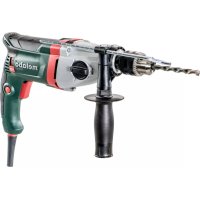
SB 8502 - Drill METABO - Free user manual and instructions
Find the device manual for free SB 8502 METABO in PDF.



| Product type | Hammer drill |
| Brand | Metabo |
| Model | SB 8502 |
| Power supply | Mains (alternating current) |
| Main functions | Drilling without percussion, drilling with percussion, screwdriving, tapping |
| Number of speeds | 2 (speed selector) |
| Chuck type | Keyed chuck or Futuro Plus/Futuro Top keyless chuck (depending on version) |
| Additional handle | Yes, included |
| Depth stop | Yes, adjustable |
| Speed preselection | Yes, thumbwheel |
| Impulse function | Yes, for tightening/loosening stuck screws |
| Safety clutch | Metabo S-automatic |
| Restart protection | Yes (electronic indicator) |
| Protection class | II (double insulation) |
| Sound level | Typical (LpA, LWA) - wear ear protection |
| Vibration values | Indicated (drilling in concrete, metal) |
| Maintenance | Chuck cleaning, carbon brush replacement by after-sales service |
| Spare parts | Available through Metabo |
| Repairs | By qualified electricians, Metabo after-sales service |
| Accessories | Exclusively Metabo |
Frequently Asked Questions - SB 8502 METABO
User questions about SB 8502 METABO
0 question about this device. Answer the ones you know or ask your own.
Ask a new question about this device
Download the instructions for your Drill in PDF format for free! Find your manual SB 8502 - METABO and take your electronic device back in hand. On this page are published all the documents necessary for the use of your device. SB 8502 by METABO.
USER MANUAL SB 8502 METABO
SB 850-2
SBE 780-2
SBE 850-2
SBE 850-2 S
SBEV 1000-2
SBEV 1100-2 S
SBEV 1300-2
SBEV 1300-2 S
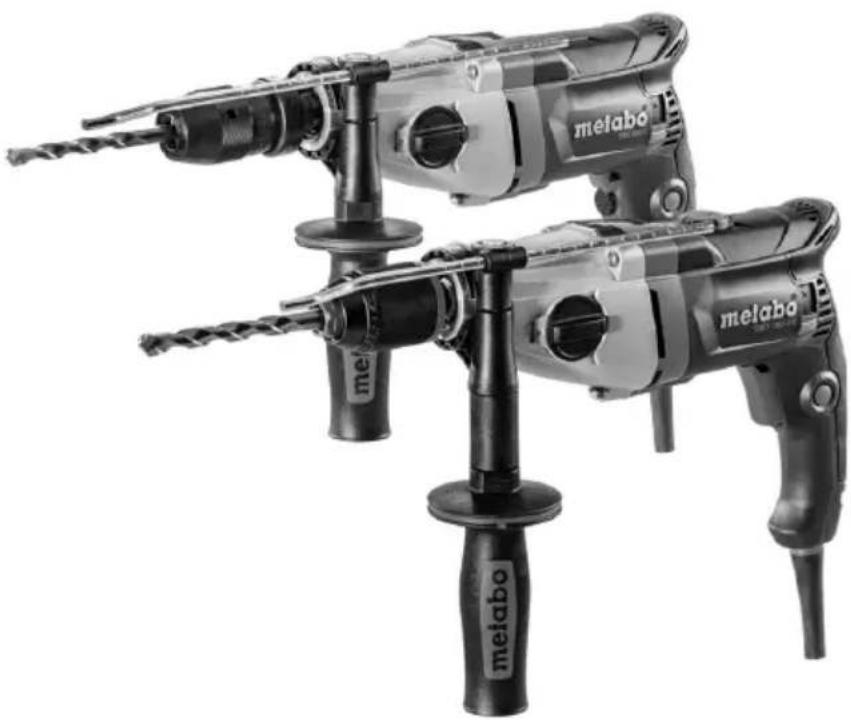
natural_image
Two Metabo electric drillers with black end caps and drill heads, displayed against a white background (no text or symbols visible on the devices themselves)
B

natural_image
Close-up of a black industrial device with a circular head and labeled component, showing a curved arrow indicating rotation (no text or symbols on the device itself)


7.1
C


8.1
D


natural_image
Three black circular icons with curved arrows, arranged vertically (no text or symbols)
natural_image
Three directional traffic signs with arrows indicating movement (no text or symbols)

8.2


H
SB 850-2
flowchart
graph TD
    A["Handheld Device"] --> B{Mouse Behavior}
    B --> C[".../min"]
    C --> D["Metabo Scanner"]
    D --> E["End"]
SBE 780-2, SBE \$50-2, SBE 850-2 S
| ømm | |||||
| 4 | F6 | FF | FF | FF | 2 |
| 8 | F | E | FF | ||
| 10 | E | D | FF | ||
| 13 | D | F | F | ||
| 16 | F | F | 1 | ||
| 20 | F | F | |||
| 30 | F | F | |||
| 40 | F | F |
| SBE 780-2, SBE 850-2, SBE 850-2 S | |||||
| A | B | C | D | E | F |
| 570 | 1050 | 1560 | 2080 | 2480 | 3100 |
| 200 | 370 | 550 | 730 | 870 | 1100 |
| ±50 | ±40 | ±30 | ±20 | ±15 | ±10 |
SBEV 1000-2
| ømm | ||||||
| 4 | 7 | 7 | 7 | 7 | ||
| 6 | 6 | 6 | 7 | 7 | ||
| 8 | 7 | 5 | 7 | 7 | 2 | |
| 10 | 5 | 4 | 7 | 7 | ||
| 13 | 3 | 7 | 7 | 7 | ||
| 16 | 3 | 6 | 7 | 7 | ||
| 20 | 7 | 7 | ||||
| 30 | 7 | 1 | ||||
| 40 | 7 | |||||
| SBEV 1000-2 | |||||||
| 1 | 2 | 3 | 4 | 5 | 6 | 7 | |
| 540 | 830 | 1250 | 1620 | 1990 | 2420 | 2800 | 2 |
| 190 | 290 | 440 | 570 | 700 | 850 | 1000 | 1 |
| ±10 | ±10 | ±10 | ±10 | ±10 | ±10 | ±10 | % |
SBEV 1100-2 S, SBEV 1300-2, SBEV 1300-2 S
| ømm | ||||||
| 4 | 6 | 6 | 6 | 6 | ||
| 6 | 4 | 5 | 6 | 6 | ||
| 8 | 6 | 4 | 6 | 6 | ||
| 10 | 4 | 3 | 6 | 6 | ||
| 13 | 3 | 6 | 6 | 6 | ||
| 16 | 2 | 5 | 6 | 6 | ||
| 20 | 6 | 6 | ||||
| 30 | 6 | |||||
| 40 | 6 | |||||
| SBEV 1100-2 S, SBEV 1300-2, SBEV 1300-2 S | |||||
| 1 | 2 | 3 | 4 | 5 | 6 |
| 510 | 1110 | 1540 | 2050 | 2590 | 3100 |
| 180 | 390 | 540 | 720 | 910 | 1100 |
| ±10 | ±10 | ±10 | ±10 | ±10 | ±10 |


 | SB 850-2*1) Serial Number: 00780.. | SBE 780-2*1) Serial Number: 00781.. | SBE 850-2*1) Serial Number: 00782..SBE 850-2 S*1) Serial Number: 00787.. | SBEV 1000-2*1) Serial Number: 00783.. | SBEV 1100-2 S*1) Serial Number: 00784.. | SBEV 1300-2*1) Serial Number: 00785..SBEV 1300-2 S*1) Serial Number: 00786.. | |||
 | P_1 | W | 850 780 850 10 | 10 1100 1300 | |||||
| P_2 | W | 490 470 490 540 | 580 730 | ||||||
 | n_1 | /min | 1 | 1100 0-1000 0-1000 0-1100 | |||||
| 2 | 3100 0-3100 0-2800 0-3100 | ||||||||
 | n_2 | /min | 1 | 640 680 640 10 | 00 1100 | ||||
| 2 | 1800 1900 1800 | 2800 3100 | |||||||
 | ø max. | mm(in) | 2 | 20(3/4") | 22(7/8") | ||||
| s max. | /min.bpm | 2 | 58900 53200 58900 | ||||||
 | ø max. | mm(in) | 1 | 40 (1 9/16") | |||||
| 2 | 25(1") | ||||||||
 | ø max. | mm(in) | 1 | 13(1/2") | 16(5/8") | ||||
| 2 | 8(5/16") | 10(3/8") | |||||||
 | b | mm(in) | 1,5 - 13(1/16" - 1/2") | ||||||
 | G | UNF(in) | 1/2"-20 | ||||||
 | H | mm(in) | 6,35(1/4") | ||||||
 | m | kglbs | 2,6 (5.7) 2,7 (5.9) 2,8 (6.2) | ||||||
 | D | mm(in) | 43(1 11/16") | ||||||
| a_h,ID/k_h,ID | m/s^2 | 17,0 / 1,5 | |||||||
| a_h,D/k_h,D | m/s^2 | 4,2 / 1,5 | |||||||
 | L_pA/K_pA | dB(A) | 103 / 3 | ||||||
| L_WA/K_WA | dB(A) | 114 / 3 | |||||||


14.
P

*2) 2014/30/EU, 2006/42/EC, 2011/65/EU
*3) EN 62841:2015, EN 62841-2-1:2018, EN IEC 63000:2018
Director Innovation, Research and Development
Responsible Person for Documentation
*4) Metabowerke GmbH, Metabo-Allee 1,
72622 Nürtingen, Germany


1.

2021-03-24
Bernd Fleischmann
(SBEV 1300-2, SBEV 1300-2 S, SBEV 1100-2 S, SBE 1000-2)
Original instructions
1. Declaration of Conformity
We declare under our sole responsibility: These impact drills, identified by type and serial number 1 ), comply with all relevant requirements of the directives 2 ) and standards 3 ). Technical file at 4 ) - Fig. P
For UK only:
UK We as manufacturer and authorized person to CA compile the technical file, see *4) → Fig. P, hereby declare under sole responsibility that these impact drills, identified by type and serial number *1) → Fig. P, fulfill all relevant provisions of following UK Regulations *2) S.I. 2016/1091, S.I. 2008/1597, S.I. 2012/3032 and Designated Standards EN 62841:2015, EN 62841-2-1:2018, EN IEC 63000:2018.
2. Specified Use
The machine is suitable for drilling, without impact, in metal, wood, plastic and similar materials and for impact drilling in concrete, stone and similar materials. It is also suitable for thread tapping and for screwdriving (not SB 850-2).
The user bears sole responsibility for any damage caused by improper use.
Generally accepted accident prevention regulations and the enclosed safety information must be observed.
3. General Safety Instructions

For your own protection and for the protection of your electrical tool, pay attention to all parts of the text that are marked with this symbol!

WARNING – Reading the operating instructions will reduce the risk of injury.

WARNING – Read all safety warnings, instructions, illustrations andifications provided with this power tool.
Failure to follow all instructions listed below may result in electric shock, fire and/or serious injury.
Save all warnings and instructions for future reference. Pass on your electrical tool only together with these documents.
4. Special Safety Instructions
4.1 Safety instructions for all operations
a) Wear ear protectors when impact drilling.
Exposure to noise can cause hearing loss.
b) Use the auxiliary handle. Loss of control can cause personal injury.
c) Brace the tool properly before use. This tool produces a high output torque and without prperly
bracing the tool during operation, loss of control may occur resulting in personal injury.
d) Hold the power tool by insulated gripping surfaces, when performing an operation where the cutting accessory or fasteners may contact hidden wiring or its own cord. Cutting accessory contacting a "live" wire may make exposed metal parts of the power tool "live" and could give the operator an electric shock.
4.2 Safety instructions when using long drill bits:
a) Never operate at higher speed than the maximum speed rating of the drill bit. At higher speeds, the bit is likely to bend if allowed to rotate freely without contacting the workpiece, resulting in personal injury.
b) Always start drilling at low speed and with the bit tip in contact with the workpiece. At higher speeds, the bit is likely to bend if allowed to rotate freely without contacting the workpiece, resulting in personal injury.
c) Apply pressure only in direct line with the bit and do not apply excessive pressure. Bits can bend causing breakage and loss of control, resulting in personal injury. Pull the plug out of the plug socket before any adjustments or servicing are performed.
4.3 Additional safety instructions
Pull the plug out of the plug socket before any adjustments or servicing are performed.
Avoid inadvertent starts by always unlocking the switch when the plug is removed from the mains socket or in case of a power cut.
Ensure that the spot where you wish to work is free of power cables, gas lines or water pipes (e.g. using a metal detector).
Smaller workpieces must be secured such that they are not carried along with the drill bit when drilling (e.g. by clamping in a vice or on a work bench with screw clamps).
Keep hands away from the rotating tool! Remove chips and similar material only with the machine at standstill.
Metabo S-automatic safety clutch. When the safety clutch responds, switch off the machine immediately! If the tool jams or catches, the power supply to the motor is restricted. Due to the strong force which can arise, always hold the machine with both hands using the handles provided, stand securely and concentrate.
The Metabo S-automatic safety clutch must not be used for torque control.
Caution with hard screwdriving (driving of screws with either a metric or an imperial thread into steel)! The head of the screw may rip off or high restoring torques may be incurred at the handle.
Reducing dust exposure:

WARNING - Some dust created by power sanding, sawing, grinding, drilling, and other
ENGLISHen
construction activities contains chemicals known to cause cancer, birth defects or other reproductive harm. Some examples of these chemicals are:
- Lead from lead-based paints,
- Crystalline silica from bricks and cement and other masonry products, and
- Arsenic and chromium from chemically treated lumber.
Your risk from these exposures varies, depending on how often you do this type of work. To reduce your exposure to these chemicals: work in a well ventilated area, and work with approved safety equipment, such as those dust masks that are specially designed to filter out microscopic particles.
This also applies to dust from other materials such as some timber types (like oak or beech dust), metals, asbestos. Other known diseases are e.g. allergic reactions, respiratory diseases. Do not let dust enter the body.
Observe the relevant guidelines and national regulations for your material, staff, application and place of application (e.g. occupational health and safety regulations, disposal).
Collect the particles generated at the source, avoid deposits in the surrounding area.
Use suitable accessories for special work. In this way, fewer particles enter the environment in an uncontrolled manner.
Use a suitable extraction unit.
Reduce dust exposure with the following measures:
- do not direct the escaping particles and the exhaust air stream at yourself or nearby persons or on dust deposits,
- use an extraction unit and/or air purifiers,
- ensure good ventilation of the workplace and keep clean using a vacuum cleaner. Sweeping or blowing stirs up dust.
- Vacuum or wash the protective clothing. Do not blow, beat or brush.
5. Figures
Illustrations are provided at the beginning of the operating instructions.
Symbol explanation:

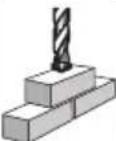
Normal drilling/Drill bit
Impact drilling
Movement direction
Driving screws/Screw
Slow
Fast
6. Overview

1 Thumb-wheel for gear selection
2 Additional handle/Additional handle with vibration damping *
3 Depth stop
4 G e a r e d c h u c k *
5 Futuro Plus keyless chuck *
6 Futuro Top keyless chuck *
7 Sliding switch (normal drilling/impact drilling)
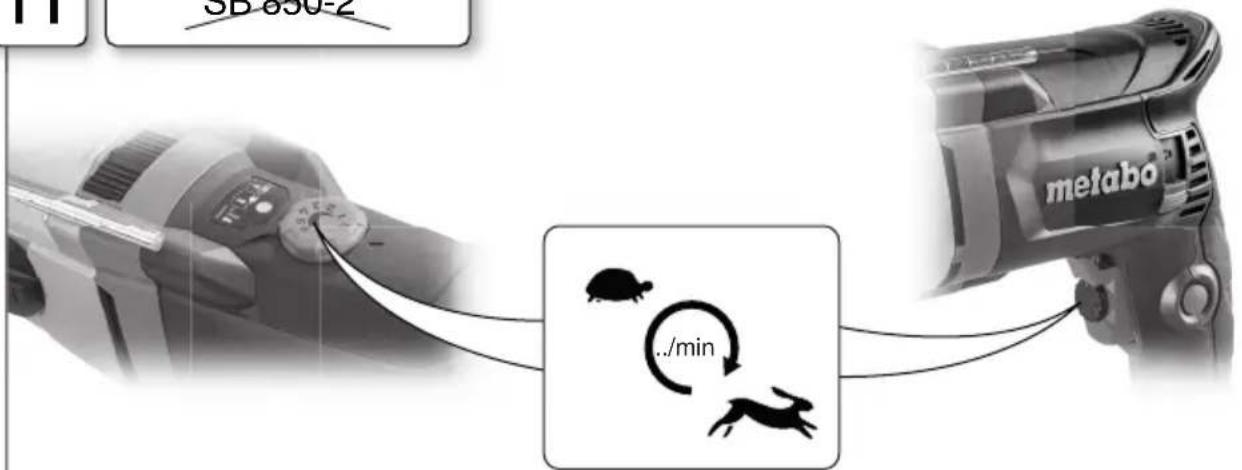
8 Speed preselection wheel *
9 Setting wheel for impulse function *
10 Electronic signal indicator *
11 Rotation selector switch *
12 Lock button for continuous activation
13 Trigger
14 Handle (gripping surface)
* depending on model
7. Initial Operation
Before plugging in the device, check to see that the rated mains voltage and mains frequency, as specified on the rating label, match your power supply.
Always install an RCD with a maximum trip current of 30 mA upstream.
To guarantee secure purchase of the chuck: After initial drilling (clockwise), use a screw-driver to firmly tighten the safety screw inside the drill chuck (if available/depending on the model). THE SAFETY SCREW HAS A LEFT-HANDED THREAD!
7.1 Fitting the additional handle (2) B
For safety reasons, always use the additional handle supplied.
Tighten the additional handle firmly by turning it.
8. Use
8.1 Setting depth stop

8.2 Setting direction of rotation, transporting safety device (switch-on lock) → Fig. D
Do not activate the rotation selector switch (11) unless the motor has completely stopped.
8.3 Setting for normal drilling, impact drilling → Fig. E
Impact drilling and normal drilling only in a clockwise direction.
8.4 Selecting gear

Change thumbwheel (1) only when the machine is in the process of running down (briefly switch it on and off).
8.5 Setting impulse function

= impulse function switched on constantly (to facilitate tightening and releasing of screws that are tight even when the screw heads are damaged. To enable clean drilling without centre punching in tiles, aluminium or other materials).
8.6 Preselecting rotational speed Fig. H
See the table for recommended rotational speeds for drilling.
8.7 Switching On and Off
Switching on, rotational speed Fig. A: Press the trigger (13).
Release the trigger to switch off.
Continuous operation → Fig. A: With the trigger (13) pressed, push in the locking button (12) and release the trigger. Press and release the trigger (13) again to switch off.
In continuous operation, the machine continues running if it is forced out of your hands. Therefore, always hold the machine with both hands using the handles provided, stand in a safe position and concentrate.
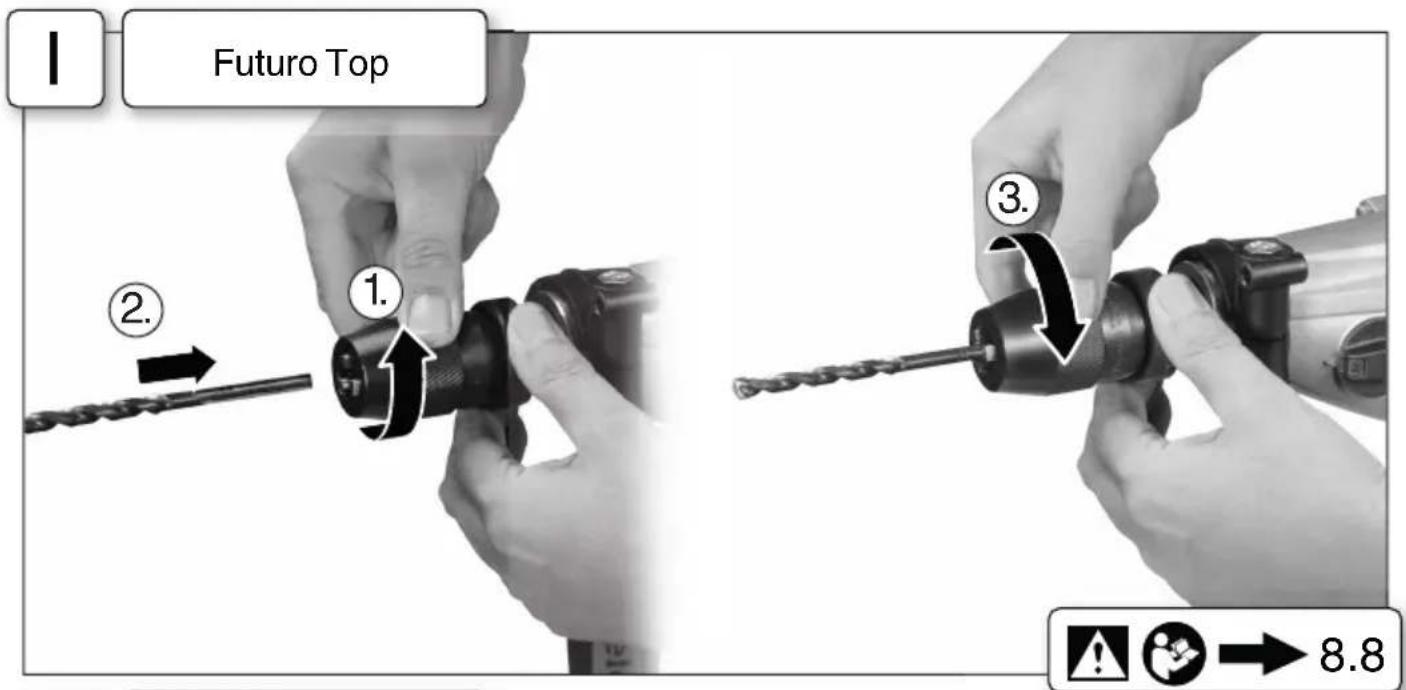
8.8 Tool change, Futuro Top keyless chuck
(6) → Fig. I
Clamp the tool by turning the sleeve firmly to its stop.
8.9 Tool change, Futuro Plus (5) keyless
chuck → Fig. J
The ratchet sound which can possibly be heard after opening the drill chuck is functional and is switched off by a reverse rotation of the sleeve.
If the chuck is very tightly closed: Firmly grip the chuck with an open-end spanner at the chuck head and firmly turn the sleeve in the direction of the arrow -1.
Clamping the tool
- Insert the tool -2- as far as possible.
- Using one hand, hold the retainer ring securely (depending on fittings).
- Turn sleeve in direction -3- until the noticeable mechanical resistance has been overcome.
- Caution! The tool is not yet fully tightened! Keep turning the sleeve (it must "click" when turning) until it cannot be turned any further - only now is the tool safely clamped.
With a soft tool shank, retightening may be required after a short period of operation.
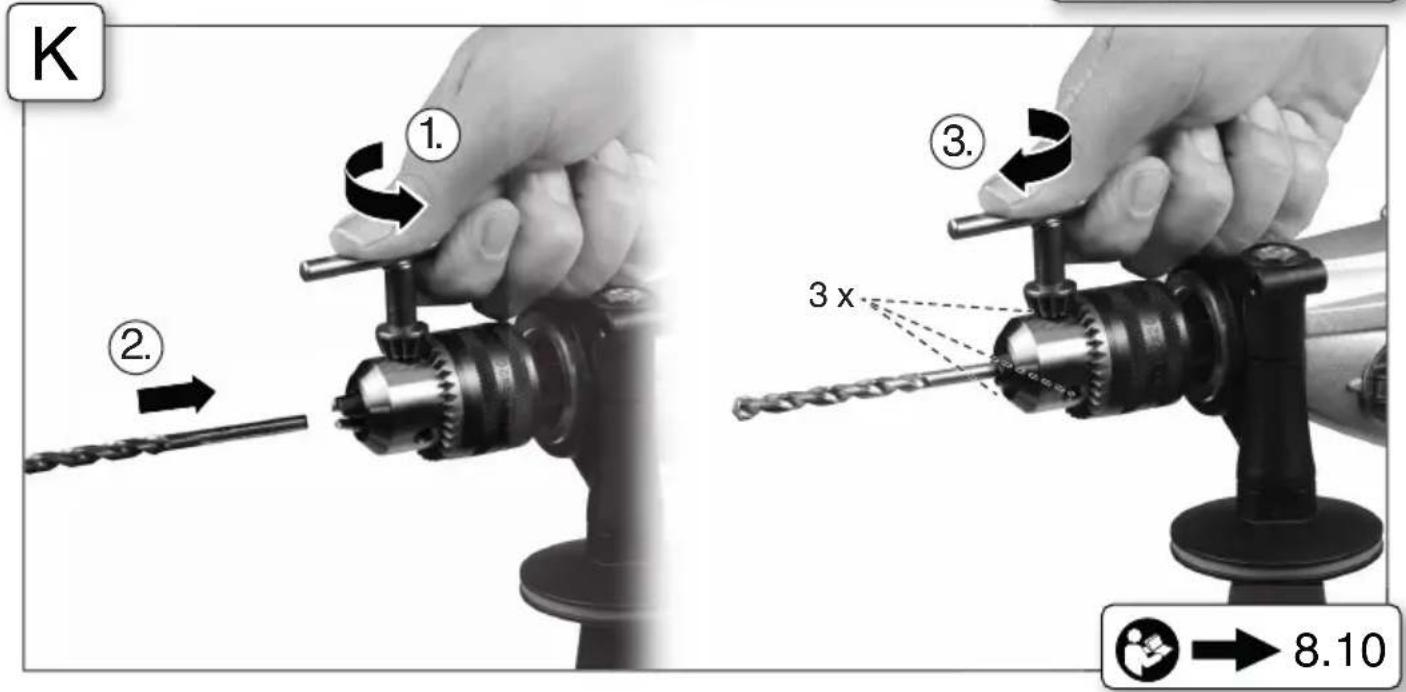
8.10 Tool change, geared chuck (4) → Fig. K
8.11 Unscrew the chuck (when driving screws without the chuck or for use with attachments) → Fig. L, M, or N
Note for Fig. M, N: Release by tapping lightly with a rubber hammer, as shown, and unscrew.
Note: If a bit clamping bush (order no. 6.31281) is attached, the screwdriver bit inserted in the hexagon socket of the spindle is held in place.
9. Cleaning, Maintenance
Keyless chuck cleaning:
After prolonged use hold the chuck vertically, with the opening facing down, and fully open and close it several times. The dust collected falls from the opening. The application of cleaning spray to the jaws and jaw openings at regular intervals is recommended.
10. Troubleshooting
Electronic signal display (10):
Rapid flashing - restart protection (SBEV 1300-2, SBEV 1300-2 S, SBEV 1100-2 S, SBE 1000-2)
When power is restored after a power failure, the machine - which is still switched on - will not start for safety reasons. Switch machine on and off again.
Slow flashing - carbon brushes worn (SBEV 1300-2, SBEV 1300-2 S, SBEV 1100-2 S)
The carbon brushes are almost completely worn. If the brushes are completely worn, the machine switches off automatically. Have the brushes replaced by an authorized service centre.
Permanently lit - overload (SBEV 1300-2, SBEV 1300-2 S, SBEV 1100-2 S) If the machine is subject to long periods of continuous overloading, the power input of the machine is limited. This prevents the further unauthorized heating of the motor.
Run the machine in idling until it cools down and the electronic signal display switches off.
11. Accessories
Use only genuine Metabo accessories.
Use only accessories which fulfil the requirements and specifications listed in these operating instructions.
Fit accessories securely. Secure the machine if it is operated in a bracket. Loss of control can cause personal injury.
For a complete range of accessories, see www.metabo.com or the main catalogue.
12. Repairs
Repairs to electrical tools must be carried out by qualified electricians ONLY!
A defective mains cable must only be replaced with a special, original mains cable from metabo, which is available only from the Metabo service.
If you have Metabo electrical tools that require repairs, please contact your Metabo service centre. For addresses see www.metabo.com.
You can download spare parts lists from www.metabo.com.
13. Environmental Protection
Observe national regulations on environmentally compatible disposal and on the recycling of disused machines, packaging and accessories.
Only for EU countries: Never dispose of power tools in your household waste! In accordance with European Guideline 2012/19/EU on used electronic and electric equipment
ENGLISHen
and its implementation in national legal systems, used power tools must be collected separately and handed in for environmentally compatible recycling.
14. Technical Specifications
→ Fig. O. We reserve the right to make technical improvements.
$$ P _ {1} = \text { Rated input } $$
$$ P _ {2} \quad = \text { Power output } $$
$$ n _ {1} ^ {*} = \text { No - load speed } $$
$$ n _ {2} ^ {*} \quad = \quad L \quad o \quad a \quad d \quad s \quad p \quad e \quad e \quad d $$
max. dia. = Max. solid drill diameter
s max = Max. impact rate
$$ b = \text { Chuck capacity } $$
$$ G = S p i n d l e t h r e a d $$
$$ H = \text { Spindle with hexagon socket } $$
$$ m \quad = \quad W \quad e \quad i \quad g \quad h \quad t $$
$$ D = D = \text { Collar diameter } $$
Measured values determined in conformity with EN 62841.
□ Machine in protection class II
\~ Alternating current
The technical specifications quoted are subject to tolerances (in compliance with the relevant valid standards).
* Energy-rich, high-frequency interference can cause fluctuations in speed. The fluctuations disappear, however, as soon as the interference fades away.
Emission values Using these values
Using these values, you can estimate the emissions from this power tool and compare these with the values emitted by other power tools. The actual values may be higher or lower, depending on the particular application and the condition of the tool or power tool. In estimating the values, you should also include work breaks and periods of low use. Based on the estimated emission values, specify protective measures for the user - for example, any organisational steps that must be put in place.
Vibration total value (vector sum of three directions) determined in accordance with EN 62841:
$$ \begin{array}{r l} {a _ {h, \mathrm{ID}}} & {= \text { Vibration emission value (impact drilling }} \ & {\text { into concrete) }} \end{array} $$
$$ \begin{array}{r l} {a _ {h, D}} & {= \text { Vibration emission value }} \ & {\text {(drilling into metal)}} \end{array} $$
$$ K _ {h, I D}, K _ {h, D} = \text { Uncertainty (vibration) } $$
Typical A-effective perceived sound levels:
$$ L _ {p A} = \text { Sound pressure level } $$
$$ L _ {W A} = \text { Acoustic power level } $$
$$ K _ {p A}, K _ {W A} = \text { Uncertainty } $$
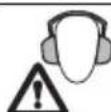
Wear ear protectors!

Notice originale
(SBEV 1300-2, SBEV 1300-2 S, SBEV 1100-2 S, SBE 1000-2)
Allumage permanent - surcharge
$$ K _ {h, I D}, K _ {h, D} = \text { Incertitude (vibration) } $$
$$ \begin{array}{l} a _ {h, D} = \text { trillingsemissiewaarde (boren in metaal) } \ K _ {h, I D}, K _ {h, D} = \text { onzekerheid (trilling) } \end{array} $$
(SBEV 1300-2, SBEV 1300-2 S, SBEV 1100-2 S, SBE 1000-2)
a_h,D =Vibrationsemissionsvärde (borrning i metall)
K_h,ID, K_h,D=onoggrannhet (vibrationer)
Normal, A-viktad ljudnivå:
L_pA =äänenpainetaso
L_WA =äänentehotaso
8.1 Stille inn anslag for boredybde

8.2 Stille inn dreieretning, transportsikring (startsperre) Fig. D

8.3 Stille inn boring, slagboring


7 Skydekontakt (boring/slagboring)
a_h,D =Vibrationsemission
(boring i metal)
K_h,ID, K_h,D=Usikkerhed (vibration)
99.17.30.4.4.6.7.8.9.10.11.12.13.14.15.16.17.18.19.20.21.22.23.24.25.26.27.28.29.30.31.32.33.34.35.36.37.38.39.40.41.42.43.44.45.46.47.48.49.50.51.52.53.54.55.56.57.58.59.60.61.62.63.64.65.66.67.68.69.70.71.72.73.74.75.76.77.78.79.80.81.82.83.84.85.86.87.88.89.90.91.92.93.94.95.96.97.98.99.100

A H T U . H N O S B H . Y W P W g t f w h I m M q I p y m l p n p g l g n l s k p , l h l n l s k p , l n c u p n l p j n l s
qnpàptf wju lklhpwpwfu qnpòhf hpw qnfufn pnp qqnucwghnn fcuwflkph: Uliuunlqalprjwi gngauulkphs yhkuuklp hwnq l hwiqlggl lklhpwpwfu hwpjwsh, hpnkhh l/ywi dwlp wnpùhwuw fylwwudfklph:
Ugjwnfqnlpjwgi pnnp gnigmufkpi ni mntgnjgpi wpuhupufki fiuki mnququjh hundmp:
Qap tkljnpwlywi qnpdhp ihnhuwighf dhwji whuunwpnptph, nntggnjgh hbn dhwuhfi:
4. Ugulnuuqqnlpjwi hwnnliy gnlgnlufkp
4.1 U.gluwfiqnipywi gngmufitp pupn wtuwqh mclpuuunffitph hundmp:
w) Tżupiłudwjfi hnpwnuńwi dwinfuwly hptf
wwcwnuwihy whwfgwlywifp: Uqnityh wqntgnipjnifp
hwpnq f, jlnipjnig wnwgwgbl:
p) Oqnnwnqnptf qnpdph hkm wnwfnjny lpwgnighs pnfiwlp: bpt uwpfp wihwnwiwptjh t qwnfntd, wnwgwntd t yihwnwlwdftp wnwfnjni qwnfiq:
q) U'hwgftng mnwq tktwnwlmi qnpdhp hwnmp
mqmhnltf pnd lmynfi htkimpufi: Ujn qnpdhp ndktn
wununnq dnlflfun l qldgtpwgfnd: bpl. qnpdhfh hwnfwp cwhwqnpdduu glpwgfnnd wquwhnd htgwpwg yuntnqdh, wjfu hwpnn f qtpwhulqnmpjnighg qnnpu qwL h qfgwwuqlwdfgtph hwnqlggkl:
n) [k]hpwpwlqngp8hfpnp6hfuklqnwwgulwukntphg, lphmejwnnnufkfnyfuwrhu hunjplpanuf, npunkn hpupnlf qnp8hifnlmejwninkhu hunwppnnwnwlfikpp aqkluhw6lnwtpwfglmd kthlpwpwlwptphg ywh nhwstkqnp8hflduhwgawu guwph: ,wpndwgu wnuq hwnnpwnwlwptphhtun hwduwgu wpnjnlgfnud lwpnup lwpqn t, qhnpwlgylk qnp8hfhutwnwnwlug uwutphg, h62p lwnwwgwghkthlpwpwlqng hwpulmd;
4.2 UfuImuUiqnupjuni gugnuUfip kplmp quyJhlnUfipph oqmuqnpduiuli dwuWfuwl.
w) hwnhly wnpqtlunl t wcjwnntl hnpwuhsh/cwnwph hwnmp paŋjwnmplh wpwqnlpjnifhg wlltgh puipap wpwqnlpjnup: Uylkth pwpap wpwqnlpjmf g ntwfmü qwlhlhup lwpnq t dwlk ywpmwnpnpnjfgh qwnijmuktp h wnwg qtnwnlhi g nhwstmi wnniynuktph dwawgwl, h6sp lwpnq t qdwwnywdfuktp hwbqtgkt:
8.6 UpwnqnpjwiG gwpwwhwpqwwnpnui → UhpH
Znpwnndwg hwdwp lunphnipn wpilqn wprwqnlpjnli6Gkpp/wqnnjng6tph fw6gwq ukt'u wnjniuwq:
8.7 U'huqnlü /U,gjwnnlü
Uhwgnid, Qmmjungtph fowgwlq → Uhwp A. Uteqdt'f ψmhwphlq (13) hw6wlq:
U.62wundmfi hundup pwnk'f qhnjowphghzh lynfuwlq:
Shuqlwfi ndchh 5pmp A. Utknqms wphk'f ynhjwpplhsh lpnfmlp, (13) Ubkwnlhlz lpnfmlpq (12) gtpu atqnkt'f h pnntk'f ynhjwpplhsh lpnfmlqp: Sluwlwfi ndchhp ufgwmnlnd h ynhjwpplhsh lpnfmlqp (13) lphlhlu ulqndcndl wjfachlunh pnntglnl:
Shkmlqmi mcjommmufmjhi nkclnmi mcjommmun umpfp cumpulqmlqni l qnpdkl kph qnpu l umhnui alnfhg:
11. lpwgnghs wmpwqmflp
Oqinnqnplf dhuji ophqhliu Metabo uupuquifp:
Oqunwqnptf uhwj gu nntgnignl fciud wwhwghkphu L ywhwghkphu hwnwwnwnwnwnwn wnpuwqufi.p:
Qupwquwltp 6hcm h wghwnwq tnqwglwnq wdpwgwl.1 uwpfhi: Gpt utnqhs pngwllp htn k cuhwqnpdjnlq uwpfp, wquw yhlqn wdpwgptf uwpfp: Gpt uwpfp wghwnnwlpctlh k ywngmiq, wnwgwlned l qliwuiwdflp wnwfuwrnc qhnwlg:
lpwgnighs wwpwqwgtph wupnnswlhw6 dpwqph6 dwfinpwlwni hundwp wjgltf www.metabo.com lwm0 oqmltf wwpwqwgtph huhgmllm6 lwmwnlnqlig:
12. Чтрулнрнqnці
! Lthwpmqng qnpdf6tph ytpw6nqnqndp lwpny k hpwnfmggtk dhwj6 hwdwnpnnnuom6 pfwqnlwnnd wnpdtuhngwl dwufgwqtunh hnqhg:
Znunufh dhuqifuq dluwudw sapp lquptl h, dhaowphdL dhujfghwnncl Metabo qnpdwpufuwjfu lwpnl, npp lquptl h, dtnfptpl Metabo uwwuwphdwg htntphg:
Metabo LjLhmpwlpwq qnpshfiklph dlpwnkpnqawfu wghpwdewnnpjwfu nkuyfnu nhtef 2lp Metabo 6kplwjwgnigshfi: Zwugtkgpp lqungtf www.metabo.com hwjfhi ypm:
b = 4mmh2h pmgduh dhqwhwf
G = 9wjjhlqnh h1h wwpnlpwl
H = 9 wJL hl Jn gh h L GhpflhG dlkgwGluunnl
m = φ m c
D = 9qh2 qhhhh mpmfw2mh
Qwqh1h dhwlpfip puu EN 62841 gnpdh:
□ 9npdhf quacnuqulprjuli II qnuh
\~ Φnihnuuuf hnuuf
Lc u d m l f h l w l q u l w l k l p n l y l w l p l h e k n l k l p n (hw ^1 w ^2 w ^3 w ^4 w ^5 ) q w ^1 w ^2 w ^3 w ^4 w ^5 ^1 h ^1 ) ^2 : f p ^w l_l^^^^^^^^^^^^^^^^^^^^^^^^^^^^^^^^^^-
UpunwGtmmuSgtpj wpdtfGtp
Cuiwud wpdtffgph oqinprjundp hluipwnlp l unnuhui h hwltawuntl wju qnpdhfnd l wjl qnpdffgtpnl wejwnwnufhg plwn npwnwgtwnntgtpf fwghlygtppp: Lun hhpwnndwg wpnjsmgftgph, qnpdhtf yhhwlhl h lhpwnndgn wmpnwqgtppl' qhahnvlulad, uldwunnd lpud fhuqnut l qhuunnugh wpwnwltnnntgtpf fwliuhp: Zwewuwph dwuwhwl hueihi unlf pnguhqnntgtppp l guop ptngwdnlpjug wejwnwnufwjhi yhnltpp: Unuwnlp wpdtffgtp unnuhwlmig htwn oquwqnpdngh hmwfmp atnhmphtf hnuwmwnwnuvmfg wmcwnpwglz uhngstp gmh lqnqdhltpmysmlw6 uhngstp:
SwunwGmubtph pghhwgmp wpdtfp (kptf mqnnpymubtph ythqnnpwjh6 qniufwp)' hndmwaj6 EN 62841 gnpuh.
a_h, ID = U_pnm6knnuf6tp|www6jmympdtf (hmpjmdmjfi hmpmmncf ptmm6h dt2)
a_h,D = S_wwwfinclifkph updlf
(Znpwnnuf dtwnwnh dtg)
K_h,ID, K_h,D = U_GlqWJnIGmIPJnIG(SwwWGnLdGtP)
Uqduh1A-nwhmwhlydwwnwh.
L_pA =Ulnluunhl bifeduw diwlpwnwh
L_WA = U_nunl h_hqnpnlpjw6 dwlqwpnwl
K_pA, K_WA=S_wwwGmU

Ωωριωηφρ χρλ, υμειωμαξις υλωθίζωλρω:
EAC
Stukhmpgmi fi qfupngh hwdwp.
ZmduwunwnuJouGm pJw6 hwnjwnwnqHn.
(SBEV 1300-2, SBEV 1300-2 S, SBEV 1100-2 S, SBE 1000-2)
(SBEV 1300-2, SBEV 1300-2 S, SBEV 1100-2 S, SBE 1000-2)
(SBEV 1300-2, SBEV 1300-2 S, SBEV 1100-2 S, SBE 1000-2)
- Original instructions
- Declaration of Conformity
- For UK only:
- Specified Use
- General Safety Instructions
- Special Safety Instructions
- Safety instructions for all operations
- Safety instructions when using long drill bits:
- Additional safety instructions
- Reducing dust exposure:
- ENGLISHen
- Figures
- Symbol explanation:
- Overview
- Initial Operation
- Use
- Preselecting rotational speed → Fig. H
- Switching On and Off
- Tool change, Futuro Top keyless chuck
- Tool change, Futuro Plus (5) keyless
- Tool change, geared chuck (4) → Fig. K
- Unscrew the chuck (when driving screws without the chuck or for use with attachments) → Fig. L, M, or N
- Cleaning, Maintenance
- Troubleshooting
- Electronic signal display (10):
- Accessories
- Repairs
- Repairs to electrical tools must be carried out by qualified electricians ONLY!
- Environmental Protection
- Technical Specifications
- Notice originale
- Stille inn anslag for boredybde
- Stille inn dreieretning, transportsikring (startsperre) Fig. D
- Stille inn boring, slagboring
- Ugulnuuqqnlpjwi hwnnliy gnlgnlufkp
- lpwgnghs wmpwqmflp
- Чтрулнрнqnці
- UpunwGtmmuSgtpj wpdtfGtp
- EAC
- Stukhmpgmi fi qfupngh hwdwp.
Brand : METABO
Model : SB 8502
Category : Drill