TFX 60 - Scale TERRAILLON - Free user manual and instructions
Find the device manual for free TFX 60 TERRAILLON in PDF.



User questions about TFX 60 TERRAILLON
0 question about this device. Answer the ones you know or ask your own.
Ask a new question about this device
Download the instructions for your Scale in PDF format for free! Find your manual TFX 60 - TERRAILLON and take your electronic device back in hand. On this page are published all the documents necessary for the use of your device. TFX 60 by TERRAILLON.
USER MANUAL TFX 60 TERRAILLON
Thank you for purchasing a Terraillon electronic bathroom scale. We hope you will find it satisfactory. Please read these instructions carefully to take full advantage of your scale.

Geachte Klant,
| Mesure Age | |||||
| 20-29 30 | -39 40-49 | 50-59 60+ | |||
| Bas <13% | <14% <16% | <17% <18% | |||
| Optimal 14-20% | 15-21% | 17-23% | 18-24% | 19-25% | |
| Moyen | 21-23% | 22-24% 24 | -26% | 25-27% | 26-28% |
| Elevé | >23% | >24% >26% | >27% | >28% | |
| Mesure Age | |||||
| 20-29 30 | -39 40-49 | 50-59 60+ | |||
| Bas <19% | <20% | <22% | <23% | ||
| Optimal 20-28% | 21-29% | 22-30% | 23-31% | 24-32% | |
| Moyen | 29-31% | 30-32% 31 | -33% | 32-33% | 33-35% |
| Elevé | >31% | >32% >33% | >34% | >35% | |
DESCRIPTION DU PRODUIT INTRODUCTION
Before using the scale, you should know...
ABOUTBODYFAT
1. Why is it important to monitor percentage body fat (%BF)?
The absolute weight traditionally determines whether or not a person is obese. Weight change in itself does not indicate whether it was the weight of body fat or muscle that had changed. In weight management, it is desirable that muscle mass be maintained while body fat is lost. Thus, monitoring the percentage fat of the body is an important step toward successful weight management and body health.
The optimal % BF of an individual varies according to age and gender.
The table that follows may be used as a guide:
Standard for Men
| Rating Age | |||||
| 20-29 30 | -39 40-49 | 50-59 60+ | |||
| Low <13% | <14% | <16% | <17% | 8% | |
| Optimal 14-20% | 15-21% | 17-23% | 18-24% | 19-25% | |
| Moderate 21 | -23% | 22-24% | 24-26% | 25-27% | 26-28% |
| High | >23% | >24% | >26% | >27% | >28% |
Source: University of Illinois Medical Center, Chicago, USA.
Standard for Women
| Mesure | Age | ||||
| 20-29 30 | -39 40-49 | 50-59 60+ | |||
| Low <19% | <20% | <21% | <22% | <23% | |
| Optimal 20-28% | 28% 21-29% | 22-30% | 23-31% | 24-32% | |
| Moderate 29-31% | 30-32% | 31-33% | 32-33% | 33-35% | |
| High | >31% | >32% | >33% | >34% | >35% |
Source: University of Illinois Medical Center, Chicago, USA.
2. How is percentage body fat (%BF) estimated?
% BF is measured by a method called Bioelectrical Impedance Analysis (BIA). The use of BIA to estimate body fat has been pioneered since the seventies. It was only in the past few years that the estimation of body fat using BIA technology was successfully offered to the consumers as a compact bathroom scale.
With the BIA technology, a low intensity electrical signal is sent through the body. The signal is very low and causes no bodily harm. Depending on the amount of body fat of the individual, the electrical signal will flow with a different degree of difficulty. The difficulty with which a signal flows through the body is called electrical impedance. Hence, by measuring the electrical impedance and applying to the data a proprietary algorithm, %BF can be estimated.
Please be reminded that the % BF estimated with the scale represents only a good approximation of your actual body fat. There exist clinical methods of estimating body fat that can be ordered by your physician.
ABOUT BODY WATER
3. Why is it important to monitor percentage Total Body Water (%) TBW) in the body?
Water is an essential component of the body and its level is one of the health-indicators.
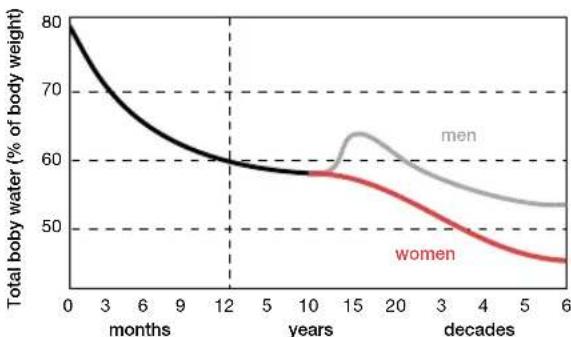
Water makes up approximately between 50 - 70% of the body's weight. It is present proportionally more in lean tissue compared to fat tissue. Water is a medium for biochemical reactions that regulate body functions.

ELECTRONIC BATHROOM SCALE - BODY FAT ANALYZER
Waste products are carried in water from cells for excretion in urine and sweat. Water provides form to cells; helps to maintain body temperature; provides moisture to skin and mucosa; cushions vital organs; lubricates joints and is a component of many body fluids.
The amount of water in the body fluctuates with the hydration level of the body and state of health. Monitoring the level of body water can be a useful tool for one's health maintenance. Similar to body fat estimation, the % TBW function provided in this scale is based on BIA.
The estimated % TBW may vary according to your hydration level, that is, how much water you have drunk or how much you have sweated immediately prior to the measurement. For better accuracy, avoid fluctuation in hydration level prior to the measurement. The accuracy of the scale in estimating TBW will also decrease with individuals suffering from diseases that tend to accumulate water in the body.
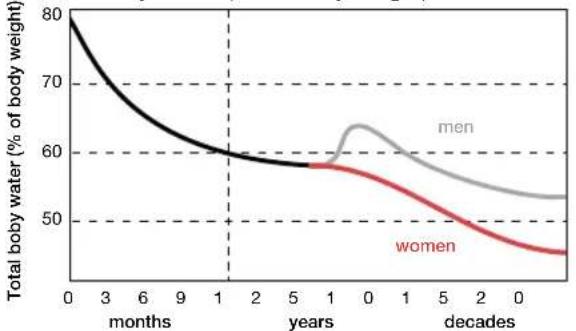
The optimal % TBW of an individual varies according to age and gender.
The following chart and table may be used as a guide:
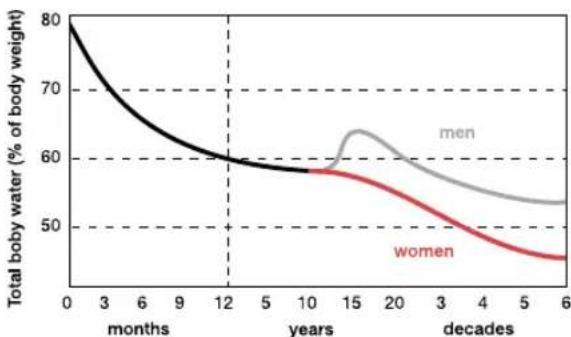
Source: University of Illinois Medical Center, Chicago, USA.
| % Body Fat Range | Optimal % total Body Water Range | |
| Men | 4 to 14 % 70 to 63 %15 to 21 % 63 to 57 %22 to 24 % 57 to 55 %25 % and over 55 to 37 % | % % % % |
| Women | 4 to 20 % 70 v 58 %21 to 29 % 58 to 52 %30 to 32 % 52 to 49 %33 % and over 49 to 37 % | % % % % |
Please be reminded that the % TBW estimated with the scale represents only a good approximation of your TBW. There exist clinical methods of estimating body fat that can be ordered by your physician.
4. When should I use the scale's body fat and total body water functions?
For maximum accuracy and repeatability, it is recommended that the scale's body fat and total body water functions be used at approximately the same time of the day, e.g. before breakfast in the morning. It is also a good practice to avoid swings in hydration level of the body prior to the measurement. Establishing your own baseline value of %BF and %TBW and track their changes is better than merely comparing your %BF and %TBW value to the population's normal value.
English
ELECTRONIC BATHROOM SCALE - BODY FAT ANALYZER
ABOUT ATHLETE MODE
- Why is the Athlete Mode necessary in a Body Fat Analyzer?
It has been found that body fat estimation using BIA could overestimate the percentage body fat of adult elite athletes. The physiological variation of athletes in muscle density and level of hydration are two of the reasons said to account for the difference.
The Athlete mode is selectable only for adults of 18 years of age or older.
- What is the definition of an Athlete?
The general consensus among researchers is that a quantitative dimension could be use in defining an athlete. For example, an athlete could be defined as a person who consistently trains a minimum of three times per week for two hours each time, in order to improve specific skills required in the performance of their specific sport and/or activity.
ABOUT DAILY CALORIE INTAKE
- What are calories?
In medicine, the quantity of energy contained in food is measured in kilocalories (one kilocalorie = 1,000 calories). The human body uses this energy to live and breathe and go about its everyday activities. We can use the notion of kilocalorie (Cal) or kilojoule, which is now the international unit. Diets however are counted in calories. Just remember that 1Cal = 4.18 kilojoules (kjoules, or kJ).
All food provides calories and all calories provide energy. The components of food (nutriments: protein, fat, carbohydrate) cover our energy needs.
i.e. 1 g of proteins provides 17 kJ (4 kCal)
| Nutriments (for one gram) Calories Kilojoules | ||
| Carbohydrate 4 kilocalories | 17 kilojoules | |
| Protein | 4 kilocalories | 17 kilojoules |
| Fat | 9 kilocalories | 38 kilojoules |
Other nutriments (Water, Vitamins, Minerals and Fibre) do not provide energy. Food and drink are composed of a combination of Protein, Fat and Carbohydrate.
The energetic value of food therefore corresponds to the sum of calories provided by each nutriment. It is always given per 100g of food.
- Which factors influence the calculation of a person's energy requirements?
Several factors influence the calculation of a person's energy requirements. They correspond to the different origins of the body's energy expenditure.
a/ The basic metabolism: it is the minimum energy needed for everyday life. Even when resting, the human body is very busy: the heart beats, the brain sends its messages, the muscles work...
the Basic Metabolism represents 60 to 70% of energy expenditure.
b/ Age: children and teenagers burn more energy per kilogram of body weight than adults. Energy requirements increase until around the age of 20 then they start to reduce by 2% per decade until the age of 60 and then by 10% .
c/ Gender: men spend more energy than women. Their body contains less body fat and 10 to 20% more muscle than women of the same age and height. Generally speaking, the energy requirements of men are 5 to 10% higher than those of women.
Exceptions: a pregnant or breastfeeding mother needs a higher energy intake for the good health of mother and baby.
d/ Thermoregulation: it corresponds to the energy needed to maintain the body at its physiological temperature of 37^ . A person living in a cold environment will burn more energy. Modern living conditions (central heating, warm clothes) reduce this consumption. This variation factor has become negligible.
e/ Thermogenesis: this is the energy burnt due to food intake, digestion of food and storage of nutrients. It represents 10% of total energy expenditure.
f/ Muscular work: an active person burns more calories than a sedentary person. Washing, dressing, gardening, walking or sport are all activities that consume the energy provided by our body. Expenditure depends on the type of activity and its intensity.
Terraillon

ELECTRONIC BATHROOM SCALE - BODY FAT ANALYZER
The following table is a reference for your Physical Activity Level (PAL) according to the World Health Organization based on human data:
| Lifestyle | Activity Level |
| Chair-bound or bed-bound AL 1 | |
| Seated work with no option of moving around AL 2 and little or no strenuous leisure activity | |
| Seated work, little or no strenuous AL 3 leisure activity | |
| Standing work (e.g. housework, AL 4 shop assistant) | |
| Strenuous work or highly active leisure AL 5 |
9. Why is it important to monitor your Daily Calorie Intake?
Daily Energy Expenditure is defined by the OMS as "the quantity of energy needed to compensate for energy expenditure and ensure a size and body composition compatible with long-term good health and physical activity adapted to the economic and social context". The most consequential variation factors are the Basic Metabolism and the Level of Physical Activity.
The balance between expenditure and energetic intake ensures the stability of weight and good health. Intake lower than expenditure leads to weight loss by the reduction of body fat and muscle and, in certain cases, nutritional deficiencies. Inversely, intake that is higher than expenditure leads to weight gain by the storage of any excess as fat. Obesity and its pathological consequences can appear.
Nutritionists, dieticians and other healthcare professionals agree that a healthy diet and reducing fat intake are the two essential factors for healthy and durable weight loss. Losing weight by reducing the daily calorie intake helps develop knowledge of what is good for your body. Healthy and durable weight loss is possible by following a balanced diet and by reducing the daily intake of calories until it is lower than energy requirements (you burn more calories than you eat). For example, for an adult aged 20 to 40, with the usual activities of the majority
of the population, the recommended energy intake is 9200kJ (2200 kcal) for women and 11300 kJ (2700 kcal) for men.
Depending on your age, size, gender and level of physical activity, the appliance you have just bought indicates your ideal weight and the number of daily calories you need to ingest to achieve this ideal weight.
ABOUT BONE MASS AND MUSCLE MASS
10. Why is it important to monitor your bone mass and muscle mass?
Two of the key problems associated with getting older are a gradual decline in muscle mass and a potential loss of bone density. That is why we developed these 2 new functions, the bone mass measurement and the body muscle measurement. Both of these measurements give you an estimated weight of your bone mass and your muscle mass with regards to your personal parameters (height, age, sex) as well as your total weight and body fat percentage. There are no recommended results for bone mass and muscle mass. However, they can help you monitor your body composition and it's changes: as you increase your activity, your weight may not change but you may transform your body fat into muscles and change your body shape.
Also monitoring your bone mass may help you develop healthy bones through exercises and a calcium-rich diet.
NB: This scale measures bone mineral content, which is the mineralized phase of bone in your body and skeletal muscle mass which is one of the 3 types of body muscles.
Regular weight watching and a very varied diet are two simple means of controlling balanced food intake. Be careful: dieting should be monitored by your doctor.
Terraillon
English
ELECTRONIC BATHROOM SCALE - BODY FAT ANALYZER
PRODUCT DESCRIPTION INTRODUCTION
Terrailion body fat scale is designed and manufactured in a facility certified in ISO 9001 Quality Management System and ISO 14001 Environmental Management System. The scale uses the method of Bioelectrical Impedance Analysis (BIA) to estimate body fat and total body water. It sends a harmless amount of electricity into the body, then estimates from the measured impedance of the body, the percentage total body water and percentage body fat. The body fat scale is also equipped with an Athlete Mode for athletes whose body build are different from non-athletes.
PRECAUTIONS OF USE
-
Do not use the scale on subjects who have a pacemaker. It may cause the device to malfunction. When in doubt, please consult your physician.
-
For pregnant women and people who have body implants such as artificial limbs, contraceptive devices, metal plates or screws, the results given by the Body Fat Analyser may be inaccurate. The reason for that is that fat is not as evenly distributed around the body as it would be at other times thus causing inaccurate results. However there is no health risk associated with using the Body Fat Analyzer.
-
Do not disassemble the scale as incorrect handling may cause injury.
-
The product is not intended for professional usage in hospitals or medical facilities; it is intended for home/consumer use only.
-
Clean after use with a lightly dampened cloth without allowing any water to get into the device. Do not use solvents or immerse the product in water.
-
Avoid excessive impact or vibration to the unit, such as dropping the product onto the floor.
SPECIFICATIONS
Weight capacity: 150kg / 23St 8Lb / 330Lb
Weight graduation : 100 g / 1/4 Lb / 0.2 Lb
Body fat graduation: 0.1%
Body water graduation : 0.1%
Body fat measurement range: 4% to 50%
- Body water measurement range: 37% to 70% .
- Body fat measurement & indication bar display
DCR reading
Total Body water measurement & indication bar display
- Muscle mass measurement (the scale shows skeletal muscle mass that is one of the 3 types of body muscles)
- Bone mass measurement (the scale shows bone mineral content that is the mineralized phase of bone in your body)
- Athlete function
- Unit conversion: Metric (kg, cm), Imperial (lb & st-lb for Euro version), feet & inch)
10 user Memories
- Fast Recall function
Memory clear function
- Height range: 100.0 to 220.0 cm (3'3.4" to 7'2.6")
Age range: 10 to 99 years
- Scale operates through 1 × 9V alkaline battery
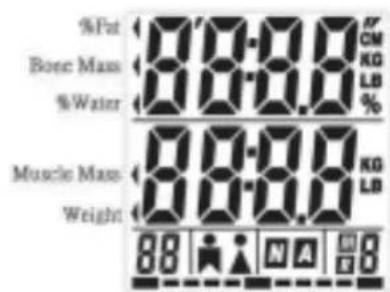
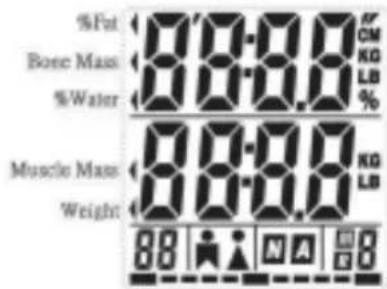
LCD DISPLAY & FUNCTION KEYS
| ← | ON | ▲ | ▼ |
English
ELECTRONIC BATHROOM SCALE - BODY FAT ANALYZER
ON:
Turns the unit on and off
Recalls the input parameters (Height, Activity Level, Age, Gender & Athlete/Normal) from memories
- Enter Body Fat Analyzer (BFA) mode
:
- Confirmation button for Body Fat function, toggles from Height, Activity Level, Age, Gender and Athlete/Normal for Body Fat analysis
&
Changes value of height, activity level and age, toggles between male, female and between Athlete/Normal for the Body Fat function - Selects memory in Memory mode & Recall mode
- Clears contents of the user memory in Recall mode
If your scale has a conversion switch, you can change the measuring units from metric to imperial or vice versa (i.e. KG/CM - ST/IN - LB/IN) by simply adjusting the conversion switch located on the under-side of the scale.
GET STARTED IN 2 STEPS 1- INITIAL SET-UP
Insert 1 × 9V alkaline battery (not included) into the battery snap. The battery compartment is located at the back of the scale.
Remove battery if the product is not being used for a long time.
2 - SCALE INITIALIZATION
The scale needs to be initialized at the first time of use or after battery replacement.
Place the scale on a hard, flat surface. Press briefly and sharply with your foot in the middle of the platform. The display reads "_____, then the scale automatically turns off. Your scale is now ready for use.
Note: it is recommended to take weight and body fat measurements at a constant time period daily for example: from 6 am to 7 am daily.
OPERATION
To get accurate reading, how you stand on the scale is important. Place the scale on a hard, flat surface. Position your feet to contact maximally the platform. This ensures the best contact between your feet and the transparent contacts.
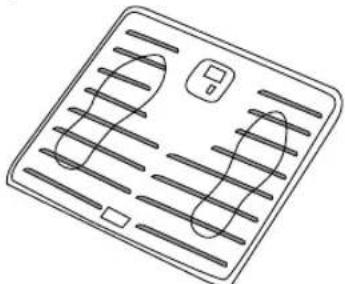
- With the automatic on function, simply step onto the scale; stand still while the scale computes your weight.
- Your weight will be displayed on the LCD screen.
- The scale turns off by itself after use.
AUTOMATIC SHUT-OFF
If no key is activated for 15 seconds, the scale shuts off automatically.
BODY FAT AND BODY WATER MEASUREMENT MODE
- Press [ON] button to enter the body water and body fat measurement mode, the height figure of the previous setting will be displayed on the toggle screen. The height figure will be blinking.
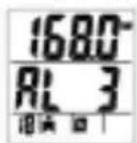
- Press [▲/▼] button to increase / decrease the height figure. Then press [←] to confirm and edit the activity level figure.
Terraillon
English
ELECTRONIC BATHROOM SCALE - BODY FAT ANALYZER
- Press [▲/▼] button to adjust the activity level (1 to 5, 1 being a very low physical activity level, 5 being a highly active physical activity level in the day). Then press [←] to confirm and edit the age figure.
- Press [▲/▼] button to increase or decrease the age.
- Press [ ] button to confirm age. The gender icon will start to blink.
- Press [▲/▼] button to toggle between Male [★] and Female [★] icons.
- Press [ ] button to confirm the gender. The arrow next to the athlete/normal mode will begin to flash.
- Press[ / ] button to toggle between athlete (A) and normal (N) icons.
N.B.: The Athlete Mode selection is only available to those aged 18 or older. For those aged 17 or under, this step is automatically by-passed.
- Presse [ ] button to confirm all settings with 1 long beep. × icon will be displayed on the display.
As soon as you hear the loud beep, step on the scale with bare feet.
- Step on the scale with bare dry feet. Stand still while the unit measures your weight. The weight will be displayed for 2 seconds.
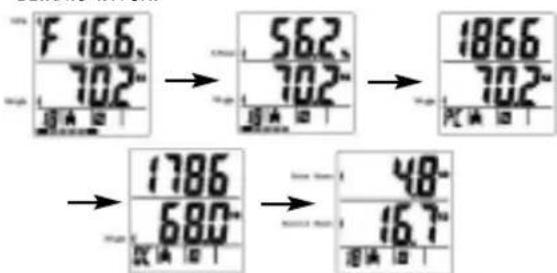
- Then it will start to measure your body water and body fat percentages. The following measurement pattern will be shown on the display during the measurement process.
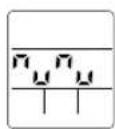
-
The measurement process finishes with 1 long beep.
-
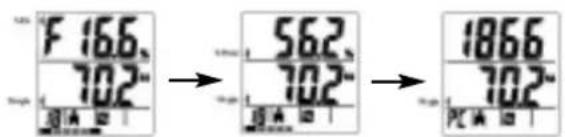
Body fat % is shown on the 1^st row of the LCD and the current weight is shown on the 2^nd row for 4 seconds.
- Then Total Body water % is shown on the 1st row of the LCD and the current weight is still shown on the 2nd row, during 4 seconds.
- Then the Daily Calorie Reference is shown on the 1^st row of LCD and the current weight still appears on the 2^nd row of the LCD. The PC (Present Calorie) icon appears instead of the age. NB: The Daily Calorie Reference corresponds to the amount of calories necessary per day to maintain your current weight.
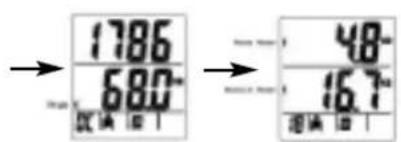
After 4 seconds, the Optimal Calorie Reference is shown on the 1^st row of the LCD and the Optimal Weight is shown on the 2^nd row of the LCD. The OC (Optimal Calorie) icon appears.
NB: The Optimal Calorie Reference corresponds to the amount of calories required per day to reach your optimal weight. Your optimal weight is calculated through a specific formula, taking into accounts your personal parameters.
- After 4 seconds, the Bone Mass is shown on the 1^st row of the LCD and the Muscle Mass appears on the 2^nd row of LCD.
After 4 seconds, the unit will turn off automatically.

ELECTRONIC BATHROOM SCALE - BODY FAT ANALYZER
MEMORY FUNCTION
The product features 10 personal memory settings. This allows users to store height, activity level, age, gender athlete /normal for frequent usage.
To store Memory
- Follow steps 1-9 in Body Fat and Body Water measurement mode procedure.
- Press [ / ] to select the memory location and the memory figure will be blinking.
- If the selected memory location is occupied, it will display "■" below the memory figure.
- Press [ ] to store your personal data to the desired memory location with 1 long beep. « R » and “■” icons will be shown on the screen, the data is memorized.
To Recall Memory
- Press and hold [ON] button for 2 seconds while in power off mode. It will enter recall mode.
- Press [ / ] to select the memory location.
- If the selected memory is unoccupied, no previous input will be displayed.
- If the selected memory is occupied, press and at the same time to clear the contents of the selected Memory.
- If the selected memory is occupied, press [ ] to confirm the desired memory with 1 long beep. « R » icon will be displayed on the display. The height, activity level, age, gender and athlete / normal of the memory will be displayed on the screen.
- Finally, repeat steps 10 to 12 as illustrated above.
Fast Recall Mode of Memory
- When your bathroom scales are switched off, press or to switch from one memory to the other: the screen displays the numbers in the memory. Press [ ] to confirm the entry.
- The « R » icon appears and the size, activity level, age, sex and Athlete/ Normal mode as well.
POWER OFF
In the body fat memory or recall mode, press and hold [ON] for 2 seconds, the unit will turn off.
SPECIAL DISPLAYS
| Display In the case of: | |
| Err0 Incorrect initialisation: begin again as explained above. | |
| Err1 Unstable weight: begin again. | |
| Err2 Overload: remove weight immediately. | |
| Err3 Body impedance exceeds the limit | |
| (100 ohm - 1kohm): begin again. For certain skin types an Err3 reading may occasionally appear. In this case you may need to dampen your feet to improve the contact with the electrod | |
| Err4 Percentage of body fat above the 4%-50% bracket: begin again. | |
| Err5 Percentage of body water is beyond the range. Clean the bottom of feet with damp cloth and step on the scale again | |
| Lo Battery failure: replace it. | |
WARRANTY
This impedance scale is guaranteed for 2 years against defects in materials or manufacturing. During this period, any such defects will be repaired free of charge (proof of purchase must be shown in the case of a complaint under warranty).
The warranty does not cover damage resulting from improper use or negligence. In the event of a claim, first contact the shop where you purchased your scale.
Terraillon

ELEKTRONISCHE PERSONENWAAGE - IMPEDANZMETER
WAS SIE VOR DER BENUTZUNG IHRES IMPEDANZMETERS WISSEN SOLLTEN
| Messung Alter | |||||
| 20-29 30 | -39 40-49 | 50-59 60+ | |||
| Niedrig <19% | <20% | <21% | <22% | ||
| Optimal 20-28% | 21-29% | 22-30% | 23-31% | 24-32% | |
| Mittel | 29-31% | 30-32% 31 | -33% | 32-83% | 33-35% |
| Hoch | >31% | >32% >33% | >34% | >35% | |
| Medida | Edad | ||||
| 20-29 30 | -39 40-49 | 50-59 60+ | |||
| Baja <13% | <14% | <16% | <17% | <18% | |
| Óptima 14-20% | 15-21% | 17-23% | 18-24% | 19-25% | |
| Media 21-23% | 22-24% | 24-26% | 25-27% | 28-28% | |
| Alta >23% | >24% | >26% | >27% | >28% | |
| Medida | Edad | ||||
| 20-29 30 | -39 40-49 | 50-59 60+ | |||
| Baja <19% | <20% | <21% | <22% | <23% | |
| Optima 20-28% | 28% 21-29% | 22-30% | 23-31% | 24-32% | |
| Media 29-31% | 30-32% | 31-33% | 32-33% | 33-35% | |
| Alta >31% | >32% | >33% | >34% | >35% | |
LA MASA MUSCULAR Y LA MASA OSEA
| Rating Age | |||||
| 20-29 30 | -39 40-49 | 50-59 60+ | |||
| Low <19% | <20% | <21% | <22% | <23% | |
| Optimal 20-28% | 21-29% | 22-30% | 23-31% | 24-32% | |
| Moderate 29-31% | 30-32% | 31-33% | 32-33% | 33-35% | |
| High | >31% | >32% | >33% | >34% | >35% |
Source: University of Illinois Medical Center, Chicago, USA.
Standard for Women
| Rating Age | |||||
| 20-29 30 | -39 40-49 | 50-59 60- | |||
| Low <13% | <14% | <16% | <17% | 8% | |
| Optimal 14-20% | 15-21% | 17-23% | 18-24% | 19-25% | |
| Moderate 21 | 22-24% | 24-26% | 25-27% | 26-28% | |
| High | >23% | >24% | >26% | >27% | >28% |
Source: University of Illinois Medical Center, Chicago, USA.
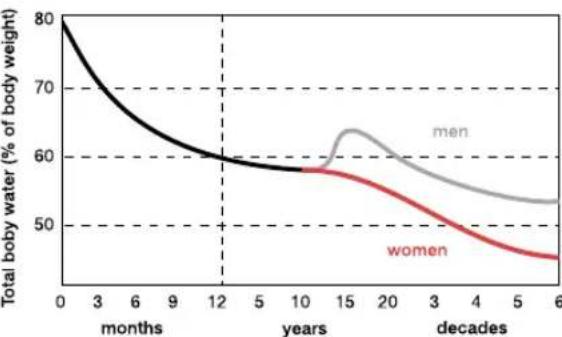
Source: University of Illinois Medical Center, Chicago, USA.
Variation of % total body water with age and gender:
| % Body Fat Range | Optimal % total Body Water Range | |
| Men | 4 to 14% | 70 to 63% |
| 15 to 21% 63 to 57% | ||
| 22 to 24% 57 to 55% | ||
| 25% and over | 55 to 37% | |
| Women | 4 to 20% | 70 to 58% |
| 21 to 29% 58 to 52% | ||
| 30 to 32% 52 to 49% | ||
| 33% and over | 49 to 37% |
| Rating Age | |||||
| 20-29 30 | -39 40-49 | 50-59 60+ | |||
| Low <13% | <14% <16% | <17% <18% | |||
| Optimal 14-20% | 15-21% | 17-23% | 18-24% | 9-25% | |
| Moderate 21-23% | 22-24% | 24-26% | 25-27% | 26-28% | |
| High >23% | >24% | >27% >28% | |||
Source: University of Illinois Medical Center, Chicago, USA.
Standard for Women
| Rating Age | |||||
| 20-29 30 | -39 40-49 | 50-59 60+ | |||
| Low <19% | 20% <21% | <22% <23% | |||
| Optimal 20-28% | 28% 21-29% | 22-30% | 23-31% | 24-32% | |
| Moderate 29-39% | 31% 30-32% | 31-33% | 32-33% | 33-35% | |
| High >31% | >32% >33% | >34% >35% | |||
Source: University of Illinois Medical Center, Chicago, USA.
-
O volume de agua recomendado pelos professionais da saude.
-
Total Body Water (% of body weight)
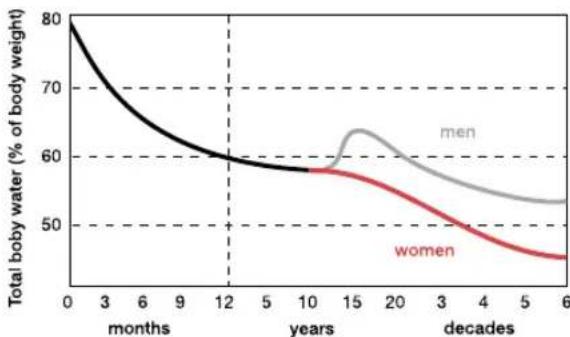
Variation of % Total Body Water with Age and Gender:
| % Body Fat Range | Optimal % total Body Water Range | |
| Men | 4 to 14% | 70 to 63% |
| 15 to 21% 63 to 57% | ||
| 22 to 24% 57 to 55% | ||
| 25% and over | 55 to 37% | |
| Women | 4 to 20% | 70 to 58% |
| 21 to 29% 58 to 52% | ||
| 30 to 32% 52 to 49% | ||
| 33% and over | 49 to 37% |
PRODUCTBESCHRIJVING INLEIDING
| Rating Age | |||||
| 20-29 30 | -39 40-49 | 50-59 60+ | |||
| Low <13% | <14% <16% | <17% <18% | |||
| Optimal 14-20% | 15-21% | 17-23% | 18-24% | 19-25% | |
| Moderate 21- | -23% | 22-24% | 24-26% | 25-27% | 26-28% |
| High >23% | >24% | >26% | >27% | >28% | |
Source: University of Illinois Medical Center, Chicago, USA.
Standard for Women
| Rating Age | |||||
| 20-29 30-39 40-49 | 50-59 60+ | ||||
| Low <19% | <20% | <21% | <22% | <23% | |
| Optimal 20-28% | 21-29% | 22-30% | 23-31% | 24-32% | |
| Moderate 29-31% | 30-32% | 31-33% | 32-33% | 33-35% | |
| High >31% | >32% | >33% | >34% | >35% | |
Source: University of Illinois Medical Center, Chicago, USA.
Variation of % Total Body Water with Age and Gender:
| % Body Fat Range | Optimal % total Body Water Range | |
| Men | 4 to 14% | 70 to 63% |
| 15 to 21% 63 to 57% | ||
| 22 to 24% 57 to 55% | ||
| 25% and over | 55 to 37% | |
| Women | 4 to 20% | 70 to 58% |
| 21 to 29% 58 to 52% | ||
| 30 to 32% 52 to 49% | ||
| 33% and over | 49 to 37% |
BESKRIVELSE AF PRODUKTET INTRODUCTION
| Rating Age | |||||
| 20-29 30 | -39 40-49 | 50-59 60+ | |||
| Low <13% | <14% <16% | <17% | 8% | ||
| Optimal 14-20% | 15-21% | 17-23% | 18-24% | 9-25% | |
| Moderate 21-23% | 22-24% | 24-26% | 25-27% | 26-28% | |
| High | >23% | >24% | >26% | >27% | >28% |
Source: University of Illinois Medical Center, Chicago, USA.
Standard for Women
| Rating Age | |||||
| 20-29 30 | -39 40-49 | 50-59 60+ | |||
| Low <19% | <20% | <21% | <22% | <23% | |
| Optimal 20-29% | 28% | 21-29% | 22-30% | 23-31% | 24-32% |
| Moderate 29% | -31% | 30-32% | 31-33% | 32-33% | 33-35% |
| High | >31% | >32% | >33% | >34% | >35% |
Source: University of Illinois Medical Center, Chicago, USA.
- Anbefalet vandrumfang af sundhedseksparter.
- Total Body Water (% of body weight).
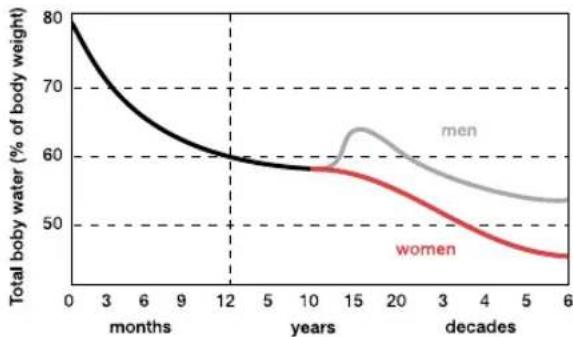
Variation of % Total Body Water with Age and Gender:
| % Body Fat Range | Optimal % total Body Water Range | |
| Men | 4 to 14% | 70 to 63% |
| 15 to 21% 63 to 57% | ||
| 22 to 24% 57 to 55% | ||
| 25% and over | 55 to 37% | |
| Women | 4 to 20% | 70 to 58% |
| 21 to 29% 58 to 52% | ||
| 30 to 32% 52 to 49% | ||
| 33% and over | 49 to 37% |
- Daglicht kalorieforbrug:
Henis til nedenstaende tavle for at beregne Deres Fysiske Aktivitetsniveau (PAL)
BESKRIVNING AV PRODUKTEN INLEDNING
| Rating Age | |||||
| 20-29 30 | -39 40-49 | 50-59 60+ | |||
| Low <13% | <14% | <16% | <17% | 8% | |
| Optimal 14-20% | 15-21% | 17-23% | 18-24% | 19-25% | |
| Moderate 21- | -23% | 22-24% | 24-26% | 25-27% | 26-28% |
| High | >23% | >24% | >26% | >27% | >28% |
Source: University of Illinois Medical Center, Chicago, USA.
Standard for Women
| Rating Age | |||||
| 20-29 30 | -39 40-49 | 50-59 60+ | |||
| Low <19% | <20% | <21% | <22% | <23% | |
| Optimal 20-28% | 21-29% | 22-30% | 23-31% | 24-32% | |
| Moderate 29-31% | 30-32% | 31-33% | 32-33% | 33-35% | |
| High | >31% | >32% | >33% | >34% | >35% |
Source: University of Illinois Medical Center, Chicago, USA.
Variation of % Total Body Water with Age and Gender:
| % Body Fat Range | Optimal % total Body Water Range | |
| Men | 4 to 14% | 70 to 63% |
| 15 to 21% 63 to 57% | ||
| 22 to 24% 57 to 55% | ||
| 25% and over | 55 to 37% | |
| Women | 4 to 20% | 70 to 58% |
| 21 to 29% 58 to 52% | ||
| 30 to 32% 52 to 49% | ||
| 33% and over | 49 to 37% |
BESKRIVELSE AV PRODUKTET INNLEDNING
MÁLING AV KROPPSFETT VED BRUK AV MINNEFUNKSJON
| Rating Age | |||||
| 20-29 30 | -39 40-49 | 50-59 60+ | |||
| Low <13% | 14% <16% | <17% <1 | 8% | ||
| Optimal 14-20% | 15-21% | 17-23% | 18-24% | 9-25% | |
| Moderate 21-23% | 22-24% | 24-26% | 25-27% | 26-28% | |
| High | >23% | >24% >26% | >27% >28% | ||
Source: University of Illinois Medical Center, Chicago, USA.
Standard for Women
| Rating Age | |||||
| 20-29 30 | -39 40-49 | 50-59 60+ | |||
| Low <19% | 20% <21% | <22% | <23% | ||
| Optimal 20-28% | 28% 21-29% | 22-30% | 23-31% | 24-32% | |
| Moderate 29-31% | 30-32% | 31-33% | 32-33% | 33-35% | |
| High | >31% | >32% | >33% | >34% | >35% |
Source: University of Illinois Medical Center, Chicago, USA.
Variation of % Total Body Water with Age and Gender:
| % Body Fat Range | Optimal % total Body Water Range | |
| Men | 4 to 14% | 70 to 63% |
| 15 to 21% 63 to 57% | ||
| 22 to 24% 57 to 55% | ||
| 25% and over | 55 to 37% | |
| Women | 4 to 20% | 70 to 58% |
| 21 to 29% 58 to 52% | ||
| 30 to 32% 52 to 49% | ||
| 33% and over | 49 to 37% |
- Daglig kaloriinntak: Se folgende tabell for a vurdere ditt fysiske aktivitetsniva (PAL)
| Rating Age | |||||
| 20-29 30 | -39 40-49 | 50-59 60+ | |||
| Low <13% | <14% <16% | <17% <18% | |||
| Optimal 14-20% | 15-21% | 17-23% | 18-24% | 19-25% | |
| Moderate 21 | 22-24% | 24-26% | 25-27% | 26-28% | |
| High | >23% | >24% >26% | >27% >28% | ||
Source: University of Illinois Medical Center, Chicago, USA.
Standard for Women
| Rating Age | |||||
| 20-29 30 | -39 40-49 | 50-59 60+ | |||
| Low <19% | <20% | <21% | <22% | <23% | |
| Optimal 20-28% | 21-29% | 22-30% | 23-31% | 24-32% | |
| Moderate 29-31% | 30-32% | 31-33% | 32-33% | 33-35% | |
| High | >31% | >32% | >33% | >34% | >35% |
Source: University of Illinois Medical Center, Chicago, USA.
- Terveydenhoidon ammattilaisten suosittelema veden tilavuus.
- Total Body Water (% of body weight)
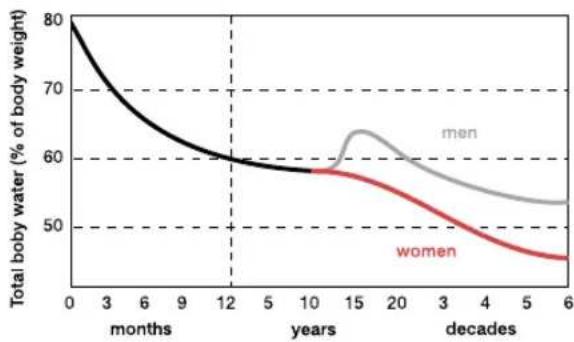
Variation of % Total Body Water with Age and Gender:
| % Body Fat Range | Optimal % total Body Water Range | |
| Men | 4 to 14% | 70 to 63% |
| 15 to 21% 63 to 57% | ||
| 22 to 24% 57 to 55% | ||
| 25% and over | 55 to 37% | |
| Women | 4 to 20% | 70 to 58% |
| 21 to 29% 58 to 52% | ||
| 30 to 32% 52 to 49% | ||
| 33% and over | 49 to 37% |
| Rating Age | |||||
| 20-29 30 | -39 40-49 | 50-59 60+ | |||
| Low <13% | 14% <16% | <17% <1 | 8% | ||
| Optimal | 14-20% | 15-21% | 17-23% | 18-24% | 19-25% |
| Moderate | 21-23% | 22-24% | 24-26% | 25-27% | 26-28% |
| High | >23% >24% >26% >27% >28% | ||||
Source: University of Illinois Medical Center, Chicago, USA.
Standard for Women
| Rating Age | |||||
| 20-29 30 | -39 40-49 | 50-59 60+ | |||
| Low <19% | 20% <21% | <22% | <23% | ||
| Optimal | 20-28% | 21-29% | 22-30% | 23-31% | 24-32% |
| Moderate | 29-31% | 30-32% | 31-33% | 32-33% | 33-35% |
| High | >31% | >32% >33% | >34% >35% | ||
Source: University of Illinois Medical Center, Chicago, USA.
- Zalecana przy bez profesjonalistów ilosc wody.
- Total Body Water (% of body weight)
Variation of % Total Body Water with Age and Gender:
| % Body Fat Range | Optimal % total Body Water Range | |
| Men | 4 to 14% | 70 to 63% |
| 15 to 21% 63 to 57% | ||
| 22 to 24% 57 to 55% | ||
| 25% and over | 55 to 37% | |
| Women | 4 to 20% | 70 to 58% |
| 21 to 29% 58 to 52% | ||
| 30 to 32% 52 to 49% | ||
| 33% and over | 49 to 37% |
ABTOMATUHECKOE BbIKJIIOUEHNE
Pp60b BbIKIOaETcA ABtOMaTnueeCKN,ecNN TeueHHe 15 ckyH NkAKaK HONKa He HaxmaeTcA.
I3MEPEHNE COIDEPXAHNA KINPA N BOJbl
- Haxmte Ha KhoNky [ON], IIH IpeXoJa B pexim n3mepeHn npoentHO codepxHa HJpa N BObl. LcPbHa 3KpaHe HaunHaOT MIRaTb - BB3OBITE napametp poCTa. LcPbCHOBA MrrAOT.
Terraillon
Pycckn
3NEKTPOHHbIE BEcBII B3BEUNBAHNAIIOJEN - PIP6OP IJI IN3MEPEHIN BNO3JEKTPNUECKOTo IMNEDAHCA
2.утобь BBECTи Baо рocT, сеует haхаы Ha KhoIGNK [▲] /[▼]. 3aTeM haXaTb [ ] ,утобь NOДТВЕРДИТь BbIbOPи BBIbECTи Ha TaNo ypoBeHb ΦиЗУСЕСКОАKTINBHOCTN.
- HaxaTneHa KHOIKN [▲] / [▼] BBecTN Baw ypoBeHb φn3NueCKo aKTHBHOCTn (OT 1 Do 5; 1 - NOyTN HNKaKO fN3NueCKo aKTHBHOCTn, 5 - INHTeHCNBHAR φn3NueCKa aKTHBHOCTb B TeueHne DHA). 3aTeM HaxaTb [ ] , YTO6bl NODTBepnTb BB6Op N BbIECTn Ha Ta6No BO3pact.
4.C NOMOJIbIO KHOJOK [▲/▼] BBeIe 3HaueHHe CBOero BO3paCTa.
5.ДЯ NOТВЕРЖDEHIN BBEDEHHO 3HAueHIN BO3pacta n nepexoJa K BBOy CnEduOJero npaMeTpra (noJa) HaxMNTe Ha KHONKy [ ].3HaUKN,6O3HaHIOJIne MyKCKO IN KEHCKM NOL, HAuHAIOT MIRATb.
6.C NOMOUIKHOHOK [ 一 / ] BBi6epnte 3Haoyok "Myx." [ ] INN "KeH." [ ]
7.ДЯ NOITBEPKHeENH BbIbpaHHOrO 3HaueHnI NOJa HaxMNTe Ha KHOJky [ ]
8.C NOMOUIK HONOK [▲/▼] BbIepeNTe 3HaueHne CnOCo6a H3MepeHna - CnpTubHbI INN CTaHdapTHbI.
3AMEUAHNE: PexnM "ATIeTn3M" MORYT NcNoB3OBaTB nla B Bo3pacte OT 18 do 80 net (ecn6bJI BBedeH Bo3pact 17 net, pexnM "ATIeTn3M" HE BKIOuHTCRA.
9.3aTeM HauKaTb Ha KhoNky [ ],YTO6bI NOITBepDnTb BEC BBeDEHHeIe napAmETpbI: Bby yCbIuNTe 3ByKOBoI CNrHaI. Ha TaNo IONBNTCAIMBOJI R
BcTaHbTe 6OcNkOM Ha Becbl, KaT TOnbKO Bbl yCnblIHTe 3ByKOBO CNrHaI.
-
BcTaHbTe 6ocnKoMa BeCbI. H DnBraTecb Bo BpemBa3BeuHaHa. TaNo nokKaKeT BaW BeC uepe3 2 ckyHbl.
-
3aTeM npn6op NaHcHt npOn3BooNtB OueHKy oBbema BoBb BaWem opraHm N ypoBHr TeLeChoro Knpa. Pn nOChte Obema BoDh N ypoBHr TeLeChoro Knpa Ha TaBNo NOBHTC nEduOuIne NapaMeTpbl.
-
Θα φa3a 3aBεpιNTcR 3ByKOBbIM CΓHαJIOM.
-
PpoeHT KINPOBOI MaccbI yKa3aH Ha nepBOi, a Bau BEc - HbTOpO CTpOKe Ta6No.
Yepe3 4 cekyHbI nepBaH cTPOUka Ta6No nokkTe npoueHT coepKaHH BODi B Baem opraHn3Me. BaTIepeuHn BEc no-tpexHemy yka3aH Ha BTOPOI cTPOUKe Ta6No.
3aTeM Ha nepBoo CTPOUKe Ta6JIO NOBHTcR
ExeJeHHeBHOE KOJIueCTBO KAOpN,
Heo6XoDnMoE Baewemy opraHn3My. Baw
TepenBn Bec No-PrpeKHeMy yka3an Ha
BToPoI CTPOUKe Ta6JIO.CmBbON PC (=
TenepeuHHee KOJIueCTBO KAOpN) NOBHTcR B
JIeBOM HxHHeM yIy 3KpaHa (Ha MeCTe
napaMeTp a Bo3pacta).
3ameyahue:EkeheBHe KOJIuuecMb KaIopuu coombemcbmyeKoJIuuecMbBy KaIOpu, Heo6xOIMOMy 0nnoepkaHuaBaWeo mepeuHBe Beca.
- Yepe3 4 cekyHbHa na nepBoi cTpoUke Ta6No NOBnTc npametp exeJHeBHOKoJIuYeCTBa KaOpu, a BaW onTmAlbHbI BeC - Ha BToPoI cTPOKe Ta6No. B JIeBOM HxKHeM yrJy Ta6No NOBnTc CmBOJ OC (= ONTmAlbHoe KOJIuYeCTBO KaOpu).
3ameaHue : OnmumalbHoe ekehEBHoe KOUuecmbo Kanoepu coombemcByem KOUuecmby Kanopu, KOMOPoe Heo6xOdmo nompebIb .eKeHEBHO dJRA oocmuKHeu onmumalbHo 20 Beca. Bau omumalbHuB Bec noocchumac nomooubAo aanaOpumma, komopby yumblaem BaWu uHOUBuybHie napamempbl.
Yepe3 4 cekyHnbI nepBaA CtpoKa Ta6nO nokaxet npametp KocTHoMaccbI, a BtopaNapametp MyckyHbHO Maccbl.
-Yepe3 4cekyHdbI npnbop aBTOMaTHUcKn BbIKJIOHTCA.
Terraillon
Pycckm
3NEKTPOHHbIE BEcBi IJIa B3BULBAHnI JIOEIN - PNI6OP IJIa N3MEPEHnI BNO3JEKTPUeCKOTo IMPeDAHCA
NCHONb3OBAHNE NAMRTN
PnBpObopcoCTOnu310pa3eJIOB,6oOc6neHHbIXpyrOT npyra.3To Daet Nolb3OBATEJAM BO3MOXHOCTbXpaHtB PnABOpa qacto NCNoIb3yeMbIEKOMBnHaunnapamETpoCTa,BO3pacta,nona nCIOOC6aN3MepeHn.
CoxpaHHeHnHΦopMaunBnAMHTnpnbopa
- BbInonHnTb onncanHhBie Bblte 3tanbl 1-9.
2.C NOMOUIK HONOK [▲/▼] BB6paTb pa3dennamrtn (OHN 06o3HaYeHb UePpAMn OT 1 do 10).Iocne 3TOR B6paHHb Homep pa3dena HaunhaetMIRaTb Ha 3kpaHe.
3.Ecnn Bb6paHHbI pa3eI IaMHT 3aHHT,TO Ha 3KpaHe,IOI erO HOMepOM,OTobpaXaetc3HaK
4.HaKaTnEM Ha KhoNky [ ]MOxHO NODTBepnntb 3HaueHnnapaMeTpOB n 3aIncatBnx B BB6paHHb pa3dennamrtn. Pocne 3TO rnp6op Bbdaet 3ByKcOBo CnHAn. Ha 3kpaHe NOBnHOTCR 3HaQOK « R », n 3HaK “■”, 3HaueHnnapaMeTpOB 3aIncbIAkOTCB nAmrTb.
Bb3OB npaMeTPOB namrtn
- Haxmte Ha KhoNky [ ON ] u ydepKnBaIte ee b Haxkatom NonoXeHn B TeueHne 2 cekyH, noka npnbop He BbIKIOHTcH. C NOMOJIbIO 3TOI onepaun aKTINBUN3InpyETcpeKHM BbIOBA n3 nAMrTn.
2.C NOMOJIbIO KHOIOK [▲/▼] BbI6epnte HxHbIpa3dien nAMrTn. - Ecnn 3OT pa3dien nyct, To Ha 3KpaHe HnUero He OTO6pakaetca.
4.Ecnn JxE B 3tOM pa3dene namATn yke 3aIncahbI daHHbI, IN Bbl XOTNTe INX ydaJIHTb, TO HxKHO HaxKaTb Ha o6e KHOJKN ▲ N ODHOBpeMeHHO.
5.HaKMITE Ha KhoNky [ ],YTO6bI NOITBepNTb 3ByKOBBIM CnHAnOM HOpem Bb6paHHOro pa3dena naMAtn. Ha 3KpaHe OTo6paXaEcTc 3HaQK « R ». Iocne 3TORO Ha 3KpaHe NoOuepeDHO OTo6paXaIoTc 3aIncaHHbE B 3TOM pa3dene NaMTn 3HaueHnnapaMeTpOB - poCT, Bo3pAcT, non n CnoCob n3MepeHn (CnpTbHbI/CTaHapTbI).
6.3aTeM cIeNyET BbIIOHHTb Oepauu 10-12, nepeuNCHeHbE BIIe.
Pekim6bictporo Bb3Oba namr
- Korda npn6op HaxoNTcB BbIKIOyeHHOM COCTORHNN, Bb6epnte pa3dien PAMHTC NMOUbKHOOK A N▼, NO3BOJIOUx NEpEXOINTb OT OJHOro pa3deNa Kpyromy. PnI 3TOM Homepa pa3deOB OTO6paKaOTcHa 3kpaHe. HaKaTneM Ha KHOJIky [ ]NODTBepXJaETcB b6op pa3deNa.
- Ha 3kpaHne NOBnIeTc3HaoyK « R » n 3HaueHnI npaMeTpOB: NoCT, BO3pact, non n CnOco6 n3MepeHnI (CnoptNBhB/CTaHdaptThbI).
BbIKJIIOUeyHNE
YTO6bblBbIKJIOUHTb npH6Op,HyXHO BpeXnme Bb3Oba n3 nAMrTn HkKaTb Ha KhoNky [ON] n ydepXnBaTb ee B HxKATOM COCTOARHN B TeueHne 2 cekyHd.
CNEUHbHE COOBUEHH
3NEKTPOHHbIE BEcBl IJIa B3BEUNBAHnI JIOJEN - PNI6OP IJIa N3MEPEHnI BNO3JEKTPuECKOTo IMNEDAHCA
TAPAHTN
Ha daHbI np6Op npEoCTabHETcRAPaHTnHa cPOK 2 rOa B OTHOWeHN NIObIX HeNCpABHOCTeN I deFeKToB u3rOToBHeN. B TeueHne 3TO rpeNoDa, ycTaPHeHne TaNX HeNCpABHOCTeN I deFeKToB npOn3BOuNTcBeCnPaTHO (INRApaHTnHOro pEmoHTa HEoXoDMo npEaBBtB DOKyMeHT, NOITBepXdaUoNn NOKyKnY).
3Ta rapaHTnHe pacnpocTpaHreTc HnOBpeXeHn, Bb3BaHHbe HeCchAcTHbIM CnyaAMn, HenpabINbHbIM NcNoJIb3OBAHEm NIn HeBpeXhBM ObaIeHNm. Co BCEMn IpTeH3NMI CneJyET Chayana ObaaATbcB MaRa3IN, Tne BbIa COBepWeHa NOKyIka.
IPOUHE3AMEUAHNA
- IpoeHT Knpa, peKOMHnyembI CneuaJIInCTAmn no oxpan 3dOpOBBa:
Standard for Men
| Rating Age | |||||
| 20-29 30 | -39 40-49 | 50-59 60+ | |||
| Low <13% | <14% <16% | <17% | <18% | ||
| Optimal | 14-20% | 15-21% | 17-23% | 18-24% | 19-25% |
| Moderate | 21-23% | 22-24% | 24-26% | 25-27% | 26-28% |
| High | >23% >24% >26% >27% >28% | ||||
Source: University of Illinois Medical Center, Chicago, USA.
Standard for Women
| Rating Age | |||||
| 20-29 30 | -39 40-49 | 50-59 60+ | |||
| Low <19% | <20% <21% | <22% | <23% | ||
| Optimal | 20-28% | 21-29% | 22-30% | 23-31% | 24-32% |
| Moderate | 29-31% | 30-32% | 31-33% | 32-33% | 33-35% |
| High | >31% >32% >33% >34% >35% | ||||
Source: University of Illinois Medical Center, Chicago, USA.
2.Obbem BOdbi, peKOMHnyeMbI CnEuaNCTAMN NO oxpaHe 3dOpOBBra.
- Total Body Water (% of body weight).
3 4 5
Variation of % Total Body Water with Age and Gender:
| % Body Fat Range | Optimal % total Body Water Range | |
| Men | 4 to 14% | 70 to 63% |
| 15 to 21% 63 to 57% | ||
| 22 to 24% 57 to 55% | ||
| 25% and over | 55 to 37% | |
| Women | 4 to 20% | 70 to 58% |
| 21 to 29% 58 to 52% | ||
| 30 to 32% 52 to 49% | ||
| 33% and over | 49 to 37% |
- ExeHbBn paCteKaIOpn:
Cm.npBBeHnHy HnKe Ta6NtCy,yTo6bIpaCCHTaB BaW npOeHb n3nuecko aKTHBHOCTn (PAL).
IPEPIPAPH TOY IPOIONTOEIGA
To ouotma lanouetpno Teraillon oxediaoNTke kai kataoekuaoTNE OE eva epyootaoio motoiounevo ISO 9001 kai ISO 14001, kai oumopawvetae ta iayovta npotuna yia tvn noiotnka kai to nepialauov. H ouakeun xponoionoiet n meofo Avaluanaeow biionektpikna avtioana (B.l.A) yia tov unoloyiao nto maacao tou linoua kai to noooTO Tou vepou oTo owa. Stelvaia abaIIOOTnA nEKTPIaou oTo oWma, kai otn ouvexia unoloyice, uotepa ano TN eTpnoan nO avtioana TOU awato, TO noooTO vepou kai maoc AInoua. H zuyapiautn diathetai enioe eva npopypma "aOHntno", yi tou ahtaneo twv onoiwTa owpataeXouv diaopoptikn ouotaan ano auta tow n aHantw.
YINOAEIEEIXXPHESH
- H zuyapiia autn 8ev npenei va xpnoiopoietai ano aToMa nou fepouv 9muato60tn. Oa mnpooe va npoknthei duolteupyia otnv iatpiKn oukeun. 2e nepintwn amphiBoiaic, oubetaeute to yiatpo oac.
- Tia yuvaikec o npioo Ekyuouovnc kal atoqa e Emuutoeic onwctexvnta ean, aviuulnniKec oukeuec, n eTaalikec kappitoec, ta anoktneVta anotelaoata unpouv va anobexoov avakpih. Auto opieiaetai oto ot to linoc dev kataveetai tooo omoiopopp aoo uno quiooloykec ouvkenkcs, e anotelaova laubavovtai diaotpebaev anaoteleogata. OTOco, n xpnon TnC Uyapiac dev napouiazki kaveva kivduvo yia tvu yia.
-
Mny anoouvapmoLoyoeite Tzuyapi. Kivduvee va TpauaTiotEte ano eva kako xepioo.
4.To npoiov auTo 8ev npoopiZeTai yia enayyeaataikxpon oE iatpiKOepiBaaov. npoopiZeTai mOvo yia tn xpon Ota nlaiaov evoc voikokupou. -
Kaθapiετε με ενα uypo navi, npoεxovtac va μην μπει ερο μεσα στη συκεύη. Mn χρομιοιείτε διλυτικες oωιες και μη βαζετε ηι συκεύη μεσα στο ερο.
- Anopuyete TIC duvatec dovnoeic n Kpouoeic, onwca va apnoete Tn ouakeun va neoi oTo danelo.
TEXNIKA XAPAKTHPIETIKA
Xwpntikotnta:150kla
; 100 .
- iαβaθμιη τοῦ ποσστου λίπους: 0,1%
- iαβαμιηn tou oykou tou vερού: 0,1%
- NoooTo AInouc: ano 4% wC 50%
- NoooTo vepou: ano 37% ως 70%
MétpnTou noooTou Tou AINouc kal Tou Oykou Tou vepou
- Fpaun axioloynont twv nooostaiow anotelaemuatwv linouc kalvpou %
Hερησια πορρόφηση Θερμιδων
METPONmuiknca(nguyapia 8ixv1n OKeAETIKmuiknaou anotelEio evaek Twv3 EiwvTwvmuikns aacTou oawatoq)
- Mētpnon ootiknc μaçac (avtiotoiεi ota avópyava aλata twv ootw tou ωμatoc)
Aeitoupyia A0AnTn
- Mováða μετρησης: kg, cm
10 uvnue xnpotn
Aetoupyia Taxeiac Avaknons
Aeitoupyia diaypaqnc mnuu
Ypsoc: a100.0 0s220.0 k.
Hukia: ano 10 wc 99 xpovia
Huyapiiaaitoupyeiueaakaikn μnatapia 1 x 9V

HAEKTPONIKH ZYΓAPIA MπANIOY - ΣYΣTHMA ΛΙΝΟΜΕΤΡΗΣ
NAHKTPA XEIPIMOY
| ← | ON | ▲ | ▼ |
ON:
TnV evpyooinon kai anevpyooinon Tns movadac
Ikavotnta avaknncs 5 napapewv (uoc, enieo dbaopniotntas, niaia, qulo, & tponoc aeitoupyias aan / kavovikoc) ano Tis uynes.
EiayTe Tov Tpno Aetoupyia Avauan atkou Ainouc (BFA)

PiKtpo EiBepaiwong ts Aetoupyiac
Somegaikou Ainous kai evaalayns eTaE
Yous, Hauiaoc, Duou kai npoypaumatos
aHant/kavovikou yia tn Ainoueponon Swatos
A&:
AALay nTnTtnc uouc kai naikac, evaalay n eTaSu apoeviKou kai thukou pfoukai npoypaatoc a9anTh/kavovikou otn aeitoupyia liouetponons
Eunoyn mvnnc stn aeitoupyia Mvnnc kal n aeitoupyia Enavapopac
- Σβηαμο Tou περιεχομενου τή μυνημς χροτηστη λειτουγία Επαναρορά