N80 - Garage door Hormann - Free user manual and instructions
Find the device manual for free N80 Hormann in PDF.



User questions about N80 Hormann
0 question about this device. Answer the ones you know or ask your own.
Ask a new question about this device
Download the instructions for your Garage door in PDF format for free! Find your manual N80 - Hormann and take your electronic device back in hand. On this page are published all the documents necessary for the use of your device. N80 by Hormann.
USER MANUAL N80 Hormann
1 Safety Instructions 14
1.1 Qualified persons.. 14
1.2Warnings and symbols used 14
1.3 Intended use 15
1.4 General safety instructions 15
2 Fitting and Initial Start-Up. 16
2.1 Safety instructions 16
2.2 Fitting. 16
2.2.1 Transport locking device / on-site infill.. 16
2.2.2 Doors with centre profile / horizontal ribbing..17
2.2.3 Fitting the handle 17
2.2.4 Fitting to the ceiling 17
2.2.5 Checking the door action and door stop...17
2.3 Initial start-up 18
2.3.1 Checking the door spring tension 18
3 Operation. 18
3.1 Safety instructions 18
3.2 Opening the door with the handle 19
3.3 Locking and unlocking the door 19
4 Inspection and Maintenance. 19
4.1 Safety instructions 19
4.2 Checking the condition of the door 20
4.3 Checking the door spring tension 20
4.4 Replacing the door tension springs.. 20
4.5 Checking the track rollers and tracks.....20
4.6 Checking the lock and locking mechanism....20
4.6.1 Adjusting the latching (Figure 9.1) 20
4.7 Accessories 20
5 Surface Protection. 21
5.1 Door with steel infill 21
5.2 Door with timber infill 21
6 Cleaning and Care 21
6.1 Door surfaces made of steel 21
6.2 Synthetic panes 21
6.3 Data label 22
7 Assistance with Malfunctions. 22
8 Dismantling 22

Dissemination as well as duplication of this document and the use and communication of its content are prohibited unless explicitly permitted. Noncompliance will result in damage compensation obligations. All rights reserved in the event of patent, utility model or design model registration. Subject to changes.
ENGLISH
Make sure that these instructions remain with the door operator!
Read and follow these instructions carefully!
They provide you with important information on safe fitting and operation, as well as proper care and maintenance of your garage door.
Keep these instructions and the warranty booklet in a safe place.
Enter the serial number (see the data plate) here.
Serial no.:
1 Safety Instructions
The manufacturer is not liable for damage resulting from non-compliance with these instructions and the safety instructions.
1.1 Qualified persons
Have a qualified person (competent persons in acc. with EN 12635) fit, start-up and maintain the door following these instructions. While doing so, the requirements listed in the standards EN 12604 and EN 12635 must be observed.
1.2Warnings and symbols used
Special safety information is provided at respective important points in these instructions. They are identified by the following symbols and signal words.
| The general warning symbol indicates a danger that can lead to injury or death. |
| WARNING |
| Indicates a danger that can lead to death or serious injuries. |
| CAUTION |
| Indicates a danger that can lead to minor or moderate injuries. |
| ATTENTION |
| Indicates a danger that can lead to damage or destruction of the product. |

Important note for avoiding damage to property

Permissible arrangement or activity

Non-permissible arrangement or activity
See the text section (e.g. Section 2.2.1)
Inspect

Move component slowly

Remove/recycle the component/packaging
1.3 Intended use
- The garage door is only intended for private use. If you would like to use the door in a commercial application, first check whether the currently valid national and international regulations permit such use.
- The garage door is suitable for use outside; it opens outwards with an up-and-over action.
- Doors without a threshold profile UA have a water tightness class 0.
- The garage door can be manually operated or fitted with an operator.
1.4 General safety instructions
Always keep the swivelling and opening area of the door clear. When in operation, make sure that neither persons, children in particular, nor objects are located within the door's area of travel.
- Do not attach any additional components of another make! The tension springs are matched to the door leaf weight. Additional components can overload the springs.
- Do not alter or remove any components! You could otherwise risk putting important safety components out of action. Only use original parts intended for use with this particular garage door.
- Protect the door from caustic, aggressive substances, e.g. nitrous reactions from stones or mortar, acids, alkali solutions, de-icing salt, aggressive paints or sealants.
- Make sure that there is sufficient water run-off and ventilation (drying) in the lower section of the side frames and the threshold profile.
Operation of the door during heavy winds may be dangerous.
ENGLISH
2 Fitting and Initial Start-Up
2.1 Safety instructions
WARNING
Danger of injury
There is a danger of injury during fitting. Observe the following instructions:

Wear safety glasses and protective gloves.

Secure the door from falling.
Support the tracks properly.
- Secure the door leaf from crashing to the floor.
Fit all delivered fastenings according to the fitting instructions.
ATTENTION
Damage to the product
Observe the following instructions:
Use plugs, washers and screws suitable for the brickwork.
Protect the door frame along with the ball-bearing bracket and door leaf against drilling dust during fitting.
Install a door with timber infill only in dry garages.
2.2 Fitting
The garage door can be fitted from the inside behind the opening or in the opening.
The garage door can be fitted with or without a threshold profile UA.
Use the frame shoe angle ZFW article no. 1 562 012 if you want to install the door without the threshold profile UA.
All the dimensions stated in the illustrated section are in mm.
2.2.1 Transport locking device / on-site infill
WARNING
Door tension spring is under tension
Observe the following instructions to avoid any injuries.
- First install the infill and then remove the transport locking device so that the door does not bounce up.
Observe the maximum permissible infill weight.
Observe the maximum infill weight of 7kg / m^2 for doors with an integrated wicket door so that the springs are not overloaded.
Maximum permissible infill weight for on-site infill:
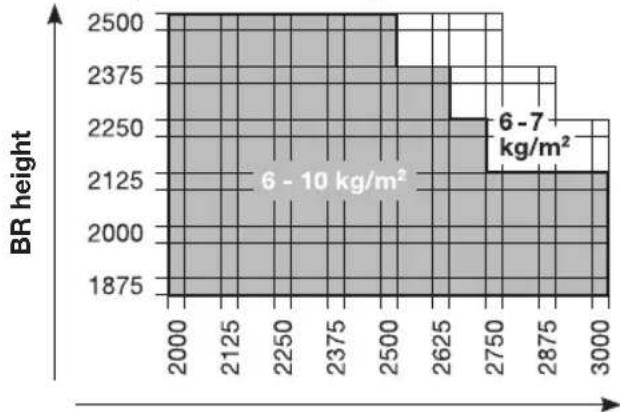
BR width
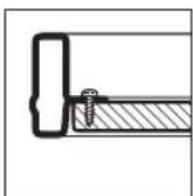
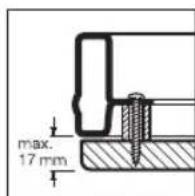
Infill in the frame Infill overlapping the frame
For on-site infill see also supplement to instructions.
2.2.2 Doors with centre profile / horizontal ribbing
The spacer bush with a square hole is only used in doors with centre profile or horizontal ribbing.
2.2.3 Fitting the handle
Always choose the pin setting (a, b or c) with the largest possible guidance for the interior handle.
- Shorten the pin of parD if dimension A is less than 36 mm.
2.2.4 Fitting to the ceiling
CAUTION
Protruding anchor
There is a risk of injury when fitting to the ceiling without sufficient headroom.
- Shorten the anchor flush with the lower edge of the track.
2.2.5 Checking the door action and door stop
Check the door action and door stop.
In order for the door to travel freely, the diagonal dimensions a and b must be equal and the rubber buffers in the end-of-travel position must contact the rear spacer on both sides.
To ensure simple and safe fitting, carefully go through the work steps!
ENGLISH
2.3 Initial start-up
2.3.1 Checking the door spring tension
Open the door halfway.
The door should hold this position.

WARNING
Door spring tension
Improper adjustment of the door spring tension may result in injuries.
Only have a specialist adjust the door spring tension in accordance with Figure 8.3 when the door is open and secured.
After adjusting the door spring tension, secure the spring holders with the spring securing pins.
If the door moves substantially downwards:
Increase the spring tension.
If the door moves substantially upwards:
Decrease the spring tension.
Perform a test run and check the door in accordance with Chapter Inspection and Maintenance.
When properly fitted and inspected, the garage door can be easily moved, is functionally safe and easy to operate.
3 Operation
3.1 Safety instructions

WARNING
Door travel
There is a risk of injury in the door's swivelling and opening area.
- When in operation, make sure that neither persons, children in particular, nor objects are located within the door's area of travel.
- Keep a safe distance of 1350mm away from the door.

Opening and closing
There is a risk of injury when opening or closing the door improperly.
Manually opening:
- Only open the door with the exterior handle or interior handle, never with the lever arm or the cord knob.
Always slide the door fully into the end-of-travel position and wait until the door has come to a stop.
Manually closing:
Only close the door with the exterior handle, interior handle or the cord knob, never with the lever arm.
Make sure that the locking engages correctly.
3.2 Opening the door with the handle
The door is not locked when closed with the grip handle. Use the key or locking pin to lock the door.
Opening from the outside:
Opening from the inside:
Turn the handle a quarter turn clockwise.
Turn the handle a quarter turn anti-clockwise.
3.3 Locking and unlocking the door
From outside with the key and from inside with the locking pin.
Unlocking from the outside:
- Turn the key one whole turn clockwise and remove the key.
Locking from the outside:
- Turn the key one whole turn anti-clockwise and remove the key.
Unlocking from the outside - self-locking:
- Turn the key half a turn clockwise and slightly open the door.
- Turn the key back to the original position and remove it.
When the door is closed, the lock is locked again.
Unlocking from inside:
Push the locking pin to the left.
1 106 030 RE/07.2018 19
By unlocking in this way, you can then open the door without a key.
Locking from inside:
Push the locking pin to the right.
NOTICE:
- Follow the operator manufacturer's instructions for doors with operator.
- Ribbed steel doors with ventilation slots are locked horizontally with non-resilient rods. The locking pin is concealed to prevent burglary.
4 Inspection and Maintenance
4.1 Safety instructions
Have a specialist perform inspection and maintenance work on the door at least once a year in accordance with these instructions.
WARNING
Door travel
There is a risk of injury in the door's swivelling and opening area.
- When in operation, make sure that neither persons, children in particular, nor objects are located within the door's area of travel.
Functional parts, particularly safety components, may only be exchanged by a specialist.
ENGLISH
4.2 Checking the condition of the door
- Visually inspect the general condition of the door, all components, and safety devices for completeness, proper condition, and effectiveness.
- Check that all of the fixing points are tight. Tighten the screws if necessary.
Lubricate all pivot points with a commercially available lubricating oil. Do not use grease.
4.3 Checking the door spring tension
See Chapter Fitting and Initial Start-Up.
4.4 Replacing the door tension springs
Have the door tension springs replaced by a specialist after approx. 25,000 door cycles. This is required at the following approximate time:
| Door cycles per day Period | |
| Up to 5 Every 15 years | |
| 6 – 10 Every 8 years | |
| 11 – 20 Every 4 years | |
| 21 – 40 Every 2 years | |
| Over 40 yearly | |
| △ CAUTION |
| Elongated door tension spring Danger of injury due to elongated door tension spring - the coil spacing is irregular. ▶ Call in a qualified specialist to replace the door tension spring immediately. |
4.5 Checking the track rollers and tracks
Clean the tracks. Do not apply grease.
- Check the track rollers for wear. Have the track rollers replaced by a specialist if they are greatly worn or damaged.
4.6 Checking the lock and locking mechanism
| ATTENTION |
| Care products |
| Unsuitable care products may cause damage. |
| Only use specialised care products for the profile cylinder. Do not use oil or graphite. |
| Lubricate the locking rotary catch with a commercially available lubricating oil. Do not use grease. |
Check the locking as shown in Figure 1.2 and adjust it if necessary.
4.6.1 Adjusting the latching (Figure 9.1)
The latching has already been adjusted for normal use. In case of building structure imprecision:
- Loosen the nuts, slide the latching in the direction of the arrow and tighten the nuts again.
4.7 Accessories
-
To ensure a high level of quality, safety, reliability, as well as a long service life, only use original parts intended for this particular garage door.
-
Only use an operator approved for the garage door according to EN 13241-1. Follow the separate instructions for fitting and operation provided by the operator manufacturer. Immobilise both rotary catches.
- Use the latching kit for up-and-over doors if you want the rotary catches to function when operating a garage door operator.
5 Surface Protection
5.1 Door with steel infill
The door leaf is made of galvanized material and has a polyester-primer coating. Scratches or minor damage are no reason for complaints. For long-lasting surface protection, we recommend applying a final coat within three months of delivery. For this, follow the steps below:
- Lightly sand the door surface with a fine sand paper (at least 180 grain size).
- Clean the door surface with water and then dry it.
-
Apply a 2K-EPOXY-etch primer to the door surface and paint it with a conventional synthetic resin paint for outdoor applications. Coordinate both coatings with each other. When doing so, follow the instructions provided by the paint manufacturer.
-
Renew the final coat when necessary, depending on the local weather conditions.
5.2 Door with timber infill
Profiled timber is given basic treatment in a neutral colour at the factory, meaning that it has long-lasting protection against blue stains and wood pests.
We recommend an additional overall intermediate and final coat with a conventional pigmented wood preservative or a suitable finishing paint before or immediately after fitting.
NOTICE:
- Only paint the profiled timber when it is dry and has a maximum moisture content of 20% .
- Avoid dark varnish or coatings.
- Renew the final coat when necessary, depending on the local weather conditions.
6 Cleaning and Care
6.1 Door surfaces made of steel
- Clean the door surfaces with clear water and a soft sponge or with conventional paint cleaners.
6.2 Synthetic panes
ATTENTION
Cleaning products
Unsuitable cleaning products can cause stress cracks and damage the panes.
Do not use any abrasive cleaners, sharp tools or alcohol-based glass cleaners.
ENGLISH
Clean the synthetic panes with clear water and a soft sponge or cloth.
- Use a mild, acrylic-compatible plastics cleaner if more heavily soiled. Follow the instructions for use provided by the manufacturer.
6.3 Data label
Clean the data label.
It must always be easy to read.
7 Assistance with Malfunctions
If the door is difficult to move or exhibits other malfunctions:
- Check all the functional parts. To do this, please follow the instructions in Chapter Inspection and Maintenance.
In the case of uncertainty, contact a specialist for assistance.
8 Dismantling
Have the door dismantled and disposed of by a specialist.
Table des matieres
IapaxKhble BopoTa MOryT 6bITb yCTaHOBJIeHbI BHyTpN 3a Ipoemom NIN B Ipoeme.
IapaxKbIe BOpTa MOrTy 6bITb CMOHTnIpOBAHbIC HxHHIM yNOpHbIM yrOJIbHNiKOM UA nn N6e3 Hero.
IcnoB3yInTe yroJIbHnK B OCHOBaHn Kopo6Kn ZFW Napr.1562012,ecnBbXOTnTe MOHTnpoBaTb BOPota 6e3 HxKHeRo yNOpHoro yroJIbHnKa UA.
Bce pa3mepbI B nJIIOCTpaTINBHOu YaCTn B MM.
2.2.1 TpaHcnpOpTnOboUHoe KpenneHne/ YCTaHOBka HJNeHKN 3aKa3HkOM
3aHpaHne BOpOT n3HyTpI:
CdBnHbTe cTOnOpHbI uTnΦT BnpaBO.
YBEDOMJIENHE:
HaBOPoTax C npuBOOM co6JIoJaTe yKa3aHnI NO 3KcJIyatauIN npuBOJa.
Ha BOpTox co CTAJIbHbIMn roΦpamn i C BeHTNJIAUHOHHbIMN OTBepCTnMn 3aInpaHne npOncXODNT B TROP3OHTaJIbHOM HAnpaBJeHm6e3 nCNoJIb3OBAHnnoDnpyKHeHHbIX WtAnr. B cIeJx 3aIuNTbI OT B3JIOMa CTOnOpHbI wTnΦT CKpbIT.
4 IcnbTaHne n o6cnyxNbaHne
4.1 Yka3aHnno 6e3oNaChOCTn
IopyaTe KBaInΦuNpOBaHHOMy CneuaJIInCTY BbIOJIHeHne pa6OT NO KOHTPOJIO N TexO6CJyXnBAHNBO COOTBETCTBUN C DaHHbIM pyKOBoIDCTBOM NO MeHbEe MEpe OOnH pa3 B rOJ.

OCTOPOXHO
Двженье Bopot
Onachoctb TpaBMIpOBAHnB 30He OTKpbITnB OPOt.
Y6eIITecb B TOM,HTO BO BpEm npNBHeHn BOpOT B DeICTBnE B 30He INX DnBKeHn HET IIODei, OcOBeHNO DeTeu, HnKaknx PpeMetOB.
3aMeHa cyHKUHOHaIbHbIX DeTalei, B OcOBeHHoCTn -3aUNTHbIX 3JeMeHTOB, DOJXHa npON3BOIDtbcra TOLbKO KBaINΦuPObAHbbIM CneLuaJIvCTOM.
4.2 KOnTpOJb coCToHnB BOpT
PpOBoDnTe Bn3yAJIbHbI KOHTPOJb 6oUero COCTOaHnB OPOT, BCEx INx DeTaJIe N yCTPOiCTB 6e3oNaCHocTN Ha npeDMet COXpaHHOCtN, pa6oUero COCTOHaNn eΦΦeKTHBHO pa6oTbl.
PpOKoHTpOJIpyuTe npOuHOCtB KpeJIeHnBa BCex ToKax KpeJIeHnA. Ppu Heo6xOUMocTn, NOJTHnTE BHTbl.
CmaXbTe 06bIHybIM Cma3OuHOro MacJlOM BCE ueHTpbB BpaueHn. He nCNoJIb3yIte KOHCNCTeHTHyIO Cma3Ky.
4.3 KOnTpOJIb HATXKeHn npyKmH BOpOT
Cm. rnaBy MoTax K BBOD B 3KcnnyatauHIO.
4.4 3aMeHa npyKnH pactXeHnBopOT
Pocne toro kak BOPota npBODnncb B DeiCTBne ok. 25000 pa3, npopynte KbaIINpUPOBaHHOMy CneuaJIncTy 3aMeHy npJxHn pactXKeHna BOPOT.
Jaee B Ta6nue yka3aHo, Kaq YacTo Heo6xOIMOp npou3BOuNTb 3aMeHy npyXnH Pn ONpeJeHHOM qncne cpa6aTbIBaHn BOPOT B DeHb.
6.3 3aBODCKa Ta6JnUka
OuIaIte 3aBODCKyIO Ta6nKy.
HaHnnc Ha He JOnKbI 6bItb OTYeTINBO BnHbI.
7ПOMOuB npn O6HapxKeHn HENcnpaBHOCTeN
TaeKebn xoB BOpOT n Dpyrme HencnpaBHOCTn:
PYCKN
PpOBepbTe FyHKnHOHaBHe DeTaH BOpOT. Co6JIouaIte npu 3TOM yKa3aHn, copeXkaUneCeB rIabe IVcNbTAHne n O6CnyKuBaHne.
Ecn y Bac Bo3HKnHyT BOnpocbl, o6paTnTecb K KBaJIuΦIuPObaHHOMy CneuaJIInCTy.
8 DEmoHTax
IeMOHTaK HnAJIeKaaJg AytINI3aunB BOPOT OJKNHbI BbIIOJIHrTbcR KBaJIOnuPOpBAHHbIM CNEUAnlNTOM.