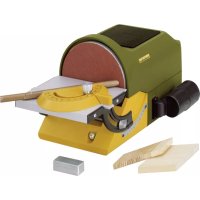
TG 125E - Sander PROXXON - Free user manual and instructions
Find the device manual for free TG 125E PROXXON in PDF.



| Product type | Disc sander (disc grinder) |
| Brand | Proxxon |
| Model | TG 125E |
| Dimensions (L × W × H) | 300 × 140 × 160 mm |
| Weight | 3 kg |
| Supply voltage | 230 V, 50/60 Hz |
| Power consumption | 140 W |
| No-load speed (max) | 3600 rpm |
| Grinding speed | 250 – 800 m/min (adjustable) |
| Grinding surface | 98 × 140 mm |
| Table tilt | +10° (upwards) / -50° (downwards) |
| Noise level | < 55 dB(A) |
| Vibration | ≤ 2.5 m/s² |
| Vacuum cleaner connection | Yes, via suction nozzle (rubber adapter Ø) |
| Grinding discs included | 2 × grit 80, 2 × grit 150, 2 × grit 240 |
| Package contents | Sander, stop square, suction nozzle, rubber sleeve, 6 discs, clamping screw, manual, safety brochure |
| Maintenance | Cleaning with soft cloth, brush or paintbrush; vacuum cleaner recommended |
| Safety | Emergency stop in case of jamming; always unplug before adjustments |
| Use | Horizontal or vertical position (with fixing bracket) |
| Machinable materials | Hard/soft woods, boards, non-ferrous metals, steel, plastics, cork, rubber, ceramics, glass |
Frequently Asked Questions - TG 125E PROXXON
User questions about TG 125E PROXXON
0 question about this device. Answer the ones you know or ask your own.
Ask a new question about this device
Download the instructions for your Sander in PDF format for free! Find your manual TG 125E - PROXXON and take your electronic device back in hand. On this page are published all the documents necessary for the use of your device. TG 125E by PROXXON.
USER MANUAL TG 125E PROXXON
Fold on the picture pages when reading the user instructions.
GB 11
Français
Translation of the Original Operating Instructions TG 125/E disc grinding machine
Contents:
1 General view (fig. 1) 11
2 Description of the machine 11
3 Scope of delivery 12
4 Technical data 12
5 Before work 13
5.1 Setting up your disc grinding machine (fig. 2): 12
5.2 Removing and inserting the grinding table (fig.3): 13
5.3 Affixing and replacing grinding wheels (fig. 4): 13
5.4 Adjusting the grinding table angle (fig. 5): 14
5.5 Connecting the dust exhaust (fig. 6): 14
6 Working with the TG 125/E disc grinding machine 14
6.1 Working with the angle stop (fig. 7): 14
6.2 Notes on grinding speed 15
7 Care and maintenance 15
8 Disposal 15
9 CE conformity declaration 15
Dear customer!
Using these instructions
- makes it easier to get familiar with the device
- prevents malfunctions caused by improper handling, and
- lengthens the service life of your device.
Please keep these instructions readily accessible at all times.
Use the device only when you have understood it exactly and always adhere to the instructions.
PROXXON is not liable for the safe functioning of the device in cases of:
- handling that does not conform to the usual usage,
- purposes of use not designated in the instructions,
- disregard of the safety instructions.
You are not entitled to guarantee claims in cases of:
- operator errors,
- inadequate maintenance.
For your own safety, please follow the safety instructions exactly.
Use only genuine PROXXON replacement parts. We reserve the right to make improvements in the sense of technical progress. We wish you much success with the device.
WARNING!
Read all safety warnings and instructions.

Failure to follow all safety warnings and instructions listed below may result in electric shock, fire and/or serious injury.
KEEP ALL SAFETY WARNINGS AND INSTRUCTIONS FOR THE FUTURE!
Do not use damaged bits and cutters. Before each use, inspect bits and cutters such as sanding discs for chips and cracks, grinding discs for cracks, strong wear or tear. After you have inspected and installed the bits and cutters, keep yourself and any other persons in the vicinity away from the plane of the rotating bits and cutters and run the device at maximum rotational speed for one minute. Damaged bits and cutters usually break during this test time.
1 General view (fig. 1)
- Grinding disc
- Swivel-mounted grinding table
- Rotary knob for speed control
- On-off switch
- Angle stop
- Mains cable
- Connecting piece
- Guide slot for angle stop
-
Clamp
-
Locking button for angle adjustment
-
Grinding discs
- Rubber connector
2 Description of the machine
Thank you for purchasing the TG 125/E disc grinding machine. You now own a high-precision machine to use in grinding work for which complete accuracy is required.
A high-precision manufactured and carefully balanced grinding disc with double ball-bearing direct drive guarantees excellent smoothness, precision concentricity and minimum wear.
In this way, soft and hard woods, plates, non-ferrous metal or steel, even plastic, cork, rubber and many further materials can be processed with high precision at grinding speeds of approx. 250-800 m/min (adjustable).
The various fixing possibilities ensure particular flexibility: Your TG 125/E can be operated both in "normal position" and in standing, with the grinding table removed. To this end, it is fixed with the enclosed clamp.
The grinding table is made of high-grade aluminium and can be adjusted upwards by 10^ and downwards by 50^ . This also includes the guide slot for the angle stop that is also included in the scope of delivery. Two grinding wheels in each of the grain sizes offered of 80, 150 and 240 are included in the scope of delivery.
In order that the swarf goes directly where it should, namely into the vacuum cleaner, there is a connecting piece to which the vacuum cleaner can be connected. So you are optimally equipped for the grinding work.
3 Scope of delivery
1 x TG 125/E disc grinding machine
1 x Angle stop
1 x Connecting piece
1 x Rubber connector
2 x Grinding wheels grain 80
2 x Grinding wheels grain 150
2 x Grinding wheels grain 240
1 x Operating instructions
1 x Brochure with safety instructions
1xVice
4 Technical data
Dimensions and weights:
Length: approx. 300 mm
Width: approx. 140 mm
Height: approx. 160 mm
Weight: approx. 3 kg
Grinding disc: 125 mm
Dimensions grinding table: 98 × 140 ~mm
Motor:
Voltage: 230 volt,
50/60 Hz
Power input: 140 watt
KB 15 min
Speed: max. 3600 rpm
Grinding speed: approx. 250-800 rpm
Noise development: < 55 dB(A)
Vibration: ≤ 2.5m / s^2
General measuring uncertainty: K = 3 dB
Only in dry rooms
Please do not dispose of this electrical machine in the household refuse!
Wear safety glasses!


Noise/vibration information
The information on vibration and noise emission has been determined in compliance with the prescribed standardised and normative measuring methods and can be used to compare electrical devices and tools with each other.
These values also allow a preliminary evaluation of the loads caused by vibration and noise emissions.
Warning!
Depending on the operating conditions while operating the device, the actually occurring emissions could differ from the values specified above!
Please bear in mind that the vibration and noise emission can deviate from the values given in these instructions, depending on the conditions of use of the tool. Poorly maintained tools, inappropriate working methods, different work pieces, too high a feed or unsuitable work pieces or materials or unsuitable bits and cutters (here: saw blade) can significantly increase the vibration load and noise emission across the entire work period.
To more accurately estimate the actual vibration and noise load, also take the times into consideration where the device is switched off, or is running but is not actually in use. This can clearly reduce the vibration and noise load across the entire work period.
Warning:
- Ensure regular and proper maintenance of your tool
- Stop operation of the tool immediately if excessive vibration occurs!
- Unsuitable bits and cutters can cause excessive vibration and noises. Only use suitable bits and cutters!
- Take breaks if necessary when working with the device!
5.1 Setting up your disc grinding machine (fig. 2):
Note:
When setting up the machine, make sure that the ground below it is level and secure! A secure stand is indispensable for working with the machine!
Note:
When setting up and fixing the machine, always disconnect the mains plug to prevent the disc being started up accidentally. Risk of injury!
Caution:
During all adjusting and assembly work, such as when adjusting the angle stop or when attaching or removing the grinding table, disconnect the mains plug to prevent the device from starting up unintentionally!
The disc grinding machine can be operated in two different positions: Once in the normal horizontal position or standing vertically (for sharpening tools and blades for example).
In both positions, the machine should be securely clamped with the enclosed vice, as shown in fig. 2.
5.2 Removing and inserting the grinding table (fig.3):
Caution:
Before removing and inserting the grinding table, always disconnect the mains plug to prevent the disc being started up accidentally. Risk of injury!
Normally, your TG 125/E is operated with the attached grinding table (as in delivery condition).
Additionally, there is also the possibility, where required, of removing the grinding table, if this is necessary for certain tasks or for changing the grinding wheels.
Caution:
Please note that when working particularly in the operating mode without the grinding table, always make sure to control the work piece by holding it
firmly and securely in order to prevent it from being flung about.
Use the machine in the horizontal position with attached grinding table, if possible!
- Remove Allen head screw 1
- Remove the grinding table with grinding table holder 2 by pulling out from the front
- To insert, simply push into the normal position
- Turn in Allen head screw 1 again
Caution:
If the grinding disc is blocked due to a work piece that is jammed between the grinding disc and the grinding table, immediately shut off the device using the On/Off switch and disconnect the mains plug.
Only put the device back into operation after the jammed work piece has been removed!
5.3 Affixing and replacing grinding wheels (fig. 4):
Note:
Before affixing or replacing the grinding wheels, always disconnect the mains plug to prevent the disc being started up accidentally. Risk of injury!
Two grinding wheels in each of the grain sizes 80, 150 and 240 are supplied as initial equipment with your disc grinding machine; these can also be easily obtained as spare parts. It is therefore no problem to change wheels, whether because of wear or because discs with various grain sizes are required when working.
Caution:
When replacing the wheels, it is advisable to remove the grinding table as described in the previous section!
- Remove the rear protective foil above the adhesive surface from the desired wheel,
- Push the wheel evenly and bubble-free onto the grinding disc.
- To replace, simply remove the grinding wheel again and push on the new wheel.
Accessories
For more detailed information on accessories, please request our device catalogue from the address specified on the last page in the warranty information.
Please note in general:
Proxxon bits and cutters have been designed to work with our machines, which makes them optimal for their use.
We will not assume any liability whatsoever for the safe and proper function of our devices when using third-party bits and cutters!
5.4 Adjusting the grinding table angle (fig. 5):
Caution:
Before adjusting the grinding table, always disconnect the mains plug to prevent the disc being started up accidentally. Risk of injury!
- Loosen rotary knob 1 At the same hold rotary knob 2
- Swing grinding table 3 into the desired angle position and check the set value on angle scale 4.
- Tighten rotary knob 1. At the same hold rotary knob 2
5.5 Connecting the dust exhaust (fig. 6): Caution:
Before connecting the dust exhaust, always disconnect the mains plug to prevent the disc being started up accidentally. Risk of injury!
It is recommended to always work with the dust exhaust! This not only guarantees clean working, it also reduces the hazardous effect of some dusts!
- Push adapter piece 1 onto connecting piece 2 of the machine
- Push rubber adapter 3 onto adapter piece 1
- Insert vacuum cleaner nozzle 4 into rubber adapter 3
- Switch on vacuum cleaner when working
Another small tip:
When using the Proxxon CW-matic vacuum cleaner, manual switching on and off is no longer necessary. The CW-matic is fitted with an automatic control device; it automatically switches on and off when the power tool is switched on and off. The same effect can be obtained with traditional vacuum cleaners by using our vacuum control device.
6 Working with the TG 125/E disc grinding machine
Caution:
Please note that the grinding disc turns to the left! If you use the left side when working with the attached grinding table, the work piece can be guided easily and securely, thus effectively preventing it from being hurled away!
Caution:
When grinding metallic work pieces, such as when grinding knife blades for example, or when grinding stone or ceramics the material to be ground can become very hot! Do not hold the material to be ground near the grinding surface in order to avoid burns!
Caution:
Wear suitable gloves to avoid abrasions especially when working with coarse sandpaper and when processing smaller work pieces!
- If metres are to be ground, adjust the grinding angle as described above
- Insert the mains plug
- Switch on the machine at On-Off-Switch
- Set the required speed on the speed control button (pos. 3, fig. 1)
Please adjust the size of the work piece to the size of the machine! A work piece that is too large and too heavy can overburden the drive or the construction of the machine and cause damage or injuries!
6.1 Working with the angle stop (fig. 7):
If, for example, the ends of somewhat thinner strips are ground for litre, it is advantageous to use the angle stop included in the scope of delivery.
- Loosen knurled screw 1
- Set the desired angle on scale 2
- Turn the knurled screw tightly and insert into the intended table groove
- Guide the desired workpiece up to the stop against the grinding wheel as shown in the illustration
6.2 Notes on grinding speed
The grinding speed of your TG 125/E is infinitely adjustable from approx. 250 - 800m / min . In this way, optimal adaptation to various material conditions is possible. Please note that the circumferential speed of the grinding disc is greatest at the edge and reduces towards the middle.
General recommendations on the selection of the grinding speed are difficult; it may be necessary to experiment somewhat to find out the correct grinding speed for "its" material and workpiece.
Based on experience, non-ferrous metals and plastic require lower grinding speeds than soft and hard wood; this also applies for ceramics and glass.
But as stated: Recommendations are difficult, the correct speed depends on the material, contact pressure and friction and grain size of the grinding wheels.
7 Care and maintenance
Caution:
Before cleaning, adjusting, service or repair, disconnect the mains plug!
Note:
The machine is largely maintenance free. To ensure a long service life, however, the machine should be cleaned with a soft cloth, handbrush or paintbrush after each time it is used. A vacuum cleaner is also recommended here. A vacuum cleaner should always be used during work!
The outside of the housing can be cleaned with a soft, possibly damp cloth. In this process, mild soap or another suitable cleaning agent can be used. Solvents or cleaning agents containing alcohol (e.g. petrol, cleaning alcohols etc.) should be avoided, since these can attack the plastic cases.
8 Disposal
Please do not dispose of this machine in household refuse! The machine contains materials that can be recycled. If you have any questions about his, please contact your local recycling company or other relevant communal facilities.
9 EC Declaration of Conformity
Name and address:
PROXXON S.A.
6-10, Härebierg
L-6868 Wecker
Product designation: TG 125/E
Article No.: 27060
In sole responsibility, we declare that this product conforms to the following directives and normative documents:
EU EMC Directive 2014/30/EC
DIN EN 55014-1/05.2012
DIN EN 55014-2/02.2016
DIN EN 61000-3-2/03.2015
DIN EN 61000-3-3/03.2014
EU Machinery Directive 2006/42/EC
DIN EN 62841-1/07.2016
Date: 26.07.2018
Machine Safety Department
The CE document authorized agent is identical with the signatory.
Plateau de meulage:125mm
Cotes de la table
Dipl.-ing. Jorg Wagner
PROXXON S.A.
TYTO POKNY DOBRE USCHOVEJTE!
Iotppe6nraMaMoUHocTb:140BT
KpaTkoBpeMeHHbI
pexim (KB) 15 mH
CKopoctb BpaueHnR: mKc. 3600 06/MnH.
CKopoocTb WInDpOBaHm: OK. 250-800 M/MnH.
YpoBeHb yMa: <55 d6(A)
Bn6paun: ≤ 2,5m / s^2
O6ua norpewhoctb n3mepenH: K=3 d6
ToIbko BCyuxN IOMeueHnX


IoxaanynCTa, He yTuJIN3npyIe daHHbI 3NeKtpueck np6Op BmecTe C 6bITOBbIM MycopOM!
Heo6xoDIMO HOCntb 3aunTHbe OcKn!
HΦopMaŋo6 ypOBe WγMa n Bnδpaζη
DaHHbIe O Bn6paCnn N 3MnCCnn 7yMa 6blN ONpeDeIeHbIB COOTBeTCTBn C CTaHdApTH3OBAHHbIMN IN PpeDNMCbIAeMbIMN HOpMaTHBaAMN MeToDAMN N3MepeHIN N MOrY NT NcNoJIb-3OBaTbCn Pn CpABHeHN MExdy Co6oN 3JIeKTPuecknx YCTpOJCTB N NHCTpyMeHTOB.
3Tn 3HaueHn TaKke N03B0JIaOT NpeDbapNTeIbHO OcEHNb ypoBeHb Bn6paunOHn Harpy3Kn N WymOBoN 3MnCCnN.
PpeooctepekeHne!
B 3aBnCmOCTN OT yCNOBn 3KcNpyataunn B npocece pa60tby yctpoiCTBa aKTnueeckn ypOBeHb Wyma MoXeT OTJNUATbcr OT yka3aHHbIX Bblwe 3HaueHn!
YyTHTe, YTO Bn6paunI ypoBeHb IyMa MOrTy OTnIuHaTcBcOT yKa3aHHbIX B daHHOM pyKOBODCTBe 3NaueHIn B 3aBNCIMoCTN OT yCNoBn ICNoNb3OBAHN IHCTpyMeHTa. HenpaBnIbHOe TexHnueckoe OBCnykBaHne IHCTpyMeHTOB, HeHaJIeXaUne MeToDbl paObl, OTnuaOnuNece Oba6aTbIBaEMbl DEtAIN, CnIuKOM BbICOKa KOpOCTb NDoaHIn, HenoXoJaUne Oba6aTaIBaEMbl DeTaN INM MaTePnaIbl IN HeNoxDxOraUm BCTabHOH INCTpyMeHT MOr TY CyueCTBeHNO Nobicntb Bn6paunOHHy Harpy3ky IyWMoByO 3MNCCnIO B TeueHne BCero pa6oeryo nepnoJa.
ДяToUHoi OueHKn Bn6paUHOHoi N WymOBO Harpy3Kn DoJXbI TaKKe yuHTbIBaTbcra IpomExyTkN BpeMeHN, B TeueHne KOTOpbIX YcTpoiCTBO BblIOUeHO INN BKNIOUeHO, HO qakTInueckn He NcNoJIb3yeTcA. 3TO MoKET RaHBO CHN3NTb Bn6paUHOHHyo N WymOBYu Harpy3ky pa6oeryo nepnoa B ueOM.
IpeodocetepexeHne!
- ObecneBte peryIapHoe n KaueCTBeHHoe TexHnueckoe obcnyKnBaHne INHCTpyMeHTa.
-При ВОЗИКHOBEHIN Upe3Мерн Вибраци NHeMeДпЕНTOpeKpaаиTe pa60Tu c nHCTpyMeHTOM! - HenoDxOaIuN BCTaBHO INHCTpyMeHT MoKet CtaTb npuHnOH Upe3MepHBix B6paunu IyMa. NcnoB3yTe TOJbKO HAJIeXaUne BCTABHbIE INHCTpyMeHTbl.
-При Heo6xOДmOCTn BO BpeM pa60bI C yCtpoIcTBOM BbIdepKmbaTe Tpe6yEmble nay3bl!
5 Do toro, kaK npucTyntb K pa6ote
5.1 YctaHOBka MaunHbI (pnc. 2):
BaxhHoe 3ameuHaHe:
Ipn yctaHOBKe MaunHbI CneIe NTe 3a TEM, YTO6bI NOBepxHocTb,Ha KOTOpyIO Bbl ee yCTaHABnBaete,6bJa POBHOH nHeuATKO! HaedKHAra YCTaHOBKa RBLrTec O6r3aTeNbHbIMycNOBnEM, rapaHTnpuyOuIM HopMaJbHyO pa60Ty MaunHbI!
BaxkHoe 3aMeuHaHe:
Ipn yctaHOBKe n KpeJIeHnMaunHbI BceRda BblHMaTe WTekep n3 po3ETKn BO n36eXaHne CnyauHoro BKIOUeHn HnnfoBaIbHorO kpyra. ONaCHOCTb NOUYeHn TpaBMbl!
BHHMaHHe:
PnBcex pa6oTAX NO HAcTpoJKe N MOHTaXy, TAKNX KAK, Hanpimep, perynipOBKa nNoXeHn yrnoBOrO ynpoa nn npicoeHHHeHne N dEmoHTax pa6oery cToJa, BbIHMaTb ceTeBOI wTEKeP n3 po3EKN, YTObI ppeDOrBpaTnTb cnUaHbI 3anyck yCTpoiCTBa!
BblMOxTeNo Bb6Opy pa60TaTb Ha MaunHe B DByx
pa3NnHbIX pa6OuNX NOJoxEHHX: NepBoe n3 HnX-3TO
ctaHdapTHoe ropn3oHTaIbHOe NOJoxEHHe, HO eCTb I
BTOpe-BePTKcAIBHOe (HaNPIMep, pni 3aToUKe
peKyuIero INCTpyMeHTa IIJI ne3BNI).
B BePtKaNbHom NOJoxEHHMaunHy cJeDyET HaJeXHO
3aΦHKcnpoBaTb C NOMOuBu IpINaRaEMO JCTpy6CUnHbI (CM.
pnc.2).
5.2 Chytne n yctaHOBka pa6oeryo cToJa (pnc. 3):
BHHMaHHe:
Ipeed TEM KAK CHaTb Hn yCTaHOBnTb paOoun CTOn, BCe- rda BbHmMaTe WTEKeP n3 PO3eKn BO n36eKaHne CnyauHoro BKIOUeHn WnIOPOBaJIbHoro Kpyra. ONaCHOctb nonyEHHra TpaMbbl!
Obivno paobt ha MaunHe TG 125/E BbInonHraTc npu yctaHOBLeHHOM paobem cToJe (T. e. B TOM BnDe, B KaKOM OHa NoCTaBJIeTc). Ondako npn Heo6xoDMocTN MoXHO TaKxe I CHrTa paobuy CTOn, ecn 3TO NOTpe6yTeTc dJa
BbINOJIHeHnO npeJeIeHHbIX BnIOB pa6OT NIN CMeHbI ⅢNPOBaJIbHbIX DnCKOB.
BHMaHHe:
CneDnTe, B OOC6eHHoCTN B pexHMe pa60TbI CO CHrTbIM pa6OuHM CToJOM, YTO6bI ObecNeuBaNacb BO3MOxHOCTb KOHTpOJI PPOUHOrO HnAedXHOrO 3aKpePJIeHn 3aROTOBKn BO n36ExKaHHe ee BbIbPoCA B OKpyXaIOoEe npocTpaHCTBO NOd DeiCTBnEM ueHTpo6ExHbIX CnI.
NcnoB3yTe cTaHOK B rOpn3oHTaIbHOM noJIOXeHm n, NO BO3MOxHOCTn, C yCTaHOBJIeHHbIM pa6OuHM CTOnOM!
1.BbIbepHyTb BnHT C BHyTppeHHM WecnturpaHHKOM (1)
2. BbITaHyb Ha ce68 TapeJIbHaTbI Kpyr BmecTe C depXaTeJem (2)
3.ДЯУCTAHOBKNHa MEcTO IPOCTO 3aIbHHTB HOPMaJIbHOE NIOJOKeHne
4. CHOba 3aBepHyTb BnHT C BHyTpEHHIM WecTnRpaHHNKOM (1)
BhimaHne:
EcT TaepaBtB WnnpOBaHbHbN DnCK 6yDeT 3aBIOPOBaH 3aTOBKO, 3aKNHbWec MExdy WnnpOBaHbHbIM NICKOM n pa6OcHm CTOLOM, CTAHOK CNeDyET He3aMeIINTeJbHO OTKIOUHTb Pn I NMOU aBAPINHO BbIKIOUaTEeN n BbHYb CeTEBO WTEKeP U3 PO3eTK. YCTPOcSTBO pa3peWaeTCR CHOBA BBOITB DEiCTBVE TOBJKO NOcNe ydaJIeHn 3aKNHbWecra 3aTOBKn!
5.3 HaKJIeNBAHHe/CMeHa WJINΦOBAIbHbIX DnC-KOB (pnc.4):
BHHMaHHe:
Ipeen TEM KAK HAKJEVAbT /3aMeHrTB WJNFOBaNbHbIe INCKN, BcERDa BbIHMaIe TE TKeP N3 pO3eTKN BO N36EkaHne CnyaHOro BKJIoueHn WJNFOBaNbHoro Kpyra. OnacHOCTb NOJUyeHn TpaBMbl!
Ba7a nopTaHbHa WInfoBaIbHa MaunHa NOCTaBnEeTc - B KaYeCTBe HaayIbHoro BapNaHTa OChAuEHn - BMeCTe C KOMnJIeKToM WInfoBaIbHbIX DnCKOB 3epHnCTocTBIO 80, 150 n 240 (no Da Ba Nska KaXdOro BnDa), KOtOpBie Bb63 np6bnm MoKeTe B DaIbHeNWe 3aKa3bIBaTb KaK 3anYactn. 3TO No3BoJNeT 6e3 np6bnm OcyuEcTBnTb 3AmEny DnCKOB, Byb To BCNECTBne IN H3HOca INn IN3-3a TORO, YTO dIra pa6obTbI Tpe6yIOTc DnCKn C pa3HoI 3epHnCTocTBIO.
BHHMaHHe:
Pekomehnyetc npn 3aMeHe dNCKOB cHMaTb pa6OHy CTOn, KaK 3To 6blNo onucaHo B npdeBlyueem pa3dene!
-
Y BbIbpaHHoro Bamn dNcKa ydaJIntb c TbIbHoI CTOpOHbl 3aunTHyIO pHeKHy, 3aKpbBaIOUky KJIeAun CNoI.
-
Пижкать ДИСК K NOВЕРХОСТИЛNOФOBАЛБНО КPyruTaK,ЧTOбI He OБразOBАЛСь ПУЗБIPN И ON JEXKANPOBHO.
3.ДЯTORO YTO6bI npON3BecTn 3aMeHy,JINIOBOAJIbHbI DnCK CNEyET pOCTO OTDeJIInTB OT OCHOBbI HANOXNTb Ha Hee HOBbI DnCK.
PnHaJnxHocTn IOnoHNHeBHaOcHaCTka
IЯ nonyeHna 6oJIe noJpo6hblx daHHbIX O npHaJaIeXHOCTaX 3anpocnTe Haaw KaTaNor INHcTpymeHTOB NO aDpeCy, yKa-3aHHOMy B INΦopMaunO rapaHTmN Ha nocJeHne cTpaHnue.
Ppoc6ba yuTbBaTcneyiooee:
BctabHbIe HnCTpyMeHTbl Proxxon pa3pa6Tohbl DnI NcNoJIb-3OBaHnC HaUMN yCTpoHCTBaMn IIO3TOMy ONImaJIbHO NOxOJr DnI pa60TbI C HIMN.
B cnyae nCnoIb3ObaHnB BCTaBbIX INHcTpymeHTOB dpynx
fmp Mbl He rapaHTnpyem 6e30napHe HndJeAuee
fynKIOHOPOBaHne HauX yCTpoiCTB!
5.4 PerynipoBka yrna pa3Bopota pa6oero cTOna (pnc. 5):
BhimaHne:
Ipeed Tem Ka npOn3BODnTb perynnpOBky noNoxehny pa6oeryo cToJa, Bcerda BbyHmMaIte WTeKepe n3 po3eTKN BO u36ekaHne CnyaHOrO BKIOUeyHn UINΦoBaJbHoro kpyra. OnachocTb nOlyeHn TpaBMbl!
1.Ocna6ntb NOBOPOTHyO pykU 1Pn3TOM ydepKuBaTb HenoDbNHO NOBOPOTHyO pykU 2
2. Pabouy cTOn 3 pa3BepHyb B JKeJaemoe NOJoxHeHne NOd yrIOM N 3aMeTnTb NOJyUHBWeecr 3HaueHne Ha yrIIOBoi wkane 4
3. 3aTnHyTb NOBOPOTHyO pykCy 1. Pn nTOM ydepKuBaTb HenoDbNxH NoBOPOTHyO pykCy 2
5.5 NpOcOeHHeHne nbIeNecOca (Pnc. 6):
BhimaHne:
Ipeep noDcoeHNHeHnEM Nblncoca Bcerda BbHMaTe WTekep n3 po3etKn BO n36ekaHne cnyaHoro BKIOueHnWnΦoBaIbHorO kpyra. OnaCHOCT bONyehn TpaBMbl!
PekomeHnyETcBcERda pa6oTaTb C BKNIOUeHHbIM OTCOCOM! Tem cambIM oEecneuBaETcH He TOnIbKO YNCTota Ha pa6OyEM MeCTe, HO TaKKe CHNXaETc CTEneHb ONaCHOCTn IJNA 3DOPOBbR, KOTOPYIO PpeDCTaBIAOT CO6O HekOTOpBIE BNDbI NblIN!
- HabepHyb nepexOHNK 1 Ha wTuape 2, npeyCMOTpeHHbHa Kopnyce MaunHbI
- Hacaɪntb pe3ɪNHObBI nATpy6oK 3 Ha nepeXOdnK 1
- BCTaBtB cOnIIO nbIeCoCA 4 B pe3INHObBI nATpy6oK 3
4.Пи ВьлОнHeHи WЛифОВаьHых OпeрaцИв BKЛIOUHTb nbJIeCOC
Eue oINH He60bWOn COBET:
Pn nCnObl3OBaHNn PbInecoca CW-matic fnpMbI Proxxon OTnadaet Heo6xOAnMoCTb ByyTomTeNbHbIX OndHo06pa3HbIX DeiCTBnX "BKIOuHTb-BbIKIOuHTb". PbInecoc CW-matic OChaSeH aBTOMaTHUeCKo CnCTEmoY npaBHeHn, 6NaRo- daJaKOTOpOH OH aBTOMaTHUeCKn BkIOUaETc PnB KIOUeHn 3JIeKTPoHnCTpymEtHa N Tak Xe aBTOMaTHUeCKn BbIKIOUaETc Pn erO BbIKIOUeHn. ToCHo TaKOrO Xe 3OfekTa MoXHO DoCTNu, ecNn NCnObl3OBaTb TpaDnOH HbI PbInECOC B KOMIIeKTE C HaWM YCTPOINCTBOM dJIy UnpaBNeHn IPOeDpyoH OTCoca.
6 Pa60Ta C nCNoIb3OBAHnEm NOpTaTnBHOJ WJIINΦOBaJIbHOJ MaUHHbI C TapeJIbHaTbIM Kpyrom, MoJ. TG 125/E
BHMaHHe:
IpoCb6a yUHtBIBaTb, yTO TapeIbUaTbI uINpOBAJIbHbI Kpyr BpaaaetcBneBo! Ecnn npn pa6ote c yCTaHOBHeHHbIM pa6OuHM CTOnOM Bbl nCNoJb3yeTe JEByO CTOpOHy, 3TO N03BOJnEo6eNeHTb ONTmAmJIbHyIO n HaJeKHyIO NOaCyN IeΦeKTINBHOe ppeOTBpaueHne Bbl6poca 3arOTOBKn!
BHHMaHHe:
B npoecce wJIOPOBaHmMeTajIuuecknx 3aOTOBOK, HnnpMep, npi 3aTOUKe Je3Bm HOKe, a TaKKe WJIOPOBaHm KAMHn IIN KepaMKn, WJIOPOBaHbMy MaTePnaJI MoKeT CInbHO HarpeBaTbcr! Bo n36eXaHne OXORA He depXnTE wJIOPOBaHbMy MaTePnaI B6Nn3n WJIOPOyEmoN NOBepxHoCTn!
BhimaHne:
Bo n36exaHne noJyehnna CcaHn HnHbIX NOBpeXdEHN Koxn pyK, B OocobHHocTn npn pa6oTe c KpyHno3epHnCTOn 7mnpoBaIbHOh6ymarO n npn o6pa60Ke MeKnx 3aTOBOK, Heo6xOdmo ODeBaTb NDOxOJaune nepuATKn.
- EcTn Tpe6yeTc 6oPb6Oka CkOcOB, yCTaHOBtpepaOCh CTOn IOd JeJaEMbIM yrIOM, KaK 6blNoONICaHO BIIe
2.BotKHTe WTeKepeBpo3ETky
3.BkIIOUHTe MaINHy c NOMOuBb BbIKHouaTeJIa
4.CnMOoBHOpyKnDnpeRyHnPOBKn YncNaO6OpOTOB 3aDaIte XeJaemyO CKOpocTb BpaueHnA (no3.3,pnc.1)
Iop6paTpe pa3Mep 3arOTOBKN B COOTBETCTBn C Tnnpa3Mepom cTahka! CnuiKOM 60nbuaN TAnKeNa 3arOTOBKa MOxET CO3daTb HeDOnyCTmYIO Harpy3Ky Ha npBOD N KOHCTpyKuIO CTaHKA N, TEM CaMbIM, Bbl3BaTb NOBpeXdHn IIN TpaMbI!
6.1 Pa6ota c nCnoB3OBAHnEm yrNoBoro ynopa (pnc. 7):
Ecnn,Ha npimep,Tpebyetc couinpoBaTb KOHcbl HeckoJIko 60Jee ToHKx PnaHOK Ha CKoc,ueNecoO6pa3HO
NcNoJIb3OBaTb BXOJaIeN B KOMJIeKT NocTaBKn yrIIOBOynp.
1.OcnaBntb BnHT CHaKaTaHHo RToOBkoI (1)
2.YctaHOBtB no uKane (2) XeNaembYyron
3. 3aBepHyb BnH T c HakaTaHHo rOIOBko N BCTaBHTb HapBaJIryUOyU yOpA B npeDyCMOTpeHHbI dIra 3TOrO na3 B pa6OeM cToJe
4.Поьвдпь полnexашую орботke 3arotobky K
шлфовальногу ДИСКУ,Опираясь Ha ynp
6.2 Pekomehdaqun no Bbibopy ckopoctn WmnoBaHna
CkopoocTb wlnfoBaHnBaWe MaunHbTG 125/E MoXHo
PnabHO peryInpoBaTb B dnaa3OHe ot 250 do 800 M/MnH.
Tem cambIM ydaetcOn OTImaJIbHO nOdoopaTb peKIM K
pa3InuHbIM xapaKtepncTKam MaTePnAa. IpoCmBac
HMeTb TAKKe B BVdu, YTO OKpyxHaar CkopoCTb
TapelbTuTo rO wlnfoBaJIbHO Kpya 6ydet MaKcImaJIbHO
y KpaEB N NOCTeNEHc CHNJaEcra K cHTpy.
DaBaTb KaKne-TO O6Une peKOMeHdaaM No Bbl6opy
CKOPOCTn WlnfoBaHn DOBOJIbHO CNOxHO -3deCb
PnIXoDITcR DeIcTBoBaTb 3KcpePMeHTaJIbHbIM NytEm
MCXODr N3 KOHKPeTHbIX O6CTOaTEJIbCTB, C TEM QTO6bl
NoHATb, KaKaJcKoPoCTb WlnfoBaHn 6ydet "CBOe" DnA
TORO INI INHO MaTePnAa/3aOTOBKn.
Obit NOKa3bIbaeT, YTO npN o6pa6OTke ZBeTHbIX MetaJIIOB
IN PIACTMaCC Tpe6yETcM Meh7aR CaKOpCTb WlnfoBaHn,
Yem pNw WlnfoBaHn DpeBecnHbMI RIKNX N TBepDbIX
NOPoD, To Xe KacaETc KePAMNK N CTekNa.
OdHako, Ka Yxe RoBOpNJocb: peKOMeHdaaM DaBaTb
CLOXHO, T. K. PnabINbHI Bbl6Op CKOPOCTN 3aBNCIT OT
MaTePnAa, ycIIaI npIXMma, a TaKxEOT CTeneHN
NCTIPAHNA IN 3ePHNCTOCTN WlnfoBaJIbHO rDCKa.
7 Texnueckoe o6nyxnbHne u yxo
BHHMaHHe:
Ipepe TEm KaK BbIOJHrTb IIO6bIe OJIepaUN No YNCTKe, perynipOBKe, npOuINaKTnke nIN peMOHTy, BbiHbTe CeTeB0I wTekep n3 pO3eTKn!
BaxHoe 3aMeaHaHe:
B obseM u cenom MaunHa noTu He Tpe6yeT texnueCKoro 06cnykBaHna. B nIObOM cnyae dIy oEcecneHnnpoJxnteIbHOrO cPoka cnyX6bl MaunHb Heo6xOIMOncJIe KaJDoR IO NCNOlb3OBAHn OcyuEcTBnTb ee YNCTKycNOMouBIO KYCKa MfKoT KKaHn, UeTK CpyKo HINKnCTn. 3decb MoKet npuroNTbcr NblNEcoC. Bo3bMITEce6e 3a npabIno pa6oTaTb C NOdkNoeHHbIM OTCOCMblnn!
C BheHHe CTOpOHbI KOpNc MaunHbIMOXHO NOTOM
npotepeMbKoTpAnKO, npn Heo6xoDMOCTN
CMOeHHo BOo. PnT ATOM dOnyCKaETcN cNoJIb3OBAHHe
Mrkoro MbJa NIn NHO IOxOJaUeO MOIOUe CpeDCTBa.
CneIyETn36eraTb npImeHEnMa MOUx CpeCTB, COePxaux pactBOpNTeIN Nn CnnpTbI (HaNPmep, 6EH3uN, CnptbI dna OCHcKn T.I.).T.K. OHN MOrYT OKa3bIBaTb arpeCCNBHOE BO3dIeCTBHe Ha nlaCTMaCCOBbie Detanl Kopnyca.
8Ytnn3a4n
IoxaanyiCTa, He yTuN3npyTte MaunHy BMeCTe C 6bITOBbIM mycopom! B ee coCTab BXoJr TceHHbIe MaTePnaJIbI, KOToPbIE MOXHO NOBVerpHytB BTOpHOMy NCNoJb3OBAHNIIO. EcInyBac BO3NHKNHT BOPcBIs, KacaIOUneCra DaHHoro acNeKTA, IoxaanyiCTa, ObaTnTEcB DeIeCTByIOUme B BaWei MeCTHO npeDnpTnR, 3aHMaIOUneCra yTuN3aUneI OTxOdB, INI INHbIe KOMMyHaJIbHbIe CnyX6bl COOTBeTCTBYIOero PPOPHINIA.
9 DeKnapaun O COOTBeTCTBn Tpe6OBAHnM EC
HaMeHOBaHne n aDpec n3rTOBtTeJIa:
PROXXON S.A.
6-10, Häreberg
L-6868 Wecker
HammehoBaHne n3dEInr: TG 125/E
ApTikyn No: 27060
HactoIIM MbI CO BcEN OTBETCTBEHHOCbIO 3aABJIaEM, YTO DaHHoe N3dJIeNc COOTBeTCTBye Tpe6OBAHNr CJeDyUxN X DnpeKTIN HOPMaTHNBbIX DOKYMENTOB:
ДиpeктнBa EC 66 3NeKtpomarHHTHOJ COBMEcTnMOCTN, 2014/30/EG
DIN EN 55014-1/05.2012
DIN EN 55014-2/02.2016
DIN EN 61000-3-2/03.2015
DIN EN 61000-3-3/03.2014
Диpeктва EC no MaшинHomу obopудованIO 2006/42/EG
DIN EN 62841-1/07.2016
Deta: 26.07.2018
Dunn. nHx. Iopr BarHep
PROXXON S.A.
OJnxHOCTb:OTdJI NCCJIeIOBaHnI pa3pa60TKI
JINOM, yNOJHOMOeHHbIM cOrnaCHO DoKymeHTaUN EC, ABJETcR JNIO, NOJNCabWee DOKymeHT
27060 - 01 Tisch / Table
27060 - 42 Schleifscheibe / Grinding disc (Accessory)
27060 - 44 Schleifteller / Grinding disc
27060 - 45 Gewindestift / Set screw
All PROXXON products are thoroughly inspected after production. Should a defect occur nevertheless, please contact the dealer from whom you purchased the product. Only the dealer is responsible for handling all legal warranty claims which refer exclusively to material and manufacturer error.
Improper use, such as capacity overload, damage due to outside influences and normal wear are excluded from the warranty.
You will find further notes regarding "Service and Spare Parts Management" at www.proxxon.com.