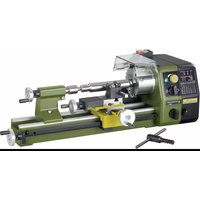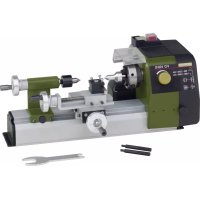
FD 150E - Metal Lathe PROXXON - Free user manual and instructions
Find the device manual for free FD 150E PROXXON in PDF.


| Product type | Metal lathe |
| Brand | Proxxon |
| Model | FD 150E |
| Supply voltage | 230 V |
| Frequency | 50 Hz |
| Power | 100 W |
| Distance between centers | 150 mm |
| Height of centers | 55 mm |
| Height above bed | 33 mm |
| Clamping capacity (inner jaws) | 1.5 - 32 mm |
| Clamping capacity (outer jaws) | 12 - 65 mm |
| Cross slide travel | 40 mm |
| Top slide travel | 60 mm |
| Permissible spindle diameter | 8.5 mm |
| Collet chuck type | ER 11 |
| Tool post section | 6 x 6 mm |
| Dimensions (L x W x H) | 360 x 150 x 150 mm |
| Weight | 4.5 kg |
| Speed ranges | 800 - 2500 rpm and 1000 - 5000 rpm |
| Restart protection | Yes |
| Safety devices | Chuck guard, emergency stop |
| Included accessories | Three-jaw chuck, tailstock, tool post, chuck guard, pins, key |
| Maintenance | Regular cleaning of chips, lubrication of guides and wheels |
| Usage | Indoor only |
Frequently Asked Questions - FD 150E PROXXON
User questions about FD 150E PROXXON
0 question about this device. Answer the ones you know or ask your own.
Ask a new question about this device
Download the instructions for your Metal Lathe in PDF format for free! Find your manual FD 150E - PROXXON and take your electronic device back in hand. On this page are published all the documents necessary for the use of your device. FD 150E by PROXXON.
USER MANUAL FD 150E PROXXON
Fold out the picture pages
when reading the user instructions.
Français
Preface 17
Safety guidelines: 17
Overview of machine 18
Legend (Fig. 1) 18
Description of the machine. 18
Scope of delivery 19
Technical data to FD 150/E Lathe: 19
Set-up and commissioning 19
Lathe elements and their operation 19
Tailstock (Fig. 3): 19
Working with the tailstock 19
Cross slide (Fig. 4) 20
Working with the cross slide 20
Upper carriage (Fig. 5) 20
Working with the upper carriage 20
The three-jaw chuck (Fig. 6) 20
Clamping the workpiece: 20
Reversing the jaws (Fig. 7): 20
The rotating multiple tool holder. 21
Select cutting tool (Fig. 8) 21
Clamping the cutting tool (Fig. 9) 21
Restart protection 21
Demand-actuated rotational speed 21
Setting the spindle speeds (Fig. 10) 22
Shifting the drive belt 22
Electronic speed control 22
Working with the machine (Fig. 11): 22
Example of straight turning (a) 22
Example of face turning (b) 22
Example of taper turning (c) 22
Parting a workpiece (d) 23
Machining longer workpieces with tailstock and lathe centre (Fig. 12) 23
Repair and Maintenance 23
Cleaning 23
Adjusting the play of the guides (Fig. 13) 23
Adjusting the play of the handwheels (Fig. 14): 23
Accessories for the FD 150/E 23
Cutting tool set (Article 24524) 23
Ring gear drill chuck (Article 24152) 24
Inserting the drill chuck (Fig. 15) 24
Multiple range ER 11 collets (Article 24154) 24
Inserting the collets (Fig. 16) 24
Disposal: 24
EC Declaration of Conformity 24
Exploded Views 112
Preface
The use of these instructions:
- makes it easier to become acquainted with the device,
- prevents malfunctions due to improper handling, and
- increases the service life of your device.
Always keep these instructions close to hand.
Only operate this device with exact knowledge of it and comply with the instructions.
Safety guidelines:
Avoid untidiness in your working area.
An untidy working area always means an increased accident risk.
Fasten the device to a solid surface and make sure it is even.
Also, always make sure that the device cannot fall down or topple during operation.
Check the device for signs of damage before each use.
Please note: Defective parts, particularly damaged safety mechanisms, may only be replaced by a specialist or the PROXXON
PROXXON will not be liable for the safe function of the device for customer service. Only use original Proxxon spare parts.
- h andling that does not comply with the usual intended use Do not manipulate your machine!
o ther application uses that are not stated in the instructionsDo not make any changes to the machine and do not manipu - d isregard of the safety regulations late anything! Changes or manipulations could impair the me
o perating errors - I ack of maintenance
- u se of non-PROXXON spare parts
For your safety, please comply with the safety guidelines without fail.
Never work without the designated safety mechanisms.
Only use original PROXXON spare parts. All rights reserved for further developments in the course of technical progress. We wish you much success with the device.
Pay attention to environmental effects!
Use the machine only in dry environments and never in the vicinity of combustible liquids or gases. Make sure you have good lighting!
Wear protective goggles!
Wear hearing protection!
The sound pressure level when working with the machine can exceed 85 dB (A), therefore always work with hearing protection!
Wear suitable working clothes!
When working, never wear loose clothing, such as neckties or scarves, as this could get caught in one of the moving parts or the automatically moving workpiece during operation and cause injuries. If you have long hair, wear a hairnet and remove your jewellery.
Do not use any damaged or deformed cutting tools.
Please make absolutely sure the cutting tools are in perfect condition. Visually check for this intact condition before each use!
Keep children and non-participants away from the working area.
Make sure that children and non-participants maintain an appropriate safety distance! Youths below the age of 16 may only use the machine under professional instruction and for purposes of schooling. When not in use, keep the machine out of the reach of children!
Do not overstress your tool.
Of course, you will only achieve optimal work results within the performance range for which the machine is designed! Therefore, avoid making the infeed too large! Do not misuse the machine, and do not use it for work for which it is not intended.
Always be prudent and attentive!
Observe the machine during work and proceed sensibly. Do not use the machine if you are distracted, tired, or if you have consumed alcohol.
Handle the connecting cable with care!
Protect the connecting cable from heat and sharp edges, and lay the cable so that it cannot be damaged. Do not pull on the cable to disconnect the plug from the socket outlet, and do not lift the device by the cable. Ensure cleanliness: Protect the cable from grease and oil!
Clean thoroughly after work! Disconnect the mains plug!
Always unplug the mains plug when not in use, before maintenance, when changing tools, cleaning or repairing! Removing the chips is also a part of cleaning!
Carefully read the operating instructions before use and keep them in a safe place!
Overview of machine
Legend (Fig. 1)
- Headstock
- Lathe chuck
- Cutting tool holder
- Travelling lathe centre
- Quill
- Clamping screw for quill
- Tailstock
- Handwheel for quill
- Clamping lever for tailstock
- Handwheel for upper carriage
- Upper carriage
- Cross slide
- Handwheel for cross slide
- Gearbox cover
- On-off switch
- Rotational speed regulating knob
- Chuck guard
- Spanners
- Dowel pins
Description of the machine
The FD 150/E is a compact precision lathe with suitably practical equipment: It offers a cross slide and an upper carriage, a sturdy headstock with a high-quality rolling bearing for the work spindle, a strong drive, and a tailstock with travelling lathe centre.
These features in conjunction with the high-strength and precise aluminium continuous casting base make the FD 150/E the specialist for all filigree workpieces.
The high rotational speed also accommodates the typical field of application:
The adjustable two-stage belt drive in combination with a sensitive control unit always ensures the suitable cutting speed even for the most minute workpiece diameters.
Apart from the classical possibilities of turning, the swivelling upper carriage also enables the manufacture of tapers or tapered elements. The drill chuck, available as accessory, makes frontal drilling of holes easy.
And for everyone with especially high requirements concerning concentricity, we have a collet set for this machine in our programme: The necessary ER11 holding fixture is provided in the main spindle. On the following pages we will introduce the machine and its possibilities in all details as well as the available accessories. The Proxxon team wishes you much happiness and success when working with your machine!
Scope of delivery
1 pc. FD 150/E Lathe
1 pc. Operating instructions
1 pc. Brochure with safety guidelines
1 pc. Open-end spanner
2 pc. Dowel pins
Technical data to FD 150/E Lathe:
Voltage: 230 Volt
Frequency: 50 / 60Hz
Capacity: 100 watt
Length between centres: 150~mm
Height of centres: 55 mm
Height via support: 33 mm
Capacity of inside jaw: 1.5 - 32mm
Capacity of outside jaw: 12 - 65mm
Cross slide adjustment: 40mm
Upper carriage adjustment: 60~mm
Spindle bore: 8.5mm
Cone holding fixture, chuck side: for ER 11 collets
Tool holder for tools: 6 × 6
Device dimensions:
360 × 150 × 150
Weight:
approx. 4.5kg
Spindle speeds:
- in gearbox stage 1:
800-2500 rpm
- in gearbox stage 2:
1000 - 5000 rpm
Only to be operated in closed rooms!
Do not dispose of the electrical device in the household waste!

Always work with hearing protection!


Set-up and commissioning
Danger!
Possibility of unexpected start-up! Injuries could be the result. Therefore, always disconnect the mains plug for all adjustment and maintenance work!
Setting up the device (Fig. 2a and Fig. 2b):
Caution!
Please check the device for any signs of damage in transit immediately upon unpacking! Damaged packaging may already indicate improper handling during transportation. Damage in transit must be claimed immediately with your dealer or the corresponding transport company!
The following elements are included with the standard equipment of the PROXXON FD 150/E lathe:
Three-jaw chuck
- Chuck guard
- Travelling lathe centre
- Set of tools
- Tool holder
Caution!
When lifting the machine, make sure that the plastic hood 1 (Fig. 2 a) of the gear case is closed. Otherwise, close the hood and tighten the knurled screw 2, or else the cap could break as a result.
- To set up the lathe, remove it from the packaging and set it up on a straight and level surface. The setup site must be stable and free from vibrations. Secure stability must be guaranteed!
- Please note: The machine may only be operated if screwed securely to the surface! Drill holes (Item 3) in the angle flanges of the base end caps have been provided for this purpose. Please use screws with a 4mm diameter.
- In order to access the screw hole, it is important to fold up the plastic hood 1 of the gear case on the headstock side. To do so, simply release the knurled screw 2 (Fig. 2a) and swing open the plastic hood.
Lathe elements and their operation
Tailstock (Fig. 3):
The tailstock 1 on the right side of the machine base contains quill 2. The travelling lathe centre 3 is inserted into the inside cone contained within. This helps support and stabilise longer workpieces.
Caution!
When the chuck projection is greater than the 3-fold workpiece diameter, the workpiece should be generally held at the right end by the tailstock with the lathe centre.
Ideally, the centre should engage with a so-called centring hole. This can be established using the drill chuck available as accessory. The procedure is described in detail later on.
Caution!
The location tapers must always be absolutely clean.
Dirt and particularly metal chips impair accuracy and can render the quill and cone useless.
Working with the tailstock
-
To insert, e.g., the lathe centre 3, extend the quill 2 by turning the handwheel 4 approx. 10mm
-
Firmly insert the lathe centre with cone by hand into the quill Working with the upper carriage The cone is seated tightly and cannot be pulled out from the front. When delivered, the upper carriage
- To push the tailstock 1 approximately up to the workpiece, release the clamping lever 5 (Fig. 3), push the tailstock on the base guide to the required position and retighten the clamping lever 5. The lathe centre can be positioned on the workpiece face side with regulated light pressure by turning the handwheel 4. The quill should be clamped to this position by tightening the knurled screw 6.
- To release the cone of the travelling centre (or another utilised tool), turn the handwheel 4 to turn the quill 2 as far as possible into the tailstock after the work. The cone will release and can be removed.
When delivered, the upper carriage 1 is set exactly to = 0^ , i.e. for (cylindrical) straight turning.
- Move the cutting tool 3 radially to the required position by turning the handwheel 2.
- Switch on the machine. Caution: make sure that the chuck guard 6 is in the bottom position!
- By turning the handwheel 5, move the upper carriage 1 with the cutting tool with the required infeed along the rotating workpiece.
If a cone or taper will be turned, the upper carriage 1 must be pivoted by the required amount:
Cross slide (Fig. 4)
The cross slide 1 enables the cutting tool 3 to move vertically the rotary axis of the workpiece by turning the handwheel 2. This permits the infeed during work, i.e. to regulate the rate of cut.
Caution: The handwheels of the machine are equipped with rotating scale rings: To traverse the carriage by a defined amount, the scale ring can be set to 0. The exact infeed can be read on the scale while operating the handwheel.
Also, this enables the machining a frontal plane face of a workpiece (face turning) or the so-called "parting" of a workpiece.
This is understood as parting beyond the rotary axis so that the workpiece is detached.
Working with the cross slide
- The cross slide (together with the upper carriage) can be pushed along the guide of the machine bed into the processing position at the workpiece. To do so, release clamping lever 4, move the carriage to the required position and retighten the clamping lever 4.
- Regulate the position of the cutting tool 3 by turning the handwheel 2 before and during work.
Upper carriage (Fig. 5)
The upper carriage 1 enables the direct guiding and traversing of the tool holder including the cutting tool preferably in the longitudinal direction.
In addition, the upper carriage in our machine can be swivelled: This makes it possible to manufacture not just cylindrical workpieces by traversing the cutting tool parallel to the longitudinal axis of the machine (longitudinal turning): Cone-shaped workpieces or tapered sections can also be turned if the upper carriage is swivelled somewhat.
We have attached an angle scale to help set the angle of the cones to be manufactured.
The traverse path of the carriage on the precision dovetail guide is 60~mm .
- By turning the handwheel 5, move the upper carriage 1 so far to the right until screw 4 can be accessed.
- Loosen screw 4 and set the required conicity using the marking on the angle scale 7.
- Retighten screw 4. Turning the handwheel 5 will traverse the upper carriage and thus the cutting tool during turning.
Please note that here, just as for the other handwheels of the machine, the scale rings are moveable and can be set to zero. The traveled path of the tool can then be read on the scale. One revolution of the handwheel corresponds to one millimetre route.
The three-jaw chuck (Fig. 6)
The chuck 1 serves as a holding fixture and for clamping the workpieces to be machined. It has a 8.5mm opening, just like the work spindle of the machine. Thus, round materials with a rough diameter of 8mm can also be guided through the spindle!
Caution!
When clamping a longer workpiece that is guided through the spindle and which projects out to the left, there is an increased risk of injuries. Be particularly careful in this case to prevent objects from being caught by the rotating shaft. Secure this area separately.
Clamping the workpiece:
Insert both pins 2 and 3 included in the delivery into the provided holes at the circumference of both chuck bodies and turn both chuck parts against each other to open the clamping jaws. The opposite turning direction causes the jaws to close after the workpiece has been inserted, thus clamping the workpiece.
Reversing the jaws (Fig. 7):
If the jaws are turned completely to the outside, as described above, they can be removed, reversed, and then reinserted.
Figure 7 shows the normal position: It is used for the conventional clamping method as shown in Fig. 6 and for clamping e.g. pipe materials from the inside. The reversed jaws are shown on the right: This position enables the clamping of workpieces with a greater outside circumference.
Parting tools (e)
f or grooving and for separating the workpiece during parting.
Boring cutters (f)
-
a re used for interior diameter turning.
-
Caution: The jaws are numbered! Open the lathe chuck far enough until the jaws can be removed from the chuck. This occurs in the sequence 3, 2, and 1.
- Reverse the jaws and insert No. 3 first into one of the three guides.
- Press Jaw No. 3 in the direction of the lathe chuck centre while turning the chuck in the "Clamping" direction at the same time.
- When the threaded screw has grasped Jaw No. 3, Jaw No. 2 must be inserted into the next guide (clockwise).
- Carry out the procedure with No. 2 and No. 1 as described previously.
- Then check if all jaws are in a centred position.
- If you wish to work with inside jaw chucks again, repeat the previously described steps, but in reverse order, i.e., insert Jaws Nos. 1 and 2 first and then No. 3.
The rotating multiple tool holder
Select cutting tool (Fig. 8)
Caution!
For proper turning, it is imperative that:
- t he correct cutting tool was selected for the corresponding purpose,
- t he cutting edge of the cutting tool is sharp,
- t he cutting edge of the cutting tool is positioned exactly in "Centre"
- t he correct rotational speed is used.
Here are the rotational speed types we have put together in our cutting tool set 24524 (accessories):
Clamping the cutting tool (Fig. 9)
Caution!
Insert the cutting tool as far as possible when clamping. A long projection causes vibrations, inaccuracies and a poor surface.
Cutting tools with a cross section of up to 6 × 6 ~mm can be clamped in the multiple tool holder.
- Turn out both fastening screws 1 (Fig. 9) until the selected cutting tool 2 fits into the holding fixture
- Insert the tool in the tool holder groove and clamp tight with the screws 1. Caution: Insert the tool as far as possible when clamping!
- Move the tip of the tool to the lathe centre of the tailstock and check the height.
It may be necessary to put, e.g., thin sheets covering the area underneath the tools in order to compensate the height for different sizes.
The tool holder provides the possibility of clamping two cutting tools at the same time. This simplifies work, because after adjusting the cutting tools between the individual machining stages for a workpiece, it is only necessary to swivel the tool holder in order to work with the respectively suitable tool.
To do so, simply loosen the Allen screw 4, swivel the tool holder and then retighten the screw 4. Of course it is possible to generally regulate the angle of the tool to the workpiece in this manner, if required.
Restart protection
Caution!
dfor safety reasons, the machine is equipped with a so-called restart protection: In case of brief voltage interruptions during operation, the machine will not restart for safety reasons.
But in this case, the machine can be started normally with the On button.
Demand-actuated rotational speed
Left cutters (a)
- a re used to wear off as much swarf in the left machining rection as possible in a short time, without special regard to the quality of the workpiece surface.
Right cutters (b)
- a re used to wear off as much swarf in the right machining section as possible in a short time, without special regard to the quality of the workpiece surface.
Roughing tools (c)
- f or rough preparatory machining on workpieces. The special cut of this tool makes it suitable for large material removal without great requirements regarding surface quality.
Pointed tools (d)
- a re used to achieve a clean surface with less chip removal
The spindle speed needs to be adjusted according to workpiece material and diameter: On the one hand, the cutting speed decreases with smaller turning radii, which needs to be compensated by a higher rotational speed; on the other hand, the choice of the correct rotational speed is also dependent to a high degree on the material to be machined. The task here is to find the right compromise.
For that reason, we have equipped our lathes with an electronic speed control as well as a two-stage belt drive.
This covers the rotational speed range from 800 up to 5000 revolutions.
Setting the spindle speeds (Fig. 10)
Shifting the drive belt
Caution!
You absolutely must disconnect the mains plug before working in the gear case. Risk of injury!
- Loosen the knurled screw 1 at the headstock and swing open5, the cover 2. 6
- Loosen the Allen screw from the belt tightener 3.
- Preselect the corresponding speed by shifting the drive belt 4. Please make sure the drive belt is seated correctly on the belt pulley!
- Lightly press the tension jack 3 in the long slot 5 against the belt drive and then retighten the Allen screw. Ensure suitable belt tension. Too much tension increases wear to the belt and bearings and greatly slows down the motor.
- Before starting work, close the gear case and retighten the knurled screw 1.
Example of straight turning (a)
Note:
Turning parallel to the rotary axis and machining cylindrical objects are the main applications of a lathe.
- Clamp the workpiece as described in the chapter "Clamping the workpiece".
- Make sure that the workpiece can be turned freely.
- Set the necessary rotational speed by shifting the belts in the gear case (see previous section). Caution: Turn the rotational speed regulating knob to the left before switching on.
-
Clamp the appropriate tool in the tool holder (see "Clamping the cutting tool").
-
Move the support to the workpiece from right to left.
- Set the cutting depth with the cross slide 1.
- Move the cross slide and upper carriage up to the workpiece.
- Switch on the machine using the master switch. Caution: Make sure that the chuck guard is folded down.
e9. Traverse the cross slide and upper carriage by turning the handwheels. Caution: Do not let the carriage or cutting tools run against the lathe chuck!
10. When you have completed your work, use the master switch to shut off the machine.
Example of face turning (b)
Note:
Electronic speed control
In addition to the selection of gearbox stages by means of shifting the drive belt, your machine also offers you the possibility to electronically adapt the rotational speed to the respective conditions.
- Turn the rotational speed regulating knob Item 6 (Fig. 10) to the left or right to set the rotational speed during operation.
Working with the machine (Fig. 11):
Caution!
Before inserting the mains plug, please check if the information on the rating plate matches the local conditions of your mains supply. If they do not match, then damage or hazards during work could be result!
Caution!
Always wear hearing protection and protective goggles while working!
Caution!
Avoid abnormal body posture! Make sure you stand securely and can keep your balance.
Caution!
Only work with a folded down chuck guard! If the guard is defective, the machine may no longer be operated!
This operating method is used to face turn the face side of a workpiece. To do so, proceed in the manner of the previously described straight turning with the following particularities:
- Clamp the right cutter adjusted by approx. 2^ to 3^ . The angle adjustment must be set by swivelling the tool holder.
- Move the cross slide with cutting tool from the outside to the inside (towards the centre) while machining the right face or shaft shoulders.
Caution!
For larger workpiece diameters, the cutting speed from the outside to the inside differs rather considerably. Therefore, infeed the cutting tool with the cross slide slowly and with sensitivity!
Example of taper turning (c)
The upper carriage is equipped with a scale and can be swivelled to two sides by 45^ for taper turning. To do so, proceed as described at "Working with the upper carriage". The method of machining is the same as for straight turning.
Insert the parting tool as far as possible when clamping. Pay attention to the exact height of the parting tool cutting edge! This should be at the level of the rotary axis or just slightly below it
- Clamp the parting tool at right angles into the tool holder.
- Move the cross slide with the cutting tool with sensitivity from the outside to the inside (towards the centre). When it passes the rotary axis of the workpiece, it is separated.
Caution:
Proceed with great caution here to prevent the separated workpiece from flying around. Risk of injuries!
Machining longer workpieces with tailstock and lathe centre (Fig. 12)
- For this purpose, a centring hole must be drilled on the right side of the workpiece.
- Face turn the right face side as necessary.
- Insert the drill chuck (accessory) in the quill 5 as described in the chapter "Inserting the drill chuck" and clamp a centring drill.
- Release the clamping lever 2 and move the tailstock 6 with drill chuck and centring drill close to the front face of the workpiece. Retighten clamping lever 2.
- Switch on the machine and drill the centring hole with the help of the quill feed. To do so, turn the handwheel 3 to the right on the tailstock and lightly push the centring drill in the workpiece with the quill. Switch off the machine.
- Move the quill 5 back with the handwheel 3 until the cone of the drill chuck releases. Exchange the drill chuck for the travelling lathe centre 1.
- Move the travelling centre 1, or the tailstock 6 up to the work piece. Please note that the clamping lever 2 is clamped after having been pushed up to the workpiece.
- Infeed the quill with the handwheel 3 until all play is eliminated.
- Block the quill with the help of the knurled screw 4.
Repair and Maintenance
Cleaning
Caution!
Always disconnect the mains plug for all adjustment and maintenance work! Risk of serious injuries or damage due to inadvertent starting up of the device, or hazard due to electric shock!
- After use, thoroughly clean all chips from the machine using a brush or handbrush. Do not use compressed air for cleaning.
- Regularly lubricate or oil all moving parts, spindles and guides!
The outside of the housing can be cleaned with a soft, dry or damp cloth. It is possible to use mild soap or other suitable cleaning agent here. Solvents or cleaning agents containing alcohol (e.g. petrol, cleaning alcohol etc.) should be avoided, since these can attack the plastic housing casings as well as wash off the lubricants.
Adjusting the play of the guides (Fig. 13)
Note:
Even if the guides are regularly lubricated or oiled, it is unavoidable that the guides will exhibit play after some time due to wear.
The procedure described here using the example of the upper carriage is the same for all guides, therefore it applies analogously to the other guides on your lathe. For that reason they will not be treated separately here. Adjust the guides according to the motto: As "tightly" as necessary, as easy running as possible! Please consider: If guides are set too closely, this causes high
ter operating forces as well as increased wear!
- Release and slightly unscrew the counter nuts 1 (Fig. 13) of the adjusting screws 2 for the upper carriage 3 using an open-end spanner 5.
- Evenly turn in the adjusting screws 2 with an Allen key 4 until the play is eliminated.
- Retighten the counter nuts 1. In the process, hold the adjusting screws 2 in position with the fixed spanner 5 so that they do not misadjust again.
- Then check if the support can still be moved easily and if it runs completely without play.
Adjusting the play of the handwheels (Fig. 14):
Just as for the guides, handwheel wear during operation cannot be avoided which ensures that the backlash increases slowly but consistently. To minimise this again, please proceed as follows:
- Hold on to the handwheel 1 and release the cap nut 2.
- Turn the handwheel slightly to the right.
- Retighten the cap nut while still holding the handwheel.
Please consider here as well:
The complete elimination of the backlash and a too "tight" adjustment for the handwheels is unreasonable: If the handwheels are set too closely, this causes higher operating forces as well as increased wear here as well!
Accessories for the FD 150/E
Cutting tool set (Article 24524)
The contents of the cutting tool set were already introduced in the chapter "Select cutting tool"
Drills with sizes 0.5 to 6.5mm can be clamped in the drill chug to manufacture holes on the plane side.
Do not dispose of the device in the household waste! The device contains materials that can be recycled. If you have questions concerning this topic, please contact your municipal disposal company or other appropriate municipal institutions.
Inserting the drill chuck (Fig. 15)
- Remove the travelling lathe centre from the quill as explained at "Working with the tailstock".
- Appropriately clean off the grease and dirt from the cone of the chuck 1 and quill 2.
- Insert the collar into the quill and firmly push on the drill chuck.
- Clamp the drill.
- The complete tailstock 3 can now be moved up to the workpiece to be machined after the clamping lever 4 has been released. Then tighten clamping screw 4.
- Turn the handwheel 5 to move the drill up to the workpiece.
- Switch on the machine and turn the handwheel 5 to lower the drill to the required depth in the workpiece.
A tip: If the drill is set down very lightly, the scale ring 6 can be "zeroised". This enables the manufacture of drill holes with a defined depth by observing the scale markings and counting the handwheel revolutions during infeed: One revolution will traverse the drill by 1mm .
EC Declaration of Conformity
Name and address:
PROXXON S.A.
6-10, Häreberg
L-6868 Wecker
Product designation: FD 150/E
Article No.: 24150
In sole responsibility, we declare that this product conforms to the following directives and normative documents:
^1 EU EMC Directive 2004/108/EC
The collets are particularly suitable for machining round parts with great precision. The true running accuracy is considerably higher here than when working with a jaw chuck.
Caution!
It is possible to use workpieces with diameters of up to 0.5mm below the nominal diameter of the collet.
Caution:
Never tighten the swivel nut if no workpiece was inserted.
EU Machinery Directive 2006/42/EC
DIN EN 61029-1 / 01.2010
Date: 26.09.2012

Machine Safety Department
Inserting the collets (Fig. 16)
The CE document authorized agent is identical with the signatory.
- Use the wrench 1 supplied with the machine to hold the main spindle 2 at the provided flat surfaces and screw off the chuck 3 from the main spindle.
- Thoroughly clean the fit for the collet holding fixture 4 in the main spindle.
- Utilise the collet 5 and slightly unscrew the swivel nut 6.
- Insert the appropriate workpiece in the collet and tighten the swivel nuts 6 with the wrench 7 provided with the collet set.
Contenu
Avant-propos 25
Example :tournage conique (c) 31
Directive UE CEM 2004/108/CE
Boorhouserzetten (fig.15)
Dipl.-ing. Jorg Wagner
PROXXON S.A.
Dikey kizak (Sekil 4) 88
Dikey kizak (Sekil 4)
Perynipovka 3a0pa HanpabJIIOxH (Pc.13) 109
Peru npovka 3a0pa maxOBuKOB (Fig.14): 109
KOMNOHEHTbI DOnONHtIELHOI KOMJIeKtauuIN dla
CTaHaFD 150/E 110
KomnneKT ToKapHbIX pe3OuB (apTnKyn 24524) 110
3y6bTaB CBePnHbN b natoh 110
(aptiky 24152) 110
YcTaHOBka CBePmIbHOro naTpoHa (pnc.15) 110
YHnBepcaIbIbe IaHroBbIe 3axmblER11 (apTkyI 24154) ...110
YCTaHOBkaTaHRObIX3axmOBPNC.16): 110
Yttnnaa: 110
DeklapaunO COOTBETCTBnTpeboHnM EC 111
KoMaHn PROXXON He HecET OTBETCTBEHHOCTn 3a HaDeXHyIO Ka HeCuaCTHO r CnyuHa.
I630nachyIO 3KcnpnyatauHIO yCTpoiCTBa B ClyaAx:
- IN CNoJIb3OBAHnI He no ero obblHOMy Ha3HaueHHIO;
- PIPIMHeHnB CEJIaX, He yNOMAHyTbIX B pyKOBoDCTBE;
HecobJIODeHHyka3AHn no 6e3ONaCHOCTN;
HecobJIOeHn npaBnKcnnyatau;
HEIOCTaTOUHOroTexHmueCKOrO06ClyXnBaHnA
PmmeHn 3aNaChbIX qacte, n3rOToBHeHHbIX He pnpMOyCTBne NOBpeKdEHN. PROXXON
B ueJax oOeCneueHn C6cTBeHHoN 6e30NaCHOCTn HeyKoCHntbHo Co6IIOaIte yKa3AHn no 6e30NaCHOCTn.
IcnoB3yTe TOnbKO opuHnHaJIbHbIe 3aNactn fupMbI PROXXON.MbIOCTabJIaEM 3a cO6o IpaBO Ha dJIbHeiWne ycoBepueHCTBOBaHn H3JeIN C yYetOM Tpe6oBaHIn TexHueckoro nporpecca.KeJaem Bam ycHexOB B paBoTe C haWM yCtpoI-CTBOM.
Yka3aHnno 6e3OnaCHOCTN:
He donyckaTb 6ecnpaKa B pa6oey 30He.
Becnpnok B paoboye 30He Bcerda 03Haayet Bo3pactaHne pnc-ka Hechacthoro clyyar.
CtaHOKdoJXKeH 6bITb yCTaHOBJIeH HaJeKHO 3aKpenIeH H aPOBHOM IpOCHOM OCHOBaHH.
B liobom cnyuae cneyety octOBepntbca, yto ctaHOK BO Bpemra paoTbHe MoKet ynaTb nn ONPOKNHyTbC.
Pepa KaKdbim NcNoIb3ObaHem npoBepaTb cTaHOK Ha ot
Ipoc6ba yuHTbIBaTb cneIyUoee: DepeKTHbIE deTaII, oO6eHNOBpeXdEHbIe 3aunTHbIe ycTPOcTBA, pa3pe7aetCra 3aMeHrTOJbKO cneuaNtCy IIN pTeDCTaBNTeIO cepBnCHOn Cnyx6blPROXXON cncnoB3OBAHmE TOJbKO opRnHaJIbHbIX 3aNaCTeIFnpMbI PROXXON.
He donyckaTb neperpy3Kn Bawero nHcTpymeHTa! OntmabhBxpe3yNbTaTOB MOxHO DoCTnHyTB TOlbKO npn pa-60te B DnaIa3OHe MoHocTe, Ha KOtOpbI paccuHaTcAHO! Po3tOMy He yctaHaBnBaTe peKyuN INcTpymeHT Ha 4pe3MepHO 60nbTuToLpHi Cy ChmAmEmo Cno! NcNoIb3yIe BaW cTAHO KTOJbKO B COOTBeCTBUN C eRo HA3HaueHEm H He npmehn
3anpeuaotcJIIObIe MaHnnyIaun c npno6peTeHHbIM BamTe erO daRa pa6oT, dNkOTopbIX OH He npedHa3HaueH. CTahKOM!
He BHOCTe HNKAHX N3MeHEnB CTAHOK, He IPOHN3BOJNTe HbYdbTe BcERda BHIMaTeNbHbI N OCTOpOxHbI! KaKIN MaHInyNAuCn CO tAHKOM! 3TO MOXET yXuDHTb MEXAHN- Ha6JIoDAaTE 3a CTAHKOM BO BPEM paBoTb IN DeiCTByIe pa- cckyo n 3NeKTPnuCeCKyIO 6e3OnaChOCTb - B qACTHOtN, He NCNoJIb3yIte CTAHOK, ecn Bbl He MoXeTe cKOH cyueCTByET OnaCHOCTb NOPaKeHHN 3NeKTPnuCeCKm TOKOM IN DO- CEHTpnpOBaTb CBOE BHIMaHne INJyCTaNN, INI HaxOJTecB B CO- pONHITbHOn yrpo3bl Baewe 6e3OnaChOCTn. CneCTBnEM 3TOI cTOnHHn aIKORJbHOrO oBHaHEHn.
MOryT 6bItb TpaBmbl N MaTePnaJIbHbI yUeep6.
HnKorda He pa6oTaB 6e3 npedycmOTpeHHbIX 3aunTHbIX yctpoiCTB.
YuHTbIBaTb BnHHe OkpyKaIoUe cpebl!
CtaHOK pa3pewaaTcN cnoB3ObaT TObKO B cyXo aTMocpepe npn OTCyTCTBUN B6JIn3n Hero roPouHX JnKoCTeIN rA3OB. ObecneuTb xopoowe ocBeueHne!
Hocntb 3aunthbIe ouKn!
POnb30BaTbcr CpdeCTBAMn 3aunTbI opraHOB cnyxa! YpOBeHb 3ByKOBOr O daBnEHn Pn pa6ote CtaHkA MoXe TnpEBbluWAtb 85 d5 (A), B CBA3N C 3TNM CJeDyET pa6oTaT b ToJbKo B 3a- uHTbIX HayuHnKax!
AkkypaTHo 06paauTebc c npncOeHNHTeHbHbIM Ka6eJem! HeoXdmo 3aunuatb npncOeHNHTeHbHbI KabeB OT TepnoBTO BO3deiCTBn I OT COpNIKOCHOBEHn C OCTpbIMN KpOMKaMn IN pOKnaDbIBaTb Ka6JIb TAK, YTObl PpeIoTbPaTtB erO NOBpeJHHe. He nCNoIb3OBaTb Ka6JIb DnI N3BLeueHn WTeNCeJIa n3 PO3eTKn, a TaKke He NODHMAtb CTaHOK C 3auenJeHnEM 3a Ka6JIb. CneDInTb 3a YnCTOTOn Ka6EJa: 3aunuATb Ka6eJIb OT BO3-DeiCTBn Jknpa n Macna!
No OKOHuaHH pa6Obl TaaTeIbHO ouHCTnB CTaHOK! BbHyTb cTeBOH wTencelN 33neKtpuYeCKo pO3eTKn! Ppi dInTeJIbHO nay3e B pa6Ote co cTaHkOM, nepei TexHueckm O6cnyXuBaHHeM, CMeHO INCHTpymEHTa, OHCTKOIN peMOHTOM BCERda BbIHMaTb cTeBOH wTencelN 33 po3eTKn! K OChCTKe OTHCNTCA TaKxe ydaJeHHe Nc TpyxKn!
Hocntb noxdoanyo pa6ohy oedxy!
Bo BpempaobTbHe DonycKaetc HooHne HnIIOTHo npine RaouxK TeNy IpeMeTOB OeXdbI (HaNPmep, raNCTyKOB nIN Wehix PnATKB), KOTOpble MoryT 6bITb 3aTHHyTB CTAHOK e NOBnKhbIMK KomnoHEHTAMN NIN ABTomAtueckn nepemeuaeMoM 3aROTOBko, IN cTaTb npuHHoN TpaBMbl. Ecn y Bac dNNBOLOCbl, HaedeBaTe CETky dNBABOLOC, a TaKKe CHImaTe yKp.
He nCnoJb3ObaTb noBpeXdEHHbIe nn deΦopMnpoBaHHbIe ToKapHbIe pe3uI.
O63aTeIbHcneITb 3a 6e3ynpeHbIM COCTOHNEM TOKApHBIX pe3c0B. KaKdbi pa3 neped BBOOM B DeNCTBNE BN3yAIBHO IN BePrtb Hx Ha OTCYCTBnE NOBpeXJDeHn!
He donyckatb haxoxkdeHn B pa6oey 30he npdom C heJTei n octopoHHnx liu.
HeoXoHMO nO3a6OTnTbC O TOM, YTObI DeTN I NOCTOPOHHe Za HaxoDINICb Ha DoCTaTOUHO 60JIbWOM 6e3ONaCHOM ydaJIeHNOT pa6Oey 3Obbl! NlUcAM MOnOKe 16 Ne Pa3pe7aEtc NcONlb3O-BaTb CTahOK ToJbKO NoI pyKOBODCBOM CNEuHaNCTa N TOlbKO C cEJIbIO oByeHn. HeNCNoB3yEmBI CTAHOK DOJXeH XpaHNTbC MeCTe, He DOCTyINHOM DnI DeTe!
Ipeed hauanom pa6oTb co ctaHcOM BHNMaTeNbHO npOHTaTb pykoBODCTBO no 3Kcnnyatauun N TuaTeNbHO xpaHnT b er!
06mBnCTaHka
YcnoBhpie 0603HaueHn (pnc.1):
- Pepednna 6a6ka
- NatpoH TokapHbI
Pe3eepkataeb - Léntp ynpnb, COBmctHO Bpaauouiin
5.Пинohl6 - BnHT 3axmHoi nIy nIHOnI
- Ba6ka 3aDnHn
MaxobuokIINHOHNI
9.BnHT 3axmHOn dna 3aDnei 6a6kn - Maxobnok dIa Bepxne Kapetkn cynpota
- Kapetka cynnopta bepxna
- Kapetka nonepeuha
- Maxobnok Дя кapetkn nonepechnoi
- KpbIwka peDyKTopa
15.Дыхиоционь ВькючateNB - Puyka c KhoNkoДЯн HabToKn YacToTbI BpaSeHnA
- 3aunTHbI KOxyx NaTPOHa
- KIIOU
19.3axmmHbte TnTcbTbI
Onncahne cTaHka
BnytpenHnn DnAmetp 8,5 MM KOnhychoe OTBepCTne,Ha cTpoHe natoHa: dIaHroBbIX 3axmOB ER 11 Pe3eepKataIb dIpape3oB: 6x6
CTaHOKFD150/E npedctabnaretco6oKOMnakTHbI npeun3HO
HbI TOKapHbI CTaHOK C OCHAeHEm, yDpBJeTBOPAIOUM npaK-
TtuecknM Tpe6oBaHnA M : CtaHOK IMeet nonepeuHyko Kapetky N
BepxHIO KapeKc cynnopTa, npouHyIO nepeHIO 6abKy C BBicabapHTbIe pa3Mepbl CTaHKa:
KOKaueCTBeHNOI ONOpoi KaeHnI dIra paoOero IunHdJIa, MoU-Macca:
HbI npBOD, a TaKxe 3aDHO 6abky C COBMeCTHO BpaauoUIM YactToA BpaueHn UINHdEJI: CByynpHBIM CEHTpOM. -B CTyneHn 1 peyuKtopa:
3TNOCO6eHHoCTN B COyEtAHm C BBICOKonpoHcTahHOn, H3-B CTyneHn 2 peDyKTopa:
TOTOBJIeHHoI 3 aIIOHMnHMeToOM npeuNHOHOro HepepbIB
HOroIITbI, dEJaOT cTaHOK FD 150/E B BBicSei CTeENH npr
IOrHbIM IINrpaHHo 6paobTKIIO6bIX 3aROTOBOK.
BbICOKa YacTota BpaueHnra TaKxe OTBeuayet Tpe6OBaHnAm TN
nHNo oBlaactn npImHeHna.
Yactota BpaueHn Daet Bo3MOXHOCTb DaJce npcambix MaIbIX dnaMetpax 3arOTOBOK Bcerda yctaHOBNTb NOxOJaUO CKOPoCTb
pe3aHn, KOtopa HacTpaBnBaETc npn NmOoN DbyxCTyneHAtoB Bcerda pa6oTaTb C nCnOJb3OBaHMe CpeCDTB npeMeHHo nepeDaun B COUeTaHm C TOHOn 3NeKTPoHHO CnCTe3aUnTb Cnyxa!
MOI perynilpoBaHNA.
Hapryd C KnaccnueckmmbapnaHTamn 6taynbHnHa ToKap-HOM cTahke, 6nraOdpa HAKNOHEmoBepxHe KApTeCynnp-Ta BO3MOXHO TaKKe N3rTOBnEHHe KOHYCOB INI 3JEMeHTOB KOHNueCKo fOpMb. C nONb30BaHnEM CBepINbHO r NaPoHa, NOCTabJIReMOr B KaueCTBe KCMNoHEHTa DOnONHtJIbHOKOMNNEkTAuNN, JERKO peaaetc npOblema CBepeHn OTBepCTn oTupca.
AДЯ BCEx, KTO npEbABnHET OOCO BbICOKne Tpe6BaHINr DnAJIbHOMy 6BENHO,B HauWM accOPTUMHeTe OCHASeHNr DnI rO CTaHKA NMeETcK KomNKeT cAHRObIX 3axIMOB.B IaBHOM WnIHDeNe npEDCMOTpeHO HeoBXODmOE OTBepCTne DnI KpenJIeHHER11.Ha CNEdyUoxn dAnee CtpaHuaX Mbl NOp6Ho npEcdTaBM Bam cTahOK n ERO BO3MOxHOCTn,a TAKXE KOMNoHEHTb DOONHITbHOKOMNKeTAuIN,KOTOpBE MOYt 6bITb 3aKa3aHbI OTdEnbHO.KONKeTbProxxon XeJaET Bam No3ITNBHOIn yCneuHoi pa60bI c pnpo6peTeHHBM Bam cTahKOM!.
06bem NOCTaBKn
1 Wt. To Kaphbl CtaHok FD 150/E
1 wT. PykoBODCTBO no 3Kcnnyatauun
1 wT. BpoWiopa c yka3aHnA m no 6e3oNachoCTM
1 wT. Taeyhbl KJIIOU c OTKpbITbIM 3EBOM
2 wT. 3axmhbie wTnΦtbI
Te xHnueckne xapaKtepncTnKn TOKapHoro cTaHka FD 150/E:
HanpaxheHe:230 BoJIbT
Yactota: 50/60 T
MoHocTb: 100 Bt
PacctoHne MeJy LcHTpAMN: 150 MM
BbICota ceHTPOB: 55 MM
BbICota Hnd cynnnpTOM: 33 MM
Дианэзн 3axma, BHyTpEHnE kyaKn: 1,5 - 32 MM
Hana3oH 3aXIma, HapyXhIe KUlaKn: 12-65 MM
HnHa XoJa NonepeuHo KapeKn: 40 MM
ДиHAхODaВерхнКapETKcynIpOtpa: 60 MM
IINIOB3OBAHNA TObko B 3aKpbTbIX NOMEeHnA
YTNIN3aUNYCTPOINCTBA BmecTe C 6bITOBBIMNOTXODAMN He DONYCKaETcI


YctaHOBka N BBOB B 3KcnpIyatauio
Onacho!
CyueCTByet BepoTHOcTb camonpon3BOJbHOro nycka! CneiCTBnEM 3TOROMoKET 6bITb NOnyHeHne TpaBM.
PdO3tomy Heo6xOJHMo nepe BbINONHeHem IIO6bIX pa60T no TeperyNnPOBKe HIN TEXHnueCKOMy 06cIyKnBaHHIO Bcerda BblHMAtb wTeNCenb n3 po3ETKn ceteBoro nHTAHn!
YctaHOBka cTaHka (pnc. 2a n pnc. 2b):
BhimaHne!
Cpa3y nocne pacnakOBKn cTaHka npoBepntb erho Na OTCyTCTBne BO3MOxKhbIX NOBpeJXDeHn Pn TpaHCnpOTpOBKe! NOBpeXdHne yNAOKBm MOKeT O3NaHTb HeHaIeJXaUee 6paUeHne C rpy3OM BO BpEMr TpaHCnpOTpOBKn! B cNyaae NOBpeXdHn Pn TpaHCnpOTpOBKe Heo6XoIMNo HeaMeIITeNBHO pPeIbABJIaTB npeTeH3nIO npOdaBcY IIOo COOTBeTCTByUOeMy TpaHCnpOTHomy npEINPnTnIO!
B CtaHdapTHe OchaueHne ToKapHOro CTaHka FD 150/E KOMnAHn PROXXON BXOaR TcEduIoune KOMNoHEHTbl:
- TpexKyaUcKOBbI naTPOH
3aunTHbIKoKxNatpoHa
COBMEcTHO BpaauounncyynopHbI cHTp,
KOMNJEKT HCHTpMeHTOB
pe3eepkataeb
BHHMaHHe!
Pn noDbemctanHa Heo6xOIMO yuHTbIaTb, YTO nlaCTMaCCOBa KpbIka (pnc. 2a) Mara3nHa dNRA 3y6uTaBX KONEc DOJXHa 6blTB 3akpbTa.B npotNBOM cnyae cneNyET 3akpItb KpbIky 3aTHyTb BNHT 2 c HakaTaHHo rONOBKo INaYe KpbIka MoXe CJOMaTbCra.
1.ДЯ установки токарно CTANKa Heo6xOДМо ydaNTb C He- ro ynaKOBky uYCTaHOBuTb CTAHOK Ha POBHOM I NIOCKOM OCHOBAHIN. OnopHAn NOBepXHOCTb DOJIXHa 6bITb Bn6poYcToHyBOH IN pOChOH.CNeDHTb 3a TEM, YTO6bl 6bl0 obecneHoY cTOnHNoBE nONOXHHe CTANKa! 4.
2.ПрocьбаучтыВаьспсдуюоee:ДЯЗКСПУАТAUИ CTAHKA Heo6xOДМО npOчHо 3akpeNTb erO ha OCHOBaHn npI NOMO- uIN BnHTOB!ДЯ 3TOBOBvXФlaHuaX TOpueBbIX KpbIe CTAHINbI npEydCMOTpeHbI OTBepCTN (no3.3).Прocьба npIMEHATB BnHTbДиamETpOM 4 MM.
3.ДиЯ obecneueHnIOCTyNa K OTBepCTNIOIaBNHT CO CTOpOHbI nepeDHei 6a6Kn BaxHo OTKpbITb INaCTMaCCOBYIO KpbIikK1 Mara3HaДл 3y6QaTbIX KOnc.ДиЯ 3TOrO nPoCTO BBINHTBnHT 2c HakataHHo rONOBKOJ (pnc.2a)И OTKNHyTB INaCTMaccOBYIO KpbIikKy.
KOMnoHeTbI TokapHOrO cTaHka n nx 06cnyxuBaHne
3aHnHa 6a6ka (pnc. 3):
3aH8 6a6ka 1 Ha npaBoi CTOPOHe CTAHnHbI COePjxN TINHOJ 2. Bo BHyTpeHHn KOHyc, HaxoDAuMciB B NINOHIN, BCTABJIeH COBMEcTHO BpaAioUmciy yOpHBi CEHTp 3. Te M cMbIM CO3daET Cn Onpa I ObecneuBaetcYCTOuHBOcTB npn o6pa6OTKe DInHbIX 3aROTOBOK.
BhimaHne!
Ecnn BbICTyaIOUaIaN3 naTpoHa Yacb 6oJIbwe, yem 3-KpaTHbIM dIaMeTp 3arOTOBKn, Heo6XODIMO NOIDepKINBaTb npaBbIK KOHeu 3arOTOBKn PnnpomOu 3aDHeN 6abKn C yOpHbIM cHTpOM.
PnTOM ynpHbI ueHp DoJxHe HneAeJIbHO BXOINb T B TaK Ha- 3bIbAeMOe ueHTPOBoE OTBepCTne. 3TO OTBepCTne MOKeT 6bITb BbINOHeHO pN NOMOu CBePInIbHoro NaTpOHa, NoCTaBnAeMOro KaK KOMNoHEt DOnONHInTeHbHO KOMnEKeTAuM. 3Ta Opeaun IopDp6Ho 6yDet Onncana DaJe.
BhimaHne!
Kohueckoe OTBepctne 3aKpenHn Bcerda doJXHO 6bIb a6coJIOTHO YcTbIM.
Ipa3b n, npexde Bcero, Metaannueckan CTpykka yxyduaiOT ToHocTb o6pabotkn mOryT npnbectn pnoHOB NnN KOHyc B HnnpuRoiHoe coCToHHe.
Pa60Ta c 3aDHe 6a6KoI
1.ДиИСПОЛБЗOBAHЯ,нанрIMeP,унорHOrO ueHTpa 3 BpaueHHem MaxOBuKa 4 BbIDBuHHTb NINHOJ 2 np6JI. Ha 10 MM.
2. C ycnHnem BpyHyIO BCTaBNTb ynpHbI ueHTp C KOHYCOM B HNOJIb. KoHyc yCTaHOBNeH C NIOTHOINOCaIKo, I erO HeBO3-MOXKHO BblrHyTb HApxy.
3. 3.3.3.3.3.3.3.3.3.3.3.3.3.3.3.3.3.3.3.3.3.3.3.3.3.3.3.3.3.3.3.3.3.3.3.3.3.3.3.3.3.3.3.3.3.3.3.3.3.3.3
JIeHnEM MaxOBuKa 4 ynpHbI ueHT moKET NOCTeNEHc C JERKIM HaxKMOM HaBnRaTbCa Ha TOPueByIO CTOPOHy 3aROTOBKn. IINHOJ NocpeDCTBOM 3aTAXKN BnHTa 6 C HAkataHHoI TONOBKOn cNeDuYET 3aKpENITb B 3TOM NONOKeHN.
4.ДЯ BBICBO6OxKeHnKoHcyCoBMEcTHo BpaaiaUeOerocyynOp-Horo ceHTpa(NIMKaKOro-Ni6o DpyrOro NHCtpymeHa)nocne-OKOHuaHnPa60Tb,BpaaJAMaxOBuQK 4,BBePHyTB nHOnlb2
ueK HAcKOJIbKO BO3MOXHO BHTpb 3aHNeB 6a6Kn.Kohyc BBICBO6OxJaetCn,Iero MOxHO yd anNTb.
3a- Ecnn Kynaukn, KaonncaHo Bblwe, noHocTbIO NOBepHyTbI HApyy, INMOxHO ydaJIHTb, nepeBepHyTb N yCTaHOBNTb CHOBA.
TOnHa pncyHke 7 noKa3aHo HOpMaIbHoe nOIOxKeHHe: OHO npIMeHReTcA DnT TpaDiuNHO HorO 3axIma, KaK nOKa3aHo Ha pnc.6, IN 3aKpePJIeHn, HanpIMep, Tpy6aTbIX MaTePnaIOB N3HyTpN. CnpBa N3o6paXeHbI nepeBepHyTBie KJNauchn: B 3OTom nOIOxKeHm MOxHO 3aKpePJIaTb TaKxe DeTaII C 60JIbUIM HApYKhblm nepMMeTpOM.
- nocpeDCTBOM BpaaHnma MaxOBuHa 5 nepemueaTb BepxHIOKapeTKy CynnopTa 1 BnpaBO Do Tex nop, noka He OTKpoeTcdoCTyn K BVHTy 4.
- BbInHTnB BuH 4 n B COOTBETCTBm C MapKnpoBko Ha yBoI Wkane 7 HactPontb XeJaemyHO KOHYCHOCTb.
- ChOBA 3aTnHyTb BnHT 4. NocpeDCTBOM BpaueHMAxOBuHKa3. 5 BepXHHa KapeTKa CynnopTa n, TEM CAMbIM, TOKapHbI pe3eB INPOCECE ObtaunBaHnMOryT nepemEuaTbCra.
Poc6ba 6bTaBnMaHne, yTO 3deCb, TaKxKe KaN Ha npynx MaxOBuHKax CTaHka, JIM6bI CO uKaJIoN NOBHXHbI N oKa3aHnHa HIX DOJXHbI 6bITb O6HyJeHbI. PyTb, npoJeHHbI TOKapHbIM 5. pe3c0M, MoKET 3aTeM CHTbBaTcR Ha uKane. Odn H opot MaXOBuHKa COOTBeTCTByeT OTpe3ky nTu 1 MM. 6.
TpexkynauKOBbI naTPOH (pnc. 6)
3aKHMHn NaTPOH 1 cnykNT dIy yCTaHOBKn 3aKpenHeHn 3a- roTOBOK, noJnxKaunx o6pa6OTke. Ero nponyckHoe OTbepctne (DnaMetp) coCTabJIeT 8,5 MM, TOHO TAK JKe, KaY pa6OHero WnIHdJIe CTAHKa. Ta KIM O6pa3OM, KpyIbIe MaTePnAbl DnaMetpOM OKNO 8 MM MoXHO nponyckatb TAKKeYepez UINHdJIb!
-
BHIMAHHe: 3aXMMHbIe KUNaChn IpoHymepoBaHb! PaKpbIBaTb TOKAPHbI NaTPOH HAcToNbKO, YTO6bl BbICBO6OdNTb 3aXMMHbIE Cn KUNaChn n3 NaTPOHa. 3TO BbINOJIHReTCB NocNeIOBaTeNbHOCTn 3,2 n 1.
Tpepebpyb 3axmMbIe Kyauchn n Chauana BCTaBtB Kyaachok N3 B Ody n3 Tpex HappaHIOxN. -
HaxaTb Ha Kynauok No 3 B HanpaBleHn ceHTpa TokapHorOeU, NaTPOHa N ODHOBpeMeHHo NOBepHyTb KJIouy NaTPOHa B HanpaBleHn «3aKpennHeHn».
-
Korda kynaqok Ng 3 byet 3axBaueh cepBRAKOM, BCTaBnTb Kynaqok Ng 2 B cneDyOuHnPaBnHOU (no yacoboi CTpeJIKe).
- IOBtOpuTb OINcaHHbI BblIe npOcecc C KynaUkamn N2 n N2 Ma-1.
- B 3aKJIouHeHne npOBepuTb, yTo BCE KJnaUKN HaxOJaTcB OTOHTpnpoBaHHOM NOIOKeHN.
- EcIn Bbl ChOba xOITne pa60TaTb c NaTpOHOM C BHyTpEHHMN KyauchKaMn, NOBtOpTe BblIeONcHHe Ie Oepaun, Ho B 06paTHOM nopAikke, T.e. ChauJaBCTaBBte KyauchKn N2 1 u 2, a 3aTEM No 3 .
IIOBOPOTbIM MHOROIO3NIOHHbI pe3ueepKataTeIb
BhimaHne!
Ecnn 3akpenIeTc nIuKOM dINHHa 3aorToBka, KOtopa npoBODITcYepe3 uNnHdJIb N BblCTynaet BLeBO, BO3paCTaET pNCKONyehn TpaBMbl. B 3Tom cnyae Heo6xOIMo CObnOdaTb Oc0byo OCTOpoxHocTb n CneNTb, YTObI BpaAioUncBaBn He 3xBAtNil KaKe-He6yD npedMeTb. ObecneYte oc6yo 3aunTy 3TOI ONaCHOI 3OHbl.
Bb6op TokapHoro pe3za (pnc. 8)
BhimaHne!
TnHa ndexauee TokapnoOB6abOTKn Heo6xOIMMO HeyKocHntbHO co6IIOdaTb cneDyUOune NyHKtbl:
- DOnJKeH 6bIb NpaBnIbHO BbIbpaN TokapHbI pe3eU, npiroD-HbI dna COOTBeTCTByIOuei CEHN
- pexyuza Kpomka TokapHoro pe3za DonxHa 6bItb octpoi,
-
pexyza Kpomka TokapHoro pe3ca IOnxHa HaxOHTbC TaOH no "UeHTpy",
-
n 6pb60tKa dOJxHa BbIOnHbTcB npn npaBnIbHO Bbl6paH- Pe3eJeepKataNb IO3BOJAE T ONDOBpeMeHHo yCTaHaBnBaTb N 3a-KpENPA TBA TOkAPbIX pe3ua. 3To ynpouaet pa60Tb, TaK kaNocne HAcTpoiKn TOkAPbIX pe3uOB B pPOMexyTKax MeXdy OT
3dec npedctabneHb daHHbIe O Tnax YactOTbI BpaueHn, KO- DeIbHbIMN OpeaunMm 6pbotKn OHOJ 3arOTOBKn Hxho ToBtOpBie Mblcrpynnipobaln PnpMeHntelbHO K HaewMy KOMPNeKtyKO NOBepHyb pe3ueepKaTeNb, YTO6bl BBINOJIHTb pa60tb C cToKapHBix pe3c0B 24524 (DOnONHteNBHaon KOMPNeKtaun): OTBETCTBYOUM NDOXODAum Pe3c0m.
JebbIe ynpHbIe npoxoHbIe pe3bI (a)
- NcNoIb3yIOCTa, YTO6bI 3a KOpOTKoe BpEMr CHrTb KaK MoXHO yCNOBHO, PnHHeOxOIMOCtN TaK MoXHO BOo6e OTperyIINPO60JIbSe CTPyXKn PnO6pa6OTke B HAnpaBneHn BNeBO 6e3BaTb yrOJ yCTaHOBKn pe3ua OTHCITenbHO 3arOTOBKn. UyeTa KaHeCTBa NOBepxHOCTn 3arOTOBKn.
PpabBle ynpHbI npoxoHbI pe3u(b)
- NcIOJIb3yIOTcR, YTObI 3a KOpOTKoe BpeM RAK MOXHO 60JIbIe CTpyxKn Pn O6pa6OTKe B HApPabIeHm Bnpabo 6e3 yHeTa KaueCTBa NOBepxHOCTN 3aROTOBKn.
YepHOBblpe3u(b) (c)
1.BbINHnBaTb 6oa KpEnexKbIX BnHTa 1 (PNC.9) Do tex nop, Ka BblpaHHbI TOkapHbI pe3e2 He BOJETB OTBepCTne, 3aKpenHeHn.
IpekeuDbibAHne npBODHORo peMH
- BCTaBnTb pe3eue Ba na 3 ha pe3uepekataene n 3aKpennTb TaMn 1.BHmAHHe: 3aKpennTb pe3eue TaK, YTObI eR0 BBICTy- NaOuaJyactb 6bla KaK MoXHO KOpOe!
BnMaHne! MH- Ipeed pa6otoB Mara3nHe dIa 3y6uAtbIX KOeC Heo6xOIMO 6o83aTeNbHO BbHyTb cTeBOI wTeNcIb. OnaChocTb nOnyuHnI PaBMbl!
-
Koheu pe34a noDBeCTn K ynpHOMy ceHTpy 3aHne 6a6Kn npOBepNTb BbICOTy.
-
OcnaBntb BnHT 1 cHaKaTaHHo rOIOBko Ha nepedne6a6Ke nOTKpbITb KpbIuKy 2.
-
BbIePhyTb BnHT C BHyTpEHHN MecTeHrpAHHKOM n3 yctpoiCTBa IIN HAATAXKeHr peMHr 3.
Дя KMнсаци OTКLOHeHи BbICOTbl npi pa3nHybIX pa3Mepax pe3Ou INroTa Tpe6yETcI NOJIOxNTb NO BCeI nIOuaDi, HapnIMep, ToHKne PnactINKn N3 MeTaNueCKOrO JNCTa.
- NocpeCTBOM nepeKnIbIbAHn npuBOdHoro pemH 4 npeBa-pnteIbHO Bbl6paTb COOTBeTCTByIOUyIO CTyneHb BpaueHnA. O6paNTb BHIMaHHe Ha npabINbHOe NOOKeHne npuBOdHoro pemHnHa peMeHHbIX uKNbax!
- YcTpoIcTBo DnH HATXeHHa peMH 3 B npoOJbHOM OTBepCTn5 CnerKa npXaTb K npVBODHompeMHIO n CHOBa 3aTHyTb BNHT C BYTpEHNM WeCTnRpaHHKOM.Heo6xOIMO yHtBaTb COOTBETCTByIOoee HATXeHHe peMH. PnCNIuKOM CNlbHOM HATXeHHN NOBbIaetcN3HOC peMH N NOUHNH-4. Ka, INpe3KO CHXkaETc MOUHOCTb 3JIeKTOpDBrTaTeHa.
- Перед Наимор pa60тbl Choba 3akpbtt Мага3ин Дпг 3у6чa5. TbIX KOJECИ 3aTAHyTB BnHT 1с HaKaTaHHOл ГОВКоI.
3NeKtpoHHa cnCTema perylnpoBaHn yactOTbl BpaueHn
DononHntenbHO K BbIbOpy CtyeHei peDyKTopa NocpeCTBOM nepeKnDbIBAHn npINBOHOro pEmn npNo6peTeHHb Bamn cTaHOK npeOCTabNReT BO3MOXHOCTb npn NOMOu 3JIeKTKPOHKN NOCTpanBaT b YACTOTy BpaueHn B 3aBNCIMOCTN OT CyueCTByIOUHX ycNOBn.
-
Puyky c KhoNko, no3. 6 (pnc. 10), dIy peryI npOBaHn y aCTObl BpaueHn BO BpeM 3KcIIpyatauIN NOBepHyTB BNEBO nn BnpBO.
-
3aKpenntb deTalb corlacho onicaHIO B rnaBe ,3aKpenneHne 3arOTOBKn".
- Y6eIHTbcra, YTO 3aTOrOBka MoKet CbOboHO BpaauTaBCra.
3.YCTAHOBNT Tpe6yEmyo qactOTy BpaueHn WmIHdJI,ДЯ Yero nepeKHyTb peMHn B Mara3InHe dIra 3y6uAtbIX KOJec (CM. TpEdbIynn pa3dI).BHMaHne: Ipeed BKIOUeHnEM NO-BepHyTb pykny dIra perynipOBAHn qactOTbl BpaueHn BNEBO.
-4. 3aKpeNTb COOTBETCTBYUOuN pe3eU B pe3ueepxatene (cm. "3aKpeTneHHe TOkapHOro pe3ua").
5.ПоДвEcTи cyIIpT K 3aOrToBKe B HAnpaBHeHn Cnpaba HaJIeBO. - Hactpontb ny6nHy pe3aHnI npn nOmoI nnopepeHoi Ka- peTkn 1.
- Повесгп посячны каретку в Верхию каретку сунnotа К заготовke.
- BkHIOuHTb CTaHOK npn NOMOUIIgABHORo BbIKJIouyateJIa.BHmAHHe: CneDHTb, YTObI 3aUHTbI KOxuyx NaTPOHa 6bln OTKHyT BHN3.
- Перемасы посячны кAPEТКИ в Ворхю кAPEТКУ сунnotа поседом врашени的最大овочь.Вимани: He donyckaы врашени каретOK Или Токарно peза в наразалени, потubонлохном наразалени врашени.To-kap Horo natpoha!
- Nocne 3aBepWeHnpa60Tb CHOBa BbIKNIOHTb IaBHbI BblKIOUcATEnb CTaHka.
Pa6ota co cTahkOM (pnc. 11)
BhimaHne!
Ipeed BKluHcHHeMe CTeBOro WTeKepa HeO6XOnMo npOBepuTb, COBnaJaIoT Jn napaMetpy Ha cnpMeHHo TabNueKe C daHHbIMBaWe MeCTHOJNeKTPocetTu. B Cnyae HecOBnAdENBO3-MoxHbIOBpexJeHNn OAnchble CoCTOHNr!
BHMaHne!
Bo Bpempa6oT Heo6xOaIMo NocToaHHO Hocntb npotnBOwymHbIe HayuHNKn 3aunTHbe Ock!
BhimaHne!
I36eraIte HeHOpMaIbHoro IIOXKeHnIa! OBeceYeTe yOboHoe noIOXKeHne TeHa n COxpaHnIe paBHOBeCne.
BHMaHHe!
Pa60TaTb TOnbKO pRn OnyeHHOM BHN3 3aunTHOM KOxye NaTpoHa! EcIN 3OT KoxyH HeNCpABeH, daJIbHeMsaA 3KcIIyatauNCTaHka 3anpeaaetcI
Ppimep npoDolbHOn oBtouKn (a)
Yka3aHHe:
OchOBHbe 6nactn npIMHeHH TOKapHoro cTahKa -3TO 6b0ka napaIIeIbHO OCN BpaueHH N 6pb6OTka CININHpruYeCKNX npedMeTOB.
PpHmep KOhycHOoBToouKn (c)
BepxHЯ KapetKa cynnnpTa oChaueHa shkaJOn I nIy KOHyCHOI
OBTOUKN MOKET HaKIOHrBcB Oobe CTOpOHbI Ha 45^ .IJIa 3TOI
DeiCTBOBaTb B COOTBeTCTBmC ONICAHNEM B rnaBe "Pa6Ota C
BepxHЯ KapeTKoCynnOpta" Cnocob6pa6OTKn TOT Ke cambl,
kak npn npdoJbHOI OToUKe
3decb Heo6xOIMO DeiCTBOBaTb C Oc060n OCTOPOXHOCTbIO, YTO-6bl He DOnyCTNTb Bbl6poca OTpe3aHHo 3arOTOBKn. OnacHOCTb nonyuHnra TpaBMbl!
CyueCTByeT onaCHOctb NOyueHn TReKeBix TpaBM NnN noBpeKdEHH npi CamOppon3BOJbHOM Nycke CTaHka NnOn achoCTb nopaxehn 3neKTpuyeckm TOKOM!
- Iocne nCNoJIb3OBAHnCTaHka TuaTeIbHO OcNCTHTb erO OT cTpyKKn KInCTbIO Nnn ⅢeTKoC pyKoC.CXaTbIB Bo3dyx dna OHCTKN He npIMeHATb.
2.Ha Bce noDvBxKhBe DetAn, WnHdEnn HnPaBnIoUme He- o6xoDMPOperyIaRHO HaHO CMA3Ky Nnn MaCNO.
C BHeHHe CTOpObI KOpNc MoXHO 3aTeM IPoTepeTb MmKoH, a npn Heo6xOmoCTn - BnaXHoN TpAnKO. Pnp 3OM DoNyckaet- cNoJIb3OBAHne MaKOrO MbJa Nnn DpyrO NOxOHaTeo MOIO- cpeCTBa. He pa3peShaETc npImeHtB pactBOpHTeH nnn CnptocOepJaaHne OChNTteHn (HanPmEp, 6eH3nH, CnptbI dna OHCTKN I.T.n.)Tak KaOH MoYr OKa3bIbTa arpeCCNBHOE BO3
-DeIcTBHe Ha INaCTMaCCOBBe DeTaJI NKpNyca.
PerynpoBka 3a3opa HappaBnaOux (pnc. 13)
06pa6oTKa dHHbIX 3arOTOBOK npn NOMOu3aHne 6a6Kn n ynpHoro ceHTpa (pnc. 12)
- C 3toI ueIbIO Heo6xOIMMo BbICBepNIITb ceHTpOBoe OTBepCTne Ha npabOM KOHcE 3arOTOBKN.
- Пи Нeo6хдмoctn, NOДpe3aTB npabBTopeu.
- BCTaBtB CBePnHbHbI NaTPOH (DOnONHHeJIbHa KOMNKeK-Taun) B NINHO5 B COOTBEcTBm C ONUCAHmE B rnaBe "YctaHOBA CBePnHbHorO NaTPOHa" n 3akpeHtB cHTpOBoe CBePNo.
- BbINHTb 3aXMHHO BnHT 2 n NOBecTN 3aHIO 6abky 6 CBePINbHbIM NaTPOHOM UeHTPOBbIM CBepNOM K Topuy 3a- roTOBKn. 3aXMHHO BnHT 2 3akpeNTb CHOBA.
- BkIIOuHTb cTaHOK n BbICBepnITb ceHTpOBoe OTBepCTne npn NOMOUI NOaCh NINOH.NIg 3TOrO BpaAaTb MAXOBuOK 3 CnpBaHa 3aDHeN 6abKe I npn NOMOUI NINOH nepeMeua CEHTpOBoE CBepNo TaK, YTObI OHO CnERKa BOJIO B 3arOTo Ky.BbIKIOuHTb cTaHOK.
6.Пинohl5 npn nOMOUI MAXOBUHka 3 OTBOINTb Ha3aIdoTex nop, noka He BblCBOBODITcKOHyc CBepnIbHoro NaTPOHa.2. CbeprnlbHbI nATpoH cHOBA 3aMeHNt b Ha COBMecTHO Bpa- uOuHsYnpHbI ueHtp 1. - CoBmecTHO BpaaIounnyynOpHbI ynHtp 1 nIIN 3aAnHO6a6ky 6 noDBeCTN K 3aROTOBKe. CneIITb, YTO6bl 3aXmH0B INHT 2 nocne cmbIkaHn8 bIIN 3akpenIe H a 3aROTOBKe.
- Пинohl пип поши Мховчka 3 подаваьdo tex nop, He Исчe3HET 3a3op.
- 3actonopntb nHOB npn nOmoBnHTa 4 cHaKaTaHHoIIOBkoN.
Yka3aHHe:
JaXe npi peryIrpHOM HaHeceHnHa HAnpabJIHOUne CMa3Kn IIM
Macna HeBO3MOxHO ppeDTBpATNTb BO3HNKHOBeHne B HIX 3a30-
paYepe3 HeKOtOpoe Bpemr.
Cnoc6 DeicTBn, OncuCaHbI 3deCb Ha npImpe BePxHei Ka-
peTkn cyInpoTa, OdnakOB dIra BCEn HaprabJIOxN, PO3Tomy
OH no aHaIorIN npimEHHM IN K dpYHM HAprabJIOUm npNo6pe-
TeHHoro BamToKapHorO cTahKa. POn3Tomy 3deCb He paccMaTpnuBaETc KaJdAan HapabJIIOUaI OTdJIHo. Perynpyte coCToHn
He HapabJIIOUx CornacHO n3peHEnO: Ka pa3 TaK "Nilot
H6, KaK HxKHO, HO eCTb BO3MOxHOcTB DnRgAeTbC TaK JERKO, KaK TTOBko MOxHO!
POMHNTe: Ecnn HnnpaBnaIOue ycTaHOJIeHbI CnNUKOM NLOTHO, 3TO nPnBOIDNT K yBeINuEHIO TpyD03aTpaT Ha O6cnyKJBaHne I Bbl3bBAET NOBIIWeHHbI N3HOC!
OcnaBtboKoHTpraKn1 (pnc.13) perynipoBOUhbx BNHTOB 2
IIN BepxHei Kapetkn CynnopTa 3 npn NMOuN KIOUca c OT-
KpbITbIM 3eBOM 5 n CnerKa OTBePhyTb nx.
- PaBHOmePno 3aKpyuBaTb peRyInpoBOUHbI BnHTbI 2 npn noMoOni WeCTnRpAHHOrO TOpCObRo KJIoua 4 Do Tex nop, noka 3a-3Op He Ncue3HeT.
- Choba 3aTahytb KOHTpraHKn 1. ПиуTom perynpoBObHbIe Bnhtb2 ydepxnbAtb npi NOMOuN uectnrpaHHoro raeHORO KIOUa 5 Bnx noloxhen, YTObbl OH CHOBa He CmecTNncb. ΦKaB 3aknoyeHne npOBepntb, YTO cynnopT BCE eue MoXHO lerKo nepemeaatb N TO OH DnBXkETcNoJHoCTbIo 6e3 3a3opa.
PerynipoBka 3a3opa MAXOBuKOB (Fig. 14):
Pemont N TexHnueeCKoe 06cIyXnBaHne
OuInCTka
BHHaHHe!
Ipeep npoBeHnem JIO6bIX pa60 no perynipOBke n texHneCKOMy 06cnykBaHHBO BbHyTb cTeBOB uTencenb n3 po3ETK!
TakKe, KaK n y HaprabnIOxN, 6e3yCIOBHO n y MaxOBuKOB He n36exKaTb n3HOca npn 3KcPnyataun, n3-3a KOTOPo 3a3Op (neptBbI XOJ) MeJIeHHO, HO NOCTOrHNO YBeJIINHBAETC. TTo6bl CBeCTn erO K MInHMMy, Heo6XoIMMo BblONHtB cJeDyUOme DeiCTBIA:
- YdepknBaTb MAXOBNUOK N OTBepHyTb KONNAKOByo raKy 2.
2.CnerKa NOBepHyTb MAXOBNUOK BnpaBO. - CHOBA 3aTnHyb KOINaKOByIO raKy, npN 3TOM ydepXNBaTB MAXOBNUOK.
B 3TOM Cnyyae NOMHHTe:
Понhoe yctpaHHe 3a3opa (MeptBTO xOda) n CnNtKOM "JecTKa" HactpoJa dIg MaxOBuKOB HeueJeceoo6pa3Ha. EcIn BnKN YCTaHOBneHb CnNtKOM NIOTHO, 3TO npINBOmT K NOblIeHHbIM Tpyo3aTpam Ha OBCnyXnBaHne N Bbl3bIBaET NOblIeHHbI n3Hoc!
KOMnoHeHbI DOnOHnTeJbHoN KOMnKeKaTaun dJa cTahKa FD 150/E
KomnneKT ToKapHbIX pe3oB (apTnKyI 24524)
DaHHbIe O coCTaBe KOMnJIeKTA TOKapHbIX pe3UOb yXe 6blm nped CTabJIeHbI B rnaBe "BbI6Op TokapHoro pe3ua". 3.
3y6aTbI CBepnIbHbI NaTPOH (apTKyI 24152)
B cBepnIbHOM nATPOHe moXHO 3aKpeNHTb CBePna OTO,5do 6.5 MM DnB BbIOJIHeHnO TBePCTn Ha IIOCKoI CTopoHe.
YcTaHOBka CBepJINJBHoro nATpoHa (pnc. 15)
- YdaHnTb n3 nHOniN COBMeCTHO BpaUaOuMnC ynpHbI ueHTp B COOTBeTCTBm C NOAChEHNAMN B rnaBe "Pa6oTa c 3aDHeB 6a6koJ"
- KoHyc nataPOna 1 n nnHOB 2 TuaTeNbHO ONUCTnTb OT Cma3KN 3aRpa3HeHH.
- Bctabntb cangby B nHOBn C ycnInem HacaNTb CBepnIbHbI naTPOH.
- 3aKpeHnTb CBePmNtBnHn naTPOH.
- Te nepb moxho 3aHIO IO 6a6ky 3 B c6ope nocne OTBnHnBaHHa 3aXmHOro BNHTa 4 NOBecTN K 3aROTOBKe, KOtOpYIO npedCTOIT o6pa60TaTb. Nocne 3TORO 3aTAYb 3axmHOn BNHT 4.
- BpaaaMaXOBuYok 5, noDBecTn CbePNO K 3arOToBKe.
- BKIOHITb CTaHOK I NOCpeIcTBOM BpaSeHHa MAXOBuKa 5 BBecTN CBePLO BHyTpB 3aOTOBKn Ha Tpe6yEmyI rHy6nHy.
Cobet: Ecnn Cbepln HacaKnaBaTcH OeyHe JIeKo, NIM6 6 co 7kaLoq MoXHO yCTaHOBnTB Ha "HyIb". TaKIM o6pa3OM, MoXHO Bbl-ONHATb OTBepCTHa ONpeDeneHHOn Iy6uHbI, pni 3tOM Heo6xOdIMO yHTbIBaTb OTMeTKn Ha 5kane N cHTaTB o6OpOTbl MAXOBUka npn nOdaue. 3a 0dn H obopot Cbepln nepemeuaetcHa 1 MM.
YHnBepcaIbHbIe ZaHROBbl 3axmbl ER 11 (apTnKyn 24154)
LaHROBbIe 3aXIMbl OcOeHHO IOxOJr TnBaCOKOTOHo 6pa6OTKn KpyrlbIX DeTaeJe. PpN 3Tom INaBHOCTb BpaueHnI
3HaHTeIbHO BblSe, Yem npn o6paBoTke C KynaKOBbIM natpoHOM.
BHMMaHHe!
Pn HOMHaJIbHOM DnAmEtpe LaHROBOro 3aXkMa BO3MOxHa 06pa6Oka 3arOTOBOK DnAmEtpOM Do 0,5 MM.
BHHMaHHe:
HnkOrda He 3aTnBaTb HauNHyu raiKy, ecn 3arotobKa He BCTabJeHa.
YcTaHOBka ZaHRObIx 3aXIMOB (pnc. 16):
1.ПиnomоиraeчHOrOKnIOa1,NocTaNReMOroCoCTAHKOM, yepxNBaTb WnIHDeNb 23a npeducmTopeHHbleIЯ3TOrJbICKNOTBnHcNBAHHe CMHTb naTPOH 3C rJabHOrO WnIHdJIa
2. TsqteIbHO OCHNTb MeCTO NocaIKN DnK pKnneHn RaHroBn BORO 3axmMa 4 B rJbHOM ShnHndeJe.
3. Bctabntb uaHroBbI 3axIM 5 n nnB cnerKa HabepyTb HAKNDHYIO raiKy 6.
4. BCTaBtB B ZaHRObBm 3aXIM NODxOJMyI 3aROTOBky I 3aTHyTB HAKINHYIO raiKy 6 npn NOMOu raeHOrO KJIHOa 7, npnJaRaemoro K KOMNKeKTy ZaHRObIX 3aXIMOB.
65 YTNIN3aunr:
He ytIIN3npyIte yctpoNCTBO BmecTe C 6bITOBbIM MycOpom! CtaHOK copeXnT MaepnAbl, npiroDhble IaB TOpuHNo nepepa-60TK. Ecnn y Bac BO3HNKHT Bonpocbl, KacaIOUmeCn DaHHoro acneKTA, npocm ObaaTbcr K MeCTHbIM PpeIpnTnM, CNEIaIN3npyUOUMcHa ytIN3aun OTxOOB, INN BdpYrNe KOMMyHaJIbHbIe Cnyk6bl COOTBETCTBYUcero npoPnIra.
ДeКларачи O COOTBETCTBnN
Tpe6oBaHnM EC
HaMeHOBaHne n aDpec n3rOToBnteJIa:
PROXXON S.A.
6-10, Häreiberg
L-6868 Wecker
HaMeHOBaHne n3dJIa: FD 150/E
ApTikyN:24150
HaTOnaUMMbCOBcENOTBeTCTBeHHOCTbIO3aBnAeM,YTO daH
Hoe H3dEInne COOTBETCTByET Tpe6oBaHnA m CneJeUxN X DnpeK
TNB HOPMaTINBHBIX DOKYMHTOB:
DupektnBa EC 06 3JektpomarHHTHOI COBmecTmocTH,
2004/108/EG
All PROXON products are thoroughly inspected after production. Should a defect occur nevertheless, please contact the dealer from whom you purchased the product. Only the dealer is responsible for handling all legal warranty claims which refer exclusively to material and manufacturer error. Improper use, such as capacity overload, damage due to outside influences and normal wear are excluded from the warranty. You will find further notes for each country regarding "Service and Spare Parts Management" at www.proxxon.com.