ManualGo.com
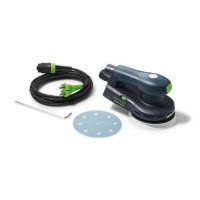
ETS 1505 E - Sander FESTOOL - Free user manual and instructions
Find the device manual for free ETS 1505 E FESTOOL in PDF.



Frequently Asked Questions - ETS 1505 E FESTOOL
Download the instructions for your Sander in PDF format for free! Find your manual ETS 1505 E - FESTOOL and take your electronic device back in hand. On this page are published all the documents necessary for the use of your device. ETS 1505 E by FESTOOL.
USER MANUAL ETS 1505 E FESTOOL
Uncertainty K = 2,0 m/s
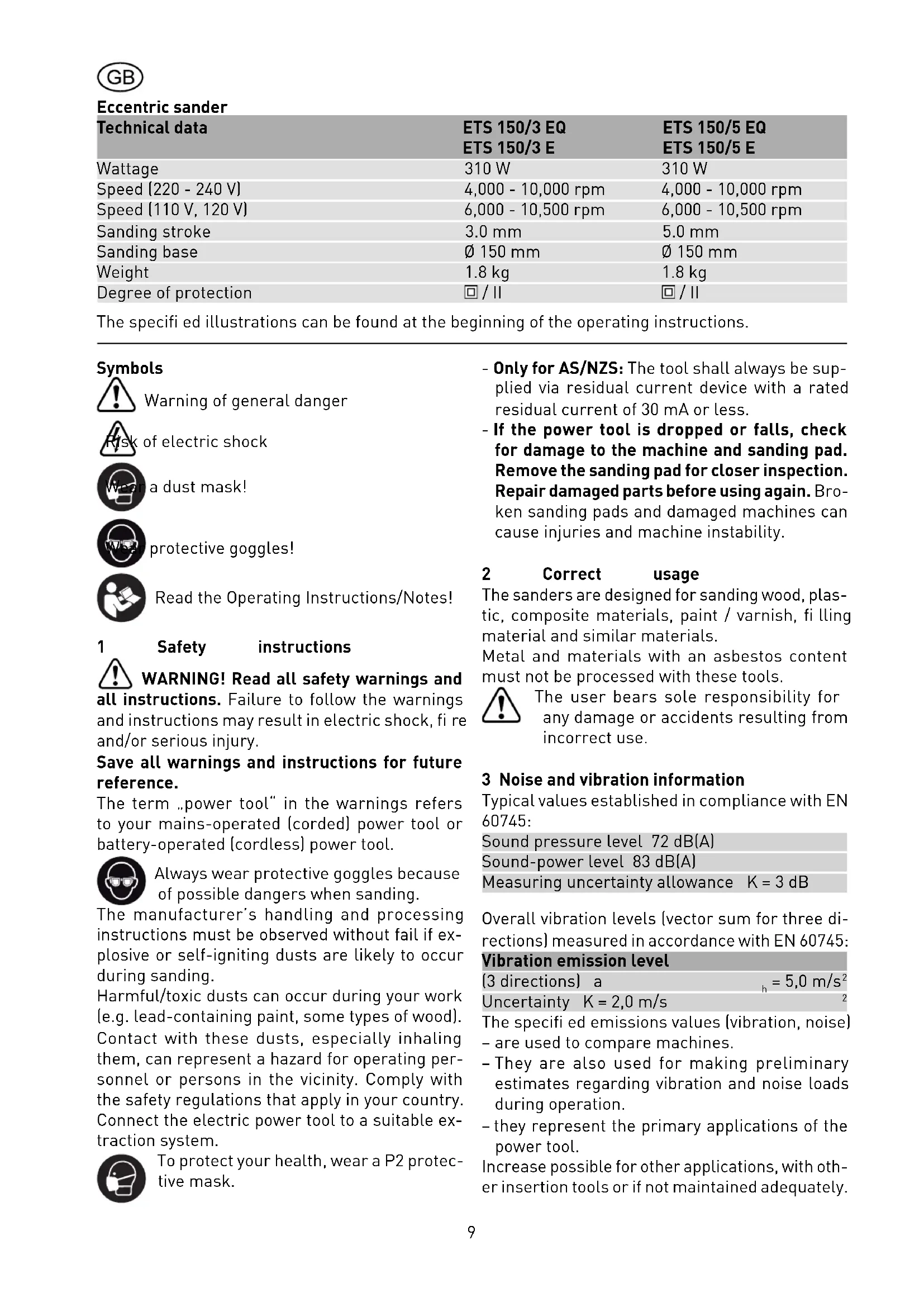
The specifi ed emissions values (vibration, noise) – are used to compare machines. – They are also used for making preliminary estimates regarding vibration and noise loads during operation. – they represent the primary applications of the power tool. Increase possible for other applications, with oth- er insertion tools or if not maintained adequately. Eccentric sander Technical data ETS 150/3 EQ ETS 150/5 EQ
ETS 150/3 E ETS 150/5 E
Wattage 310 W 310 W Speed (220 - 240 V) 4,000 - 10,000 rpm 4,000 - 10,000 rpm Speed (110 V, 120 V) 6,000 - 10,500 rpm 6,000 - 10,500 rpm Sanding stroke 3.0 mm 5.0 mm Sanding base Ø 150 mm Ø 150 mm Weight 1.8 kg 1.8 kg Degree of protection / II / II The specifi ed illustrations can be found at the beginning of the operating instructions.10 Take note of idling and downtimes of machine! 4 Electrical connection and operation
WARNING Risk of accident if the machine is operated using unauthorised voltages or frequencies. - The mains voltage and the frequency of the power source must correspond with the speci- fi cations on the machine’s name plate. - In North America, only Festool machines with voltage specifi cations of 120 V may be used. Switch (1.2) is an on/off switch. For continuous use it can be engaged with the lateral locking button (1.3). Pressing the switch again releases the lock. Only ETS 150/3 EQ, ETS 150/5 EQ: See Fig. 3 for connection and disconnection of the power cable. 5 Electronic control The ETS 150/3 EQ, ETS 150/3 E, ETS 150/5 EQ, ETS 150/5 E has an electronic control with which the rotational speed can be varied step-free. This allows the sanding speed to be adapted to the optimum level according to the material con- cerned (see Chapter 9). The speed is set using the rotary control button (1.1). 6 Dust extraction CAUTION Dust may be harmful or cause allergic reac- tions!
- Always connect the machine to a dust extractor.
- When performing work that generates dust, always wear a dust mask.
6.1 Turbo-fi lter (partly accessories)
The sanding dust is extracted through suction openings in the sanding base (1.13) and trapped in the turbo-fi lter (1.5).The turbo-fi lter has to be changed when it is so full of dust that the extrac- tion power diminishes. Inserting a turbo-fi lter - Push the front cardboard section of the turbo- fi lter with the sealing lip (1.4) onto the extraction nozzle (1.9) of the fi lter holder - Insert rear cardboard section with slot (1.6) onto the retaining strip (1.7) of the fi lter holder - Push the fi lter holder with its opening (1.11) as far as it will go onto the extraction nozzle (1.12) of the machine and clamp tight by turning rotary knob (1.10).
6.2 External extraction by an extraction unit
In order to avoid frequent changing of the turbo- fi lter when carrying longer sanding jobs, it is possible to connect a Festool extractor to the unit instead of using inbuilt extraction. In this case, the extraction pipe (Ø 27 mm (1.8)) of the extraction unit is connected to the suction nozzle (1.12). 7 Choice and installation of the sanding disks
7.1 Choice of sanding disk
The appliance can be fi tted with three sanding disks of different hardness depending on the surface to be treated. Hard: coarse sanding on surfaces, sanding at edges. Soft: universal for coarse and fi ne sanding, for fl at and curved surfaces. Super-soft: fi ne sanding on formed parts, curves, radii. Do not use on edges!
The sanding disks and the tool-holding fi xture on the appliance are equipped with a positive holder (2.1). CAUTION Risk of injury
- Make sure the sanding disk is correctly posi- tioned before screwing it tight.
- For safety reasons, only use original Festool sanding disks! 8 Attaching sanding material Always use original Festool sanding materials! The appropriate Stickfi x sanding paper and Stick- fi x sanding felt can be fastened quickly and easily onto the Stickfi x sanding base. The self-adhesive sanding material (1.14) is simply pressed onto the sanding base (1.13) and held safely in place by the Stickfi x sanding base velcro surface. After use, the StickFix sandpaper is simply pulled off. 9 Operating instructions Never overload the tool by using too much pressure! The best sanding results are achieved when ap- plying moderate pressure. The ETS 150/3 EQ,11 ETS 150/3 E gives the best surface quality and low abrasion. The ETS 150/5 EQ, ETS 150/5 E provides high abrasion with good surface qual- ity. The sanding performance and quality depend mainly on the choice of the right sanding material. Festool offers the appropriate sanding material for all applications (seeFestool catalogue or on the Internet under “www.festool.com”). We recommend the following settings on the rotary control (1.1) for electronic machines: rotary control setting - sanding work
- sanding with max. drive - sanding old paint - sanding wood and veneer prior to painting - interim sanding of paint on surfaces
- sanding of thinly applied primer - sanding of wood with sanding vlies - sanding edges on wooden parts - smoothing primed wooden surfaces.
- sanding full wooden and veneer edges - sanding in the grooves/rebates of windows and doors - interim paint sanding on edges - pre-sanding natural wood windows with sanding vlies - smoothing wood surfaces with sanding felt prior to staining - rubbing down stained surfaces with sanding vlies - rubbing down or removing excess lime paste with sanding vlies
- interim paint sanding on stained surfaces - cleaning natural wood window grooves with sanding felt
- sanding stained edges - sanding thermoplastic synthetics 10 Sanding base brakes The sanding base is braked by a collar (2.2) in order to prevent any uncontrolled excessive speed of the sanding base. Because the collar wears down in the course of time, it has to be replaced by a new one (order no. 453 388) as soon as there is any reduction in the braking effect. 11 Maintenance and care
WARNING Risk of accident, electric shock
- Always pull the plug out of the socket before performing any type of work on the machine.
- All maintenance and repair work which re- quires the motor housing to be opened must only be carried out by an authorised service workshop.
- Check the plug and the cable regularly and should either become damaged, have them replaced by an authorised after-sales service workshop. The cooling air vents on the motor housing must always be free of blockages and clean to ensure air circulation. Customer service and repair only through manufacturer or service workshops: Please fi nd the nearest address at: www.festool.com/Service EKAT
Use only original Festool spare parts! Order No. at: www.festool.com/ Service 12 Disposal Do not throw the power tool in your household waste! Dispose of machines, accessories and packaging at an environmentally-responsible recycling centre. Observe the valid national regu- lations. EU only: European Directive 2002/96/EC stipulate that used electric power tools must be collected separately and disposed of at an environmentally responsible recycling centre. Information on REACh: www.festool.com/reach 13 Accessories The order numbers of the accessories and tools can be found in the Festool catalogue or on the Internet under “www.festool.com”.12 Ponceuse excentrique Caracteristiques techniques ETS 150/3 EQ ETS 150/5 EQ
Incertitude K = 2,0 m/s
Incertezza K = 2,0 m/s
Incerteza K = 2,0 m/s