
ZRG10800WA - Refrigerator ZANUSSI - Free user manual and instructions
Find the device manual for free ZRG10800WA ZANUSSI in PDF.



| Product type | Refrigerator with freezer compartment |
| Brand | ZANUSSI |
| Model | ZRG10800WA |
| Climatic class | SN, N, ST, T (from +10°C to +43°C according to class) |
| Power supply | 220-240 V ~ 50 Hz |
| Interior light bulb power | 220-240 V, max. 1,5 W |
| Refrigerant | Isobutane (R600a) |
| Water pressure (if connected) | 1 bar (0,1 MPa) to 10 bar (1 MPa) |
| Maximum freezing capacity/24h | 1 kg |
| Defrost | Automatic for the refrigerator, manual for the freezer |
| Door reversibility | Yes, opening direction can be changed |
| Thermostat | Positions 0 (off) to 7 (coldest) |
| Included accessories | Ice cube tray, shelves, door bins, vegetable drawer, butter/cheese compartment, egg separator |
| Maintenance and cleaning | Regular cleaning with a soft cloth and warm water, manual defrosting of the freezer, dusting the condenser |
| Safety instructions | Do not block ventilation openings, do not use electrical appliances inside, do not damage the refrigeration circuit |
| Spare parts available | Egg tray, door bins, shelves, vegetable drawers, butter/cheese compartments |
| Dimensions (required clearance) | 100 mm above, 25 mm on each side (min.) |
| Weight | Not specified in the manual |
Frequently Asked Questions - ZRG10800WA ZANUSSI
User questions about ZRG10800WA ZANUSSI
0 question about this device. Answer the ones you know or ask your own.
Ask a new question about this device
Download the instructions for your Refrigerator in PDF format for free! Find your manual ZRG10800WA - ZANUSSI and take your electronic device back in hand. On this page are published all the documents necessary for the use of your device. ZRG10800WA by ZANUSSI.
USER MANUAL ZRG10800WA ZANUSSI
SAFETY INFORMATION. 2 SAFETY INSTRUCTIONS. 4 Installation. 5 Reversing the refrigerator door. 6 Appliance description. 7 Internal accessories. 8 Defrosting. 9 Recommendations. 10 Troubleshooting. 11 Changing the pump. 13

SAFETY INFORMATION
Prior to installation and use of this appliance, read the instructions provided carefully. The manufacturer is not liable for damage or injuries caused by improper installation and use. Keep these instructions together with the appliance for future reference.
Safety of children and vulnerable people
- This appliance may be used by children aged 8 and over and persons with reduced physical, sensory or mental capabilities or who lack sufficient experience and knowledge to handle it, provided they have been given instruction or supervision concerning use of the appliance in a safe way and understand the risks involved.
- This appliance may be used by children between 3 and 8 years of age, as well as people with significant and complex disabilities, provided they are under continuous supervision.
- Children under the age of 3 should be kept away from the appliance unless they are under continuous supervision.
- Do not allow children to play with the appliance.
- Cleaning and maintenance of the appliance should not be done by children without supervision.
- Keep all packing material out of the reach of children and dispose of it safely.
General Safety Instructions
- This appliance is intended exclusively for household use and similar applications, such as:
- Farm houses; staff kitchen areas in shops, offices and other working environments.
- By clients of hotels, motels, B&Bs or guest houses and other residential environments.
- WARNING: Keep ventilation openings, in the appliance enclosure or in the built-in structure, clear of obstruction.
- WARNING: Do not use mechanical appliances or other means to accelerate the defrosting process, other than those recommended by the manufacturer.
- WARNING: Do not damage the refrigerant circuit.
- WARNING: Do not use electrical appliances inside the food storage compartments of the appliance, unless they are of the type recommended by the manufacturer.
- Do not use water spray or steam to clean the appliance.
- Clean the appliance with a soft damp cloth. Use only neutral detergents. Do not use abrasive products, hard scourers, solvents or metal objects.
- Do not store explosive substances such as aerosol cans with a flammable propellant in this appliance.
- If the power cable is damaged, for the avoidance of risk it should be changed by the manufacturer, one of its service engineers or a professional electrician.
- If the appliance is equipped with an ice maker or water dispenser, fill with drinking water only.
- If the appliance requires a water connection, connect to a drinking water outlet only.
- The water inlet pressure (minimum and maximum) should range between 1 bar (0.1 MPa) and 10 bar (1 MPa).
Installation

WARNING!
The installation of this appliance should only be performed by a qualified person.
- Remove all packaging material.
- Do not install or use a damaged appliance.
- Follow the installation instructions provided with the appliance.
- This appliance is heavy. Care should always be taken when moving it. Always wear protective gloves.
- Ensure you have good air circulation around the appliance.
- Wait at least 4 hours before connecting the appliance to the power supply. This will allow the oil to settle in the compressor.
- Do not install the appliance near radiators, cookers, ovens or hobs.
- The back of the appliance should be placed against a wall.
- Do not install the appliance where it receives direct sunlight.
- Do not install the appliance in areas that are too damp or too cold, such as annexes, garages or warehouses.
- When moving the appliance, lift it by the leading edge to avoid scratching the floor.
Electrical connection

WARNING!
There is risk of fire and electric shock.
WARNING!

When installing the appliance, ensure that the electrical supply cable is not trapped or bent.

WARNING!
Do not use multi-plug adapters or extension cables.
- The appliance should be grounded.
- All electrical connections should be carried out by a qualified electrician.
- Ensure that the electrical specifications on the rating plate match those of the power supply. Otherwise, contact an electrician. Always use a grounded electrical outlet.
- Do not use adapters with multiple plugs or extension cords.
- Ensure no damage is caused to electrical components (such as the plug, the power cord and the compressor). Contact a qualified electrician or the Service Force Centre for the replacement of a damaged cable.
- The power cord must be kept below the level of the plug.
- Connect the plug to the power outlet only when installation is complete. Ensure you have access to the power supply plug after installation is complete.
- Do not disconnect the appliance by pulling on the power cord. Always pull the plug to disconnect.
Use

WARNING!
There is a risk of injury, burns, electric shock or fire.

The appliance contains a flammable gas, isobutane (R600a), a natural gas with a high degree of environmental compatibility. Ensure the cooling circuit containing the isobutane is not damaged.
- Do not alter the specifications of this appliance.
- Do not put electrical appliances (such as ice cream makers) inside the appliance, unless specifically approved by the manufacturer.
- Ensure no damage is caused to the refrigerant circuit. It contains isobutane (R600a), a natural gas with a high level of environmental compatibility. This gas is flammable.
- If the refrigerant circuit is damaged, ensure there are no sources of ignition or flames in the room. Ventilate the room.
- Do not place hot containers on the plastic parts of the appliance.
- Do not put carbonated drinks in the freezer. Pressure will be created in the beverage container.
- Do not store flammable gases or liquids in the appliance.
- Do not place flammable products or objects moistened with flammable products inside the appliance, or near or on top of it.
- Do not touch the compressor or condenser. They are very hot.
- Do not remove or touch items from the freezer compartment with wet or damp hands.
- Do not refreeze food that has thawed.
- Follow the instructions on the frozen food packaging.
Interior lights

WARNING!
Danger of electric shock.
- The type of light used for this appliance is specific for household appliances. It should not be used for home lighting.
Maintenance and cleaning

WARNING!
There is a risk of injury or damage to the appliance.
- Before proceeding with maintenance, turn off the appliance and unplug it from the power outlet.
- The refrigeration unit of this appliance contains hydrocarbons. Maintenance and recharging of the unit should be performed exclusively by a qualified engineer.
- The water drain hole should be checked regularly and, if necessary, cleaned. If the water drain hole is blocked, defrost water will accumulate on the floor of the appliance.
Appliance Disposal

WARNING!
There is risk of injury or asphyxiation.
- Unplug the appliance from the power outlet.
- Remove the power cord and discard it.
- Remove the door to prevent children and animals from getting trapped inside the appliance.
- The refrigerant circuit and insulating materials of this appliance do not cause harm to the ozone layer.
- The insulating foam contains flammable gas. Contact your local council for information on how to dispose of the appliance correctly.
- Do not damage the part of the refrigerant unit that is near the heat exchanger.
Installation
Installation location

WARNING!
See the chapters on safety.
The appliance should be positioned in a dry, well-ventilated room.
Ambient temperature affects energy consumption and appliance performance.
The appliance should therefore not be exposed to direct sunlight. The appliance should not be installed near radiators, the cooker or other heat sources. It should only be installed at a location where the ambient temperature corresponds to the climate class for which the appliance is designed.
The climate class can be found on the rating plate, found on the left side of the interior of the appliance.
Position the appliance so that the plug socket is easily accessible.
The following table shows the correct ambient temperature for each climate class:
| Climate class | For ambient temperature |
| SN | From +10 to +32°C |
| N | From +16 to +32°C |
| ST | From +16 to +38°C |
| T | From +16 to +43°C |
If the refrigeration appliance is installed next to another fridge or freezer, a clearance space of 5 cm should be left on either side, in order to prevent the formation of condensation outside the appliance.
The refrigerator requires ventilation.
To ensure optimal operation of the appliance, it should be installed in a dry environment, away from heat sources such as cookers, radiators, boilers and direct sunlight.
Ensure air can circulate freely behind and above the appliance. There should be clearance space of 100 mm between the top of the appliance and any overhanging kitchen furniture.
Alternatively allow 50 mm between the top of the cabinet and any overhanging kitchen furniture and a gap of 25 mm on either side of the appliance.
Door reversal
The refrigerator door can be opened from left or right. This unit is supplied with left side door opening. If required, the direction in which the door opens can be changed in accordance with the following instructions.
Note:
Ensure any parts removed are carefully retained for re-installation of the door.
Refrigerator door reversal
- Remove the screws (11).
- Keep the door open, raise the edge of the top cover, push it (10) forward and remove it from the top cover block (9); then remove the bottom block (8).
- Remove the two threaded bolts (6) that connect the upper hinge (5) on the RH side of the cabinet top.
- Lift the door off carefully and place it on a soft surface to avoid scratches.
- Remove the cap (7) and transfer it to the open hole on the right side of the unit. Be sure to press the cap firmly into the hole.
- Remove the two screws (6) that hold the bottom hinge (2) on the right-hand side of the unit.
- Unscrew the front foot (4) and move it to the right side, as shown in the diagram.
- Mount the door in its new position, ensuring that the pin enters the pin housing in the lower section of the frame (hole).
- Secure the upper hinge (5) that was removed in step 3 on the left-hand side of the unit. Ensure that the pin enters the pin housing in the upper section of the frame (hole).
- Attach the lower left hinge (2) without adjusting and do not tighten the screws until the door is closed and levelled.
- Insert the cap (7) into the empty hole (right-hand side).
- Attach the trim block (8) on the right of the top cover (10).
- With the door open, lift the edge of the top cover, push it (10) forward and remove it from the top cover block (9); then move the bottom block (8). With the door open, lift the edge of the top cover, push it (10) backwards until it engages with the block (9).
- After replacing the top cover (10), close the door and secure with the screws (11).
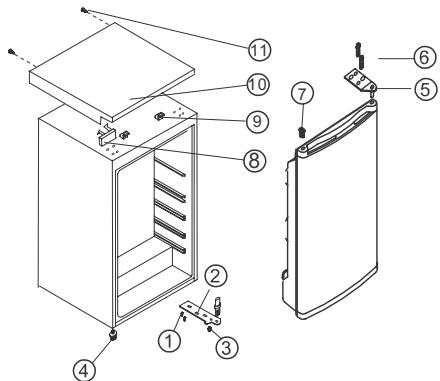
- Screw
- Bottom hinge
- Top hinge
- Adjustable bottom foot
- Adjustable top foot
- Screw
- Plug
- Trim Block
- Top cover block
- Top cover
- Screw
Freezer compartment door reversal
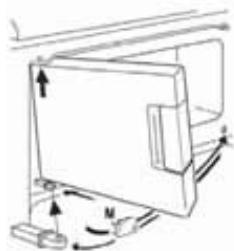
Open the freezer door a little way. Using a small screwdriver, press the spring in the opening of the lower door bearing slightly upwards towards the opening of the lower door support and take the door bearing out complete with the door.
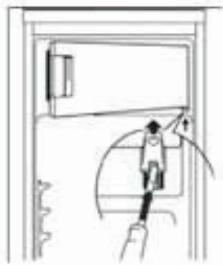
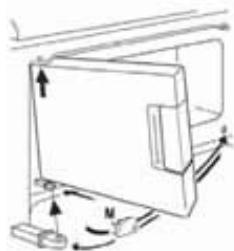
Position the covering plug (M) on the opposite side.
Turn the freezer compartment door 180 degrees and fit the lower door bearing into the lower bearing cavity of the freezer compartment door. Lift the freezer compartment door a little way upwards, fit it into the upper door bearing, and at the same time insert the bottom door bearing into
the square hole. Small upward and downward adjustments of the floor will make fitting easier.
Prior to initial start-up
Clean the inside of the appliance and all accessories prior to initial start-up (see section: Cleaning and Care).
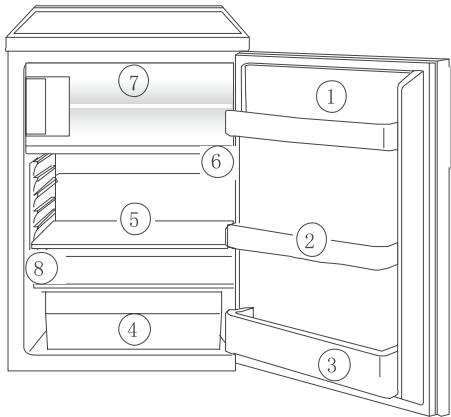
View of the appliance
- Cheese/eggs compartment, with lid and egg storage insert.
- Door storage compartment
- Bottle shelf
- Vegetable drawers
- Storage shelves
- Temperature regulator
- Freezer compartment
- Rating plate
Starting up and temperature regulation
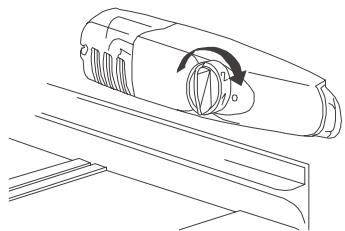
Insert the plug of the connection lead into the mains socket with protective earth contact. When the refrigerator compartment door is opened, the internal lighting is switched on. The temperature selector knob is located on the RH side of the refrigerator compartment.
Setting "0" means:
Off. When turned clockwise in direction "1", Refrigerating Unit On it operates automatically.
Setting "1" means:
Highest temperature, warmest setting.
Setting "7"(end-stop) means:
Lowest temperature, coldest setting.
The temperatures in the refrigerator compartment and freezer compartment cannot be independently regulated.
At a low ambient temperature of around 16°C, setting '1' should be select setting '2'. At ambient temperature of around 25°C, select setting '2'. If you need a lower temperature, select setting '3' or '4'. On this setting, you can be sure the fresh food will be reliably frozen and that a storage
temperature of -18°C will be maintained.
If you want to freeze fresh food rapidly, select setting '7', ensuring that the temperature in the refrigerator compartment does not drop below 0°C.
You should promptly reset the temperature regulator to setting '3' or '4'.
Important!
High ambient temperatures (e.g., on hot summer days) and a cold setting on the temperature regulator (position '6' to '7') can cause the compressor to run continuously.
Reason: when the room temperature is high, the compressor must run continuously to maintain the low temperature in the appliance. The refrigerator will not be able to defrost, since automatic defrosting is only possible when the compressor is not running (see also 'Defrosting' section). The result is the build-up of a thick layer of frost on the fridge rear wall.
If this happens, turn the temperature regulator back to a warmer setting (position '3' or '4'). At this setting, the compressor will be switched on and off as usual and automatic defrosting recommenced.
Storage shelves/trays
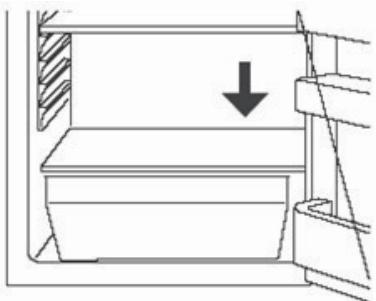
The appliance has various plastic and glass storage shelves and wire trays. Different models have different combinations. You should always slide one of the full-size glass storage shelves into the lowest set of guides, above the fruit and vegetable containers, and keep it in this position. The height of the shelves can be adjusted: To do this, pull the storage shelf forward until it can be swivelled upwards or downwards and removed. Perform the same procedure in reverse to place it at a different height.
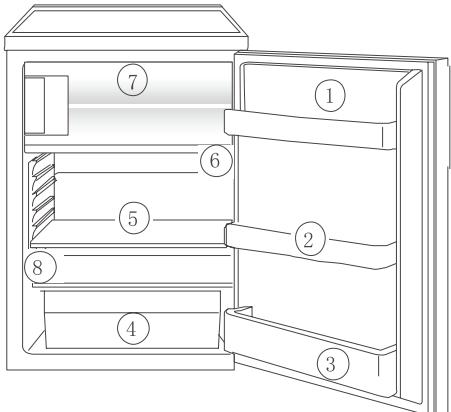
Correct storage
- Butter and cheese
- Preserves
- Drinks
- Cheese storage, fruit and vegetables
- Meat, salami, cold cuts, dairy products.
- Ready meals, pastries, preserves
- Frozen food storage/freezing food
Tip:
Food in the fridge should always be covered or packaged, to prevent drying and tainting of other food.
The following products are suitable for packaging:
Airtight polyethylene bags and wraps
- Plastic containers with lid
- Special plastic covers with elastic
- Aluminium oil
Freezing and storing frozen food The freezer compartment is for freezing and storing food.
Important!
The freezer compartment must be at a temperature of -12°C or colder before freezing food or storing food already frozen.
Do not freeze too large a quantity at once (max. 1 kg per 24 hours). The quality of food is best preserved when it is frozen right through (to the core) as quickly as possible. Allow warm foods to cool before freezing. The warmth will cause increased ice formation and increase the power consumption.
Observe the maximum storage times specified by the manufacturer. Thawed foods that have not been processed further (cooked) should not be frozen a second time.
Containers with flammable gases or liquids can leak at low temperatures. There is a risk of explosion! Do not store any containers with flammable materials, such as spray cans, fire extinguisher refill cartridges, etc., in the freezer compartment. Bottles and cans must likewise not be placed in the freezer. These can burst when the content freezes, and high carbonate content drinks can even explode! Never store lemonade, juices, beer, wine, sparkling wine etc. in the freezer. All foods must be packed air tight before freezing so that they do not dry out or lose their flavour, and so that no flavour contamination of other frozen goods occurs.
Caution!
Do not touch frozen foods with wet hands. Your hands could stick to the food and cause skin abrasions.
Lay the packaged food on the floor of the freezer compartment.
Unfrozen food must not touch items already frozen, otherwise the frozen food could begin to defrost.
Tips:
The following are suited for the packaging of frozen goods:
- Freezer bags and polyethylene wraps
- Special containers for frozen food
- Extra-thick aluminium foil
The following are suitable for sealing bags and wraps: plastic clasps, rubber bands or adhesive tape. Smooth the air out of the bag before sealing; air makes it easier for the frozen food to dry out. Make flat packages, because they freeze more quickly. Do not fill containers for frozen goods to the brim with liquid or paste-like goods,
as liquids expand during freezing.
Defrosting
The refrigerator defrosts automatically.
The rear wall of the fridge covers with frost when the compressor is running, and defrosts when the compressor is off. The water from the thawing frost evaporates by itself.
Defrosting the freezer compartment
During use of the freezer and when the door is opened, moisture is deposited in the compartment as frost. Remove this frost from time to time with the soft plastic scraper. Do not use hard or pointed objects to remove frost from the appliance. The freezer compartment should always be defrosted when the layer of frost has reached a thickness of approx. 4 millimetres; however at least once a year. A good time for defrosting is when the appliance is empty or contains only little food.
Warning!
Do not use electrical heating appliances or any other mechanical or artificial devices to speed up the defrosting process, with the exception of those recommended by the manufacturer. Do not use defrosting sprays, they can be hazardous to health and/or contain substances that damage plastics.
Caution!
Do not touch frozen foods with wet hands. Your hands could stick to the food and cause skin abrasions. Remove frozen food, wrap it in several layers of newspaper and store it in a cool place. Switch off the appliance and unplug it, or pull the fuse or switch off the circuit breaker.
Preparation of ice cubes
Fill the ice cube tray 3/4 full with cold water, place it in the freezer compartment and leave to freeze. To loosen the frozen cubes, either bend the ice cube tray or hold it under running water for a few seconds.
Important!
Never try to free an ice tray that is frozen to the freezer compartment using pointed or sharp edged objects, since you may damage the refrigerant circuit. Use a plastic scraper.
Tip:
To speed up the defrosting water process in the freezer, close the doors. Remove pieces of ice that come off before they completely defrost. After defrosting, thoroughly clean the freezer compartment (see "Cleaning and Care" section).
Switching off the appliance
To switch off the appliance, turn the temperature regulator to position "0".
If the appliance is not going to be used for an extended period:
Remove all refrigerated packages. Switch off the appliance by turning the temperature regulator to position "0". Remove the mains plug or pull the fuse or switch off the circuit breaker. Clean thoroughly (see "Cleaning and care" section). Leave the door open to prevent the build-up of odour.
Cleaning and Care
For hygienic reasons, the appliance interior, including interior accessories, should be cleaned regularly.
Warning!
The appliance must be disconnected from the mains during cleaning. Danger of electric shock! Before cleaning, switch off the appliance and remove the plug from the mains, remove the fuse or switch off the circuit breaker. Do not use a steam cleaner to clean the appliance. Moisture could accumulate in electrical components, with danger of electric shock. Hot steam can damage plastic parts. The appliance must be dry before it is switched back on.
Important!
Ethereal oils and organic solvents can attack plastic parts, e.g. lemon juice or the juice from orange peel; butyric acid and cleaners that contain such substances. Do not allow such substances to come into contact with appliance parts. Do not use any abrasive cleaners. Remove frozen food and food from the refrigerator. Wrap frozen food in several layers of newspaper. Store well covered in a cool place. Defrost the freezer compartment prior to cleaning (see "Defrosting" section).
Switch off the appliance and unplug it from the mains, or remove the fuse or switch off the circuit breaker. Clean the appliance and the interior accessories with a cloth and lukewarm water.
Commercially available dish washing detergents can also be used. After cleaning, wipe with fresh water and rub dry.
Accumulation of dust in the condenser increases energy consumption. For this reason, thoroughly clean the condenser at the back of the appliance once a year with a soft brush or a vacuum cleaner.
Check the water drain hole on the rear wall of the refrigerator. After everything is dry, switch on the appliance again.
Energy saving tips
Do not install the appliance near the cooker, radiators or other sources of heat. High ambient temperature causes longer, more frequent operation of the compressor.
Ensure sufficient air circulation and outlet at the base of the appliance and at the back wall of the appliance.
Do not obstruct vent openings.
Do not place warm food in the appliance. Wait for it to cool first. Only leave the door open as long as necessary. Do not set the temperature any colder than necessary.
Put frozen food in the refrigerator to defrost. The cold in the frozen food will then be used to cool the refrigerator. Always keep the heat emitting condenser, the metal grill on the rear wall of the appliance, clean.
Tips
Normal operating sounds
The following sounds are normal during operation:
- A faint gurgling and bubbling sound from coils when refrigerant is pumped.
- A whirring and pulsating sound from the compressor when refrigerant is pumped.
- A sudden cracking noise from inside the appliance caused by thermal dilatation (a natural and not dangerous physical phenomenon).
- A faint click noise from the temperature regulator when the compressor switches on or off.
Hints for energy saving
- Do not open the door frequently or leave it open longer than absolutely necessary.
- Do not remove the cold accumulators from the freezer basket.
Hints for fresh food refrigeration
- Do not store warm food or evaporating liquids in the refrigerator.
- Cover or wrap food, particularly if it has strong flavours.
- Position food so that air can circulate freely around it.
Hints for refrigeration
Useful hints:
- Meat (all types): wrap in a suitable packaging and place it on the glass shelf above the vegetable drawer. Store meat for a maximum of 1-2 days. Cooked foods, cold dishes: cover and place on any shelf.
- Fruits and vegetables: clean thoroughly and place in a special drawer. Food such as bananas, potatoes, onions and garlic should not be kept in the refrigerator, unless packed.
Butter and cheese: place in a special airtight container or wrap or a polythene bags to exclude as much air as possible. - Bottles: close with a cap and place on the door bottle shelf, or (if available) on the bottle rack.
Hints for freezing
- Freeze only top quality, fresh and thoroughly cleaned, foodstuffs.
- To freeze and thaw more effectively, prepare food in small portions.
- Wrap up food in aluminium foil or polyethylene bags. Ensure containers or wrappings are airtight.
- To avoid increases in the temperature of food which is already frozen, do not allow non-frozen food to touch it.
- Lean foods freeze better than fatty ones. Salt reduces food storage life.
- Do not eat ice cubes, sorbets or ice cream immediately after removal from the freezer. There is a risk of freeze burns.
- It is advisable to label each package with the freezing date to monitor how long it has been stored for.
Hints for storing frozen food
- Check that the commercially frozen foodstuffs were adequately stored by the retailer.
- Ensure that frozen foodstuffs are transferred from the store to the freezer in the shortest possible time.
- Once defrosted, food deteriorates rapidly and cannot be refrozen.
- Do not exceed the storage period indicated by the food manufacturer.
Troubleshooting
Correcting malfunctions
Spare parts
The following spare parts can be ordered from your local AEG Service Force Centre.
You can fit them yourself without any special skill or training, e.g. butter/cheese compartment, egg holders, door racks, fruit and vegetable drawers, storage racks.
A malfunction may be caused by only a minor fault that you can rectify yourself using the following instructions.
Do not perform any other work on the appliance if the following information does not provide assistance in your specific case.
Important!
Repairs to refrigerators/freezers must be performed only by competent service engineers. Improper repairs can represent significant hazards to the user.
If your appliance needs repairing, please contact a professional specialist or your local Service Force Centre in your area.
| Symptom | Possible cause | Solution |
| Appliance does not work. | Appliance is not switched on. | Switch on the appliance. |
| Mains plug is not connected or is loose. | Insert mains plug. | |
| Fuse has blown or is defective. | Check fuse, replace if necessary. | |
| Socket is defective. | Mains malfunctions are to be corrected by an electrician. | |
| Appliance cools too much. | Temperature is set too cold. | Turn the temperature regulator temporarily to a warmer setting. |
| Food is too warm. | Temperature is not properly adjusted. | See “Initial Start-Up” section. |
| The door was left open for a long period. | Only leave the door open as long as necessary. | |
| A large quantity of warm food was placed in the appliance within the last 24 hours. | Turn the temperature regulator temporarily to a colder setting | |
| The appliance is near a heat source. | See the “Installation location” section. | |
| Interior lighting does not work. | Light bulb is defective. | See the “Changing the light bulb” section. |
| Heavy build-up of frost, possibly also on the door seal. | Door seal is not airtight (possibly after reversing the door). | Carefully warm the leaking sections of the door seal with a hair dryer (on a cool setting). At the same time, shape the warmed door seal by hand such that it sits correctly. |
| Unusual noises. | Appliance is not level. | Readjust the feet. |
| The appliance is touching the wall or other objects. | Move the appliance slightly. | |
| Some component, e.g. a pipe, on the rear of the appliance is touching another part of the appliance or the wall. | If necessary, carefully bend the component out of the way | |
| The compressor does not start immediately after changing the temperature setting. | This is normal and does not mean that there is a malfunction. | The compressor starts after a period of time. |
| Water on the floor or storage shelves. | Water drain hole is blocked. | See the “Cleaning and care” section. |
Warning!
There is a risk of electric shock! Before changing the bulb, switch off the appliance and unplug it from the mains, remove the fuse or switch off the circuit breaker.
Light bulb data: 220~240V, max. 1.5 W
To switch off the appliance, turn the temperature regulator to position "0".
Unplug the mains plug.
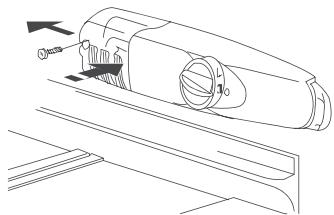
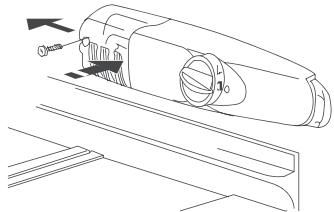
To change the light bulb, undo the screw.
Press the light bulb cover as shown and slide it backwards.
Replace the defective light bulb.
Replace the light bulb cover and the screw.
Switch the refrigerator back on again.
Noises during operation
The following noises are characteristic of fridges:
Clicks
Whenever the compressor switches on or off, a click can be heard.
Humming
As soon as the compressor is in operation, you can hear it humming.
Bubbling
The noise of the refrigerant flowing through thin tubes.
Splashing
Bubbling or splashing noises. Even after the compressor has been switched off, this noise can be heard for a short time.
Changing the door hinges
Open the door of the freezer. With the help of a small screwdriver, press the hinge pin into the opening of the lower hinge and remove the door completely with the hinge.
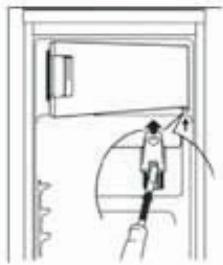
Place the hinge (M) on the opposite side.
Turn the door 180 degrees, place the door in the hinge opening.
With the small hinge, mount it on the upper hinge, at the same time insert the lower hinge into the square opening.
The upper and lower hinge positions of the freezer door will make the installation easier.
Before using the appliance, read the inside of the device and the appliance itself when switching on (see the device: Cleaning and Maintenance).
Appliance description
- Shelves for cheese/casserole and baking tray 2. Shelf for storing dishes
- Dish for grill
- Drip tray for vegetables
- Storage shelf
- Temperature regulator
- Freezer
- Rating plate
Switching on and temperature regulation
Plug the appliance into a wall socket with a protective earth contact. When the refrigerator door is open, the light is on.
The temperature control knob is located on the right side inside the refrigerator.
Setting to "0" means:
Off.
Set the thermostat to position "1".
The thermostat is switched on, the appliance operates automatically.
Setting to "1" means:
Highest temperature, highest pressure.
Setting to "7" (maximum point) means:
Highest temperature, highest pressure.
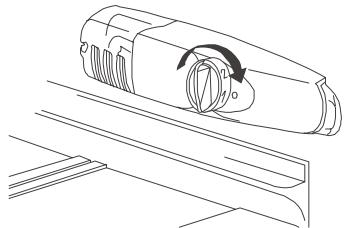
The temperature in the thermostat and the pressure cannot be regulated independently.
Switching off the appliance
To switch off the appliance, set the thermostat to position "0".
If the appliance is not to be used for a longer period:
Remove all the packets from the thermostat. Switch off the appliance by setting the temperature regulator to "0". Remove the main cable and switch off the main switch. Clean the appliance (see the chapter "Cleaning and maintenance"). Leave the door open to prevent the formation of an unpleasant odour.
Cleaning and maintenance
For hygienic reasons, the appliance, including the interior, must be cleaned regularly.
Warning!
The appliance must not be connected to the mains during cleaning. Danger of electric shock! Before cleaning, disconnect the appliance from the power supply by removing the cable from the socket, or switch off the main switch. Never clean the appliance with a steam cleaner. Moisture can get into the electrical components, there is a risk of electric shock! Steam cleaner can damage the plastic parts. The appliance must be dry before it is put back into use.
Remove the protective film and organic residues from the plates with a soft cloth, e.g., from the door or the portal; butyl sealant; strips containing salt sealant.
Do not allow such substances to come into contact with the plates.
Do not use abrasive agents.
Remove the protective food and food from the refrigerator. Store the protective food in a suitable container.
Always keep the appliance well covered. Rinse the protective device before cleaning (see 'Rinsing').
Unplug the appliance or disconnect it from the power supply, or switch off the main circuit breaker.
Clean the appliance and the interior with a cloth and warm water.
Commercially available dishwashing detergents may also be used.
After use, rinse with clean water and dry. Accumulation of dirt on the condenser increases energy consumption. Therefore, carefully clean the condenser on the back of the appliance at least once a year with a soft brush or vacuum cleaner.
Do not immerse the appliance in water
on the side, radiators or other heat sources
on the fuel. High temperatures
cause damage, so the compressor operates.
Ensure good air circulation around the front and back of the appliance.
yeoT. HnkoraH He ng nokpmbajTe OTbOpnte
3a BeHTnlauija. He BHeCyBajTe ToJIa XpHa BO ypeIoT. OctabeTe ja TOnIata XpaHa da ce n3IaIi.
Држete ja bpaata OTbopeha camo konky wto e notpe6ho. He ja noctabyaBJte Temnepaypata ha noladno od notpe6hoto. Ctabete ja 3amp3HaTATA xTaha BO φpNkndepot da ce oJMP3HyBa. JaHOTO od 3amp3HaTATA xpaHa Ke ce KOPN CTN 3a JIaeHe Ha φpNkndepot.
Cekorauo odpxybajte ro KOHdEHN3aTOpOT, MeTaIHaTa peWetka Ha 3aDnnot Snd OJ ypeDoT YnCTa.
PešaBaJIbe npo6JIeMn
Koperpahe Ha HencnpaBHOCTN
Pe3epBnIeIOBn:
CneHnTe pe3epBHN DeNoBN MOKAT da ce HapauaaT kaj nokaJIHHOT AEG cepBuceN cHTap.
Obne moKeTe da r n MOHTnpaTe u camnTe 6e3 noc6Ha BeUITHna nn o6yka, np.:
nperpa3a 3nyTepe/cupeHe,dpkaH3a
jajca, noJnIe 3a Ha BpaTa, fIOKNI 3a OBOUJI e 3eJIeHcyK, noJNlIe 3a CkJaInpaHe
HeicnpaBHOCT MOKe Da 6nDE npeDn3BvKAna OJ MaJa rpeuKa KoJa MoXeTe da Ja KopernPate N CamITE Co NOMOu Ha CneDnTe INHCTpyKUIN.
He n3BpyBaJte npya paObaTa Ha ypeoT aKcIeHnTe INΦopMaun He NOMOrHaT Bo BaUnOT cnyaj.
Baxho!
components electrolycros.
SAFETY INFORMATION
Replace the defective bulb.
Keep the plug out of reach of children.
Insert the cap (M) on the opposite side.
Replace the faulty lamp.
Put the lamp in place and tighten the screw.
Switch the refrigerator on again.
During operation
The following noises are normal for refrigerators:
Clicking
The switching on and off of the compressor can be heard.
Humming
When the compressor is running, its hum can be heard.
Bubbling sound
The flow of refrigerant through the thin pipes can be heard.
These sounds may be audible even for some time after the processor is switched off.
VRør illegal activities VRør maybe a good idea to have a legal basis for the operation of the firm.
Unscrew the screw to change the bulb.
- SAFETY INFORMATION
- SAFETY OF CHILDREN AND VULNERABLE PEOPLE
- GENERAL SAFETY INSTRUCTIONS
- INSTALLATION
- WARNING
- ELECTRICAL CONNECTION
- USE
- INTERIOR LIGHTS
- MAINTENANCE AND CLEANING
- APPLIANCE DISPOSAL
- INSTALLATION LOCATION
- THE REFRIGERATOR REQUIRES VENTILATION
- DOOR REVERSAL
- NOTE
- FREEZER COMPARTMENT DOOR REVERSAL
- PRIOR TO INITIAL START-UP
- VIEW OF THE APPLIANCE
- STARTING UP AND TEMPERATURE REGULATION
- SETTING "0" MEANS
- SETTING "1" MEANS
- SETTING "7"(END-STOP) MEANS
- IMPORTANT
- STORAGE SHELVES/TRAYS
- CORRECT STORAGE
- TIP
- CAUTION
- TIPS
- DEFROSTING
- THE REFRIGERATOR DEFROSTS AUTOMATICALLY
- DEFROSTING THE FREEZER COMPARTMENT
- PREPARATION OF ICE CUBES
- SWITCHING OFF THE APPLIANCE
- IF THE APPLIANCE IS NOT GOING TO BE USED FOR AN EXTENDED PERIOD
- CLEANING AND CARE
- ENERGY SAVING TIPS
- NORMAL OPERATING SOUNDS
- HINTS FOR ENERGY SAVING
- HINTS FOR FRESH FOOD REFRIGERATION
- HINTS FOR REFRIGERATION
- HINTS FOR FREEZING
- HINTS FOR STORING FROZEN FOOD
- TROUBLESHOOTING
- CORRECTING MALFUNCTIONS
- NOISES DURING OPERATION
- CLICKS
- HUMMING
- BUBBLING
- SPLASHING
- CHANGING THE DOOR HINGES
- APPLIANCE DESCRIPTION
- SWITCHING ON AND TEMPERATURE REGULATION
- IF THE APPLIANCE IS NOT TO BE USED FOR A LONGER PERIOD
- CLEANING AND MAINTENANCE
- PEŠABAJIBE NPO6JIEMN
- KOPERPAHE HA HENCNPABHOCTN
- BAXHO
- DURING OPERATION
- CLICKING
- BUBBLING SOUND
Brand : ZANUSSI
Model : ZRG10800WA
Category : Refrigerator