
VT 32 - Scarifier ATIKA - Free user manual and instructions
Find the device manual for free VT 32 ATIKA in PDF.



User questions about VT 32 ATIKA
0 question about this device. Answer the ones you know or ask your own.
Ask a new question about this device
Download the instructions for your Scarifier in PDF format for free! Find your manual VT 32 - ATIKA and take your electronic device back in hand. On this page are published all the documents necessary for the use of your device. VT 32 by ATIKA.
USER MANUAL VT 32 ATIKA
Operating Manual – Safety instructions – Spare parts
Declaration of conformity 16
Extent of delivery 16
Operating times 16
Symbols machine 16
Symbols used in the operating instructions 16
Normal intended use 16
Residual risks 16
Security instructions 16
Assembly 19
Start-up 19
Setting the work depth 20
Working instructions 20
Working with the Thatcher 20
Working with the lawn aerator 21
Maintenance and care 21
Transport 21
Storage 22
Guarantee 22
Description of device / Spare parts 22
Possible faults 23
Technical data 24
EC Declaration of Conformity
according to Directive 98/37 EC
ATIKA GmbH & Co. KG
Schinkelstraße 97
59227 Ahlen - Germany
declare under our sole responsibility, that the product
Thatcher / Lawn aerator Type VT 32
to which this declaration relates corresponds to the relevant basic safety and health requirements of the Directive 98/37/EC, and to the requirements for the other relevant Directives:
2004/108/EC, 2006/95/EC and 2000/14/EC.
Measured level of the acoustic output L_WA96 dB (A) and guaranteed level of the acoustic output L_WA97 dB (A).
Ahlen, 11.01.2007
Extent of delivery A
After unpacking, check the contents of the box
That it is complete
Check for possible transport damage
1 Pre-assembled device
- 1 Hoop mount left (7)
1 Hoop mount right (8)
1 Handle hoop (2)
- 1 Aerator drum (41) - optional accessory, if applicable
- 1 Grass catching bag (40) - optional accessory, if applicable
- 1 Screw bag
1 Cable strain relief (1)
2 Cable brackets (5) - 1 Operating manual
Report any damage or missing items to your dealer, supplier or the manufacturer immediately.
Operating times
Before initiating the device please observe the provisions pertaining to corresponding laws (regional provisions) for the noise control.
Symbols machine
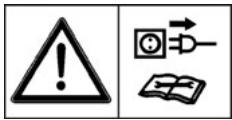
| Carefully read operator's manual before handling the machine. | Shut off engine and remove power cord before performing cleaning, maintenance or repair work. |
| Danger – objects may be thrown out at high speed when motor is running. Keep people, pets and domestic animals out of the danger area. | When connecting cable is damaged or cut through immediately pull out the power plug. |
| Beware of rotating blades. Do not keep hands and feet near or under rotating parts while the machine is running. | Caution! Blades run after! |
| Wear eye and ear protection. | Protect against moisture. |
Symbols Operating instructions

Threatened hazard or hazardous situation. Not observing this instruction can lead to injuries or cause damage to property.

Important information on proper handling. Not observing this instruction can lead to faults in the machine.
Proper use
- The Thatcher / lawn aerator is suitable for raking and thatching lawns as well as collecting leaves on lawns in the private home and hobby garden.
- The device is not allowed to be used in public gardens, parks, sports centres or at roadsides as well as in agriculture and forestry. The device is not allowed to be used in public gardens, parks, sports centres or at roadsides as well as in agriculture and forestry.
-
The Thatcher / lawn aerator may not be used:
-
to trim bushes, hedges and shrubs
- to level uneven grounds (e.g. mole hills)
- as power tiller
- on plastered or gravelled areas
Risk of injuries existing!
- The intended usage also includes compliance with the operating, servicing and repair conditions prescribed by the manufacturer and following the safety instructions included in the instructions.
- The relevant accident prevention regulations for the operation as well as the other generally acknowledged occupational medicine and safety rules must be complied with.
- Any other use is deemed not to be use as prescribed. The manufacturer is not liable for any type of damage resulting from this: the user bears the sole risk.
- Arbitrary modifications on the Thatcher / lawn aerator exclude a liability of the manufacturer for damages of all kinds resulting from it.
- Only persons who are familiarised with the device and informed about possible risks are allowed to prepare, operate and service this device. Repair works may only be carried out by us or by a customer service agent nominated by us.
- The machine may not be used in a potentially explosive environment or be exposed to the rain.
Residual risks
Even if used properly, residual risks can exist even if the relevant safety regulations are complied with due to the design determined by the intended purpose.
Residual risks can be minimised if the "Safety information" and the "Intended usage" as well as the whole of the operating instructions are observed.
Observing these instructions, and taking proper care, will reduce the risk of personal injury or damage to the equipment.
-
Risk injury of hands and feet if they come close to or under the rotating parts.
-
Risk of injury of fingers and hands during assembly and cleaning activities on the Thatcher drum.
Stones and soil may be thrown off. - Danger resulting from electric current, if improper connecting wires are used.
- Touching live parts of opened electrical components.
- Impairment of hearing when working on the machine for longer periods of time without ear protection.
In addition, in spite of all the precautionary measures taken, non-obvious residual risks can still exist.
Safety instructions
Thatchers / lawn aerators can be dangerous when used improperly. The use of electrical tools requires the observation of basic safety precautions to eliminate risk of fire, electrical shock and personal injuries.
Before commissioning this product, read and keep to the following advice. Also observe the preventive regulations of your professional association and the safety provisions applicable in the respective country, in order to protect yourself and others from possible injury.
Pass the safety instructions on to all persons who work with the machine.
i Keep these safety instructions in a safe place.
- Make yourself familiar with the equipment before using it, by reading and understanding the operating instructions.
- Be attentive. Be careful what you do. Behave sensibly when working. Do not use the device when you are tired or under the influence of drugs, alcohol or medicaments. One moment of carelessness when using the device can result in serious injuries.
- Do not use the device for purposes it is not intended for (see "Intended use").
- Familiarize yourself with your environment and pay attention to possible dangers which you may not be able to hear because of the motor noise.
- Within his area of work the operator is responsible for third parties.
- Children and young persons under 16 years of age as well as persons who have not read the instruction manual are not allowed to operate this product.
- Keep bystanders and animals away from your working area.
Do not allow other persons, especially children, to touch the tool or cable.
- Switch off the machine if persons, in particular children or pets, are close to you or if you change your working area.
- Never leave the device unattended.
-
Wear protective clothing:
-
safety goggles
-
ear protection (Sound intensity level at workplace can exceed 85 dB (A))
-
Wear suitable work clothes:
-
do not wear loose-fitting clothes or jewellery; they can catch in moving parts.
Solid shoes or boots with a nonskid sole
- Trousers to protect the legs
Take into consideration environmental influences:
- Do not use the device in moist or wet ambience.
- Do not expose the device to rain.
- Do not work directly near swimming pools or garden ponds
- Do only work with sufficient visibility conditions. Provide for good illumination.
-
Do not operate the device when the grass is wet, if possible.
-
Before trimming, remove all foreign objects (e.g. stones, branches, wires, etc.). While working watch out for further foreign objects.
- If you come across to foreign objects, please power off the device and remove those foreign objects. However before you restart the device, check it for possible damages and have it repaired if necessary.
- Do not overload the device! You work better and safer in the given performance range.
- Only operate the machine with complete and correctly attached safety equipment and do not alter anything on the machine that could impair the safety.
- Do not alter the revolution speed of the motor, since this controls the safe maximum operating speed, and protects the motor and all rotating parts against damage due to excess speed.
- Do not modify the device or parts of the device respectively.
- Before turning on the motor, make sure that your feet are at a safe distance from the cutting tools.
- Pay attention to sure footing especially when working on slopes or on wet grass and keep your balance at all times. Guide the device only a walking speed.
- Do not thatch on steep slopes.
- When thatching on slopes, always work perpendicular to the slope and never up and down.
-
Observe the safety distance given by the handle bar.
Always push the device forward while it is operating. Do not pull it to yourself or behind you.
While the motor is running, do not -
lift or carry the device about
-
lift the impact guard
-
Caution! The tool runs after. Do not try to slow down the tool by hand.
- Pay attention that the impact guard is closed or that the grass catching bag (optional accessory, if applicable) is attached.
-
Turn off the device and wait until the drum has stopped when
-
tilting the Thatcher
crossing areas not planted with grass -
transporting the device to and from the work area
-
Switch the machine off and remove the mains plug from the socket when
carrying out repair works
- maintenance and cleaning
- Removing malfunctions and blockages
- transport and storage
- Blade replacement
- leaving unattended
(even during short interruptions)
- When the Thatcher begins to exhibit unusual vibrations
-
when you have hit an obstacle with the Thatcher.
-
Do not wash down device with water. (origin of danger electric current).
- Store unused equipment in a dry, locked place out of the reach of children.
-
Check the machine for possible damage:
-
Before continuing to use the machine, the protective devices must be inspected to ensure that they work perfectly and with their intended function. This includes also the grass catching bag if available.
- Check if parts are damaged or defective. All parts must be properly mounted and meet all conditions to ensure flawless operation.
- Damaged guards and parts must be properly repaired or exchanged by a recognized, specialist workshop; insofar as nothing else is stated in the instructions for use.
-
Damaged or illegible safety warning labels should be replaced immediately.
-
Maintain your Thatcher / lawn aerator with care:
-
Ensure that all nuts, bolts and screws are tight.
- Make sure that the ventilation apertures are free.
- Keep handles free of oils and grease.
Follow the maintenance instructions.
Electrical safety
- 1.5 ~mm^2 for cable lengths up to 25 ~m
-
2.5 ~mm^2 for cable lengths over 25 ~m
-
Design of the connection cable according to IEC 60245 (H 07 RN-F) with a core cross-profile section of at least
- Long and thin connection lines result in a potential drop. The motor does not reach any longer its maximal power; the function of the device is reduced.
- Plugs and coupler outlets on connection cables must be made of rubber, non-rigid PVC or other thermoplastic material of same mechanical stability or be covered with this material.
- The connector of the connection cable must be splashproof.
- When running the connection line observe that it does not interfere, is not squeezed, bended and the plug connection does not get wet.
- Wind off completely the cable when using a cable drum.
- Do not drive the device across the extension cable. Make sure that it is behind you in a secure position. Place the cable on a path or area that has already been thatched. K
- Do not use the cable for purposes for which it is not meant. Protect the cable against heat, oil and sharp edges. Do not use the cable to pull the plug from the socket.
- Protect yourself against electric shocks. Avoid touching earthed parts with your body (e.g. pipes, heating apparatus, cookers, fridges etc.).
- Regularly check the extension cables and replace them if they are damaged.
-
Do not use any defective connection cables.
-
When working outdoors, only use extension cables especially approved and appropriately labelled for outdoor use.
- Do not set up any provisional electrical connections.
- Never bypass protective devices or deactivate them.
- Only hook up the machine by means of a fault-current circuit breaker (30 mA).
The electrical connection or repairs to electrical parts of the machine must be carried out by a certified electrician or one of our customer service points. Local regulations - especially regarding protective measures - must be observed.
Repairs to other parts of the machine must be carried out by the manufacturer or one of his customer service points.
Use only original spare parts, accessories and special accessory parts. Accidents can arise for the user through the use of other spare parts. The manufacturer is not liable for any damage or injury resulting from such action.
Assembly
Handle hoop
- Push the left and the right hoop mount (7 and 8) into the housing (32). B
- Push the cable strain relief (1) on the handle hoop (2). A
- Connect parts 7 and 8 with 2 by mounting the supplied screws (4) and wing nuts (6) on both sides. C
- Mount the slide linkage to the bottom of the housing using the 2 screws (31) supplied. Tighten then firmly with a screw driver. D
Switch-plug unit E
- Open the cover of the safety switch (3).
- Push the switch-plug unit on the handle hoop (2) until the holes on the switch-plug unit align with those on the handle hoop.
- Close the cover and mount the switch using the 2 screws supplied.
- Mount the cable on the two cable brackets (5) supplied. Make sure that the cable has enough free motion. F
Grass catching bag - optional accessory, if applicable F
Pull the impact guard (39) up and hold it.
- Mount the holder of the grass catching bag (40) to the hook on the housing (32).
Installing the aerator drum - optional accessory, if applicable G
If the device shall be used as lawn aerator, the Thatcher drum (29, see device description) must be exchanged against the aerator drum (41).
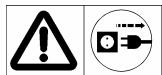
Before exchanging the drums:
- switch off device
- wait until the drum is stationary
- pull out main plug


Wear protective gloves when exchanging the drums. Risk of injury!
- Loosen the pan head screws (31) at the seat of the bearing (30).
- Lift the Thatcher drum at the seat of the bearing and pull it out.
- Push the hexagonal protrusion (a) of the aerator drum into the drive opening (28).
- Remount the seat of the bearing (30) using the screws (31).
To achieve perfect function of the machine, follow the notes given in these instructions
Commissioning
Mains connection
Compare the voltage given on the machine model plate e.g. 230 V with the mains voltage and connect the machine to the relevant and properly earthed plug.
Connect the machine via a circuit breaker switch (residual-current-operated circuit switch) 30mA .
- Use connecting or extension cables up to a length of 1.5 ~m featuring a core cross section of at least 25 ~mm^2 .

Mounting of the extension cable H
- Plug the female connector of the extension cable on the male connector of the switch-connector combination.
- Thread the extension cable through the strain relief (1) as a loop and hang it up.
- Make sure that the extension cable has enough free motion.
Switching on
Do not use any device where the switch can not be switched on and off. Damaged switches must be repaired or replaced immediately by the customer service.
The device is equipped with a safety circuitry preventing inadvertent switching on.

Start the device only after you have placed it on a low-growth lawn area.

Switching on
- Tilt the Thatcher slightly towards you so that the front wheel are above the ground.
- Push the safety button (a) and keep it depressed.
- Next, pull the switch lever (b) toward the handle hoop.
- The Thatcher starts and the Thatcher drum can rotate freely.
- Now release the safety button.

Switching off
When you release the switch lever it returns automatically to its original position.

Motor protection
The motor is equipped with a protective circuit breaker and switches off automatically in case of overloading. After a cooling-down break (approx. 15 min), the motor may be restarted.
Setting the work depth

Before settings the work depth:
- switch off device
-
wait until the drum is stationary
-
Pull out the stop lever.
- Push it to the desired position.
- Allow the stop lever to catch again.
- Set the same work depth at both wheels.
| Position (from rear) | Work depth | |
| Thatcher | Lawn aerator | |
| 1 | 4,0 mm | 10 mm |
| 2 | 0,5 mm | 6,5 mm |
| 3 | -3,0 mm | 3,0 mm |
| 4 | -6,5 mm | -0,5 mm |
| 5 | -10,0 mm | -4,0 mm |
① Set the work depth according to the grass and ground conditions at both running wheels.
Recommended work depths:
| Position | |
| Regularly thatched soft ground; without stones | 5 |
| Seldom thatched mossy ground; with stones | 3 / 4 |
| Uncultivated very mossy; with stones | 1 / 2 |

Set a lower work depth when the motor is straining (motor speed drops and motor noise changes). Example: Work depth set to 5 change to 4
Working instructions

Before commencing work, ensure the following:
- You may not start to operate the machine until you have read these operating instructions, observed all the instructions given and installed the machine as described!
- Provide for a safe and cleaned workplace. Remove from the working area objects which might be thrown off.
- Before starting your work make sure that: - drum and blades are in proper condition (see "blade replacement")
- all screw connections are tight
- no other persons or animals stay within the working area,
you can always step back without any barriers,
you have always a secure standing position.

Always keep your hands and feet at a safe distance to the rotating tool.
If persons who have blood circulation problems are too often exposed to vibrations damages to the nervous system or to blood vessels may occur.
You can reduce vibrations
- by thick and warm working gloves,
- shorter working time (have longer breaks).
See a doctor if your fingers swell, you don't feel well or your fingers become numb.
Working with the Thatcher
Thatching
Using the Thatcher drum, the device can be used as Thatcher to remove mats and mosses in the lawn and to cut through wild growth with low roots.
To enable the growth of a healthy lawn in spring, the absorption of water, air and nutrients in the root area needs to be increased. We recommend thatching the lawn in spring and autumn.
To achieve good results and to extent the life of the Thatcher drum, the lawn should be mowed before thatching (shorter than 4 cm).
Do not thatch when the lawn has been freshly sown or when it is wet or too dry.
- Place the Thatcher at the edge of the lawn near the receptacle.
- Move the cable after each turn to the opposite already thatched side. K
- Select the work depths according to the condition of the lawn (see "Setting the work depth")
- Make sure not to place excessive strain on the Thatcher.
In case of excessive strain, the motor speed drops and the motor noise changes.
Stop and release the switch lever
Wait until the Thatcher drum stands still
Set a lower work depth
- Move the Thatcher at an appropriate uniform speed in straight lines across the lawn.
The lawn surface will be damaged if you let the Thatcher run too long at one spot. - In case of uncultivated very mossy lawn, move once more across to the rows setting the work depth then to a higher position (e.g. from 4 to 3)
- When working on slopes, always position yourself perpendicular to the incline and ensure safe footing. Do not thatch on steep slopes.
- Empty the grass catching bag when it is full to prevent the blades from being blocked and subsequently the motor from being overloaded.
Mow the lawn once more after thatching. - Reseed blank spots that may have developed after thatching.
- Fertilize the lawn only after fresh grass seeds have put down roots.
Ensure that you always comply with the safety instructions given on p. 17
Working with the lawn aerator
Aerating
With the aerator drum (optional accessory, if applicable) the device can be used as lawn aerator to remove grass and moss as well as cutting through wild growth with low roots.
To enable the growth of a healthy lawn in spring, the absorption of water, air and nutrients in the root area needs to be increased. We recommend aerating the lawn, depending on the condition, every 6 - 8 weeks.
To achieve good results and to extent the life of the aerator drum, the lawn should be mowed before aerating (approx. 2 cm).
Install the aerator drum (see "Assembly")
- Fight the moss with a commercially available agent before aerating.
- Proceed as described under "Thatching".
Maintenance and cleaning
Before each maintenance and cleaning work:
- switch off device
- wait until the drum is stationary
- pull out main plug
Maintenance and cleaning activities beyond those described in this chapter may only be performed by customer service.
For maintaining and cleaning, removed security devices must unconditionally be mounted properly and proved again.
Use only original parts. Other parts can result in unexpected damages and injuries.
Store devices outside of the reach of children.
Maintenance
Blade replacement L
Worn blades reduce the performance of the device and put excessive strain on the motor. Therefore check the condition of the blades before each use. If necessary, have the blades sharpened by an expert or replaced by new ones.


Wear protective gloves when working with the blades. Risk of injury!

The blades can be turned. To turn the blades, proceed as follows:
- Loosen the head screws (31) at the seat of the bearing (30).
- Remove the Thatcher drum (29).
- Loosen the hexagonal nut (a) and remove the cover cap (b), the flange (c), the blades (44) and the spacers (d) from the axle (e).
- Turn the blades or insert new ones and install the drum again in the opposite sequence.

Replace worn or damaged blades only as a set to avoid imbalances!
- Retighten the hexagonal nut and place the drum in the device.
Spring replacement G
To replace the springs, proceed as follows:
- Loosen the head screws (31) at the seat of the bearing (30).
- Remove the aerator drum (41).
- Loosen the hexagonal nut (a) and remove the washer (b) and cover cap (c).
- Insert new springs (45) and install the drum again in the opposite sequence.
Pay attention to the correct position of the springs.
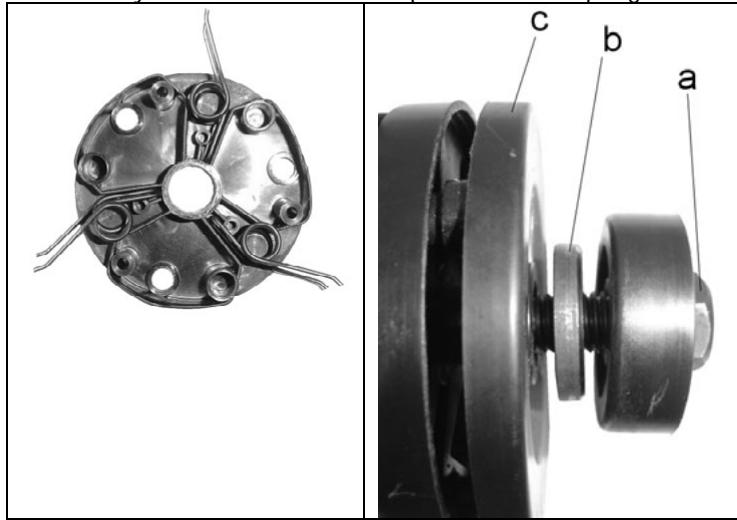
- Retighten the hexagonal nut and place the drum in the device.
Cleaning

Clean the device carefully after each use to ensure faultless function to be maintained.
- Clean the device immediately after finishing the work.
- Empty and clean the grass catching bag if necessary.
- Clean the bottom of the device and the Thatcher or aerator drum.
- Clean the housing, especially the vent slots, from grass and dirt stuck to it.
- Remove the dirt with a cloth or brush.
- Do not clean the machine with running water or high-pressure cleaners.
- Do not use solvents for the synthetic parts (petrol, alcohol, etc.) as these can damage the synthetic parts.


Wear protective gloves when working with the blades. Risk of injury!
Transport


Pull the mains plug prior to transport.

The drum can be damaged during transport, e.g. on hard ground, even when the motor is switched off. Therefore set the work depth of the drum to position 1 during transport.
Storage
Pull out main plug
- Store unused equipment in a dry, locked place out of the reach of children.
In case of extended storage (e.g. during winter) ensure that the device is protected against frost and corrosion.
Before extended storage, please observe the following to increase the service life of the device and to ensure smooth operation:
thoroughly clean the device
- Treat metal parts after each use against corrosion using an environmentally friendly biologically degradable spray oil.
i Never use any grease!

To facilitate space-saving storage of the device, you can fold down the handle hoop. Loosen the wing nuts (6) for this purpose until the handle hoop (2) can be folded down onto the housing. C
Guarantee
Please observe the enclosed terms of guarantee.
Description of device / spare parts
| Pos. | Denomination | Order-No. | Pos. | Denomination | Order-No. | |
| 1. | Cable strain relief | 380950 | 23 | Work depth setting left complete | 380964 | |
| 2. | Handle hoop | 24 | Running wheel | 380965 | ||
| 3. | Switch-plug unit (VDE) | 380951 | 27 | Wheel cover | 380966 | |
| 3. | Switch-plug unit (CH) | 380946 | 29 | Thatcher drum complete with blades | 380967 | |
| 4. | Screw M6 x 45 | 390143 | 30 | Seat of bearing | ||
| 5. | Cable bracket | 380953 | 31 | Pan head screw M 5 x 16 | 403108 | |
| 6. | Wing nut M 6 | 380954 | 32 | Housing | ||
| 7. | Hoop mount left | 33 | Work depth setting right complete | 380969 | ||
| 8. | Hoop mount right | 36 | Wheel shaft | 380970 | ||
| 9. | Motor cover | 380955 | 37 | Axle | 380971 | |
| 11. | Motor complete | 380956 | 38 | Spring | 380972 | |
| 14. | Bearing 608 Z | 380957 | 39 | Impact guard | 380973 | |
| 15. | Shaft | 380958 | 40 | Grass catching bag (optional accessory, if applicable) | 380974 | |
| 16. | Belt pulley | 380959 | 41 | Aerator drum complete with springs (optional accessory, if applicable) | 380981 | |
| 17. | Belt | 380960 | 42 | Safety label | 380975 | |
| 18. | Belt pulley | 380961 | 43 | Screw ST 4.8 x 22 | 401422 | |
| 19. | Snap ring | 44 | Blade set (18 blades) | 380978 | ||
| 21. | Bearing 6000Z | 380962 | 45 | Spring set (18 springs) | 380980 | |
| 22. | Belt pulley | 380963 |
Before each fault clearance
- switch off device
- wait until the drum is stationary
- pull out main plug
After each fault clearance, put into operation and recheck all security installations.
| Fault | Possible cause | Remedy |
| Device doesn't start | no power | Check power supply, power socket and fuse protection |
| Extension cable defect | Check extension cable, exchange defect cable immediately | |
| Main plug, motor or switch defect | Have motor or switch checked by an approved electrician or replaced by original spare parts | |
| Protective motor switch has tripped | Work depth too deep reduce work depth 2. Drum blocked remove the blockage 3. Grass too long mow the grass Allow the motor to cool down approx. 15 minutes before continuing to work | |
| The device operates with interruptions | Extension cable defect | Check extension cable, exchange defect cable immediately |
| Internal fault. | Please contact the after sales service. | |
| ON/OFF button defective. | Please contact the after sales service. | |
| Unusual sounds | Drum is blocked | Remove the blockage |
| Toothed belt slips | Please contact the after sales service. | |
| Loose screws, nuts or other fasteners | Tighten all parts; contact customer service if the noises continue to occur. | |
| Unusual vibrations | Cutting blade damaged or dull | See "Changing blades" |
| Work depths too deep | Set a lower work depth | |
| Lawn too high | Mow the lawn before thatching | |
| Unsatisfactory ventilating result | Work depth too low | Set a greater work depth |
| Dull blades | See "Changing blades" | |
| Discharge opening blocked | Empty the grass catching bag and remove the blockage |
Technical data
| Type | VT 32 | |
| Model | VT 32 | |
| Motrating P1 | 1300 W S6 - 40% | |
| Mains voltage / Mains frequency | 230 V~ / 50 Hz | |
| Mains fuse | 10 A | 10 A inert |
| No-load speed n0 | n0 | 2500 min-1 |
| Working width | 32 cm | |
| Work depth Thatcher | -10 - 4 mm in 5 steps | |
| Work depth lawn aerator | -4 - 10 mm in 5 steps | |
| Grass catching bag capacity | 35 l | |
| Hand-arm vibration according to EN 786 | 2,93 m/s2 | |
| Sound levels at the work-place LPA (according to 2000/14/EC) | 82 dB (A) | |
| Sound levels LWA (according to 2000/14/EC) | 97 dB | measured sound power level 96 dB (A) guaranteed sound power level 97 dB (A) |
| Dimensions (length x bright x height) | 77,5 cm x 44,5 cm x 107,5 cm | |
| Weight | appr. 10.5 kg | |
| Safety class | II |
Sommaire
2004/108/CE, 2006/95/CE, 2000/14/EC.
2004/108/EG, 2006/95/EG, 2000/14/EG.
Měrěna hladina hlučnosti LWA 96 dB (A),
zaručená hladina hlučnosti LwA 97 dB (A).
Ahlen, 11.01.2007
2004/108/EF, 2006/95/EF, 2000/14/EF
Mältydeffektniveau LwA 96 dB (A) og garanteret lydefeffektniveau LwA 97 dB (A).
Ahlen, 11.01.2007
2004/108/EY, 2006/95/EY, 2000/14/EY.
2004/108/EK, 2006/95/EK, 2000/14/EK.
2004/108/EG, 2006/95/EG, 2000/14/EG.
2004/108/CE, 2006/95/CE, 2000/14/CE.
2004/108/EG, 2006/95/EG i 2000/14/EG.
conform directivei 98/37 a UE
ATIKA GmbH & Co. KG
Schinkelstraße 97
59227 Ahlen - Germany
2004/108/UE, 2006/95/UE, 2000/14/UE.
2004/108/EG, 2006/95/EG, 2000/14/EG.
2004/108/ES, 2006/95/ES, 2000/14/ES.
Namerana hladina hluku LWA 103 dB (A).Zaručena hladina hluku LWA 105 dB (A).
Ahlen, 11.01.2007
2004/108/EG, 2006/95/EG, 2000/14/EG.
Izmerjen nivo zvočne jakosti LwA 96 dB (A), garantirani nivo zvočne jakosti LwA 97 dB (A).
Ahlen, 11.01.2007