
AF-S TELECONVERTER TC-20E III - Photo Accessories NIKON - Free user manual and instructions
Find the device manual for free AF-S TELECONVERTER TC-20E III NIKON in PDF.

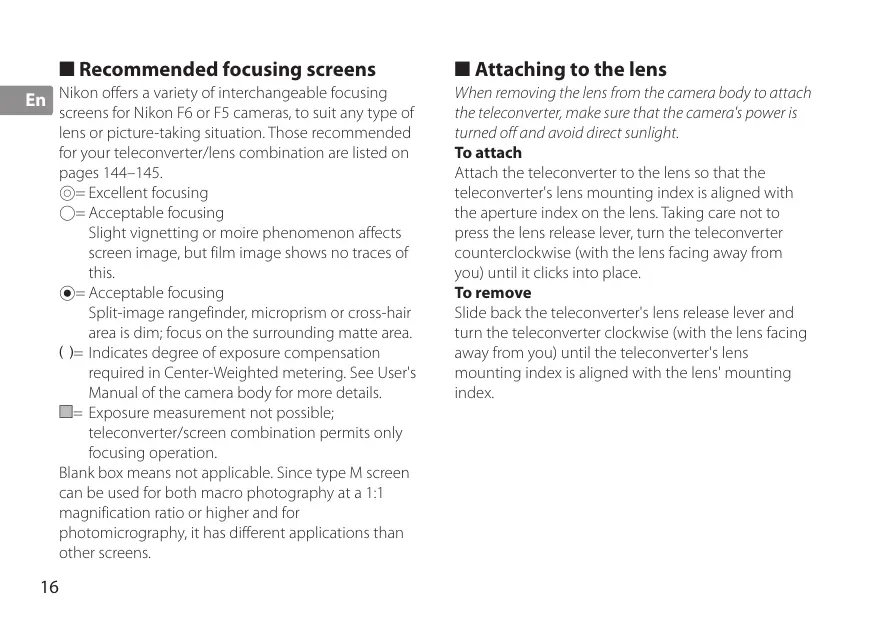


| Product Type | Teleconverter for NIKKOR AF-S/AF-I lenses |
| Brand | Nikon |
| Model | AF-S Teleconverter TC-20E III |
| Multiplication Factor | 2× (doubles focal length) |
| Light Loss | 2 stops (effective aperture divided by 2) |
| Mount | Front: specific to AF-S/AF-I NIKKOR lenses; Rear: Nikon bayonet mount |
| Dimensions | Approximately 66 mm diameter × 48 mm (extension); total length approx. 60 mm |
| Weight | Approximately 330 g |
| Optical Construction | 7 elements in 5 groups (1 aspherical lens) |
| Diaphragm | Fully automatic |
| Exposure Measurement | By maximum aperture method (AI or microcomputer cameras) or by aperture stop-down (others) |
| Effective Aperture Range | f/4 to f/64 (with main lens f/2 to f/32) |
| Minimum Focus Distance | Same as the main lens |
| Autofocus Compatibility | AF-S/AF-I NIKKOR (some limited models, see instructions) |
| CPU Contacts | Yes, data transmission |
| Main Functions | Doubles focal length, autofocus, metering coupling, minimum aperture coupling |
| Maintenance and Cleaning | Clean CPU contacts; blow off lens; use a soft cloth with ethanol; avoid organic solvents |
| Safety | Do not look at the sun through it; do not use in presence of flammable gas; keep out of reach of children; avoid moisture |
| Supplied Accessories | Teleconverter cap, rear cap, soft case CL-0715 |
| Repairability | Repairs only by a Nikon authorized technician |
| Storage | Cool, dry place, away from direct sunlight and chemicals (camphor, naphthalene) |
Frequently Asked Questions - AF-S TELECONVERTER TC-20E III NIKON
User questions about AF-S TELECONVERTER TC-20E III NIKON
0 question about this device. Answer the ones you know or ask your own.
Ask a new question about this device
Download the instructions for your Photo Accessories in PDF format for free! Find your manual AF-S TELECONVERTER TC-20E III - NIKON and take your electronic device back in hand. On this page are published all the documents necessary for the use of your device. AF-S TELECONVERTER TC-20E III by NIKON.
USER MANUAL AF-S TELECONVERTER TC-20E III NIKON
Touching the internal parts of the camera or lens could result in injury. Repairs should be performed only by qualified technicians. Should the camera or lens break open as the result of a fall or other accident, take the product to a Nikon-authorized service representative for inspection after unplugging the product and/or removing the battery.
Turn off immediately in the event of malfunction
Should you notice smoke or an unusual smell coming from the camera or lens, remove the battery immediately, taking care to avoid burns. Continued operation could result in injury. After removing or disconnecting the power source, take the product to a Nikon-authorized service representative for inspection.
Do not use the camera or lens in the presence of flammable gas
Operating electronic equipment in the presence of flammable gas could result in an explosion or fire.
Do not look at the sun through the lens or viewfinder
Viewing the sun or other strong light sources through the lens or viewfinder could cause permanent visual impairment.
Keep out of reach of children
Particular care should be taken to prevent infants from putting the batteries or other small parts into their mouths.
Observe the following precautions when handling the camera and lens
- Keep the camera and lens unit dry. Failure to do so could result in fire or electric shock.
- Do not handle or touch the camera or lens unit with wet hands. Failure to do so could result in electric shock.
- When shooting with back-lighting, do not point the lens at the sun or allow sunlight to pass directly down the lens as this may cause the camera to overheat and possibly cause a fire.
- When the lens will not be used for an extended period of time, attach both front and rear lens caps and store the lens away from direct sunlight. Failure to do so could result in a fire, as the lens may focus sunlight onto a flammable object.
Nomenclature
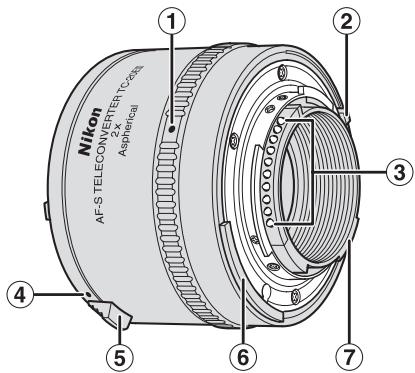
① Teleconverter-camera index (p. 17)
② Minimum aperture signal post (EE servo coupling post)
③ CPU contacts (p. 19)
④ Lens mounting index (p. 16)
⑤ Lens release lever (p. 16)
⑥ Meter coupling lever
⑦ Maximum aperture coupling ridge
( ): reference page
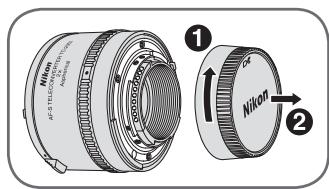
Thank you for purchasing the AF-S Teleconverter. Before using this teleconverter, please read these instructions and refer to your lens' and camera's User's Manual.
■ Major features
- This teleconverter doubles the prime lens' focal length with a two-stop loss in effective aperture.
- Because your AF-S Teleconverter has CPU contacts, and features autofocus, meter coupling and minimum aperture coupling, you can fully take advantage of prime lens' features.
- This teleconverter employs aspherical lens, which minimizes optical interference of the prime lens.
Important
- This teleconverter is exclusively for the AF-S or AF-I NIKKOR lens (p.15); other lenses cannot be used.
- The functions of the lens attached depend on the camera in use. For details, refer to the lens' User's Manual.
• Refer to the Focusing (p. 18) for available autofocus and focus assist.
■ Usable lenses
The following AF-S and AF-I NIKKOR lenses can be used with the TC-20E III:
| AF-S VR Micro-Nikkor 105mm f/2.8G IF-ED* | AF-S NIKKOR 500mm f/4G ED VR* |
| AF-S VR Nikkor 200mm f/2G IF-ED | AF-S Nikkor 500mm f/4D IF-ED II* |
| AF-S NIKKOR 300mm f/2.8G ED VR II | AF-S Nikkor 500mm f/4D IF-ED* |
| AF-S VR Nikkor 300mm f/2.8G IF-ED | AF-I Nikkor 500mm f/4D IF-ED* |
| AF-S Nikkor 300mm f/2.8D IF-ED II | AF-S NIKKOR 600mm f/4G ED VR* |
| AF-S Nikkor 300mm f/2.8D IF-ED | AF-S Nikkor 600mm f/4D IF-ED II* |
| AF-I Nikkor 300mm f/2.8D IF-ED | AF-S Nikkor 600mm f/4D IF-ED* |
| AF-S Nikkor 300mm f/4D IF-ED* | AF-I Nikkor 600mm f/4D IF-ED* |
| AF-S NIKKOR 400mm f/2.8G ED VR | AF-S NIKKOR 70-200mm f/2.8G ED VR II |
| AF-S Nikkor 400mm f/2.8D IF-ED II | AF-S VR Zoom-Nikkor 70-200mm f/2.8G IF-ED |
| AF-S Nikkor 400mm f/2.8D IF-ED | AF-S Zoom-Nikkor 80-200mm f/2.8D IF-ED |
| AF-I Nikkor 400mm f/2.8D IF-ED | AF-S VR Zoom-Nikkor 200-400mm f/4G IF-ED* |
* Autofocus cannot be used.
- Other lenses cannot be used. Do not attach other lenses since the rear elements of the lens will touch and may damage the elements in the teleconverter.
- Vibration reduction function can be used with the VR (Vibration Reduction) lens used with Nikon digital SLR (Nikon FX/DX format) cameras, F6, F5, F100, F80-series/N80-series**, F75-series/N75-series** and F65-series/N65-series** camera body.
** The Nikon N80-series, N75-series and N65-series are sold exclusively in the U.S.A.
■ Recommended focusing screens
Nikon offers a variety of interchangeable focusing screens for Nikon F6 or F5 cameras, to suit any type of lens or picture-taking situation. Those recommended for your teleconverter/lens combination are listed on pages 144–145.
◎= Excellent focusing
○= Acceptable focusing
Slight vignetting or moire phenomenon affects screen image, but film image shows no traces of this.
●= Acceptable focusing
Split-image rangefinder, microprism or cross-hair area is dim; focus on the surrounding matte area.
( )= Indicates degree of exposure compensation required in Center-Weighted metering. See User's Manual of the camera body for more details.
☐= Exposure measurement not possible; teleconverter/screen combination permits only focusing operation.
Blank box means not applicable. Since type M screen can be used for both macro photography at a 1:1 magnification ratio or higher and for photomicrography, it has different applications than other screens.
■ Attaching to the lens
When removing the lens from the camera body to attach the teleconverter, make sure that the camera's power is turned off and avoid direct sunlight.
To attach
Attach the teleconverter to the lens so that the teleconverter's lens mounting index is aligned with the aperture index on the lens. Taking care not to press the lens release lever, turn the teleconverter counterclockwise (with the lens facing away from you) until it clicks into place.
To remove
Slide back the teleconverter's lens release lever and turn the teleconverter clockwise (with the lens facing away from you) until the teleconverter's lens mounting index is aligned with the lens' mounting index.
■ Attaching teleconverter to camera body
Make sure that the camera's power is turned off and avoid direct sunlight.
To attach
Attach the camera to the lens/teleconverter assembly so that the camera's mounting index is aligned with the teleconverter-camera index on the teleconverter. Taking care not to press the camera's lens release button, turn the camera body counterclockwise (with the camera body facing away from you) until it clicks into place.
- If your camera has a lift-up meter coupling lever, make sure that the meter coupling lever is correctly positioned. (For details, see your camera User's Manual.)
To remove
While pressing the lens release button on the camera body, turn the camera body clockwise (with the camera body facing away from you) until the teleconverter-camera index is aligned with the camera's lens mounting index.
■ Determining exposure
Using this teleconverter with a lens decreases the effective aperture by two stops.
- With AI-type cameras with/without CPU contacts: Determine exposure in the same manner as using the prime lens only. (However, exposure cannot be determined with the G-type lens.)
- With non-AI-type cameras: Perform stop-down method. (However, exposure cannot be determined with the G-type lens.)
- See your camera User's Manual for available exposure modes and metering systems.
Focusing
| Camera | Camera's focus mode | Lens' focus mode | |
| M/A, A/M | M | ||
| Nikon digital SLR (Nikon FX/DX format) cameras, F6, F5, F4-series, F100, F90X/N90s*1, F90-series/N90*1, F80-series/N80-series*, F75-series/N75-series*, F70-series/N70*1, F65-series/N65-series*, PRONEA 600i/6i*1 and PRONEA S | AF(C/S) | Autofocus with manual priority*2, Autofocus with auto priority*2 | Manual focus (Focus assist is available*2) |
| MF | Manual focus only (Focus assist is available*2) | ||
| Other AF (autofocus) cameras (except for F3AF*3) | AF(C/S) MF | Manual focus only (Focus assist is available*4) | |
| Non-AF Nikon cameras | Manual focus only | ||
*1 The Nikon N90s, N90, N80-series, N75-series, N70, N65-series and PRONEA 6i are sold exclusively in the U.S.A.
*2 Both autofocus and manual focus using electronic rangefinder are possible with an AF-S/AF-I NIKKOR lens having maximum aperture of f/2.8 (effective aperture of f/5.6) or faster.
*3 The Nikon F3AF camera cannot be used.
*4 Manual focus using electronic rangefinder is possible with an AF-S/AF-I NIKKOR lens having maximum aperture of f/2.8 (effective aperture of f/5.6) or faster, or maximum aperture of f/2 (effective aperture of f/4) with F-501/N2020 ^*5 attached.
*5 The Nikon N2020 is sold exclusively in the U.S.A. and Canadian markets.
- With the AF-S VR Micro-Nikkor 105mm f/2.8G IF-ED, the brightness of the image at the image sensor (or film plane) decreases as the reproduction ratio increases, and the effective aperture becomes larger (brightness diminishes).
Teleconverter care
- Be careful not to allow the CPU contacts to become dirty or damaged.
- Clean teleconverter's lens surfaces with a blower brush. To remove dirt and smudges, use a soft, clean cotton cloth or lens tissue moistened with ethanol (alcohol) or lens cleaner. Wipe in a circular motion from the center to outer edge, taking care not to leave traces or touch other parts of the lens.
- Never use organic solvent such as thinner or benzene to clean the teleconverter's lens.
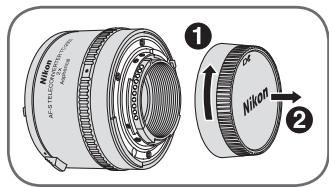
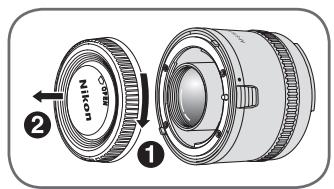
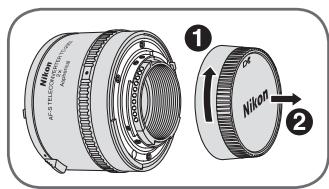
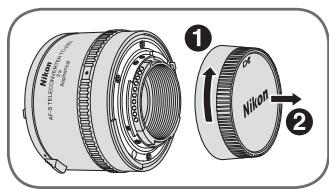
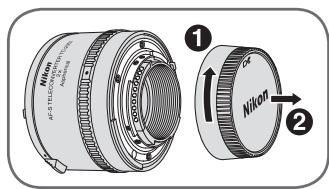
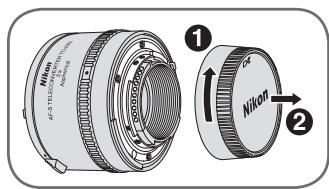
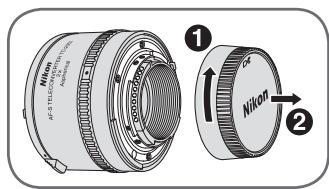
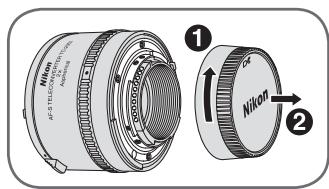
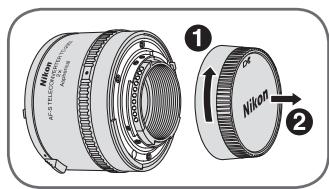
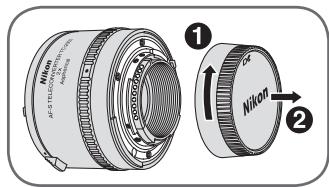
- When storing the teleconverter, attach both the front and rear teleconverter caps.
- When the lens will not be used for an extended period of time, store it in a cool, dry place to prevent mold and rust. Be sure to store the teleconverter away from direct sunlight or chemicals such as camphor or naphthalene.
- Do not get water on the lens or drop it in water as this will cause it to rust and malfunction.
- Reinforced plastic is used for certain parts of the lens. To avoid damage, never leave the lens in an excessively hot place.
■ Standard accessories
- Teleconverter Cap
- Rear Lens Cap
• Flexible Lens Pouch CL-0715
Specifications
| Lens construction: | 7 elements in 5 groups (1 aspherical lens) |
| Diaphragm: | Fully automatic |
| Exposure measurement: | Via full-aperture method with AI cameras or cameras having a CPU; via stop-down method for other cameras |
| Mount: | Front: Special mount for AF-S/AF-I NIKKOR lensRear: Nikon bayonet mount |
| Dimensions: | Approx. 66 mm (2.6 in.) dia. × 48 mm (1.9 in.) extension from camera's lens mounting flange; overall length is approx. 60 mm (2.4 in.) |
| Weight: | Approx. 330 g (11.6 oz.) |
With a prime lens
| Focal length: | Double that of a prime lens |
| Aperture coupling range: | f/2 - f/32(effective aperture f/4 - f/64) |
| Reproduction ratio: | Double that of a prime lens |
| Depth of field: | 1/2 that of a prime lens |
| Minimum focusing distance: | Same as that of a prime lens |
Specifications and designs are subject to change without notice or obligation on the part of the manufacturer.
⚠ VORSICHT
Nicht zerlegen
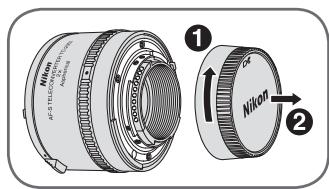
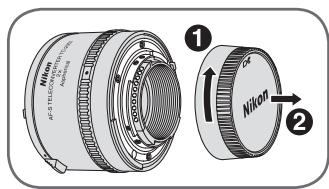
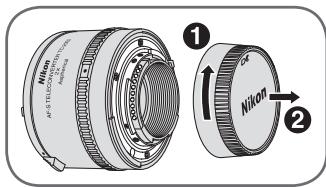
No reproduction in any form of this manual, in whole or in part (except for brief quotation in critical articles or reviews), may be made without written authorization from NIKON CORPORATION.
NIKON CORPORATION
© 2010 Nikon Corporation
CE
Printed in Japan
KL0C03(E3)
7MAA62E3-03▲G01