
WG326E - Saw WORX - Free user manual and instructions
Find the device manual for free WG326E WORX in PDF.


User questions about WG326E WORX
0 question about this device. Answer the ones you know or ask your own.
Ask a new question about this device
Download the instructions for your Saw in PDF format for free! Find your manual WG326E - WORX and take your electronic device back in hand. On this page are published all the documents necessary for the use of your device. WG326E by WORX.
USER MANUAL WG326E WORX
1.SAFETY INSTRUCTIONS PRODUCT SAFETY GENERAL POWER TOOL SAFETY WARNINGS

WARNING Read all safety warnings, instructions, illustrations and
specifications provided with this power tool.
Failure to follow all instructions listed below may result in electric shock, fire and/or serious injury.
Save all warnings and instructions for future reference.
The term "power tool" in the warnings refers to your mains-operated (corded) power tool or battery-operated (cordless) power tool.
1) Work area safety
a) Keep work area clean and well lit. Cluttered or dark areas invite accidents.
b) Do not operate power tools in explosive atmospheres, such as in the presence of flammable liquids, gases or dust. Power tools create sparks which may ignite the dust or fumes.
c) Keep children and bystanders away while operating a power tool. Distractions can cause you to lose control.
2) Electrical safety
a) Power tool plugs must match the outlet. Never modify the plug in any way. Do not use any adapter plugs with earthed (grounded) power tools. Unmodified plugs and matching outlets will reduce risk of electric shock.
b) Avoid body contact with earthed or grounded surfaces, such as pipes, radiators, ranges and refrigerators. There is an increased risk of electric shock if your body is earthed or
grounded.
c) Do not expose power tools to rain or wet conditions. Water entering a power tool will increase the risk of electric shock.
d) Do not abuse the cord. Never use the cord for carrying, pulling or unplugging the power tool. Keep cord away from heat, oil, sharp edges or moving parts. Damaged or entangled cords increase the risk of electric shock.
e) When operating a power tool outdoors, use an extension cord suitable for outdoor use. Use of a cord suitable for outdoor use reduces the risk of electric shock.
f) If operating a power tool in a damp location is unavoidable, use a residual current device (RCD) protected supply. Use of an RCD reduces the risk of electric shock.
3) Personal safety
a) Stay alert, watch what you are doing and use common sense when operating a power tool. Do not use a power tool while you are tired or under the influence of drugs, alcohol or medication. A moment of inattention while operating power tools may result in serious personal injury.
b) Use personal protective equipment. Always wear eye protection. Protective equipment such as dust mask, non-skid safety shoes, hard hat, or hearing protection used for appropriate conditions will reduce personal injuries.
c) Prevent unintentional starting. Ensure the switch is in the off-position before connecting to power source and/or battery pack, picking up or carrying the tool. Carrying power tools with your finger on the switch or energising power tools that have the switch on invites accidents.
d) Remove any adjusting key or wrench before turning the power tool on. A wrench or a key left attached to a rotating part of the power tool may result in personal injury.
e) Do not overreach. Keep proper footing and balance at all times. This enables better control of the power tool in unexpected situations.
f) Dress properly. Do not wear loose clothing or jewellery. Keep your hair and clothing away from moving parts. Loose clothes, jewellery or long hair can be caught in moving parts.
g) If devices are provided for the connection of dust extraction and collection facilities, ensure these are connected and properly used. Use of dust collection can reduce dust-related hazards.
h) Do not let familiarity gained from frequent use of tools allow you to become complacent and
ignore tool safety principles. A careless action can cause severe injury within a fraction of a second.
4) Power tool use and care
a) Do not force the power tool. Use the correct power tool for your application. The correct power tool will do the job better and safer at the rate for which it was designed.
b) Do not use the power tool if the switch does not turn it on and off. Any power tool that cannot be controlled with the switch is dangerous and must be repaired.
c) Disconnect the plug from the power source and/or remove the battery pack, if detachable, from the power tool before making any adjustments, changing accessories, or storing power tools. Such preventive safety measures reduce the risk of starting the power tool accidentally.
d) Store idle power tools out of the reach of children and do not allow persons unfamiliar with the power tool or these instructions to operate the power tool. Power tools are dangerous in the hands of untrained users.
e) Maintain power tools and accessories. Check for misalignment or binding of moving parts, breakage of parts and any other condition that may affect the power tool's operation. If damaged, have the power tool repaired before use. Many accidents are caused by poorly maintained power tools.
f) Keep cutting tools sharp and clean. Properly maintained cutting tools with sharp cutting edges are less likely to bind and are easier to control.
g) Use the power tool, accessories and tool bits etc. in accordance with these instructions, taking into account the working conditions and the work to be performed. Use of the power tool for operations different from those intended could result in a hazardous situation.
h) Keep handles and grasping surfaces dry, clean and free from oil and grease. Slippery handles and grasping surfaces do not allow for safe handling and control of the tool in unexpected situations.
5) Battery tool use and care
a) Recharge only with the charger specified by the manufacturer. A charger that is suitable for one type of battery pack may create a risk of fire when used with another battery pack.
b) Use power tools only with specifically designated battery packs. Use of any other
battery packs may create a risk of injury and fire.
c) When battery pack is not in use, keep it away from other metal objects, like paper clips, coins, keys, nails, screws or other small metal objects, that can make a connection from one terminal to another. Shorting the battery terminals together may cause burns or a fire.
d) Under abusive conditions, liquid may be ejected from the battery; avoid contact. If contact accidentally occurs, flush with water. If liquid contacts eyes, additionally seek medical help. Liquid ejected from the battery may cause irritation or burns.
e) Do not use a battery pack or tool that is damaged or modified. Damaged or modified batteries may exhibit unpredictable behaviour resulting in fire, explosion or risk of injury.
f) Do not expose a battery pack or tool to fire or excessive temperature. Exposure to fire or temperature above 130^ may cause explosion.
g) Follow all charging instructions and do not charge the battery pack or tool outside the temperature range specified in the instructions. Charging improperly or at temperatures outside the specified range may damage the battery and increase the risk of fire.
6) Service
a) Have your power tool serviced by a qualified repair person using only identical replacement parts. This will ensure that the safety of the power tool is maintained.
b) Never service damaged battery packs. Service of battery packs should only be performed by the manufacturer or authorized service providers.
1) General pruning saw safety warnings:
a) Keep all parts of the body away from the saw chain when the pruning saw is operating. Before you start the pruning saw, make sure the saw chain is not contacting anything. A moment of inattention while operating pruning saws may cause entanglement of your clothing or body with the saw chain.
b) Always hold the chain saw with your right hand on the rear handle and your left hand on the front handle. Holding the chain saw with a reversed hand configuration increases the risk of personal injury and should never be done.
c) Hold the pruning saw by insulated gripping surfaces only, because the saw chain may contact hidden wiring. Saw chains contacting a live wire may make exposed metal parts of the pruning saw live and could give the operator
an electric shock.
d) Wear safety glasses protection. Further protective equipment for hearing, head, hands, legs and feet is recommended. Adequate protective clothing will reduce personal injury by flying debris or accidental contact with the saw chain.
e) Do not operate a pruning saw in a tree, on a ladder, from a rooftop, or any unstable support. Operation of a pruning saw in this manner could result in serious personal injury.
f) Always keep proper footing and operate the pruning saw only when standing on fixed, secure and level surface. Slippery or unstable surfaces may cause a loss of balance or control of the pruning saw.
g) When cutting a limb that is under tension, be alert for spring back. When the tension in the wood fibres is released, the spring loaded limb may strike the operator and/or throw the pruning saw out of control.
h) Use extreme caution when cutting brush and saplings. The slender material may catch the saw chain and be whipped toward you or pull you off balance.
i) Carry the pruning saw by the front handle with the pruning saw switched off and away from your body. When transporting or storing the pruning saw, always fit the guide bar cover. Proper handling of the pruning saw will reduce the likelihood of accidental contact with the moving saw chain.
j) Follow instructions for lubricating, chain tensioning and changing the bar and chain. Improperly tensioned or lubricated chain may either break or increase the chance for kickback.
k) Cut wood only. Do not use pruning saw for purposes not intended. For example: do not use pruning saw for cutting metal, plastic, masonry or non-wood building materials. Use of the pruning saw for operations different than intended could result in a hazardous situation.
I) This pruning saw is not intended for tree felling. Use of the pruning saw for operations different than intended could result in serious injury to the operator or bystanders.
m) Follow all instructions when clearing jammed material, storing or servicing the pruning saw. Make sure the switch is off and the battery pack is removed. Unexpected actuation of the pruning saw while clearing jammed material or servicing may result in serious personal injury.
n) Recommendation that the first-time user should, as a minimum, practise cutting logs on a saw-horse or cradle.
o) Recommendation to have sharpening and maintenance of the saw chain performed by authorised service centres.
2) Causes and operator prevention of kickback:
Kickback may occur when the nose or tip of the guide bar touches an object, or when the wood closes in and pinches the saw chain in the cut.
Tip contact in some cases may cause a sudden reverse reaction, kicking the guide bar up and back towards the operator.
Pinching the saw chain along the top of the guide bar may push the guide bar rapidly back towards the operator.
Either of these reactions may cause you to lose control of the saw which could result in serious personal injury. Do not rely exclusively upon the safety devices built into your saw. As a pruning saw user, you should take several steps to keep your cutting jobs free from accident or injury.
Kickback is the result of pruning saw misuse and/or incorrect operating procedures or conditions and can be avoided by taking proper precautions as given below:
a) Maintain a firm grip, with thumbs and fingers encircling the chain saw handles, with both hands on the saw and position your body and arm to allow you to resist kickback forces.
Kickback forces can be controlled by the operator, if proper precautions are taken. Do not let go of the pruning saw.
b) Do not overreach and do not cut above shoulder height. This helps prevent unintended tip contact and enables better control of the pruning saw in unexpected situations.
c) Only use replacement bars and chains specified by the manufacturer. Incorrect replacement guide bars and saw chains may cause chain breakage and/or kickback.
d) Follow the manufacturer's sharpening and maintenance instructions for the saw chain. Decreasing the depth gauge height can lead to increased kickback.
Residual risks
Even with the intended use of the appliance there is always a residual risk, which can not prevented. According to the type and construction of the appliance the following potential hazards might apply:
- Contact with exposed saw teeth of the saw chain (cutting hazards)
- Access to the rotating saw chain (cutting hazards)
-
Unforeseen, abrupt movement of the guide bar (cutting hazards)
-
Flung out of parts from the saw chain (Cutting / injection hazards)
- Flung out of parts of the work piece
- Skin contact with the oil
- Loss of hearing, if no required ear protection used during work
SAFETY WARNINGS FOR BATTERY PACK
a) Do not dismantle, open or shred cells or battery pack.
b) Do not short-circuit a battery pack. Do not store battery packs haphazardly in a box or drawer where they may short-circuit each other or be short-circuited by conductive materials. When battery pack is not in use, keep it away from other metal objects, like paper clips, coins, keys, nails, screws or other small metal objects, that can make a connection from one terminal to another. Shorting the battery terminals together may cause burns or a fire.
c) Do not expose battery pack to heat or fire. Avoid storage in direct sunlight.
d) Do not subject battery pack to mechanical shock.
e) In the event of battery leaking, do not allow the liquid to come into contact with the skin or eyes. If contact has been made, wash the affected area with copious amounts of water and seek medical advice.
f) Keep battery pack clean and dry.
g) Wipe the battery pack terminals with a clean dry cloth if they become dirty.
h) Battery pack needs to be charged before use. Always refer to this instruction and use the correct charging procedure.
i) Do not maintain battery pack on charge when not in use.
j) After extended periods of storage, it may be necessary to charge and discharge the battery pack several times to obtain maximum performance.
k) Recharge only with the charger specified by Worx. Do not use any charger other than that specifically provided for use with the equipment.
I) Do not use any battery pack which is not designed for use with the equipment.
m) Keep battery pack out of the reach of children.
n) Retain the original product literature for future reference.
o) Remove the battery from the equipment when not in use.
p) Dispose of properly.
q) Do not mix cells of different manufacture, capacity, size or type within a device.
r) Keep the battery away from microwaves and high pressure.
s) Warning! Do not use non-rechargeable batteries.
SAVE THESE INSTRUCTIONS
Instructions concerning the proper techniques for limbing and cross-cutting
1. Limbing a tree
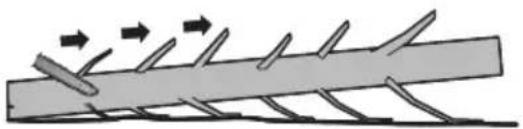
Limbing is removing the branches from a fallen tree. When limbing leave larger lower limbs to support the log off the ground. Remove the small limbs in one cut as illustrated in Figure 1. Branches under tension should be cut from the bottom up to avoid binding the pruning saw.
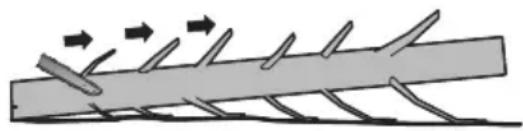
Figure 1
2. Bucking a log
Bucking is cutting a log into lengths. It is important to make sure your footing is firm and your weight is evenly distributed on both feet. When possible, the log should be raised and supported by the use of limbs, logs or chocks. Follow the simple directions for easy cutting.
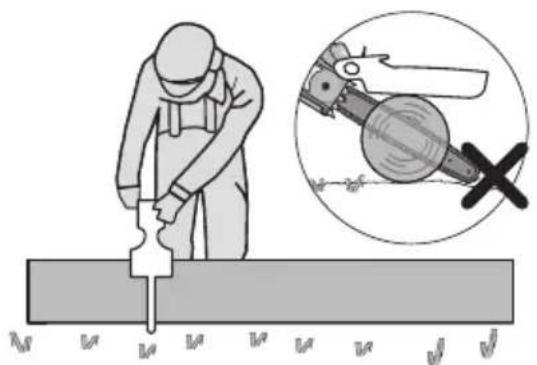
When the log is supported along its entire length as illustrated in Figure 2, it is cut from the top (overbuck), avoid contacting ground as this will greatly reduce the chain sharpness.
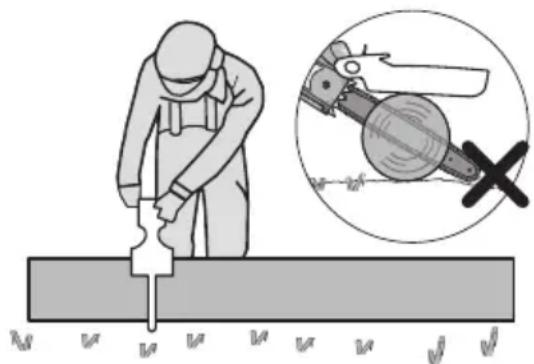
Figure 2
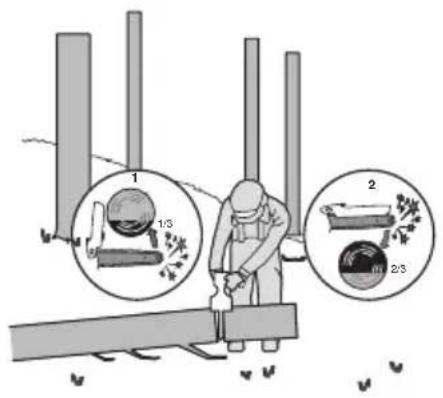
When the log is supported on one end, as illustrated in Figure 3, cut 1/3 the diameter from the underside (underbuck) (1). Then make the finished cut by overbucking (2) to meet the first cut.
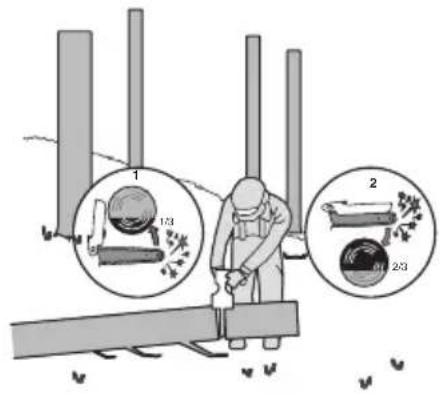
Figure 3
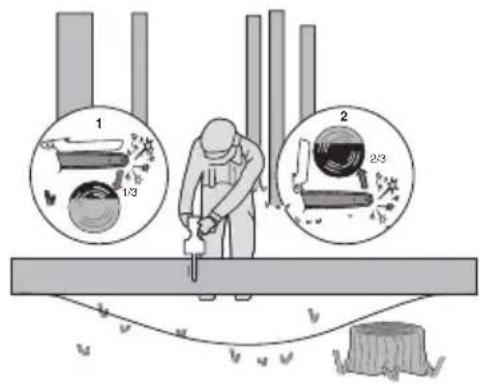
When the log is supported on both ends, as illustrated in Figure 4, cut 1/3 the diameter from the top (overbuck) (1). Then make the finished cut by underbucking (2) the lower 2/3 to meet the first cut.
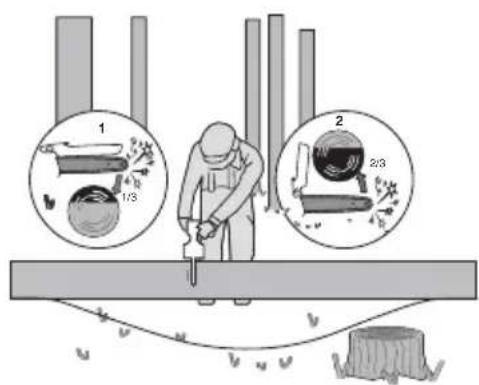
Figure 4
When bucking on a slope always stand on the uphill side of the log, as illustrated in Figure 5. When "cutting through", to maintain complete control release the cutting pressure near the end of the cut without relaxing your grip on the pruning saw handles. Don't let the chain contact the ground. After completing the cut, wait for the saw chain to stop before you move the pruning saw. Always stop the motor before moving from tree to tree.
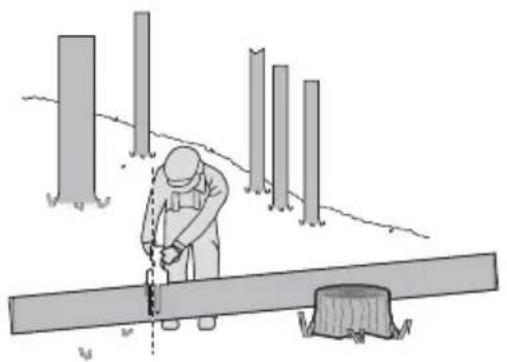
Figure 5
SYMBOLS
| To reduce the risk of injury, user must read instruction manual |
| Wear ear protection |
| Wear eye protection |
| Wear dust mask |
| Beware of pruning saw kickback and avoid contact with bar tip |
| Do not expose to rain |
| Wear protective gloves |
| Do not burn |
| Batteries may enter water cycle if disposed improperly, which can be hazardous for ecosystem. Do not dispose of waste batteries as unsorted municipal waste. |
| Waste electrical products must not be disposed of with household waste. Please recycle where facilities exist. Check with your local authorities or retailer for recycling advice. | |
| elément d'embeliage | The symbol on the packaging is for France only. |
| Always use pruning saw two-handed | |
| Li-Ion | Li-Ion battery. This product has been marked with a symbol relating to 'separate collection' for all battery packs and battery pack. It will then be recycled or dismantled in order to reduce the impact on the environment. Battery packs can be hazardous for the environment and for human health since they contain hazardous substances. |
2. COMPONENT LIST
1.CHAIN GUARD
2. HOUSING-COVER KNOB
3. LOCK-OUT BUTTON
4. ON/OFF SWITCH
5. GRIP AREA
6. BATTERY PACK*
7. BATTERY PACK RELEASE BUTTON *
8. HAND GUARD
9. HOUSING-COVER
10.CHAIN
11.GUIDEBAR
12. BASE PLATE
13.BAR PAD
14. BAR LOCATING TAB
15. CHAIN TENSIONING BOLT
16. FASTENING BAR BOLT
17.DRIVE SPROCKET
18. BAR AND CHAIN SHEATH/SCABBARD
- Not all the accessories illustrated or described are included in standard delivery.
3. TECHNICAL DATA
Type WG326E WG326E.X (3 - designation of machinery, representative of battery-operated pruning saw)
| WG326E WG326E.X*** | |
| Voltage 20 V Max.** | --- |
| Bar length | 12 cm |
| Chain speed | 7.6 m/s |
| Chain pitch | 7.6 mm |
| Number of chain drive links | 28 |
| Chain gauge | 1.1 mm |
| Adaptive chain type | WA0142 |
| Adaptive guide bar type | WA0151 |
| Battery type | Lithium-ion |
| Machine weight (chain & bar included) (bare tool) | 1.18 kg |
Voltage measured without workload. Initial battery voltage reaches maximum of 20 volts. Nominal voltage is 18 volts.
X=1-999,A-Z,M1-M9 there are only used for different customers,there are no safe relevant changes between these models.
SUGGESTED BATTERIES AND CHARGERS
| Category | Type | Capacity |
| 20V Battery | WA3639 | 2.0 Ah |
| 20V Charger | WA3802 | 2.0 A |
We recommend that you purchase your accessories from the same store that sold you the tool. Refer to the accessory packaging for further details. Store personnel can assist you and offer advice.
NOISE INFORMATION
| A weighted sound pressure L | pA = 78.6 dB(A) |
| KpA | 3 dB(A) |
| A weighted sound power L | wA = 91.64 dB(A) |
| KpA | 3 dB(A) |
Wear ear protection.
VIBRATION INFORMATION
Vibration total values (triax vector sum) determined according to EN 62841:
| Vibration emission value: a | h = 1.801 m/s2 |
| Uncertainty K = 1.5 m/s2 |
The declared vibration total value and the declared noise emission value have been measured in accordance with a standard test method and may be used for comparing one tool with another.
The declared vibration total value and the declared noise emission value may also be used in a preliminary assessment of exposure.
WARNING: The vibration and noise emissions during actual use of the power tool can differ from the declared value depending on the ways in which the tool is used especially what kind of workpiece is processed dependant on the following examples and other variations on how the tool is used:
How the tool is used and the materials being cut or drilled.
The tool being in good condition and well maintained. The use of the correct accessory for the tool and ensuring it is sharp and in good condition.
The tightness of the grip on the handles and if any anti vibration and noise accessories are used.
And the tool is being used as intended by its design and these instructions.
This tool may cause hand-arm vibration syndrome if its use is not adequately managed.
WARNING: To be accurate, an estimation of exposure level in the actual conditions of use should also take account of all parts of the operating cycle such as the times when the tool is switched off and when it is running idle but not actually doing the job. This may significantly reduce the exposure level over the total working period.
Helping to minimise your vibration and noise exposure risk.
Always use sharp chisels, drills and blades. Maintain this tool in accordance with these instructions and keep well lubricated (where appropriate).
If the tool is to be used regularly then invest in anti vibration and noise accessories.
Plan your work schedule to spread any high vibration tool use across a number of days.
4. INTENDED USE
- The mini pruning saw is intended for cutting only wood and branches up to a diameter corresponding to the length of the pruning saw guide bar.
- The mini pruning saw must be used at ground level or from a suitable platform that is completely stable and secure.
The mini pruning saw is intended for outdoor use only.
The mini pruning saw is not intended for any other use. - Mounting of parts on the mini pruning saw is authorized only for original or manufacturer-approved spare parts (chain guides or saw chains for example) as well as for authorized chain guide / saw chain combinations as indicated in the manual.
- The user is responsible for any accident resulting from improper use or unauthorized modification of the mini pruning saw.
5. ASSEMBLY
WARNING! Do not install the battery pack before it has been completely assembled.
Always use gloves when handling the chain.
MOUNTING THE SAW CHAIN
- Unpack all parts carefully. Remove the housingcover by turning the housing-cover knob in a counterclockwise direction. (See Fig. A1)
- Place the pruning saw on a solid, level surface.
- Use only genuine Worx chains or those recommended for guide Bar.
- Slide the chain in the slot around the guide bar. Ensure the chain is in correct running direction by comparing it to the chain icon on the guide bar, or referring to the chain direction symbol found on the saw body. (See Fig. A2)
- Fit the chain onto the drive sprocket, so that the fastening bar bolt and the bar locating tab on the bar pad fit into the keyway of the opening on the guide bar. (See Fig. B1, B2)
- Assure all parts are seated properly. Make sure the drive links are fully seated in the drive sprocket (See Fig. C1), avoiding a kink as shown in Fig. C2. If kink occurs, pick up the chain at the guide bar just ahead of the kink and then pull the kink out.
NOTE: Chain should rotate freely and be free of
kinks.
- Fit the housing cover. The correct chain tension is reached when the chain can be raised approx. Half the drivelink depth from the guide bar in the center. This should be done by using one hand to raise the chain against the weight of the machine. Then tighten the housing cover by turning the housing-cover knob clockwise until it is tight.
If the chain tension is incorrect, loosen the housing cover and re-tighten it once the chain tension is properly adjusted. (See Fig. D)
NOTE: The chain is properly tensioned when it can be lifted off of the guide bar and the drivelink is within the rail of the guide bar. (See Fig. E)
NOTE: The chain will stretch while cutting and lose proper tension. When the chain becomes loose, completely unscrew the housing-cover knob or turn the knob around three full turns in a counter-clockwise direction, then re-tighten the housing-cover knob to properly reset the chain tension.
NOTE: New saw chains will stretch. Check the chain tension frequently when first used and tighten when the chain becomes loose around the guide bar.
LUBRICATION
NOTE: Chain life and cutting capacity depend on optimum lubrication. Therefore, the chain should be oiled before operation.
IMPORTANT: It is important to use bar and chain lubricant that is formulated to perform over a wide temperature range with no dilution required. This can be found at the location where you purchased this saw or your local hardware store. Do not use dirty, used or otherwise contaminated oil. Damage may occur to the bar or chain. Use of non-approved oil will void the warranty.
Do not swallow. If swallowed, call a physician immediately. Keep out of reach of children. Store away from heat or open flame.
- Switch off the pruning saw and remove the battery.
- Place the pruning saw on a level surface with the housing-cover facing up.
- Clean the guide bar and chain with a soft brush or solvent.
- Apply lubrication oil in area (a) between guide bar and chain. (See Fig. F)
NOTE: Apply lubrication oil after cutting every 5 times for best performance.
- Fit the battery. Switch on the pruning saw. Lubrication oil is evenly distributed over the chain. The saw chain is lubricated.
6. OPERATION
WARNING! The charger and battery pack are specially designed to work together so do not attempt to use any other devices. Never insert or allow metallic objects into your charger or battery pack connections because of an electrical failure and hazard will occur.
NOTE: Your battery pack is UNCHARGED and you must charge once before use.
The battery charger supplied is matched to the Li-ion battery installed in the machine. Do not use another battery charger.
(1). CHARGING YOUR BATTERY PACK (See Fig. G1, G2)
The Li-ion battery is protected against deep discharging. When the battery is empty, the machine is switched off by means of a protective circuit. In a warm environment or after heavy use, the battery pack may become too hot to permit charging. Allow time for the battery to cool down before recharging.
(2). TO REMOVE OR INSTALL BATTERY PACK (See Fig. H)
Depress the battery pack release button to remove the battery pack from your tool. After recharging, insert the battery pack into the battery port. A simple push and slight pressure will be sufficient until a click is heard. Check to see if the battery is fully secured.
NOTE: When removing the battery pack, hold it firmly to avoid dropping and injury.
(3). HOLDING AND CONTROL OF THE SAW (See Fig. 1)
Hold rear handle by right hand and auxiliary grasping the motor enclosure by left hand, operate the pruning saw safely.
2. SWITCHING ON AND OFF (See Fig. J)
ATTENTION: Check the battery pack before using your cordless tool. Only use the battery pack listed in the accessories section.
For switching on the tool, press the lock-out button, then fully press the on/off switch and hold in this position. The lock-out button can now be released. For switching off, release the on/off switch.
3.CUTTING
Important: Check recent replaced chain tension about every 10 minutes during operation.
(1) Installing the battery pack into the machine.
(2) Make sure section of log to be cut is not laying on the ground. This will keep the chain from touching the ground as it cuts through the log.
Touching the ground while the chain is moving is
dangerous and will dull the chain.
(3) When ready to make a cut, push the lock-out button completely in with the right thumb and squeeze the trigger. This will turn saw on. Releasing the trigger will turn the saw off. Make sure the saw is running at full speed before starting a cut.
(4) When starting a cut, slowly place moving chain against the wood. The wood should be as close to the saw body as possible. Hold saw firmly in place to avoid possible bouncing or skating (sideways movement) of saw.
(5) Guide the saw using light pressure and do not put excessive force on the saw, letting the saw do its work. The motor will overload and can burn out. It will do the job better and safer at the rate for which it was intended.
(6) Remove the saw from a cut with the saw running at full speed. Stop the saw by releasing the on/off switch. Make sure the chain has stopped before setting the saw down.
(7) Keep practicing on scrap logs in a secure working area until you are comfortable, using a fluid motion and a steady cutting rate.
Kickback safety devices on this saw
This saw has a low-kickback chain and reduced kickback guide bar. Both items reduce the chance of kickback. However, kickback can still occur with this saw.
The following steps will reduce the risk of kickback.
- Keep all safety items in place on saw. Make sure they work properly.
- Do not overreach or cut above shoulder height.
- Keep solid footing and balance at all times.
- Stand slightly to the left side of saw. This keeps your body from being in direct line with chain.
- Do not let guide bar nose touch anything when chain is moving.
- Never try cutting through two logs at same time. Only cut one log at a time.
- Do not bury the guide bar nose or try plunge cut (boring into wood using guide bar nose).
- Watch for shifting of wood or other forces that may pinch chain.
- Use extreme caution when reentering a previous cut.
- Use only the low-kickback chain and guide bar that were supplied with this pruning saw or recommended.
- Never use a dull or loose chain. Keep chain sharp with proper tension.
How to use saw safely
- Use the pruning saw only with secure footing.
- Hold the pruning saw at the right-hand side of your body (See Fig. K).
- The chain must be running at full speed before it makes contact with the wood.
- Use the base plate to secure the saw onto the
wood before starting to cut.
- Use the base plate as a leverage point while cutting. (See Fig. L)
- Raise the chain guard when cutting from bottom to top of material. (See Fig. M)
- Do not operate the saw with arms fully extended, attempt to saw areas which are difficult to reach, or stand on a ladder while sawing. (See Fig. N)
WARNING: When cutting a limb that is under tension, use extreme caution. Be alert for wood springing back. When wood tension is released, limb could spring back and strike operator causing severe injury or death.
When sawing logs supported on both ends, start the cut from above(Y) about 1/3 of the diameter into the log (overbuck) and then finish the cut (Z) from below, in order to avoid contact of the pruning saw with the ground. When sawing logs supported on only one end, start the cut from below (Y) about 1/3 of the diameter into the log (underbuck) and finish the cut from above (Z) in order to avoid log splitting or jamming of the pruning saw.
7. SAW MAINTENANCE
Follow maintenance instructions in this manual. Proper cleaning of saw and chain and guide bar maintenance can reduce chances of kickback. Inspect and maintain saw after each use. This will increase the service life of your saw.
NOTE: Even with proper sharpening, risk of kickback can increase with each sharpening.
MAINTENANCE AND STORAGE OF PRUNING SAW
- Remove the battery pack
- When not in use
Before moving from one place to another - Before servicing
- Before changing accessories or attachments, such as saw chain and guard
- Inspect pruning saw before and after each use. Check saw closely if guard or other part has been damaged. Check for any damage that may affect operator safety or operation of saw. Check for alignment or binding of moving parts. Check for broken or damaged parts. Do not use pruning saw if damage affects safety or operation. Have damage repaired by authorized service center. To locate an authorized service center, visit www.worx.com.
- Maintain pruning saw with care.
- Never expose saw to rain or direct moisture.
- Keep chain sharp, clean, and lubricated for
better and safer performance.
- Follow steps outlined in this manual to sharpen chain.
- Keep handles dry, clean, and free of oil and grease.
- Keep all screws and nuts tight.
- When servicing, use only identical replacement parts.
- When not in use, always store pruning saw
- in a high or locked place, out of children's reach
- in a dry place
- with bar and chain sheath/scabbard in place
BAR MAINTENANCE
To maximize bar life, the following bar maintenance is recommended.
The bar rails that carry the chain should be cleaned before storing the tool or if the bar or chain appear to be dirty.
The rails should be cleaned every time the chain is removed.
TO CLEAN THE BAR RAILS.
- Remove housing-cover, bar and chain. (See section ASSEMBLY)
- Using a wire brush, screwdriver or similar tool, clear the residue from the inner groove of the bar. (See Fig. P)
- Make sure to clean oil passages thoroughly.
Conditions which require chain and guide bar maintenance:
- Saw cuts to one side or at an angle.
- Saw has to be forced through the cut.
- Inadequate supply of oil to the bar and chain. Check the condition of the guide bar each time the chain is sharpened. A worn guide bar will damage the chain and make cutting difficult.
After each use, remove the battery pack, clean all sawdust from the guide bar and sprocket hole.
When rail top is uneven, use a flat file to restore square edges and sides.
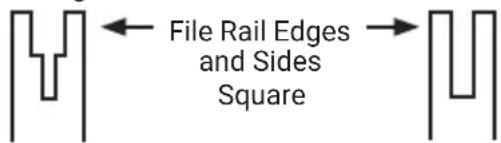
Worn Groove Correct Groove
Replace the guide bar when the groove is worn, the guide bar is bent or cracked, or when excess heating or burring of the rails occurs. If replacement is necessary, use only the guide bar specified for your saw in the repair parts list or on the decal located on the pruning saw.
REPLACING BAR & CHAIN
Replace chain when cutters are too worn to sharpen or when chain stops. Only use replacement chain
noted in this manual.
Inspect guide bar before sharpening chain. A worn or damaged guide bar is unsafe. A worn or damaged guide bar will damage chain. It will also make cutting harder.
SHARPENING SAW CHAIN
WARNING: Remove the
Remove the battery pack before servicing. Severe injury or death could occur from electrical shock or body contact with moving chain. Cutting edges on chain are sharp. Use protective gloves when handling chain.
Keep chain sharp. Your saw will cut faster and more safely. A dull chain will cause undue sprocket, guide bar, chain, and motor wear. If you must force chain into wood and cutting creates only sawdust with few large chips, chain is dull.
ENVIRONMENTAL PROTECTION

Waste electrical products must not be disposed of with household waste. Please
recycle where facilities exist. Check with your local authorities or retailer for recycling advice.
FOR BATTERY TOOLS
The ambient temperature range for the use and storage of tool and battery is 0^ - 45^
The recommended ambient temperature range for the charging system during charging is 0^ - 40^
DETAILS REGARDING SAFE DISPOSAL OF USED BATTERIES
At the end of the life of the appliance, remove the battery pack safely before disposing of the appliance. Do not throw batteries away or throw them in the normal trash can. Also do not dispose of the battery with the machine. Remove the used battery pack from the appliance and dispose of it at the nearest or convenient dedicated recycling facility. If in doubt, consult your local environmental protection department. Batteries may enter water cycle if disposed improperly, which can be hazardous for ecosystem. Do not dispose of waste batteries as assorted municipal waste.
8. TROUBLESHOOTING TABLE
The following table gives checks and actions that you can perform if your machine does not operate correctly. If these do not identify/remedy the problem, contact your service agent.

WARNING: Switch off and remove the battery pack before investigating fault.
| Symptom Possible Cause Remedy | ||
| Pruning saw fails to operate | Out of battery. Charge the battery pack. | |
| Pruning saw operates intermittently | Over heating Applying too much pressure while cutting. Loose connection. Internal wiring defective. On/Off switch defective. | Place the machine in a cool, ventilated place to cool it down Applying relatively less pressure while cutting Contact service agent. |
| Chain/chain bar over-heats | Chain is over tensioned Dull chain | Adjust chain tension Sharpen chain or replace |
| Pruning saw rips, vibrates, does not saw properly | Chain tension too loose Dull chain Chain worn out Chain teeth are facing in the wrong direction | Adjust chain tension Sharpen chain or replace Replace chain Reassemble with chain in correct direction |
9. DECLARATION OF CONFORMITY
We,
Positec Germany GmbH
Postfach 680194, 50704 Cologne, Germany
On behalf of Positec declare that the product Description Battery-powered pruning saw Type WG326E;WG326E.X (3-designation of machinery, representative of battery-operated pruning saw)
Function Cutting wood Serial number It can be found on marking label
Complies with the following Directives: 2006/42/EC, 2014/30/EU 2011/65/EU&(EU)2015/863 2000/14/EC amended by 2005/88/EC & (EU)2024/1208
The notified body involved
Name: SGS Fimko Ltd
Address: Takomotie 8, FI-00380 Helsinki, Finland
Certification No.: MD-556
2000/14/EC amended by 2005/88/EC& (EU)2024/1208:
- Conformity Assessment Procedure as per Annex V
- Measured Sound Power Level 91.64 dB(A)
- Declared Guaranteed Sound Power Level 96 dB(A)
Standards conform to EN 62841-1, EN ISO 12100, EN ISO 3744, EN IEC 55014-1, EN IEC 55014-2, EN IEC 63000
The person authorized to compile the technical file, Name Marcel Filz Address Positec Germany GmbH Postfach 680194,50704 Cologne,Germany

2025/05/11
Allen Ding
Deputy Chief Engineer, Testing & Certification
authorized to issue the declaration of conformity on behalf of the manufacturer
Positec Technology (China) Co., Ltd
18, Dongwang Road, Suzhou Industrial Park, Jiangsu 215123, P. R. China
DECLARATION OF CONFORMITY (BATTERY)
We,
Positec Germany GmbH
Postfach 680194, 50704 Cologne, Germany
On behalf of Positec declare that the product Description Battery pack Type Designation WA3639 Function Provide energy for power tools, garden tools and similar products Serial number It can be found on marking label
Complies with the following Regulation and Directives: (EU) 2023/1542, 2011/65/EU & (EU) 2015/863
Standards conform to EN 62133-2, EN IEC 63000
The person authorized to compile the technical file, Name Marcel Filz
Address Positec Germany GmbH
Postfach 680194, 50704 Cologne, Germany

2025/05/11
Allen Ding
Deputy Chief Engineer, Testing & Certification
authorized to issue the declaration of conformity on behalf of the manufacturer
Positec Technology (China) Co., Ltd
18, Dongwang Road, Suzhou Industrial Park, Jiangsu 215123, P. R. China
INHALTSVERZEICHNIS
18, Dongwang Road, Suzhou Industrial
Park, Jiangsu 215123, P. R. China
18, Dongwang Road, Suzhou Industrial
Park, Jiangsu 215123, P. R. China
SOMMAIRE
- CONSIGNES DE SCURITÉ
- LISTEDES COMPOSANTS
- CARACTERISTIQUES TECHNIQUES
- UTILISATION CONFORME
- MONTAGE
- FONCTIONNEMENT
- ENTRETIEN DE LA TRONÇONNENSE
- GUIDE DE DEPANNAGE
- DÉCLARATION DE CONFORMITÉ
1. CONSIGNES DE SCURITE SÉCURITÉ DU PRODUIT AVERTISSEMENTS DE SÉCURITÉ GENÉRAUX POUR L'OUTIL

INFORMATIONS RELATIVES AU BRUIT
INFORMATIONS RELATIVE AUX VIBRATIONS
Detalls concerning l'elimination sure des batteries usages :
18, Dongwang Road, Suzhou Industrial
Park, Jiangsu 215123, P. R. China
DECLARATION DE CONFORMITE (BATTERIE)
Nos,
Positec Germany GmbH
Postfach 680194, 50704 Cologne, Germany
18, Dongwang Road, Suzhou Industrial
Park, Jiangsu 215123, P. R. China
EXIGENCES D'ETIQUETAGE DES PRODUITS DE TRIMAN FRANCE
At the end of the life of the appliance, remove
the battery pack safely before disposing of the appliance. Do not throw batteries away or throw them in the normal trash can. Also do not dispose of the battery with the machine. Remove the used battery pack from the appliance and dispose of it at the nearest or convenient dedicated recycling facility. If in doubt, consult your local environmental protection department. Batteries may enter water cycle if disposed improperly, which can be hazardous for ecosystem. Do not dispose of waste batteries as assorted municipal waste.
8. INDIVIDUAZIONE DEI GUASTI
Deputy Chief Engineer, Testing & Certification authorized to issue the declaration of conformity on behalf of the manufacturer
Positec Technology (China) Co., Ltd
18, Dongwang Road, Suzhou Industrial
Park, Jiangsu 215123, P. R. China
18, Dongwang Road, Suzhou Industrial
Park, Jiangsu 215123, P. R. China
INDICE
- INSTRUCCIONES DE SEGURIDAD
- LISTA DE COMPONENTES
- CHARACTERISTICAS TECNICAS
- USO INDICADO
- MONTAJE
- FUNCIONAMENTO
- MANTENIMIENTO DE LA SIERRA
- INVESTIGACION DE AVERIAS
- DECLARACION DE CONFORMIDAD
No实用性: No, but it's a good idea.
Aserrado de madera en tension (Ver Fig. 0)
18, Dongwang Road, Suzhou Industrial
Park, Jiangsu 215123, P. R. China
DECLARACION DE CONFORMIDAD (BATERIA)
Los que reciben,
Positec Germany GmbH
Postfach 680194, 50704 Cologne, Germany
18, Dongwang Road, Suzhou Industrial
Park, Jiangsu 215123, P. R. China
INDICE
- INSTRUÇÉS DE SEGURANÇA
- LISTA DE COMPONENTES
- DADOS TECNICOS
- UTILIZACAO DE ACORDO COM AS DISPOSICOs
- MONTAGEM
- OPERACAO
- MANUTENÇA O DA SERRA
- LOCALIZACAO DE ERROS
- DECLARACAO DE CONFORMIDADE
1. INSTRUÇÉS DE SEGURANÇA SEGURANÇA DO PRODUCTO AVISOS GERAIS DE SEGURANÇA DE FERRAMENTAS ELECTRICAS

18, Dongwang Road, Suzhou Industrial
Park, Jiangsu 215123, P. R. China
DECLARACAO DE CONFORMIDADE (BATERIAS)
Nos,
Positec Germany GmbH
Postfach 680194, 50704 Cologne, Germany
Em nome da Positec, declara que o produits
Descrição Baterias
Tipo WA3639
18, Dongwang Road, Suzhou Industrial
Park, Jiangsu 215123, P. R. China
INHOUDSOPGAVE
- VEILIGHEIDSINSTRUCTIES
- ONDERDELENLIJST
- TECHNISCHE GEGEVENS
- BEOOGD GEBRUIK
- MONTAGE
- BEDIENING
- ZAAG ONDERHOUD
- PROBLEMEN OPLOSSEN
- CONFORMITEITVERKLARING
1. VEILIGHEIDSINSTRUCTIES PRODUCTVEILIGHEID ALGEMENE VEILIGHEIDSWAARSCHUWINGEN VOOR VERMOGENSMACHINE

18, Dongwang Road, Suzhou Industrial
Park, Jiangsu 215123, P. R. China
CONFORMITEITVERKLARING (ACCUPACK)
Wij,
Positec Germany GmbH
Postfach 680194, 50704 Cologne, Germany
Standards in overeenstemming met,
EN 62133-2, EN IEC 63000
18, Dongwang Road, Suzhou Industrial
Park, Jiangsu 215123, P. R. China
INDHOLDSFORTEGNEALSE
- SIKKERHEDSINSTRUKTIONER
- KOMPONENTLISTE
- TEKNISK DATA
- FORESKREVET ANVENDELS
- MONTERING
- BETJENINGSVEJLEDNING
- VEDLIGEHOLDELSAFAVEN
- FEJLFINDING
- KONFORMITETSERKLÄERING
1. SIKKERHEDSINSTRUKTIONER PRODUKTSIKKERHED GENERELLE SIKKERHEDSINSTRUKSER FOR EL-VAERKTØJ
18, Dongwang Road, Suzhou Industrial
Park, Jiangsu 215123, P. R. China
KONFORMITETSERKLÄERING (BATTERI)
Vi,
Positec Germany GmbH
Postfach 680194, 50704 Cologne, Germany
18, Dongwang Road, Suzhou Industrial
Park, Jiangsu 215123, P. R. China
INNHOldFOrTEGNEsE
- SIKKERHETSINSTRUKSJONER
- KOMPONENTLISTE
- TEKNISKE DATA
- FORMÁLSMESSIG BRUK
- MONTERING
- ANVENDELS
- VEDLIKEHOLD AV SAG
- FEILSØKING
- SAMSVARSERKLÄERING
1. SIKKERHETSINSTRUKSJONER PRODUKTSIKKERHET GENERELLE ADVARSLER FOR ELEKTROVERKTØY

7. VEDLIKEHOLD AV SAG
18, Dongwang Road, Suzhou Industrial
Park, Jiangsu 215123, P. R. China
SAMSVARSERKLÄERING (BATTERI)
Vi,
Positec Germany GmbH
Postfach 680194, 50704 Cologne, Germany
18, Dongwang Road, Suzhou Industrial
Park, Jiangsu 215123, P. R. China
INNEHÄLLSFORTECKNING
- SÄKERHETSINSTRUKTIONER
- KOMPONENTER
- TEKNISK INFORMATION
4.ÄNDAMALSENLAGANVÄNDNING - MONTERING
- DRIFT INSTRUKTIONER
- SAGUNDERHALL
- FELSÖKNING
- DEKLARATION OM ÖVERENSSTÄMMELSE
1. SÄKERHETSINSTRUKTIONER PRODUKTSÄKERHET GENERELLA SÄKERHETSVARNINGAR FÖR ELVERKTYG

18, Dongwang Road, Suzhou Industrial
Park, Jiangsu 215123, P. R. China
DEKLARATION OM ÖVERENSSTÄMMELSE (BATTERIPAKET)
Vi,
Positec Germany GmbH
Postfach 680194, 50704 Cologne, Germany
18, Dongwang Road, Suzhou Industrial
Park, Jiangsu 215123, P. R. China
SPIS TRESCI
- INSTRUKCJENT. BEZPIECZENSTWA
- LISTAKOMPONENTOW
- DANE TECHNICZNE
- UZYCIE ZGODNE Z PRZEZNACZENIEM
- MONTAZ
- DZIAŁANIE
- KONSERWACJA PILY
- ROZWIAZYWANIE PROBLEMOW
- DEKLARACJA ZGODNOSCJI
1. INSTRUKCJE NT. BEZPIECZENSTWA BEZPIECZENSTWO PRODUKTU OGOLNE OSTRZEŽENIA DOTYCZACE BEZPIECZENSTWA PODCZAS PRACY Z ELEKTRONARZEDZIAMI

injury to the operator or bystanders.
1. INPIN TH XPHSH TOY AXYZPMATOY EPTAAEIOT\SA
18, Dongwang Road, Suzhou Industrial
Park, Jiangsu 215123, P. R. China
△HAΩΣH ΣYMMOPΦΩΣHΣ (MNPATAPIA)
Eeic,
Positec Germany GmbH
Postfach 680194, 50704 Cologne, Germany
Ek epouc tnc Positec 8nawoue oT to npoiov
Nepiyapn Mnatapia
Tucoc WA3639
Aetoupyia NapexeEvpeyia yia nektpika epaia,epyaia knnou kalnapoia npoiovta.
18, Dongwang Road, Suzhou Industrial
Park, Jiangsu 215123, P. R. China
TARTALOMJEGYZÉK
- BIZTONSAGI UTASITASOK
- ALKATRESZ LISTA
- MUSZAKI ADATOK
- RENDELTETES
5.ÖSSZESZERELEŠ - MUKODES
- A FÜRÉSZ KARBANTARTÁSA
- HIBAELHÁRITÁS
- MEGFELELOSEGI NYILATKOZAT
1. BIZTONSÁGİ UTASITÁSOK TERMÉKBIZTONSÁG ELEKTROMOS KÉZISZERSZÁMOK BIZTONSAGOS HASZNÁLATÁVAL KAPCSOLATOS ÁLTALÁNOS FIGYELMEZTETÉSEK
18, Dongwang Road, Suzhou Industrial
Park, Jiangsu 215123, P. R. China
MEGFELELOSEGI NYILATKOZAT (AKKUMULATO)
A gyártó,
Positec Germany GmbH
Postfach 680194, 50704 Cologne, Germany
18, Dongwang Road, Suzhou Industrial
Park, Jiangsu 215123, P. R. China
CUPRINS
- INSTRUCTION DE SIGURANTA
- LISTÄ DE COMPONENTE
- DATE TEHNICE
- UTILIZARE CONFORM DESTINATION
- ASAMBLAREA
- FUNCTIONAREA
- INTREINEREA FERASTRAULUI
- DEPANAREA
- DECLARATIE DE CONFORMITATE
1. INSTRUCTIONSI DE SIGURANTA SECURITATEA PRODUSULUI AVERTISMENTE GENERALE DE SIGURANTA PENTRU UNELTE ELECTRICE
18, Dongwang Road, Suzhou Industrial
Park, Jiangsu 215123, P. R. China
DECLARATIE CONFORMITATE (ACUMULATOR)
Noi,
Positec Germany GmbH
Postfach 680194, 50704 Cologne, Germany
18, Dongwang Road, Suzhou Industrial
Park, Jiangsu 215123, P. R. China
OBSAH
- BEZPECNOSTNI POKNY
- SEZNAM SOUÇÁSTEK
- TECHNICKÉ UDAJE
- PRÉDMÉT POUZITI
- SESTAVENI
6.POUZITI - UDRZBA PILY
- ODSTRANOVÁNÍ PROBLEMU
- PROHLÁSÉNÍ O SHODE
1. BEZPECNOSTNI POKNY BEZPECNOST VYROBKAU OBECNA BEZPECNOSTNI UPOZORNENI PRO ELEKTRICKÉ NASTROJE
TYTO POKNY USCHOVEJTE
Pokyny tychajci se spravné techniky pro odvetovani a pricné rezy
- Odvětvení
Pod odvetvenim se Rozumi oddeleni vtevi od
pokaceneho strom. Pri odvetovani nechte vetsi, dolu smerujici vete, ktere strom podepiraji, prozatim stat. Drobné vete odstrahte jegnimrezem, jak je znazorneno na obrazku 1. Vete, jezjsou pod pnutim, by se mely rezat odspoda nahoru, aby se zabrano sevreni piloveho retezu.
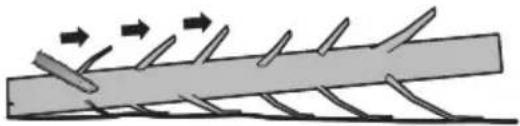
Obr.1
INFORMACE TÉKAJÍCÍ SE HLUČNOSTI
18, Dongwang Road, Suzhou Industrial
Park, Jiangsu 215123, P. R. China
PROHLÁSENÍ O SHODE (BATERIE)
My,
Positec Germany GmbH
Postfach 680194, 50704 Cologne, Germany
18, Dongwang Road, Suzhou Industrial
Park, Jiangsu 215123, P. R. China
OBSAH
- BEZPECNOSTNE POKNY
- ZOZNAM SUCASTI
- TECHNICKÉ PARAMETRE
- POUZIVANIE PODLA URCENIA
- MONTAZ
- PREVÁDZKA
- OCHRANA ZIVOTNEHO PROSTREDA
- UDRZBA PILY
- PREHLÁSENIE O ZHODE
1. BEZPECNOSTNÉ POKYNY BEZPECNOST VYROBKAU VSEOBECNÉ BEZPECNOSTNÉ UPOZORNENIA

VAROVANIE Precitajte si vsetky
TIETO POKNY USCHOVAJTE
18, Dongwang Road, Suzhou Industrial
Park, Jiangsu 215123, P. R. China
VYHLÁSENIE O ZHODE (BATÉRIOVÍ)
My,
Positec Germany GmbH
Postfach 680194, 50704 Cologne, Germany
18, Dongwang Road, Suzhou Industrial
Park, Jiangsu 215123, P. R. China
KAZALOVSEBINE
- VARNOSTNA NAVODILA
- SESTAVNI DELI
- TEHNIÇNI PODATKI
- NAMENUPORABE
- SESTAVLJANJE
- DELOVANJE
- VZDRZEVANJE ZAGE
- ODPRAVLJANJE NAPAK
- IZJAVA O SKLADNOSTI
1. VARNOSTNA NAVODILA VARNOST IZDELKA SPLOŠNA VARNOSTNA OPOZORILA
18, Dongwang Road, Suzhou Industrial
Park, Jiangsu 215123, P. R. China
IZJAVA O SKLADNOSTI (BATERIJO)
Mi,
Positec Germany GmbH
Postfach 680194, 50704 Cologne, Germany
18, Dongwang Road, Suzhou Industrial
Park, Jiangsu 215123, P. R. China
ОГЛавлЕне
- YKA3AHNIO TEXHnke BE30nACHOCTN
2.CNcOK COCTABJIOUx - TEXHnueCKNE DAHHbIE
- HA3HAUHNE
5.CBOPKA
6.PA5OTA - 3KcPJIyATAUINIJIbI
- TÁBЛЦA YCTPAHEHЯ HENCIPABHOCTEY
9.ДЕКЛAPALENCOOTBETCTBNA
1. YKA3AHNЯ ПО TEXHnke БE3OПACHOCTN OBUNE ПРABnla TEXHnKn B63OПACHOCTN ПРИ PABOTE C ЗЛЕКТРОнHCT-PYMEHTOM

I P E D Y I P E X K D E H N E! B H M a T e J b H O 03H a K o m b T e C b H C T p y k u n a r m.
HeBbIOnHHe BCEx HIXeepNBedeEHbIX INHcTpkyKuN I peKOMeHaaU MOKeT pPnBeCTN K nopaxeHIO 3JeKtpNuYeCKM TOKOM, NOXApY IN cepBe3HbIM TpaBMam.
CoxpaHnTe 3t HnHCTpyKuH!
B daIbHeIWeM TepMN "3JIeKTPoHnCTpyMeHT" nCNoIb3yETcKaK dIpaOtaIOUeRo OT cTeN (npoBOHOrO) 3JIeKTPoHnCTpyMeHTa, TaK I dIra 3JIeKTPoHnCTpyMeHTa, paOtaIOUeO O t AkkymyIaTopa (6ecnpoBOHOrO).
1) PABOYEMECTO
a) CopekHTe pa6ooye MeTO B uHCTOTE H XOPOIO OCBeUeHHbIM. 3aRpOMoxJdeHHbIE BepCTAKI NTemHbIE 30HbI CnOCo6CTByOT BO3HNKHOBeHNU HeCuaCTbIX CNYaEB.
6) He pa6oTaIe C nHcTpymeHTOM BO B3pblBOOanacHO aTMocpepe, B npHCyTCTBHN BOCnlaMeHReMbIX XnKoCTe, ra3OB HIN PbIIH. Bo3nkaIOUne npa6ote 3JIeKTPOINHCTpyMeHTa NCKpbI MOrTy pnpBeCTN K BOCnlaMeHeHIO rOpOuHX BeueCTB.
B)Пи pa6Ote c HNcTpymeHTOM DeTu N NOCTOPOHHeJIOJIxHbI HaxoNTbcr Ha 6e3onachom paccToHH. OTbNeueHne BHIMaHry MOKeT pINBeCTn K NOTEpe BaMn
KoHTpOJa.
2) 3JEKTP06E30NACHOCTb
3)ЛИЧАБE30ПACHOCTb
a) 109eBHe BnKn 3JekTpOHcTpymeHToB DOXHBIOOTBETCTBOBaTb pO3eTKam. HIKoRda HIKoUM o6pa3OM He n3MeHnTe CoeHNHTeBHyO BuNKy. PpN 3a3eMnEHHbIX 3JekTpOHCTpyMeHTax He NCNoJIb3yIte HNKaNX nepexoHNKOB. Hen3MeHeHHbIE BuNKu I COOTBeTCTByOUIne pO3eTKn CHnKaIOT PNCK Iopaxhenra 3JekTpOTOKOM.
6) ɪn36eərʌte Φɪn³ηueckɔrɔ KoHTaKTa c 3a3eMJIeHHbIMN NOBepxHOCCTaMn, TaKIMN, KaK Tpy6bl, paDnaTOpbl, pIHTbl N XOJODnJIbHNKn. PnCK nopaxeHnA 3neKtpOTOK OM nOBblIaetCra, ecnn BaWe TeNo 6yddT 3a3eMJIeHo.
B) He noDBePraIte 3JIeKTPoHnCTpyMeHTbI BO3dEChTBIO DOXJr NIN BbICOKO BlaXHOCTN. IOnaJaHne BOJbIB 3JIeKTPoHnCTpyMeHT IOBbIaet ONaCHOCTb NopaxKeHnA 3JIeKTPoTOKOM.
r) PpaBnIbHo 6paaauTecb c 3JeKtpoka6eEm. HkOrda He nCnoB3yIte Ka6eIb dIe nepeHocKn 3JeKTPoMHCTpyMeHTa, a TaKKe He TAHNTe 3a Ka6eIb IJI BbIKIOUcEHN Ma pO3eTKn. DepxHtE Ka6eIb Ha 6e3oNaChOM paCCToRHN OT NCTOuyHKOB TeIIa, MacJa, OCTpbIX KpOMOK IN DBNXkyuNXcYacTei. NOBpeJxHeHHbIe IIN 3aNyTaHHbIe Ka6eI NOBbiAOT PNCK NopaxHeN 3JeKTPOTOKOM.
a)Пи pa6oTe c 3JIeKTPoHnCTpyMeHTOM BHe NOMeueHm NcNoIb3yIte ydINHnTeH, KOToPbIe npEdHa3HaueHHb IЯ na pa6oTbI Ha OTKpbITOM BO3dYxe.3TO CHNkaET pNCK npopaxeHn 3JIeKTPoTOKOM.
e)Прн ИСпОЛБ3ОВAHиЗЛЕКТрОИСТPyМЕНА BO ВlaЖHOM NOME ueHn erO Heo6xOДМо NOДКЛIOчATb K 3ЛeKТрOCeTH Yepe3 yCTpoIcTBO 3aUHTHOrO OTKILOUeHn (Y30) nO TOKy yTeuKn. IcNoь3OBaHne Y3O cHnKaeT pNCK nopaxHeHn 3JIeKTPOTOKOM.
a) BydbTe BHNMaTeIbHbI: CJeInte 3a TeM, yTO Bbl DeIaeTe n pyKOBODCTByTEcB 3dpabBIM CmbicLOm, pa6oTaT a 3NeKTponHCTpyMeHTOM. He nCnOJIb3yIte 3NeKTPOINHCTpyMeHT, eCNI Bbl YCTaII N IINI HAXOINTECb IOd BO3DeNCTBHeM CInIbHOJeICTBYIOUx CpeDCTB, aIKOROJIa IINI MeINKaMeHTOB. IOTepR BHNMaHnA DaJKe Ha KOpOTKoe MRHOBeHne npu pa6Ote C 3NeKTPOINHCTpyMeHTOM MOKeT npNBecTI K Cepbe3HbIM TpaBMam.
6) Испльбутей сндундуалыньные срет CBа 3auntbI. Bcerda нада вайе вайе срет CBа 3auntbI rna3.Тakne срет CBа 3auntbI,кak pecnPapTop,
HeCKoJIb3aIa3aUHTHa8OByB, KaCKa IIN 3aUHTbIe HauuHnK, NcNoJIb3yUOnecB COOTBeTCTByUOnx YCIOBnX, CHNXaOT PNCI ONyuEHH TpaBM.
B)ПpeoTbpaaaiTe cnyaHbI nyck 3NeKtpOnHcTpymeHTa.Y6eHITecb,TO BbIKIOuATelb HaxOHTC8 B NIOLOKeHHN «BbIKIOUeHO» nepeD NOkIOUeHHem K 3NeKtpocTeH/INn aKKyMylrAToHOpH6aTapeH, C6OpKoHnnpeHOCOM 3NeKtpOnHcTpymeHTa. IpeD BKIOUeHHeM B CeTb y6eHITecb, YTO BbIKIOUaTeJIb HxOHTC8 B BbIKIOUeHHOM NIOJoxEHNI. PepeHOCKa INCTpymeHTa C nAInbUcEM Ha KNOpKE PysCA INN B KIOUeHHe B CeTb 3NeKtpOnHcTpymeHTa C BKIOUeHHbIM BbIKIOUaTeJIeM CnOCo6CTByeT HeCuaCTHOMy CNYaHO.
r) YdaIaIte Bce peryIHpOBOHbIe npncnoc6neHna nn raeHbIe KJIIOuN nepeBkIOUcEHem 3JIeKTPoHcTpymeHTa. OctabJIeHHbIe Ha BpaauIoXxCJeTaNJx 3JIeKTPoHcTpymeHTa, OH NMOyT npNBecTu K TpaBMe.
d) He nepehanpraaTecb. NocToHNo 3aHmMaTe yctOuHBOe noloxehne n noDepxHBaIte paBHOBeCne. 3To n03BoJrE TnyUwe KOHTpOINPOBaTb 3JeKTPoHCTpyMeHT B HnpeDbNdeHHbIX CNTyaCuJX.
e) OndeBaItebHaJIeXaUIM 6pa3oM.He HaIeBaIte CBo6OHyO OeJy IIN yKpaWeHn. DepeKInTe BOIOcbI, OeJy INepTuKn Ha yJaJIeHNOT DnBxKyUnxCyaCTe. CBo6OHyO OeJy, YKpaWeHn IIN dINHHbIe BOIOcbI MOKeT 3aTAYb B DnBxKyUneCyaCTN.
K) NcnoB3yIe npedymOTpeHHbIe cpeCTBa n yctpoiCTBa Ira c6opa n ydaJIeHn nn. NcnoB3OBAHne TaNX cpeCTB MOKeT CHN3NTb ONaCHOCTN, CBA3aHHbIe C nbIbIO.
h) He no3BOJnTe 3HaKOMCTBy, nOlyeHHOMy B pe3yIbTaTe YAcTOrO NcNoJIb3OBaHn IHCtpyMeHTOB, I03BOJnTB Bam CHN3NTb BHIMaHne K 6e3ONaCHOCTn N rHOpnPObaTb npHNznnbl 6e3ONaCHOCTn IHCTpyMeHTa. HeocToPOxHoe DeiCTBnE MoXe T MrHOBeHHo npNBecTN K cepbe3HbIM TpaBMam.
4) NcIIOJIb3OBAHHe 3JIeKTPOnHCTPYMEHTA H YXoD 3A HIM
a) He neperpykaiTe 3neKtpoHcTpymeHT. IcnoJIb3yIte nOxOJaUm HcTpyMeHT Jn KaJdoOn npedeJeHHo ceN. PpaBnIbHO NDo6paHbI 3NeKtpoHcTpymeHT BbINOJIHt pa60Ty nuWe n HaedKHee Ha ypOBHe, Jn KOTOpOrO OH npedHa3NaueH.
6) He nCnoIb3yIte 3neKtpoHcTpymeHT, ecJn BblKJIIOUaTeIb HeB03MOXHO BKJIIOuHTb JIN BblKJIIOUHTb. JIO6OJ 3neKtpoHcTpymeHT,
KOTOpbI HeBO3MOxHO KOHTpOINpOBaTb BbIKNoUaTeJeM, npeCTaBnAeT ONaCHOCTb I DoJXeH 6bITb OTpeMOHTnpOBaH.
B) OToCoeHnHTe WTeNceJIb OT 3NeKTPocETn H/HnAkkymyIaTophyIO 6aTapeIO OT 3NeKTPoHnCTpymEtA nepeI npObeHHeM KAKnx-1n60 HAcTpoE KMeHO HacAOK Hn XpaHeHm 3NeKTPoHnCTpymEtA. IOnO6HbIe npedoxpaHnTeJbHbIe Mepbl CHNkaOT OnaCHOCTb CnyauHOrO NcKa 3NeKTPoHnCTpymEtA.
r) XpaHnTe He nCnoJb3yUoIuecra 3JIeKTPOnHCTpyMeHTbIB MeCtax,HeJoCTyINhbIX IЯ DeTei. He pa3pewaIte pa60TaTb C 3JIeKTPOnHCTpyMeHTOM IuCaM, KOToPbIe He 3HaOT erO Oco6eHHoCTe NII H E O3HaKOMJeHbIC DaHHoN HcTpyKUnei. 3JIeKTPOnHCTpyMeHTbIB pyKaX Heo6yueHHbIX NOJIb3OBaTeIeI npedCTaBnIOT onaCHOCTb.
Д) ПОджнвайт eлкгонсгчмент
В ИспраВHom coctoHи. Проверйт
ИнсгчмENT ha п徳met cmeшени
ПИЗаDHЯДУДУДУССЯЧТe,
ПОLOМКI DeTaleH ИИ NIO6bIX INHbIX
НЕСпразВнOCTeH, мOrушIN NOВЛЯТь Ha
pa6OTy 3лкгонсгчментa. B clyuae
ПОВрждENH сLeDyET OTpeMOHTNPOBaTb
3лкгонсгчмENT NepeД пIMMeHHeHem.
MHorne HeCuaCTHbie CnyuAи Вbl3BaHbI ПLOXIM
YxOДOM 3a 3лкгонсгчmENTOM.
e) PexkyuHn HnCTpyMeHT DoJIKeH 6bITb 3aTOueHHbIM N uNCTbIM. Ipn noIepKaHn peKyuNX nHCTpyMeHTOB B NaIeKaIWeM COCTOAHN IN C OCTpbIMpeKyuUM KpOMKaMn BePOrTHoCTb IN 3aKJIINHnBaHn yMeHbShaETcN IMNJIeYynpabJrTb.
JX) IcnoIb3yIte 3NeKTPoHnCTpyMeHT, npHaJIeXHoCTn, CBepLa N T. N. B COOTBeTcTBnC DaHHbIMN HnCTpyKUmaMn, CneuHkoN KOHKpeTHOrO Tnna 3NeKTPoHnCTpyMeHTa, yHtBIBaYcIOBn pa60TbI N BblINOnHReMyIO 3aDaCy. IcnoIb3OBAHne 3NeKTPoHnCTpyMeHTa DJI INhIx Onpaun, NOMMO Tex, dJI KOTOpbIX OH PpeHa3HaueH, MoKeT npVBecTu K BO3HNKHOBeHIO ONaCHO CNTyaUIN.
h)ДерхиTe pyкNи NOBepxHocTH 3axBaT a cyxIMn, YHCTbIMN n CBO6OndbIMN OT Macna H Knpa. CKoJIb3Kne pyckn N IOBepxHocTh He I03BOJIAOT dЯб6e3OnaChOrO o6paueHn Y KOHTpOJa NaI INHCTpyMeHTOM B HeOxKnDaHHbIX CNTyaCuaNX.
5) INCIOJIb3OBAHHe AKKYMylrTOPHOro HNCTPYMEHTA N YXOD 3A HUM
a) Пдзарду Akkymлтopa npoH3BODHTOЛько орннHLbHbIM 3apdHbIMycTpoIcTBOM.Зардhoe yctpoIcTBO,KOTOpoe
NOxOHTIg OJHOro Tnna aKKymyTOpHO
6aTapeu, MoKeT npNBecTu K NoXapy,
KOrda NcNoJIb3yeTcR C DpyrIM TINOM
aKKymyTOpHO 6aTapeu.
6) NcnoJb3yIte aKKymyJIaTOPbI INHCTpyMeHT TOJbKO C opHnHaJIbHbIMN aKKymyJIaTOPaM. NcnoJb3OBAHne IIObO rDpyrO rTtna aKKymyJIaTOPa MOKeT PpNBecTu K TpaBMe nnn noXapy.
B) HeuOnb3yEmblie aKkymyIaTopHbIe 6aTape XpaHHTe OTdEJIbHO OT MeTaJIInuecknX PpeIMeTOB, TaKHX KaK cKpenKn IJy 6ymarH, MOHeTbI, KJIIOUH, rBO3Dn, BnHTbI N TOMy NOO6Hoe, KOtOpBle MOrY T aMKHyTb KOHTaKTbI 6aTape. 3aMbIKaHne KOHTaKTob aKKymyJIaTOpHoi 6aTapeN MoKeT npNBecTu K OxKOram nII NoKapy.
r) B KpHTnuecknx CNTyaunx H3 aKKymyIaTopa MOKeT BbITeKaTb KNDKOCTb - N36eraIte KOHTaC Hei. EcH JNDKOCTb BCE Je IONaHa NOBepXHOCTb KOHN - cMOITE ee 6OJIbUHM KOINCeTBOM BObl. PpN IOnaDaHH KNDKoCTN B Tla3a CpouHo O6paTnTEcb 3a MeINHCKoN NOMouBIO. KNDKOCTb, BbITeKwAa H3 aKKymyIaTopa, MOKeT Bb13BaTb pa3IpaXeHne INN OXkOrn.
d) He nCnoB3yIe 6aTapeHbI 6Iok IINn HnCTpyMeHT, KOtOpbI IOBpeKJen IIN MoNΦnUPOBaHHbIe 6aTapeM OryT npNBecTN KIOXApY, B3pbIBy IIN NOJyEHNTO TaBMbl I BO3HnKHOBeHNIO HEOxNdaHNOCTeI.
e) He no3B0JrTe 6aTapee 3arOpetbCn nn neperpetbc. Ioxap nn TeMnepaTypa Bblwe 130^ MoKET npuBecTu K B3pbBy.
K) CneyuTe HNCTpykUIM No 3apJKe N He 3apJXaIte 6aTapeHbI 6nok NnN HNCTpymeHT 3a npedJaMn TempepaTyphoro dnaHa3oHa, yka3aHHoro B nHCTpykUnx. HenpaBnIbHa 3apJka Nn TEmpepaTypa, BbIXOJaZa 3a npedeJIb Yka3aHHoro dnaHa3oHa, MOKeT IOBpeINTb aKKyMyJATOp N NOBbICNTb PNC BO3rOpAHIA.
6) CEPBNC
a) PeMoHT 3JIeKTpOHcTpyMeHTa DOJIHNO BbIINHOHTbC KBAHIOuPObAHbIM NepCOHaON C HcNoJIb3OBAHmE ToJIbKO OpHMHaJIbHbIX 3aNaChbIX YAcTe. 3To o6ecneHT rapaHTnIO 6e3oNaCHOCTn erO NCNoJIb3OBAHn.
6) HeIb3a peMOHTnPOBaTb NOBpeKdEHHbIe aKKymyIaTOpbI. 06cnykuaHne aKKMyJIaTOpHbIX 6JIOKOB DOJXHO BblONHrTbcra TOnbKO pOuN3BOIDnteJeM IIN aBTOPn3OBaHHbIM NoCTaBUnKaMn ycnyr.
1) YKA3AHNIO TEXHnke 6E30nACHOCTNIPII PA6OTE C LENHbIMN NIIAMN:
a)Держнтесь поалбwe OT DBNKKUSeencaenn pa6oTaOuSe nHbI.пeped 3anyckomnbl06a3aTeNbHO y6eDnTecb B OTCyTCTBKNKoHTa TnHbHOn c KaKHMn-лбО npedMeTamn. Notepa BHIMHa Ha KOpOTKoeMRHOBeHne BO BpeMa pa6oTbIC cEHNo NNoLO MoKeT npNBecTu K 3axBaTy OeJDbI NIn KaKOJINo6O qactTu TeNa NnHbHOn cEpbIO.
b) Bcerda ČeρЖиTe ζeHny ΜnHy npaBoi pyKoJ 3a 3aHIOU pyKoTky, a JeBOI pyKoJ - 3a nepeHIOU. YdePkaHne ZeHNO IINblB DpyROM pa6OcHem NpOKeHNu PYK pe3KO NOBbIwaET onaCHocTb TpaBMIpOBaHry n Po3TOMy HeDOnyCTM0.
c) 063aTeNbHo DepxHte 3eKTPoHnCtpymeHT TOnbKO 3a H3OlnpOBAHHbIe pyuKn, NocKoJIbKy NNbHa Yenb MoKeT 3aDeTb CkPbItyO 3eKTPoNPOBOKy. KoHTaKT PnIbHOu c HaxOJaUeNc NOd HapJxKeHnE M pOBOkOu MOKeT 3apXKaTb MeTaNueCKne YaCTN 3eKTPoHnCtpymeHTa IN pNBoDnTb K ydaPy 3eKTPnuCeKNM TOKOM.
d) 063aTeIbHo HaedeBaIte 3auNTHbIe Oukn n CpeIcTbA 3auNTbI OpraHOB clyxa. PekomeHdyETc TaKKe MCnonb3oBaTb CpeIcTbA HndNBduayabHOH 3auNTbI dra rOIOBbl,pyKnHor. IOnxOJa7a 3auNTHaJr Odekda n ObyBb CHNkaet ONaCHOCTb TpaBMnpOBaHn BblTeAIOUmm CTpyKKaMn N npu CnyaHOM KOHTaKTe C dBHXyueiCra NNbHOu ceNbIO.
e) HnKOrda He pa6oTaIte cenHoi nHoi, haxOJaCb Ha DepeBe. Pa6oTa cENHO nnIOHa DepeBe CB3aHa C BbICOKO ONaCHOCTbIO TpaBMIpOBaHna.
f) Bcerda cneiTe 3a npaBnIbHoN CToIKo N
ncnoJb3yIte ueHny nHy ToIbKO npn CToKe
Ha npOuHOM,6e3OnacHom HPOBOM rpyHTe.
CkOJIb3KOE nNI HeCTa6NJbHOE OCHOBaHne,
HaNP., Ha neCTHnCe, MOKeT npNBecTu K NOtepe
paBHOBecnA N, KaK CNeIcCTBHe, K NOtepe
KOHrPoJra Na CEHNHOI NIOIoN.
g)ПиОБрзAHnHAnpJxKHeHbIXBETBeN 063aTeIbHO CHTaITcEb C BO3MOxHOCtBu IX HeoXnDaHHOrO OTpyXmHBaHn.Пи BblCBO6OXDeHn MExaHnueCKOrO HApJxKeHn IpeBeCHbIX BOLOKOH BblPMAJIIOuNEcH HApJxKeHHbIe BeTKM OryT NOnaCTb B pa6OtaUoIero N/INn PnIBeCTN K NTope KOHTpOra NaI cenHO nNoI.
h) BybTe oc06eHNO octopoxHbI npn 6pe3aHHN NOIecka MMOAbIX DepeBbeB.ToHKIN Cpe3aeMbIMaTePnaI,3aXBaueHHbI INlbHOU CeIbIO, MoKET HaHeCTN HeOxuaHHbI ydAp IIN BbIECTN N3 COCTOHN paBHOBecnA.
i) IpehenocTe ueHyIO nnIy ToIbKO B BbIKIOUeHOM COCTOAHN, DePka ee 3a nepeHIOpyKoRTky TaK, UTO6bl NnIbHaue nBcerda cMOtpeLa B cTOpOH yOT BaUero Kopnyca TeLa. PpN TpaHCnOpTnOpBKe HIN xpaHeHHu CENHOI NIIbI BCERda HaDeBaHTe Ha Hee 3aunTHbIKoKxh.BHMATEJIbHoe o6paueHne C CEHNHOI NINO Pe3KO CHNXaET BepoTHOCb ClyuaHOrO KOHTaKTa C DBHXUeICr NlNbHOJ UeMbIO.
j) TuaTeNbHO BbIOnHnYe BCE yKa3aHnno CMa3Ke n HaTJXeHHIO cenn N CBOeBpeMeHHO 3aMeHnTe npHaadJeXHoCTn. HenpaBnIbHO nn HeoCTaTOUHO Xopoio HaTAYta nn HeCMA3aHHa cenb cyuceCTBeHHo NOBbIwaet ONaCHOCTb NoBLeHHa pbIKOB nn OTdaun HHCTpyMeHTa.
k) NcnoIb3yIte nHCTpyMeHT TOnbKO dIpaacnIKN DpeBecnHbI. He nCnoIb3yIte cENHyIO nNy dJIe BblIOJIHeHnRApo6OT, He npEpyCMOTpeHHbIX B nHCTpyKcUNn PO 3KcNlyatauHN. PpIMep: He nCnoIb3yIte cENHyIO nNy dJIa paCnIIKN pNaCTMacc, KaMeHHoN KnaIK Nn HeDpeBechix CTPONTeINbHbIX MaTePnaHOB. PpIMeHneUeHNHO nnIbI dJIe BblIOJNeHnRApo6T He nO npRMOy Ha3HaueHnIO MOKeT npNBecTu K qpe3BbIyaHNO ONaChbIM CNTyaCnM.
I)Пиlaпрдна3нayehaДЯ ПОдpe3KN DepeBbeB.ИспоьзOBaHne ПилblДЯ OБpe3KN BeTOKВДpyrnx ZeJx MoKet npUBeCTN K Cepbe3HbIMТpaBMam OпePaTopa ИИн HaxOJaUxXcR prdOMЛюdei.
m) PnOuNCKe OTe 3aCTPbBxN XpeDMeTOB, XpaHeHn H cepBnCHOM 06cnyXnBaHH NnblI Dn O6pe3Kn BeTOK co6LIOaJIte Bce npNBedeHHbIe HnCtpyKuHN. IpoBepbTe, YTO nepeKlIOyAteJIb BbvIKNoUeyH n AKKyMylTOpHbI KOMnJIeKT n3BLeueH. CnyaHnaA kTINBaCuN PnblI Dn O6pe3Kn BeTOK pN OUYCTKe OT 3aCTPbBHX PpeMeTOB nNN CepBnCHOM 06cnyXnBaHH MoKeT PpNBecTu K cepBe3HOJ TpaBMe NepcoHaJa.
n) Yelobeky, HcnoIb3yIoUeMy Nnly B nepBbI pa3, peKOMeHdyETcA, KaK MmHmym, nonpaKTnKObaTbcra B 6pe3Ke cybeB Ha nHbHbIX KO3Jax NnHa onOpHoPaMe.
o) PeKOMeHdyTeTc npHBNeKaTb K 3aTOUKe HnH TexO6CnyXKNBaHHIO NnIbHOJ cENI TOJIbKO COtpyDnIKOB yNOLHOMOeHHbIX CepBnCHbIX ueHTPOB.
(2)Пичны И педOTВрашени образноТаун:
OTdau MoKet BO3HKnKHyTb npi KOHTaKeTe OCTpna HnpaBraIooJe IINHbIC KaKIM-NIO6 ppeMeTOM nPi npuN3rN6e DpeBeCInhbl, pnpBOJaem K
3axaTIO NIIbHOI CEIN B npONJIe.
PnKacHne ocTpna HbI K NOcTOpOHHeMy
PpeMety MoKeT npBecTu B pRde Cnyaeb K
HeOKnDaHHOMy HAnpaBLeHHOMy Ha3aD OTCKOKy,
PnKOTOPOM HAnpaBraIOUcaa ShHa OTKNbIBaETcA
BBePx B HAnpaBHeHn OnpaTopa.
3aXaTne BepxHero Kpaar HappaBIAUocei uHbI PnIbHOJ cENN MOKeT pPBeCTN K 6bICTpOMy OTCKOKU uHNbI B HAppaBLeHIn OpeaTopa.
Kakda TaKaPeaeknMoKeT npBeCTn K
NToTepe KOHTPOJI NaI NIOI N TAgKeIOn TpaBMe.
He IOnaraiTeCb ToIbKO Ha BCTpoeHbIe B NIIe
PpeOxpanTeJIbHbIe yCTpOiCTBa OecneueHn
6e3OpacHOCTn. POnb3OBaTeJIu CENHOJ NIIbl
DOJIXHbI PrINrABT BCE BO3MOXHbIE Mepbl
PpeOCTOpoxHoCTn DnA ObecneueHn 6e3OpacHO
pa60Tbl.
PikooietAIBIeTcCneCTBnEM OUn6OuHOro
HIN He npabunbHorO nCNoIb3OBaHnRA
3NeKTPoHHCTpyMeHTa. IocneJHee MoxHo
PpeDToBpaTtB NDOxOJaUIM MepaMNIpeOCTOpOXHOCTN, ONNCaHHbIMN daJe:
a) Kpenko DeppKHTe Nnly DByMaPyKaAM, npn 3TOM NaIbCuI DOJXHbI XopoOo OXBaTbIBaTb pyKoRTKn ZenHOI Nnbl.3aHmMaTe TaKoe NOLOXeHne I BceRda DeppKHTe pyKu TAK, YTO6bl npn Heo6xOdmocTo HadeXHO IpOTNBOCToTb CnIam OTDaN. Pp npiHrTn HaJIeKaUnx MEP ppeOCTOpOXHOCTo ONepaTop MOKe T COBlaadTaB C yCNIIaMm OTdauN. HNKOrda He BbInyckaTe IV3pyk BKIOUeHHU OeHNHyO NnIy.
b)ИЗбeraиTe HENPnroDhbIXДЯ pa6oTbI NOLOXeHm KOpnyca n He pINlTe Ha ypoBHe Bblwe nneu.3TO N03BOJNT NCKJIQUHTb CNYaHbIe npKacAHN OCTPNJ WNHbIK OKpykaIOUIM PpeMEdtAm n OBeCneuT LyuWn KOHTpOb 3a CEHNOH INIOB B HEnpeDbUdEHHbIX CNTyaUnx.
c) Bcerda nCnoB3yIte ToJbKO npEaHncaHbIe N3rOToBHTeIem 3aNaChbIe uHHbI NnnbHbIe cenn. IcNoJIb3OBAHne HEnpRuOdHbIX uHH NnnbHbIX cenei MoKeT npuBeCTN K pa3pbIBaM cenn nn OTdaue.
d) BbINOHnYe yKa3aHnN H3rOToBnTeJn npn 3aTOUKe N BbINOJIHeHm TExHnueCKoR O6cIyXnBaHn NIIbHOJ cENN. CnWkoM Hn3KO YCTaHOBNeHHbIe ORpaHnHTeN rIy6uHbI IOBbIaOT BO3MOxHOCtB OTaHn.
OCTATOHbIE PNCKN
JaXe npHa3HaueHHOM NcNoJIb3OBAHnnp6opa Bcerda cyuecTByeT OCTaToUHbIpnCK, KOtOpbI He MoXeT 6bl TpeDoTbpaUeH. B 3aBncMocTn OT TnPa I KOHCTpyKUnnp6opa MoryT pOnCxOJNT bCJeDyUOHeNotEHuaNbHbIe ONaCHOCTN:
-KoHTaKT CnnIbHbIMN 3y6bMaN (ONaCHOCtB nope3a)
-ДocTyнКВрашоцяпльнОи (onacHocTb nope3a)
- HenpeBnDcHHe, pe3Koe DbXKeHne nIbHOJ uHHbl (OnaCHOCTb nope3a)
-BbIeT dTeaEn n3 nIIbHOJ cENn (ONaCHOCb nope3a / npOHKnHOBeHna)
- BbIeT qacte 3aROTOBKn
-KoHTaKT KOKN C MacJLOM
- Iontepra cnyxa, ecn He nCnoJb3ayetcTpe6yemma 3aunTa ywei BO Bpempa60TbI
ПРЕДУПЕЖДECHИ БЕЗОПACHOCKТДЛЯ АKKUMЛЯTOPHО БATAPEN
a) He donyckaetca pa36npaTb, BCKpbIBaTb, n3MeIb4aTb 3JeMeHTbl NHTaHn aKKymJrTopHyIO 6aTapeio.
b) He donyckaetc haKopoTko 3aMbikatb 3IeMeHtbl nHTaHnN nn aKKymyIATop. He donyckaetc 6ecnpaOnHO xpaHntb 3IeMeHtbl nHTaHnN nn aKKymyIATop B Kopo6ke nn JaUKe, rDe OH N MOryt 3aMKHyTb dpyr dpyra nn MOryt 6bITb 3aMKHyTb dpyrMM MeTaJIInueckMn NpeDMeTAM. Ecln aKKymyIATopHa8 6aTaper He nCIOBb3yeTcR, depXnTe ee NOdaJIbWe OT MeTaJIInueckNX npeDMeTOB, TaKnx KaK 3aXIMbl, MOHeTbl, rBO3dN, BNHTbl I npOuNe MeTaJIInueckne npeDMeTbl He6oJbWoRo pa3Mepa, KOToPbIE MOryt CoeINHtB KLeMMbl dpyr C dpyrom. KopotKoe 3aMbikaHne KLeMM 6aTaper MoKet cTaTb pnuHHo OxKOrOB nn IOxapa.
c) He donyckaetcnoBepraTb aKKymlyaTopHyIO 6aTapeIO BO3deIcTBIO BBICOKHX TemnepaTyp HIN PIIaMeHN. N36eraTe xpaHEnria kKymlyaTopHO 6aTapeN B MecTax, NOBepKeHHbIX BO3dEICTBIO Ipramoro CoJIneHOrO CBeta.
d) He donyckaetc noDbepraTb aKKymIaTophyIO 6aTapeIO MexaHnueckm ydapam
e) B clyaae npoteckn aKKymyIToPnoH 6atapen, He donyckaite KOHTaKaT a 3JeKTPoNHTa c KoxKe Hnn rna3amn. B clyaae TaKoro KOHTaKaT a Heo6xOdmo IpOMbITb NopaxeHHbI yAcTOK 06NJbHbIM KOJIHeCTBOM BObl N O6paNTbCra 3a MeDnUHcKo NOMOu bIO.
f) AKKymyIaTOpHyIO 6aTapeIO Heo6xOJHMO coepKaTb B uNcToTe n cyXocTH.
g) B cnyuae 3aarp3HeHnKoHTaKToB aKKymyIaTOpHoi 6aTapen Hx Heo6XoDnMo npoTepeTb YnCToI cyXO TkAhbIO.
h) AkkymyIaTOpHyIO 6aTapeIO Heo6XoIMMo 3apJxKaTb IpeE NcNoJIb3OBAHHem. Bcerda cIeNyIte DaHHO INcTpyKUnn HcNoJIb3yIte npaBnIbHbI INopJaOK 3apJdKN.
i) He donyckaetc octabTb aKKymyIaTOP Ha 3apAHHOM yCTpOietBe, eCJH OH He HcNoJIb3yeTc.
j) Nocne npoDOnKHTeIbHOrO xpaHeHn MoKeT nOTpe6oBaTbcr HeCKoJIbKO pa3 3apAHTb n pa3pAHTb aKKyMylrTOphyIO 6aTaPeEO IJRA DOCTNHexHn MaKcHMaJIbHOI 3ΦΦeKTNBHOCTNe ee pa60Tbl.
k)ИспользуITEToIbKO3apЯнbie yctpoiCTBa,yka3aHHbIeWorx.He IONYCKaETcNcNoJIb3OBAtB KaKHe-JIH6O 3apЯнbie yCTpoiCTBa,3a NCKJIIOUeHENEM CNEuHaBHO ppeHa3NaueHHbIXДЯ DaHHoro 06OpydoBaHnI.
I) He donyckaetcnaonb30BaTb KaKne- n6o akKymytaTophbie 6aTapen, He npedHa3HaueHHbIe IJRA HCnOJIb30BaHnra C daHHbIM 06OpydoBaHnem.
m) XpaHnte aKKyMnyTopHyIO 6aTapeIO B MeCTax, HeOcTyNhbIX dIra DeTei.
n) CneJeT coxpaHHTb opRHHaIbHyIO DOkymeHTaUIO Ha n3dJIne IJIA 6yduero NCNoJIb3OBAHnA.
o) IIO BO3MOXHOCTN 3BNEkaIte aKKymyJrTOpHyIO 6aTapeIO H3H3dEINIA, ecNI OHa He NcNoJIb3YeTc.
p) YTNIN3npyuTe aKKymyIaTOpHyIO 6aTapeo DOJXHBIM 06pa3OM.
q) He nCnoB3yIte C yCtpoiCTBOM 3JeMeHTbI pa3HOrO npOn3BOcTBA, eMKoCTn, pa3Mepa nn Tnna.
r)ДерхиTe 6aTapeIO noaIbWe OT MKNPOBOJIHOBbIX NeeH N BbICOKO rDaBJIeHn.
s) IpeynpeXdHne! He nCnoB3yIte HeaKKymyTopHbIe 6aTapeKn.
COXPAHNTE 3TN NHCTPYKUN
Yka3aHn, KacaIOuNecr npaBnIbHbIX MeToIOB, 06pe3Kn cybeb n nonepueHno paCnNoBkn
1.YdaJIeHHe BeTBei
Iod ydaJIeHHeM BeTBe NOpa3yMeBaEcTc Hx CnIIbAHne c yXe NOBaJIeHHOro DepeBa Ipn YdaJIeHn BeTBe BHaUaJe OCTaBbTe Ha MeCTe CaMbIe KpyNbIe N3 HIX, KOToPbIe HApPaBJIeHbI BHN3 H Na KOTOpbIe ONIPAeTCra NOBaJIeHHoe DepeBO. YdaJIInTe MeHbIe BETkO OdHM 3aNNJOM, KaK 3TO NOKa3aHO Ha pncYHke. BeTKI, HaxOJaIuIecr IOD HApPjaKeHHeM, DOJXHbI OTnJIINBaTbCRA CHN3y BBepx, YTO6bl NCKLIIOHTb BO3MOXHOCTb 3aXaTna NNbHOJ cenn. (Cm. pnc.1)
PNC.1
2. Pa3pe3aHne CTbOJa DepeBa Ha qactn
Iod 3TtM IOHmaeTc paCnJIuBaHHe CTBOJa
NobaleHHoro DepeBa NO dInHe Ha qactn. CneHTe 3a 6e3oNaChOCTbIO CTOnKn n paBHomepHbIM
pacpeJeHem Beca TeHa o6e HOrn. Ecnn 3TO
BO3MOXHO, CJIeDyET CO3DaTb ONOpY IJr CTBOJa
DepeBa c NOMoubIO BeTBei, 6aJOK NII KINHbeB.
BbINOJHnYe IpocTbIe yKa3aHnI dIra JERKOrO
paCnJIuBaHnI.
EcnI CTBOJ DepeBa 6yJeT paBHomepHo yloKeH NO BCen dInHe, NaHHTe pacnNkCy CBepx.y. (Cm.pnc.2)
pnc.2
Ecni CTBOJ DepeBa JIeKHT Ha OJHOM KOHcE, npoJIInTe BHaUaJe 1/3 DnAmEtpa CTBOJa C HIXHei CTOpObI, a 3aTeM npoJIInTe oCTaTOK CBepxHaI MeCTOm HIXKeHrO 3aIINa. (Cm.pnc.3)
pnc.3
EcnI CTBOJ DepeBa JIeKHT Ha 06Ox KOHcax, npoJIInTe BHaayane 1/3 dHaMeTp a CTBOJa C BepXHei CTOpOHbI, a 3aTeM npoJIInTe 2/3 CHn3y Ha MeCe Te BepXHero 3aIINa. (Cm. pnc. 4)
PNC.4
Pn BbIOJIHeHn paCnIIOUhIx pa60Ha CKNoHE cToIe BceIa BblIe CTBOna DepeBa. Ia coXpaHEnHn POHoro KOHTpOra BO BpeMg «PpONIIuBaHnRA yMeHbAaTe B KOHcpe PpONIIa PpIXMMHOye YCNIIne, He OcIa6JIa KpeNocTb 3axBaTa pyKoTOK cENHO nnbl. BHIMATEJbHO CLeIte 3a TeM, YTObI NNbHa Y cENb He Kacalacb 3emn. NocIe 3aBepWeHn paCnIIa nepeydaJIeHnEM cENHO nnbl DOxKnITecb POHoi OCTaHOBKn nnblHO cenn. BcerDa BbIKIOuaTe DBIrAtelb cENHO nnbl Prn nepexOde OT ODHOrO DepeBa K dpyromy. (Cm. pnc.5)
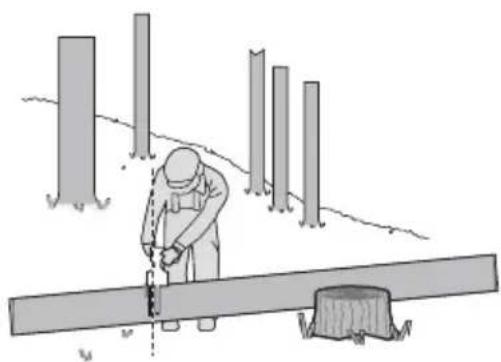
pnc.5
YCIOBHBIE O6O3HAUeyn
| Для сноженя риска Травмьпользовать Долженьproчтать рухковдоств поэксплуатци. | |
| Наденье зашиту сныха | |
| Наденье зашиные очkin | |
| Наденье песнира_TOP | |
| He донувские отскoked пелы иee KO的手има с кончим Рлианки. | |
| ТOKOM обераяte OT дождя | |
| Одевайе зашиные有很大пспспstмы. He yтллзирейные有很大пспспstмы. | |
| He поочи ratb. | |
| При несяватьй ог утллаз榴етьбатарей могут поастьВодный сизд, чу ожетьбытob�аим дд дд дд дд дд dд dд dд dд dд dд dд dд dд dд dд dд dд dд dд dд dд dд dд dд dд dд dд dд dд dд dд dд dд dд dд dд dд dд dд dд dд dд dд dд dд dд dд dд dд dд dд dд dд dд qd qd qd qd qd qd qd qd qd qd qd qd qd qd qd qd qd qd qd qd qd qd qd qd qd qd qd qd qd qd qd qd qd qd qd qd qd qd qd qd qd qd qd qd qd qd qd qd qd qd qde qde qde qde qde qde qde qde qde qde qde qde qde qde qde qde qde qde qde qde qde qde qde qde qde qde qde qde qde qde qde qde qde qde qde qde qde qde qde qde qde qde qde qde qde qde qde qde qde qde q.de qde qde qde qde qde qde qde qde qde qde qde qde qde qde qde qde qde qde qde qde qde qde qde qde qde qde qde qde qde qde qde qde qde qde qde qde qde qde qde qde qde qde qde qde qde qde qde qde qde qDE qDE qDE qDE qDE qDE qDE qDE qDE qDE qDE qDE qDE qDE qDE qDE qDE qDE qDE qDE qDE qDE qDE qDE qDE qDE qDE qDE qDE qDE qDE qDE qDE qDE qDE qDE qDE qDE qDE qDE qDE qDE qDE qDE qDE qDE qDE qDE qDE qDE q(DE qDE qDE qDE qDE qDE qDE qDE qDE qDE qDE qDE qDE qDE qDE qDE qDE qDE qDE qDE qDE qDE qDE qDE qDE qDE qDE qDE qDE qDE qDE qDE qDE qDE qDE qDE qDE qDE qDE qDE qDE qDE qDE qDE qDE qDE qDE qDE qDE qDE qRE qDE qDE qDE qDE qDE qDE qDE qDE qDE qDE qDE qDE qDE qDE qDE qDE qDE qDE qDE qDE qDE qDE qDE qDE qDE qDE qDE qDE qDE qDE qDE qDE qDE qDE qDE qDE qDE qDE qDE qDE qDE qDE qDE qDE qDE qDE qDE qDE qDE qIDE qDE qDE qDE qDE qDE qDE qDE qDE qDE qDE qDE qDE qDE qDE qDE qDE qDE qDE qDE qDE qDE qDE qDE qDE qDE qDE qDE qDE qDE qDE qDE qDE qDE qDE qDE qDE qDE qDE qDE qDE qDE qDE qDE qDE qDE qDE qDE qDE qDE qID qDE qDE qDE qDE qDE qDE qDE qDE qDE qDE qDE qDE qDE qDE qDE qDE qDE qDE qDE qDE qDE qDE qDE qDE qDE qDE qDE qDE qDE qDE qDE qDE qDE qDE qDE qDE qDE qDE qDE qDE qDE qDE qDE qDE qDE qDE qDE qDE qDE qLEq qDE qDE qDE qDE qDE qDE qDE qDE qDE qDE qDE qDE qDE qDE qDE qDE qDE qDE qDE qDE qDE qDE qDE qDE qDE qDE qDE qDE qDE qDE qDE qDE qDE qDE qDE qDE qDE qDE qDE qDE qDE qDE qDE qDE qDE qDE qDE qDE qDE qADE qDE qDE qDE qDE qDE qDE qDE qDE qDE qDE qDE qDE qDE qDE qDE qDE qDE qDE qDE qDE qDE qDE qDE qDE qDE qDE qDE qDE qDE qDE qDE qDE qDE qDE qDE qDE qDE qDE qDE qDE qDE qDE qDE qDE qDE qDE qDE qDE qDE qODE qDE qDE qDE qDE qDE qDE qDE qDE qDE qDE qDE qDE qDE qDE qDE qDE qDE qDE qDE qDE qDE qDE qDE qDE qDE qDE qDE qDE qDE qDE qDE qDE qDE qDE qDE qDE qDE qDE qDE qDE qDE qDE qDE qDE qDE qDE qDE qDE qDE qIDES qDE qDE qDE qDE qDE qDE qDE qDE qDE qDE qDE qDE qDE qDE qDE qDE qDE qDE qDE qDE qDE qDE qDE qDE qDE qDE qDE qDE qDE qDE qDE qDE qDE qDE qDE qDE qDE qDE qDE qDE qDE qDE qDE qDE qDE qDE qDE qDE qDE qDERQYDAHDAHDAHDAHDAHDAHDAHDAHDAHDAHDAHDAHDAHDAHDAHDAHDAHDAHDAHDAHDAHDAHDAHDAHDAHDAHDAHDAHDAHDAHDAHDAHDAHDAHDAHDAHDAHDAHDAHDAHDAHDAHDAHDAHDAHDAHDAHDAHDAHDAHDAHAHDAHDAHDAHDAHDAHDAHDAHDAHDAHDAHDAHDAHDAHDAHDAHDAHDAHDAHDAHDAHDAHDAHDAHDAHDAHDAHDAHDAHDAHDAHDAHDAHDAHDAHDAHDAHDAHDAHDAHDAHDAHDAHDAHDAHDAHDAHDAHDAHDAHdaHDAHDAHDAHDAHDAHDAHDAHDAHDAHDAHDAHDAHDAHDAHDAHDAHDAHDAHDAHDAHDAHDAHDAHDAHDAHDAHDAHDAHDAHDAHDAHDAHDAHDAHDAHDAHDAHDAHDAHDAHDAHDAHDAHDAHDAHDAHDAHDAHDAHFAHDAHDAHDAHDAHDAHDAHDAHDAHDAHDAHDAHDAHDAHDAHDAHDAHDAHDAHDAHDAHDAHDAHDAHDAHDAHDAHDAHDAHDAHDAHDAHDAHDAHDAHDAHDAHDAHDAHDAHDAHDAHDAHDAHDAHDAHDAHDAHDAHDAHCAHDAHDAHDAHDAHDAHDAHDAHDAHDAHDAHDAHDAHDAHDAHDAHDAHDAHDAHDAHDAHDAHDAHDAHDAHDAHDAHDAHDAHDAHDAHDAHDAHDAHDAHDAHDAHDAHDAHDAHDAHDAHDAHDAHDAHDAHDAHDAHDAHDAHDBA HDAHDAHDAHDAHDAHDAHDAHDAHDAHDAHDAHDAHDAHDAHDAHDAHDAHDAHDAHDAHDAHDAHDAHDAHDAHDAHDAHDAHDAHDAHDAHDAHDAHDAHDAHDAHDAHDAHDAHDAHDAHDAHDAHDAHDAHDAHDAHDAHDAHDA HDAHDAHDAHDAHDAHDAHDAHDAHDAHDAHDAHDAHDAHDAHDAHDAHDAHDAHDAHDAHDAHDAHDAHDAHDAHDAHDAHDAHDAHDAHDAHDAHDAHDAHDAHDAHDAHDAHDAHDAHDAHDAHDAHDAHDAHDAHDAHDAHDAHda HDAHDAHDAHDAHDAHDAHDAHDAHDAHDAHDAHDAHDAHDAHDAHDAHDAHDAHDAHDAHDAHDAHDAHDAHDAHDAHDAHDAHDAHDAHDAHDAHDAHDAHDAHDAHDAHDAHDAHDAHDAHDAHDAHDAHDAHDAHDAHDAHDAHCA HDAHDAHDAHDAHDAHDAHDAHDAHDAHDAHDAHDAHDAHDAHDAHDAHDAHDAHDAHDAHDAHDAHDAHDAHDAHDAHDAHDAHDAHDAHDAHDAHDAHDAHDAHDAHDAHDAHDAHDAHDAHDAHDAHDAHDAHDAHDAHDAHDAH DA HDAHDAHDAHDAHDAHDAHDAHDAHDAHDAHDAHDAHDAHDAHDAHDAHDAHDAHDAHDAHDAHDAHDAHDAHDAHDAHDAHDAHDAHDAHDAHDAHDAHDAHDAHDAHDAHDAHDAHDAHDAHDAHDAHDAHDAHDAHDAHDAHDAHBA HDAHDAHDAHDAHDAHDAHDAHDAHDAHDAHDAHDAHDAHDAHDAHDAHDAHDAHDAHDAHDAHDAHDAHDAHDAHDAHDAHDAHDAHDAHDAHDAHDAHDAHDAHDAHDAHDAHDAHDAHDAHDAHDAHDAHDAHDAHDAHDAHDAHDB A HDAHDAHDAHDAHDAHDAHDAHDAHDAHDAHDAHDAHDAHDAHDAHDAHDAHDAHDAHDAHDAHDAHDAHDAHDAHDAHDAHDAHDAHDAHDAHDAHDAHDAHDAHDAHDAHDAHDAHDAHDAHDAHDAHDAHDAHDAHDAHDAHDAHFA HDAHDAHDAHDAHDAHDAHDAHDAHDAHDAHDAHDAHDAHDAHDAHDAHDAHDAHDAHDAHDAHDAHDAHDAHDAHDAHDAHDAHDAHDAHDAHDAHDAHDAHDAHDAHDAHDAHDAHDAHDAHDAHDAHDAHDAHDAHDAHDAHDAHMA HDAHDAHDAHDAHDAHDAHDAHDAHDAHDAHDAHDAHDAHDAHDAHDAHDAHDAHDAHDAHDAHDAHDAHDAHDAHDAHDAHDAHDAHDAHDAHDAHDAHDAHDAHDAHDAHDAHDAHDAHDAHDAHDAHDAHDAHDAHDAHDAHDAHSA HDAHDAHDAHDAHDAHDAHDAHDAHDAHDAHDAHDAHDAHDAHDAHDAHDAHDAHDAHDAHDAHDAHDAHDAHDAHDAHDAHDAHDAHDAHDAHDAHDAHDAHDAHDAHDAHDAHDAHDAHDAHDAHDAHDAHDAHDAHDAHDAHDAH | |
*He BCE npHnHaIeJXHOCTN, HJIIOCTpnpOBAHHbIE HIN ONHCaHHbIE BKJIIOUeHbI B CTAHdapTHyIO NOCTaBky.
3. TEXHnueCKNE DAHHbIE
TIN WG326E WG326E.X (3 HanmeHOBaHn yCtpoiCTBa, npedctablaIOuIe pa6oTaIOUyO ot akKymyIaTopa nnny Ira 06pe3Kn BeToK; X - BapbnpyeTcO T 1 Do 99, yka3bIBaHa pa3mNBAkceccyapax. KIOueBbIe xapaKTepnCTNK ocTaIoTc HEN3MeHHbIMn.)
OCTOPOXHO! He ycTaHaBnBaIeTe
6aTapeHbI 6nok Do noHoro 3aBepHeHra
c6opKn.
Bcerda nCnoIb3yIte nepuatkn npn pa6oTe c ceIbIO.
MOHTAX LENI NINJIbHOJ UINHbI
- Octopoxho pacnakyte BCE yactn. Chmnte Koxyx ceinn, noBepHyb pykny perynipobkn
HaTaeKeHnIeNbHOIeN IpoTNB YacoBOI cTepeKn. (CM.pnc.A1)
- Пложкite 6eH3OПИУ Ha poBHyIO, yCToIuNByIO NOBepxHOCTbIO.
- NcnoJb3yIe TOnbKO opnHaJIbHbIe cenn Worx Hnn cen, peKOMeHDoBaHHbIe dny nNlbHOH hnbl.
- BCTaBbTe ueB b na3 BOKpyr HappaBraIOuei shnHbI. Y6eHITecb, yTO ueb h AxODHTcB I npabNtBHom HaPpABLeHn DnHexeHn, CpaBHbE ro Co 3Hauchom ceHn Ha HAppaBIAOuei shnHe, nIN NocMOTpeB Ha 3NaOH K HAppaBLeHn ceHn Ha cTaHKe nnbl. Y6eHITecb, yTO naneHb HataJxHeHnShnHbI o6paueHa HapyKy. (CM. pnc. A2)
5.ПомecTte ueNBHa 3Be3doUky npNBOda,TaK, YTO6bl KpeJekHbIe OTBepCTnA uINbI N DBe KpeJekHbIe IaIKN Ha npOKJaIKe uINbI nOpaJI B na3 OTBepCTnHa HapBaJIIOuJe uINHe.(Cm. pnc.B1,B2) - Y6eHITecb,TO BCE deTaJIy yCTaHOBJIeHbI npabINbHo, u ydepKINBaIte cIeNb I HApapBIAIOUyIO UHNHy B TOpN3OHTaIbHOM NIOLOXeHN. Y6eHITecb, yTO pNIBoDhIe 3BeHbI NOIHOCTbIO BCTaBLHeBI B 3Be3DOUky PnIBOda (CM.pnc.C1), 6e3 n3r6a, KaK noka3aHO Ha pnc.C2.Ecnn Bo3HnKaET n3r6, BO3BMNTe cIeNb Ha HApapBIAIOUeJ WInHe nepeJ n3r6OBm I NOTAHHTe YTO6bI BblPOBHrtb erO.
PIMMEUAHNE: LcenbdoJXHa cB6oJHo BpaataBcH N3rN6OB He doJXHO 6bITb.
- YcTaHOBnTe KpbIshky cenN. IpaBnHoe HataJxHeNe cenn IOCTuRHyTo, KOrDa cenb NOHNMaETCr np6bn3nteNbHO Ha NIOOBHy rIy6nHbI pINBOHDoro 3BeHa OT HAnpaBIAHOseu HInHbIB CEHTpe. 3TO DOJXHO 6bITb CdeNaHO OHOpyKoI, YTO6bl NOHNrTb cEnb IpOTNB Beca yCTpOcTBa. IV 3aTaNITE, NOBepHyB pyKy peYIpOBKn HAtJxHeHn NIIbHOH cENn No YacOBOn CTpeJIke Do ynopa.
EcniHaTjKeHHe ceni HnepaBnIbHoe, ocna6bTe KpbIuKy Kopnyca n 3aTaNHTe e CHOBA Nocne npabunbHO npylnpOBKn. (CM. pnc.D)
IPIPMEYAHNE:HaTJXeHneBcenn yCTaHOblEno HndJeXaUm O6pa3OM, KOrda ee MoKHO NODHrTb C HApBaJIIOUeJ UINHbI, IN PnIBOdHoe 3BeHO HaxOOnTCB HApBaJIIOUeJ UINHbI. (Cm.pnc.E)
PIMMEAHNE: LcB 6ydt pactraHBaTbCBO Bpempa6tbl NOTepreT npabNtHoeHaTjXeHne. KOrda HataJxHeHne cenn Ocna6HeT,NOJIHOCTbIO OTKpyTnTe pykY perynipOBKnHaTjXeHnI cenn nIN NOBepHnTe ee HaTPn O6Opota npOTnb YacOBoi CTpeJIKN3aTEM 3aHOBO 3aTaNHTe pykY perynipOBKnHaTjXeHnI cenn, YTO6bl npabNtHo HalaNTbHaTjXeHne cenn.
PIMMEAHHE: HoBbIe nIIbHbIe cENn 6yDyT pactaIBaTbcr. NocToHHo npOBepaTe
HaTJKeHHe cENPi nepBOM nCNoIb3ObaHHN 3aTARnBaIte, KOrDa cenpbacTgRnBaETcB BOKpyr HanpaBIAIOUeI uINhbl.
CMA3KA
EcnBepKn HEPOBHbI,NCNoJIb3yIte PNOCKn HAnNbHnK, YTO6bl BOCCTaHOBNTb KBaApTaHbIe KpaI N CTOpOHbl.
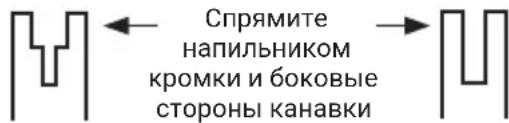
U3HOWeHHa KaHaBKa UcnpaBHa KaHaBka
3aMeHnTe HnPaBnHOuO uHy KOrDa n3bI
n3HOWeHb,ecn uHa nOrHyTa uN TpeChyla,
KOrDa npOnCXoDnT nepeRpeB uN NoBnAOTc
3a3y6pnHb Ha peKax. Pn Heo6xOdMocTn
3aMeHb,ncNoJb3yNte ToNbKO HnPaBnIOUne
uHHb,yKa3aHnBe B CnNCke DeTaleN dJa
peMOHTa DnBaSei Nnbli Nn Ha NaKLeKax,
pacnoLOXeHHbx Ha 6eH3OpnIe.
3aMeHa uHHbI u cen
3aMeHnTe 1eB,ecn 3y6b8cNlWKOM N3HOWeHbI, YTO6bI INMOXHO 6blIO 3aTOUHTb,INIKoDA cENb OCTaHaBnBaETc. IcNoJIb3yIte TOJIbKO cENb dJr 3aMeHbI PpeDIOKeHHyO B DaHHO INHCTpyKuIN.
Ocmotpnte HapablaHouyUo shHy npeTd Tem KaK 3aTouHTb cenb. N3HOweHHa nn NobpeXdEHHa HapabLIOUa SHHa He6e3OpacHa. N3HOweHHa NN NOBpeXDeHHa HapabLHOUa SHHa npIBeTe K NOBpeXdEHUo ceni. TaKke OHa 3aTpudHt pe3Ky.
Positec Technology (China) Co., Ltd 18, Dongwang Road, Suzhou Industrial Park, Jiangsu 215123, P. R. China
DEKJIAPAUnCOOTBETCTBnA(AKKUMYJATOP)
Mbl,
Positec Germany GmbH
Postfach 680194,50704 Cologne,Germany
OTIMeHINPositec3aBnE,HTO npOyKT
OnncAHne AKKymyIaTOp
TIn WA3639
Ha3NaYeHne 06ecNeuNbaET3HeprMei
3JeKTPoHNCTpyMeHtbl,CaIOBbIe
3aBOJcKOHOMep yKa3aH Ha MapKnpoI
Ta6nUke
CoOTBeTCTBye T CJIeIyUOuIM peIaMeHTy I nIpeKTHBaM: (EU) 2023/1542, 2011/65/EU & (EU) 2015/863
I cTaHapTaM, EN 62133-2, EN IEC 63000
Лицoc npabOM KOMnIIpOBaHnaДaHHOro
TEXNueckoroФанla,
OncanHe Marcel Filz
Adesc Positec Germany GmbH
Postfach 680194,50704 Cologne,Germany

CtpaHa npOn3BoDCTBa: KHP
I3roTOBnTeJIb: N03ntek TexHONOJxN (KHP) Ko., IITd.
Изговпелы: Positec Technology (China) Co., Ltd.
Ampc:Homep 18,OnBaHr Poyd,CyXKoy INHaCTpnaI Napk,L3aHcy,KHP
Ampes: No. 18, Dongwang Road, Suzhou Industrial Park, Jiangsu, P.R.China
Cpok cnjx6b1 n3dennr: 6 neT
Cpok rapaHTn: 2 roda
Data npon3BODCTBa n3dJIy: yka3aHa Ha n3dJIy
YnolHOMOeHHoe IuO dIy npHrTna ppeTeH3n: 000 «PONTEK-EBPA3NIA»
Adec: Poccncka Phedepauia, 117342, r. MockBa, yI. ByTnepoBa, d. 17, 3KOM 67
Tepeon cepBucnoi cnyk6bl 000 «I03NTEK-EBPA3NIA»:+7 (495) 136-83-96
3NeKtpoHHa noUra: service.ru@positecgroup.com
WORX
www.worx.com
Copyright © 2025, Positec. All Rights Reserved.
V1-18L-WG326E WG326E.X-M-20250924