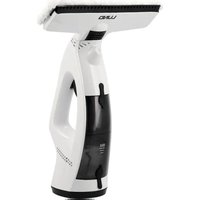
67172 - Steam cleaner Lund - Free user manual and instructions
Find the device manual for free 67172 Lund in PDF.


| Product type | Cordless window cleaner (steam cleaner) |
| Brand and model | Lund 67172 |
| Power supply | Li-ion battery 3.7 V DC |
| Battery capacity | 2000 mAh (7.4 Wh) |
| Rated input voltage | 5 V DC |
| Rated input current | 1 A |
| Clean water tank capacity | 100 ml |
| Dirty water tank capacity | 100 ml |
| Weight | 0.65 kg |
| Charging time | Approx. 2 hours |
| Runtime | 30 to 35 minutes |
| Included accessories | Suction head with squeegee, spray nozzle, clean and dirty water tanks, microfiber cover, charging cable |
| Housing material | ABS plastic (estimate) |
| Maximum water temperature | 40 °C |
| Use | Household only |
| Safety | Do not immerse; do not use with flammable liquids; keep out of reach of children |
| Maintenance | Clean housing with a soft cloth; cover machine washable at 40 °C |
| Storage | In a dry place, away from heat sources and moisture |
| Spare parts and repairability | Replaceable microfiber cover; for other parts, contact an authorized service center |
Frequently Asked Questions - 67172 Lund
User questions about 67172 Lund
0 question about this device. Answer the ones you know or ask your own.
Ask a new question about this device
Download the instructions for your Steam cleaner in PDF format for free! Find your manual 67172 - Lund and take your electronic device back in hand. On this page are published all the documents necessary for the use of your device. 67172 by Lund.
USER MANUAL 67172 Lund
natural_image
White LUND washing machine with black handle and black buttons, no visible text or symbols on bodyCE

PL
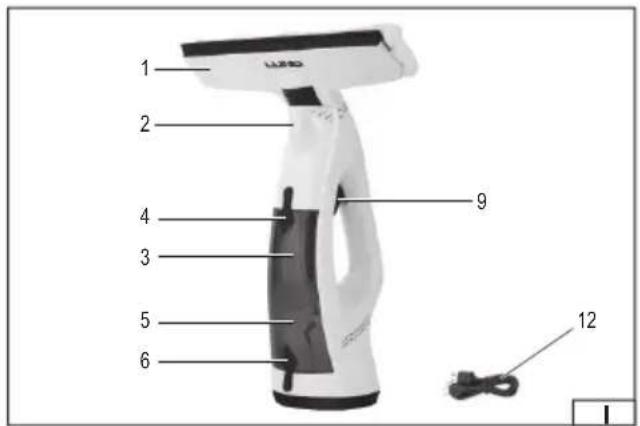
- suction head with wiper
- washer nozzle
- clean water tank
- clean water tank cap
- dirty water tank
- dirty water tank cap
- microfi ber cover
- switch
- washer trigger
- charging indicator
- charging socket
- charging cable
DE
Read the operating instruction
This symbol indicates that waste electrical and electronic equipment (including batteries and storage cells) cannot be disposed of with other types of waste. Waste equipment should be collected and handed over separately to a collection point for recycling and recovery, in order to reduce the amount of waste and the use of natural resources. Uncontrolled release of hazardous components contained in electrical and electronic equipment may pose a risk to human health and have adverse effects for the environment. The household plays an important role in contributing to reuse and recovery, including recycling of waste equipment. For more information about the appropriate recycling methods, contact your local authority or retailer.
The battery-powered window washer with sprayer is a compact device designed for quick and convenient cleaning of smooth surfaces such as windows, mirrors, tiles, and shower cabins. Thanks to the integrated sprayer and battery-powered suction, it allows for simultaneous application of cleaning agent and effective removal of dirt and excess water without leaving streaks. The product has been designed for home use only and is not to be used for commercial purposes. The correct, reliable and safe operation of the device depends on proper use, therefore:
Before using the appliance, read the entire manual and keep it.
The supplier is not liable for any damage resulting from failure to comply with the safety regulations and recommendations of this manual.
EQUIPMENT
The washer comes with microfiber pads and a charging cable. The product does not come with a charger.
TECHNICAL PARAMETERS
| Parameter Unit of measurement Value | ||
| Catalogue number 67172 | ||
| Nominal input voltage [V d.c.] 5 | ||
| Rated input current [A] 1 | ||
| Power battery Li- lon 3.7V dc ; 2000 mAh ; 7.4 Wh | ||
| Clean water/dirty water tank capacity [ml] 100 / 100 | ||
| Mass [kg] 0.65 |
SAFETY INSTRUCTIONS
Before using the product, read the instruction manual carefully. Keep it in a safe place for future reference. Make sure that everyone who uses the washer is familiar with this manual.
Use only as described in this instruction manual.
Do not leave the washer unattended while operating.
Keep the washer out of the reach of children and untrained persons.
Use extreme caution when working near children.
Do not allow anyone to treat the washer as a toy.
Only use accessories recommended by the manufacturer.
Protect the product from heat sources such as radiators, ovens, etc. Do not expose to direct sunlight or moisture.
Do not touch the washer with wet or damp hands.
Do not insert any objects into the openings in the housing. Do not use the washer if any of the openings are blocked. Do not cover the ventilation openings and keep them clear. Covered and/or blocked ventilation openings can cause the device to overheat. This can damage the device and may also cause a fire or electric shock.
Use extreme caution when working on stairs.
If the suction opening becomes blocked, turn off the washer and remove the blockage before restarting.
Before installing accessories, performing maintenance or in the event of a fault, turn off the washer and disconnect it from the power supply.
The washer is intended for home use only. It is not suitable for commercial use.
Do not vacuum up burning objects such as cigarettes, matches or hot ashes.
Do not use the washer in damp rooms. Do not suck up wet objects, liquids or flammable substances such as gasoline. Avoid using it in places where such substances may be present. The device is designed for use in closed rooms and should not be exposed to water, including precipitation.
Do not immerse the cord, power supply or washer in water or any other liquid.
Do not use the device in environments with an increased risk of explosion, containing flammable liquids, gases or vapors.
Regularly check the technical condition of the washer and the power cord. Do not switch on the device if it is damaged.
After use and before cleaning, allow the appliance to cool down.
Do not throw the battery into fire or expose it to temperatures above 40^ C.
Do not touch moving parts while the device is operating.
Do not attempt to repair it yourself. In case of failure, contact an authorized service center.
The appliance may be used by children aged 8 years and over and by persons with reduced physical or mental abilities and persons lacking experience and knowledge of the appliance, if supervision or instruction is provided regarding the safe use of
EN
the appliance so that the hazards involved are understood. Children must not play with the appliance. Children must not clean or maintain the appliance without supervision. Keep the washer and power cord out of the reach of children under 8 years of age.
Battery Charging Safety Instructions
ion batteries ( lithium -ion) do not exhibit the so-called „memory effect", which allows them to be charged at any time. However, it is recommended to discharge the battery during normal operation and then charge it to full capacity. If, due to the nature of the work, it is not possible to treat the battery in this way every time, it should be done at least every few or a dozen cycles of work. In no case should batteries be discharged by short-circuiting the electrodes, as this causes irreversible damage! It is also forbidden to check the battery charge by short-circuiting the electrodes and checking for sparking.
Battery storage
To extend the battery life, ensure proper storage conditions. The battery can withstand about 500 charge-discharge cycles. The battery should be stored in a temperature range of 0 to 30 degrees Celsius, with a relative humidity of 50%. To store the battery for a longer period of time, it should be charged to about 70% of its capacity. In the case of longer storage, the battery should be charged periodically, once a year. Do not over-discharge the battery, as this will shorten its life and may cause irreversible damage. During storage, the battery will gradually discharge due to leakage. The process of self-discharge depends on the storage temperature, the higher the temperature, the faster the discharge process. If the batteries are not stored properly, electrolyte may leak. In the event of a leak, secure the leak with a neutralizing agent, in the event of contact of the electrolyte with the eyes, rinse the eyes thoroughly with water and then seek immediate medical attention. It is forbidden to use a tool with a damaged battery. When the battery is completely worn out, it should be taken to a specialist waste disposal facility.
Battery transportation
Lithium -ion batteries are considered hazardous materials by law. The user of the tool can transport the device with the battery and the batteries themselves by land. No additional conditions must be met. In the event of entrusting transport to third parties (e.g. shipping by courier), the regulations for the transport of hazardous materials must be followed. Before shipping, contact a person with appropriate qualifications in this matter. It is prohibited to transport damaged batteries. National regulations for the transport of hazardous materials must also be observed.
The product should be unpacked, completely removing all packaging elements and protections for the duration of transport. It is recommended to keep the packaging, it may be helpful in later transport and storage of the product.
Charging
Before use, the product must be charged using the included charging cable. The window washer requires approximately 2 hours of charging to operate continuously for 30-35 minutes. The cable plug should be connected to the charging socket on the device, and then the other end of the cable should be connected to the mains charger, which should be connected to the mains socket. You can also use any USB port compatible with the plug of the included cable for charging, provided that it can provide the current capacity specified in the technical parameters table.
The indicator light is red while charging. It turns green when fully charged. Do not leave the device unattended while charging. Once charging is complete, first unplug the charger from the wall outlet and then disconnect the charging cable from the device. Warning! Do not leave the device connected to the charger after charging is complete. Leaving the device with a fully charged battery connected to the charger may damage the battery or even cause a fire.
Preparing for work
Note! Before starting preparations, make sure the device is turned off and disconnected from the power source. Attach the suction head with the wiper to the device body. A distinct click will indicate correct attachment. Use Velcro to attach the microfi ber cover to the suction head.
Using the washer
Wipe the front edge of the suction head with the wiper to remove dirt. Unscrew the cap of the clean water tank and fill the tank with water. Do not overfill. Do not immerse the body of the device in water. You can add a small amount of mild window cleaning agent. Caution! Never use agents that contain bleach, oils, solvents, alcohol, corrosive, abrasive or flammable substances. The use of such agents may damage the device or even cause a fire. Do not use water or cleaning solution at temperatures above 40^ C.
Squeeze the trigger to spray the solution onto the glass and wipe away any dirt with a cloth.
Turn on the window washer by pressing the switch.
Move the washer vertically from the top to the bottom of the glass until clean.
Hold the washer at the bottom of the glass to collect excess dirty water.
Turn off the washer when the dirty water tank is full.
Open the cap of the dirty water tank and empty its contents, then proceed with maintenance.
EN
Cleaning, maintenance and storage
Before cleaning and maintenance, always turn the appliance off and disconnect it from the power source.
The housing of the device should be cleaned with a soft, slightly damp cloth. Never immerse the body of the device in water. After cleaning, leave to dry completely. The suction head with the wiper and the spray nozzle should be cleaned with warm water and a mild detergent and then left to dry.
the microfibre cover at a maximum temperature of 40^ C using a normal programme. Wash only with similar colours. Only use detergents designed for coloured or delicate fabrics. Do not tumble dry. Do not iron or dry clean. Wash separately. After washing, lay fl at and leave to dry completely.
The pad wears out during use. If you notice signs of wear, such as dirt that cannot be removed, fibers that are falling out, or abrasions, replace the pad with a new one. The pad should also be replaced if it becomes damaged during use.
Store the device completely dry, disconnected from the power supply, away from heat sources and moisture, in a place inaccessible to children and animals.
Troubleshooting
| Problem Possible solution | |
| The device does not spray | Fill the tank with clean water. If the spray nozzle is clogged, fill the tank with warm water and gently press the trigger to unclog it. If there is no improvement, contact an authorized service center for the manufacturer. |
| Water is leaking from the device | The clean water tank may be overfilled or the dirty water tank may be full. Check the filter assembly seal. If damaged, contact an authorized manufacturer service center for a replacement part. |
| The device does not suck | The device may not be sufficiently charged. Charge the battery according to the instructions. |
DE
GERÄTEMERKMALE
WERKING VAN HET APPARAAT
- PL
- DE
- Before using the appliance, read the entire manual and keep it.
- EQUIPMENT
- TECHNICAL PARAMETERS
- SAFETY INSTRUCTIONS
- EN
- Battery Charging Safety Instructions
- Battery storage
- Battery transportation
- Charging
- Preparing for work
- Using the washer
- Cleaning, maintenance and storage
- GERÄTEMERKMALE
- WERKING VAN HET APPARAAT
Brand : Lund
Model : 67172
Category : Steam cleaner