
PS 1815 - Saw AL-KO - Free user manual and instructions
Find the device manual for free PS 1815 AL-KO in PDF.
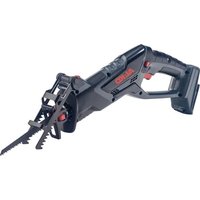


| Product type | Cordless reciprocating saw |
| Brand | AL-KO |
| Model | PS 1815 |
| Power supply | Lithium-ion battery (sold separately, model B125 Li ref. 113896) |
| Battery voltage | 18 V (typical for the series) |
| Charger type | Charger suitable for AL-KO Li-ion batteries (sold separately) |
| Delivery content | Reciprocating saw, holding bracket, blade for wood, blade for metals, blade for plastics, user manual |
| Suitable materials | Wood, soft metals (copper, lead), plastic, fiberboard, plasterboard |
| Safety devices | Unlock button, two-hand operation, overload protection, work light |
| Warning symbols | Read the manual, wear hearing/eye/respiratory protection, do not use in rain, do not burn |
| Maintenance and cleaning | Clean with brush/cloth, no water or solvents, oil blade and holder, check screws |
| Common malfunctions | Motor does not work, power drop, jam, battery not rechargeable: empty battery, worn battery, dirty contacts |
| Transport | Remove battery, pack battery (energy >100 Wh), stick adhesive on contacts, use original packaging |
| Storage | Dry, closed place, out of reach of children; battery removed |
| Disposal | Do not dispose of with household waste, take to specific collection points |
| Warranty | Legal according to country, subject to compliance with the manual and proper use |
| After-sales service | Contact the nearest AL-KO service via website |
Frequently Asked Questions - PS 1815 AL-KO
User questions about PS 1815 AL-KO
0 question about this device. Answer the ones you know or ask your own.
Ask a new question about this device
Download the instructions for your Saw in PDF format for free! Find your manual PS 1815 - AL-KO and take your electronic device back in hand. On this page are published all the documents necessary for the use of your device. PS 1815 by AL-KO.
USER MANUAL PS 1815 AL-KO
AL-KO KOBER GROUP Kottz, Germany
This documentation or excerpts therefrom may not be reproduced or disclosed to third parties without the express permission of the AL-KO KOBER GROUP.
| PS 1815 | |
| 113923 | |
| ca. 1,2 kg | |
| 152 mm | |
| 150 mm | |
| max. Ø 80 mm | |
| 2500 min-1 | |
| 78,5 dB(A) [K = ±5 dB(A)] | |
| 89,5 dB(A) [K = ±5 dB(A)] | |
| 13,0 m/s2[K = ±1,5 m/s2] |
| B50 Li (PBA 18V 2.5Ah W-B) | B75 Li (PBA 18V 4.0Ah W-C) | B100 Li (PBA 18V 5.0Ah W-C) | B125 Li (PBA 18V 6.0Ah W-C) |
| 113893 113894 | 113895 113896 | ||
| 18 V | |||
| 2,5 Ah 4,0 Ah | 5,0 Ah 6,0 Ah | ||
| 45 Wh 72 Wh | 90 Wh 108 Wh | ||
| C50 Li: ≈ 60 min FC100 Li: ≈ 36 min | C50 Li: ≈ 95 min FC100 Li: ≈ 39 min | C50 Li: ≈ 105 min FC100 Li: ≈ 46 min | C50 Li: ≈ 130 min FC100 Li: ≈ 62 min |
| 0 °C – +45 °C | |||
| -20 °C – +50 °C | |||
| C50 Li (AL 1830 CV) | FC100 Li (AL 1880 CV) | ||
| 113897|113898 (UK) 113899|113900 (UK) | |||
| 220 – 240 V AC, 50/60 Hz | |||
| 14,4 V – 18 V DC | |||
| 3 A 8 A | |||
| 0 °C – +45 °C | |||
| / II | |||
1 About these operating instructions 18
1.1 Symbols on the title page 18 1.2 Legends and signal words 19
2 Product description 19
2.1 Designated use 19 2.2 Possible foreseeable misuse 19 2.3 Residual risks.. 19
2.4 Safety and protective devices 19
2.4.1 Unlock knob. 19 2.4.2 Two-hand operation 19 2.4.3 Overload protection 20
2.5 Symbols on the appliance 20 2.6 Product overview (01) 20 2.7 Scope of supply 20
3 Safety instructions 20
3.1 General Power Tool SafetyWarnings 20 3.1.1 Work area safety 21 3.1.2 Electrical safety 21 3.1.3 Personal safety 21 3.1.4 Power tool use and care. 21 3.1.5 Battery tool use and care 22 3.1.6 Service 22
3.2 Safety warnings for reciprocating saws 22
3.3 Vibration load 23 3.4 Noise pollution 23 3.5 Safety notes for rechargeable battery and charger 23
4 Installation 24
4.1 Pushing up/removing the retaining bracket (02) 24 4.2 Installing/removing the saw blade (03) 24
5 Start-up 24
5.1 Charging the rechargeable battery.... 24 5.2 Inserting/removing the battery (04) .... 24
6 Operation 24 6.1 Switching the appliance ON/OFF (05) 24 7 Working techniques (06, 07) 25 8 Maintenance and care. 25 9 Help in case of malfunction 25 10 Transport. 26 11 Storage 27
11.1 Storing the appliance 27 11.2 Storing the rechargeable battery and charging unit 27
12 Disposal 27 13 After-Sales/Service 28 14 Guarantee 28
1 ABOUT THESE OPERATING INSTRUCTIONS
The German version is the original operating instructions. All additional language versions are translations of the original operating instructions. Always safeguard these operating instructions so that they can be consulted if you need any information about the appliance. Only pass on the appliance to other persons together with these operating instructions. Comply with the safety and warning information in these operating instructions.
1.1 Symbols on the title page
Symbol Meaning

It is essential to read through these operating instructions carefully before start-up. This is essential for safe working and trouble-free handling.

Operating instructions
Symbol Meaning
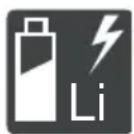
Handle Li-lon rechargeable batteries with care! In particular, observe the notes on transport, storage and disposal in these operating instructions!
1.2 Legends and signal words
DANGER! Denotes an imminently dangerous situation which will result in fatal or serious injury if not avoided. WARNING! Denotes a potentially dangerous situation which can result in fatal or serious injury if not avoided. CAUTION! Denotes a potentially dangerous situation which can result in minor or moderate injury if not avoided.
IMPORTANT! Denotes a situation which can result in material damage if not avoided.
NOTE Special instructions for ease of understanding and handling.
2 PRODUCT DESCRIPTION
These operating instructions describe a hand-held cordless sabre saw with removable rechargeable battery.
The appliance may only be used together with the lithium-ion rechargeable batteries and chargers specified in the technical data. See the separate operating instructions for further information on rechargeable batteries and chargers:
Operating instructions 443130: rechargeable batteries Operating instructions 443131: chargers
IMPORTANT! Danger of damage to the appliance and battery. If the appliance is operated with unsuitable batteries, both the device and the batteries may be damaged.
Operate the appliance only with the specified rechargeable batteries.
2.1 Designated use
The sabre saw is intended for sawing branches, wooden laths, soft metals (e.g. copper, lead), plastic, lightweight boards, plasterboards, etc. The saw blade types appropriate to the material to be sawn must be used (see Technical data).
The sabre saw must be firmly in contact with the material during sawing. Wide saw blades produce straight cuts. Narrow saw blades allow curves to be sawn. The maximum permissible material width must not be exceeded.
This appliance is intended solely for use in non-commercial applications. Any other use as well as unauthorised conversions or modifications are regarded as contrary to the intended use and will result in voiding of the warranty as well as loss of conformity; the manufacturer will thus decline any responsibility for damage and/or injury suffered by the user or third parties.
2.2 Possible foreseeable misuse
The appliance is designed neither for commercial use in public parks and sports facilities, nor for use in farming and forestry. Do not use the appliance in rainy weather.
2.3 Residual risks
Even during correct use of the appliance, there is always a certain residual risk that cannot be excluded. Depending on the use, the following potential risks can be derived from the type and construction of the appliance:
- Contact with the saw blade (risk of cutting).
- Sudden and unexpected movement of the appliance (risk of cutting).
- Detachment of parts of the saw blade, e.g. if the appliance is tilted (risk of cuts/injuries).
- Detachment of parts of the material being worked on. Impairment of hearing during work if ear defenders are not used.
2.4 Safety and protective devices
WARNING! Risk of injury. Defective and disabled safety and protective devices can result in serious injury.
Have any defective safety and protective devices repaired. - Never disable safety and protective devices.
2.4.1 Unlock knob
The appliance has an unlock knob for the ON/OFF switch to prevent unintentional starting.
2.4.2 Two-hand operation
The appliance is intended for two-hand operation to avoid the risk of injuries to the hands.
2.4.3 Overload protection
The appliance is equipped with an overload protection device that cuts out in the event of an overload (e.g. if the saw blade becomes jammed). After a short cooling-down phase, the appliance can be switched on again.
2.5 Symbols on the appliance
| Symbol Meaning | |
| ! | Pay special attention when handling this product! |
| Read the operating instructions before starting operation! | |
| Wear ear protection! | |
| Wear eye protection! | |
| Wear a face mask! | |
| Do not use in the rain! Protect against moisture! | |
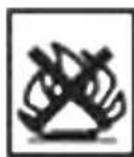
| Do not burn the tool! | |
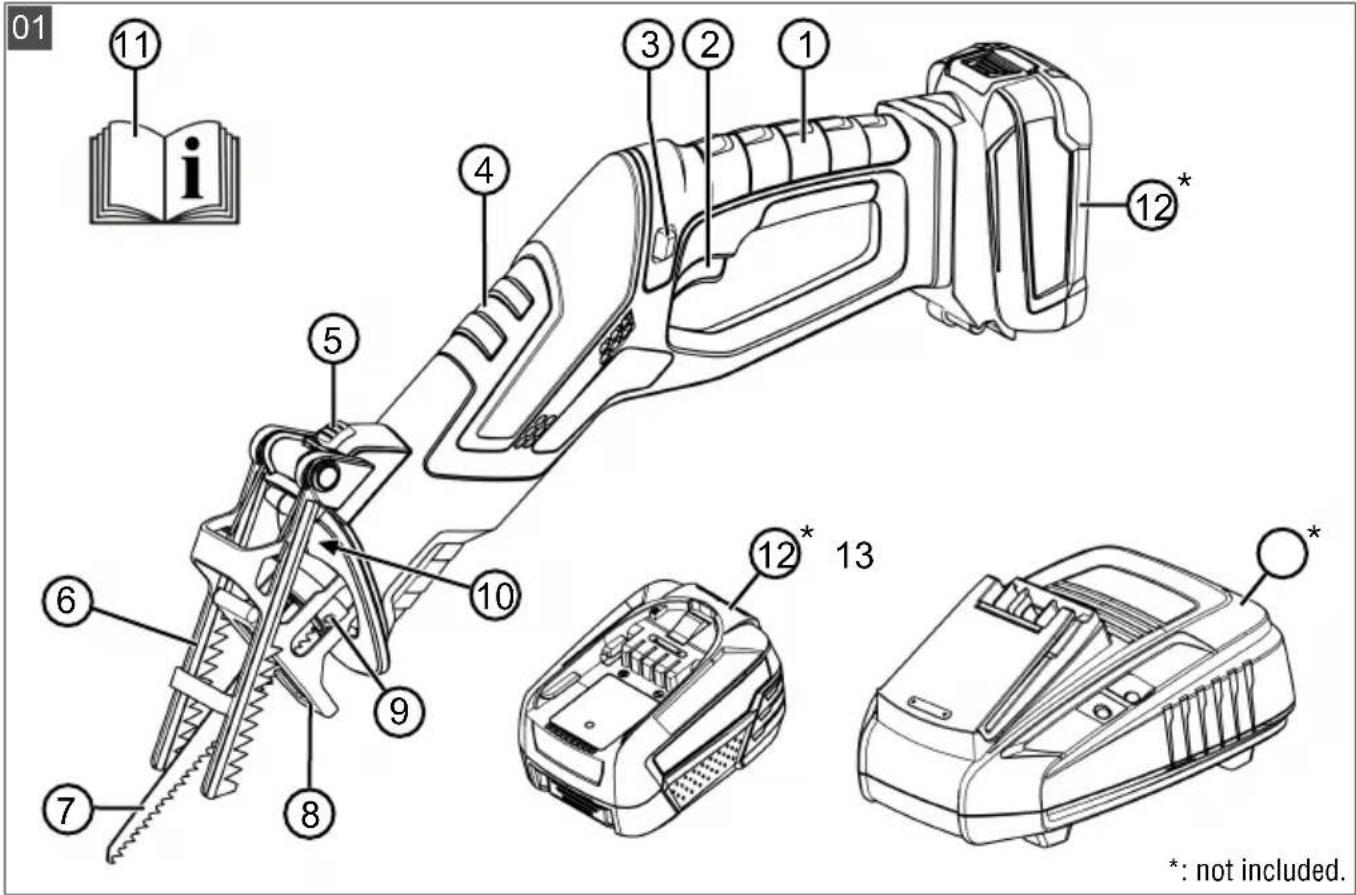
2.6 Product overview (01)
| No. Component |
| 1 Rear handle |
| 2 ON/OFF switch |
| 3 Unlock knob for ON/OFF switch |
| 4 Front handle |
| 5 Unlock knob for retaining strap |
| No. Component |
| 6 Retaining strap |
| 7 Saw blade |
| 8 Foot plate |
| 9 Saw blade clamping ring |
| 10 Work light |
| 11 Operating instructions |
| 12 Rechargeable battery* |
| 13 Charger* |
*Not included in the scope of supply, but can be purchased under the following article numbers: See Technical data.
2.7 Scope of supply
The items listed here are included in the standard scope of supply. Check that all items are present:
| No. Component |
| 1 Cordless sabre saw |
| 2 Retaining strap |
| 3 Saw blade for wood |
| 4 Saw blade for metal |
| 5 Saw blade for plastic |
| 6 “Cordless sabre saw” operating in-structions |
NOTE The rechargeable battery and charging unit are not included in the scope of delivery and must therefore be purchased separately.
3 SAFETY INSTRUCTIONS
3.1 General Power Tool Safety Warnings
WARNING! Read all safety warnings, instructions, illustrations and specifications provided with this power tool. Failure to follow all instructions listed below may result in electric shock, fire and/or serious injury.
Save all warnings and instructions for future reference.
The term "power tool" in the warnings refers to your mains-operated (corded) power tool or battery-operated (cordless) power tool.
3.1.1 Work area safety
- Keep work area clean and well lit. Cluttered or dark areas invite accidents.
- Do not operate power tools in explosive atmospheres, such as in the presence of flammable liquids, gases or dust. Power tools create sparks which may ignite the dust or fumes.
- Keep children and bystanders away while operating a power tool. Distractions can cause you to lose control.
3.1.2 Electrical safety
Power tool plugs must match the outlet. Never modify the plug in any way. Do not use any adapter plugs with earthed (grounded) power tools. Unmodified plugs and matching outlets will reduce risk of electric shock. Avoid body contact with earthed or grounded surfaces, such as pipes, radiators, ranges and refrigerators. There is an increased risk of electric shock if your body is earthed or grounded. Do not expose power tools to rain or wet conditions. Water entering a power tool will increase the risk of electric shock. Do not abuse the cord. Never use the cord for carrying, pulling or unplugging the power tool. Keep cord away from heat, oil, sharp edges and moving parts. Damaged or entangled cords increase the risk of electric shock. When operating a power tool outdoors, use an extension cord suitable for outdoor use. Use of a cord suitable for outdoor use reduces the risk of electric shock. If operating a power tool in a damp location is unavoidable, use a residual current device (RCD) protected supply. Use of an RCD reduces the risk of electric shock.
3.1.3 Personal safety
- Stay alert, watch what you are doing and use common sense when operating a power tool. Do not use a power tool while you are tired or under the influence of drugs, alcohol or medication. A moment of inattention while operating power tools may result in serious personal injury. Use personal protective equipment. Always wear eye protection. Protective equipment such as a dust mask, non-skid safety shoes, hard hat, or hearing protection used
for appropriate conditions will reduce personal injuries.
Prevent unintentional starting. Ensure the switch is in the off-position before connecting to power source and/or battery pack, picking up or carrying the tool. Carrying power tools with your finger on the switch or energising power tools that have the switch on invites accidents. Remove any adjusting key or wrench before turning the power tool on. A wrench or a key left attached to a rotating part of the power tool may result in personal injury. Do not overreach. Keep proper footing and balance at all times. This enables better control of the power tool in unexpected situations. Dress properly. Do not wear loose clothing or jewellery. Keep your hair and clothing away from moving parts. Loose clothes, jewellery or long hair can be caught in moving parts. If devices are provided for the connection of dust extraction and collection facilities, ensure these are connected and properly used. Use of dust collection can reduce dust-related hazards. Do not let familiarity gained from frequent use of tools allow you to become complacent and ignore tool safety principles. A careless action can cause severe injury within a fraction of a second.
3.1.4 Power tool use and care
- Do not force the power tool. Use the correct power tool for your application. The correct power tool will do the job better and safer at the rate for which it was designed.
- Do not use the power tool if the switch does not turn it on and off. Any power tool that cannot be controlled with the switch is dangerous and must be repaired.
- Disconnect the plug from the power source and/or remove the battery pack, if detachable, from the power tool before making any adjustments, changing accessories, or storing power tools. Such preventive safety measures reduce the risk of starting the power tool accidentally. Store idle power tools out of the reach of children and do not allow persons unfamiliar with the power tool or these instructions
to operate the power tool. Power tools are dangerous in the hands of untrained users.
- Maintain power tools and accessories. Check for misalignment or binding of moving parts, breakage of parts and any other condition that may affect the power tool's operation. If damaged, have the power tool repaired before use. Many accidents are caused by poorly maintained power tools.
- Keep cutting tools sharp and clean. Properly maintained cutting tools with sharp cutting edges are less likely to bind and are easier to control. Use the power tool, accessories and tool bits etc. in accordance with these instructions, taking into account the working conditions and the work to be performed. Use of the power tool for operations different from those intended could result in a hazardous situation.
- Keep handles and grasping surfaces dry, clean and free from oil and grease. Slippery handles and grasping surfaces do not allow for safe handling and control of the tool in unexpected situations.
3.1.5 Battery tool use and care
- Recharge only with the charger specified by the manufacturer. A charger that is suitable for one type of battery pack may create a risk of fire when used with another battery pack. Use power tools only with specifically designated battery packs. Use of any other battery packs may create a risk of injury and fire.
- When battery pack is not in use, keep it away from other metal objects, like paper clips, coins, keys, nails, screws or other small metal objects, that can make a connection from one terminal to another. Shorting the battery terminals together may cause burns or a fire. Under abusive conditions, liquid may be ejected from the battery; avoid contact. If contact accidentally occurs, flush with water. If liquid contacts eyes, additionally seek medical help. Liquid ejected from the battery may cause irritation or burns.
- Do not use a battery pack or tool that is damaged or modified. Damaged or modified batteries may exhibit unpredictable behaviour resulting in fire, explosion or risk of injury.
- Do not expose a battery pack or tool to fire or excessive temperature. Exposure to fire or temperature above 130°C may cause explosion.
- Follow all charging instructions and do not charge the battery pack or tool outside the temperature range specified in the instructions. Charging improperly or at temperatures outside the specified range may damage the battery and increase the risk of fire.
3.1.6 Service
Have your power tool serviced by a qualified repair person using only identical replacement parts. This will ensure that the safety of the power tool is maintained. Never service damaged battery packs. Service of battery packs should only be performed by the manufacturer or authorized service providers.
3.2 Safety warnings for reciprocating saws
Hold the power tool at the insulated handles when performing operations where the attachment may contact hidden wiring. Contacting a "live" wire may also make metal parts of the appliance "live" and result in an electric shock. Use clamps or another practical way to secure and support the workpiece to a stable platform. Holding the workpiece by hand or against your body leaves it unstable and may lead to loss of control. Keep your hands away from the saw blade area. Do not reach under the workpiece. Contact with the saw blade can lead to injuries. Switch on the power tool before bringing it into contact with the workpiece. There is otherwise a danger of a recoil if the attachment jams in the workpiece. Ensure that the foot plate is always in contact with the workpiece when sawing. The saw blade can become wedged and lead to loss of control over the power tool. When the cut is completed, switch off the power tool and pull the saw blade out of the cut only after it has come to a standstill. In this way you can avoid a recoil and can put down the power tool safely. Use only undamaged saw blades that are in a perfect condition. Bent or blunt saw
blades can break, negatively influence the cut, or lead to a recoil.
- Do not bring the saw blade to a stop by applying side pressure after switching off. The saw blade can be damaged, break or cause a recoil.
- Clamp the material securely. Do not support the workpiece with your hand or foot. Do not touch other objects or the floor with the saw running. Danger of recoil. Use appropriate detectors to detect hidden utility lines in the work area or call the local utility company for assistance. Contact with electric lines can lead to fire and electric shock. Damaging a gas line can lead to an explosion. Cutting into a water pipe causes property damage.
- Secure the workpiece. A workpiece secured with clamps or in a vice is held more securely than if held in your hand. Wait until the power tool has come to a standstill before putting it down. The attachment can jam and lead to loss of control over the power tool.
3.3 Vibration load
WARNING! Danger due to vibration. The actual magnitude of the vibration emissions during the use of the appliance may deviate from that stated by the manufacturer. Observe the following influencing factors before or during use:
Is the appliance being used as intended? Is the material being cut or processed in the proper manner? Is the appliance in a proper condition of use? Is the cutting tool properly sharpened or is the correct cutting tool installed? Are the handle grips and any optional vibration grips mounted, and are they firmly attached to the appliance? Only operate the tool at the motor speed required for the respective work. The noise and vibrations of the tool may increase due to improper use and maintenance. This leads to health damage. In this case, immediately switch off the tool and have it repaired by an authorized service workshop. The degree of stress due to vibration depends on the work to be performed or on the use of the tool. Estimate the stress and plan appropriate work breaks. This considerably
reduces stress due to vibration over the entire working time.
- Extensive use of the tool exposes the operator to vibrations, which can lead to circulatory issues ("white fingers"). To avoid this risk, wear gloves and keep your hands warm. If any symptoms of "white fingers" occur, immediately consult a physician. These symptoms include: numbness, loss of feeling, tingling, itching, pain, reduced muscular strength, changes in the color or condition of the skin. Normally these conditions affect the fingers, hands, or pulse. The risk increases at low temperatures. Take long breaks during your working day so you can recover from the noise and the vibrations. Plan your work in such a way that the use of appliances that generate strong vibrations is spread over several days. If you notice an unpleasant sensation or discoloration of the skin on your hands when using the tool, stop work immediately. Take sufficient work breaks. Without sufficient breaks, a hand/arm vibration syndrome can occur.
- Minimize your risk of being exposed to vibrations. Maintain the tool according to the instructions in the operating instructions. If the tool is used frequently, contact your dealer to purchase anti-vibration accessories (e.g., handles).
- Avoid working with the tool at temperatures below 0°C. Define how the vibration load can be limited in a work plan.
3.4 Noise pollution
A certain level of noise exposure from this appliance is inevitable. Carry out noisy work at approved and specified time periods. Observe rest periods as necessary and restrict the duration of the work to a minimum. For your personal protection and protection of persons in the vicinity, appropriate hearing protection must be worn.
3.5 Safety notes for rechargeable battery and charger
Please observe the safety instructions for the rechargeable battery and the charger in the separate operating instructions.
See:
- Operating instructions 443130: rechargeable batteries Operating instructions 443131: chargers
4 INSTALLATION
WARNING! Danger if assembly is not carried out completely! Use of an incompletely assembled appliance can result in serious injury.
Operate the appliance only when it is fully assembled! Do not insert the battery into the appliance until it is fully assembled!
CAUTION! Risk of injury. Sharp-edged and moving appliance parts can lead to injury. Always wear protective gloves during assembly!
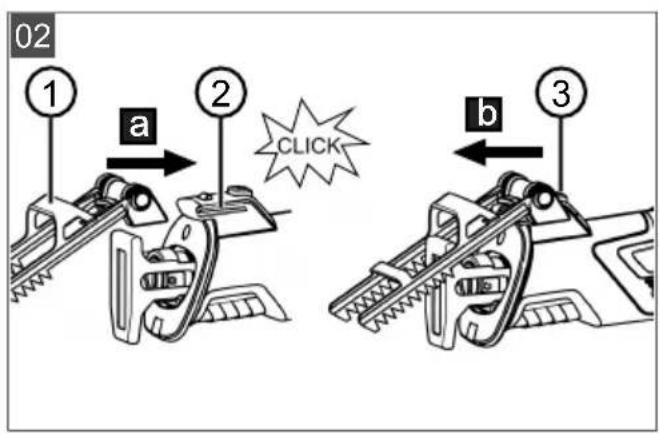
4.1 Pushing up/removing the retaining bracket (02)
- Remove the battery if it is installed on the appliance.
Pushing up the retaining bracket
- Push retaining bracket (02/1) into guide (02/2) from the front (02/a) until it engages.
Removing the retaining bracket
- Press the unlock knob (02/3).
- Pull off the retaining bracket forwards (02/b).
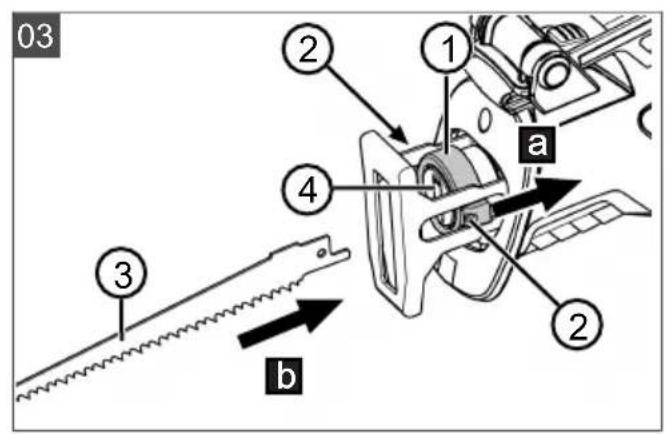
4.2 Installing/removing the saw blade (03)
- Remove the battery if it is installed on the appliance.
- Pull clamping ring (03/1) against the stop on the appliance (03/a).
Note: To pull the clamping ring, place your thumb and index finger onto the left and right sides (03/2) of the clamping ring.
- Installing/removing the saw blade:
Push saw blade (03/3) with the shaft up to the stop in the saw blade holder (03/4) (03/b).
Note: The saw blade holder must be free of material residues.
OR: Pull out the saw blade.
- Release the clamping ring. The clamping ring goes automatically to its home position and the saw blade is secured.
- Check whether the saw blade is securely installed in the saw blade holder.
5 START-UP
5.1 Charging the rechargeable battery
Observe the temperature range for charging, see technical data.
NOTE For detailed information, see the separate operating instructions for the rechargeable battery and the charger:
Operating manual 443130: Rechargeable batteries Operating manual 443131: Chargers
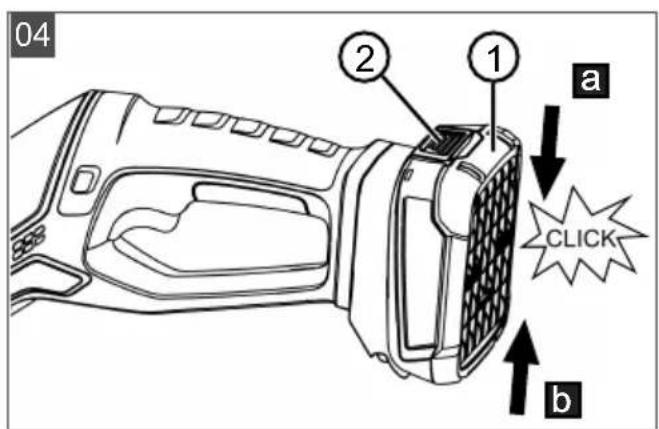
5.2 Inserting/removing the battery (04)
IMPORTANT! Danger of damage to the rechargeable battery. If the rechargeable battery is left in the appliance after use, it may damage the rechargeable battery.
- Immediately after use, pull the rechargeable battery out of the appliance and store in a frost-protected area. Only insert the rechargeable battery in the appliance immediately before starting work.
Inserting the rechargeable battery
- Push rechargeable battery (04/1) into the battery slot (04/a) from above until it engages.
Removing the rechargeable battery
- Press unlock knob (04/2) and pull out the rechargeable battery upwards (04/b).
6 OPERATION
WARNING! Risk of injury due to detaching appliance parts. Appliance parts detaching during operation can lead to serious injury.
Before turning the appliance on, check that all the parts of the appliance are firmly tightened. - Attach cutting tools so that they cannot detach during operation.
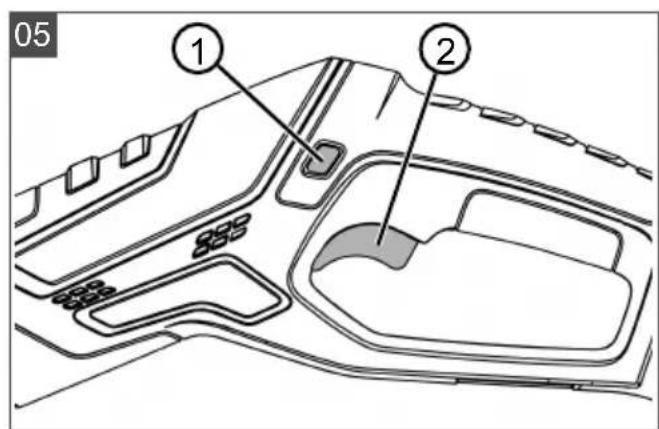
6.1 Switching the appliance ON/OFF (05)
Switching on the appliance
- Press unlock knob (05/1).
- Press ON/OFF switch (05/2) and release the unlock knob.
Switching off the appliance
- Release the ON/OFF switch.
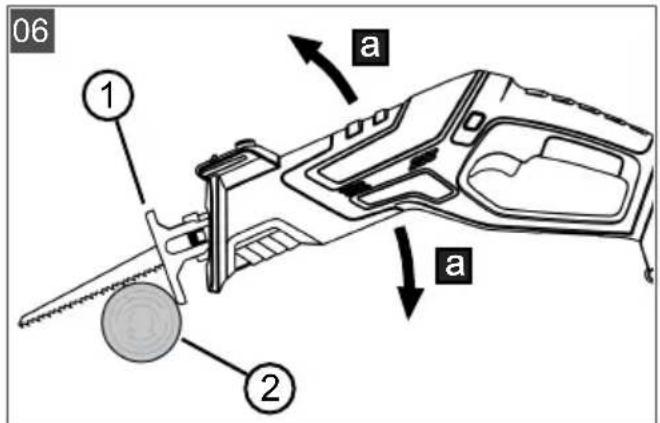
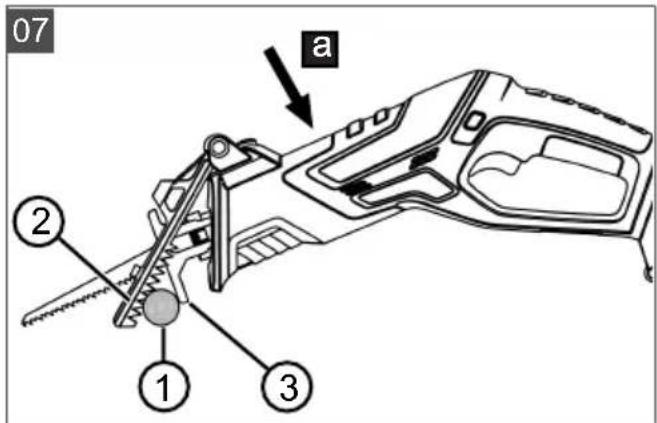
7 WORKING TECHNIQUES (06, 07)
WARNING! Hazards from loose material! Sawing of material that is not clamped can lead to serious injuries.
Saw material only when it is securely clamped. - Contact the material with the saw blade of the handsaw only when the handsaw has reached its full speed. Ensure that the material to be sawn is securely clamped - any movement of the material will influence the sawing result. Start to cut only when the sabre saw has reached its full speed. - Do not apply excessive force during sawing – a uniform, gentle pressure offers the best results. - With thick workpieces: Place foot plate (06/1) firmly onto workpiece (06/2) and move the sabre saw slowly and uniformly around the workpiece (06/a). With thin workpieces: Fix workpiece (07/1) between retaining bracket (07/2) and foot plate (07/3). Then push the sabre saw slowly and uniformly downwards (07/a). - Reduce the pressure shortly before the material is sawn through completely. Wait until the saw blade has come to a complete standstill before removing it from the workpiece. The saw blade becomes very hot during operation. Allow it to cool down before touching it. Saw dust can be toxic. Therefore ensure good ventilation at the place of work and wear a face mask. Saw dust can ignite. Therefore dispose of saw dust as quickly as possible.
8 MAINTENANCE AND CARE
WARNING! Danger of cuts and lacerations. Danger of cuts and lacerations when reaching into sharp-edged, moving appliance parts and into cutting tools.
Before maintenance, care and cleaning work, always switch off the appliance. Remove the rechargeable battery. Always wear protective gloves during maintenance, care and cleaning work.
NOTE Repair work is only allowed to be carried out by expert workshops or our service centres.
- Do not expose the appliance to rain or moisture. After every use:
Remove the rechargeable battery and inspect the appliance for damage. Pull out the saw blade, clean and spray with corrosion protection oil. Clean the housing using a brush or cloth. Do not use water and/or aggressive cleaning agents or solvents - risk of corrosion and damage to the plastic parts. Remove deposits of wood chips from clamping ring (03/1) and saw blade holder (03/4) using a brush or cloth. Then apply a few drops of corrosion protection oil to the saw blade holder.
Inspect the saw blade at regular intervals. Contact one of the manufacturer's service centres in the event of:
A defective saw blade A blunt saw blade Excessive wear
Inspect all bolts for tightness at regular intervals. Inspect the electrical contacts of the appliance for corrosion, clean with a fine wire brush if necessary and then spray with a contact spray.
9 HELP IN CASE OF MALFUNCTION
CAUTION! Risk of injury. Sharp-edged and moving appliance parts can lead to injury.
Always wear protective gloves during maintenance, care and cleaning work. - Switch off the appliance and remove the rechargeable battery.
NOTE For malfunctions that are not listed in this table or that you cannot resolve yourself, please contact our customer service.
| Malfunction Cause Remedy | ||
| Motor does not start. Rechargeable battery missing or not seated correctly. | Insert the rechargeable battery correctly. | |
| Rechargeable battery is flat. Charge the rechargeable battery. | ||
| Switches are defective. Do not operate the appliance! Contact one of the manufacturer's service centres. | ||
| Engine loses power. Rechargeable battery is flat. Charge the rechargeable battery. | ||
| Saw blade is blunt. Replace the saw blade. | ||
| Motor stops during saw-ing. | Motor is overloaded. Switch off the appliance. | |
| Rechargeable battery is flat. Charge the rechargeable battery. | ||
| Saw blade is blunt. Replace the saw blade. | ||
| The service life of the rechargeable battery has expired. | Replace the rechargeable battery. Use only genuine accessories from the manufacturer. | |
| Rechargeable battery cannot be charged. | Rechargeable battery contacts are dirty. | Contact one of the manufacturer's service centres. |
| The rechargeable battery or charger is faulty. | Order spare parts acc. to the spare parts card. | |
| Rechargeable battery is too hot. | Allow the battery to cool down. | |
10 TRANSPORT
Before transporting, carry out the following measures:
- Switch off the appliance.
- Remove the rechargeable battery from the appliance.
- Pack the battery properly (see below).
Battery "B125 Li" (Art. No. 113896)
NOTE The nominal energy of the rechargeable battery is more than 100 Wh. Therefore, observe the following transport instructions.
The li-ion rechargeable battery contained in the appliance is subject to the hazardous goods law, but can be transported under simplified conditions:
The rechargeable battery can be transported on public roads by the private user without further conditions provided it is packaged for retail sale and the transport serves personal purposes. Commercial users who carry out the transport in connection with their main activity
(e.g. delivery from and to building sites, or demonstrations) can also take advantage of this simplification.
In both cases, it is essential to take the mandatory precautions mentioned above to prevent any leakage of the contents. In other cases, it is essential to comply with the regulations of the hazardous goods law. In the case of non-compliance, severe penalties can be imposed on the sender and possibly the transporter.
Additional notes on transport and shipment
Only transport or send the li-ion rechargeable battery in an undamaged condition. For transporting the rechargeable battery, only use the original cardboard box or a suitable hazardous goods cardboard box (not required for rechargeable batteries with a nominal energy less than 100 Wh). Tape off exposed rechargeable battery contacts to avoid a short circuit. - Secure the rechargeable battery against shifting in the packaging to avoid damage to the rechargeable battery.
Ensure the correct marking and documentation of the shipment for transport or shipping (e.g. by parcel service or freight forwarding). Check in advance that transport with the selected service provider is possible and indicate the shipment.
We recommend involving a hazardous goods specialist in preparation of the shipment. Also heed any further national regulations.
11 STORAGE
11.1 Storing the appliance
Remove the rechargeable battery from the appliance after every use. Thoroughly clean the appliance and, if present, attach all covers. Store the appliance in a dry, lockable place out of the reach of children.
Carry out the following jobs before intervals in work lasting longer than 30 days:
Thoroughly clean the appliance and store it in a dry place.
11.2 Storing the rechargeable battery and charging unit
NOTE: For detailed information, heed the separate operating instructions for the rechargeable battery and for the charging unit.
12 DISPOSAL
Information on the German Electrical and Electronic Equipment Act (ElectroG)

Electrical and electronic appliances do not belong in household waste, but should be collected and disposed of separately.
Used batteries or rechargeable batteries that are not installed permanently in the old appliance must be removed before disposal. Their disposal is regulated by the battery law. Owners or users of electrical and electronic appliances are obliged by law to return them after use. The end user bears personal responsibility for deleting his personal data from the old appliance to be disposed of.
The symbol of the crossed-through rubbish bin means that electrical and electronic appliances may not be disposed of in the household rubbish.
Electrical and electronic appliances can be handed in at the following places at no charge:
Public service disposal or collection points (e.g., municipal building yards) and points of sale of electrical appliances (stationary and online) provided traders are obliged to take them back or offer this voluntarily.
These statements only apply to appliances that are installed and sold in the countries of the European Union and are subject to European Directive 2012/19/EU. Different provisions may apply to the disposal of electrical and electronic appliances in countries outside the European Union.
Information on the German Battery Act (BattG)

Used batteries and rechargeable batteries do not belong in household waste, but should be collected and disposed of separately.
For safe removal of batteries or rechargeable batteries from the electrical appliance and for information on their type or chemical system, follow the further information within the operating or installation instructions. - Owners or users of batteries and rechargeable batteries are obliged by law to return them after use. Return is limited to the handover of customary household quantities.
Used batteries can contain harmful substances or heavy metals that can cause damage to the environment and human health. Reuse of the used batteries and use of the resources contained therein contributes to the protection of these two essential commodities.
The symbol of the crossed-through rubbish bin means that batteries and rechargeable batteries may not be disposed of in household rubbish.
In addition, if the symbol Hg, Cd or Pb appears under the rubbish bin, this stands for the following:
Hg: Battery contains more than 0.0005% mercury. Cd: Battery contains more than 0.002% cadmium. Pb: Battery contains more than 0.004% lead. Rechargeable batteries and batteries can be handed in at the following places at no charge: Public service disposal or collection points (e.g. municipal building yards).
Points of sale of batteries and rechargeable batteries. Disposal points of the common take-back system for the used batteries of appliances. Disposal point of the manufacturer (if not a member of the common take-back system).
These statements apply only to rechargeable batteries and batteries that are sold in the countries of the European Union and that are subject to European Directive 2006/66/EU. Different provi
sions can apply to the disposal of rechargeable batteries and batteries in countries outside the European Union.
13 AFTER-SALES/SERVICE
In the event of questions of warranty, repair or spare parts, please contact your nearest AL-KO Service Centre. These can be found on the Internet at: www.al-ko.com/service-contacts
14 GUARANTEE
We will resolve any material or manufacturing faults on the appliance during the legal warranty period for claims relating to faults, in accordance with our choice either to repair or replace. The legal warranty period is determined by the legislation of the country in which the appliance was purchased.
Our warranty promise applies only if:
These operating instructions are heeded. The appliance is handled correctly. Original spare parts have been used.
The warranty becomes void in the case of:
Unauthorised repair attempts Unauthorised technical modifications Non-intended use
The guarantee excludes:
Paint damage that can be attributed to normal wear and tear Wear parts that are marked with a frame xxxxx (x) on the spare parts card
The guarantee period commences with purchase by the first end user. The date on the proof of purchase is decisive. In the event of a guarantee claim, please take this guarantee declaration and the original proof of purchase, and contact your dealer or the nearest authorised customer service centre. This statement does not affect the purchaser's statutory claims for defects against the vendor.
TRANSLATION OF THE ORIGINAL USER MANUAL Table of contents
2 PRODUCT DESCRIPTION
www.al-ko.com/service-contacts
14 WARRANTY
www.al-ko.com/service-contacts
14 WARRANTY
www.al-ko.com/service-contacts
14 WARRANTY
www.al-ko.com/service-contacts
14 WARRANTY
Possible material or manufacturing defects on the device will be removed during the statutory limitation period for warranty on defects, at our own choice, by repair or replacement delivery. The limitation period is determined according to the law of the country where the device was purchased.
Do not use if damaged! Protect from water!
Do not short-circuit!
2.6 Production date (01)
Serial No.
1. Battery tester 2. Test lead for battery 3. Test lead for battery 4. Test lead 5. Test lead for battery 6. Test lead 7. Test strip 8. Battery 9. Test strip holder 10. Light 11. Instruction manual 12. Battery* 13. Spare
- Not included, but available under the following item numbers: see part of technical data.
2.7 Scope of delivery
The scope of delivery includes the following items. Check that all items are included:
Item No. Component
1 Battery tester 2 Test lead 3 Test strip for battery 4 Test strip for metal
Serial No.
5 Test strip for paste
6 Instruction manual for battery tester
NOTE: Battery and test strips are not included in the scope of delivery and must be purchased separately.
3 BE3BEdHOcHE HAnOMEHE
3.1 OnuTe cnryphoche Hanomehe 3a eJektpnue aIaTe
yN03OPEHbE! Ipoountajte cBe 6e36eHocHe HAnomeHe, yNyTcTba, nIyucTpaunje N TexnUcKe noDaTke ca KoJMa je nCnpuyen OBaj eJeKTPnuHn anaT.
HenowToBaHe DoBux yNyTCTaBA MOxE DOBeCTn Do eNeKtpuHOr ydapa, NoXapa n/nn O3bHnx Nobpeda.
3aDpxnTe CBe 6e36eHocHe HAnomeHe n ynyTCTBa 3a 6ydyh ynotpe6y.
Nojam "enekpuHu anam" koju ce kopucmu y 6e36ednchum Hanomehama odnocu ce Ha mpexHe ekepuyne aname (ca Ka6nom 3a HanajaBe) unu Ha 6amepujcke ekekpuHne aname (6e3 Ka6na 3a HanajaBe).
3.1.1 Be36eHocT Ha paHOM MecTy
OdpxkaBajTe paHNo noDpyje YnCTHM n do6po OCBeTJbeHm. Hepd nn HeocBETbEHa paHa noDpyja Mory da DOBeNy Do He3rOda. HemojTe da paAnTe ca eNeKtpnHm aIaTom y OkOnHH ca onachowhy od ekCnlo3nje, y Kojoj ce HaJana3e 3anabNBte TeuHOCTn, racOBn nn npaunHe. EneKtpnuHn anatnpoN3BOde BapHnue, Koje Mory da 3anaje npaunHy nnn nape. Deu npyre ocobe dpxnte noaBe y Toky ynoTpe6e enektpnHor anata. Y cnuyajy ckpeTaHa naXHe moKeTe da n3rybnte KOHTpOHy HaD eNeKTPnHIM aIaNtOM.
3.1.2 EJektpnHa 6e36eHnoCT
IpnKbUyHn yTuKaU eNeKtpuHOr aHaTa Mopa Da cTaje y yTuChNu. YTuKaU Hn Ha KaKaB NaHH He CMe Da ce MoNΦuKyJe. HemoJTe Da KopNCtnte aAdanTepCKe yTuKaue 3ajeHo ca eNeKtpuHm aNaTMa KoJ N MaJy 3aWTuTHO y3eMJIbeHe. HemoDnΦuKOBaHn yTuKaU n
OndroBapajhe yTnHnue cMaHyjy pN3NK Od CTpyjHor yDapa.
CnpeHTe p3n3uKN KOHTaKT ca y3emJbeHMM NOBpUHHama NOnyT ueBN, rpejaHa, PNHRnN OpNxNepa. NoctoJn NOBeHAnr p3NK OD cTpyjHor ydapa, aKO je BaWe TeNo y3emJbeHo. Дрхпе eнкгчнe a naTe daJIbe Od KnWe nIb BOe. ПpoIop BOe y eNeKgTNH aIaT noBeHaBa pN3NK oD CTpyJHor ydapa. HemojTe MeBaTHn HameHy npNKbUyHOr Ka6Ja, Da 6nCTe eNeKTPuHn aJat HocNJn NJI KauNJN IIN Da 6nCTe n3BnauHn yTnKauch 3 yTnHuNce. DpxHTe npNKbUyHn BOd BaH DomaJaja Tonlote, yIba, oWtpnx NBua NIN NOKpeTHNX DeNoBA. OwTeHeH NIN 3aNETbAHN npNKbUyHn BODOBN yBeHaBJy pN3NK oD cTpjuHor yDapa. Ako eIeKtpnHm aJatom paNte Ha OTBOpeHOM, KOpNCtnte cAmo npOdyXHe BOIOBE KoJn cy nOrOHN 3a paNHaNoJb. YnoTpe6a npOdyxHOR BODa nOrOHNr 3a paN HANOJb CMaHByje pN3NK oD cTpyHOr ydapa. Ako ce paad ca eIeKtpnHm aJatom y BnaXHom OKpyXeBy He MoXe n36ehn, KopncTHe 3aHTHy cKnONky cTpyje KBapa . YnoTpe6a 3aHTHe cKnONke cTpyje KBapa cMaByje onaCHOCT OJ cTpyjHor ydapa.
3.1.3 Be36eHocT lyduN
Be careful, take the correct position and properly start working with the electric tool. Do not use the electric tool if you are tired or under the influence of alcohol, drugs, or medication. A moment of inattention when using the electric tool can lead to serious injuries. Wear personal protective equipment and always wear safety glasses. Wearing personal protective equipment, such as a dust mask, non-slip safety shoes, safety helmet, or hearing protection, depending on the type and use of the electric tool, reduces the risk of injury. Prevent accidental starts. Make sure the electric tool is switched off before connecting it to the power supply and/or battery, picking it up, or carrying it. If you carry the electric tool with your finger on the switch or connect it to the power supply while it is switched on, this can lead to accidents.
Remove any adjusting tools or wrenches before switching on the electric tool. A tool or wrench that is left attached to a rotating part of the electric tool can lead to injury. Avoid abnormal body posture. Keep proper footing and always maintain balance. This way you can better control the electric tool in unexpected situations. Wear suitable clothing. Do not wear loose clothing or jewelry. Keep hair and clothing away from moving parts. Loose clothing, jewelry, or long hair can get caught in moving parts. If dust extraction and collection equipment can be mounted, make sure they are connected and properly used. The use of dust extraction can reduce dust-related hazards. Do not be careless and do not ignore safety rules for electric tools, even if you are familiar with the electric tool after frequent use. Careless action within a fraction of a second can lead to serious injuries.
3.1.4 Use and handling of the electric tool
Do not overload the electric tool. Use the correct electric tool for your work. With the appropriate electric tool, you will work better and more safely within the specified performance range. Do not use an electric tool whose switch is defective. An electric tool that can no longer be switched on or off is dangerous and must be repaired. Pull the plug out of the socket and/or remove the battery that can be removed before making adjustments, changing accessories, or putting the electric tool aside. Such preventive measures reduce the risk of accidental starting of the electric tool. Store unused electric tools out of the reach of children. Do not allow people who are not familiar with the electric tool or have not read these instructions to use it. Electric
tools are dangerous if used by inexperienced people.
Check the power tool for damage before use. The controls must work flawlessly and must not be blocked, and the parts must be assembled in such a way that the function of the power tool is not impaired. Have damaged parts repaired before using the power tool. Many accidents are caused by poorly maintained power tools. Keep cutting tools sharp and clean. Properly maintained cutting tools with sharp cutting edges are less likely to jam and are easier to control. Use the power tool, the tool for inserting, the tool for inserting, etc. in accordance with these instructions. Take into account the working conditions and the work to be performed. Use of power tools for purposes other than those intended may lead to dangerous situations. Keep handles and gripping surfaces dry, clean, and free from oil and grease. Slippery handles and gripping surfaces do not allow safe handling and control of the tool in unexpected situations.
3.1.5 Use and handling of the cordless tool
Charge the battery only with chargers recommended by the manufacturer. Using a charger that is suitable for one type of battery may create a risk of fire when used with other batteries. Use only the batteries intended for this purpose in the power tools. Use of other batteries may cause injury and fire hazard. Keep the unused battery away from paper clips, coins, keys, nails, screws, or other small metal objects that could cause bridging of the contacts. Short-circuiting the battery contacts may cause burns or fire. In case of incorrect use, liquid may leak from the battery. Avoid contact with it. If contact occurs,
rinse with water. If liquid gets into eyes, seek medical help additionally. Battery liquid leaking may cause skin irritation or burns.
Do not use damaged or modified batteries. Damaged or modified batteries may behave unpredictably and lead to fire, explosion, or risk of injury. Do not expose the battery to fire or excessive temperatures. Fire or temperatures above 130°C may cause explosion. Follow all instructions for charging the battery or the cordless tool and never exceed the temperature range specified in the instructions for use. Incorrect charging or charging outside the permitted temperature range may damage the battery and increase the risk of fire.
3.1.6 Service
Have your power tool serviced only by qualified personnel using only original spare parts. This ensures that the safety of the power tool is maintained. Never attempt to service damaged batteries. Any battery service should be performed only by the manufacturer or authorized service centers.
3.2 Safety instructions for sabre saws
Electric shock hazard. The rotating blade can cause serious injury if it comes into contact with the body. Contact with live electrical wires can also cause metal parts to become live, leading to electric shock. Place the tool on a stable surface using a workbench or other means. Holding the tool only by hand leaves it unstable, which can lead to loss of control.
Keep hands away from the cutting area. Never reach under the material. Contact with the blade can cause injury. Disconnect the electric tool before changing accessories. There is a risk of injury from rotating parts if the tool is accidentally started. Always keep the tool in contact with the material during operation. The blade can jam and cause loss of control over the electric tool. After finishing work, turn off the electric tool and remove the blade from the material only after it has stopped. This will prevent kickback and allow you to safely store the electric tool. Use only undamaged, properly maintained blades. Bent or dull blades can break, cause kickback, or lead to loss of control. Do not press the blade against the side of the material after switching off. The blade can be damaged, break, or cause kickback. Replace worn materials. Do not support the workpiece with your hands or feet. Do not place any objects under the moving blade. There is a risk of kickback. Use suitable detectors to locate hidden cables or contact the utility company before cutting. Contact with electric wires can cause fire and electric shock. Damaged gas pipes can cause explosions. Damaged water pipes can cause material damage. Secure the workpiece. A workpiece held with clamps or a vise is held more securely than by hand. Wait for the electric tool to stop before putting it down. The tool can jam and cause loss of control over the electric tool.
3.3 Vibration load
WARNING! Danger of injury
Vibration. The actual vibration emission value during use of the tool may differ from the stated value by the manufacturer. Before use, pay attention to the following factors influencing vibration:
Does the device work as intended? Is the material being cut in the correct way? Is the device in proper working condition? Is the result according to the intended use? Is the device properly maintained? Is the device equipped with the appropriate protective and possibly anti-vibration handles, and are they securely attached to the device? The device should only be used with the number of motor revolutions required for the corresponding work. After incorrect use or maintenance, the vibration level of the device may increase. This can lead to health problems. In that case, immediately turn off the device and have it repaired by an authorized service workshop. The vibration load depends on the work to be performed with the device. Read and follow the corresponding instructions during work. This significantly reduces the vibration load during the entire working time. Prolonged use of the device exposes the operator to vibrations and can cause problems with circulation ("white finger"). To reduce the risk, after use, warm your hands. If you recognize the symptom of "white finger", immediately consult a doctor. These symptoms include: tingling, numbness, itching, tingling, pain, weakness of the body, change in skin color. These symptoms usually relate to fingers, hands, and wrists. At low temperatures, the danger increases. During the working day, take frequent breaks to recover from noise and vibrations. Plan your work so that the use of devices that produce strong vibrations is spread over several days.
If you notice numbness, tingling, or change in skin color during use of the device, stop working immediately. Take sufficiently long breaks. Without sufficiently long breaks, vibration syndrome of the hand-arm can occur. Minimize your risk of exposure to vibrations. Hold the device in accordance with the instructions in the user manual. If the device is used frequently, contact your distributor to obtain anti-vibration equipment (e.g., gloves). Avoid working with the device at temperatures lower than 0°C. In the work plan, define how the vibration load can be limited.
3.4 Load due to noise
Certain noise exposure cannot be avoided due to the nature of the device. Plan work with intensive noise for permissible and predetermined times. According to the regulations, maintain the prescribed times and limit the duration of work to the necessary minimum. For your personal protection and the protection of persons in the vicinity, appropriate noise protection must be worn.
3.5 Safety instructions for battery and charger
Read the safety instructions for the battery and charger in the separate user manuals.
See:
User manual 443130: Batteries User manual 443131: Chargers
4 ASSEMBLY
WARNING! Danger due to incomplete assembly! Use of an incompletely assembled device can lead to serious injuries.
Use the device only when it is completely assembled! Insert the battery into the device only after the device is completely assembled!
CAUTION! Danger of injury. Sharp and moving parts of the device can cause injuries.
Remove the protective gloves before starting!
4.1 Inserting/removing the battery for the device (02)
Insert the battery until it clicks into place.
Press the release button
Inserting the battery
www.al-ko.com/service-contacts
14 WARRANTY
www.al-ko.com/service-contacts
14 WARRANTY
www.al-ko.com/service-contacts
14 WARRANTY
www.al-ko.com/service-contacts
14 WARRANTY
8 MAINTENANCE AND CARE
www.al-ko.com/service-contacts
14 WARRANTY
www.al-ko.com/service-contacts
14 WARRANTY AND PRODUCT LIABILITY
www.al-ko.com/service-contacts
14 WARRANTY
2.2 Examples of improper use
The device is not intended for commercial use in public parks, sports fields, or agricultural and forestry operations. Do not use the device in the rain.
2.3 Residual risks
Even if the device is used properly, there is always a certain residual risk that cannot be excluded. The following potential
hazards may arise based on the type and design of the device, depending on the use:
Contact with the sanding disc (risk of cuts). Sudden or unexpected movement of the device (risk of cuts). Separation of parts of the sanding disc, for example, when rolling the device (risk of cuts/injuries). Separation of parts of the processed material. Hearing damage during work if ear protection is not used.
2.4 Safety and protective devices
Risk of injury. Malfunction or failure of safety and protective devices can lead to injuries.
Malfunctioning safety and protective devices must be repaired. Never bypass or disable safety and protective devices.
2.4.1 Unlocking button
The workplace must be clean and well lit. Cluttered or dark areas can lead to accidents.
Do not operate power tools in explosive atmospheres, such as in the presence of flammable liquids, gases, or dust. Power tools create sparks, which may ignite the dust or fumes. While using a power tool, keep children and bystanders away. If you are distracted, you may lose control of the power tool.
3.1.2 Electrical safety
The power tool plug must match the outlet. Never modify the plug in any way. Do not use any adapter plugs with earthed (grounded) power tools. Unmodified plugs and matching outlets will reduce risk of electric shock. Avoid body contact with earthed or grounded surfaces, such as pipes, radiators, ranges and refrigerators. If your body is earthed, there is an increased risk of electric shock. Do not expose power tools to rain or wet conditions. Water entering a power tool will increase the risk of electric shock. Do not abuse the cord. Never use the cord for carrying, pulling or unplugging the power tool. Keep cord away from heat, oil, sharp edges or moving parts. Damaged or entangled cords increase the risk of electric shock. When operating a power tool outdoors, use an extension cord suitable for outdoor use. Use of a cord suitable for outdoor use reduces the risk of electric shock. If operating a power tool in a damp location is unavoidable, use a residual current device (RCD) protected supply. Use of an RCD
reduces the risk of electric shock.
3.1.3 Personal safety
When working with a power tool, you must be careful and approach the work with an understanding of the purpose of the actions. Do not use a power tool while tired, under the influence of alcohol, narcotics, or medications. A brief lapse of attention while using a power tool can lead to serious injuries. Use personal protective equipment and always wear safety glasses. Depending on the type and conditions of use of the power tool, the use of personal protective equipment such as a respirator, non-slip safety footwear, a safety helmet, or hearing protection significantly reduces the risk of injury. Avoid accidental starting. Make sure the switch is in the off position before connecting to a power source (or battery), picking up, or carrying the tool. If you carry the power tool with your finger on the switch or connect it to a power source with the switch on, this can lead to accidents. Before turning on the power tool, remove any adjustment tools or wrenches. A wrench or key left attached to a rotating part of the power tool can cause damage. Avoid awkward body positions. Maintain a stable stance that allows you to keep your balance at all times. This will help you better control the power tool in unexpected situations. Wear appropriate clothing. Do not wear loose clothing or jewelry. Keep your hair away from moving parts. Loose clothing, jewelry, or long hair can get caught in moving parts.
If dust extraction and collection equipment is provided, make sure it is properly connected and used. The use of dust extraction can reduce dust-related hazards. Do not become complacent and do not ignore safety rules for power tools, even if you are familiar with the tool after repeated use. Careless handling can lead to serious injuries within a few seconds.
3.1.4 Use of the power tool and working with it
Do not overreach with the power tool. Use the power tool only for its intended purpose. You will work better and more confidently with the power tool for the work it is intended for. Do not use the power tool if its switch is defective. A power tool that cannot be switched on or off is dangerous and requires repair. Before adjusting the device, changing accessories, or storing the device, pull the plug from the socket and/or remove the battery. This precautionary measure prevents accidental starting of the power tool. Store unused power tools out of the reach of children. Do not allow persons who are not familiar with the power tool or who have not read these instructions to use it. Power tools are dangerous if used by inexperienced persons. Take good care of the power tool and accessories. Check that moving parts function flawlessly, are not jammed, broken, or damaged to such an extent that the power tool functions worse. Before using the power tool, damaged parts must be repaired. Many accidents are caused by poorly maintained power tools.
Keep cutting tools sharp and clean. Properly maintained cutting tools with sharp cutting edges are less likely to jam and are easier to control. Use the power tool, accessories, etc. in accordance with these instructions. Consider the working conditions and the nature of the work. Using power tools for purposes for which they are not intended can lead to dangerous situations. Ensure that handles and gripping surfaces are dry and clean, free of oil and grease. Slippery handles and gripping surfaces do not allow safe operation and control of the power tool in unexpected situations.
3.1.5 Using the tool with a battery
Charge batteries only in chargers recommended by the manufacturer. If a charger intended for a specific type of battery is used with other batteries, there is a risk of fire. Use only the batteries specified for your power tool. Using other batteries may result in injury and fire hazard. Keep unused batteries away from paper clips, coins, keys, nails, screws, and other small metal objects that could cause short-circuiting of the contacts. Short-circuiting between battery contacts may cause burns or fire. If the battery is used improperly, liquid may leak. Avoid contact with it. In case of accidental contact, rinse with water. If liquid gets into eyes, seek medical help. Leaking battery liquid may cause skin irritation or burns. Do not use damaged or modified batteries. Damaged or modified batteries may behave unpredictably.
causing fire, explosion, or risk of injury.
- Keep batteries away from fire or high temperatures. Fire or temperatures above 130 °C may cause explosion. Follow the charging instructions and never charge the battery or the battery-powered tool outside the temperature range specified in the operating manual. Incorrect charging or charging outside the approved temperature range may lead to battery destruction and increased fire hazard.
3.1.6 Service
Repair of the power tool should only be carried out by qualified specialists using original spare parts. This ensures the reliability of the power tool is maintained. Never service damaged batteries. Battery servicing should only be carried out by the manufacturer or its authorized service center.
3.2 Safety instructions for sabre saws
When performing work where the tool may come into contact with hidden wiring, hold it by the insulated gripping surfaces. Contact with a live wire may also make exposed metal parts of the tool live and cause an electric shock. Securely clamp the workpiece to a stable surface with clamps or other means. If the workpiece is held by hand or against the body, it remains unstable, which may lead to loss of control. - Keep hands away from the cutting area. Do not reach under the workpiece. Contact with the saw blade poses a risk of injury. Guide the power tool only when it is switched on, in the direction of the workpiece. Otherwise, there is a risk of kickback.
www.al-ko.com/service-contacts
14 WARRANTY
The manufacturer eliminates possible material defects during production within the warranty period established by law regarding quality claims, by repairing or replacing the product. The warranty period is determined by the legislation of the country where the device was purchased.
The warranty obligation is valid only if:
Only if:
You follow this manual for operation and proper handling; use original spare parts.
There are no attempts at self-repair; no unauthorized technical modifications; use in accordance with the intended purpose.
The warranty does not cover:
Damage to the paint coating caused by normal wear; wearing parts marked in the spare parts list as (X).
The warranty period begins after the first end user purchases the product. The determining factor is the date on the document confirming the purchase. Contact your dealer or an authorized service center with this certificate and the purchase document. This certificate does not affect the statutory rights of the buyer to make claims against the seller.
TRANSLATION OF THE ORIGINAL OPERATING MANUAL
Contents
1 Information about the operating manual 239
1.1 Symbols on the title page 240 1.2 Symbols and signal words 240
2 Description of the device 240
2.1 Intended use .... 240 2.2 Examples of incorrect use 240 2.3 Residual risks. 240 2.4 Safety and protective elements ......... 241
2.4.1 Lock button 241 2.4.2 Control panel 241 2.4.3 Overload protection... 241
2.5 Designation of the device..... 241 2.6 Visual inspection of the product (01) 241 2.7 Delivery set 242
3 Safety instructions 242
3.1 General safety recommendations for power tools 242
3.1.1 Safety at the workplace... 242 3.1.2 Electrical safety 242 3.1.3 Personal safety 243 3.1.4 Using the power tool and handling it 243 3.1.5 Using the battery tool and handling it...244 3.1.6 Service. 244
3.2 Safety instructions for rechargeable tools .244 3.3 Vibration load 245 3.4 Acoustic load 245 3.5 Safety rules for the battery and charger ....246
4 Mounting 246
4.1 Installation/removal (02)..... 246 4.2 Insertion/removal of the pulse pad (03) 246
5 Commissioning. 246
5.1 Charge the battery.. 246 5.2 Insertion/removal of the battery (04) 246
6 Operation 247
6.1 Switching the device on/off (05) 247
7 Working methods (06, 07) 247 8 Maintenance and care..247 9 Troubleshooting 248 10 Transport 248 11 Storage 249
11.1 Storing the device 249 11.2 Storing the battery and charger 249
12 Disposal 249 13 Service and maintenance. 250
14 Warranty. 251
1 INFORMATION FOR THE OPERATOR'S MANUAL
This manual is the original operating manual. All other language versions are translations of the original operating manual. Keep this operating manual with the device so that the information about the device is always available. Hand over the device to other persons only together with this operating manual. Read and follow the safety and warning instructions contained in this operating manual.
1.1 Symbols on the device and in the text
Symbol
Meaning

You must read this operating manual before putting the device into operation. This is a prerequisite for safe and trouble-free operation.

2.5 Symbols on the device
Symbol

Meaning
Be especially careful when using the device.
Symbol
Meaning

Before putting into operation, read the operating manual!

Wear protective gloves!

Wear protective goggles!

Attention, operator!

Do not use under voltage! Check the circuit breaker and the water!
Do not press the trigger!
2.6 Visual inspection (01)
Number
Component
1. Trigger lock button 2. Lock button for switching on/off 3. Lock button for the handle 4. Trigger 5. Handle lock button 6. Handle 7. Dust bag 8. Support plate 9. Dust bag retaining ring 10. Working light 11. Operating instructions 12. Battery*
No. Component
13. Charger*
- Not included in the delivery set, but available under these order numbers: see technical data.
2.7 Delivery set
The delivery set includes all listed items. Check the presence of all items:
Component number
1. Battery pack 2. Handle 3. Dust bag for wood 4. Dust bag for metal 5. Dust bag for plastic 6. Operating instructions for the battery pack
8. Note: The battery pack and charger are not included in the delivery set; they can be purchased separately.
3 SAFETY RULES
3.1 General safety recommendations for power tools
WARNING! Read all safety rules, instructions, illustrations and technical specifications included with this power tool. Failure to follow the safety rules and instructions may result in electric shock, fire and/or serious injury.
Keep the safety rules and instructions for future reference.
The term "power tool" used in the safety rules refers to both mains-operated power tools (with a power cord) and battery-operated power tools (without a power cord).
3.1.1 Workplace safety
The workplace must be clean and well lit. Cluttered or dark areas are prone to accidents. Do not use this power tool in explosive atmospheres, such as in the presence of flammable liquids, gases or dust. Power tools create sparks, which may ignite dust or fumes. Keep bystanders, children and other persons at a safe distance while operating the power tool. If you are distracted, you may lose control of the power tool.
3.1.2 Electrical safety
The power tool plug must match the outlet. Never modify the plug in any way. Do not use any adapter plugs with earthed (grounded) power tools. Unmodified plugs and matching outlets will reduce risk of electric shock. Avoid body contact with earthed surfaces such as pipes, radiators, ranges and refrigerators. There is an increased risk of electric shock if your body is earthed. Do not expose power tools to rain or wet conditions. Water entering a power tool will increase the risk of electric shock. Do not abuse the cord. Never use the cord for carrying, pulling or unplugging the power tool. Keep cord away from heat, oil, sharp edges or moving parts. Damaged or entangled cords increase the risk of electric shock. When operating a power tool outdoors, use an extension cord suitable for outdoor use. Use of a cord suitable for outdoor use reduces the risk of electric shock. If operating a power tool in a damp location is unavoidable, use a residual current device (RCD) protected supply. Use of an RCD reduces the risk of electric shock.
3.1.3 Personal safety
3.1.3 Personal safety
Be careful and stay alert when working with power tools. Do not use a power tool if you are tired or under the influence of drugs, alcohol, or medication. A moment of inattention while operating a power tool may result in serious personal injury. Use personal protective equipment and always wear eye protection. Depending on the type of power tool and how it is used, protective equipment such as a dust mask, non-skid safety shoes, hard hat, or hearing protection used in appropriate conditions will reduce personal injuries. Avoid accidental starting. Ensure the switch is in the off-position before connecting to a power source and/or battery pack, picking up or carrying the tool. Carrying power tools with your finger on the switch or energizing power tools that have the switch on invites accidents. Remove any adjusting key or wrench before turning the power tool on. A wrench or a key left attached to a rotating part of the power tool may result in personal injury. Do not overreach. Keep proper footing and balance at all times. This enables better control of the power tool in unexpected situations. Dress properly. Do not wear loose clothing or jewelry. Keep your hair and clothing away from moving parts. Loose clothes, jewelry, or long hair can be caught in moving parts. If devices are provided for the connection of dust extraction and collection facilities, ensure these are connected and properly used. Use of these devices can reduce dust-related hazards.
Do not become complacent and ignore safety rules for power tools, even if you are familiar with the power tool after frequent use. Careless action can cause severe injury within a fraction of a second.
3.1.4 Using the power tool and handling it with care
Do not overreach with the power tool. Use the power tool only for the intended work. To ensure efficiency and safety, do not exceed the specified power range of the power tool. Do not use power tools with a faulty switch. Power tools that cannot be switched on or off are dangerous and must be repaired. Before using the power tool, replace the spare tool or the storage compartment cover, pull the plug from the socket and/or remove the battery. This will prevent unintentional switching on of the power tool. Store power tools that are not in use in a dry place. Do not allow persons who are not familiar with the power tool or have not read these instructions to use it. Using the power tool by unqualified persons is unsafe. Carefully maintain the power tool and accessories. Ensure that moving parts work safely and do not jam, and that there are no damaged or broken parts that could affect the operation of the power tool. Repair damaged parts before using the power tool. Many accidents are caused by poorly maintained power tools. Cutting tools must be sharp and clean. Carefully inspect cutting tools with sharp edges; they are less likely to jam and are easier to control. Use power tools and accessories according to their instructions. Consider the working conditions and the nature of the work. Using the power tool for purposes other than intended can lead to dangerous situations.
lead to dangerous situations.
Ensure that handles and gripping surfaces are dry and clean, free of oil or grease. Slippery handles and gripping surfaces do not allow for safe operation and control of the power tool in unexpected situations.
3.1.5 Using the battery tool and handling it
Charge the battery only with the charger recommended by the manufacturer. If a charger intended for one type of battery is used with other batteries, there is a risk of fire. Use the power tool only with the battery specifically designed for it. Using other batteries may cause injury or fire. Keep the battery away from paper clips, coins, keys, nails, screws, and other small metal objects that could short the contacts. Shorting the battery contacts may cause burns or fire. If used incorrectly, liquid may leak from the battery. Avoid contact with it. If contact occurs accidentally, flush with water. If liquid contacts the eyes, seek medical help. Liquid ejected from the battery may cause irritation or burns. Do not use a damaged or modified battery. A damaged or modified battery may behave unpredictably and cause fire, explosion, or injury. Keep the battery away from fire or high temperatures. Fire or temperatures above 130 °C may cause explosion. Follow the charging instructions and do not charge the battery or the battery-powered tool outside the temperature range specified in the operating manual. Incorrect charging or charging outside the approved temperature range may
lead to battery damage and increased risk of fire.
3.1.6 Service
Have the power tool serviced only by qualified specialists using original spare parts. This ensures that the power tool remains safe to use. Never service damaged batteries. Servicing of batteries is allowed only by the manufacturer or its service partners.
3.2 Safety instructions for hedge trimmers
When performing work during which the power tool may contact hidden wiring, hold the power tool by insulated gripping surfaces. Contact with a live wire will make exposed metal parts of the power tool live and can give the operator an electric shock. Securely clamp the workpiece to a stable surface with clamps or another way. If the workpiece is held by hand or against the body, it becomes unstable and can lead to loss of control. Keep your hands away from the cutting area. Never reach under the workpiece. Contact with the saw blade can cause injury. Only operate the power tool with the workpiece properly secured. Kickback can occur if the power tool contacts the workpiece. When sawing, always ensure that the saw blade is not touching the workpiece before starting. The saw blade can jam, causing loss of control of the power tool. After finishing the operation, switch off the power tool and do not remove the saw blade from the cut until it has stopped completely. This allows you to avoid kickback and safely place the power tool down. Use only undamaged, sharp saw blades. Bent or dull saw blades can break, have a negative effect on the cut, or cause kickback.
Do not bend or twist the saw blade when removing it from the cut. The saw blade can break, shatter, or cause kickback. Do not pull the material toward you. Do not hold the workpiece with your hand or leg. Do not touch objects or the ground while working with the saw. There is a risk of kickback. Use appropriate detection devices to locate hidden electrical lines or contact the local utility company. Contact with electrical wiring can cause fire and electric shock. Damaged gas lines can lead to explosions. Penetrating water lines can cause property damage. Clamp the workpiece. A workpiece clamped with clamps or a vise is held more securely than by hand. Wait for the power tool to stop completely before putting it down. The power tool can jam, leading to loss of control.
Do not bend or twist the saw blade when removing it from the cut. The saw blade can break, shatter, or cause kickback. Do not pull the material toward you. Do not hold the workpiece with your hand or leg. Do not touch objects or the ground while working with the saw. There is a risk of kickback. Use appropriate detection devices to locate hidden electrical lines or contact the local utility company. Contact with electrical wiring can cause fire and electric shock. Damaged gas lines can lead to explosions. Penetrating water lines can cause property damage. Clamp the workpiece. A workpiece clamped with clamps or a vise is held more securely than by hand. Wait for the power tool to stop completely before putting it down. The power tool can jam, leading to loss of control.
3.3 Selecting the correct saw blade
WARNING! Vibration hazard. The actual vibration emission value during use of the tool may differ from the declared value. Observe the following factors influencing vibration, both before and during use:
■ Are you using the tool for its intended purpose? Is the material being cut or processed correctly? Is the tool in good working condition? Is the cutting tool correctly sharpened or installed? ■ Are the handles and, if applicable, additional vibration-reducing handles installed, and are they firmly attached to the tool? Operate the tool only at the rotational speed required for the specific job. Incorrect operation and maintenance of the tool can increase vibration. This can be harmful to health. In such cases, switch off the tool immediately and seek medical advice.
Have the tool repaired at an authorized service center.
Vibration hazards from the performed work or from using the tool. Take breaks and set up additional breaks during work. As a result of vibration exposure throughout the entire working day, the risk will be significantly reduced. Prolonged use of the tool may affect the operator's hands and can cause problems with blood circulation (the "white finger" symptom). To change this risk, wear gloves and keep your hands warm. If the "white finger" symptom is detected, consult a doctor immediately. Symptoms to watch for: numbness, loss of sensitivity, tingling, pain, weakness, change in color or condition of the skin. Usually these symptoms affect the fingers, hands, or wrists. At low temperatures, the risk increases. Take long breaks during the working day to recover from noise and vibration. Plan your work so that you distribute the operation of tools that create strong vibrations over several days. If you feel discomfort or notice skin changes in your hands during use of the tool, stop working immediately. Set up sufficient breaks in work. Working without sufficient breaks can lead to vibration disease. Minimize vibration exposure. Perform tool maintenance according to the instructions in the operating manual. If you use the tool frequently, contact the dealer to add anti-vibration accessories (for example, handles). Avoid working with the tool at temperatures below 0°C In the work plan, determine how you can limit vibration exposure.
3.4 Acoustic exposure
The acoustic exposure caused by the tool cannot be completely avoided. Perform noisy work at established and designated times. If necessary, consider the guidelines for permissible noise levels and limit the duration of work to the necessary minimum. To ensure proper protection and protection of persons nearby, it is necessary to wear hearing protection.
Installing the battery
- Insert the battery (04/a) with the top edge first into the handle.
Removing the battery:
- Press the release button (04/2) and pull the battery (04/b) out.
6 OPERATION
WARNING! Danger of injury due to loosening of the tool. During operation, loose parts of the tool can lead to serious injuries.
Before moving the tool, make sure that all parts of the tool are securely closed. Secure moving tools so that they cannot detach during work.
6.1 Switching the tool on/off (05)
Switching on the tool
- Press the lock button (05/1).
- Press the switch (05/2) and release the lock button.
- __SUPPIMER__
7 WORKING METHODS (06, 07)
WARNING! Danger of unfixed material! Spreading unfixed material can lead to serious injury.
Spread the material only when it is firmly fixed. Hold the material with the whole hand only when the hand is at a safe distance from the working area. Make sure that the material is firmly fixed before spreading - any movement of the material affects the quality of spreading. Do not start spreading until the hand is at a safe distance. Do not use high pressure during spreading, even at low pressure. For thick workpieces: firmly install the support plate (06/1) on the workpiece (06/2) and guide the glue evenly around the workpiece (06/a). For thin workpieces: fix the workpiece (07/1) between the handle (07/2) and the support plate (07/3). Then press the glue evenly in the direction of the arrow (07/a). Change the pressure directly before spreading the materials.
Prevention of workpiece damage: Wait until the glue has completely dried. During operation, the glue heats up strongly. Let it cool down first, do not touch it. The glue may ignite during sanding. Ensure good ventilation of the work area and use a protective mask. The glue may ignite during sanding. Remove any residues.
8 MAINTENANCE AND CARE
WARNING! Danger of injury!
Danger of injury from contact with sharp moving parts of the device and rotating tools.
Disconnect the device before maintenance and servicing and before cleaning. Remove the battery. Wear protective gloves during maintenance, cleaning and inspection.
9 TROUBLESHOOTING
WARNING! Danger of injury.
Moving parts and parts with sharp edges can cause injury.
During maintenance, cleaning and inspection, always wear protective gloves! Disconnect the device and remove the battery!
If a malfunction occurs that is not listed in the table, or a malfunction that the user cannot fix themselves, contact our service department.
- Insert the battery.
- Insert the battery with the contact.
- Insert the battery correctly (see below).
Battery B125 Li (Art. No: 113896)
ATTENTION! The nominal power of the battery is more than 100 Wh! Therefore, follow the following transport rules!
Lithium-ion batteries are subject to the law on the transport of dangerous goods, but they can be transported under simplified conditions:
For private use, users can transport batteries by road without any additional safety measures, but in the packaging of the retail sale; commercial users who carry out transport in connection with their main activity (for example, deliveries to construction sites or between shipments and from them) can also use the simplified procedure.
In both cases, it is necessary to take measures to prevent short circuits. In these cases, the rules on dangerous goods must be strictly observed! Non-compliance endangers the shipment and, possibly, the carrier with severe penalties.
Other instructions for transport and shipment
Transport and shipment of lithium-ion batteries is allowed only in an undamaged condition! For transport, use only the original packaging or equivalent packaging for dangerous goods (does not apply to batteries with a nominal power of less than 100 Wh). It is necessary to cover the open contacts of the battery to avoid short circuits. It is necessary to protect the battery from damage inside the packaging to avoid damage. In case of transport or shipment, it is necessary to check the correctness of marking and shipping documents (for example, by courier or express service). It is necessary to find out whether transport is possible with the chosen service provider and to report the shipment.
We recommend contacting the dangerous goods department for clarification before shipping. Follow any additional instructions.
STORAGE
11.1 Storage of the device
Before using the device, carefully read the operating instructions. Describe the device in detail and, if installed, all protective measures. Keep the device in a dry place, protected from moisture and inaccessible to children.
In case of prolonged storage, the following steps must be performed:
Carefully clean the device, storing it in a dry room.
11.2 Storage of the battery and charger
See the instructions for use. Detailed information is provided in the separate manuals for the battery and charger.
12 DISPOSAL
Information on electrical and electronic equipment (ElektroG)

Electrical and electronic devices do not belong in household waste. They must be collected and disposed of separately.
Used batteries or accumulators that are no longer used in the old device must be removed before disposal! Their disposal is regulated by the Battery Act. Owners or users of electrical and electronic equipment are obliged to return them in accordance with the legislation after use. The end user is responsible for deleting personal data from the old device before disposal!
The symbol with the crossed-out waste bin indicates that electrical and electronic devices must not be disposed of together with other household waste.
Electrical and electronic devices can be handed in free of charge at the following locations:
Public waste disposal or collection authorities (e.g., municipal collection points) and electrical appliance stores (stationary and online stores) under the condition that sellers are obliged to accept them or offer them on a voluntary basis.
These regulations apply to devices installed and sold in the countries of the European Union, in accordance with EU Directive 2012/19/EC. In countries outside the European Union, other rules may apply for the disposal of electrical and electronic devices.
www.al-ko.com/service-contacts
14 WARRANTY
Until the expiration of the warranty period established by law, the manufacturer eliminates possible material defects or manufacturing defects through repair or replacement (at their choice). The warranty period is determined by the legislation of the country where the product was purchased.
The warranty is maintained under the following conditions:
Compliance with the operating instructions, use of the device for its intended purpose, and use of original spare parts.
The warranty is void under the following conditions:
Self-repair, unauthorized modification of technical characteristics, or use not in accordance with the intended purpose.
The warranty does not cover:
Damage to the paint coating caused by natural wear and tear of parts, wear and tear, or damage to spare parts within the frame; (X)
The warranty period begins from the date of purchase of the product by the first end user. The purchase date is indicated in the receipt. In the event of a warranty claim, contact the factory or the original receipt confirming the purchase, either directly or through the nearest authorized service center. This warranty obligation does not affect the statutory rights of the buyer against the seller.


- ABOUT THESE OPERATING INSTRUCTIONS
- SYMBOLS ON THE TITLE PAGE
- SYMBOL MEANING
- LEGENDS AND SIGNAL WORDS
- PRODUCT DESCRIPTION
- DESIGNATED USE
- POSSIBLE FORESEEABLE MISUSE
- RESIDUAL RISKS
- SAFETY AND PROTECTIVE DEVICES
- UNLOCK KNOB
- TWO-HAND OPERATION
- OVERLOAD PROTECTION
- SYMBOLS ON THE APPLIANCE
- PRODUCT OVERVIEW (01)
- SCOPE OF SUPPLY
- SAFETY INSTRUCTIONS
- GENERAL POWER TOOL SAFETY WARNINGS
- WORK AREA SAFETY
- ELECTRICAL SAFETY
- PERSONAL SAFETY
- POWER TOOL USE AND CARE
- BATTERY TOOL USE AND CARE
- SERVICE
- SAFETY WARNINGS FOR RECIPROCATING SAWS
- VIBRATION LOAD
- NOISE POLLUTION
- SAFETY NOTES FOR RECHARGEABLE BATTERY AND CHARGER
- SEE
- INSTALLATION
- PUSHING UP/REMOVING THE RETAINING BRACKET (02)
- PUSHING UP THE RETAINING BRACKET
- REMOVING THE RETAINING BRACKET
- INSTALLING/REMOVING THE SAW BLADE (03)
- START-UP
- CHARGING THE RECHARGEABLE BATTERY
- INSERTING/REMOVING THE BATTERY (04)
- INSERTING THE RECHARGEABLE BATTERY
- REMOVING THE RECHARGEABLE BATTERY
- OPERATION
- SWITCHING THE APPLIANCE ON/OFF (05)
- SWITCHING ON THE APPLIANCE
- SWITCHING OFF THE APPLIANCE
- WORKING TECHNIQUES (06, 07)
- MAINTENANCE AND CARE
- HELP IN CASE OF MALFUNCTION
- TRANSPORT
- BATTERY "B125 LI" (ART. NO. 113896)
- ADDITIONAL NOTES ON TRANSPORT AND SHIPMENT
- STORAGE
- STORING THE APPLIANCE
- STORING THE RECHARGEABLE BATTERY AND CHARGING UNIT
- DISPOSAL
- INFORMATION ON THE GERMAN ELECTRICAL AND ELECTRONIC EQUIPMENT ACT (ELECTROG)
- INFORMATION ON THE GERMAN BATTERY ACT (BATTG)
- AFTER-SALES/SERVICE
- GUARANTEE
- TRANSLATION OF THE ORIGINAL USER MANUAL TABLE OF CONTENTS
- WARRANTY
- PRODUCTION DATE (01)
- SERIAL NO
- SCOPE OF DELIVERY
- ITEM NO. COMPONENT
- BE3BEDHOCHE HANOMEHE
- ONUTE CNRYPHOCHE HANOMEHE 3A EJEKTPNUE AIATE
- BE36EHOCT HA PAHOM MECTY
- EJEKTPNHA 6E36EHNOCT
- BE36EHOCT LYDUN
- USE AND HANDLING OF THE ELECTRIC TOOL
- USE AND HANDLING OF THE CORDLESS TOOL
- SAFETY INSTRUCTIONS FOR SABRE SAWS
- WARNING! DANGER OF INJURY
- LOAD DUE TO NOISE
- SAFETY INSTRUCTIONS FOR BATTERY AND CHARGER
- ASSEMBLY
- INSERTING/REMOVING THE BATTERY FOR THE DEVICE (02)
- PRESS THE RELEASE BUTTON
- INSERTING THE BATTERY
- WARRANTY AND PRODUCT LIABILITY
- EXAMPLES OF IMPROPER USE
- UNLOCKING BUTTON
- USE OF THE POWER TOOL AND WORKING WITH IT
- USING THE TOOL WITH A BATTERY
- TRANSLATION OF THE ORIGINAL OPERATING MANUAL
- CONTENTS
- INFORMATION FOR THE OPERATOR'S MANUAL
- SYMBOLS ON THE DEVICE AND IN THE TEXT
- MEANING
- SYMBOLS ON THE DEVICE
- VISUAL INSPECTION (01)
- NO. COMPONENT
- DELIVERY SET
- COMPONENT NUMBER
- SAFETY RULES
- GENERAL SAFETY RECOMMENDATIONS FOR POWER TOOLS
- WORKPLACE SAFETY
- USING THE POWER TOOL AND HANDLING IT WITH CARE
- USING THE BATTERY TOOL AND HANDLING IT
- SAFETY INSTRUCTIONS FOR HEDGE TRIMMERS
- SELECTING THE CORRECT SAW BLADE
- ACOUSTIC EXPOSURE
- INSTALLING THE BATTERY
- REMOVING THE BATTERY
- SWITCHING THE TOOL ON/OFF (05)
- SWITCHING ON THE TOOL
- WORKING METHODS (06, 07)
- TROUBLESHOOTING
- BATTERY B125 LI (ART. NO: 113896)
- OTHER INSTRUCTIONS FOR TRANSPORT AND SHIPMENT
- STORAGE OF THE DEVICE
- STORAGE OF THE BATTERY AND CHARGER
- INFORMATION ON ELECTRICAL AND ELECTRONIC EQUIPMENT (ELEKTROG)
Brand : AL-KO
Model : PS 1815
Category : Saw