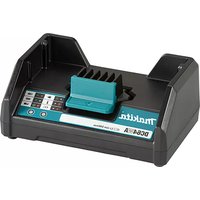
DC64WA - Battery charger MAKITA - Free user manual and instructions
Find the device manual for free DC64WA MAKITA in PDF.
 FR
FR
 BG
BG
 CS
CS
 DA
DA
 DE
DE
 EL
EL
 EN
EN
 ES
ES
 ET
ET
 FI
FI
 HU
HU
 IT
IT
 KK
KK
 LT
LT
 LV
LV
 MK
MK
 NL
NL
 NO
NO
 PL
PL
 PT
PT
 RO
RO
 RU
RU
 SK
SK
 SL
SL
 SQ
SQ
 SR
SR
 SV
SV
 TR
TR
 UK
UK
 ZH
ZH
| Product type | Battery charger |
| Brand | Makita |
| Model | DC64WA |
| Compatible batteries | Makita Li-ion rechargeable batteries |
| Output voltage | 57.6 V (max. 64 V) |
| Number of battery cells | 32 |
| Battery capacity (example) | 4.0 Ah (per IEC61960) |
| Charging time (for 4.0 Ah) | 120 minutes |
| Recommended charging temperature | 10 °C to 40 °C |
| LED indicators | Green and red LEDs for charge status (0-80%, 80-100%, completed, fault) |
| Protection | Double insulation, protection against overheating, short circuit, reverse polarity |
| Usage | Indoor use only |
| Power supply | AC (voltage according to rating plate) |
| Maintenance and cleaning | Clean with a dry cloth; do not use solvents |
| Safety instructions | Read the manual; do not expose to rain; do not charge non-rechargeable batteries; disconnect before maintenance |
| Recycling | Do not dispose of with household waste; take to a collection point |
Frequently Asked Questions - DC64WA MAKITA
User questions about DC64WA MAKITA
0 question about this device. Answer the ones you know or ask your own.
Ask a new question about this device
Download the instructions for your Battery charger in PDF format for free! Find your manual DC64WA - MAKITA and take your electronic device back in hand. On this page are published all the documents necessary for the use of your device. DC64WA by MAKITA.
USER MANUAL DC64WA MAKITA
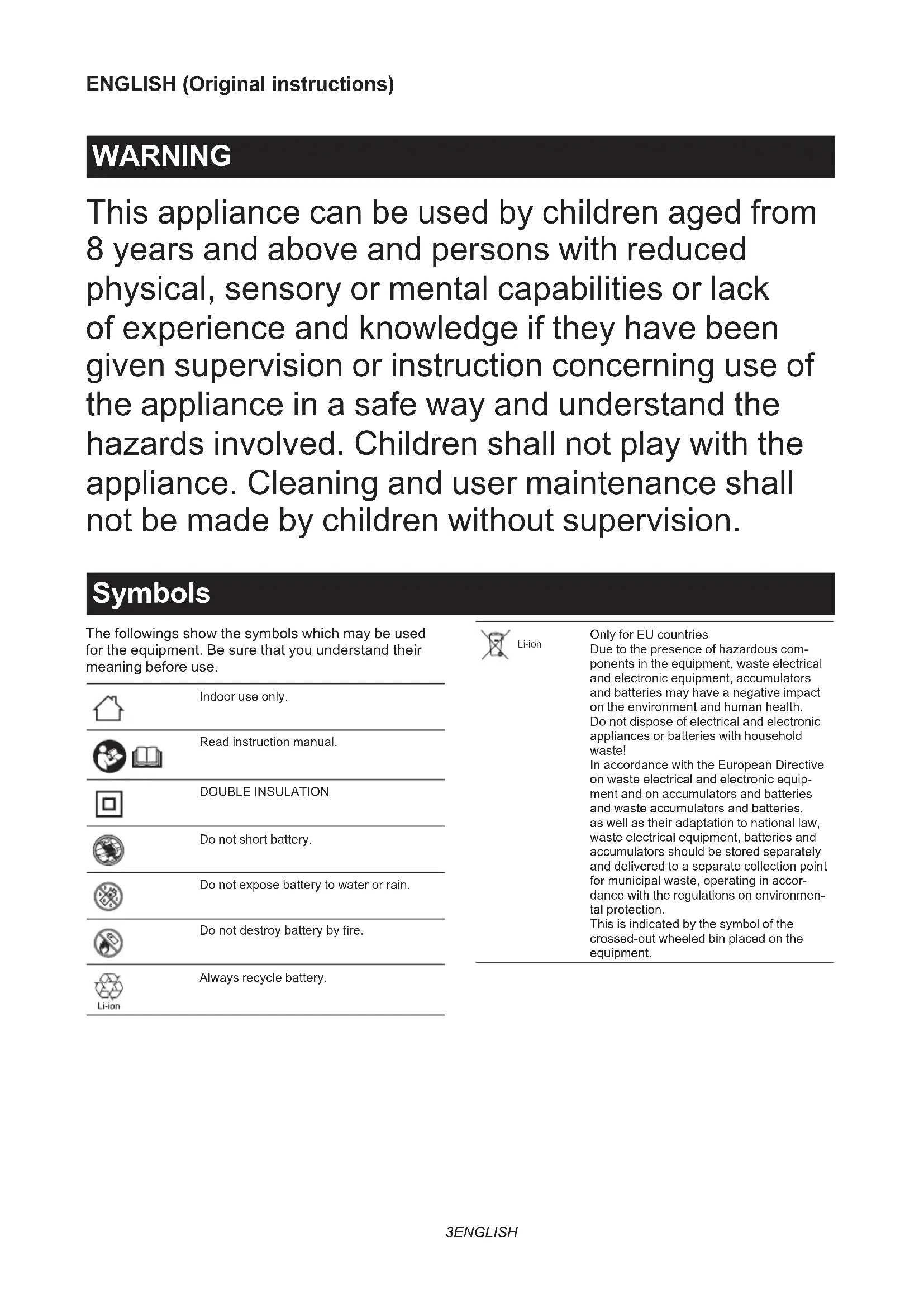
This appliance can be used by children aged from 8 years and above and persons with reduced physical, sensory or mental capabilities or lack of experience and knowledge if they have been given supervision or instruction concerning use of the appliance in a safe way and understand the hazards involved. Children shall not play with the appliance. Cleaning and user maintenance shall not be made by children without supervision.
Symbols
| The followings show the symbols which may be used for the equipment. Be sure that you understand their meaning before use. | |
| Indoor use only. | |
| Read instruction manual. | |
| DOUBLE INSULATION | |
| Do not short battery. | |
| Do not expose battery to water or rain. | |
| Do not destroy battery by fire. | |
| Always recycle battery. | |

Li-ion
Only for EU countries
Due to the presence of hazardous components in the equipment, waste electrical and electronic equipment, accumulators and batteries may have a negative impact on the environment and human health. Do not dispose of electrical and electronic appliances or batteries with household waste!
In accordance with the European Directive on waste electrical and electronic equipment and on accumulators and batteries and waste accumulators and batteries, as well as their adaptation to national law, waste electrical equipment, batteries and accumulators should be stored separately and delivered to a separate collection point for municipal waste, operating in accordance with the regulations on environmental protection.
This is indicated by the symbol of the crossed-out wheeled bin placed on the equipment.
▶ Fig.1
| Ready to charge. | |
| Delay charge (too hot or too cold battery). | |
| Charging (0 - 80 %). |

CAUTION
- SAVE THESE INSTRUCTIONS – This manual contains important safety and operating instructions for battery charger.
- Before using battery charger, read all instructions and cautionary markings on (1) battery charger, (2) battery, and (3) product using battery.
- CAUTION – To reduce risk of injury, charge only Makita type rechargeable batteries. Other types of batteries may burst causing personal injury and damage.
- Non-rechargeable batteries cannot be charged with this battery charger.
- Use a power source with the voltage specified on the nameplate of the charger.
- Do not charge the battery cartridge in presence of flammable liquids or gases.
- Do not expose charger to rain, snow, or wet condition.
- Never carry charger by cord or yank it to disconnect from receptacle.
- Remove the battery from the charger when carrying the charger.
- After charging or before attempting any maintenance or cleaning, unplug the charger from the power source. Pull by plug rather than cord whenever disconnecting charger.
-
Make sure cord is located so that it will not be stepped on, tripped over, or otherwise subjected to damage or stress.
-
Do not operate charger with damaged cord or plug. If the cord or plug is damaged, ask Makita authorized service center to replace it in order to avoid a hazard.
- If the supply cord is damaged, it must be replaced by the manufacturer, its service agent or similarly qualified persons in order to avoid a hazard.
- Do not operate or disassemble charger if it has received a sharp blow, been dropped, or otherwise damaged in any way; take it to a qualified serviceman. Incorrect use or reassembly may result in a risk of electric shock or fire.
- Do not charge battery cartridge when room temperature is BELOW 10^ C ( 50^ F) or ABOVE 40^ C ( 104^ F). At the cold temperature, charging may not start.
- Do not attempt to use a step-up transformer, an engine generator or DC power receptacle.
- Do not allow anything to cover or clog the charger vents.
- Do not plug or unplug the cord and insert or remove the battery with wet hands.
- Never use gasoline, benzine, thinner, alcohol or the like to clean the charger. Discoloration, deformation or cracks may result.
Charging
- Plug the battery charger into the proper AC voltage source. Charging lights will flash in green color repeatedly.
- Insert the battery cartridge into charger until it stops while aligning the guide of charger.
-
When the battery cartridge is inserted, the charging light color will change from green to red and charging will begin. The charging light will keep lighting up steadily during charging. One red charging light indicates charged condition in 0–80 % and red and green ones indicate 80–100 %. The 80 % indication mentioned above is approximate value. The indication may differ according to battery temperature or battery condition.
-
When charging is finished, red and green charging lights will change to one green light.
- After charging, remove the battery cartridge from charger while pushing the hook. Then unplug the charger.
NOTE: If the hook does not open smoothly, clean dust around mounting parts.
▶ Fig.2: 1. Hook
NOTE: Charging time varies by temperature (10°C (50°F)–40°C (104°F)) that battery cartridge is charged at and conditions of the battery cartridge, such as a battery cartridge which is new or has not been used for a long period of time.
| Voltage Number | of cells Li-ion battery cartridge Capacity (Ah) | according to IEC61960 | Charging time(Minutes) | |
| 57.6 V - 64 V (max.) | 32 BL6440 4.0 | 120 | ||
NOTICE: The battery charger is for charging Makita-battery cartridge. Never use it for other purposes or for other manufacturer's batteries.
NOTE: If the charging light flashes in red color, charging may not start due to the condition of the battery cartridge as below:
— Battery cartridge from just-operated tool or battery cartridge that has been left in a location exposed to direct sunlight for a long time.
— Battery cartridge that has been left for a long time in a location exposed to cold air.
NOTE: When the battery cartridge is too hot, charging does not begin until the battery cartridge temperature reaches the degree at which charging is possible.
NOTE: If the charging light flashes alternately in green and red color, charging is not possible. The terminals on the charger or battery cartridge are clogged with dust or the battery cartridge is worn out or damaged.
AVERTISSEMENT


Brand : MAKITA
Model : DC64WA
Category : Battery charger