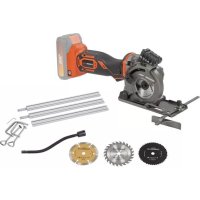
POWDP25400 - Saw PowerPlus - Free user manual and instructions
Find the device manual for free POWDP25400 PowerPlus in PDF.



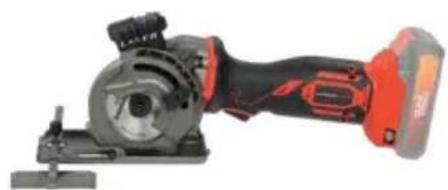
| Product type | Cordless plunge circular saw (mini) |
| Brand | PowerPlus |
| Model | POWDP25400 |
| Rated voltage | 20 V |
| No-load speed | 3150 min⁻¹ |
| Blade diameter | 89 mm |
| Bore | 10 mm |
| Kerf | 1.8 mm |
| Number of teeth | 24 |
| Blade thickness | 1.0 mm |
| Shaft lock | Yes |
| Max. cutting width (90°) | 28.5 mm (wood) |
| Weight (estimated) | Approximately 2.5 kg |
| Battery | Li-ion 20 V (not included) |
| Soft grip handle | Yes |
| Laser guide | Yes (class 2) |
| Dust extraction | Yes (port and hose included) |
| Guide rails | 3 pieces included |
| Warranty | 36 months |
| Package contents | 1 saw, 3 blades (TCT, HSS, diamond), 2 hex keys, 1 parallel guide, 1 extraction hose, 3 rails, 2 clamps, manual |
Frequently Asked Questions - POWDP25400 PowerPlus
User questions about POWDP25400 PowerPlus
0 question about this device. Answer the ones you know or ask your own.
Ask a new question about this device
Download the instructions for your Saw in PDF format for free! Find your manual POWDP25400 - PowerPlus and take your electronic device back in hand. On this page are published all the documents necessary for the use of your device. POWDP25400 by PowerPlus.
USER MANUAL POWDP25400 PowerPlus
FI·EL·HR·CS·SK·RO·PL·HU·RU·BG
POWDP25400
PLUNGE SAW
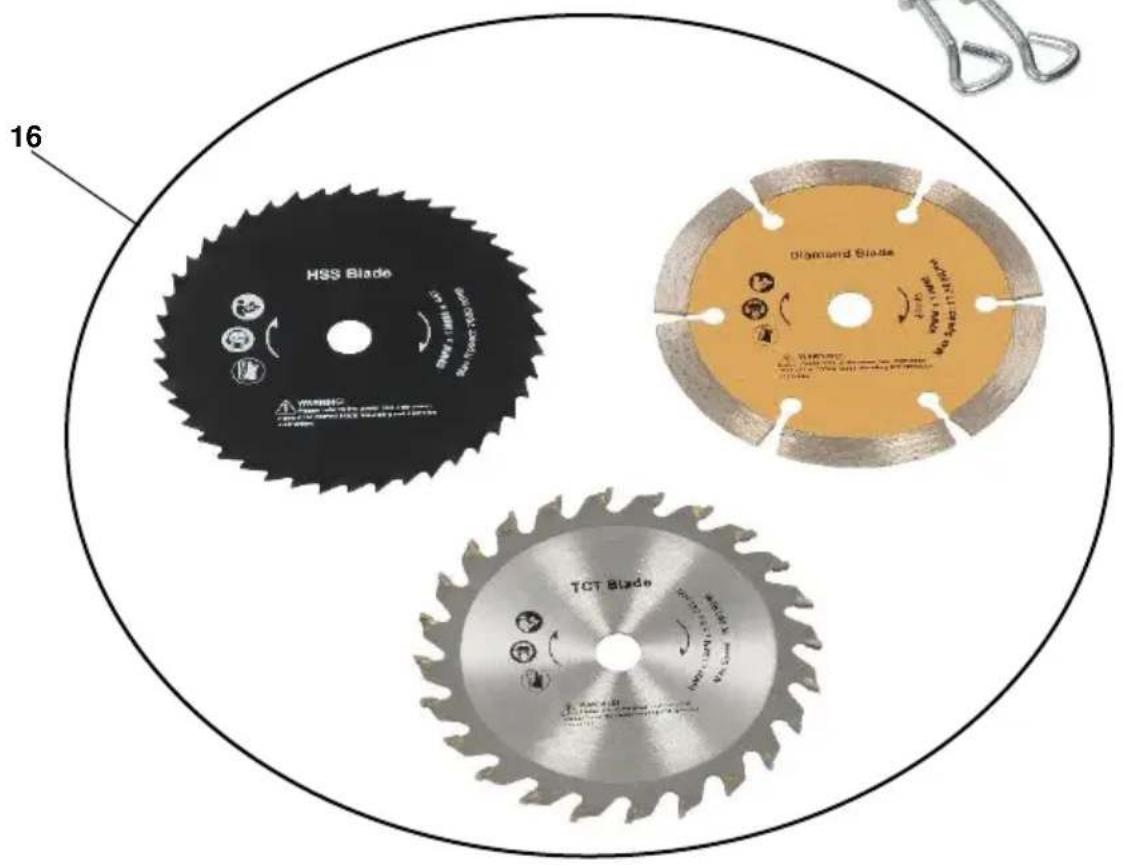
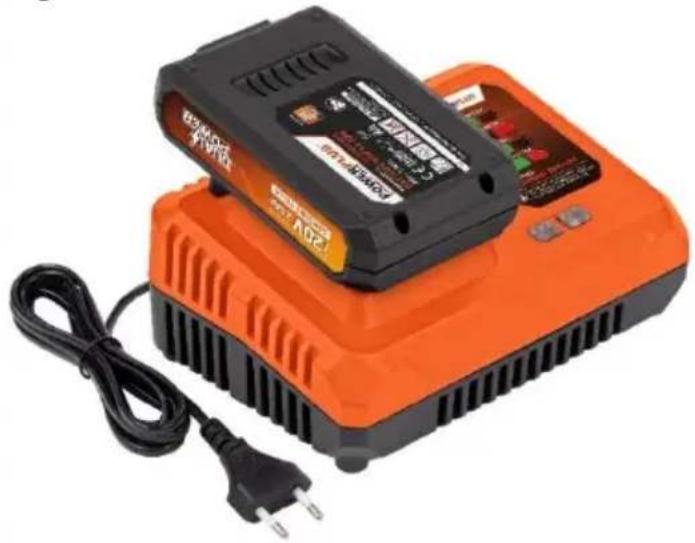
Fig. 1
natural_image
Orange and black power supply unit with charging cable and power outlet (no visible text or symbols)Fig. 2
natural_image
Black and orange dual power bank battery with orange handle (no visible text or symbols)Fig. 3
natural_image
Close-up of a hand holding a power tool with orange and black buttons, no visible text or symbolsFig. 4
natural_image
Close-up of a power saw cutting tool with labeled parts A, B, and C (no text or symbols on the tool itself)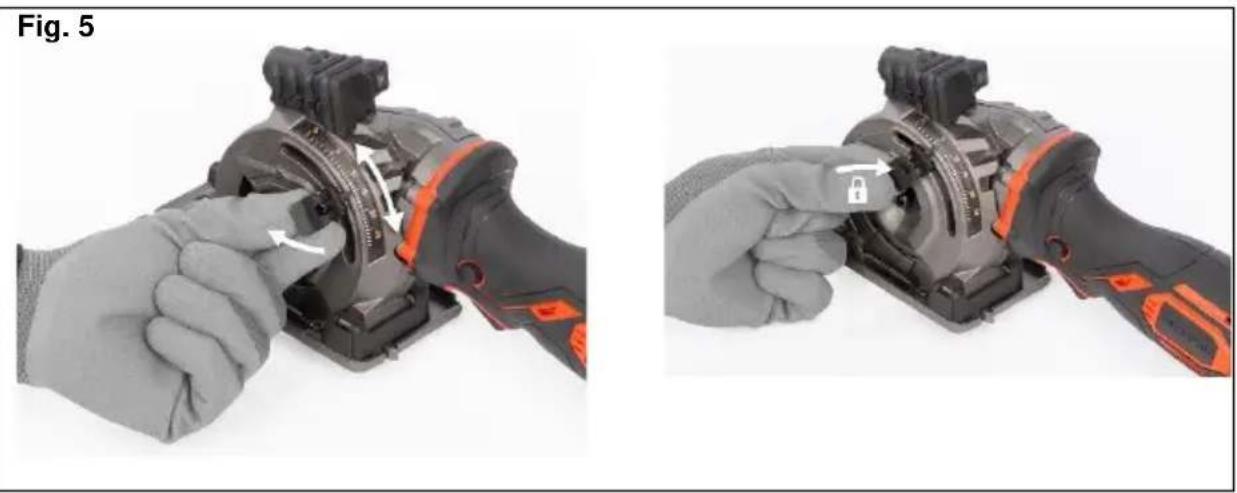
Fig. 6
natural_image
Close-up of a hand adjusting metal strips with a small tool, no text or symbols visibleFig. 7
natural_image
Close-up of a red-handled circular saw cutting into a flat workpiece (no text or symbols visible)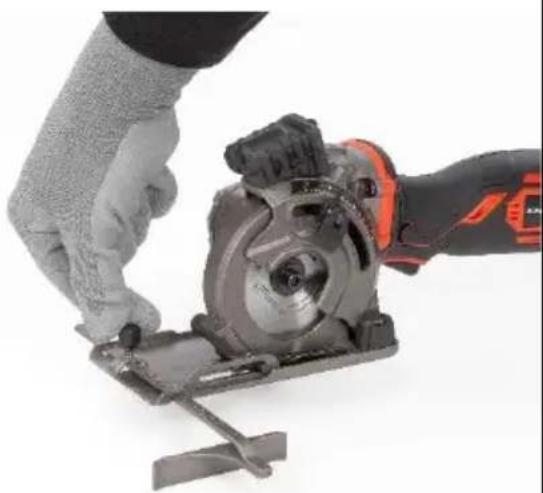
natural_image
Close-up of a hand using a power tool to cut a circular saw (no text or symbols visible)Fig. 8
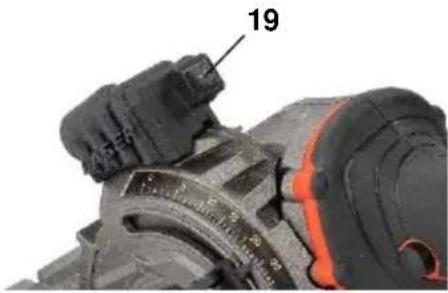
Fig. 9
natural_image
Two hand-painted industrial motors with attached cable, one holding a flexible hose and the other showing internal components (no text or symbols visible)Fig. 10
natural_image
Cross-sectional diagram of a mechanical device with labeled component 'e' (no text or symbols beyond label)Fig. 11
natural_image
Close-up of a hand using a power tool to cut a mechanical component (no visible text or symbols)Fig. 12
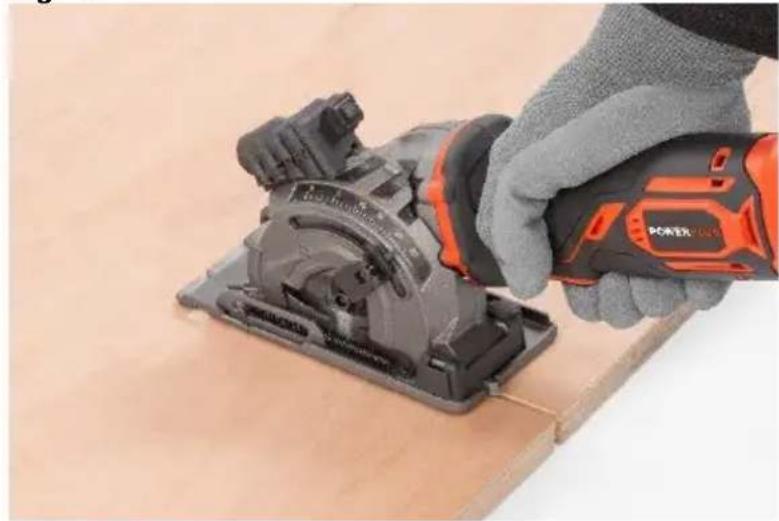
natural_image
Close-up of a hand using a power tool to cut a wooden cutting board (no text or symbols visible)Fig. 13

natural_image
Hand using a power tool to cut a saw blade on a wooden surface (no text or symbols visible)2 BESCHRIJVING (FIG. A)
natural_image
Simple hand-drawn sketch of a rounded rectangular shape with a small circular mark at the top (no text or symbols)Philippe Vankerkhove
Regelgevings- en compliancemanager
15/07/2021, Lier - Belgium
natural_image
Simple hand-drawn sketch of a rounded rectangular shape with a small circular mark on top (no text or symbols)Philippe Vankerkhove
15/07/2021, Lier - Belgium
1 INTENDED USE....3
2 DESCRIPTION (FIG. A)....3
3 PACKAGE CONTENT LIST .... 3
4 SYMBOLS....4
5 GENERAL POWER TOOL SAFETY WARNINGS....4
5.1 Working area....4
5.2 Electrical safety....4
5.3 Personal safety .... 5
5.4 Power tool use and care....5
5.5 Battery tool use and care .... 5
5.6 Service....6
6 ADDITIONAL SAFETY INSTRUCTIONS FOR PLUNGE SAWS ..... 6
7 CAUSES AND PREVENTION OF KICKBACK......7
8 ADDITIONAL SAFETY INSTRUCTIONS FOR LASERS......8
9 ADDITIONAL SAFETY INSTRUCTIONS FOR BATTERIES AND CHARGERS 8
9.1 Batteries 8
9.2 Chargers....8
10 FUNCTIONS....9
10.1 Soft grip (1)....9
10.2 Li-ion battery (10)....9
10.3 Dust extraction outlet (9)....9
11 BEFORE USE 9
11.1 Charging the battery pack....9
11.1.1 Charging indication (Fig. 1)....9
11.2 Battery capacity indicator (Fig. 2)....10
11.3 Inserting and removing the battery (Fig. 3)....10
11.4 Attaching and removing the blade (Fig. 4)....10
11.5 Adjust the cutting depth (Fig. 5)....11
11.6 Guide rails (15)....11
POWERPLUS HIGH QUALITY TOOLS
POWDP25400 EN
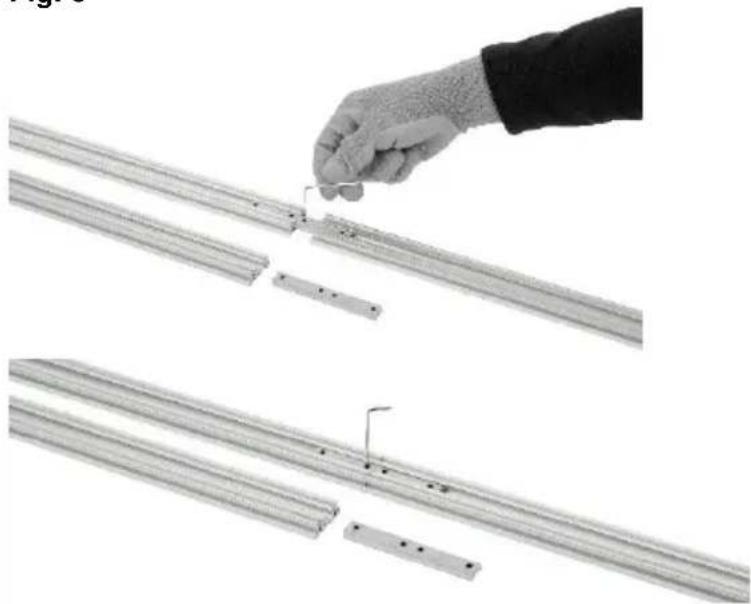
11.7 Connecting rods for guide rails (Fig. 6)....11
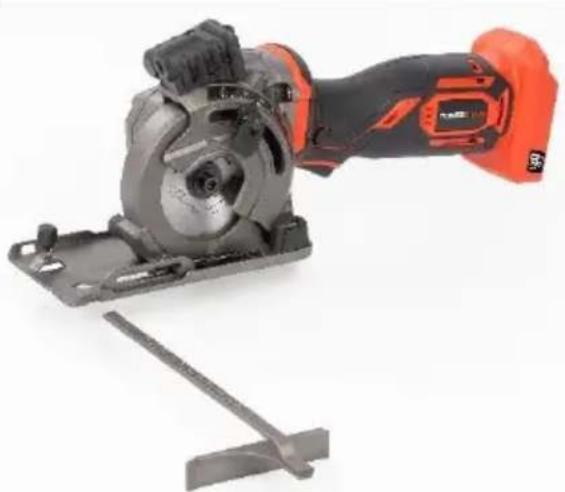
11.8 Parallel cut adjustment (Fig. 7)....11
11.9 Laser line generator (Fig. 8)....11
11.10 Sawdust removal (Fig. 9)....12
11.11 Line following (Fig. 10)....12
11.12 Switching On and Off (Fig. 11)....12
12 CUTTING....12
12.1 General cut (Fig. 12)....12
12.2 Pocket cut (Fig. 13)....13
12.3 Cutting particularly Tough or Abrasive Materials....13
12.3.1 Sheet metal:....13
12.3.2 Ceramic tiles, slates etc: 14
12.3.3 Plasterboard:....14
13 WORKING HINTS FOR MINI PLUNGE SAW 14
14 MAINTENACE....14
15 TECHNICAL DETAILS 14
16 NOISE....15
17 WARRANTY....15
18 ENVIRONMENT 15
19 DECLARATION OF CONFORMITY 16
MINI CIRCULAR SAW 20V-89MM (NO ACCU) POWDP25400
1 INTENDED USE
The tool is intended for ripping and cross-cutting wood and other materials in straight cutting lines, while resting firmly on the work piece. Not suitable for professional use.

WARNING! Read this manual and general safety instructions carefully before using the appliance, for your own safety. Your power tool should only be passed on together with these instructions.
2 DESCRIPTION (FIG. A)
- Soft grip
- Unlock button
- Trigger switch
- Depth scale
- Cutting depth locking lever
- Parallel guide clamping bolt
- Base plate
- Spindle lock button
- Dust extraction outlet
- battery (not included)
- Battery pack release button
- Dust extraction hose
- Hex key
- Parallel guide
- Guide rail (3 pieces)
- Blade (3 pieces)
- Clamp
- Laser
- On/off switch laser
- Hex key
3 PACKAGE CONTENT LIST
■ Remove all packaging materials.
- Remove remaining packing and package inserts (if included).
- Check that the package contents are complete.
- Check the appliance, the power cord, the power plug and all accessories for transportation damage.
- Keep the packing materials as far as possible till the end of the warranty period. Dispose it into your local waste disposal system afterwards.

WARNING: Packaging materials are not toys! Children must not play with plastic bags! Danger of suffocation!
1x mini circular saw
1x TCT blade
1x HSS blade
1x diamond blade
2x hex key
1x side guide
1x dust extraction hose
1x manual
3x guide rail
2x clamp

If any parts are missing or damaged, please contact your dealer.
4 SYMBOLS
In this manual and/or on the machine the following symbols are used:
 | Denotes risk of personal injury or damage to the tool. |  | In accordance with essential requirements of the European directive(s). |
 | Read manual before use. |  | Class II - The machine is double insulated; Earthing wire is therefore not necessary (only for charger). |
 | Ambient temperature 40 °C max. (only for battery). |  | Do not expose charger and battery pack to water. |
 | Use battery and charger only in closed rooms. | 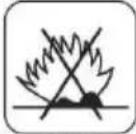 | Do not incinerate battery pack or charger. |
 | Mandatory use of eye protection. |  | Wear gloves. |
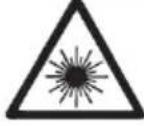 | Laser radiation. |  | Do not stare into beam. |
5 GENERAL POWER TOOL SAFETY WARNINGS
Read all safety warnings and instructions. Failure to heed warnings and follow instructions may result in electric shock, fire and/or serious injury. Keep safety warnings and instructions for future reference. The term "power tool" in the safety warnings refers to your mains-operated (corded) power tool or battery-operated (cordless) power tool.
5.1 Working area
- Keep working area clean and well lit. Untidy and dark areas can lead to accidents.
- Do not operate power tools in potentially explosive surroundings, for example, in the presence of inflammable liquids, gases or dust. Power tools create sparks which may ignite the dust or fumes.
- Keep children and bystanders at a distance when operating a power tool. Distractions can cause you to lose control of it.
5.2 Electrical safety
- Always check that the power supply corresponds to the voltage on the rating plate.
- Power tool plugs must match the outlet. Never modify the plug in any way. Do not use adapter plugs with earthed power tools. Unmodified plugs and matching outlets will reduce the risk of an electric shock.
- Avoid body contact with earthed surfaces such as pipes, radiators, kitchen ranges and refrigerators. There is an increased risk of an electric shock if your body is earthed.
- Do not expose power tools to rain or wet conditions. If water gets inside a power tool, it will increase the risk of an electric shock.
- Do not damage the cord. Never use the cord for carrying, pulling or unplugging the power tool. Keep the cord away from heat, oil, sharp edges or moving parts. Damaged or entangled cords increase the risk of an electric shock.
POWDP25400 EN
- When operating a power tool outdoors, use an extension cable suitable for outdoor use. Using a cord suitable for outdoor use reduces the risk of an electric shock.
5.3 Personal safety
- Stay alert, watch what you are doing and use common sense when operating a power tool. Do not use a power tool when you are tired or under the influence of drugs, alcohol or medication. A moment of inattention when operating a power tool may result in serious personal injury.
- Use safety equipment. Always wear eye protection. Using safety equipment such as a dust mask, non-skid safety shoes, a hard hat, or hearing protection whenever it is needed will reduce the risk of personal injury.
- Avoid accidental starts. Ensure the switch is in the off position before inserting the plug. Carrying power tools with your finger on the switch or plugging in power tools when the switch is in the on position makes accidents more likely.
- Remove any adjusting keys or spanners before turning on the power tool. A spanner or key left attached to a rotating part of the power tool may result in personal injury.
- Do not reach out too far. Keep your feet firmly on the ground at all times. This will enable you retain control over the power tool in unexpected situations.
- Dress properly. Do not wear loose clothing or jewellery. Keep your hair, clothing and gloves away from the power tool. Loose clothes, jewellery or long hair can become entangled in the moving parts.
- If there are devices for connecting dust extraction and collection facilities, please ensure that they are attached and used correctly. Using such devices can reduce dust-related hazards.
- Do not let familiarity gained from frequent use of tools allow you to become complacent and ignore tool safety principles. A careless action can cause severe injury within a fraction of a second.
5.4 Power tool use and care
- Do not expect the power tool to do more than it can. Use the correct power tool for what you want to do. A power tool will achieve better results and be safer if used in the context for which it was designed.
- Do not use the power tool if the switch cannot turn it on and off. A power tool with a broken switch is dangerous and must be repaired.
- Disconnect the plug from the power source before making adjustments, changing accessories, or storing power tools. Such preventive safety measures reduce the risk of starting the power tool accidentally.
- Store power tools, when not in use, out of the reach of children and do not allow people who are not familiar with the power tool or these instructions to operate it. Power tools are potentially dangerous in the hands of untrained users.
- Maintain power tools. Check for misalignment or jammed moving parts, breakages or any other feature that might affect the operation of the power tool. If it is damaged, the power tool must be repaired. Many accidents are caused by using poorly maintained power tools.
- Keep cutting tools sharp and clean. Properly maintained cutting tools with sharp cutting edges are less likely to jam and are easier to control.
- Use the power tool, accessories and cutting tools, etc., in accordance with these instructions and in the manner intended for the particular type of power tool, taking into account the working conditions and the work which needs to be done. Using a power tool in ways for which it was not intended can lead to potentially hazardous situations.
5.5 Battery tool use and care
- Recharge only with the charger specified by the manufacturer. A charger that is suitable for one type of battery pack may create a risk of fire when used with another battery pack.
POWDP25400 EN
- Use power tools only with specifically designated battery packs. Use of any other battery packs may create a risk of injury and fire.
- When battery pack is not in use, keep it away from other metal objects, like paper clips, coins, keys, nails, screws or other small metal objects that can make a connection from one terminal to another. Shorting the battery terminals together may cause burns or a fire.
■ Under abusive conditions, liquid may be ejected from the battery; avoid contact. If contact accidentally occurs, flush with water. If liquid contacts eyes, additionally seek medical help. Liquid ejected from the battery may cause irritation or burns. - Do not use a battery pack or tool that is damaged or modified. Damaged or modified batteries may exhibit unpredictable behaviour resulting in fire, explosion or risk of injury.
- Do not expose a battery pack or tool to fire or excessive temperature. Exposure to fire or temperature above 130 °C may cause explosion.
NOTE: The temperature "130 °C" can be replaced by the temperature "265 °F".) - Follow all charging instructions and do not charge the battery pack or tool outside the temperature range specified in the instructions. Charging improperly or at temperatures outside the specified range may damage the battery and increase the risk of fire.
5.6 Service
- Your power tool should be serviced by a qualified specialist using only standard spare parts. This will ensure that it meets the required safety standards.
- Never service damaged battery packs. Service of battery packs should only be performed by the manufacturer or authorized service providers.
6 ADDITIONAL SAFETY INSTRUCTIONS FOR PLUNGE SAWS
- Make sure that the mains voltage matches the specifications on the type plate.
- Persons with restricted physical, sensory or mental capabilities are not allowed to use the plunge saw unless they are supervised and instructed by a guardian.
- Never leave the powered-on saw unattended and keep them out of reach of children and persons in need of supervision.
- Do not bring your hands in the cutting area and the saw blade.
- Keep in mind that even a worn saw blade is still very sharp. Always grasp the saw blade on the sides. Do not fling the saw blade and do not drop it.
■ Never use the plunge saw with grinding wheels.
- Do not grip underneath the workpiece. The protective cover cannot protect you from the saw blade under the workpiece.
- Adjust the cutting depth to the thickness of the workpiece. It should be visible less than a full tooth height under the workpiece.
- Do not cut very small workpieces. When cutting round wood, use a device which secures the workpiece from twisting. Never hold the workpiece to be cut in your hand or across your leg. It is important to secure the workpiece properly to minimise the risk of physical contact, jamming of the saw blade or loss of control.
- Hold the saw only by the insulated gripping surfaces when performing an operation where the cutting tool may come into contact with hidden power lines or its own device cable. Contact with a live wire also exposes the metal parts to tension and leads to an electric shock.
- Use always saw blades in the correct size and with suitable locating bore. Saw blades that do not match the mounting parts of the saw will run unevenly and lead to loss of control.
- Never use a damaged or incorrect outer flange or a damaged clamping screw. The outer flange and the clamping screw have been specially designed for your saw for optimum performance and reliability.
- Start the plunge saw and begin cutting when it reaches the full idling speed.
- Never brake the saw blade using lateral pressure after switching it off.
- Set the saw aside only when the saw blade comes to a standstill.
- Do not expose the saw to high temperatures, humidity and strong shocks. The saw can be damaged as a result.
- Hold the saw firmly with both hands and bring your arms into a position in which you can resist the kickback forces
7 CAUSES AND PREVENTION OF KICKBACK
- A kickback is the sudden reaction as a result of a stuck, jammed or misaligned saw blade which leads to an uncontrolled saw to be lifted and moved from the workpiece out in the direction of the operator.
- A kickback can occur when the saw blade gets stuck or jammed in the saw gap. The saw blade is blocked and the motor force repels the circular saw in the direction of the operator.
- A kickback can occur when the saw blade becomes twisted or misaligned in the saw groove. As a result, the teeth of the back edge of the saw blade can get stuck in the surface of the workpiece, whereby the saw blade is moved out of the saw gap and the saw jumps back in the direction of the operator.
- A kickback is the result of incorrect or faulty use of the saw. It can be prevented by appropriate precautions as described below.
- Hold the saw firmly with both hands and bring your arms into a position in which you can resist the kickback forces. Always hold the saw baldes on the sides, never bring the blade in line with your body. In a kickback, the saw can jump backwards, but the operator can control the kickback forces if appropriate measures were taken.
- If the saw blade jams or sawing is interrupted for any reason, release the ON / OFF switch and calmly hold the saw in the material until the saw blade stands completely still. Never attempt to remove the saw from the workpiece or pull it backwards as long as the saw blade is moving or a kickback might occur. Find the cause of the saw blade jam and eliminate them through appropriate measures.
- When you want to restart a saw that is stuck in a workpiece, center the saw blade in the saw gap and check that the saw teeth are not stuck in the workpiece. If the saw blade jams, it can move out from the workpiece or a kickback can happen if the saw is restarted.
- Prop up large panels in order to minimise the risk of a kickback by a jammed saw blade. Large panels tend to sag under their own weight. Panels must be supported on both sides, both in the vicinity of the saw gap as well as on the edge.
- Do not use dull or damaged saw blades. Saw blades with blunt or misaligned teeth cause increased friction, jamming of the saw blade and kickback by an excessively narrow saw gap.
- Tighten the cutting depth position prior to cutting. If the settings change while cutting, the saw blade can jam and a kickback can occur.
- Be especially careful if you perform a "circular cut" in a hidden area, such as an existing wall. The protruding saw blade can get blocked in hidden objects while cutting and cause a kickback.
- Do not place the saw on the workbench or the floor unless the saw blade is at a standstill. An unprotected, running saw blade moves the saw against the cutting direction and cuts whatever is in its way. Thus note the delay time of the saw.
■ For this reason, the saw is not suitable for use in reverse position as fixed equipment.
- Do not operate the saw if it is not working properly or has been damaged. In case of technical problems, do not attempt to repair it on your own. Contact the service or have the saw repaired by a professional.
8 ADDITIONAL SAFETY INSTRUCTIONS FOR LASERS

Warning! The laser beam potentially causes eye damage. Do not look or stare into the laser beam.
- During use, do not point the laser beam at people, directly or indirectly through reflecting surfaces.
- This laser complies with class 2 according to the relevant standard. The unit includes no servicing components. Do not open the housing for any reason. If the unit is damaged, have the damage repaired by an authorized repair agent.
- Laser viewing glasses are not protective glasses against laser radiation.
9 ADDITIONAL SAFETY INSTRUCTIONS FOR BATTERIES AND CHARGERS

Use only batteries and chargers applicable for this machine.
9.1 Batteries
■ Never attempt to open for any reason.
- Do not store in locations where the temperature may exceed 40 °C.
- Charge only at ambient temperatures between 4 °C and 40 °C.
- Store your batteries in a cool dry place (5 °C-20 °C). Never store batteries in discharged state.
It is better for Li-ion batteries to discharge and reload them regularly (at least 4 times a year). The ideal charge for long-term storage of your Li-ion battery is 40% of capacity.
- When disposing of batteries, follow the instructions given in the section "Protecting the environment"
- Do not cause short circuits. If connection is made between the positive (+) and negative (-) terminal directly or via accidental contact with metallic objects, the battery is short circuited and an intense current will flow causing heat generation which may lead to casing rupture or fire.
- Do not heat. If batteries are heated to above 100 °C, sealing and insulating separators and other polymer components may be damaged resulting in electrolyte leakage and/or internal short circuiting leading to heat generation causing rupture or file. Moreover do not dispose of the batteries in fire, explosion and/or intense burning may result.
■ Under extreme conditions, battery leakage may occur. When you notice liquid on the battery, proceed as follows:
- Carefully wipe the liquid off using a cloth. Avoid skin contact.
– In case of skin or eye contact, follow the instructions below:
√ Immediately rinse with water. Neutralize with a mild acid such as lemon juice or vinegar.
√ In case of eye contact, rinse abundantly with clean water for at least 10 minutes. Consult a physician.
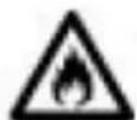
Fire hazard! Avoid short-circuiting the contacts of a detached battery. Do not incinerate the battery.
9.2 Chargers
■ Never attempt to charge non-rechargeable batteries.
- Have defective cords replaced immediately.
- Do not expose to water.
- Do not open the charger.
- Do not probe the charger.
■ The charger is intended for indoor use only.
10 FUNCTIONS
10.1 Soft grip (1)
Your mini plunge saw is equipped with TPR soft grip and protective parts. TPR (Thermoplastic rubber) is elastic, chock absorbing and environmental friendly (recyclable).
10.2 Li-ion battery (10)
Advantages of Li-ion batteries:
- Li-ion batteries have a higher capacity/weight ratio (more power for less heavy, more compact, battery).
- No memory effect (capacity loss after several charge/discharge cycles) like other type batteries. (Ni-Cd, Ni-MeH,...).
- Limited self-discharge (also see chapter: Storage).
10.3 Dust extraction outlet (9)
The saw includes a dust extraction outlet that can be attached with a dust extraction hose (12) for dust removal. This adapter port can be attached to a vacuum cleaner (not included). Hook up a vacuum cleaner and keep your workspace free of dust and debris while you work.
11 BEFORE USE
11.1 Charging the battery pack
The battery pack for this tool is supplied in a low charge condition to prevent possible problems; therefore, you have to charge the battery before first use.

Note: Batteries will not reach full charge the first time they are charged. Allow several cycles for the item to fully charge. The battery should only be charged indoors.
After normal use, about 1 hour of charging time is required for the battery to be fully charged. The battery pack will become slightly warm while charging; this is normal and does not indicate a problem.
Do not place the charger in an area of extreme heat or cold. Best is at normal room temperature. When the battery becomes fully charged, unplug your charger from the power supply and remove the battery pack from the charger.
Note:
- Allow the battery pack to cool completely before charging
- Inspect the battery pack before charging; do not charge a cracked or leaking battery pack.
11.1.1 Charging indication (Fig. 1)
Connect the charger to the power outlet socket:
- Solid green: ready to charge.
■ Flickering red: charging. - Solid green: charged.
- Solid green and red: battery or charger damaged.

Note: If the battery does not fit properly, disconnect it and confirm that the battery pack is the correct model for this charger as shown on the specification chart. Do not charge any other battery pack or any battery pack that does not securely fit the charger.
- Frequently monitor the charger and battery pack while connected.
- Unplug the charger and disconnect it from the battery pack when finished.
- Allow the battery pack to cool completely before using it.
- Store the charger and battery pack indoors, out of reach of children.

NOTE: If battery is hot after continuous use in the tool, allow it to cool down to room temperature before charging. This will extend the life of your batteries.

NOTE: Remove battery pack from charger stand which use your thumb or fingers, press the battery's release button in and pull the battery pack off at the same time.
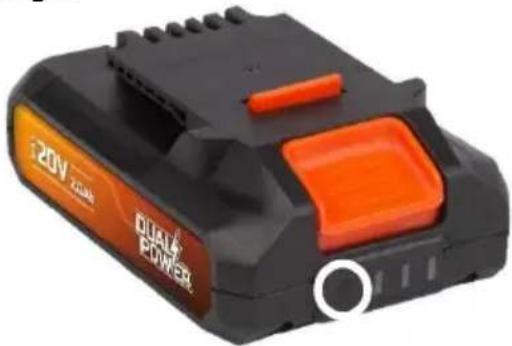
11.2 Battery capacity indicator (Fig. 2)
There are battery capacity indicators on the battery pack; you can check the capacity status of the battery if you squeeze the button. Before using the machine, please press switch trigger to check if the battery is full enough for properly working.
Those 3 LED might show the status of the capacity level of the battery:
3 LED's are litt: Battery fully charged.
2 LED's are litt: Battery 60% charged.
1 LED is litt: Battery almost discharged.
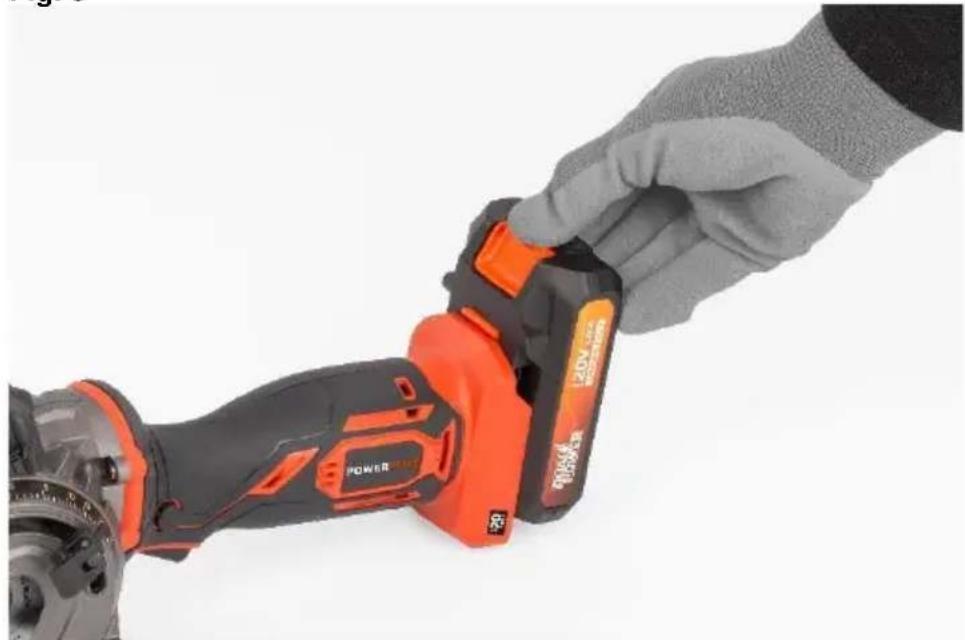
11.3 Inserting and removing the battery (Fig. 3)

WARNING: Before making any adjustments ensure the drill is switched off with the direction of rotation selector in the centre position
- Remove the battery: press the battery release button in and at the same time pull the battery pack off.
- To insert the battery, push the battery pack onto the contacts of the tool.
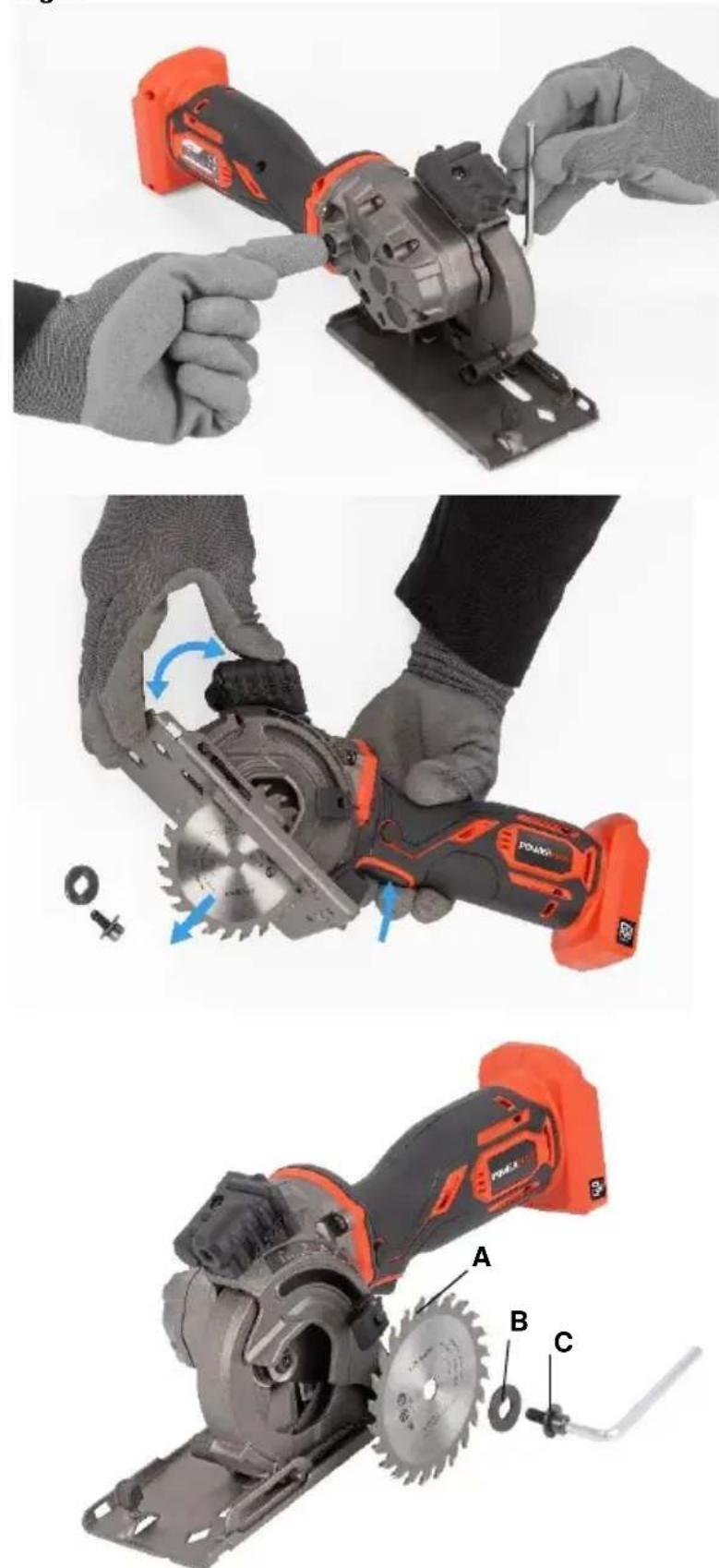
11.4 Attaching and removing the blade (Fig. 4)

Warning: When mounting the saw blade, wear protective gloves. Danger of injury when touching the saw blade.
Only use saw blade that correspond with the characteristic data given in the operating instructions.

CAUTION! Switch off the tool and disconnect it from the battery pack before assembly.
- Place the saw on its side of a flat surface.
POWDP25400 EN
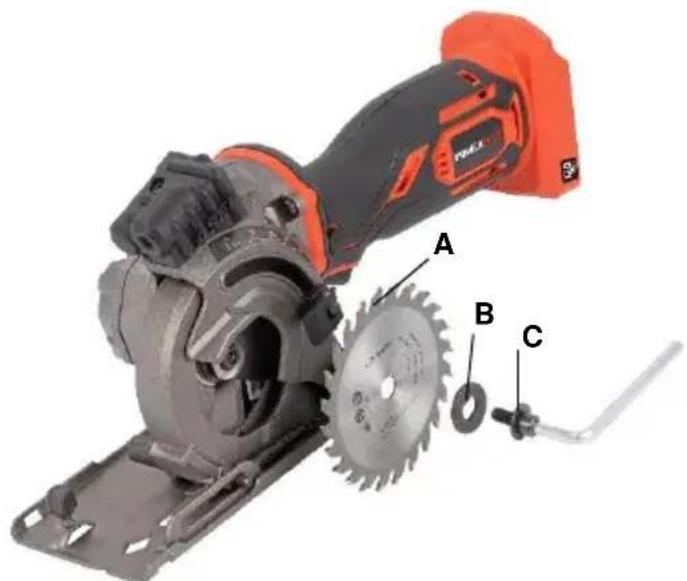
- Press the unlock button (2), hold, lift the base plate (pushing the front side upward) to mount the saw blade (a) onto the spindle.
- Make sure the saw teeth and arrow on the blade point in the same direction as the arrow shown on the guard.
- Install the outer flange (b), washer and blade clamp bolt (c), then put the hex key (13) in the bolt head. While keeping the spindle lock button (8) depressed, turn the hex key (13) slowly counter-clockwise until the blade lock engages and the blade stops rotating.
■ Make sure the saw blade can turn freely by turning the blade using the hex key (13).
■ If you need to remove the saw blade, please follow the reverse order

NOTE: For best cutting results, use a saw blade suited to the material and cut quality desired.
11.5 Adjust the cutting depth (Fig. 5)
Determine the desired depth according to the thickness of the material plus a blade allowance
- Loose the cutting depth locking lever (5) by lifting it up.
- Set the desired cutting depth by aligning the triangular depth indicator with the depth scale (4).
■ Tighten the cutting depth locking lever (5).
11.6 Guide rails (15)
The guide rails allow precise and clean straight cuts, miter cuts and fitting. The rails also protect the work piece surface from damages.
Fixing with the clamps (17) ensures solid grip and safe work.
- Place the guide rail on the work piece and fix the guide rail with the clamps. Slide the bar into the groove of the guide rail and tighten the clamp with the lever.
- Place the plunge saw on the guide rail. The base plate has a groove, which exactly fits into the guide ridge of the rail.
11.7 Connecting rods for guide rails (Fig. 6)
- To connect both guide rails, use the S2 Hex key (20) to loosen the connecting rod, slide the first connecting rod from the bottom into the groove of the guide rail.
- Slide the other connecting rod into the second groove.
- Use the S2 Hex key (20) to tighten the stud screws to connect the rails.
11.8 Parallel cut adjustment (Fig. 7)
The parallel guide enables exact cuts along a work-piece edge and cutting strips of the same dimension.
- Turn the parallel guide clamping bolt (6) counter-clockwise to loosen.
- Insert the parallel guide (14) through all three slots on the base plate (7), slide the parallel guide (14) left or right to a desired position.
- Tighten the parallel guide clamping bolt (6) by turning it clockwise. Check if the parallel guide (14) is locked in place.
- Ensure that the parallel guide (14) rests against the wood along its entire length to give a consistent parallel cuts.
11.9 Laser line generator (Fig. 8)

Warnings: Do not stare directly at the laser beam, do not deliberately aim the beam at personnel and ensure that it is not directed towards the eye of a person for longer than 0.25s.

When you make the line of the cut on the work piece, the laser line generator can help you get better alignment.
Turn on: Press the laser generator switch (19) to "I" position, the laser generator (18) works. Turn off: Press the laser switch (19) to "O" position.
■ Make sure line of the cut is on the work piece.
- Adjust the depth of cut as required.
- Plug in the machine and start the motor.
- When the blade is at its maximum speed, place the saw on the work-piece.
- Switch on the laser generator (18) from the laser aperture using the laser generator switch (19).
- Align the beam with the mark on the work-piece and slowly push the saw forward using both hands, keeping the red light beam on the mark.
- Switch off the laser beam when completion of the cut.
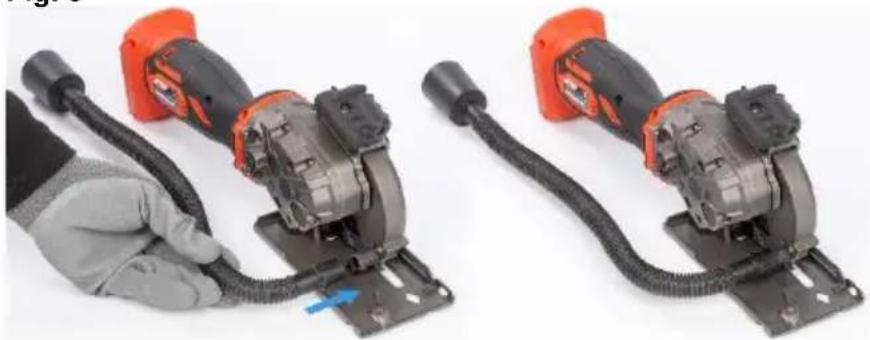
11.10 Sawdust removal (Fig. 9)
The plunge saw is a powerful tool capable of producing a large amount of dust. As the tool has a fully enclosed blade, forced dust extraction is particularly efficient. Forced dust extraction should be used for all but small trimming jobs.
- Push the dust extraction hose (12) on to the dust extraction outlet (9).
- Connect a vacuum device approved for the extraction of sawdust and splinters to the dust extraction hose (12).
11.11 Line following (Fig. 10)
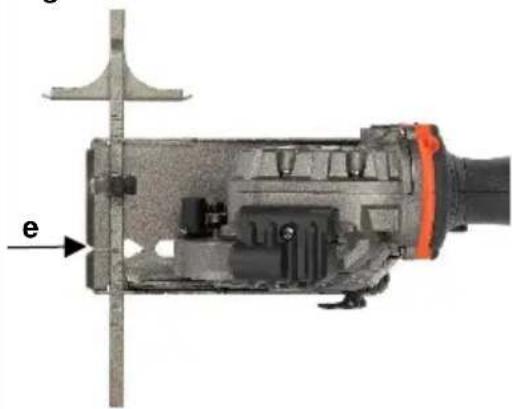
A V-shaped pointer and pointer locate at the front and the rear position of the base plate (7) which allow a line to be followed during operation.
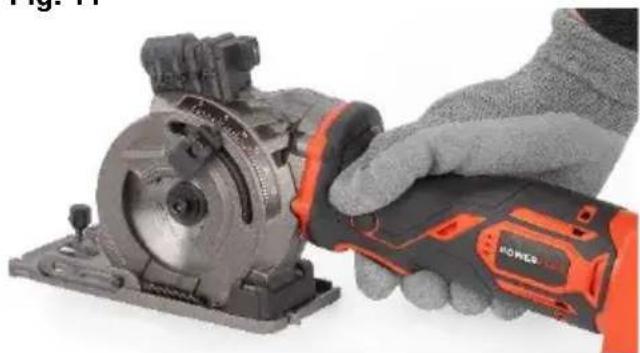
11.12 Switching On and Off (Fig. 11)

WARNING! Before engaging the on/off switch, check the saw blade to see if it is fitted properly and runs smoothly, and the blade clamp screw is well tightened.
To start the machine
- First press the unlock button (2).
- Then press the trigger switch (3) and keep it pressed.
To switch off the machine - First take the machine out of the work-piece.
■ Then release the trigger switch (3).

Note: For safety reasons, the trigger switch (3) cannot be locked; it must remain pressed during the entire operation.
12 CUTTING
12.1 General cut (Fig. 12)
- Check the specifications to ensure the suitability of the material to be cut.
- Fit the correct blade ensuring it is sharp and not damaged.
■ Set the depth of cut. - Mount and connect the dust extraction system.
- lace the material to be cut onto a flat surface such as a workbench, table or floor. Use a piece of scrap material underneath if: You do not wish to damage the work surface.
- Connect the tool with battery pack.
POWDP25400 EN
- Grasp the tool firmly and rest its metal base plate onto the surface to be cut. Ensure that the rear half of the base plate overhangs the work surface. Do not plunge the blade into the material.
- Switch on the tool and wait for a moment for the blade to run up to speed. Next, depress the unlock button (2) and plunge the blade into the material slowly and gently, but firmly. Then push the tool forwards along the line to be cut.
■ NOTE: Never draw the tool backwards.
- Very little force should be used to feed the tool along the cut. Excess force will cause operator fatigue and excessive wear to the blade and tool. Excess force is also likely to cause the temperature cut-out to trip, resulting in delays.
- Once the cut has been finished, lift the tool from the work surface before switching off. If a lot of dust has been created, keep switched on for a few seconds extra to allow the dust to clear from within the tool.
12.2 Pocket cut (Fig. 13)

WARNING: Always maintain proper control of the saw to make sawing safer and easier. Loss of control of the saw may cause serious injury.
A pocket cut is a cut that must be made inside the area of the work-piece rather than starting from an outside edge and working inward.
- Install a saw blade suitable for the material you are about to saw.
- Clearly mark the area to be cut. Set the depth of cut on the saw. Tilt the saw over the marked area with the front edge of the base plate (7) resting on the work surface and the back edge lifted above the work surface. The cutting guide (e) (Fig. 10) should be aligned with the line you have marked on your work-piece.
- With the saw still in the tilted position, apply pressure to the base plate so that the saw blade is fully exposed through the blade slot in the base plate (according to the depth of cut you have set). Ensure the blade is not touching but is close to the work surface.
- Hold the saw firmly while applying the least amount of pressure as possible on base plate. To avoid kickback, you should hold the tool firmly before switching on the saw.
- Switch the plunge saw on, wait for it to reach full speed, and gently guide the blade down into the material but maintain a pivoting force on the front edge of the base. Then push the tool forwards along the line to be cut.
■ Watch your cutting line by carefully looking through the front end of the blade slot.
- When the cut is complete, release the trigger switch and let the blade come to a complete stop.
- DO NOT REMOVE the saw and blade from the work-piece while the blade is moving. This could damage your cut (kerf), cause kickback and loss of control, resulting in injury.

WARNING: Always cut in a forward direction when pocket cutting. Cutting in the reverse direction could cause the saw to climb up on the work-piece and back toward you.
12.3 Cutting particularly Tough or Abrasive Materials
12.3.1 Sheet metal:
- Only use a blade specifically designed for this purpose.
- Always set the depth adjustment to at least 1 mm deeper than the material thickness to avoid the blade riding up over the surface. Scrap material is required underneath the work surface.
POWDP25400 EN
- Remove burrs and rust as these impede the feed across the material.
- Thick beeswax (furniture polish) applied to the base plate of the tool makes metal cutting easier. (the base plate will slide easier over the work piece)
- Only suitable for cutting brass, copper, lead, aluminium or galvanised mild steel.
- Every 2 minutes of metal cutting should be followed by a rest of at least 3 minutes.
12.3.2 Ceramic tiles, slates etc:
- Only use a blade specifically designed for this purpose.
- Always use with a suitable vacuum cleaner or dust extractor connected as the dust can be hazardous to the operator and prevent the guard operating correctly.
12.3.3 Plasterboard:
- Only use a blade specifically designed for this purpose.
- The plunge saw is only recommended for making occasional cut outs in plasterboard and always us it with a suitable vacuum cleaner or dust extractor connected. The dust can prevent the guard operating correctly.
- Conventional tools such as keyhole saws or knives generally give excellent results, though the plunge saw can be used if a particularly neat, dust free cut is required or if there is a danger of cutting pipes or cables.
13 WORKING HINTS FOR MINI PLUNGE SAW
Always use a blade suited to the material and material thickness to be cut. The quality of cut will improve as the number of blade teeth increase. Always ensure the work-piece is firmly held or clamped to prevent movement. Support large panels close to the cut line. Any movement of the material may affect the quality of the cut. The blade cuts on the upward stroke and may chip the uppermost surface or edges of your work piece when cutting, ensure your uppermost surface is a non-visible surface when your work is finished.
14 MAINTENACE
Remove the battery pack from the tool before carrying out any adjustment, servicing or maintenance.
Your power tool requires no additional lubrication or maintenance. There are no user serviceable parts in your power tool. Never use water or chemical cleaners to clean your power tool. Wipe clean with a dry cloth. Always store your power tool in a dry place. Keep the motor ventilation slots clean. Keep all working controls free of dust. Occasionally you may see sparks through the ventilation slots. This is normal and will not damage your power tool.
15 TECHNICAL DETAILS
| Rated voltage | 20 V |
| Rotation speed | 3150 min ^-1 |
| Disc diameter | 89mm |
| Bore size | 10mm |
| Kerf | 1.8mm |
| Teeth total | 24T |
| Blade thickness | 1.0mm |
| Spindle lock | Yes |
| Max cutting width 90°-90° | Wood 28.5mm |
| Soft grip | Yes |
16 NOISE
Noise emission values measured according to relevant standard. (K=3)
Acoustic pressure level LpA
Max 90dB(A)
Acoustic power level LwA
Max 101dB(A)

ATTENTION! Wear hearing protection when sound pressure is over 85 dB(A).
aw (Vibration)
Max 5.5m/s²
K = 1.5 ~m / s^2
17 WARRANTY
- This product is warranted for a 36-month period effective from the date of purchase by the first user.
- This warranty covers all material or production flaws excluding : batteries, chargers, defective parts subject to normal wear & tear such as bearings, brushes, cables, and plugs, or accessories such as drills, drill bits, saw blades, etc. ; damage or defects resulting from maltreatment, accidents or alterations; nor the cost of transportation.
- Damage and/or defects resulting from inappropriate use also do not fall under the warranty provisions.
- We also disclaim all liability for any bodily injury resulting from inappropriate use of the tool.
- Repairs may only be carried out by an authorised customer service centre for Powerplus tools.
- You can always obtain more information at the number 00 32 3 292 92 90.
- Any transportation costs shall always be borne by the customer, unless agreed otherwise in writing.
- At the same time, no claim can be made on the warranty if the damage of the device is the result of negligent maintenance or overload.
- Definitely excluded from the warranty is damage resulting from fluid permeation, excessive dust penetration, intentional damage (on purpose or by gross carelessness), inappropriate usage (use for purposes for which the device is not suitable), incompetent usage (e.g. not following the instructions given in the manual), inexpert assembly, lightning strike, erroneous net voltage. This list is not exhaustive.
- Acceptance of claims under warranty can never lead to the prolongation of the warranty period nor commencement of a new warranty period in case of a device replacement.
■ Devices or parts which are replaced under the warranty therefore remain the property of Varo NV. - We reserve the right to reject a claim whenever the purchase cannot be verified or when it is clear that the product has not been properly maintained. (Clean ventilation slots, carbon brushes serviced regularly, etc.).
- Your purchase receipt must be kept as proof of date of purchase.
- Your appliance must be returned undismantled to your dealer in an acceptably clean state, (in its original blow-moulded case if applicable to the unit), accompanied by proof of purchase.
- Your tool must be charged at least 1x per month to ensure optimal operation of this tool.
18 ENVIRONMENT
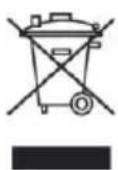
Should your appliance need replacement after extended use, do not dispose of it with the household refuse, but in an environmentally safe way.
Waste produced by electrical machine items should not be handled like normal household rubbish. Please recycle where recycle facilities exist. Check with your Local Authority or retailer for recycling advice.
VARO – Vic. Van Rompuy N.V. - Joseph Van Instraat 9 - BE2500 Lier - BELGIUM, declares that,
Product: mini circular saw 20V–89mm (NO ACCU)
Trade mark: POWERplus
Model: POWDP25400
is in conformity with the essential requirements and other relevant provisions of the applicable European Directives, based on the application of European harmonized standards. Any unauthorized modification of the apparatus voids this declaration.
European Directives (including, if applicable, their amendments up to the date of signature):
2011/65/EU
2006/42/EC
2014/30/EU
European harmonized standards (including, if applicable, their amendments up to the date of signature):
EN60745-1:2009
EN60745-2-22:2011
EN62841-1:2015
EN62841-2-5:2014
EN55014-1:2017
EN55014-2:2015
Keeper of the Technical Documentation: Philippe Vankerkhove, VARO – Vic. Van Rompuy N.V.
The undersigned acts on behalf of the company CEO,
natural_image
Simple hand-drawn sketch of a rounded rectangular shape with a small circular mark on top (no text or symbols)Philippe Vankerkhove
Regulatory Affairs – Compliance Manager
15/07/2021, Lier - Belgium
natural_image
Simple hand-drawn sketch of a rounded rectangular shape with a small circular mark on top (no text or symbols)Philippe Vankerkhove
15/07/2021, Lier - Belgium
natural_image
Simple hand-drawn sketch of a rounded rectangular shape with a small circular mark on top (no text or symbols)Philippe Vankerkhove
15/07/2021, Lier - Belgium
natural_image
Simple hand-drawn sketch of a rounded rectangular shape with a small circle on top (no text or symbols)Philippe Vankerkhove
Regulatory Affairs – Compliance Manager
15/07/2021, Lier - Belgium
natural_image
Simple hand-drawn sketch of a rounded rectangular shape with a small circular mark at the top (no text or symbols)Philippe Vankerkhove
3 PAKKENS INNHOLD....3
4 SYMBOLFORKLARING .... 4
5 GENERELLE SIKKERHETSADVARSLER....4
natural_image
Simple hand-drawn sketch of a rounded rectangular shape with a small circular mark on top (no text or symbols)Philippe Vankerkhove
Regulatoriske saker – Samsvarsleder
15/07/2021, Lier – Belgia
1 TILSIGTET BRUG....3
2 BESKRIVELSE (FIG. A) 3
3 MEDF∅LGENDE INDHOLD 3
4 SYMBOLER 4
5 GENERELLE SIKKERHEDSFORSKRIFTER ....4
13 ARBEJDSTIPS TIL MINI-DYKSAVEN
natural_image
Simple hand-drawn sketch of a rounded rectangular shape with a small circular mark at the top (no text or symbols)Philippe Vankerkhove
Regulatory Affairs (afdelingen for juridiske anliggender) – Compliance Manager 15/07/2021, Lier - Belgium
3 FÖRPACKNINGSINNEHÅLL
natural_image
Simple hand-drawn sketch of a rounded rectangular shape with a small circle on top (no text or symbols)Philippe Vankerkhove
natural_image
Simple hand-drawn sketch of a rounded rectangular shape with a small circular mark on top (no text or symbols)Philippe Vankerkhove
15/07/2021, Lier - Belgium
προϊόν: MINI KYKΛΙΚΟ ΠΡΙΟΝΙ 20V – 89mm (ΔΕΝ ΠΕΡΙΛΑΜΒΑΝΕΙ
ΜΠΑΤΑΡΙΕΣ)
natural_image
Simple hand-drawn sketch of a rounded rectangular shape with a small circular mark on top (no text or symbols)Philippe Vankerkhove
15/07/2021, Lier - Belgium
1 NAMJENA....3
2 OPIS (SLIKA A) 3
3 POPIS SADRŽAJA PAKETA 3
4 SIMBOLI....4
5 OPĆA UPOZORENJA O SIGURNOSTI RUKOVANJA ELEKTRIČNIM ALATIMA......4
5.1 Radno mjesto 4
5.2 Električna sigurnost....4
5.3 Osobna sigurnost .... 5
5.4 Uporaba i održavanje električnog alata .... 5
8 DODATNE SIGURNOSNE UPUTE ZA LASERE....8
9 DODATNE SIGURNOSNE UPUTE ZA BATERIJE I PUNJAČE .....8
9.1 Baterije....8
9.2 Punjači....9
10 ZNAČAJKE....9
10.1 Meki rukohvat (1)....9
10.2 Litij-ionska baterija (10)....9
10.3 Izlaz za izvlačenje prašine (9)....9
11 PRIJE UPOTREBE 9
11.1 Punjenje baterije 9
11.1.1 Indikacija punjenja (slika 1)....9
11.2 Indikator kapaciteta baterije (slika 2)....10
11.3 Umetanje i vađenje baterije (slika 3)....10
natural_image
Simple hand-drawn sketch of a rounded rectangular shape with a small circular mark at the top (no text or symbols)Philippe Vankerkhove
natural_image
Simple hand-drawn sketch of a rounded rectangular shape with a small protrusion (no text or symbols)Philippe Vankerkhove
natural_image
Simple hand-drawn sketch of a rounded rectangular shape with a small circular mark at the top (no text or symbols)Philippe Vankerkhove
Regulačné záležitosti – Compliance Manager
15/07/2021, Lier – Belgicko
natural_image
Simple hand-drawn sketch of a rounded rectangular shape with a small circular mark on top (no text or symbols)Philippe Vankerkhove
Divizia de reglementare – Director de conformitate
15/07/2021, Lier - Belgia
9.1 Akumulatory....9
9.2 Ładowarki....9
10 CECHY 9
10.2 Akumulator Li-ion (10)....10
10.2 Akumulator Li-ion (10)
natural_image
Simple hand-drawn sketch of a rounded rectangular shape with a small circular mark on top (no text or symbols)Philippe Vankerkhove
15/07/2021, Lier - Belgium
natural_image
Simple hand-drawn sketch of a rounded rectangular shape with a small circular mark at the top (no text or symbols)Philippe Vankerkhove
15/07/2021, Lier - Belgium
natural_image
Simple hand-drawn sketch of a rounded rectangular shape with no text or symbolsPhilippe Vankerkhove
15/07/2021, Lier - Belgium
natural_image
Simple hand-drawn sketch of a rounded rectangular shape with a small circular mark on top (no text or symbols)Philippe Vankerkhove
15/07/2021, Lier - Belgium
natural_image
Exterior view of a modern office building (no signage)DISCOVER THE ENTIRE PRODUCT RANGE AT
WWW.DUAL-POWER.COM


- BESCHRIJVING (FIG. A)
- POWERPLUS HIGH QUALITY TOOLS
- POWDP25400 EN
- MINI CIRCULAR SAW 20V-89MM (NO ACCU) POWDP25400
- INTENDED USE
- DESCRIPTION (FIG. A)
- PACKAGE CONTENT LIST
- SYMBOLS
- GENERAL POWER TOOL SAFETY WARNINGS
- Working area
- Electrical safety
- Personal safety
- Power tool use and care
- Battery tool use and care
- Service
- ADDITIONAL SAFETY INSTRUCTIONS FOR PLUNGE SAWS
- CAUSES AND PREVENTION OF KICKBACK
- ADDITIONAL SAFETY INSTRUCTIONS FOR LASERS
- ADDITIONAL SAFETY INSTRUCTIONS FOR BATTERIES AND CHARGERS
- Batteries
- Chargers
- FUNCTIONS
- Soft grip (1)
- Li-ion battery (10)
- Dust extraction outlet (9)
- BEFORE USE
- Charging the battery pack
- Note:
- Charging indication (Fig. 1)
- Battery capacity indicator (Fig. 2)
- Inserting and removing the battery (Fig. 3)
- Attaching and removing the blade (Fig. 4)
- Adjust the cutting depth (Fig. 5)
- Guide rails (15)
- Connecting rods for guide rails (Fig. 6)
- Parallel cut adjustment (Fig. 7)
- Laser line generator (Fig. 8)
- Sawdust removal (Fig. 9)
- Line following (Fig. 10)
- Switching On and Off (Fig. 11)
- CUTTING
- General cut (Fig. 12)
- Pocket cut (Fig. 13)
- WARNING: Always maintain proper control of the saw to make sawing safer and easier. Loss of control of the saw may cause serious injury.
- WARNING: Always cut in a forward direction when pocket cutting. Cutting in the reverse direction could cause the saw to climb up on the work-piece and back toward you.
- Cutting particularly Tough or Abrasive Materials
- Sheet metal:
- Ceramic tiles, slates etc:
- Plasterboard:
- WORKING HINTS FOR MINI PLUNGE SAW
- MAINTENACE
- NOISE
- WARRANTY
- ENVIRONMENT
- ARBEJDSTIPS TIL MINI-DYKSAVEN
- FÖRPACKNINGSINNEHÅLL
- Akumulator Li-ion (10)
Brand : PowerPlus
Model : POWDP25400
Category : Saw