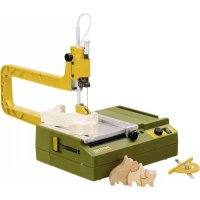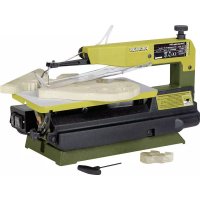
DSH - Saw PROXXON - Free user manual and instructions
Find the device manual for free DSH PROXXON in PDF.



| Product type | Scroll saw (fret saw) |
| Brand | PROXXON |
| Model | DSH |
| Article number | 2 8092 |
| Dimensions (L x W x H) | 53 x 27 x 33 cm |
| Throat depth | 400 mm |
| Weight | Approx. 15 kg (cast iron stand) |
| Power supply | 230 V, 50/60 Hz |
| Power consumption | 145/205 W |
| Number of strokes | 900 or 1400/min |
| Stroke length | 19 mm |
| Max. cutting depth (wood) | 50 mm |
| Max. cutting depth at 45° | 25 mm |
| Saw blade length with pin | 127 mm |
| Saw blade length without pin | 125-130 mm |
| Noise level | < 70 dB(A) |
| Vibration | < 2.5 m/s² |
| Table tilt | Up to 45° |
| Cuttable materials | Wood (up to 50 mm), plastics (30 mm), non-ferrous metals (10 mm), plexiglass, fiberglass, foam, rubber, leather, cork |
| Motor type | Induction motor |
| Vacuum connection | Yes, via sleeve |
| Air blower | Yes, adjustable air nozzle |
| Safety features | Blade guard, on/off button |
| Warranty | See terms (material/ manufacturing defects) |
Frequently Asked Questions - DSH PROXXON
User questions about DSH PROXXON
0 question about this device. Answer the ones you know or ask your own.
Ask a new question about this device
Download the instructions for your Saw in PDF format for free! Find your manual DSH - PROXXON and take your electronic device back in hand. On this page are published all the documents necessary for the use of your device. DSH by PROXXON.
USER MANUAL DSH PROXXON
Fold out the picture pages when reading the user instructions.
François
Mechanical fret saw DSH1
Dear customer!
Using these instructions
- makes it easier to get familiar with the device
- prevents malfunctions caused by improper handling, and
- lengthens the service life of your device.
Please keep these instructions readily accessible at all times. Use the device only when you have understood it exactly and adhere to the instructions.
PROXXON is not liable for the safe functioning of the device in cases of:
- handling that does not conform to the usual usage,
- purposes of use not designated in the instructions,
- disregard of the safety instructions.
You are not entitled to guarantee claims in cases of: - operator errors,
- inadequate maintenance.
For your own safety, please follow the safety instructions exactly.
Use only genuine PROXXON replacement parts.
We reserve the right to make improvements in the sense of progress. We wish you much success with the device.
WARNING!
Read all safety warnings and instructions. Failure to all safety warnings and instructions listed below may result in electric shock, fire and/or serious injury.
KEEP ALL SAFETY WARNINGS AND INSTRUCTIONS FOR THE FUTURE !

2Legend (fig. 1)
- Adjusting knob for saw blade tensioning
- Saw blades holder, top
- Saw blade
- ON-OFF-switch
- Stroke rate adjusting knob
- Clamping screw for the inclination of the work table
- Foot made of cast steel
- Air nozzle
- Saw table
alwa.8.Saw blade holder,bottom
- Drill holes for attachment screws
- Storage compartment for saw blades
- Connection for vacuum cleaner
- Network cable
- Induction motor
- Saw arm (top)
- Saw blade guard
- Connecting piece for vacuum cleaner
Description of machine (also see fig. 1a and 1b)
The PROXXON mechanical fret saw is a very solid and robustly designed device. The heavy base made of cast material, item 7, forms a solid basis for the expensive mechanism of the machine that is elaborately and precisely supported and driven by a particularly quiet-running and reliable induction motor with 2 adjustable speeds (900/1400 rpm). The areas of application are multifaceted. Your DSH is particularly suitable for mould construction, precision engineering model building and toy manufacture. For this reason, it is precisely the right tool for designers, architects (model building) and carpenters.
The large-area, saw table 9 for litre cuts can be titled up to 45^ , is manufactured from aluminium die casting for the highest precision and bility, and is then ground for optimal glide properties.
The arrangement of the saw blade holders item 2 and 10 allow the vitibseeach other.
of both saw blades with and without cross pin depending on the area of
application and the material of the tool. In the PROXXON accessory values also allow a preliminary evaluation of the loads caused by range you will find the corresponding saw blades for the respective vibration and noise emissions.
We recommend that you use only PROXXON saw blades!
The replacement saw blades are stored in the "saw blade garage" on the side of the panelling of the top arm.
The DSH saws soft wood up to a thickness of 50~mm , plastic up to 10~mm and non-ferrous metals up to 10~mm .
The saw can also be used without problem for separating Plexiglas GRP, foam, rubber, leather and cork.
And so that the dust does not obscure the view of the cutting line and increase the vibration load and noise emission across the entire working, there are automatically driven bellows with adjustable air nozzler period.
- An additional vacuum cleaner can also be connected. The connecting piece 13 is positioned at 90^ to save space. To m
This guarantees clean work.
Technical data4
No. of strokes: 900 or 1400/min
Stroke height: 19 mm
Max. cutting depth: 50 mm
(in wood) at 45^ : 25 mm
Cutting blade length: 127 mm (with cross pin)
125-130 mm (without cross pin)
Noise development: <70 dB(A)
General measuring uncertainty K = 3 dB
Vibration: < 2.5m / s
Measurements:
LxBxH: 53 x 27 x 33 (in cm)
Table: 360 × 180 mm
Saw frame radius: 400 mm
Motor:
Voltage: 230 Volt, 50/60 Hz
Power consumption: 145/205 W
For use in dry environments only
Risk of injury!
Never work without dust protection mask and set glasses. Some dusts have a hazardous effect! Materials containing asbestos may not be machined!
For your safety, always wear
hearing protection while working!
Please do not dispo
off the machine!


Noise/vibration information
The information on vibration and noise emission has been determined in compliance with the prescribed standardised and normative measuring methods and can be used to compare electrical devices and tools
newtseach other.
area of
These values also allow a preliminary evaluation of the loads caused by tidalkation and noise emissions.
Warning!
Depending on the operating conditions while operating the device, the actually occurring emissions could differ from the values specified above
Please bear in mind that the vibration and noise emission can deviate from the values given in these instructions, depending on the condition of use of the tool. Poorly maintained tools, inappropriate working methods, different work pieces, too high a feed or unsuitable work pieces or materials or unsuitable bits and cutters (here: saw blade) can signifi
meantherincrease the vibration load and noise emission across the entire zukerk period.
ecting
To more accurately estimate the actual vibration and noise load, also take the times into consideration where the device is switched off, or running but is not actually in use. This can clearly reduce the vibration and noise load across the entire work period.
Warning:
- Ensure regular and proper maintenance of your tool
- S top operation of the tool immediately if excessive vibration occurs!
- Unsuitable bits and cutters can cause excessive vibration and noise. Only use suitable bits and cutters!
- Take breaks if necessary when working with the device!
Set-up and commissioning of the saw
5Unpacking (fig. 1a and 1b)
- Unpack the device and remove it from the box. Ensure that the is not lifted by the plastic panelling around the top arm 16.
- For transport reasons, the saw table 9 is folded up at an angle of about 45^ . Turn the toggle 6 to tilt the table back into the horizontal position (the precise setting is described below). Then close the toget 6 a gain.
5.Setting up the saw
Note:
Safe and precise work is only possible with careful fixing!
-
Secure saw with two screws ( 06mm not included in scope of delivery) on a solid workbench. Use the drill holes intended for this purpose (11, fig. 1) which are located at the front and back of the saw b
-
Slightly loosen toggle 1 (fig. 2) and fold saw table 2 up to stop screw 3.
- Clamp saw blade 4! See the corresponding section 5.7.1 structions. Caution! Mains plug must not be connected.
- Using an angle 5 on the saw table 2, check the right-hand the saw blade. The stop screw is preset. If this still has to be adjusted, you can adjust the setting yourself using an Allen key 7, as fig. 2, once the counter nut has been loosened. After correct tighten the counter nut. Make sure that the stop screw does out of position in this process.
- Check the "zero" setting of the indicator 8, if necessary, correct after the fastening screw has been loosened. For precise working, carry out sawing sample.
- Saw a sample from a piece of wood and check the angle again, if necessary adjust the saw table 2, indicator 8 or s top screw 3as shown in fig. 2.
Assembling the air nozzle (fig. 3)5.4
- Take parts for securing the air nozzles from the bag.
- Screw the knurled screw 1 with clamping pieces 2 into the saw frame.
- Introduce the air nozzle pipe 3 into the hole on the opened clamp pieces, adjust the pipe and slightly tighten the toggle 1.
- Place the air hose 4 on pipe 3 and nipple 5.
5.5Saw blade guard
Caution!
The scope of delivery of your scroll saw includes a saw blade guag This is simply mounted in the upper plastic cover of the saw arm.
Fig. 3a shows how to assemble the saw blade guard. Both pins and saw blade guard are clipped into the designated drill holes. Please, that the saw blade guard is an important safety tool and the saw should not be operated without it! Injuries could be the result.
The following describes activities in which the guard may be disass bled expeditently. But it must be clearly noted that the saw blade guard must be mounted again when this work is completed: Operation with this important safety accessory is not permitted!
Further graphics in these instructions sometimes show the device without a saw blade guard. This only serves as optical clarification of the illustrated actions and is in no way intended to convey that the machine may be operated without the saw blade guard!
50 connecting the vacuum cleaner (fig. 4)
- Place the vacuum hose 1 of the vacuum cleaner in the connecting piece 2.
- Switch on the vacuum cleaner before sawing so that the sawdust is vacuumed and the suction device does not get blocked. For practical reasons, the PROXXON suction control device is recommended.
5.7 Saw blades
Caution!
Always remove the mains plug before performing the activities described here.
Standard blades with cross pins and hand(leaf) blades without cross-pin are clamped into the saw blade mount.
Replace damaged or worn saw blades immediately. They represent a dangefety risk and worsen the work result. The best cutting performance and precision can only be achieved with perfect saw blades.
shown in setting, PROXXON original saw blades and carefully select suitable saw not blades for the intended purpose and material to be cut. With PROXXC there are also various fine toothings, flat and round blades, and some with and without cross pin. You will find suggestions in these instructions.
5.7.$aw blades with cross pin (fig. 5a)
Saw blades with cross pin are particularly suitable for working with many closed inside cuts. The saw blade can be quickly and comfortably removed from the upper mount, looped through the work piece and repositioned. You will find more precise information in the section "Inside cuts".
Caution!
Saw blades with cross pins may only be hung in position. Do not use the saw blades with the cross pin additionally by means of the chest head screws. Risk of fracture!
- The rotary knob 1 (Fig. 6) for saw blade tensioning to the left until the saw blade is loose.
- Press the top arm 5 (fig. 5a) lightly if necessary and remove a saw blade already in the holder.
guag. 3: Place saw blade 1 with the toothing pointing downwards through the arm. table opening 2 and fit in the bottom mount 3.
- Press lightly on the top arm 5 and fit blade in the upper mount 6, see case note fig. 5a).
- Release arm and by turning the rotary knob 1 (Fig. 6) to the right, set the saw blade tensioning.
- If required, finely adjust the saw blade clamp as described under 5.7.2.
Sal1Blades with flat ends or leaf saw blades, see fig. 5b)
machineTurn rotary knob 1 (Fig. 6) for saw blade tensioning to the left until the saw blade is loose.
- Open cheese-head screws 4 with the T grip Allen key 5 and remove the saw blade through the table opening.
- Place saw blade 1 with the totoing at the bottom through the ta opening 2 and fit in the bottom mount 3. Then clamp the blade at the mount by tightening the cheese-head screw 4 with the supplier Allen key with T grip 5. Caution: Make sure that the blade is cl a really far forward! This is where the clamping force is at its great Press lightly on the top arm 6, introduce the saw blade into the per holder 7 and tension in the same way.
- Release the arm and set the saw blade tensioning by turning the rotary knob 1 (Fig. 6) to the right.
- If required, adjust the saw blade clamp as described under 5.7.2
Finely setting the correct saw tensioning (fig. 6)5.7.2
Correct saw tensioning is an essential factor for a clean work result. This must, therefore, be carefully set. If over or undertensioned, blade can lightly crack. Turn knurled button 1 to set the tensioning. If the button is moved to the right (clockwise), the saw blade is more tensioned. If it is turned to the left (anticlockwise) the blade is A correctly tensioned blade sounds a slight tone if "plucked" like a string.
Working with the saw6
General information for working with mechanical fret saw6.1
The mechanical fret saw is predominantly a machine for sawing cur and precise sections. A typical application is shown in fig. 7. The work piece must be carefully guided by the operator. Note: Mechanical fret saws are normally operated without length stop, as the saw blade its line if forced in, particularly in the grain of wood.
Please note that the saw blade only saws in reverse motion in the direction in which the teeth point.
For good results, please note the following points:
- W hen sawing, press the work piece onto the work plate (fig. 7) by feeling and with little power; more pressure on the work plate pressure against the saw blade.
- Make sure that the work piece is lying properly on the saw tab burrs or sawdust)
- A dapt the feed to the requirements by saw blade, speed and w piece material.
- H ard materials, fine saw blades and thicker work pieces do not "erate" as much feed as soft materials, rough saw blades and the work pieces. You can also experiment with various speeds.
- Guide the work piece slowly into the saw blade, particularly if blade is very thin and the teeth very fine or if the work piece thick.
- O nly use perfect saw blades.
- D onot let the device operate unsupervised.
- C arefully mark out/block the check line.
- Make sure there is good lighting.
- A lways work with connected vacuum cleaner and carefully set the nozzle (8, fig. 1).
- You will achieve the best results if the wood thickness is under 25 mm.
- W ith wood thicknesses of greater than 25~mm , the work piece be very carefully guided to stop the saw blade from jamming, be twisting or breaking.
- F or precise cutting, note that the saw blade will always try to fit the direction of the fibre (applies particularly to thin saw blades).
6.1. Selecting the saw blade
As already mentioned, the correct selection of material has a very great influence on the quality of the result. The table below should serve small guide. Extensive experience with many materials and types of saw blade is, of course, always helpful with selection. You can experiment here.
Tip: The saw blades are mostly only particularly worn at places where the teeth are particularly highly utilised when sawing and, therefore, become blunt very quickly. To "use up" the non-worn teeth and thus increase the edge life of the sawing blades, you can artificially "raise" the bearing surface for the work piece somewhat.
fulyo this, simply secure a smooth, table-sized underlay with the required thickness to the saw table, using, for example, double-sided sticky tape. The non-worn parts of the saw blade are now sawing the work piece. This is particularly sensible if you often saw very hard and wear-intense materials with thin blades.
The numerical data for characterising the "fineness" of the toothing is related to the number of teeth per inch of saw blade length:
| ve teeth/inches | Material |
| approx. 10-14 oses | Soft and hard wood (from approx. 6-50 mm), plastics, soft materials, thicker work pieces |
| approx. 17-18 direc- | Fine sawing work, wood (up to 6 mm), plastics, soft materials, thinner work pieces |
| approx. 25-28 | Plastic, GRP, non-ferrous metal, Plexiglas, iron with restriction Pertinax |
| approx. 41 loss | Iron, Pertinax |
Round sawing blades (with flat ends) can ideally be used for plastic hard and soft wood. They cut on all sides, so it is not necessary the work piece when sawing.
Please note in general:
PROXXON bits and cutters have been designed to work with our machine, which makes them optimal for their use.
we will not assume any liability whatsoever for the safe and proper function of our devices when using third-party bits and cutters!
6.1.2Selecting the speed
This representation can, of course, only give instructions on the gene direction to take. As in the previous section, you have to "experimer little to find the optimal result. The appropriate speed also, of course depends on the blade used, the material of the work piece, the fee
must
| Diegel | Material |
| 900 strokes/min | Steel, brass, non-ferrous metals, GRP, plastics |
| 1400 strokes/min | Aluminium, wood, polystyrene, rubber, leather, cork |
6.1. Possible causes of faults
The following causes may break the saw blade:
- I f b lade is tensioned too tightly or not tightly enough
- M mechanical overloading of the blade by feeding too quickly.
- B ending or twisting of the blade when turning the work piece too early when cutting curves.
- W hen the wear limit of the saw blade has been reached.
- If the screws are tightened on saw blades with cross pin.
Invery few cases (slanted cutting edge in the work piece, strong adgrain cuts, the table is simply tilted by the required amount. This drift during operation) it could be necessary to make minor adjustmeaks as follows:
to the blade alignment at the upper saw blade mount (see pos. 2, fig. 2).
By rotating the saw blade mount, the saw blade alignment will be1. Slightly loosen knurled screw 1 (fig. 2) and align saw table 2 to the changed as desired. required value, using scale 9 on indicator 8.
- Clamp the saw blade and check the parallelism of the saw blade. Tighten knurled screw 1.
ing an angle 5 ( or angled work piece) arranged as shown in tBPeRss the work piece particularly firmly against the table for a grain graphic. cut. - The saw blade can be aligned if necessary. Release screw 11 using
an Allen key and swivel the saw blade mount into the correct position
to align the saw blade in parallel to the angle.
- Tighten the saw blade mount in the correctly set position using the Allen key 11.
6.2Sawing (fig. 7)
7Service and maintenance
Caution!
Pull the mains plug before making any adjustments, performing maintenance work, or carrying out repairs!
Note:
After you have fixed the saw to the work space, adjusted the work table roll saw is basically maintenance free. However, to ensure a long prepared the dust exhaust and air nozzle and have clamped the suitable life you should clean the device after each use with a soft cloth, saw blades, switch on the machine and guide the work piece as swat or brush. A vacuum cleaner is also advisable for this. in fig. 7.
Remember: Adapt the feed according to the material, the saw blade and the work piece thickness. Hard materials, fine saw blades and thick work pieces do not "tolerate" as much feed as soft materials, rough saw blades
and thin materials.
You can also experiment with various speeds.
Note:
Safe and precise work is only possible with careful fixing!
8 Disposal
biades
External cleaning of the housing can be carried out using a soft, possibly moist cloth. While doing so, a mild detergent or other suitable cleansing agent can be used. Do not use solvents or cleansing agents contain alcohol (e.g. benzene, cleaning alcohol, etc.) as these can corrode the plastic housings.
The mechanical fret saw is predominantly a machine for sawing curves.
For good results, please note the following points:
Please note:
- Only use perfect saw blades.
- Always remove the mains plug for maintenance and upkeep work.
- Do not let the device operate unsupervised.
6.2.Inside cuts (fig. 8)
Caution!
Always remove the mains plug before releasing the saw blade.
If you must also make inside cuts when working with your mechanical
fret saw, proceed as follows:
- Drill a hole in the inside part 1 to be cut out of your work piece.
- Take the saw blade from the top saw blade guide 2.
- Push the saw blade through the drill hole. Reattach saw blade at the top. Tension the saw blade properly again.
- Cut out the opening and remove the work piece once the saw blade has been removed again.
Tip: If you drill the hole in such a way that it does not touch the later inside contour, you can allow the saw line to run tangentially into the contour. This produces a nice even sawing edge.
Name and address of the manufacturer:
PROXXON S.A.
6-10, Häreberg
L-6868 Wecker
Product designation: DSH
Article No.: 28092
In sole responsibility, we d eclare that this product conforms to the
following directives and normative documents:
EU EMC Directive 2004/108/EC
DIN EN 55014-1/08.2018
DIN EN 55014-2/01.2016
DIN EN 61000-3-2/03.2015
DIN EN 61000-3-3/03.2014
EU Machinery Directive 2006/42/EC
DIN EN 62841-1/07.2016
Date: 18.07.2019
Machine Safety Department
The CE document authorized agent is identical with the signatory.
Sommaire
m = 311 ;


Press lightly on the top arm 5 and fit blade in the upper mount (tica se fig. 5a).
- Release arm and by turning the rotary knob 1 (Fig. 6) to the right, set the saw blade tensioning.
- If required, finely adjust the saw blade clamp as described under 5.7.2.
LxBxH: 53 x 27 x 33 (in cm)
Tafel: 360 × 180 ~mm
Stojemission: < 70 dB(A)
K=3 dB
Vibration: < 2.5m / s
Mäl:
|xbxh: 53 x 27 x 33 (i cm)
Bord: 360 x 180 mm
Overhaeng savbue: 400 mm
Motor:
Spaending:
230 Volt, 50/60 Hz
Dipl.-ing. Jorg Wagner
PROXXON S.A.
TYTO P OKNY DOBRE USCHOVEJTE!

2.Legenda (obr.1)
Obecnaneurcitostmefeni K=3dB
Vibrate: < 2.5 m/s
Rozměry:
D x S x V: 53x27x33(vcm)
Stul: 360 x 180 mm
Vylozeni ramu pily: 400 mm
Motor:
5.7 NnBhbie NOIOTHa:
BHHMaHHe:
PnBbINOJIHeHm BcEx ONIcaHHbIX 3decb pa60T BceTa BbIHMaIte n3 pO3ETKn CTeBOI WTeNCEJIb.
5.7.1 3akpenenne nnilbHoro noLoTHa (pnc.5a n 5b):
B DepeKaTeIaX NINbHOrO NOIOTHa MOKHO 3aKepeNnTb KaC tAHapTHbe NINbHbIE NOIOTHa C NOEpeYHbIMu WITcTAMn, TAK ININbHbIE NOIOTHa pyHbIX NIN (No63IKOB) 6e3 NopeYHbIX WITcTob.
Ppoc6bHa He3aMeIINTeBHO 3aMeHbTb NOBpeXeHHbIe NIM N3HOuEH HbIbHbIe NOnOTHa! TaKHe NINbHbIe NOnOTHa ppeCTabJIOT c60oYrpo3y Be3ONaChOcTH uYxUdAoiT pe3yIbTaIpa60tI. NOnHAR npoN3BOInTeBHoCTb NTOHOCb paCnIIa MoKet 6blr rapANTIpobHa ToNko C a6CONIOHO nCnPaBHBIM NINbHBM NOONHAMM.
IcnoB3yTeΦnmeHbIe NlNbHbIe NOIOTHa KOMnHIM PROXXON n TuaTeNbHO BbIpaIte NOXOJaIe NlNbHbIe NOIOTHa B3aBNCIMoCTn OT oBlaCTn PpImeHEnr I paNINIBaEMOr MATEPnaIa: IIN 3TOr KOMnHIN PROXXON npednaraet NIOCKne INKpyTbe NlNbHbIe NOITNa C paNINHbIM 3y6bAm, C NOpepeHbIM UTNΦTom INN 6e3 NOpepeHoro UTNΦTa. PpeNoKeHnBbHa HaeTe B daHHom pyKOBOdCTBe.
5.7.1.1 NnIbHbIe noIOnTHa c nonepeuHbIM wTHΦTOM (pnc. 5a):
NIIbHbIe NOIOTHa C NONEpeHHbIM WITnFtOM OcObeHNO pInroDnbl IINRA pa6oT c 60JIbUIM KONIueCTBOM 3AMKHytbx BHYtpEHNX pacnnIOB. IINr 3TOr MOXHO 6bICTPO uYIOb HO BByHTb NIIbHOE NOnIOHO n3 BEpxHero depkataTe, npOTAHyTB uepe 3aROTOBY B BnDE neTJIN H ChOBa nODBecTb. BoJe eNoPbOHoe onucaHne cm. B nyHKe «BHytpEHHe pacnnJIbI>.
BHHMaHHe:
NINbHbIe NONoTHa C nonepuHbIM wTnΦTom pa3peWaaetcra TOLbKO NOBBeWNBaTb. Poc6ba DOnONHHTeNbHO He fNKcnpoBaTb 3aXHMbIM BHTAMN INbHbIe NOnoTHa C nonepuHbIM wTnΦTom! OnachOCTb NONOMK!
- BpaaaTe BnEBo pyky 1 (pnc.6) 3axmua NnIbHOrO nNoTHa, noka nnIbHoe nIoTHo He OCbo6oNTcra.
- Pn Heo6xOUMOCn CnErKa HaxMnTe Ha BepXHO KOHcOnb 5 (PNC 5a) N BbIbTe NnBHoE NoToHO (ecNn OHO BCTaBHeHO) n3 DepKAten.
3.BCTaBbTe NINbHoe NOIOTHO 13y6bAMn BHN3 uepe3 OTBepCTne B CTOIe2 INBBeDNTe NOIOTHO B HNkHN DEpKAtenb 3.
4.CnErKa HaxMITE Ha BepxHIO KOHcOJIb 5 IN NOBecbTe NINbHOe NOItoHO B BepxHNI DEpKATen6. - OTnyctte KOHCOB IN BpaauTe pyky 1 (pnc.6) nIpeRynipOBKn 3aKIMa NJIbHO r OIOTHA.
6.Пи Heo6xOIMOCn NOpErpyIpye 3aKIM NINbHOrO NIOToHa, KaONicaHO Hnke BnyHKe 5.7.2.
5.7.1.2 NnIbHbIe NoIOTHa C nIOCKMn KOHcAMn (NnIbHbIe NoIOTHa pyHoi NnIbIu NnI NO63Nka, CM. pnc. 5b):
- BpaaTBeBneBo pyky 1 (pnc.6) 3axmna nIbHoro nonoTHa, noka nIbHoe nonoTHO He oCbo6oNDTCra.
- BbIePNTE BNT CUNINHIDPnueckoR TOnOBKO4 PnPi NmOuN nPiNarAeMOrO TOPOBOrO WecTnIRpaHHORo RaehHO KIIIOUa C T-06pa3HOpyKoRTKo5 N BbIHbTe NOJIoTHO UpeE 0TBepCTne BCTone.
3.BCTaBbTe NINbHO NOIOTHO 13y6bAMN BHN3uepe3 OTBepcTne B CTOIe 2 INoDBecbTe B HxHnI depXaTeNb 3.3aTEM 3axMNTe NINbHO NOIOTHO B DEpXaTeNe, DnYero 3aTaNITE BHT C UINHDPuYeCKO RONBOK4 PnnpOMU npnnaeraEMOr TOpOBOr OeCTNRpaHHOR RaehHORO KNOHaC T-06pa3HO pyKoRtKO 5.BHMAnHe: npOBepbTe, YTO NINbHO NOIOTHO 3akpenJIeHO DOCTaTOH0 6nN3KO K nepeDHeK KpOMKe! 3deCb yCNJNE 3axIMA ABJIaTc MAKCMMaJIbHbIM.
4.Cnerka HaxMMTe Ha BepxHIOKOHCOJIb 6,BBEaNTe NINbHOE NOOTHO B BepxHnI depKaTeB 7 n3axMMte aHaONuHbIM opa3OM. - OTnyctnte KOHcOJIb n BpaaIaTe pyky 1 (pnc.6) dIpyIyIpOBKn 3aJIMMa NIIbHOrO I OIoTHA.
- Пи HeobxOdoMocTn NOpeRyIpyuTe 3aJxIM NIIbHoro NoIOTHa, KaO nOncaHO HIXe B NYKTe 5.7.2.
5.7.2 ToHKa peryIupOBka npabHbHoro HataKeHHa NnHbHoro noJToHa (pnc. 6):
PpabnIbHoe HATxKeHHe NINbHOrO NIOHTa RABTcpeaaIOUmm fakTopom nIy UcCTbIX pe3yNbTaTOB pa60tI. NoTOMy peryNipOBKa HATxKeHn DOxKHa 6bITb BbINOHHe OChb TuaTeNbHO, npH HeoCTaTOHOM INI Ype3MePHOM HATxKeHm NINbHoe NIOTHO MoKet IERKO pa3OpBaTbcra. DnpepyNipOBKn HATxKeHn BpaauaTe pyky C haceKo
- PnBpaueHm pyKn BnpaBO (no yacobO CTpeNke) HATJKeHne NIIbHoro NOIOTHa YBeHNHBAETC, PnBpaueHm BNeBO (npOTNB HAcoBO CTpeKN), COOTBETCTBeHHO, YMeHbJaetC.
Pn «OTBeEHN» npaBnIbHO HATyHOe NINbHOe NOOTHO 3daet YHCTbIM 3ByK, PNOO6HO CTpyHe.
6 Pa60Ta C JIo63NKOBbIM CTaHKOM
6.1 O6uhe daHHbIe no pa6oTe cNo63KOBbIMn CTaHKAM:
JIo63nKOBbI CTaHOK npeHa3NaueH, npeXe BCero, IЯ BrBbININBaHn KpBONHeHbIX IN TOHbIX φpaMeHTOB. TInuHna OBnactb npImeH HnpeCTabNeHa Ha pnc.7. Ppi 3ToM NOb3ObaTeNb DOJIKeH TuaTeNBHO HAnpAbTb 3arOToBky. NOMHume: O6bUHO No63nKOBbIe CTAHNICOnb3yIO63 npOOnbHorO yNopa, noCKoJIbKy npi «PpHyDntelHOM» HAnpAbJeHn Ha yNope NIIbHoe NOnOTHO «YBoDNTcR”, B YaCTHOCTN, B TEKCType DpeBeCnHbI.
IyIPOUeHnXoOuHXpe3yJIbTaTOB cTporo co6nJaTe cneDuOne IyHKtbl:
-Пи ВьИПИВаHIMnpIXIMaTe 3arOTOBky K pa6oeyI pInTe (pnc.7); HapabTne 3arOTOBky OCTopoxHo N C He6OJIbUIM yCINnEM; 60Ib-We daBHeHnHa pa6ooyIO pInTy, MeHbSe dABNeHnHa nIIbHOe NOIOTHO.
-06ecnebTe pIoTHoe npIeHHe 3aToBKN K cToIy cTaNka (HnKaKnx 3ayceHueB nJIn CTpyKeK).
- Otperynpyte noaHy B COOTBETCTBn C nINbHbIM NOIOTHom, CKoPocTbIO MATEpnaJOM 3arOTOBKn.
TBepeMaTePnAblMeNKe NnIbHbIe DnCKn H6Oone ToIcTbe 3a- roTOBKn He «BbIePcknBaHT TAKyIO BbICOKyIO nOaHy, KaK 60one MmR Kne MaTePnaIbI, 60one rpy6ble NnIbHbIe DnCKn H6Oone ToKHe 3a- roTOBKn. BbINONHte np6HbI paCnII dIra npOBepKn pe3yNbTaTa np Pa3HbIX CKOpocTAX.
BBOJNTe 3aROTBKY BINbHbN DnCK MeIeHHO,OCo6eHHO,ecnIN INbHbN DnCK OChEB TOHKN,3y6bA OChEB MeKHe,IN3aROTOBKa IMe-ET 60JIbUHy TOIuHiY.
- Icnonbayte tonko a6conHToHo nCpabHbIe nJbHbIe noLToHa!
- He octabnIte yctpoIcTBO 63 npncmToPa!
TataTeBHO HaHocite /pa3MeaHte KOHTypbI paCnnaI
-ObecneBte xopoOee oCbeHHe!
Bcerda pa6oTaIe C noKJIOUeHHbIM nbIeBBm OTcOCOM n TuaTeNb HO OTPeryuPyIe NOJKeHHe BO3dUHOrO conla (8, pnc.1)
BbI nonyuHte HauNyUwne pe3yNbTaTbI,ecnToLunHa DepeBHHo 3arotobKn CoCTabJrE MeHee 25 MM. - Pn TOJIUNHe DepeBHHNo 3aTOOBK 6oJee 25 MM HappabTne 3aTOOBky OeHb octOpOxHO, YTO6bI He DOnyCTNtB 3aeDAnHn, N3rN6a, nepeKpyuHBAHn INONOMKn NINbHoro NOIOTHa.
IINI NOUYEHNTOUHbIXpACINIOB B DpeBecnHE Heo6xOIMO yHTbBaT, YTO NINbHOE NOIOTHO BCErda CTPeMTbCRcNEOBaTb HAnpaJIeHNBOLOKOH DpeBecnHbI (3TO, INPEXKe BCERO, OTHOCNTCR K TOHKIM NINbHbIM NOIOTHAM).
6.1.1 Bb6op nIbHoro noNoTHa:
Kak yke ynomHaNoCb Bblie, npaBnIbHbB bIb6p NnIbHO rONOTHa BOOTBETCTBN C O6paBaTbAembIM MaTePnAION OeHb CyUcETBeHHO BnIureT Ha KaueCTBO pe3yIbTaTOB pa60tI. HxKeepuBEeHNHr Ta5nua MoKet Cnykntb KAK ONpeDeneHHeOpneHTnpoBOOHoe NOc6ne. Pa3yMeETc, Bcerda Oco6eHNO nOe3EN pIn 3OM 6oNbWOn ONbIT pa60tI c pa3HbIMMaTePnAanAMn TINAmn NIIbHbIX NIOTeH. 3Decb CnOKoHOr MOXHO HEMHO I O3KcpePmEHTnpoBaTb!
Coeem:ПиьньгплOTHa,В OCHOBHOM,6OЛБWE BCERO N3HAWBAHOTc B TOM MecTe,Дe npn pacINININBaHm 3y6bЯ NOBepraKOTc OOCeHNO BbICOKO Harpy3Ke. YTO6bl《NcNoJIb3OBAbTb》 HEN3HOweHHBe 3y6bЯ IN TEM CAMbIM npOДNTb CpOK Cnyk6bl ПиьнБHbIX NOIOTeH,MOXHO NCKycCTBeHNO HEMHOrO «PpINOHrTaTb」 ONOPHYIO NOBepxHOCTb 3aROTOBKn.
Ira 3Toro, Hanpimep, npn NOMOUs DByXCTOpOHne KneKoJ IeHTb npocTo 3akpenlhot Ha cTone cTAnka pOKnaDky HxKHO TOniunHb, pa3mep KOtopo CoOTBETCTByET pa3mepy cTOna. Blaorapr 3ToMy BblnINBaHne 6ydet npou3BOuNTbcra eue HeN3HOWeHHo YacTbIO NnIbHO rNOToHa.
3TOT npHem oO6eHHo NOpE3EH,ecn Heo6xoJIMo yacto BbININBaTb TOHKMMI INJIbHbIMN IIOOTHAMN BOHeh TBepdbix N YCKOPAUXN 3HOC MaTePnaJax.
YncnEHHbIe 3naueHne dIaXapakTepeNTKIN (MeNkoCTN) 3y6beB OTHocTcR K YNCny 3y6beB Ha DIOHM DIIINHb IINbHO rO NOIOTHa:
IOnOMKa NINbHOrO NONoTHa MOXeT 6bITb BbI3BaHa CNeDuOuIMn PnHHAMN:
CINUKOM BbICOKoe INH HeIOCTaTOHoe HAraKeHne INJIbHOro NOIOTHa.
-MexaHnuecka neperepy3ka nIbHoro noTnBa BCneDCTBnCnUkOM 6bIcTpoi noaHn.
- 13rmb nnn nepekpyuBaHne nllbHoro noIOnTHa npn CnUHKOM 6blCTpOM NOBOPaunBaHH 3arOTOBK BO BpeM BbIOJHeHH KPNBOJIHHeHOrO p acnna.
- Pn doctxkeHH npedeHbHO n3Hoc a HbHO noIOTHa.
- EcnB Cnyae NnIbHbIX NOIOTeH C noIpeuHbIM WTHOtom OHOBpEmEHNO 3aTnBaHTc BnHTbI depKataeney nNtBHO rnoTHa.
6.1.3.1 Perynpobka noJooKeHH nnHbHoro noLoTHa (pnc. 2):
B OueHb peKnx CnyaX (CKoUeHHa KpOMka pacnna, CNbHO OTKnOHe Hne NInbHoro NOnOTHa B npoucece pa60t) MOKeT NOpTe6OBaTcBcH3NaHTeNbHra peryNIOPOBa NOONKeHNA NInbHoro NOnOTHa Ha BepxHem DepkataTe (cm. no3. 10, pnc. 2).
- 3axmnte nIbHoe noIOTHO npOBepTe nappanenbHoctb nobepxHOCTHnIIbHorO noIOTHa npn NMOU yrobnHka 5 (nnn deTann C NOxOJrM yIOM), kak nOKa3aHO Ha pncyHke.
- Pn Heo6xOIMOCn NOIOKeHne NINbHOrO NOIOTHa MOXHO OTpeYnipOBaTb. Dn3TOrO ocna6Be BnHT 11 npn NOMOnu TOpOBOrO WeCTIRpaHHOrO raeHHOrO KInOy, HAKIOHNTE depKaTeNb NINbHOrO NoIOTHa B HyXHOe NOIOKeHne N BblPOBHNTE NIIbHOe NIOITHO naPapnnelbHO yrobnHKy.
3.Пи NOMOUII TOpCIOBOrI WeCTnIRpaHHORI RaeyHOrO KJIIOUa 3aTAHITe DePKeTb NINbHOrO NOIOTHa B NoIOXKeHN, OTPeryNIpOBaHHOM HAdnEkaunm O6pa30M.
6.2BbInnInBaHne (pnc. 7):
Iocne toro, kak Bbl 3aKpeHnIN cTahOK ha pa6oey nOBepxHOCTN, OTpeYnnpOBAJn pa6oyn CTOn, NODROBNI PbIeBOI OTCOC N BO3dyHoe conno, n 3aKpeHnIN NOXODAUIE NIIbHbIE NOOTHa, BKJIIOHTe cTAHOK HAnpABnIte 3arOTOBKY, KAK NOKa3aHO HA pnc.7. IOMNHTE: OtperyInpyTe Noay B 3aBNCIMOCTHN OT MaTePnAIA, NIIbHORO NOIOTHa NTOUINHb 3arOTOBKn! TBePdbie MaTePnaJIbI, MeNKNE NIIbHbIE DnCKN u Boone ToCtBe 3arOTOBKn He «BbldePknBaOT» TaKyIO BbICOKyIO Noay, kak Bolee MmKne MaTePnAIbI, Boene rpybIe NIIbHbIE DnCKN u Boone TohKe 3arOTOBKn.
BbINOJIHInTe npo6HbI paCnII nI npOBepKn pe3yNbTaT a np pa3HbIX ckopocTAX.
TomHume:
YcIOBnEMIIN6e3oNaCHOIpeu3MOHHOpa6ObIyABnREcHaNDeKaaee Kpennene!
Ipoocba yumbmeambcneedyouoe:
- IcnoIb3yIte TOnbko a6coNIOTHO IcnpaBHeI NJIbHbIe NoIOTHa.
- PnpoBedeHnpa6oT noTexHnueckomy 06cnykBaHnHO u xOyBCerda BbHMaTe CeTeBOI wTeNCeB n3 pO3eKn.
He octabnIte pa6oTaioooe ycTooiCTBO 63 npncMoTpa.
6.2.BhytpenHne pacnbl (pnc.8):
BHHMaHHe:
IpeeppackpenneHemnnbHoro nnoTb Bcerda BbyHmMaTe cTeBOW tencnb n3 p03eKn.
1.Порсевергпente OTBергсте 3 BHytpn BBININNAeMoN YacTn 1 BaWei 3aROTOBKn.
2. OToCoEINHnTe NnIbHOe NoIOTHO OT BepXHeN HAnpaBnHOUe NnIbHOro nONoTHa 2
3.BCTaBbTe NINbHOe NOIOTHO B IPOCBepJIeHHoe OTBepCTne. CHOba NODBecbTe NINbHOe NOIOTHO HABepxy. CHOba HAHTHHe NINbHOe NOIOTHO HADJIeKaUIM 06pa3OM.
4. Bbinnnte OTBepCTne ydaIITe 3arOTOBky nocne nobTOphoro OTOcoEINHeHn IINbHOrO NIOToHa.
CoeM:Ecnn Bbl npocBepnnte OTBepCTne TAKIM o6pa3OM, YTO OHO He 6ydt Kacatbca NocJeDyUoIero BHTpeHHero KOHTpy (Kak noka3aHo Ha pucyHke), Bbl moKeTe BBecTN JINHIO paCNNA B KOHTyp NO KacaTeNbHO. TaKIM o6pa3OM, nonYunTCKpacNBAR paBHomepHaar KpOMKa pacnna.
6.2.2 PaCnIbI noI yrIOM:
IINBbINOJIHeHnPaCnIOB NOyYrNOM CTOn IeKHO HAKnOHaTcH HnyKHyIO BENmHy. DnA 3TOrO CneDyET:
1.CIerkaOcna6nTB TNCKOBbB BHT 1 (pnc.2) HndJekaaMm 06pa3OM OTperyIInpoBaTb NIOJOKeHHe CTOna CTAHka 2 npn NOMoU WkaJIb9 Ha yKa3aTeJe 8.
2. CHOBA 3aTARHHTe TnCKOBbI BnHT 1.
3.Пи ВИОЛНЕСИпacnINIOB NOД yrIOM npnxKIMaHTe 3aROTOBky K CTO-ny OcOБEHNO NNotHO.
7 TexHnueckoe 06cIyXuBaHne n peMOHT
BHMaHHe:
Ipeed npoBeHnem JIO6bIX pa60 nO texHnueckOMy 06cnyKnBaHIO, ONUCTke I pEMOHTy BbIHMaJIte CTeBOI uTEnCeNB u3 po3ETKn. IIO63IKOBII CTahOK DSH NOnTH He Tpe6yeT texHnueckORO 06cnyKnBAHNIA, 3a NCKNoueHnEM peYnRAHON ONUCTKN (CM. HnKe).
BbINOHeHne pemOHThbIX pa60 nOpyuAte KBaIINΦmIpObaHHbIM CnEuaJIncTAM HN, YTO eUe lyUWe, CepBnCHOMY ceHTpy KOMNaHN PROXXON! Hn npn KaKnx 0cbToTe bCTbX He npOn3BOJnte peMOHT 3JEkTpueckNX KOMNoHEtOB, HO BcERda 3aMeHnIe IN TOJbKO φIpMeHHbIM 3aNaChbIM NaCTMn KOMNaHN PROXXON!
OuHCTka n y xo8
BHHMaHHe:
Ipeep npoBeHnem IIO6bIX pa60 nTO texHnueckOMy 06cnyKnBaHHIO, OHCTKe npeMOHTy BbIHMaTe CeTeBOI UTeNCenb n3 po3ETKn.
IЯ obecneueHn npdoJnxTeIbHoro cpoKa cnyk6bI Heo6xOIMO nocJe KaKdOrO hCNOJb3OBAHnra CTaHka OUnuTaB erO MAnKoT KAnbU, UeTKoI CpyKoNnnKCTbHO.3Decb peKOMeHdyETc TaKKe NcNoJIb3OBA Tb nbIEcOC.
C BHeUHe CTOpOHe KOpNc Nmbl MoXHO NOTOM IpOTepeTb MRAKOI TpRAnKo, PnH Heo6xOuMoCTn, CMOeHHoB OBOJ. PnI 3OM DOnyckaet CnONb3OBaHne MArKOrO MbIna NnDpyrTO NOxOJaEro MOUeTo CpeCTBa. He pa3peWaeTc npImeHb OChntEn, CoepKaune pacTBOpNTe Nn CNptb (HanpMep, Beh3Hn, CNptbl nIg OChtKn I.T.)T.K.OH NOr TY OKa3bIBaTb arpeccNBoe BO3dEICTBNE Ha INaCTMacCOBBle Detanu Kopnyca.
Ytlin3aun:
Ioxayncta, He bblbpaibaite yctpoiCTBO B 6ak C 6bIb0BIMN OTXoDAMn! B coCTAB yctpOcTBA BXODI TcHbIe MATEPnAIbI, KOTOpBE MoKHO NIOBeprHyTB TOpuHOMy IcNOJIb3OBAHmIO. EcnY BaBocNHkHTBONPOCbI, KacaIOUncEaDaHHOro ACNEKTA, IpocIM oBaPaTaBCaMeTHbIM PpeINPNITnM, CneuaIaN3HpyIOUImCMA Ha yTInI3aUIM NTxODOB, ININ BdpYrHE KOMMyHaJIbHBe CUYK6bI COOTBETCTBYIOUero IpocnIa.
9ДeКларuaи O COOTBeTCTBn Tpe6oBaHnM EC
HaMeHOBaHne n aDpe N3rOToBHTeIa:
PROXXON S.A.
6-10, Häreberg
L-6868 Wecker
HaMeHOBaHne H3dJIeN: DSH
Aptnkyn No: 28092
HaTcToaM Mbl CO BceI OTBeTCTBHeHcTbI 3aABnE, YTO DaHHoe N3- DeNne COOTBeTCTByET Tpe6oBaHnRm CNeDyIOuNX DnpeKtNB HOpMaTINBbIX DOKymeHTOB:
Директва EC o6 3ЛeКТРOMaRHTHоI COBMecTHMOCTH, 2004/108/EG
DIN EN 55014-1/08.2018
DIN EN 55014-2/01.2016
DIN EN 61000-3-2/03.2015
DIN EN 61000-3-3/03.2014
All PROXXON products are thoroughly inspected after production. Should a defect occur nevertheless, please contact the dealer from whom you purchased the product. Only the dealer is responsible for handling all legal warranty claims which refer exclusively to material and manufacturer error.
Improper use, such as capacity overload, damage due to outside influences and normal wear are excluded from the warranty.
You will find further notes regarding "Service and Spare Parts Management" at www.proxxon.com.