
HD 13354 Cage - Pressure washer Kärcher - Free user manual and instructions
Find the device manual for free HD 13354 Cage Kärcher in PDF.
 FR
FR
 BG
BG
 CS
CS
 DA
DA
 DE
DE
 EL
EL
 EN
EN
 ES
ES
 ET
ET
 FI
FI
 HU
HU
 ID
ID
 IT
IT
 KO
KO
 LT
LT
 LV
LV
 NL
NL
 NO
NO
 PL
PL
 PT
PT
 RO
RO
 RU
RU
 SK
SK
 SL
SL
 SV
SV
 TR
TR
 UK
UK
 ZH
ZH
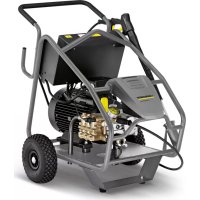
| Product type | Professional ultra-high pressure cleaner |
| Brand | Kärcher |
| Model | HD 13354 Cage |
| Service pressure | 130 bar (max) |
| Water flow rate | 350 l/h (max) |
| Power supply | 400 V / 50 Hz / three-phase |
| Power consumption | 4 kW |
| Weight | 30 kg |
| Dimensions (L x W x H) | 500 x 400 x 500 mm |
| High-pressure hose length | 10 m |
| Motor type | Water-cooled electric motor |
| Electrical protection | 30 mA residual current circuit breaker, class I |
| Detergent tank capacity | 1 L (integrated) |
| Admissible water temperature | Up to 60 °C (max) |
| Sound level (LpA) | 85 dB(A) |
| Vibration (hand-arm) | 2.5 m/s² |
| Chassis material | Steel with protective cage |
| Protection rating | IPX5 |
| Included accessories | High-pressure gun, lance, rotating nozzle, 10 m hose |
Frequently Asked Questions - HD 13354 Cage Kärcher
User questions about HD 13354 Cage Kärcher
0 question about this device. Answer the ones you know or ask your own.
Ask a new question about this device
Download the instructions for your Pressure washer in PDF format for free! Find your manual HD 13354 Cage - Kärcher and take your electronic device back in hand. On this page are published all the documents necessary for the use of your device. HD 13354 Cage by Kärcher.
USER MANUAL HD 13354 Cage Kärcher
Safety instructions Ultra-high-pressure cleaner
Read these safety instructions and the original operating instructions before using the device for the first time. Act in accordance with them. Keep the two booklets for
inal operating instructions before using the device for the first time. Act in accordance with them. Keep the two booklets for
You also need to take into consideration the general safety regulations and accident prevention guidelines of the legislator in addition to the notes in the operating instructions. Warnings and information notices attached to the device provide important information for hazard-free operation.
- You also need to take into consideration the general safety regulations and accident prevention guidelines of the legislator in addition to the notes in the operating instructions. Warnings and information notices attached to the device provide important information for hazard-free operation.
DANGER
Indication of an imminent threat of danger that will lead to severe injuries or even death.
WARNING
Indication of a potentially dangerous situation that may lead to severe injuries or even death.
Indication of a potentially dangerous situation that may lead to severe injuries or even death.
Indication of a potentially dangerous situation that may lead to minor injuries.
Indication of a potentially dangerous situation that may lead to minor injuries.
Indication of a potentially dangerous situation that may lead to damage to property.
Indication of a potentially dangerous situation that may lead to damage to property.
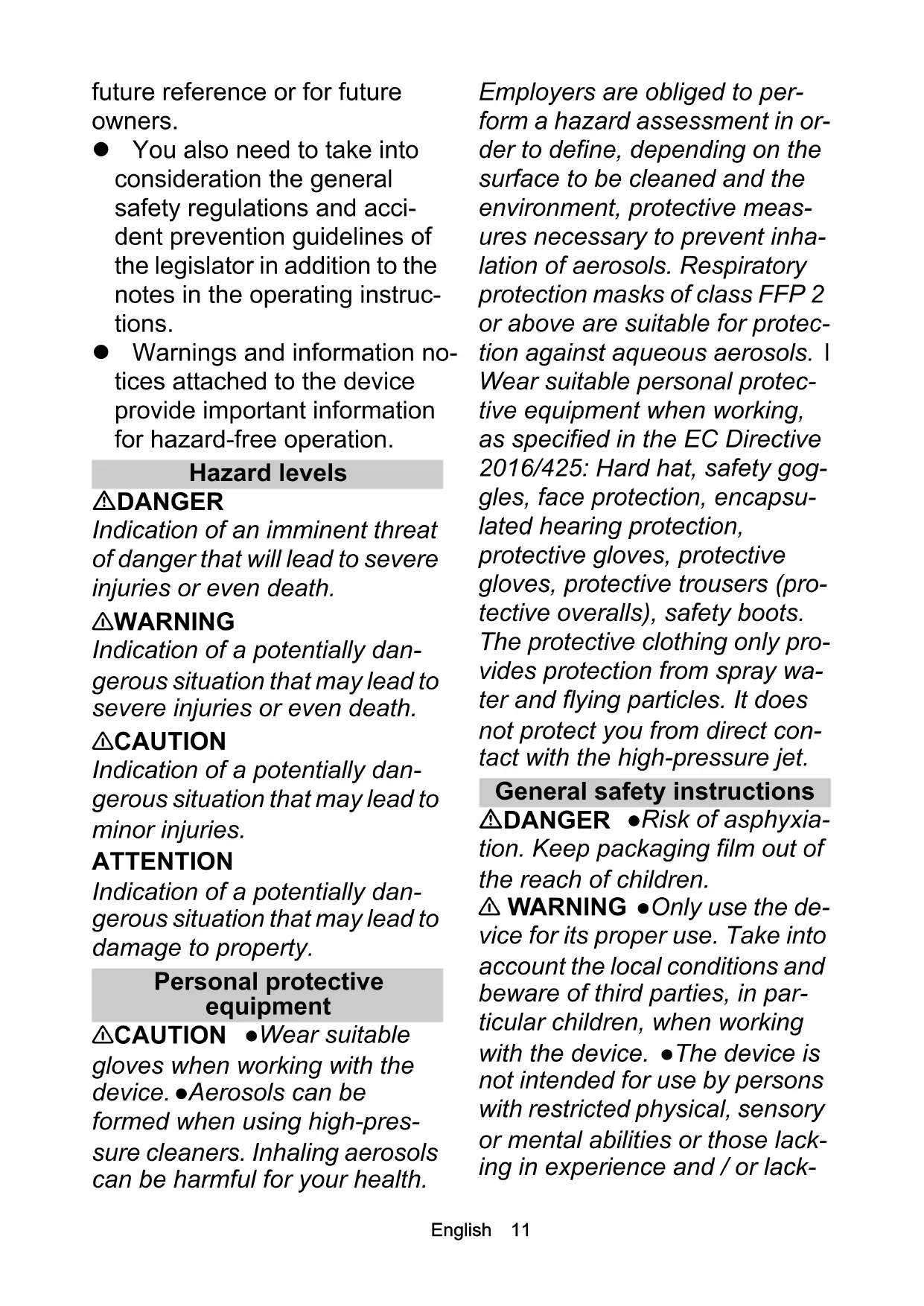
Personal protective equipment
CAUTION: Wear suitable gloves when working with the device. Aerosols can be formed when using high-pressure cleaners. Inhaling aerosols can be harmful to your health.
Employers are obliged to perform a hazard assessment in order to define, depending on the surface to be cleaned and the environment, protective measures necessary to prevent inhalation of aerosols. Respiratory protection masks of class FFP 2 or above are suitable for protection against aqueous aerosols. Wear suitable personal protective equipment when working, as specified in the EC Directive 2016/425: Hard hat, safety goggles, face protection, encapsulated hearing protection, protective gloves, protective trousers (protective overalls), safety boots. The protective clothing only provides protection from spray water and flying particles. It does not protect you from direct contact with the high-pressure jet.
General safety instructions DANGER Risk of asphyxiation. Keep packaging film out of the reach of children.
WARNING: Only use the device for its proper use. Take into account the local conditions and beware of third parties, in particular children, when working with the device. The device is not intended for use by persons with restricted physical, sensory or mental abilities or those lacking in experience and/or lack
ing in knowledge. Only people who have been instructed on how to use the device, or have proven their ability to operate it, and have been explicitly instructed to use it, must use the device. Children must be supervised to prevent them from playing with the appliance. Children and minors must not use the device.
CAUTION: Safety devices are provided for your own protection. Never modify or bypass safety devices.
Risk of electric shock
DANGER: Only connect protection class I devices to properly earthed power sources. The voltage indicated on the type plate must match the voltage of the power source. Take into account the minimum protection required for the socket, see chapter Technical data in the operating instructions. Only operate the device via a fault current protection switch (maximum 30 mA). Use a plug to connect the device to the mains grid. Permanent connection to the mains grid is prohibited. The plug is used for disconnection from the mains. Never touch the mains plug and socket with wet hands. The mains plug and coupling of the extension cable must be water tight and may not
be placed in water. The coupling may not be on the floor. Use cable drums to ensure that the sockets are at least 60 mm above the floor. All live parts in the work area must be protected against water jets. Use only a splash-protected extension cable with the cross-section specified in the operating instructions. Prevent any connections from lying in water. Do not clean the device with a high pressure water jet or low pressure water stream.
WARNING • Only connect the device to an electrical connection which has been set up by a qualified electrician as per IEC 60364-1. Check the power supply cable with mains plug for damage before operation each time. Do not put the device into operation with a damaged power supply cable. Have a damaged power supply cable replaced immediately by the authorised customer service / qualified electrician. Do not damage the power supply and extension cable by running over it, crushing or yanking it or similar. Protect the power supply cable from heat, oil and sharp edges. Only use the mains connection cable prescribed by the manufacturer, including when replacing the cable. For order no. and type see operating
instructions. Unsuitable electrical extension cables can be dangerous. Only use approved and appropriately marked electrical extension cables with a sufficient cable cross section for outdoors. Only replace couplings on the power supply or extension cable using those with the same water density and the same mechanical strength.
CAUTION In case of longer breaks in operation and after use, switch off the device at the main switch / device switch and pull the mains plug.
ATTENTION • Switch-on procedures will generate short-term voltage drops. • Unfavourable mains conditions may cause other devices to be impaired. • In case of a network impedance of less than 0.15 ohms, no malfunctions are to be expected.
Water connection
WARNING The screw connections of all connection hoses must be leak-tight. Do not exceed the maximum permissible water supply temperature. Route the hose lines in a safe manner.
ATTENTION Use only hose lines rated for the operating pressure, mechanical loads and chemical loads present. Do not bend the hose lines beyond the minimum permissible bending
radius. Replace the hose lines at appropriate intervals, even when no defects are visible. Hose lines have a limited service life. Observe the regulations at your water distribution company.
High-pressure connection
DANGER Use hosesleeves, protective covers or shields to eliminate hazards presented by the hose lines.
WARNING: The device must not be started up if the high-pressure hose is damaged. Replace a damaged high-pressure hose at once. Only those hoses and connections recommended by the manufacturer may be used. For order no. see operating instructions. Do not subject the hose lines to mechanical, chemical or thermal loads. The screw connections of all high-pressure hoses must be leak-tight. Tighten the screw connections to a maximum tightening torque of 20 Nm. Use a hose catching fixture. Use only high-pressure hoses and accessories having a rated operating pressure of at least the same as the device. Check the high-pressure hoses daily. Do not use kinked high-pressure hoses. Do not use high-pressure hoses having a visible outer wire mesh. Do not use high-pressure hoses having a damaged thread.
Do not use high-pressure hoses that have been driven over or subjected to impacts, even if no damage is visible. Route high-pressure hoses so that they cannot be driven over. Leaking fluid can cause injuries. Do not search for leaks with your bare hands.
CAUTION: Store the high-pressure hoses so that they are not subjected to any mechanical loads.
Operation
DANGER: Incorrect initial startup of an ultra-high-pressure cleaner is dangerous and can lead to severe injuries or death in some cases. Operate the device only when all hoods, covers and electrical cabinets are closed. Never leave the device unsupervised while it is in operation. In the case of an energy supply malfunction, switch off the device to prevent it from restarting uncontrollably when the malfunction has been corrected. Secure the device to prevent unauthorized use during work breaks. Do not work with the device when under the influence of medication or alcohol. Secure the work area in a clearly visible manner against unauthorized access. Erect warning signs and cordon off the area.
Only the operator is permitted to be present in the work area (within a radius of 10 m). Take suitable measures to secure yourself against falling when working on scaffolding. The recoil forces occurring present a risk of falling. Always stand on stable ground when working.
You must always be standing securely. Adjust the nozzle and operating pressure to suit each other so that the resulting recoil force can be kept under control by the operator. The recoil force must not exceed 250 N (25 kg). Use only pipe cleaning accessories having a marking allowing timely recognition of the nozzle outlet. The clearance between the nozzle and marking should be 500 mm. Insert pipe cleaning accessories at least 500 mm into the pipe to be cleaned before activating the high-pressure jet. When using the device in hazard zones (e.g. service stations), adhere to the respective safety regulations. Operation in explosive atmospheres is prohibited. Never suction solvents, liquids containing solvents or undiluted acids. This includes e.g. petrol, paint thinner or heating oil. The spray mist is highly flammable, explosive and poisonous.
WARNING: Eliminate dangerous situations immediately.
Observe the applicable national work safety regulations when working in enclosed spaces. A recoil force will arise due to the water stream ejecting from the spray lance. An angular spray lance produces a force that acts in upward direction. Make sure you grip the gun and spray lance firmly. Do not aim the high-pressure jet at yourself, e.g. to clean clothes or shoes. Do not direct the high-pressure jet at persons, animals, live electrical equipment or at the device itself. Do not spray any objects which contain harmful substances (e.g. asbestos). Check the device and the accessories, such as the high-pressure hose, high-pressure gun and safety devices, to make sure they are in proper safe and reliable condition before each operation. Do not use the device if it is damaged. Replace damaged components immediately.
CAUTION: Keep the work area clean and tidy. Equip a manually held spray unit with a body support if the recoil force exceeds 150 N (15 kg). Never leave the device unsupervised while it is in operation. Never open the cover while the motor is running. Never clamp the lever of the high-pressure gun during operation. The device
must be placed on an even, firm subsurface.
ATTENTION: Observe the local accident prevention guidelines and the safety instructions. Do not operate the device at temperatures below 0°C.
Note: Observe the legislature's national accident prevention regulations. Liquid jet cleaners must be tested regularly and the results of the test recorded in writing.
Operation with detergent
CAUTION: Keep the detergent out of the reach of children. When using detergents, observe the safety data sheet of the detergent manufacturer, in particular instructions on protective gear. Only use the detergents supplied or specified by the manufacturer. The use of other detergents or chemicals can impair the safety of the device. Never use the recommended detergents undiluted. These products are operationally safe since they do not contain any acids, alkali or substances that are harmful to the environment. Should detergents come into contact with eyes, rinse these out immediately and thoroughly using water and seek medical attention immediately. The same applies if detergents are swallowed.
Device with a hand-arm vibration value > 2.5 m/s² (see chapter Technical Data in the operating instructions)
CAUTION
Using the device for longer periods can cause poor circulation in the hands due to vibrations. A general period of use cannot be set, because this depends on several influencing factors:
- Personal tendency to suffer from poor circulation (frequently cold fingers, tingling sensation in the fingers)
- Low ambient temperature. Wear warm gloves to protect your hands.
- Holding the device too tightly hindering blood circulation.
- Continuous operation is more harmful than operation interrupted by work breaks.
You should see a doctor if using the device regularly and for lengthy periods of time, and in the event of repeated occurrences of symptoms such as tingling in the fingers or cold fingers.
Devices with pneumatic tyres
CAUTION In case of devices with screw-in wheel rims: Make sure that all wheel rim bolts are tightened securely before setting the tyre filling pressure. Make sure that the pressure reducer is set correctly on the compressor before setting the tyre filling pressure.
Never exceed the maximum permissible tyre filling pressure. The tyre filling pressure needs to be read on the tyre and if necessary on the wheel rim. If these values differ, use the smaller value.
Hot water and petrol driven devices, devices with a combustion engine
DANGER: Explosion hazard due to unsuitable fuel. Only fill the fuel specified in the operating instructions. Switch off the motor before refuelling. Do not refuel in confined spaces.
WARNING: Exhaust gases are toxic. Never breathe in the exhaust gases. Ensure rooms where the device is operated are sufficiently ventilated and that exhaust gases can be conducted away. During tanking, make sure that no fuel gets on hot surfaces. Clean up spilt fuel immediately.
CAUTION Risk of burns. Never bend down over the exhaust gas opening and never reach inside it. Do not touch the heating boiler while the burner is in operation. Never close off exhaust gas openings. Make sure that no exhaust gases are emitted close to air vents. Observe the safety instructions for petrol-driven devices in the operating instructions.
Care and service
WARNING Prior to cleaning, maintenance and replacement of parts, the device needs to be switched off and the mains plug removed with mains operation devices. Depressurise the high-pressure system prior to all work on the device or its accessories.
CAUTION Repairs may only be carried out by approved customer service sites or staff qualified in this area who are familiar with all relevant safety instructions. Do not operate the device again until all malfunctions have been eliminated.
ATTENTION Pay attention to the safety inspection for mobile devices for industrial use in accordance with the locally applicable regulations Short-circuits or other damage. Do not clean the device with a hose or high-pressure water jet. Do not use acetone, undiluted acids or solvents, as they corrode the materials used on the device.
Accessories and spare parts CAUTION •Only use accessories and spare parts which are approved by the manufacturer. Only original accessories and original spare parts ensure that the appliance will run fault-free and safely. •Only have repairs and installation of spare parts
performed by the approved Customer Service in order to prevent any hazards.
Transport
CAUTION Switch off the device prior to transport. Secure the device, taking into account its weight. See chapter Technical Data in the operating instructions. Risk of accidents and injuries. Take into account the weight of the device for transportation and storage. See chapter Technical data in the operating instructions. Observe the applicable national road traffic regulations when transporting the device on public roads. Use ropes, chains, tensioning devices and slinging gear equipped with retainers, conforming to the applicable regulations.
Individual protective equipment must comply with EU Directive 2016/425: helmet, protective goggles, protective visor (face shield), hearing protection, protective gloves, protective jacket, protective trousers (trousers with chainsaw protection), protective boots. Protective clothing provides protection only against splashes and flying particles. In direct contact with high-pressure jets, there is no sufficient protective effect.
Do not use or tamper with the device.
Danger from electric shock
DANGER: Connect the device only to a properly grounded power source. Check that the rated voltage matches the voltage of the power source. Compare the minimum contact protection, see chapter Technical Data for electrical equipment. Work with the device only in contact with the protective device against low voltage (max. 30 mA). Connect the device to the electrical network via a residual current device. Connection to the electrical network without the possibility of disconnection is prohibited. Use residual current devices for disconnection from the network. Never touch the network plug and contacts with wet hands. The residual current device and the plug of the device must be protected from moisture and must not be located in the outlet. The plug must not be placed on the floor. Allow cables to be checked to ensure that the contacts are not damaged.
At least 60 mm of water column. All live parts in the work area must be protected from water jets. Use only splash-proof extension cables as specified in the operating instructions. Check the position of the connection in the water. Do not clean the device with a high-pressure water jet.
WARNING
Connect the device to an electrical outlet that has been tested by an electrician according to IEC 60364-1. Before use, check the power cord for damage. Do not use the device with a damaged power cord. Have damaged power cords replaced by an authorized service/electrician. The power cord and the extension cable must not be damaged or kinked, pinched, pulled, or otherwise stressed. Keep the power cord away from heat, oil, and sharp edges.
Use only the power cord specified by the manufacturer, also when replacing the cable. See order number and type plate. Operating instructions. Unsuitable extension cables can be dangerous. For outdoor use, use only extension cables approved for this purpose and appropriately marked, with sufficient conductor cross-section. Replace the plugs of the power cord or the extension cable only with those of the same type and with the same electrical and mechanical protection. CAUTION: For longer work interruptions and after use, disconnect the device from the main power supply / device power supply and remove the power plug.
WARNING: The device is designed for short-term operation. Under unfavorable operating conditions, other settings may be required. For a setting below 0.15 ohm, do not expect damage.
Water inlet
WARNING: The hose connections of all connected devices must be leak-proof. Do not exceed the maximum permissible temperature of the supplied water. Check the hoses regularly.
WARNING: Use only hoses that meet the requirements for working pressure, mechanical and chemical resistance. Do not exceed the minimum permissible bending radius of the hoses. Check the hoses at regular intervals for damage. Hoses have a limited service life. Follow the instructions of your water supply company.
High-pressure hose connection DANGER: Use protective goggles, protective clothing, and protective shields to avoid the risk of hose rupture. WARNING: Do not operate the device if the hoses are damaged.
For work under high pressure, the hose is essential. Check the hose regularly for work under high pressure. Use only hoses and connections recommended by the manufacturer. Follow the operating instructions. Do not expose the hoses to mechanical, chemical, or thermal stress. The screw connection of all hoses for work under high pressure must be tight. Tighten the connections with a maximum torque of 20 Nm. Use the tightening device for the hoses. Use the hoses for work under high pressure and accessories only if the working pressure corresponds to the minimum specified for the device. Check the hoses for work under high pressure every day. Do not use damaged hoses for work under high pressure. Do not use hoses for work under high pressure that show cracks or tears in the material. Do not use hoses for work under high pressure with damaged threads.
Do not use hoses for work under high pressure that have been subjected to stress from stepping on them, cutting, or impact, or if there is visible damage. Store the hoses for work under high pressure so that they cannot be stepped on. The bursting pressure can cause injury. Do not use them with hot water.
CAUTION: Store the hoses for work under high pressure so that they are not subjected to mechanical stress.
Operation
DANGER: Incorrect use of the device for cleaning with high pressure is dangerous and can cause serious injury, in certain circumstances even death. Work with the device only if all valves, covers, and electrical connections are in place. Never leave the device unattended while it is running. In case of malfunction, disconnect the device from the power supply to prevent uncontrolled restart after the fault is rectified.
DANGER. To prevent accidents, ensure that the work area is safe. Do not work with the device under the influence of medication or alcohol. Keep the work area clean and well lit. Use warning signs and guards. In the work area (radius 10 m), only authorized personnel are allowed. When working on scaffolds, ensure protection against falls by using appropriate measures. Due to the reactive forces, there is a risk of falling. When working, stand on a stable base. Always maintain a safe position. Coordinate the device and the work area with each other so that only authorized personnel can control the reactive force. The reactive force must not exceed 250 N (25 kp). Use only approved fastening accessories for hoses with markings that allow immediate identification of the hose type. The distance between the hose and the marking must be at least 500 mm.
For hoses longer than 500 mm, use approved hose fastening accessories to prevent uncontrolled movement under high pressure. When using the device in hazardous areas (such as petrol stations), follow the relevant safety regulations. Operation is prohibited in areas where there is a risk of explosion. Never use solvents, solvent-containing substances, or undiluted acids. Examples include petrol, paint thinners, or paints. Aerosol mist is highly flammable, explosive, and toxic. WARNING: Always eliminate dangerous situations. When working in enclosed rooms, follow the national regulations for occupational safety. Due to the recoil force from the spray jet, the reactive force is high. Due to the high spray pressure, the force is directed upwards. Hold the spray gun firmly. Do not point the jet at yourself, e.g., to clean clothing or shoes. Do not point the jet
at high pressure at people, animals, active electrical equipment, or the device itself. Do not spray onto objects containing substances hazardous to health (e.g., asbestos). Before each use, check the device and accessories for proper condition and safe operation, such as high-pressure hoses, high-pressure guns, and safety devices. Do not use the device if there are defects. Replace defective components immediately.
CAUTION -Keep the work area clean and tidy. -Equip the manual spray device with a protective guard when the reactive force exceeds 150 N (15 kp). -Never leave the device unattended while it is running. -Do not open the cap while the device is running. -During operation, do not kink the hose of the high-pressure gun. -The device must be placed on a level, stable base.
WARNING: Follow local regulations for the disposal of waste and safety instructions. Do not
Work with the device at temperatures below 0°C
Instructions for safe use of the device. Follow the manufacturer's instructions for the device. The device must be checked periodically and the results of the check must be recorded.
Work with compressed air tools
WARNING: Store compressed air tools in places inaccessible to children. When using compressed air tools, follow the safety information for the manufacturer's compressed air tools, based on the instructions for personal protective equipment. Use only supplied or recommended by the manufacturer compressed air tools. Use of other compressed air tools or chemicals may affect the safety of the device. Do not use recommended compressed air tools for other purposes. The products are safe for work, but as they do not contain acids, alkalis or harmful substances for the environment. In case of damage to compressed air tools, immediately
rinse with water and do not forget to seek medical help, as well as when using compressed air tools.
Vibration level of the vibrating plate > 2.5 m/s² (see technical data in the operating instructions)
WARNING
Prolonged use of the device may lead to vibration-related disorders in the hands and arms, caused by vibrations. The duration of use cannot be determined, as it depends on many factors that have an impact:
- Personal disorders with vibration (e.g., poor blood circulation in the fingers and tingling in the fingers of the hands) require low ambient temperature. Wear gloves to protect the hands. Difficult vibration causes health problems.
- Continuous work is more harmful than work interrupted by breaks. With regular, alternating use of the device at
repeated occurrence of symptoms, such as tingling and numbness in the fingers of the hands, you should consult a doctor.
WARNING: For pneumatic tools with compressed air: Make sure that all parts of the tool are in good condition before adjusting the air pressure of the tool. Make sure that the compressor regulator is correctly set before adjusting the air pressure of the tool. Never exceed the maximum permissible air pressure of the tool. You should read the information about the air pressure of the tool and possibly of the tool. In case of different values, follow the higher value.
Vibration level with gasoline engine and diesel engine, vibration level with internal combustion engine
DANGER: Danger of explosion due to improper fuel. Only use the recommended fuel for operation. Before refueling, turn off the engine. Do not
General safety instructions
OHT Lambumisoht. Hoidke pakendikiled lastest eemal.
moluo J5 100
pge j Jg B aS> bjiJ1
oo goo y/ s Jo bdo
b2a//1b2a/2a//b2a//
baiaa aai jaaa
Iaio laXbaoogjyWscJo
y. 2gaaal/ y/1b/ y/ c J0
auiu u y. aolw p01g/
jiee
J11 1
2gj//iic .pJ/1j
a b/111 a u u 1 p/22w/
s/12eewJjIgCg/4g/4bci
a b11 b9b2 c a w b120
iic jIgJ1 Jueuw 2awy

- SAFETY INSTRUCTIONS ULTRA-HIGH-PRESSURE CLEANER
- DANGER
- INDICATION OF AN IMMINENT THREAT OF DANGER THAT WILL LEAD TO SEVERE INJURIES OR EVEN DEATH
- INDICATION OF A POTENTIALLY DANGEROUS SITUATION THAT MAY LEAD TO SEVERE INJURIES OR EVEN DEATH
- INDICATION OF A POTENTIALLY DANGEROUS SITUATION THAT MAY LEAD TO MINOR INJURIES
- INDICATION OF A POTENTIALLY DANGEROUS SITUATION THAT MAY LEAD TO DAMAGE TO PROPERTY
- PERSONAL PROTECTIVE EQUIPMENT
- RISK OF ELECTRIC SHOCK
- WATER CONNECTION
- HIGH-PRESSURE CONNECTION
- OPERATION
- OPERATION WITH DETERGENT
- DEVICE WITH A HAND-ARM VIBRATION VALUE > 2.5 M/S² (SEE CHAPTER TECHNICAL DATA IN THE OPERATING INSTRUCTIONS)
- CAUTION
- DEVICES WITH PNEUMATIC TYRES
- HOT WATER AND PETROL DRIVEN DEVICES, DEVICES WITH A COMBUSTION ENGINE
- CARE AND SERVICE
- TRANSPORT
- DANGER FROM ELECTRIC SHOCK
- WARNING
- WATER INLET
- WORK WITH COMPRESSED AIR TOOLS
- GENERAL SAFETY INSTRUCTIONS
Brand : Kärcher
Model : HD 13354 Cage
Category : Pressure washer