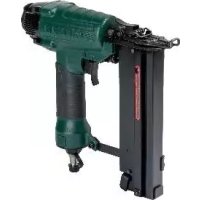
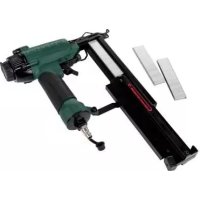
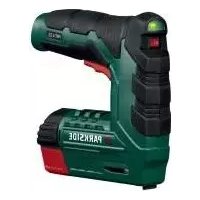
USER MANUAL PDT 40 F4 PARKSIDE
Operation and Safety Notes
Translation of the original instructions
FR BE CH
AGRAFEUSE-CLOUEUSEPNEUMATIQUE
Before reading, unfold the page containing the illustrations and familiarise yourself with all functions of the device.
DE AT BE CH
GB/IE/NI/CY/MT Translation of the original instructions Page 5
Special instructions
Regulations.. 9
Comment.. 10
Safety instructions for the fastening device.. 10
Operating hazards.. 12
Additional safety instructions for devices powered by compressed air.. 15
Supplementary safety instructions for air staplers and nailers 16
Supplementary safety instructions for protective goggles.. 16
Explanation of the markings on the protective goggles: 17
Trigger device 17
Trigger system 18
Additional instructions for fastening devices powered by compressed air.. 18
Original accessories/additional devices.. 19
Before using the device.. 19
Using the device.. 19
Connecting the compressed air supply.. 19
Filling the magazine. 20
Operation 20
Handling the device.. 21
Removing jammed staples.. 21
Maintenance.. 22
Maintenance by the user.. 22
Cleaning.. 22
Information about recycling and disposal.. 22
EC Declaration of Conformity 23
Warranty and service information.. 24
Warranty conditions.. 24
Warranty period and statutory claims for defects.. 24
Extent of warranty.. 24
Processing of warranty claims.. 25
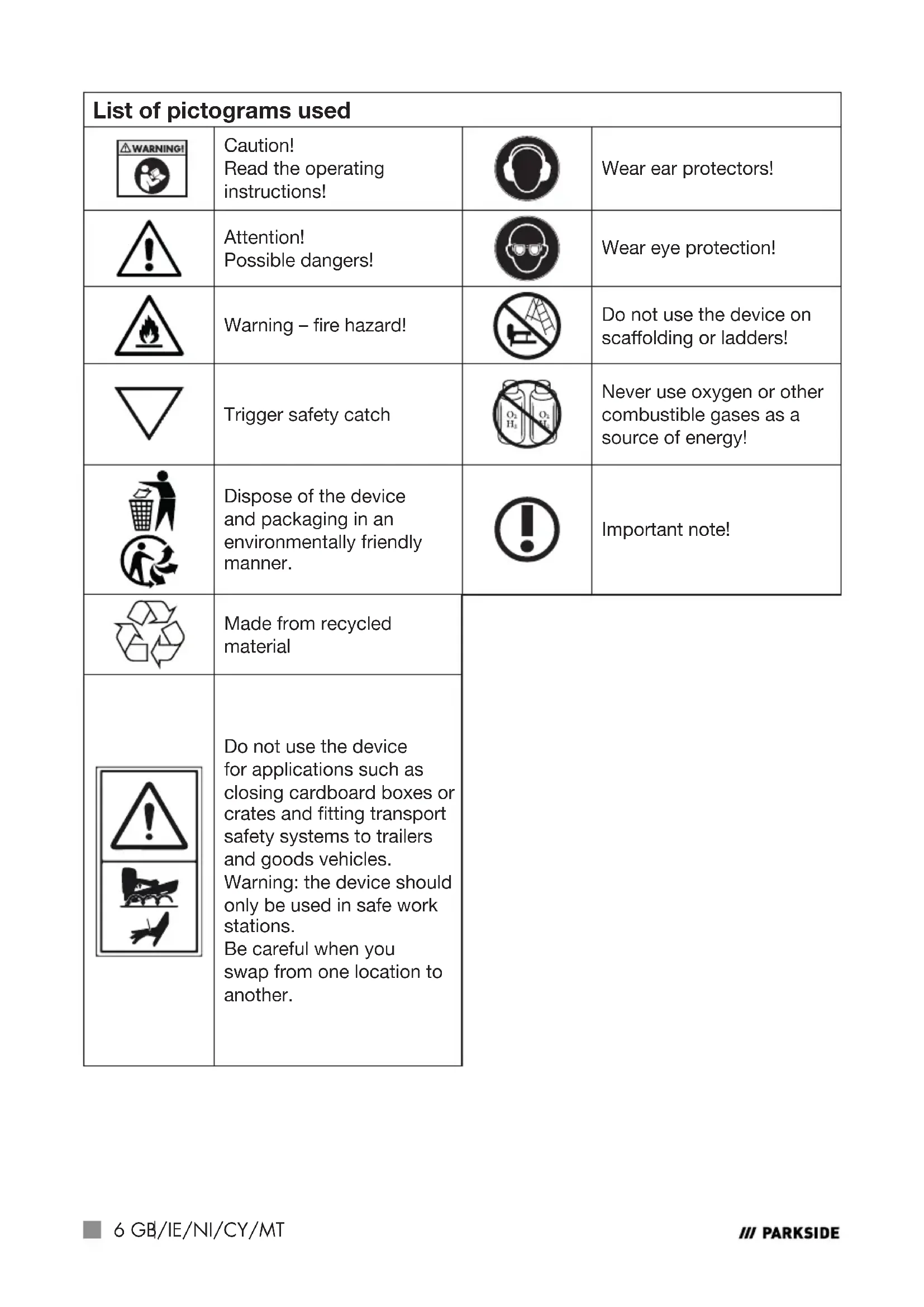
| List of pictograms used |
| △WARNING! | Caution!
Read the operating
instructions! | | Wear ear protectors! |
| Attention!
Possible dangers! | | Wear eye protection! |
| Warning - fire hazard! | | Do not use the device on
scaffolding or ladders! |
| Trigger safety catch | | Never use oxygen or other
combustible gases as a
source of energy! |
| Disposition of the device
and packaging in an
environmentally friendly
manner. | | Important note! |
| Made from recycled
material | |
| Do not use the device
for applications such as
closing cardboard boxes or
crates and fitting transport
safety systems to trailers
and goods vehicles.
Warning: the device should
only be used in safe work
stations.
Be careful when you
swap from one location to
another. | |
AIR STAPLER & NAILER PDT 40 F4
Introduction
Congratulations on the purchase of your new device. By doing this you have chosen one of our high-quality products. The operating instructions form part of this product. They contain important information on safety, usage and disposal. Please familiarise yourself with all operating and safety instructions before using the product. Use the product only as described and only for the specific applications as stated. Ensure you hand over all documentation when passing the product on to a third party.
Intenduse
The air stapler and nailer is designed for installation and repair work. You must wear the appropriate eye protection every time you use it.

Caution! This device may be used only as specified herein.
Use on hard materials such as stone, metal, etc. is not permitted.
Store these instructions in an easily accessible place. Ensure you hand over all documentation when passing the product on to a third party. Any use that differs to the intended use as stated is prohibited and potentially dangerous. Damage resulting from non-observation or incorrect use is not covered by the warranty or any liability on the part of the manufacturer. This product is not suitable for commercial use. It is only suitable for domestic use or similar applications. Commercial use will void the warranty.

Only trained persons may use this product.

Keep out of the reach of children!
PLEASE NOTE:
The use of the term 'product' or device in the following text refers to the air stapler and nailer named in these operating instructions.
Package contents
| 1 Air | Stapler & Nailer PDT 40 F4 |
| 1 | Oil container with special compressed air oil |
| 1 | Threaded barbed fitting 6.35 mm (1/4") (pre-mounted) |
| 1 | Pack of nails, 1000 pcs. (pack of 250 each of 15 mm, 25 mm, 40 mm, 50 mm) |
| 1 | Pack of staples, 1000 pcs. (pack of 250 each of 16 mm, 40 mm, pack of 500 of 25 mm) |
| 1 | Protective goggles |
| 1 | Operating instructions |
- Features
1 Exhaust air outlet (can be rotated)
Trigger
3 Handle
Threaded barbed fitting 6.35 mm (1/4")
5 Cover cap
6 Magazine lever
7 Magazine
8 Fill level display
Knurled screw
Trigger safety catch
11 Mouth
12 Face plate
13 Quick clamp lever for face plate
14 Oil container with special compressed air oil
15 Protective goggles
16 Nails
17 Staples
- Technical specifications
| Dimensions (W x H x D) | 245 x 237 x 58 mm |
| Weight
(without fasteners) | 1251 g |
| Type of trigger Compressed air |
| Maximum permitted pressure
(working pressure) | max. 8 bar |
| Recommended pressure range | 4-7 bar |
| Air consumption
depending on the
fastening operation | approx. 0.09 l |
| Recommended
lubricant | Special
compressed air oil |
| Loading capacity 100 pcs. |
| Nail lengths | 15 mm, 20 mm,
25 mm, 30 mm,
32 mm, 35 mm,
38 mm, 40 mm,
45 mm, 50 mm |
| Staple length 10-40 mm |
| Staple width 5.7 mm | |
| Recommended hose diameter (internal) | 9 mm |
| Compressed air quality | clean,
oil-atomised and condensate-free |
These values are device-related characteristic values and do not reflect the noise emission at the place of use. The noise emission at the place of use depends, for example, on the working environment, the workpiece, the workpiece support, the number of fastening operations. Depending on the work station conditions and the shape of the workpiece, it may be necessary to implement customised noise reduction measures, such as, for example, placing the workpieces on sound-absorbing mats, preventing vibration of the workpieces by clamping or covering, adjusting to the lowest pressure necessary for carrying out the procedure. In specific cases, you must wear personal ear protectors.
Measured value determined in accordance with EN 12549:1999, EN ISO 4871.
The A-weighted sound pressure level of the device is typically: 93 dB(A)
Uncertainty K = 3 dB
Total vibration value
Vibration emission value a_n = 2.481 m/s^2
Uncertainty K = 1.5m / s^2 in accordance with ISO 8662-11:1999
Mechanical impacts (vibration)
For the fastening device, the vibration characteristic value is determined in accordance with ISO 8662-11:1999 - Handheld motor-driven machines - Measuring mechanical vibrations on the handle - Fastening devices (see Technical specifications). The value is a device-related characteristic value and does not represent the effect of the hand-arm system when using the device. The impact on the hand-arm system when using the device depends, for example, on the gripping force, contact pressure, direction of operation, the air pressure which has been set, the workpiece, the workpiece support.
- Special instructions
- Regulations
The DIN EN ISO 11148-13:2018 standard "Handheld non-electrically operated machines - Safety requirements - part 13: Fastening devices" applies to fastening devices. This standard states that
you must only work with those fastening devices as listed in the corresponding operating instructions for the fastening devices (see
Technical specifications). The fastening device and the fasteners indicated in the operating instructions are regarded as a safety system;
Quick couplings are used for connection to the compressed air supply and the non-closable nipple must be fitted to the device so that when it is disconnected, there is no compressed air in the device.
Oxygen or combustible gases must not be used as a source of energy for fastening devices powered by compressed air;
Fastening devices must only be connected to lines, where the maximum permitted pressure of the device cannot be exceeded by more than 10% ; with higher pressures, a pressure regulating valve (pressure reducer) with downstream pressure relief valve must be fitted in the compressed air line;
only spare parts designated by the manufacturer or his representative may be used for servicing fastening devices;
Servicing work may only be carried out by an agent appointed by the manufacturer or by other experts
taking the information contained within the operating instructions into account;
An expert is someone who, due to his/her professional training and experience has sufficient knowledge in the area of fastening devices and is familiar with the relevant national occupational health and safety regulations, accident prevention regulations, directives and generally accepted rules of technology (e.g. CEN or CENELEC standards) to the extent that he/she can assess the operational safety of fastening devices.
Brackets to fix fastening devices onto a support, e.g. workbench, must be designed by the manufacturer such that the fastening devices can be securely fixed for the intended purpose, e.g. so that they cannot be damaged, rotated, moved.
Special areas of application for the fastening device may require compliance with additional regulations and rules (e.g. working in hazardous areas (Ex)).
- Safety instructions for the fastening device

Read all safety instructions and other instructions.

Read and understand all the safety instructions before you connect, disconnect, load, use or
maintain the device, replace accessories or work near the device. Failure to do so can result in serious bodily injury.
Please keep all safety instructions and other instructions in a safe place!
- Keep your fingers away from the trigger when you are not using this device and switch from a working position to another position.
Before starting work each time, check that the safety and trigger devices are working properly and that the screws and nuts are all tight.
Do not carry out any alterations to the device.
- Do not dismantle or block any parts of the fastening device, such as, for example, a trigger safety catch.
Do not carry out any "Emergency repairs" using inappropriate tools/methods.
The fastening device must be maintained regularly and properly, in accordance with the manufacturer's specifications.
Avoid any type of weakening or damage to the device, for example, through:
Stamping or engraving,
Modification measures which are not permitted by the manufacturer,
Guiding using templates which are made out of hard material, e.g. steel,
- Dropping on the floor or pushing across the floor,
Using it as a hammer,
any type of blunt impact.
- Keep your fingers away from the trigger when you are not using this device and switch from a working position to another position.
- Keep body parts such as hands, legs, etc. away from the direction of firing and make sure that the fastener cannot penetrate in any parts of the body.
When you use the device, please be aware that the fastener could ricochet and cause injuries.
Hold the device with a firm grip and prepare yourself for recoil.
Do not use a device which is damaged.
■ Be careful when handling fasteners, particularly when loading and unloading, as the fasteners have sharp points which could cause injuries.
Before use, always inspect the device for defects, parts which are not corrected properly or worn parts.
Do not lean too far forward. Only use in safe work stations. Always make sure your footing is secure and maintain your balance at all times.
Only wear gloves which give an appropriate sense of touch and mean that you can operate the trigger and all adjustment devices safely.
Only technically-trained users should use the fastening device.
- Do not carry out any alterations to the fastening device. Alterations can reduce the efficiency of the safety measures and increase the risk for the user and/or a third party.
- Keep away from other people (if you are working in an environment where there are likely to be people passing).
Clearly mark your work station.
Never aim at yourself or others with the device.
- Operating hazards
Always make sure your footing is secure and maintain your balance at all times.
Hold the fastening device when working such that if there is a possible recoil due to a fault in the power supply or due to hard points in the workpiece, your head and body cannot be injured.
Never shoot the fastening device into the air. You will thus avoid the hazard due to flying objects and overloading the device.
To transport the fastening device, disconnect it from the compressed air supply, particularly if you are using ladders or if you have to move around with your body in an unusual position.
At the work station, only carry the fastening device using the handle and do not have the trigger pressed.
Take the work station conditions into account. Fasteners may possibly punch through thin workpieces or may slip
you are when working on corners and edges of workpieces and this could put individuals in danger.

Use the appropriate protective equipment for
your personal protection, such as, for example, ear protectors and eye protection. Depending on the type of fastening device and how it is used, wearing personal protective equipment such as a dust mask, non-slip safety shoes, a hard hat and hearing protection can lessen the risk of injuries.
Hold the device properly, in order to be able to react to normal or sudden movements, such as, for example, recoil.
After using the fastening device, disconnect the compressed air supply from the device and store the device safely by placing it on its side. The device must not be stored in an upright position.
Hazards due to flying objects
The fastening device must not be connected when you are unloading fasteners, carrying out adjustments, removing blockages or replacing acces
sories.
During operation, please ensure that the fasteners always penetrate properly into the material and are not deflected or incorrectly positioned pointing in the direction of the user and/or a third party.
During operation, fragments of the workpiece or parts of the fixing or magazine system may be ejected.
Make sure that the device is always firmly positioned on the workpiece and cannot slip.
Always wear impact-resistant eye protection with side shields when operating the device.
The risk for others must be assessed by the user.
Hazard due to repeated movements
When using the fastening device over longer periods of time, this could cause the user to experience pain in their hands, arms, shoulders, neck or other parts of the body.
When using the device, the user should adopt a comfortable posture, stand on a stable surface, and avoid postures which make it difficult to maintain balance. The user should
change their posture during long work periods, thereby helping to minimise unpleasant sensations and fatigue.
If the user experiences symptoms such as persistent or recurring pains, aches, palpitations, areas which ache, tingling, numbness, a burning feel or stiffness, these are warning signals which must not be ignored. The user must see a qualified occupational health professional with regard to general activities.
Hazards due to accessories and consumables
- Disconnect the device from the compressed air supply before you replace accessories or carry out adjustments.
Use exclusively those accessories and consumables of the sizes and types recommended by the manufacturer of the air stapler.
Hazards at the work station
Slipping, tripping, and falling are the predominant causes of accidents at work.
Be aware of slippery surfaces, arising from the use of the
device and also trip hazards, caused by the compressed air hose.
Proceed carefully in unfamiliar environments. There may be hidden dangers in the form of electric or other supply cables.
The air stapler is not intended for use in potentially explosive areas and is not isolated against contact with electrical energy.
Make sure that there are no electrical lines, gas piping, etc., that may pose a hazard in the event of damage caused by the device in use.
Hazards due to dust and gases
If the device is used in an area where there is static dust, the dust may swirl up and this could cause a hazard.
The air stapler must be operated and serviced as recommended in these instructions if the release of dust and vapours is to be minimised.
The exhaust air must be extracted in such a manner that the dust raised and dusty environments are reduced to a minimum.
All device-fitted installations or accessories designed to
capture, extract, or suppress airborne dust or vapours should be used and serviced in accordance with the manufacturer's instructions.
Do not breathe in the device's exhaust air. Avoid exposing your eyes to the device's exhaust air.
The exhaust air from the device can contain water, oil, particles of metal or dirt from the compressor. This can be harmful to health.
Hazards due to noise
Being subject to a high level of noise without protection can cause permanent disability, loss of hearing and other problems such as tinnitus (ringing, buzzing, whistling or humming in the ears).
Use hearing protection equipment as required by work and health protection regulations.
The air stapler must be operated and serviced as recommended in these instructions if there is to be no unnecessary increase to noise levels.
Hazards due to vibrations
The effect of vibrations can
lead to nerve paralysis and interruption to the blood supply to the hands and arms.
When working in cold environments, wear warm clothing and keep your hands warm and dry.
If you experience numbness, tingling, aches and white coloration of the skin on your fingers or hands, then you should seek medical advice from a qualified occupational health professional with regard to general activities.
Use and maintain this device as recommended in these instructions, in order to prevent an unnecessary increase in the vibration level.
Hold the device with a light but secure grip, as, in general, the risk through vibrations is greater, the higher the grippingforce.
Additional safety instructions for devices powered by compressed air
Compressed air can cause serious injury.
Always close off the air supply and disconnect the device from the air supply when it is
not being used.
Always disconnect the device from the compressed air supply before replacing accessories, carrying out adjustments and/or repair work and when you are moving from one work area to another.
- Keep your fingers away from the trigger when the device is not being used and when you move from one operating position to another.
Never direct compressed air at yourself or someone else.
Hose lines which are whipping round can cause serious injuries. Always check for damaged or loose hoses or connections.
- Never pull or carry a device powered by compressed air by its hose.
- Do not exceed the maximum operating pressure when using devices powered by compressed air.
Devices powered by compressed air should only be operated with compressed air at the lowest possible pressure for the work process, in order to reduce noise and vibrations and to minimise wear.
Take care when using devices
powered by compressed air, as the device could become cold which affects grip and control.
Supplementary safety instructions for air staplers and nailers

DANGER OF INJURY!
Never exceed
the maximum permitted
working pressure of 8 bar.
Use a pressure reducer to
adjust the working pressure.

DANGER OF INJURY!
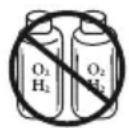
Never use oxygen or other combustible gases as a source of energy.
Ensure that your work area is clean and well illuminated.
Untidiness and poorly lit work areas can cause accidents to happen.
- Keep children and other individuals away while the fastening device is being used. If you are distracted, you could lose control of the device.
Always pay attention, be aware of what you are doing and take the utmost care when working with a fastening
device. Do not use the fastening device if you are tired or under the influence of drugs, alcohol or medicines. A brief moment of carelessness when using the fastening device can result in serious injuries.
Ensure good bodily posture during use. Ensure that you are not likely to overreach or lose your balance during use. This will make it easier for you to control the fastening device in unexpected situations.
- Disconnect the device from the compressed air supply before carrying out repair and servicing work or moving the device. Never allow new or old oil to flow into the floor or sewer system. This is illegal! Collect old oil in a suitable container in order to protect the environment. Dispose of it at your local collection point, petrol station or oil dealer.
Supplementary safety instructions for protective goggles
Protective equipment that was subject to impact must be disposed of and replaced.
If the impact strength classes of the glass and frame do not match, the overall protec
tion corresponds to the lower class.
The protective goggles are designed for use with the air stapler and must only be used in the application area for the air stapler.
Protective goggles offer sufficient protection against particles of up to 6mm diameter with a speed of up to 45m/s.
Replace the protective goggles, as soon as there is damage or scratches on the viewing panes.
When you replace protective goggles, make sure that you use protective goggles with the same protective properties.
Materials which come into contact with the skin of the wearer can cause allergic reactions for sensitive individuals.
The impact of particles on the protective goggles could pose a danger for the wearer through the transfer of impact, if prescription glasses are worn under the protective goggles.
- Explanation of the marking on the protective goggles:
CMC: Identification of the certificate holder
16321: Number of the EN test
standard for protective goggles
1:Opticalclass
C:Protection against low-velocity impacts
1-M: These goggles are suitable for head shape 1-M.
CE:CEmarking
If the letter for impact intensity is not followed with the letter T, the eye protection equipment must only be used at room temperature against high-speed particles. If the markings for the mechanical strength on the carrier body and on the viewing pane do not match, then the lower mechanical protection level will always apply for the complete product.
Trigger device
This fastening device is operated by pressing the trigger with your finger. In addition, certain fastening devices must be fitted with a trigger safety catch, which only allows a fastening procedure to be carried out if the mouth of the device is placed on a workpiece. These devices are marked with a triangle shown standing on its point (and may not be used
without an effective trigger safety catch 10.
Trigger system

DANGER OF INJURY!
Do not use the device on scaffolding or ladders!
Fastening devices which are fitted with a contact trigger must be marked with the graphical symbol for "Do not use on scaffolding or ladders". They must not be used for certain applications, for example: when you will be swapping from one fixing point to another using scaffolding, steps, ladders or ladder-like constructions, such as, for example, roof lathing, or you intend to seal boxes or crates, when fitting transport locking devices, e.g. onto vehicles and wagons.
Additional instructions for fastening devices powered by compressed air

DANGER OF INJURY!
Do not operate the device if the trigger safety catch ⑩ is defective or has been removed.
Otherwise this could result in injuries.
When undoing the hose coupling, hold the hose firmly in your hand, in order to avoid injuries caused by the hose springing back.
It is essential that you use a 1 / 4'' threaded barbed fitting and quick coupler for the compressed air connection.
- Never put your hands near the mouth of the device, when the device is ready for operation. Otherwise this could result in injuries.
Before setup or first use, check the device for any damage. If the device shows any defects, then it must not be used under any circumstances.
- Do not use any sharp objects. Never insert any pointed and/or metallic objects into the inside of the device.
The fastening device powered by compressed air should only be connected to lines where there is a guarantee that exceeding the maximum permitted pressure by more than 10% is prevented, e.g. through a pressure regulating valve (pressure reducer) with downstream or integrated
pressure relief valve fitted in the compressed air line.
When using fastening devices powered by compressed air, make sure that the max. pressure is not exceeded.
The fastening device powered by compressed air must only be operated with the pressure required for that particular work process, in order to avoid unnecessarily high levels of noise, increased wear and faults which could occur because of this.
Ensure that compressed air device repairs always use original replacement parts and are performed by a qualified technician. This ensures that the compressed air device is
safe to operate at all times.
- Before using the device
Please read and follow these operating instructions, before you start using the device. It is essential that you follow the basic safety measures, in order to prevent damage to the device and avoid injuries to operating personnel or others present in the working environment.
Using the device

FIRE AND EXPLOSION HAZARD!
Never use hydrogen, oxygen, carbon dioxide or any other bottled gas as the source of energy for this tool, since this may cause an explosion and lead to serious injury.
- Original accessories/ additional devices
Only use accessories and additional devices which are stated in the operating instructions. The use of other fasteners or other accessories than those recommended in the operating instructions can represent a risk of injury for you.

PLEASE NOTE: Before the device each time, we put on the protective ties delivered with the act.
- Connecting the compressed air supply
PLEASE NOTE: The air stapler and nailer must only be operated with clean, oil-atomised compressed air and must not exceed the maximum working pressure of 8 bar at the device. To regulate the working pressure, the compressor must be fitted with a pressure reducer.
Connect the device to a suitable compressed air supply.
To do this, press the quick coupler of the compressed air hose (not included
in the delivery) onto the threaded barbed fitting 14 of the air stapler.
The latch locks into place automatically.
Connect the other end of the compressed air hose with the (filter) pressure reducer on the compressor.
For the fastening device to work properly, you need to use a sufficient quantity of filtered, dry, oiled compressed air. If the pressure in the supply network is higher than the maximum permitted pressure for the fastening device, then a pressure regulating valve with a downstream pressure relief valve must be fitted.
PLEASE NOTE: When generating compressed air using compressors, the natural air humidity condenses and collects as condensation in pressure vessels and piping. This condensate must be removed through water traps. Water traps must be checked on a daily basis and emptied, if necessary, otherwise corrosion may occur in the compressed air system and in the fastening device and this could promote wear.
The compressor must be sufficiently dimensioned with regards to pressure and suction capacity (volume flowrate) for the expected usage. If the line cross section is too small, taking into account the line length (for pipes and hoses) or overloading the compressor can lead to a drop in pressure.
Oilers must be checked daily and, if necessary, be refilled with the recommended oil (see Technical specifications). When using hose lengths longer than 10m , the supply of oil to the fastening device is not guaranteed. We recommend putting two to five drops of the recommended oil into the air inlet of the device each working day.
Alternatively, an oiler can be fitted directly onto the fastening device.
Use a compressed air hose with an internal
diameter of at least 9mm . Otherwise the staples/nails will be fired very slowly or with a low level of pressure.
Filling the magazine
Only the fasteners listed in the "Technical specifications" section may be used. To fill the magazine, hold the device so that the mouth is not pointing towards your own body or other individuals.
Press the magazine lever and pull the magazine cover back till it reaches the stop.
Insert the relevant fasteners (nails, see Fig. D or staples, see Fig. C) into the magazine 7. The staples must be placed on the rail of the magazine 7.
Push the magazine cover forwards until it clicks into place.
Operation
Load the magazin of the air stapler, as described in the "Filling the magazine" chapter.
Set the correct working pressure using the pressure reducer.
Make sure that you do not exceed the maximum working pressure of 8 bar at the device. Increasing the working pressure does not bring any benefit to performance, but it just increases the consumption of compressed air and accelerates wear and tear on the device.
Switch the compressor on.
- Allow the compressor to run until the maximum vessel pressure is reached and the device switches off.
Place the air stapler on the workpiece and press the trigger 2.

PLEASE NOTE: The air stapler and nailer is
equipped with a trigger safety
catch 10. The fastener only leaves the device when the mouth of the air stapler and nailer is pressed against the workpiece and the trigger 2 is pressed.
- Handling the device
Please follow the "Special instructions" in these operating instructions. Check that the fastening device is working properly and is ready for operation, then place it on the workpiece and press the trigger.
Check whether the fastener has gone in, and meets the relevant requirements.
If the fastener is protruding, increase the air pressure in steps of 0.5 bar.
If the fastener is too deep, decrease the air pressure in steps of 0.5 bar.
Alternatively, you can speed up operation by holding the trigger 2 pressed in.
Place the air stapler on the workpiece.
Press the device onto the workpiece until the mouth 11 touches the workpiece. The fastener leaves the device.
As long as you keep the trigger pressed, then, every time the mouth touches the workpiece, a fastener will leave the device.
Alternatively you can also keep the mouth 11 of the device pressed continuously onto the workpiece.
Every time you press the trigger one fastener leaves the device.
In all cases you should endeavour to work with the lowest level of air pressure. This brings you three significant advantages:
1) You save energy,
2) You reduce the noise level,
3) You reduce the wear on the fastening device.
Avoid triggering the fastening device when the magazine is empty. If the fastening device is defective or is not working properly, disconnect it immediately from the compressed air and hand it over to an expert for inspection. During long work breaks or when work has finished, disconnect the device from the compressed air system and ideally empty the magazine. Protect the compressed air connections of the fastening device and the hose lines against contamination. Penetration of coarse dust, chips, sand, etc. leads to leaks and damage to the fastening device and couplings.
PLEASE NOTE: It is also possible to carry out fine adjustments using the knurled screw.
Rotate the knurled screw down, to make the fastener go deeper into the workpiece.
Rotate the knurled screw up, to make the fastener go less deep into the workpiece.
Rotate the exhaust air outlet, to guide the exhaust air flow point in the direction you want.
- Disconnect the device from the compressor after completing work.
- Removing jammed staples
If a staple/nail has got stuck in the magazine shaft, remove the compressed air supply immediately.
Open the magazine as described in the "Load magazine" chapter.
- Open the face plate by pulling the quick clamp lever for the face plate in the direction of the trigger safety catch 10.
Remove the jammed fastener. Close the face plate by pulling the quick clamp lever for the face plate in the direction of the exhaust air outlet 1.
Close the magazine of the air stapler, as described in the "Load magazine" chapter.
- Maintenance

DANGER OF INJURY!
Always disconnect the
device from the compressed air supply and empty the magazine before cleaning and/or carrying out maintenance work.
Lubricate with the oil-atomiser:
PLEASE NOTE: As a preparatory step, after the pressure reducer an oil-atomiser lubricates the air stapler continuously and in the very best way. An oil-atomiser dispenses oil in fine droplets into the airflow and thereby guarantees regular lubrication.
Fit the oil-atomiser after the (filter) pressure reducer. To do this, plug the barbed fitting of the oil-atomiser into the quick coupler of the (filter) pressure reducer.
Then connect the compressed air device to the quick coupler provided for this purpose.
Manual lubrication:
PLEASE NOTE: If you do not have an oil-atomiser, you must lubricate after you have used approximately 5000 fasteners.
Put 1-2 drops of compressed air special oil into the threaded barbed fitting 4 of the air stapler.
Then press the trigger a few times.
ATTENTION: Under no circumstances should you use too much oil, as otherwise this could leave the mouth with the fas
tener and this could possibly damage the workpiece.
- Cleaning
- Do not use sharp objects to clean the device and the protective goggles. Do not allow liquids to get inside the unit - Otherwise, the device could be damaged.
Clean the device and protective goggles regularly. The best time to do so is straight after completing work.
Clean the device housing with a dry cloth.
Clean the protective goggles with a soft and dry or moistened cloth or clean it with a cloth moistened with disinfectant - under no circumstances should you use gasoline, solvents or cleaners which corrode plastic.
Store the compressed air stapler, the goggles, and the compressed air special oil in their packaging after every use to protect them from contamination.
PLEASE NOTE: Using, cleaning and storing the protective goggles can reduce the service life by approx. 3 years. If the viewing pane is scratched or there is other visible damage on the protective goggles, replace them immediately.

dispose of the product
including any accessories in standard household waste, take it to your municipal collection points for material recovery.

The packaging is made of environmentally-friendly material, which you can dispose of at your local recycling centres.

Please note the marking on the different packaging materials and separate them as necessary. The
packaging materials are marked with abbreviations (a) and digits (b) with the following definitions: 1-7: Plastics, 20-22: Paper and cardboard, 80-98: Composite materials.
Air Stapler & Nailer
We,
C. M. C. GmbH Holding
Responsible for documentation:
Joachim Bettinger
Katharina-Loth-Str. 15
66386 St. Ingbert
Germany
hereby take sole responsibility for declaring that the product
Air Stapler & Nailer
Item number: 2917
Year of manufacture: 2026/04
IAN:494747_2504
Model: PDT 40 F4
meets the basic safety requirements as specified in the European Directives
Machinery Directive 2006/42/EC
and the amendments to these Directives. The manufacturer will be solely responsible for the creation of the declaration of conformity.
The object of the declaration described above meets the requirements of Directive 2011/65/EU of the European Parliament and of the Council of 8 June 2011 on the restriction of the use of certain hazardous substances in electrical and electronic equipment.
This conformity assessment is based on the following harmonised standards:
EN 12100:2011
EN 11148-13:2019
Responsible for documentation:
Joachim Bettinger
Katharina-Loth-Str. 15
66386 St. Ingbert
Germany
hereby take sole responsibility for declaring that the product
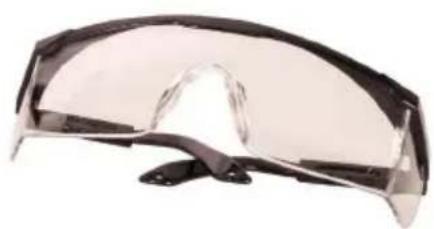
Protective goggles 026
(CMC 1 C CE / CMC 16321 C 1-M CE)
Year of manufacture: 2026/04
meets the basic safety requirements as specified in the European Directives
Personal protective equipment regulation (EU)/2016/425
General product safety directive 2001/95/EC
and the amendments to these Directives. The manufacturer will be solely responsible for the creation of the declaration of conformity.
This conformity assessment is based on the following harmonised standards:
ISO 16321-1:2022
The notified certification body ECS GmbH - European Certification Service, Obere Bahnstraße 74, 73431 Aalen, Notified body number 1833, carried out the EC type examination and issued the EC type examination certificate C4050.1CMC.
Warranty from C. M. C. GmbH Holding
Dear Customer,
The warranty for this equipment is 3 years from the date of purchase. In the event of product defects, you have legal rights against the retailer of this product. Your statutory rights are not affected in any way by our warranty conditions, which are described below.
Warranty conditions
The warranty period begins on the date of purchase. Please retain the original sales receipt. This document is required as your proof of purchase.
Should this product show any defect in materials or manufacture within 3 years from the date of purchase, we will repair or replace it - at our discretion - free of charge. This warranty service requires that you retain proof of purchase (sales receipt) for the defective device for the three year period and that you briefly explain in writing
what the fault entails and when it occurred. If the defect is covered by our warranty, we will repair and return your product or send you a replacement. The original warranty period is not extended when a device is repair or replaced.
Warranty period and statutory claims for defects
The warranty period is not extended by the guarantee. This also applies to replaced and repaired parts. Any damages or defects detected at the time of purchase must be reported immediately after unpacking. Any incidental repairs after the warranty period are subject to a fee.
- Extent of warranty
This device has been manufactured according to strict quality guidelines and carefully inspected before delivery.
The warranty applies to material and manufacturing defects only. This warranty does not extend to product parts, which are subject to normal wear and tear and can thus be regarded as consumable parts, or for damages to fragile parts, e.g. switches or parts made from glass.
This warranty is voided if the product becomes damaged or is improperly used or maintained. For proper use of the product, all of the instructions given in the operating instructions must be followed precisely. If the operating instructions advise you or warn you against certain uses or actions, these must be avoided in all circumstances.
The product is for consumer use only and is not intended for commercial or trade use. The warranty becomes void in the event of misuse and improper use, use of force, and any work on the device that has not been carried out by our authorised service branch.
- Processing of warranty claimsContact form: https://parkside-diy.com/service
To ensure prompt processing of your claim, please follow the instructions given below.
Please retain proof of purchase and the article number (e.g. IAN) for all inquiries.
The product number can be found on the type plate on the product, an engraving on the product, the cover page of your instructions (bottom left), or the sticker on the back or underside of the product.
In the event of malfunctions or other defects, please first contact our service department below by phone or contact form.
If your product is found to be defective, you can then send your product with proof of purchase (till receipt) and a statement describing what the fault involves and when it occurred free of charge to the service address given.
You can view and download this handbook and many more at parkside-diy.com. With this QR code you can go straight to parkside-diy.com. You can access the user instructions for your product by entering the product number (IAN) 494747_2504.
Phone: 0-808-189-0652
Registered office: Germany
IAN 494747_2504
Please note that the following address is not a service address. Please contact the service point given above first.
Address:
C. M. C. GmbH Holding
Katharina-Loth-Str. 15
66386 St. Ingbert
Germany

How to contact us:
GB, IE, NI, CY, MT
Website: www.cmc-creative.de
Directive relative aux machines 2006/42/CE
Site web: www.cmc-creative.de
Formulaire de contact: https://parkside-diy.com/service
Telephone: 0033 (0) 387 84 72 34
Siège: Allemagne
IAN 494747_2504
https://parkside-diy.com/service
IAN 494747_2504
z up. Joachima Bettingera
Dziat Jakosci
Okulary ochronne
My,
C. M. C. GmbH Holding
z up. Joachima Bettingera
Dziat Jakosci -