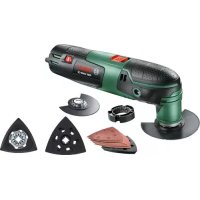
PMF 2000 CE - Power tool BOSCH - Free user manual and instructions
Find the device manual for free PMF 2000 CE BOSCH in PDF.



| Brand | Bosch |
| Model | PMF 2000 CE |
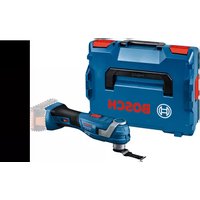
| Product type | Oscillating multi-tool |
| Rated input power | 220 W |
| Output power | 130 W |
| No-load speed | 15,000 – 20,000 rpm |
| Oscillation angle | 1.4° (left/right) |
| Weight (according to EPTA 01:2014) | 1.1 kg |
| Mains voltage | 230 V ~ |
| Protection class | /II (double insulation) |
| Speed preselection | Yes, thumbwheel (1-6) |
| Constant electronic control | Yes |
| Soft start | Yes |
| Tool holder clamp | Yes, integrated magnet for retention |
| Main applications | Sawing, cutting, sanding, scraping, grout removal |
| Compatible accessories | Plunge cut blades HCS/bimetal/carbide, segment blades, sanding plates, scrapers, depth stop |
| Additional anti-vibration handle | Available as accessory |
| Dust extraction system | Suitable dust extraction device, connection for vacuum cleaner |
| Sound level (sound pressure) | 84 dB(A) |
| Sound level (sound power) | 95 dB(A) |
| Vibration (sanding) | 10 m/s² (K=1.5 m/s²) |
| Maintenance | Clean ventilation slots regularly, replace worn parts |
| Safety | Double insulation, On/Off switch, protection against electric shock |
| Repairability | Spare parts available via Bosch after-sales service |
| Warranty | Manufacturer's warranty (see conditions) |
Frequently Asked Questions - PMF 2000 CE BOSCH
User questions about PMF 2000 CE BOSCH
0 question about this device. Answer the ones you know or ask your own.
Ask a new question about this device
Download the instructions for your Power tool in PDF format for free! Find your manual PMF 2000 CE - BOSCH and take your electronic device back in hand. On this page are published all the documents necessary for the use of your device. PMF 2000 CE by BOSCH.
USER MANUAL PMF 2000 CE BOSCH
General Power Tool SafetyWarnings
WARNING
Read all safety warnings, instructions, illustrations and specifica
tions provided with this power tool. Failure to follow all instructions listed below may result in electric shock, fire and/ or serious injury.
Save all warnings and instructions for future reference.
The term "power tool" in the warnings refers to your mains-operated (corded) power tool or battery-operated (cordless) power tool.
Work area safety
- Keep work area clean and well lit. Cluttered or dark areas invite accidents.
Do not operate power tools in explosive atmospheres, such as in the presence of flammable liquids, gases or dust. Power tools create sparks which may ignite the dust or fumes. - Keep children and bystanders away while operating a power tool. Distractions can cause you to lose control.
Electrical safety
Power tool plugs must match the outlet. Never modify the plug in any way. Do not use any adapter plugs with earthed (grounded) power tools. Unmodified plugs and matching outlets will reduce risk of electric shock.
- Avoid body contact with earthed or grounded surfaces, such as pipes, radiators, ranges and refrigerators. There is an increased risk of electric shock if your body is earthed or grounded.
Do not expose power tools to rain or wet conditions. Water entering a power tool will increase the risk of electric shock.
Do not abuse the cord. Never use the cord for carrying, pulling or unplugging the power tool. Keep cord away from heat, oil, sharp edges or moving parts. Damaged or entangled cords increase the risk of electric shock.
When operating a power tool outdoors, use an extension cord suitable for outdoor use. Use of a cord suitable for outdoor use reduces the risk of electric shock.
If operating a power tool in a damp location is unavoidable, use a residual current device (RCD) protected supply. Use of an RCD reduces the risk of electric shock.
Personal safety
Stay alert, watch what you are doing and use common sense when operating a power tool. Do not use a
power tool while you are tired or under the influence of drugs, alcohol or medication. A moment of inattention while operating power tools may result in serious personal injury.
Use personal protective equipment. Always wear eye protection. Protective equipment such as a dust mask, non-skid safety shoes, hard hat or hearing protection used for appropriate conditions will reduce personal injuries.
Prevent unintentional starting. Ensure the switch is in the off-position before connecting to power source and/or battery pack, picking up or carrying the tool. Carrying power tools with your finger on the switch or energising power tools that have the switch on invites accidents.
Remove any adjusting key or wrench before turning the power tool on. A wrench or a key left attached to a rotating part of the power tool may result in personal injury.
Do not overreach. Keep proper footing and balance at all times. This enables better control of the power tool in unexpected situations.
Dress properly. Do not wear loose clothing or jewellery. Keep your hair and clothing away from moving parts. Loose clothes, jewellery or long hair can be caught in moving parts.
If devices are provided for the connection of dust extraction and collection facilities, ensure these are connected and properly used. Use of dust collection can reduce dust-related hazards.
Do not let familiarity gained from frequent use of tools allow you to become complacent and ignore tool safety principles. A careless action can cause severe injury within a fraction of a second.
Power tool use and care
Do not force the power tool. Use the correct power tool for your application. The correct power tool will do the job better and safer at the rate for which it was designed.
Do not use the power tool if the switch does not turn it on and off. Any power tool that cannot be controlled with the switch is dangerous and must be repaired.
- Disconnect the plug from the power source and/or remove the battery pack, if detachable, from the power tool before making any adjustments, changing accessories, or storing power tools. Such preventive safety measures reduce the risk of starting the power tool accidentally.
- Store idle power tools out of the reach of children and do not allow persons unfamiliar with the power tool or these instructions to operate the power tool. Power tools are dangerous in the hands of untrained users.
Maintain power tools and accessories. Check for misalignment or binding of moving parts, breakage of parts and any other condition that may affect the power tool's operation. If damaged, have the power
tool repaired before use. Many accidents are caused by poorly maintained power tools.
- Keep cutting tools sharp and clean. Properly maintained cutting tools with sharp cutting edges are less likely to bind and are easier to control.
Use the power tool, accessories and tool bits etc. in accordance with these instructions, taking into account the working conditions and the work to be performed. Use of the power tool for operations different from those intended could result in a hazardous situation. - Keep handles and grasping surfaces dry, clean and free from oil and grease. Slippery handles and grasping surfaces do not allow for safe handling and control of the tool in unexpected situations.
Service
Have your power tool serviced by a qualified repair person using only identical replacement parts. This will ensure that the safety of the power tool is maintained.
Safety information for multifunction tools
Hold power tool by insulated gripping surfaces, when performing an operation where the cutting accessory may contact hidden wiring or its own cord. Cutting accessory contacting a "live" wire may make exposed metal parts of the power tool "live" and could give the operator an electric shock.
Use clamps or another practical way to secure and support the workpiece to a stable platform. Holding the workpiece by hand or against your body leaves it unstable and may lead to loss of control.
Only use the power tool for dry sanding. Water entering a power tool will increase the risk of electric shock.
Warning: Danger of fire! Avoid overheating the workpiece and the sander. Always empty the dust collector before taking a break from work. Sanding dust in the dust bag, microfilter, paper bag (or in the filter bag or vacuum cleaner filter) can spontaneously combust under certain conditions, for example if flying sparks are created when sanding metals. This risk is increased if the sanding dust is mixed with paint or polyurethane residue or with other chemical substances and if the workpiece is hot as a result of prolonged work.
- Keep hands away from the sawing area. Do not reach under the workpiece. Contact with the saw blade can lead to injuries.
Clean the air vents on your power tool regularly. The motor's fan will draw the dust inside the housing and excessive accumulation of powdered metal may cause electrical hazards.
Use suitable detectors to determine if utility lines are hidden in the work area or call the local utility company for assistance. Contact with electric lines can lead to fire and electric shock. Damaging a gas line can lead to explosion. Penetrating a water line causes property damage or may cause an electric shock.
16 | English
Hold the power tool firmly with both hands and make sure you have a stable footing. The power tool can be more securely guided with both hands.
When changing the application tool, wear protective gloves. Application tools can become hot when used for prolonged periods of time.
Do not scrape any dampened materials (e.g. wallpaper) or on damp surfaces. Water entering a power tool increases the risk of electric shock.
Do not treat the surface you will be working on with any fluids that contain solvents. Poisonous vapours may develop due to the materials heating up when being scraped.
Take particular care when handling scrapers and blades. The application tools are very sharp. Danger of injury.
Products sold in GB only:
Your product is fitted with an BS 1363/A approved electric plug with internal fuse (ASTA approved to BS 1362).
If the plug is not suitable for your socket outlets, it should be cut off and an appropriate plug fitted in its place by an authorised customer service agent. The replacement plug should have the same fuse rating as the original plug.
The severed plug must be disposed of to avoid a possible shock hazard and should never be inserted into a mains socket elsewhere.

Keep the magnet away from cardiac pacemakers. The magnet (7) generates a field that can impair the function of pacemakers.
- Keep the power tool away from magnetic data carriers and magnetically sensitive equipment. The effect of the magnet (7) can lead to irreversible data loss.
Product Description and Specifications

Read all the safety and general instructions. Failure to observe the safety and general instructions may result in electric shock, fire and/or serious injury.
Please observe the illustrations at the beginning of this operating manual.
Intended Use
The power tool is intended for sawing and cutting wood-based materials, plastic, plasterboard, non-ferrous metals and mounting elements (e.g. nails, clamps). It is also suitable for working on soft wall tiles and for dry sanding and scraping of small areas. It is ideal for working close to edges and flush with surfaces.
Product Features
The numbering of the product features refers to the diagram of the power tool on the graphics page.
(1) On/off switch
(2) Orbital stroke rate preselection thumbwheel
(3) Ventilation slots
(4) Handle (insulated gripping surface)
(5) Thread for auxiliary handle
(6) Tool holder
(7) Magnet
(8) Plunge cut saw blade
(9) Clamping bolt
10) Hex key
11) Sanding plate
12) Sanding sheet
13) Depth stop
14) Segment saw blade
15) Clamping lever for dust extraction system
16) Dust extraction outlet
17) Dust extraction system
18) Dust extraction hose
A) Accessories shown or described are not included with the product as standard. You can find the complete selection of accessories in our accessories range.
Technical Data
| Multifunction tool PMF 220 CE | ||
| PMF 2000 CE | ||
| Article number | 3603 A02 0.. | |
| Orbital stroke rate preselection | ● | |
| Constant electronic control | ||
| Soft start | ||
| Rated power input W 220 | ||
| Power output W 130 | ||
| No-load speed n0 | min-1 | 15000-20000 |
| Oscillation angle on left/right | ° | 1.4 |
| Weight according to EPTA-Procedure 01:2014 | kg | 1.1 |
Protection class / II
回
The specifications apply to a rated voltage [U] of 230V . These specifications may vary at different voltages and in country-specific models.
Noise/Vibration Information
Noise emission values determined according to EN 62841-2-4.
Typically, the A-weighted noise level of the power tool is: 84 dB(A); sound power level 95 dB(A). Uncertainty K = 3 dB.
Wear hearing protection
Working without the Auxiliary Handle
Total vibration values a_t (triax vector sum) and uncertainty K determined according to EN 62841-2-4 (Sanding),
EN 62841-2-11 (Cutting):
Sanding: a_h = 10m / s^2,K = 1.5m / s^2
Cutting with plunge cut saw blade: a_h = 16 m/s^2 , K = 2 m/s^2 ,
Cutting with segmental saw blade: a_h = 14 m/s^2 , K = 3 m/s^2
Scraping: a_h = 12m / s^2 K = 1.5m / s^2
Working with the auxiliary handle
Total vibration values a_h (triax vector sum) and uncertainty K determined according to EN 62841-2-4 (Sanding),
EN 62841-2-11 (Cutting):
Sanding: a_h = 9m / s^2 K = 1.5m / s^2
Cutting with plunge cut saw blade: a_h = 17m / s^2 K = 2m / s^2 Cutting with segmential saw blade: a_h = 18.5m / s^2 K = 3m / s Scraping: a_h = 16m / s^2 K = 1.5m / s^2
The vibration level and noise emission value given in these instructions have been measured in accordance with a standardised measuring procedure detailed in EN 62841 and may be used to compare power tools. They may also be used for a preliminary estimation of vibration and noise emissions.
The stated vibration level and noise emission value represent the main applications of the power tool. However, if the power tool is used for other applications, with different application tools or is poorly maintained, the vibration level and noise emission value may differ. This may significantly increase the vibration and noise emissions over the total working period.
To estimate vibration and noise emissions accurately, the times when the tool is switched off or when it is running but
not actually being used should also be taken into account. This may significantly reduce vibration and noise emissions over the total working period.
Implement additional safety measures to protect the operator from the effects of vibration, such as servicing the power tool and application tools, keeping their hands warm, and organising workflows correctly.
Fitting
Pull the plug out of the socket before carrying out any work on the power tool.
Changing the tool
Wear protective gloves when changing tools. There is a risk of injury when touching the application tools.
Selecting an Application Tool
Please observe the application tools intended for your power tool.
| Application tool PMF 220 CE | PMF 2000 CE | |
| STARLOCK | ✓ | |
| STARLOCKPLUS | × | |
| STARLOCK MAX | × | |
The following table shows examples of application tools. You can find additional application tools in Bosch's extensive range of accessories.
| Application tool Material Application | |||
| Bi-metal segment saw blade | Wood-based materials, plastic, non-ferrous metals | Separating cuts and plunge saw cuts; including sawing close to edges, in corners and in difficult-to-reach areas; example: Shortening skirting boards that are already installed or door frames, plunge cuts when adapting floor panels | |
| Sanding plate for Delta series 93 mm sanding sheets | Depends on the sanding sheet | Sanding surfaces at edges, in corners or in difficult-to-reach areas; depending on the sanding sheet, e.g. for sanding wood, paint, varnish, stone; fleeces for cleaning and for texturing wood, removing rust from metal and for keying varnish, polishing felt for pre-polishing | |
| Profile sander Wood, pipes/profiles, paint, varnish, filler, metal | Convenient and efficient sanding of profiles up to a diameter of 55 mm; red sanding sheets for sanding wood, pipes/profiles, varnish, filler and metal | ||
| Bi-metal plunge cut saw blade for wood and metal | Softwood, soft plastics, plasterboard, thin-walled aluminium profiles and non-ferrous metal profiles, thin sheet metal, | Small separating cuts and plunge cuts; example: Cutting a recess for sockets, cutting a copper pipe so that it is flush with a surface, making plunge cuts in plasterboard | |
18 | English
Application tool Material Application
| non-hardened nails and screws | Delicate adaptation work in wood; example: Sawing recesses for locks and fittings | ||
| HCS plunge cut saw blade for wood | Wood-based materials, soft plastics | Separating cuts and plunge saw cuts; including sawing close to edges, in corners and in difficult-to-reach areas; example: Thin plunge cut in solid wood for installing a ventilation grille | |
| Bi-metal plunge cut saw blade for hard-wood | Hardwood, laminated boards | Plunge cuts in laminated boards or hardwood; example: Installation of skylights | |
| TC plunge cut saw blade, metal | Metal, extremely abrasive materials, fiberglass, plas-terboard, cement-bonded fibreboard | Plunge cuts in extremely abrasive materials or metal; example: Cutting kitchen front covers, easy cutting through hardened screws, nails and stainless steel | |
| Bi-metal plunge cut saw blade for wood and metal | Softwood, hardwood, veneered boards, plastic-coated boards, non-hardened nails and screws | Plunge cuts in laminated boards or hardwood; example: Shortening door frames, recesses for a shelf | |
| TC-Riff segment saw blade | Cement joints, soft wall tiles, fiberglass-reinforced plastics, porous concrete | Making cuts near edges, in corners or in difficult-to-reach areas; example: Removing joints between wall tiles for improve-ment work, cutting recesses in tiles, plasterboard or plastics | |
| Diamond-Riff seg-ment saw blade | Cement joints, soft wall tiles, epoxy resin, fibre-glass-reinforced plastics | Precise routing and cutting of tile/joint material, epoxy resin and fiberglass-reinforced plastics; example: Producing small cut-outs in soft wall tiles and routing recesses in fiberglass-reinforced plastic | |
| TC-Riff Delta plate | Mortar, concrete residue, wood, abrasive materials | Rasping and sanding on a hard surface; example: Removing mortar or tile adhesive (e.g. when replacing damaged tiles), removing carpet adhesive residue | |
| TC-Riff grout and mortar remover | Mortar, joints, epoxy resin, fiberglass-rein-forced plastics, abrasive materials | Routing and cutting of joint material and tile material, as well as rasping and sanding on a hard surface; example: Removing tile adhesive and joint mortar | |
| HCS multi blade Roofing felt, carpets, arti-ficial turf, cardboard, PVC flooring | Fast and precise cutting of soft material and flexible abrasive materials; example: Cutting carpets, cardboard, PVC flooring, roo-fing felt, etc. | ||
| Scraper, fixed Carpets, mortar, con-crete, tile adhesive | Scraping on a hard surface; example: Removing mortar, tile adhesive, concrete residue and carpet adhesive residue | ||
| Scraper, flexible Carpet adhesive, paint residue, silicone | Flexible scraping on a soft surface; example: Removing silicone joints, carpet adhesive residue and paint residue | ||
| Bi-metal segment serrated blade | Insulation material, insula-tion boards, floor panels, impact sound insulation boards, cardboard, car-pets, rubber, leather | Precise cutting of soft materials; example: Cutting insulation boards to size, cutting pro-truding insulation material to length so that it is flush with the surface | |
Application tool Material Application
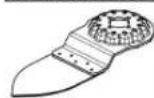
TC-Riff sanding fin-ger
Wood, paint Sanding of wood or paint in hard-to-reach areas without sanding paper;
example: Sanding off paint between window shutter slats, sanding wooden flooring in corners
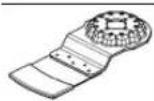
TC-Riff plunge cut saw blade
Fibreglass, mortar, wood Plunge cuts in extremely abrasive materials; example: Routing of thin mosaic tiles
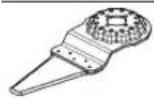
HCS universal joint cutter
Expansion joints, window Cutting soft materials; putty, insulation materials example: Cutting silicone expansion joints or window (rock wool) putty
Fitting/changing the application tool (see figures A and B)
Remove the application tool if one has already been fitted. To remove the application tool, use the hex key (10) to loosen the clamping bolt (9) and remove the tool. Position the required application tool (e.g. plunge cut saw blade (8)) on the tool holder (6) so that the depressed centre is facing downwards (see figure on the graphics page, text on the application tool should be legible from above). Turn the application tool to a position which is convenient for the job at hand and allow it to lock into place in the cam of the tool holder (6). Twelve positions offset by 30^ are possible for this.
The built-in magnet (7) holds the application tool in the required position in order to make it easier to mount.
Secure the application tool using the clamping bolt (9). Tighten the clamping bolt using the hex key (10) until it is flush with the application tool.
Check that the application tool is seated securely. Application tools that are attached incorrectly or are not securely fixed in place may come loose during operation, thereby putting you at risk.
Fitting and Adjusting the Depth Stop
The depth stop (13) can be used when working with segment saw blades.
Remove the application tool if one has already been fitted. Slide the depth stop (13) over the tool holder (6) and onto the collar of the power tool as far as it will go, with the labelled side facing upwards.
The depth stop is intended for the following cutting depths:
-
With segment saw blades ACZ 85 ... with a diameter of 85mm : Cutting depths 8mm , 10mm , 12mm and 14mm (information on the depth stop in a larger font size and without brackets).
-
With segment saw blades ACZ 100 with a diameter of 100mm : Cutting depths 14mm , 16mm , 18mm and 20mm (information on the depth stop in a smaller font size and in brackets).
Insert the appropriate segment saw blade for the desired cutting depth. Slide the depth stop (13) from the tool holder (6) in the direction of the application tool until you can rotate it freely. Rotate the depth stop (13) so that the desired cutting depth is above the section of the saw blade that will be used to saw. Slide the depth stop (13) onto the collar of the power tool once again as far as it will go.
Remove the depth stop (13) for all other cutting depths and for working with other application tools. To do this, remove the application tool and pull the depth stop away from the collar.
Fitting the Auxiliary Handle (accessory)
The low-vibration auxiliary handle enables the tool to be used safely and more comfortably.
Screw the auxiliary handle into the thread (5) on the left or right of the machine head depending on how you are working.
Do not continue to use the power tool if the auxiliary handle is damaged. Do not make any alterations to the auxiliary handle.
Choosing the Sanding Sheet
Different sanding sheets are available, depending on the material you are working with and the required surface removal rate:
Sanding sheet Material Application Grit
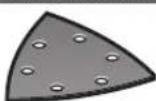
Red quality
- All wood and wood-based materials (e.g. hardwood, softwood, chipboard, construction boards)
Metal materials
For pre-sanding, e.g. of rough and uneven beams and boards
Coarse 40
For surface sanding and levelling of slight irregularities Medium 80
60
100
120
For finish-sanding and fine sanding of wood Fine 180
240
20|English
Sanding sheet Material Application Grit
| White quality | - Paint - Varnish - Filler - Bodyfiller | For sanding down paint Coarse 40 | 320 400 |
| For sanding undercoats (e.g. removing brushstrokes, paint drips and paint runs) | 60 | ||
| For final sanding of primers prior to painting Fine 180 | Medium 80 100 120 | ||
| 240 320 |
Attaching/changing the sanding sheet on the sanding plate
The sanding plate (11) is fitted with a hook-and-loop fastening, allowing sanding sheets with a hook-and-loop backing to be secured quickly and easily.
Tap the hook-and-loop fastening of the sanding plate (11) before fitting the sanding sheet (12) to facilitate maximum adhesion.
Position the sanding sheet (12) so that it is flush with one side of the sanding plate (11), then place the sanding sheet on the sanding plate and press it on firmly.
To ensure optimum dust extraction, make sure that the punched holes in the sanding sheet are aligned with the drilled holes in the sanding plate.
To remove the sanding sheet (12), take hold of it by a corner and pull it away from the sanding plate (11).
You can use all sanding sheets, polishing and cleaning fleeces from the Delta 93 mm series in Bosch's range of accessories.
Sanding accessories such as fleece/polishing felt are attached to the sanding plate in the same way.
Dust/chip extraction
The dust from materials such as lead paint, some types of wood, minerals and metal can be harmful to human health. Touching or breathing in this dust can trigger allergic reactions and/or cause respiratory illnesses in the user or in people in the near vicinity.
Certain dusts, such as oak or beech dust, are classified as carcinogenic, especially in conjunction with wood treatment additives (chromate, wood preservative). Materials containing asbestos may only be machined by specialists.
-
Use a dust extraction system that is suitable for the material wherever possible.
-
Provide good ventilation at the workplace.
-
It is advisable to wear a P2 filter class breathing mask.
The regulations on the material being machined that apply in the country of use must be observed.
- Avoid dust accumulation at the workplace. Dust can easily ignite.
Connecting the dust extraction system (see figure C)
The dust extraction system (17) is only designed for use with the sanding plate (11); it serves no purpose when used together with other application tools.
Always connect a dust extraction system for sanding.
Remove the application tool and the depth stop (13) for fitting the dust extraction system (17) (accessory).
Slide the dust extraction system (17) as far as it will go over the tool holder (6) onto the collar of the power tool. Turn the dust extraction system to the required position (not directly under the power tool). Push the clamping lever (15) shut to fix the dust extraction system in position.
Plug the tool sleeve of the extraction hose (18) onto the extraction outlet (16). Connect the dust extraction hose (18) to a dust extractor (accessory).
You will find an overview of how to connect various dust extractors at the end of these operating instructions.
The dust extractor must be suitable for the material being worked.
When extracting dry dust that is especially detrimental to health or carcinogenic, use a special dust extractor.
Operation
Starting Operation
Pay attention to the mains voltage. The voltage of the power source must match the voltage specified on the rating plate of the power tool.
▶ Products that are only sold in AUS and NZ: Use a residual current device (RCD) with a nominal residual current of 30 mA or less.
Switching On/Off
Make sure that you are able to press the On/Off switch without releasing the handle.
To switch on the power tool, slide the on/off switch (1) forward so that "1" appears on the switch.
The electronic soft start limits the torque when the power tool is switched on and increases the service life of the motor.
The Constant Electronic keeps the orbital stroke rate at no load and under load virtually consistent, guaranteeing uniform performance.
To switch off the power tool, slide the on/off switch (1) backwards so that "0" appears on the switch.
Preselecting the orbital stroke rate
You can even preselect the required orbital stroke rate during operation using the orbital stroke rate preselection thumbwheel (2).
The required orbital stroke rate is dependent on the material and the work conditions and can be determined using practical tests.
Orbital stroke rate level "6" is recommended for sawing, cutting and sanding harder materials, such as wood or metal; orbital stroke rate level "4" is recommended for softer materials, such as plastic.
Practical Advice
Pull the plug out of the socket before carrying out any work on the power tool.
Always wait until the power tool has come to a complete stop before placing it down.
Note: Do not keep the ventilation slots (3) on the power tool closed when working as this will reduce the service life of the power tool.
Operating principle
The oscillating drive causes the application tool to oscillate back and forth by 2.8^ up to 20000 times per minute. This enables precise work in the tightest of spaces.
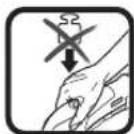
Use a consistent, low contact pressure when performing work; otherwise, the performance will be impaired and the application tool may jam.
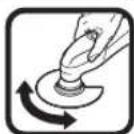
While working, move the power tool back and forth to prevent the application tool overheating and jamming.
Sawing
Use only undamaged saw blades that are in perfect condition. Bent or dull saw blades can break, negatively influence the cut, or lead to kickback.
- When sawing lightweight materials, take into account the statutory provisions and recommendations of the material manufacturers.
- Plunge cuts may only be applied to soft materials, such as wood, gypsum board, etc.
Before using HCS saw blades to saw into wood, chipboard, building materials, etc., check these saw blades for foreign objects, such as nails, screws, etc. Remove the foreign objects as required or use bi-metal saw blades.
Cutting
Note: When cutting wall tiles, please bear in mind that the application tools are subject to high wear if used for extended periods.
Sanding
The material removal rate and sanding result are primarily determined by the choice of sanding sheet, the preselected orbital stroke rate level and the contact pressure.
Only immaculate sanding sheets achieve good sanding performance and make the power tool last longer.
Be sure to apply consistent contact pressure in order to increase the lifetime of the sanding sheets.
Excessively increasing the contact pressure will not lead to increased sanding performance, rather it will cause more severe wear of the power tool and of the sanding sheet.
To sand corners, edges and hard-to-reach areas accurately, you can also work with the tips alone or with an edge of the sanding plate.
The sanding sheet may heat up significantly when used to sand specific points rather than entire surfaces. Reduce the orbital stroke rate and contact pressure and allow the sanding sheet to cool down at regular intervals.
Do not use a sanding sheet for other materials after it has been used to work on metal.
Use only original Bosch sanding accessories.
Always connect a dust extraction system for sanding.
Scraping
Select a high orbital stroke rate level for scraping.
Work on a soft surface (e.g. wood) at a flat angle and with low contact pressure. Failure to do so may cause the scraper to cut into the surface underneath.
Maintenance and Servicing
Maintenance and cleaning
Pull the plug out of the socket before carrying out any work on the power tool.
To ensure safe and efficient operation, always keep the power tool and the ventilation slots clean.
Regularly clean Riff application tools (accessories) using a wire brush.
In order to avoid safety hazards, if the power supply cord needs to be replaced, this must be done by Bosch or by a customer service centre that is authorised to repair Bosch power tools.
After-sales service and advice on using products
Our after-sales service can answer questions concerning product maintenance and repair, as well as spare parts. You can find exploded drawings and information on spare parts at: www.bosch-pt.com
The Bosch product use advice team will be happy to help you with any questions about our products and their accessories.
In all correspondence and spare parts orders, please always include the 10-digit article number given on the type plate of the product.
22 | Français
Great Britain
Robert Bosch Ltd. (B.S.C.)
P.O.Box 98
Broadwater Park
North Orbital Road
Denham Uxbridge
UB95HJ
At www.bosch-pt.co.uk you can order spare parts or arrange the collection of a product in need of servicing or repair.
Tel. Service: (0344) 7360109
E-Mail: boschservicecentre@bosch.com
Ireland
Origo Ltd.
Unit 23 Magna Drive
Magna Business Park
City West
Dublin 24
Tel. Service: (01) 4666700
Fax: (01) 4666888
Australia, New Zealand and Pacific Islands
Robert Bosch Australia Pty. Ltd.
Power Tools
Locked Bag 66
Clayton South VIC 3169
Customer Contact Center
Inside Australia:
Phone: (01300) 307044
Fax: (01300) 307045
Inside New Zealand:
Phone: (0800) 543353
Fax: (0800) 428570
Outside AU and NZ:
Phone: +61 3 95415555
www.bosch-pt.com.au
www.bosch-pt.co.nz
Republic of South Africa
Customer service
Hotline: (011) 6519600
Gauteng - BSC Service Centre
35 Roper Street, New Centre
Johannesburg
Tel.: (011) 4939375
Fax: (011) 4930126
E-mail: bsctools@icon.co.za
KZN - BSC Service Centre
Unit E, Almar Centre
143 Crompton Street
Pinetown
Tel.: (031) 7012
Fax: (031) 7012446
E-mail: bsc.dur@za.bosch.com
Western Cape - BSC Service Centre
Democracy Way, Prosperity Park
Milnerton
Tel.: (021) 5512577
Fax: (021) 5513223
E-mail: bsc@zsd.co.za
Bosch Headquarters
Midrand, Gauteng
Tel.: (011) 6519600
Fax: (011) 6519880
E-mail: rbsa-hq.pts@za.bosch.com
Disposal
The power tool, accessories and packaging should be recycled in an environmentally friendly manner.

Do not dispose of power tools along with
household waste.
Only for EU countries:
According to the European Directive 2012/19/EU on Waste Electrical and Electronic Equipment and its implementation into national law, power tools that are no longer usable must be collected separately and disposed of in an environmentally friendly manner.
Français
| STARLOCK | ✓ | |
| STARLOCKPLUS | × | |
| STARLOCKMAX | × |
Robert Bosch (France) S.A.S.
ServiceApres-Vente Electropotatif 126, rue de Stalingrad
93705 DRANCY Cedex
Tel.: (01) 43119006
Fax:(01)43119033
E-Mail: sav.outillage-electroportatif@fr.bosch.com
Calle Robert Bosch No. 405
C.P. 50071 Zona Industrial, Toluca - Estado de Mexico
Tel.: (52) 55 528430-62
Tel.: 8006271286
Dermed sikres storst mulig maskinsikkerhed.
Bosch Service Center
Telegrafvej 3
2750 Ballerup
Pá www.bosch-pt.dk kan der online bestilles reservedele el-ler oprettes en reparations ordre.
Tlf. Service Center: 44898855
Fax: 44898755
E-Mail: vaerktoej@dk.bosch.com
Bortskaffelse
Bosch Service Center
Telegrafvej 3
2750 Ballerup
Danmark
Tel.: (08) 7501820 (inom Sverige)
Fax: (011) 187691
Avfallshantering
EN 62841-2-4 (slipining), EN 62841-2-11 (saging):
Slipning: a = 10m / s^2, K = 1,5m / s^2
Saging med dykksgablad: a_n = 16m / s^2 K = 2m / s^2
Saging med segmentsagblad: a_1 = 14m / s^2 K = 3m / s^2 Skraping: a_1 = 12m / s^2 K = 1,5m / s^2
EN 62841-2-4 (slipning), EN 62841-2-11 (saging):
Slipning: a = 9m / s^2, K = 1,5m / s^2
Saging med dykksagblad: a_r = 17 m/s^2 , K = 2 m/s^2
Saging med segmentsagblad: a_1 = 18,5m / s^2 K = 3m / s^2 Skraping: a_1 = 16m / s^2 K = 1,5m / s^2
a ae aae aee aee aee aee aee aee aee aee
Tia Tny Eaopaiion mic daviknc avappoipnnc nC okovnc npooETE, wote o diatpnoeic oTo quAio Aieavanc va ouunitouv me Tc Tpuene cTnv naKa Aieavanc.
Tia TnV apaipean Tou pfauau aeivanc (12) maoTe ao pia kpn kal paBniTe to any nTu naKa aeivanc (11).
Mnpoeite va xpnaiouonnae oda ta pfuaa aeiaovanc kai olouc touk etae6c otlaowoc kai kaopapou tnc oipac Delta 93 mm Tou npoypaatoc EaptnaTsw Bosch.
Eapntmuataeiaovoc onwoc depa/ketaoc otaiwoon otepeowovrta nnynnaeaiaeiaovnc kata tov io tpo.
Avappoqnon oKovnc/pokaviidow
H oKnV ano opiaeva uikn. x. ano poluBouxec moyiec, ano epiKa EIg Eulou, ano opukra uikka kai ano metaAa Inpoei va eiv auvuyevn. H enapn n t kn Oknv /kai n eiTov Tnc npOpel va npokalaeai allepyikec avtbpaeic /kai aoTheveie cTwv avanveotikow odw Tou xhotn tuxov napepuokoeov atouw.
Oipueva eBn oKovnc, n. x. oKovn ano Euao belavidiac n Oiaac 8ewpouvtaikapkivoyova, 16iaitepa oe auvduaouo me biapopa oupnaopwatika uuknou npauonoiuovta tny katepyaia Euawv (evwoeicxpwliou, Euonpoataeutik aea). H katepyaia qiaivtouxwuyukov empteteta povo e Eioka eKtanaedeuva atota.
- Na xpnqumnoieite kata to duvat yia to ekatoe uko tv katannan avappopn.
- Na φροντιζέτε γία τον καλό αερίαμό του χώρου εργαίας.
- Saouououe va opate paokce avanveotiknpoostaoiae me pIatro KAthyopias P2.
Na tnpie Tc diataeic nou toxouov otn xopa oac yia ta diapopa unkatepyaia uikda.
Anopeuyete nBnoupyia ouoopeuocokovnc oTo xpo nou epyace. Okovec avapayovtai ekola.
Eu6eog nC avappopnnc oKovnc (BLeene eKova C)
H avapoppon nC oKovnc (17) npoobiopictai mOvo yia epyaic e Tnv Nkaka aeIavocn (11), oe ouvuaaupo e aaaa Eapntmuata dev evai xphoum.
Tia nIeiaovduoete nVtoia avapopponokovnc.
Tia nOuvaipoloynon TnC avapopponc TnC akovnc (17)
(εαptma) aqaipote to εαptma kai tov obnyo bαouc
(13).
J 1 J 1 J 1 J 1 J 1 J 1 J 1 J 1 J 1 J 1 J 1 J 1 J 1 J 1 J 1 J 1 J 1 J 1 J 1 J 1 J 1 J 1 J 1 J 1 J 1 J 1 J 1 J 1 J 1 J 1 J 1 J 1 J 1 J 1 J
Jgllg baw jy jj 1 g 1 g 1 g 1 g 1 g 1 g 1 g 1 g 1 g 1 g 1 g 1 g 1 g 1 g 1 g 1 g 1 g 1 g 1 g 1 g 1 g 1 g 1 g 1 g 1 g 1 g 1 g 1 g 1 g 1 g 1 g 1 g 1 g 1 g
Lg 624u 3u uul 6d 5u 2 Lc u gai aui yauoal uol 1e g 1aai wai gaiuai 6u 6u 6uuu 6u 6uuu
auijgSll pddaiwgldoo jn
cluawl ydiwjlqal jusy bja 4
Jcuii. cuii aaiaaai ayuagil
auijrgsll oall abwgl lol jsi g jss
Jgsall JLoo qaiall
aL 1s u! aJyss sSs
JlKlI JdJ!
aJySsJy jolal aolal lslwj
jlo81uJdAaLs
gajglg oJssllg
aui jgSll 0sally aajol lalogolg p
g 150olololglllall 29gaiygl/g g uu
aalgag aaiuI Ualal gaaal
g pssuilll 4uuljSll oal lbaa aag
aagogall ayuugll sall aayssll uolal
(auiuusll aasll jls abwgl) auiuuea uu
(1s (g3) paj oogjall uugsl sall uag
.
JswjSoylo
aaiaaIgcl eao! goo ciS u!
JswaLgllswu
.1gJgogJgJgJgJgJgJgJg
JUJI UUg
g jg g u l jSlojI jJaoJI jBj
aai aai I g iJg I Jlg W
15 9
auiu 1JJg auiu 1 Ss
.6Jg 0e
4000 1
aJaaJoo
aJusSll oessl JosuW lo sic Icuu w. jauI lc obaunul s9 uuuu olui
yJyS11 J0s
40 aijjll jll
JgJgJgJgJgJgJgJgJgJgJgJgJgJgJgJgJgJgJgJgJgJgJgJgJgJgJgJgJgJgJgJgJgJgJgJgJgJgJgJgJgJgJgJgJgJgJgJgJgJgJ
()
LulS 1
gI gI gI gI gI gI gI gI gI gI gI gI gI gI gI gI gI gI gI gI gI gI gI gI gI gI gI gI gI gI gI gI gI gI gI gI gI gI gI gI gI gI gI gI gI gI gI gI gI gI gI
- agbjgl jlloJc
J 1
gJLSSJ 8. JSLJ UJSSJ WJ 8
WgI gJw gA yjUgSJI OJLL J
JSLJ 1gJ LgJ UJyUgJ 0u J
JgJgJgJgJgJgJgJgJgJgJgJgJgJgJgJgJgJgJgJgJgJgJgJgJgJgJgJgJgJgJgJgJgJgJgJgJgJgJgJgJgJgJgJgJgJgJg
UjiaJIaJlaaJIgJI 0
c|113
J 1 J 1 J 1 J 1 J 1 J 1 J 1 J 1 J 1 J 1 J 1 J 1 J 1 J 1 J 1 J 1 J 1 J 1 J 1 J 1 J 1 J 1 J 1 J 1 J 1 J 1 J 1 J 1 J 1 J 1 J 1 J 1 J 1 J 1 J
gj gglgglgglgglgglgglgglgglgglgglgglgglgglgglgglgglgglgglgglgglgglgglgglgglgglgglgglgglgglgglgglgglgglgglgglgglgglgglgglgglgglgglgglgglgglgglgglgglgglgglggl
c|115
J
4.03JUJswuSic a
| PMF 2000 CE | ||
| √ | STARLOCK | |
| × | STARLOCKPLUS | |
| × | STARLOCKMAX | |
J 1
JauuI JueaI
ssJ auaaai I ayjusll ooiy juiy U.
gill gll gglg jg golj g jal lsc no jall lgc jaiw .jaiil daii aaii aiial
jaiall aiaagg g jaiiall gglg lpsxssj
gj gou 93 wu wu wu wu wu wu
U
Jaaal slg aagk alglg Cw
aaijbl uoi jll a
a aao 1c jaiall gjg jy
jSauLgjguuu (11) aullaagugji
aJw gjU U Cuiu yiaai [] gjg
.ugw9
aaii aai (g)ii gai i jll
Jku 12)
.
aai aaa a jla 12) oiai (gjg
aao ojaiall a9g sso gblu1f
aay qale baiy jno pksay gaiy
aclwlljlae aoljy aodaa jil
e 100000000000000000000000000000000000000000000000000000
sic jgll pjc lgiSll aJl oJl J. jall aLoo 0o Suig
/1u 1j 1c b 1s 1d 1s 1
c|119
pssw2l oJluwugLaoJd
aalaiial lcll aas jso y g wll saj jell gab aolxu uug gail I jull gbaa ologallg a
:g www.bosch-pt.com
sIgog abgsaaal auiuill giaaill g uai
gga uogaa bgl g1 UJwawla JUwJ Sic
Lg g jai JuiJg caiJg jS jj
aaiJgiaagj
aui jSll o sll Jo ull
Jgglgglg auiuul
aiJU Lc abelao aobjbu lylaill ao jso
aaii aaiiaaa

gblil gJg aagai j
Jll Jll Jsc aag g jiaiil (gjg jLj
JSSI Ibeog laaol qo
1111111111111111111
auiuull auiu uuiu
ojg jjaiia jia jia 1e aagall
.ajaiallgjggd
JgjI Jgjj IJI Jgjj IJI baiuoiuj (s)
gJg aJyjgSJJ 8aS uu uu uu uuu
.
gga gj Jaxnna jaiu elka
sic ggs Jsu ggl Uo boa gl a
.1JiJIaJJI JsloJg JgJgJgJg
gJll sic sW JsW oJaiall gjg
jSijxiaoboggajllssy. jJall
auiu kuy u j oiaai aegglawlg
aJlalqllasiwajg gww oaioo aagjogdo
e 1
aai 1g j gj gj paa
JlaoaJlaIabgWwogu laI a
.
buiSJI
aJle aee 1
aabaaagglj()aab
aJggljxJg2g.
doJg dlal
aibjllg ailll
aJjSJJ aSJI Jc Jc |J|
auiuJl auiu
aui Lc Js kla
aagglulaiigg auiuieS


- General Power Tool SafetyWarnings
- WARNING
- Work area safety
- Electrical safety
- Personal safety
- Power tool use and care
- Service
- Safety information for multifunction tools
- | English
- Products sold in GB only:
- Product Description and Specifications
- Intended Use
- Product Features
- Noise/Vibration Information
- Working without the Auxiliary Handle
- Working with the auxiliary handle
- Fitting
- Changing the tool
- Selecting an Application Tool
- | English
- Application tool Material Application
- Fitting/changing the application tool (see figures A and B)
- Fitting and Adjusting the Depth Stop
- Fitting the Auxiliary Handle (accessory)
- Choosing the Sanding Sheet
- Sanding sheet Material Application Grit
- Attaching/changing the sanding sheet on the sanding plate
- Dust/chip extraction
- Connecting the dust extraction system (see figure C)
- Operation
- Starting Operation
- Switching On/Off
- Preselecting the orbital stroke rate
- Practical Advice
- Operating principle
- Sawing
- Cutting
- Sanding
- Scraping
- Maintenance and Servicing
- Maintenance and cleaning
- After-sales service and advice on using products
- | Français
- Great Britain
- Ireland
- Australia, New Zealand and Pacific Islands
- Republic of South Africa
- Customer service
- Gauteng - BSC Service Centre
- KZN - BSC Service Centre
- Western Cape - BSC Service Centre
- Bosch Headquarters
- Disposal
- Only for EU countries:
- Français
- Bortskaffelse
- Avfallshantering
- Avappoqnon oKovnc/pokaviidow
- Eu6eog nC avappopnnc oKovnc (BLeene eKova C)
- JlKlI JdJ!
- c|113
- c|119
- pssw2l oJluwugLaoJd
- :g www.bosch-pt.com
- aui jSll o sll Jo ull
- buiSJI
- doJg dlal
- aibjllg ailll
Brand : BOSCH
Model : PMF 2000 CE
Category : Power tool