USER MANUAL PD 400 PROXXON
When you are reading the instructions for use, please unfold the front and back pages.

14
Français
$$
n = V _ {c} \times 1 0 0 0 / (D \times 3. 1 4)
$$
$$
n = 1 3 2 \times 1 0 0 0 / (3 0 \times 3. 1 4) = 1 4 0 0 U / \min
$$
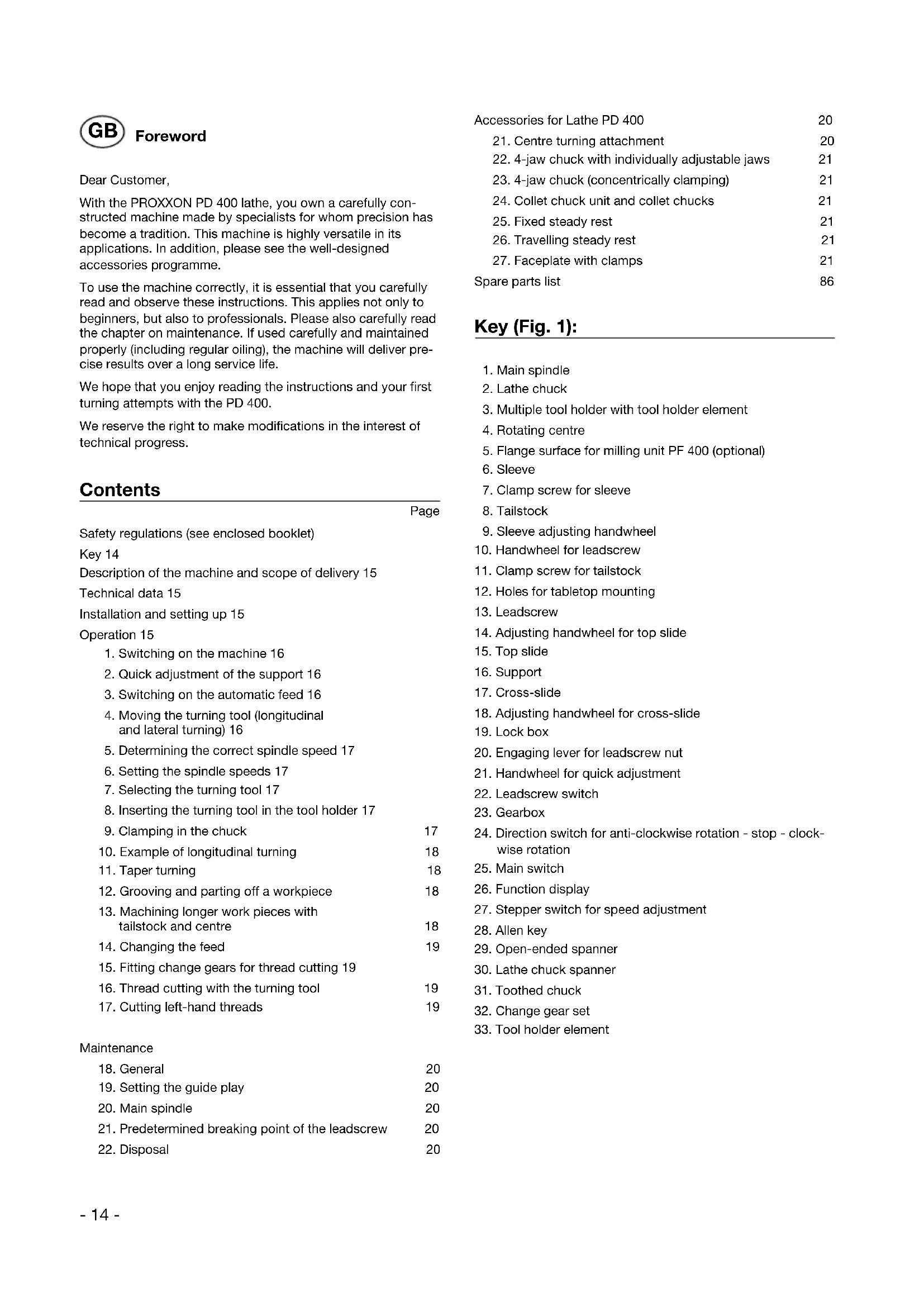
With the PROXXON PD 400 lathe, you own a carefully constructed machine made by specialists for whom precision has become a tradition. This machine is highly versatile in its applications. In addition, please see the well-designed accessories programme.
To use the machine correctly, it is essential that you carefully read and observe these instructions. This applies not only to beginners, but also to professionals. Please also carefully read the chapter on maintenance. If used carefully and maintained properly (including regular oiling), the machine will deliver precise results over a long service life.
We hope that you enjoy reading the instructions and your first turning attempts with the PD 400.
We reserve the right to make modifications in the interest of technical progress.
Contents
Page
Safety regulations (see enclosed booklet)
Key 14
Description of the machine and scope of delivery 15
Technical data 15
Installation and setting up 15
Operation 15
- Switching on the machine 16
- Quick adjustment of the support 16
- Switching on the automatic feed 16
- Moving the turning tool (longitudinal and lateral turning) 16
- Determining the correct spindle speed 17
- Setting the spindle speeds 17
- Selecting the turning tool 17
- Inserting the turning tool in the tool holder 17
- Clamping in the chuck 17
- Example of longitudinal turning 18
- Taper turning 18
- Grooving and parting off a workpiece 18
- Machining longer work pieces with tailstock and centre 18
- Changing the feed 19
- Fitting change gears for thread cutting 19
- Thread cutting with the turning tool 19
17.Cutting left-hand threads 19
Maintenance
- General 20
19.Setting the guide play 20
- Main spindle 20
- Predetermined breaking point of the leadscrew 20
- Disposal 20
Accessories for Lathe PD 400 20
- Centre turning attachment 20
- 4-jaw chuck with individually adjustable jaws 21
- 4-jaw chuck (concentrically clamping) 21
- Collet chuck unit and collet chucks 21
- Fixed steady rest 21
26.Travelling steady rest 21
- Faceplate with clamps 21
Spare parts list 86
Key (Fig. 1):
- Main spindle
- Lathe chuck
- Multiple tool holder with tool holder element
- Rotating centre
- Flange surface for milling unit PF 400 (optional)
- Sleeve
- Clamp screw for sleeve
- Tailstock
-
Sleeve adjusting handwheel
-
Handwheel for leadscrew
- Clamp screw for tailstock
- Holes for tabletop mounting
- Leadscrew
- Adjusting handwheel for top slide
- Top slide
- Support
- Cross-slide
- Adjusting handwheel for cross-slide
- Lock box
- Engaging lever for leadscrew nut
- Handwheel for quick adjustment
- Leadscrew switch
- Gearbox
- Direction switch for anti-clockwise rotation - stop - clockwise rotation
- Main switch
- Function display
- Stepper switch for speed adjustment
- Allen key
- Open-ended spanner
- Lathe chuck spanner
- Toothed chuck
- Change gear set
- Tool holder element
Description of the machine and scope of delivery
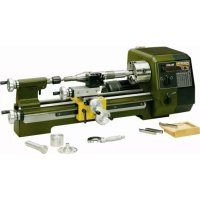
The PROXXON PD 400 lathe is an extendable system characterised by:
- rugged, ribbed lathe bed with prismatic guide
- 6 spindle speeds (switch for 2 motor speeds and 3 additional gears)
- Quick adjustment of the support by easy-to-use crank
Automatic feed
The scope of delivery includes:
- Precision triple-jaw chuck (100 mm diameter)
- Rotating centre
- Toothed chuck (for up to 10mm )
-
Change gear set for two feed speeds (0.07mm/rev. and 0.14mm/rev.), 19 metric thread pitches and also inch thread pitches from 10 to 48 threads.
-Auxiliary tools
-
Multiple tool holder with 2 tool holder elements
- Left-hand thread cutting device
- Chuck guard
- Two spare shear pins
Technical data:
Machine
Centre height 85 mm
Centre distance 400 mm
Max.workpiece diameter
above support 116mm
Spindle aperture 20.5 mm
Main spindle, chuck side MK3
Spindle speeds Stage I 80 rpm; 330 rpm;
1400 rpm
Stage II: 160 rpm; 660 rpm
2800 rpm
Lathe chuck Inner jaws 3-33 mm
Outer jaws 32-83 mm
Refer to the instructions for information on the chuck.
Automatic feed 0.07 or 0.14mm / rev
Thread pitches see table in gearbox
Tailstock sleeve stroke 30 mm/MK 2
Tool holder 10× 10mm
Dimensions 900x400x300 mm (LxWxH)
Weight 45 kg
Noise ≤ 70dB (A)
For use in dry environments only
Please do not dispose off the machine!
Motor
Voltage 220-240 volts, 50 / 60Hz
Stage I Stage II
Speed 1400 rpm 2800 rpm
Output power 0.25 kW 0.55 kW
Consumption 2.1 A 3.9 A
Installation and setting up:
Note:
The machine must not be lifted by the gearbox 23 (Fig. 1) or by the cover cap of the motor when transporting. The plastic caps could break.
The supporting surface must be flat and sufficiently strong to absorb the vibration generated during work. The machine must be fastened to the surface using the holes 12 (Fig. 1) provided for this purpose. Ensure that the power cable is outside the danger zone.
Mount the lathe chuck 2 (Fig. 1) on the main spindle with the 3 screws. Ensure that the chuck seating is free of dust.
Refer to the separately enclosed clamping chuck instructions for information on using the chuck.
All polished metal parts are supplied with a corrosion protection coating. This is not intended as a lubricant, but as a preservative only. It must be rinsed off, e.g. with petroleum, before the machine is used. All guides must be checked and adjusted if necessary. (See also Chapter „Maintenance".)
The polished guides and spindles must then be well lubricated with a suitable machine oil. The chuck guard can then be mounted.
Note:
Do not oil the any part of the mechanical drive mechanism (belt pulleys, belts, gearwheels). If there is any excessive noise, however, it could be advisable to apply a light coat of Molykote grease to the gearwheels.
Operating:
Attention!
Before turning on the machine, check that the screws of chuck 2 (Fig. 1) are tightened properly, that the chuck key has been removed, and that support 16 (Fig. 1) is at a safe distance from the chuck.
Attention!
Practice without a workpiece clamped in the chuck first. Be sure to ensure that the turning jaws are tightened securely since they could be loosened by centrifugal force if there is no resistance.
Practice first by running the machine at low speeds.
Please note that the turning chuck has been oilied slightly and could throw off oil when run for the first time.
Attention!
Please note that due to the motor design, the motor could become very hot if allowed to idle for an extended length of time. Although this does not indicate that the motor is defective, it is advisable nevertheless to avoid situations of this kind by not allowing the motor to idle unnecessarily.
Switching on the machine
- Set direction switch 1 (Fig. 2) to "0".
- Disengage the leadscrew (turn leadscrew switch 2 to the left).
- Set a low speed (stepper switch 3 to I).
- Switch on the machine at the main switch 4. The function display 5 now lights.
- Turn the direction switch to the right. The lathe chuck now rotates in the working direction.
Quick adjustment of the support
The support can be quickly moved via handwheel 1 (Fig. 3).
For this purpose, the support must first be disengaged.
Important
Loosen clamping screw 2 by half a turn beforehand.
- Push lever 3 upwards.
- Adjust the support by turning handwheel 1 (1 revolution = 10.5mm
Switching on the automatic feed
- Set machine to "0" at direction switch 1 (Fig. 2)
- Disengage support (push lever 3 (Fig. 3) upwards).
- Ensure that handwheel 10 (Fig. 1) moves freely because it moves the leadscrew when engaged.
- Engage leadscrew (turn leadscrew switch 2 (Fig. 2) to the right).
- Switch machine on by setting direction switch to the right. The leadscrew and the handwheel now also turn.
Important
The automatic feed is not equipped with an automatic cut-off. Ensure that you disengage the support before it runs against the lathe chuck.
6. Engage support (push lever 3 (Fig. 3) downwards). The support now moves in the working direction.
Note
When working, always operate the automatic feed via lever 3 (Fig. 3) only. Only operate the leadscrew switch 2 (Fig. 2) when the machine is stopped.
Apart from the quick adjustment of the support and the automatic feed, the turning tool can be moved in 3 different ways.
A. Movement with the leadscrew (longitudinal turning)
- Disengage leadscrew (turn leadscrew switch 2 (Fig. 2) to the left).
- Engage support (push lever 3 (Fig. 3) downwards).
- Move support using the handwheel 10 (Fig. 1).
1 turn = 1.5 mm
B. Movement of the top slide (longitudinal turning)
- If required, clamp the support (tighten screw 2 (Fig. 3)).
- Move top slide with handwheel 4.
1 turn = 1.0 mm.
C. Moving the cross-slide (face turning)
- If required, clamp the support (tighten screw 2).
- Move cross-slide with handwheel 5.
1 turn = 1 mm feed = 2 mm change in diameter.
Determining the correct spindle speed
The choice of the correct cutting speed is a decisive factor in obtaining good results. In the case of longitudinal turning, this is the peripheral speed of the workpiece. The table on the gearbox of the machine provides directions for the choice of the correct cutting speed.
When the cutting speed "Vc" and the workpiece diameter "D" are known, the required spindle speed n , can be calculated as follows:
$$
n = V _ {c} \times 1 0 0 0 / (D \times 3. 1 4)
$$
Example: An aluminium workpiece with a diameter of 30mm is to be turned. The required cutting speed according to the table is 100 - 180m / min . Thus: 132m / min .
$$
n = 1 3 2 \times 1 0 0 0 / (3 0 \times 3. 1 4) = 1 4 0 0 \mathrm {r p m}
$$
This result can also be read directly from the table on the gearbox.
Setting the spindle speeds
One way of changing the spindle speed is by switching the motor speed (stepper switch 1, Fig. 4). This halves or doubles the speed. Another way of changing the speed is by changing the belt transmission.
- Switch off the machine at the main switch 2 and open gearbox 3 with the Allen key.
- Loosen clamping screw 1 (Fig. 5) by half a turn.
- Turn screw 3 anti-clockwise using Allen key 2. This releases the intermediate belt pulley 4.
- Then change the belts as shown in Fig. 6.
- Remove Allen key 2 and tighten clamping screw 1.
- Close gearbox 3 (Fig. 4).
Note:
It is possible that the motor will not always start when the multiple contact switch is set to stage II. In this case, start by setting the switch to I first and then to stage II.
There are several different types of turning tool. There follows a brief explanation (see Fig. 7):
Roughing tools (1) are used to cut away as much material as possible in a short time (without regard to the finish of the surface of the workpiece).
Smoothing tools or thread chasers (2) are used to achieve a smooth surface.
Right (3) and left side tools are used for longitudinal and face turning and to turn out acute angles in a right or left hand working direction.
Part-off tools (4) are used to start grooves and to cut off workpieces.
Threading tools (5) to cut external threads.
Internal turning tools (6) are used for turning out.
The basic equipment of the PD 400 includes a multiple tool holder (Fig. 8) consisting of tool holder block 1 and two tool holder elements 2. For good working results, it is essential for the tool to be set precisely to "the middle," and that the turning tool is held short to prevent vibration.
- Place turning tool 3 in tool holder element 2. Tighten the two screws 4 securely.
- Place tool holder element in tool holder block 1. Adjust the height of the turning tool via nut 5 and lock via nut 6. Adjust the height of the blade to that of the centrepoint of the tailstock.
- Clamp tool holder element with screw 7.
Note:
The entire holder block can be swivelled by loosening screw 8.
Clamping in the chuck
Attention!
Follow the instructions in the enclosed operator's manual provided by the manufacturer of the chuck.
Important
If workpieces are only clamped in the lathe chuck without support by the tailstock, the projection must not be greater than three times the diameter of the material (L = 3× D) , see Fig.9.
Example of longitudinal turning
Longitudinal turning designates the turning of a cylindrical workpiece parallel to the turning axis. The following paragraph explains work with the lathe to the beginner using the example of longitudinal turning.
Clamp a short workpiece in the lathe chuck as described above (remove the key from the chuck).
Set the belt transmission to the correct speed (note table on gearbox and Fig. 6).
Disengage the leadscrew (leadscrew switch 2 (Fig. 2) to left) and engage the support (lever 3 (Fig. 3) downwards).
Now move the support from the right to the left close to the workpiece (handwheel 10 (Fig. 1)).
Before switching on the machine, check that the chuck moves freely by twisting the chuck by hand.
Switch on the machine (direction switch 1 (Fig. 2) to right).
Set the cutting depth by moving the cross-slide (handwheel 5 (Fig. 3)). It is best to start with a cutting depth of 1 / 10mm (4 graduations on the scale).
Now move the support in the working direction by turning the handwheel 10 (Fig. 1) at the rear. If all settings are correct, the machine works smoothly and without excessive loading.
Important
Risk of injury. When turning, always keep your fingers away from the rotating workpiece. Never measure the workpiece with a calliper gauge or a similar tool when the machine is running. Do not apply a file or emery cloth to the workpiece when the machine is running.
Taper turning
To turn tapers, the top slide is adjusted according to the desired angle.
- Move top slide to the right with handwheel 1 (Fig. 11).
- Loosen clamping screws 2.
- Adjust the angle of the top slide and re-tighten the screws.
Note:
The top slide is equipped with a vernier scale (similar to a calliper gauge). The correct angles are indicated on the outer scale A (Fig. 11a). On the inner scale B, they are compressed (1 graduation on the inner scale corresponds to 4.5^ ). The angle can be read in 5^ stages by aligning the zero mark of the inner scale with the outer scale. If you wish to add 1^ , the "2" on the inner scale must be aligned 10^ further outwards on the outer scale. For 2^ , the "4" must be aligned 20^ further outwards etc. In this example, the "2" is aligned with the "20", or 10^ further outwards than the basic value of 10^ . This produces an angle of 10^ + 1^ = 11^ .
- Clamp support with screw 3 (Fig. 11).
- The feed is advanced via the handwheel of top slide 1.
Note:
A precise taper is only achieved when the height of the turning tool is adjusted exactly to the centre position.
Grooving and parting off a workpiece
Grooving designates the production of fine grooves. If the groove is continued to the middle of the workpiece, this is called parting off. Ensure that the height of the parting-off tool is adjusted to the centre of the workpiece and clamp the tool as short as possible. Use a small turning tool and lubricate the tool with a little machine oil if possible.
Machining longer work pieces with tailstock and centre
Longer workpieces (chuck projection greater than 3 times the workpiece diameter) must be held at the right hand end by the tailstock and the travelling centrepoint. For this purpose, provide a centrebore on the right hand face:
- Turn the face of the right hand end carefully.
- Insert chuck 1 (Fig. 12) in the tailstock and clamp a centring bit.
- Move the tailstock to the workpiece and fasten with clamping screw 2.
- Switch on the machine and make the centrebore using the sleeve feed (handwheel 4).
You can then replace the chuck with the travelling centrepoint. Guide the point into the centrebore and close down carefully until any play is eliminated. Then fasten the sleeve with tommy screw 3.
Changing the feed
In the standard version, the PD 400 is supplied with a feed of 0.07mm / rev . To use a faster feed (0.14mm / rev.) , the gear-wheel of shaft Z1 (5, Fig. 13) with 20 teeth must be replaced by the gearwheel with 40 teeth in the gearbox. For this purpose, please proceed as follows:
- Switch off the machine at the main switch 25 (Fig. 1) and open the gearbox 23.
- Loosen screw 1 (Fig. 14) slightly and tilt wheel arm 2 downwards.
- Remove clip 3 (Fig. 13).
- Loosen shaft 4 at the square section by half a turn. Replace the gearwheel 5 with 20 teeth by one with 40 teeth.
Note:
When changing the gearwheels, always place a strip of newspaper between the tooth flanks before tightening the shafts. The thickness of the paper strip should correspond to the required tooth flank play.
- Re-tighten the shaft, push on the clip, fold up the wheel arm and re-tighten screw 1 (Fig. 14).
Fitting change gears for thread cutting
With the PD 400, it is possible to turn 19 different metric threads (see table in the gearbox and Fig. 25) and inch threads from 10 to 48 threads. To adjust the thread pitches, the change gears must be exchanged correspondingly. The change gears for a thread pitch of 1mm are installed in Fig. 14.
The table in the gearbox shows: w = 30 , Z1 = -/50
Z2 = 40 / 30 L = 60 / - .W designates the gearwheel on the main spindle. It is fastened to the main spindle by a stud. Z1 and Z2 are the two shafts of the intermediate gears. The first number always designates the front gear of the shaft, the last number the rear gear. The rear gear with 30 teeth is therefore firstly pushed onto the shaft Z2 and then the front gear with 40 teeth. On shaft Z1, first install the rear gear with 50 teeth and then an intermediate ring.
L designates the gear on the leadscrew. Nut 6 must be loosened to change this gear. The compensating disc 7 has exactly the width of a gearwheel and must be mounted in front of or behind the gear.
Note:
For the following operations, the work piece must be machined completely and have the correct thread outer diameter. It is advisable to turn a chamfer at the beginning of the thread and to turn a small groove at the end of the thread. The thread turning tool must be clamped at an angle of exactly 90^ .
Important
When cutting threads, always work at the lowest speed (80 rpm) because otherwise the feed is too fast (risk of injury).
- Set the turning tool to the starting position.
- Engage leadscrew (turn leadscrew switch 1 (Fig. 15) to the right).
- Switch on the machine.
- Advance the turning tool slightly by means of the cross-slide.
- Engage the support (lever 2 downwards).
- When the desired thread length has been reached, retract the cross-slide and switch off the machine at the direction switch.
- Wait until the chuck has stopped. Turn the direction switch to left to return the support.
- Advance the turning tool again and repeat the procedure until the required thread depth is reached.
Note:
During the entire procedure, the support and the leadscrew must not be disengaged as this shifts the pitch of the thread.
The top slide is used to improve the quality of the thread. Advancing the thread tool is performed using the cross-slide as described above. For this purpose, the top slide is adjusted by 0.025mm (1 graduation) to the left and then to the right. The cuttings are thus only removed from one side. Once the full thread depth has been reached, a final full cut is made by advancing slightly.
Cutting left-hand threads
To cut left hand threads, an additional shaft must be installed with an intermediate gearwheel Z (Fig. 16) between Z2 and the leadscrew, gear L. Thus, the turning direction of the leadscrew is reversed. The number of teeth of the gear is irrelevant. The support runs from right to left when the chuck is turning clockwise. The thread must therefore be made from left to right.
Maintenance
Important
Before conducting maintenance or cleaning work, switch off the machine at the main switch. Do not use compressed air for cleaning as this can cause cuttings to enter the guides.
General
After use, thoroughly clean all cuttings from the machine using a paintbrush or hand brush.
Grease or oil all parts according to the lubrication plan (Fig. 17). When oiling the contact surfaces, move the slide backwards and forwards several times by hand so that oil enters the guides.
A = oil / lubricate each time before use
B = oil / lubricate once a month
Also oil the flange unit of the leadscrew in the gearbox through the hole provided for this purpose.
Setting the guide play
Regular lubrication of the guides does not prevent evidence of play in the guides after a certain amount of time.
-
Release adjustment screw lock nuts 1 (Fig. 18) for the top slide 2, screw in all adjustment screws 3 evenly until play is eliminated and re-tighten the lock nuts.
-
Repeat this procedure for cross-slide 4.
Note:
The guide can be clamped using screw 5.
- Turn the machine upside down and unscrew stud 1 (Fig. 19) slightly.
- Tighten clamping screws 2 slightly to reduce the play.
- Check whether the support can still be pushed easily. If the support is difficult to move, increase the play a little.
Main spindle
The 2 taper roller bearings of the spindle are maintenance-free for at least 6000 hours at minimum speed and 1800 hours at maximum speed. If slight play is evident after this period, the bearings can be adjusted by a specialist.
Predetermined breaking point of the leadscrew
The shear pin (see in explosion drawing, page 88, item 81) in the flange unit (item 71) could shear off if the machine jams or is otherwise overloaded. This pin is designed as a predetermined breaking point and must be replaced (you can obtain shear pins from us as spare parts). To replace the shear pin, remove the change gear and drive the remaining pieces of the broken shear pin out of the leadscrew and the top-mounted sleeve (item 82) using a suitable tool (mandrel, drift or similar). When driving the new shear pin into the hole, ensure that it is flush and does not protrude; otherwise it will be difficult to put the gearwheel back in place. Also ensure that the pin is seated only on one side, i.e. the load is only on one side of the shearing point.
Disposal:
Please do not dispose of the device in domestic waste! The device contains valuable substances that can be recycled. If you have any questions about this, please contact your local waste management enterprise or other corresponding municipal facilities.
Accessories for Lathe PD 400
Note:
The following accessories are not included in the standard equipment.
Important
Before installing accessories, switch off the machine at the main switch.
Centre turning attachment
Installing the centre turning attachment:
Note:
Longer work pieces are clamped between the brad points of the main spindle and tailstock. The work piece must be provided with a centre bore on both faces.
An exactly cylindrical work piece is only achieved if the points align in the horizontal position.
- Remove three fastening screws from the three-jaw chuck and remove chuck.
- Thoroughly clean the fit for the drive plate 3 (Fig. 20), the centrepoint 1 and its fit in the main spindle.
- Insert the centrepoint 1 in the fit of the main spindle. Insert the second centrepoint in the tailstock.
- Insert adapter 4 in the drive plate 3 and tighten the stud lightly. Push both over the workpiece 5. Screw driver 2 into the spindle flange.
- Clamp the workpiece between the centrepoints. Push drive plate 2 (Fig. 21) over the driver and fasten to the workpiece using Allen key 1.
Important
When using a centre fixed to the tailstock, regular lubrication of the centre and centre bore is necessary to prevent overheating due to friction.
Removing the centrepoint:
- Guide a suitable aluminium or brass rod through the main spindle from left to right.
- Hold the centre and release by lightly tapping the rod.
4-jaw chuck with individually adjustable jaws
Note:
Round, oval, square and irregularly shaped work pieces can be clamped as it is possible to adjust the jaws individually. Centric or eccentric clamping is possible. Unlike the three-jaw chuck, centring of the work piece must be performed manually.
- Detach the three-jaw chuck and attach the four-jaw chuck.
- Open the four jaws, clean the contact faces and clamp the work piece lightly according to visual estimation.
- Move the support and turning tool onto the plane surface of the work piece.
- Turn the chuck by hand to establish symmetrical deviations.
- Adjust by opening one of the jaws and re-set the opposite jaw accordingly.
- Tighten all four jaws evenly, alternating crosswise.
Important
In the normal clamping jaw position, only work pieces with an edge length of max. 55mm can be clamped. The maximum length is 100mm in the reverse position. Larger work pieces are not securely held. Danger of accident.
4-jaw chuck (concentrically clamping)
Jaws not individually adjustable (automatic centring). Chuck Ø 100 mm. Max. clamping range 83 mm. Larger work pieces are not securely held. Danger of accident.
Collet chuck attachment and collet chucks
Note:
The collet chuck unit is especially suitable for processing round parts with great precision. The concentricity is considerably greater than when working with a jaw chuck.
- Remove three fastening screws from the three-jaw chuck and remove chuck.
- Thoroughly clean the fit for the collet chuck mount 2 (Fig. 22) and the fit in the main spindle 1.
- Attach the collet chuck mount 2 using four fastening screws 3.
Important
Always use the correct collet chuck to suit the work piece. Chucks with an oversized diameter are destroyed.
- Insert the collet chuck 6 and loosely attach the union nut 5.
Important
Never tighten the union nut when there is no work piece inserted. Remove the pins 4 for tightening the union nut 5 immediately after tightening.
- Insert the appropriate work piece in the collet chuck and tighten the union nut 5 using the tool pins 4.
Fixed steady rest
The steady rest is particularly suitable for hollowing out long work pieces with diameters up to 50~mm .
- Release the fastening screw 4 (Fig. 23) and position retaining plate 3 laterally.
- Place the steady rest on the bed guide and set to the desired position.
- Swivel the retaining plate 3 parallel to the steady rest base and tighten fastening screw 4.
- Release all clamp screws 1 and drive the individual retaining jaws 2 onto the workpiece.
Important
The jaws 2 must only touch the work piece and must not clamp it. Otherwise there is a risk of the work piece surface becoming scratched and the motor becoming overloaded.
If the work piece is not round and smooth at the support point, it must first be turned round. Lubricate the jaws and work piece regularly when turning.
- Check that the work piece is positioned in the steady rest free of play and re-tighten clamp screws 1.
Travelling steady rest
Installation identical to the fixed steady rest, but this steady rest is attached to the support (Fig. 24).
Faceplate with clamps
This is installed in place of the lathe chuck. Ideal for clamping larger and asymmetrical workpieces. 0150mm 2 continuous T-grooves, incl. clamps.
We assume sole liability for ensuring that this product conforms with the following EC guidelines:
EC Low Voltage Guideline 73/23 EEC
93/68/EWG
EN 61029-1/12.2003
EC-EMC Guideline 89/336/EEC
DIN EN 55014-1/09.2002
DIN EN 55014-2/08.2002
Equipment Safety Division

Avant-propos
Cher client,
Vitesse II:160 tr/min; 660 tr/min
2800 tr/min
$$
n = V _ {c} \times 1 0 0 0 / (D \times 3. 1 4)
$$
$$
n = V _ {c} \times 1 0 0 0 / (D \times 3. 1 4)
$$
$$
n = V c \times 1 0 0 0 / (D \times 3. 1 4) = 1 4 0 0 g i r / \min .
$$
$$
n = V _ {c} \times 1 0 0 0 / (D \times 3. 1 4)
$$
$$
n = V _ {c} \times 1 0 0 0 / (D \times 3, 1 4)
$$
$$
n = V _ {c} \times 1 0 0 0 / (D \times 3. 1 4)
$$
$$
n = 1 3 2 \times 1 0 0 0 / (3 0 \times 3. 1 4) = 1 4 0 0 / \min
$$
$$
n = V _ {c} \times 1 0 0 0 / (D \times 3. 1 4)
$$
$$
n = V _ {c} \times 1 0 0 0 / (D \times 3. 1 4)
$$
$$
n = V _ {c} \times 1 0 0 0 / (D \times 3. 1 4)
$$
EG-EMV-Normlari 89/336/Avrupa
Ekonomik Birligi
EN 55014-1/09.2002
EN 55014-2/08.2002
EN 61000-3-2/12.2001
EN 61000-3-3/05.2002
AB-Makine normlari 98/037/Avrupa
Ekonomik Birligi
EN 61029-1/12.2003

Yuk.-Muh. Jorg Wagner
01.02.2005
PROXXON S.A.
Makine Emniyet Departmani