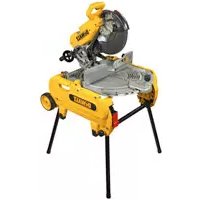
USER MANUAL D27107 DEWALT
You have chosen a DEWALT tool. Years of experience, thorough product development and innovation make DEWALT one of the most reliable partners for professional power tool users.
Technical data
| D27107 | D27107XPS |
| Voltage | V |
| Type | | |
| Power input W | 2000 | 2000 | | |
| Power output | | W | 1080 | 1080 |
| Max. blade speed | | min-1 | 4000 | 4000 |
| Blade diameter | | mm | 305 | 305 |
| Blade bore | | mm | 30 | 30 |
| Blade body thickness | | mm | 2.1 - 2.2 | 2.1 - 2.2 |
| Riving knife thickness | | mm | 2.5 | 2.5 |
| Automatic blade brake time | | s | < 10 | < 10 |
| Weight | | kg | 42 | 42 |
Cutting capacities
| Mitre saw mode |
| Mitre (max. positions) | left | 48° | 48° |
| right | 48° | 48° |
| Bevel (max. positions) | left | 48° | 48° |
| right | 2° | 2° |
| Max. crosscut capacity at 90°/90° | mm | 205 x 63 | 205 x 63 |
| Max. litre cut capacity at 45° | mm | 160 | 160 |
| Max. depth of cut 90° | mm | 90 | 90 |
| Max. depth of bevel cut 45° | mm | 60 | 60 |
| Max. depth of cut at 45° bevel, 45° litre | mm | 60 | 60 |
| Saw bench mode |
| Max. ripping capacity left/right | mm | 120/320 | 120/320 |
| Depth of cut at 90° | mm | 81 | 81 |
| Depth of cut at 45° | mm | 56 | 56 |
| L_Fx (sound pressure) | dB(A) | 95.0 | 95.0 |
| K_Fx (sound pressure uncertainty) | dB(A) | 3.0 | 3.0 |
| L_vxi (sound power) | dB(A) | 106.0 | 106.0 |
| K_vxi (sound power uncertainty) | dB(A) | 3.0 | 3.0 |
Vibration total values (triax vector sum) determined according to EN 61029:
| Vibration emission value ah |
| ah= | m/s2 | 2.1 | 2.1 |
| Uncertainty K = | m/s2 | 1.5 | 1.5 |
The vibration emission level given in this information sheet has been measured in accordance with a standardised test given in EN 61029 and may be used to compare one tool with another. It may be used for a preliminary assessment of exposure.

WARNING: The declared vibration emission level represents the main applications of the tool. However if the tool is used for different applications, with different accessories or poorly maintained, the vibration emission may differ. This may significantly increase the exposure level over the total working period.
An estimation of the level of exposure to vibration should also take into account the times when the tool is switched off or when it is running but not actually doing the job. This may significantly reduce the exposure level over the total working period.
Identify additional safety measures to protect the operator from the effects of vibration such as: maintain the tool and the accessories, keep the hands warm, organisation of work
230 patterns. 230
| Fuses: | 2 |
| Europe | 230 V tools |
| U.K. & Ireland | 230 V tools |
NOTE: This device is intended for the connection to a power supply system with maximum permissible system impedance Zmax of 0.28 Ω at the interface point (power service box) of user's supply.
The user has to ensure that this device is connected only to a power system which fulfils the requirement above. If necessary, the user can ask the public power supply company for the system impedance at the interface point.
Definitions: Safety Guidelines
The definitions below describe the level of severity for each signal word. Please read the manual and pay attention to these symbols.
DANGER: Indicates an imminently hazardous situation which, if not avoided, will result in death or serious injury.
WARNING: Indicates a potentially hazardous situation which, if not avoided, could result in death or serious injury.
CAUTION: Indicates a potentially hazardous situation which, if not avoided, may result in minor or moderate injury.
NOTICE: Indicates a practice not related to personal injury which, if not avoided, may result in property damage.
Denotes risk of electric shock.
Denotes risk of fire.

D27107/D27107XPS
DEWALT declares that these products described under Technical Data are in compliance with: 2006/42/EC, EN 61029-1, EN 61029-2-11.
These products also comply with Directive 2004/108/EC and 2011/65/EU. For more information, please contact DEWALT at the following address or refer to the back of the manual.
The undersigned is responsible for compilation of the technical file and makes this declaration on behalf of DEWALT.
Horst Grossmann
Vice President Engineering and Product Development
D-65510, Idstein, Germany
01.12.2011
Safety Instructions

WARNING! When using electric tools basic safety precautions should always be followed to reduce the risk of fire, electric shock and personal injury including the following.
Read all these instructions before attempting to operate this product and save these instructions.
SAVE THIS MANUAL FOR FUTURE REFERENCE
General Safety Rules
1. Keep work area clear.
Cluttered areas and benches invite injuries.
2. Consider work area environment.
Do not expose the tool to rain. Do not use the tool in damp or wet conditions. Keep the work area well lit (250 - 300 Lux). Do not use the tool where there is a risk of causing fire or explosion, e.g., in the presence of flammable liquids and gases.
3. Guard against electric shock.
Avoid body contact with earthed surfaces (e.g., pipes, radiators, cookers and refrigerators). When using the tool under extreme conditions (e.g., high humidity, when metal swar is being produced, etc.), electric safety can be improved by inserting an isolating transformer or a (FI) earth-leakage circuit-breaker.
4. Keep other persons away.
Do not let persons, especially children, not involved in the work, touch the tool or the extension cord and keep them away from the work area.
When not in use, tools must be stored in a dry place and locked up securely, out of reach of children.
It will do the job better and safer at the rate to which it was intended.
Do not force small tools to do the job of a heavy duty tool. Do not use tools for purposes not intended; for example do not use circular saws to cut tree limbs or logs.
8. Dress properly.
Do not wear loose clothing or jewellery, as these can be caught in moving parts. Non-skid footwear is recommended when working outdoors. Wear protective hair covering to contain long hair.
9. Use protective equipment.
Always use safety glasses. Use a face or dust mask if working operations create dust or flying particles. If these particles might be considerably hot, also wear a heat-resistant apron. Wear ear protection at all times. Wear a safety helmet at all times.
If devices are provided for the connection of dust extraction and collecting equipment, ensure these are connected and properly used.
11. Do not abuse the cord.
Never yank the cord to disconnect it from the socket. Keep the cord away from heat, oil and sharp edges. Never carry the tool by its cord.
12. Secure work.
Where possible use clamps or a vice to hold the work. It is safer than using your hand and it frees both hands to operate the tool.
13. Do not overreach.
Keep proper footing and balance at all times.
14. Maintain tools with care.
Keep cutting tools sharp and clean for better and safer performance. Follow instructions for lubricating and changing accessories. Inspect tools periodically and if damaged have them repaired by an authorized service facility. Keep handles and switches dry, clean and free from oil and grease.
When not in use, before servicing and when changing accessories such as blades, bits and cutters, disconnect tools from the power supply.
16. Remove adjusting keys and wrenches.
Form the habit of checking to see that adjusting keys and wrenches are removed from the tool before operating the tool.
17. Avoid unintentional starting.
Do not carry the tool with a finger on the switch. Be sure that the tool is in the "off" position before plugging in.
18. Use outdoor extension leads.
Before use, inspect the extension cable and replace if damaged. When the tool is used outdoors, use only extension cords intended for outdoor use and marked accordingly.
19. Stay alert.
Watch what you are doing. Use common sense. Do not operate the tool when you are tired or under the influence of drugs or alcohol.
20. Check for damaged parts.
Before use, carefully check the tool and mains cable to determine that it will operate properly and perform its intended function. Check for alignment of moving parts, binding of moving parts, breakage of parts, mounting and any other conditions that may affect its operation. A guard or other part that is damaged should be properly repaired or replaced by an authorized service centre unless otherwise indicated in this instruction manual. Have defective switches replaced by an authorized service centre.
Do not use the tool if the switch does not turn it on and off. Never attempt any repairs yourself.

WARNING! The use of any accessory or attachment or performance of any operation with this tool other than those recommended in this instruction manual may present a risk of personal injury.
This electric tool complies relevant safety rules. Repairs should only be carried out by qualified persons using original spare parts; otherwise this may result in considerable danger to the user.
Additional safety rules for metre saws
- Make sure all locking knobs and clamp handles are tight before starting any operation.
- Ensure that the machine arm is securely fixed when performing bevel cuts.
- Do not operate the machine without the guard in position, or if the guard does not function or is not maintained properly.
- Never place either hand in the blade area when the saw is connected to the electrical power source.
- Never attempt to stop a machine in motion rapidly by jamming a tool or other means against the blade; serious accidents can occur.
- Select the correct blade for the material to be cut.
- Wear suitable gloves when handling saw blade and rough materials.
- Never perform any cleaning or maintenance work when the machine is still running and the head is not in the rest position.
- The front section of the guard is louvred for visibility while cutting. Although the louvres dramatically reduce flying debris, there are openings in the guard and safety glasses should be worn at all times when viewing through the louvres.
- With laser assembled do not exchange with other types of laser. Repairs shall only be performed by the laser manufacturer or an authorized agent.
- Never cut workpiece shorter than 200mm .
-
Without additional support the machine is designed to accept the maximum workpiece size of:
-
Height 63 mm by width 205 mm by length 500 mm
-
Longer workpieces need to be supported by suitable additional table, e.g. DE3474. Always clamp the workpiece safely.
-
During use in metre saw mode ensure that the portion of the saw blade, below the table, is completely enclosed by the guard (63) shown in Fig. E.
Additional safety rules for saw benches
- Make sure that the blade rotates in the correct direction and the teeth are pointing to the front of the saw bench.
- Make sure all locking knobs and clamp handles are tight before starting any operation.
- Be sure all blade and flanges are clean and the recessed sides of the collar are against the blade. Tighten the arbor nut securely.
- Use correctly sharpened saw blades. Observe the maximum speed mark on the saw blade. The marked maximum speed shall always be higher than the speed marked on rating plate.
- Never operate the saw without the upper and lower guards in place.
- Never place either hand in the blade area when the saw is connected to the electrical power source.
- Disconnect the saw from the mains before changing blades or carrying out maintenance.
- Use a push stick at all times, and ensure that you do not place hands closer than 200mm from the saw blade while cutting.
- Do not attempt to operate on anything but the designated voltage.
- Do not apply lubricants to the blade when it is running.
- Do not reach around behind the saw blade.
Always keep the push stick in its place when not in use.
- Do not stand on top of the unit.
- During transportation make sure that the upper part of the saw blade is covered, e.g. by the guard.
- Do not use the guard for handling or transportation.
- Rebating, slotting or grooving is not allowed.
- Ensure riving knife is adjusted correctly. Never cut without riving knife assembled.
- Never cut workpiece smaller than 30 mm .
- Without additional support the machine is designed to accept the maximum workpiece size of:
- Height 81 mm by width 400 mm by length 600 mm
- Longer workpieces need to be supported by suitable additional table, e.g. D271055 or D271058.
Additional safety rules for flip-over saws
Report the failure and mark the machine in suitable form to prevent other people from using the defective machine.
- When the saw blade is blocked due to abnormal feed force during cutting, turn the machine off and disconnect it from power supply. Remove the workpiece and ensure that the saw blade runs free. Turn the machine on and start new cutting operation with reduced feed force.
- Refrain from removing any cut-offs or other parts of the workpiece from the cutting area while the machine is running and the saw head is not in the rest position
- Do not use the machine without the legs mounted.
Make sure your position is always left or right of the cutting line.
- Provide adequate general or localized lighting.
- Ensure the operator is adequately trained in the use, adjustment and operation of the machine.
- Switch the machine off when unattended.
- Make sure that the LED meets EN 62471. Do not replace the LED with a different type. If damaged, have the LED light repaired by an authorized service agent.
- Connect the saw to a dust collection device when sawing wood. Always consider factors which influence exposure of dust such as: type of material to be machined (chip board produces more dust than wood);
sharpness of the saw blade;
correct adjustment of the saw blade,
- dust extractor with air velocity not less than 20 m/s .
Ensure that the local extraction as well as hoods, baffles and chutes are properly adjusted.
- Never cut light alloy, especially magnesium.
Residual risks
The following risks are inherent to the use of saws:
- injuries caused by touching the rotating parts.
In spite of the application of the relevant safety regulations and the implementation of safety devices, certain residual risks cannot be avoided. These are:
Impairment of hearing;
- Risk of accidents caused by the uncovered parts of the rotating saw blade;
- Risk of injury when changing the blade;
- Risk of squeezing fingers when opening the guards;
Health hazards caused by breathing dust developed when sawing wood, especially oak, beech and MDF.
The following factors are of influence to noise production:
The material to be cut;
The type of saw blade;
The feed force.
The following factors increase the risk of breathing problems:
- No dust extractor connected when sawing wood;
- Insufficient dust extraction caused by uncleaned exhaust filters
Worn saw blade;
-Workpiece not exactly guided.
The following pictograms are shown on the tool:

Read instruction manual before use.

Wear ear protection.

Wear eye protection.
Carrying Point

Hands Away
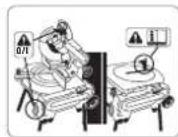
When using the machine in the mitre saw mode, make sure to operate the trigger switch in the handle when switching ON and OFF. Do not operate the switchbox in this mode. The ON/OFF switch located on the machine frame is foreseen for table saw mode only.

When using the machine in the mitre saw mode, make sure the riving knife is secured in its rest position.
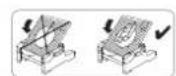
Never use as litre saw when the guard is not in place.
DATE CODE POSITION (FIG. A1)
The Date Code (143), which also includes the year of manufacture, is printed into the housing.
Example:
2012 XX XX
Year of Manufacture
Package contents
The package contains:
1 Partly assembled machine
1 Box containing:
1 Top guard for bench saw position
1 Under-table guard for litre saw position
4 Legs
2 Wheels
4 Feet
1 Parallel fence
1 Material clamp
1 Instruction manual
1 Exploded drawing
- Check for damage to the tool, parts or accessories which may have occurred during transport.
- Take the time to thoroughly read and understand this manual prior to operation.
Description (fig. A1 - A11)
A1
1 On/off switch (saw bench mode)
2 Table release lever
3 Rotating table clamp
4 Mitre saw table
5 Rotating table
6 Fence right-hand side
7 Fence left-hand side
8 Moveable lower blade guard
9 Guard release lever
0 Operating handle
142 Circuit breaker reset button
143 Date code
A2
10 Operating handle
11 Trigger switch (mitre saw mode)
12 Fixed upper blade guard
13 Dust extraction adapter
14 Wheel
15 Leg
16 Foot
17 Bevel clamp knob
A3
17 Bevel clamp knob
18 Height adjuster
19 Saw bench table
20 Riving knife
21 Upper blade guard
22 Parallel fence
23 Push stick
Optional accessories
A4
For use in metre saw mode:
30 Fence insert (DE7120)
A5
31 Adjustable stand 760 mm (max. height) (DE3474)
32 Support guide rails 1,000 mm (DE3494)
33 Support guide rails 500 mm (DE3491)
34 Inclinable support (DE3495)
35 Swivelling stop (DE3462)
36 Length stop for short workpieces (to be used with guide rails [33]) (DE3460)
37 Support with removable stop (DE3495)
38 Support with stop removed (DE3495)
A6
40 Roller support table (DE3497)
For use in saw bench mode:
A7
41 Mitre fence (D271052)
A8
42 Extension table (D271058)
A9
43 Sliding table (D271055)
Push sticks (DE3454) (not shown)
For use in all modes:
A 10
44 Three way dust extraction kit (D271054)
A 1 1
144 LED Worklight System
INTENDED USE
Your DEWALT D27107 flip-over saw has been designed to operate as a litre saw or a saw bench to perform the four main sawing operations of ripping, cross-cutting, bevelling and mitring easily, accurately and safely.
This unit is designed for use with a nominal blade diameter 305 mm carbide tip blade for professional cutting wood, wood products and plastics.
DO NOT use under wet conditions or in presence of flammable liquids or gases.
These flip over saws are professional power tools.
DO NOT let children come into contact with the tool. Supervision is required when inexperienced operators use this tool.

WARNING! Do not use the machine for purposes other than intended.
- This product is not intended for use by persons (including children) suffering from diminished physical, sensory or mental abilities; lack of experience, knowledge or skills unless they are supervised by a person responsible for their safety. Children should never be left alone with this product.
MITRE SAW MODE
In litre saw mode, the sawing machine is used in vertical, litre or bevel position.
BENCH SAW MODE
Turned over on its central axis, the sawing machine is used to perform the standard ripping operation and for sawing wide pieces by manually feeding the workpiece into the blade.
Electrical Safety
The electric motor has been designed for one voltage only. Always check that the power supply corresponds to the voltage on the rating plate.

Your tool is double insulated in accordance with EN 61029; therefore no earth wire is required.
In case of cord replacement the tool must only be repaired by an authorized service agent or by qualified electrician.
Mains Plug Replacement (U.K. & Ireland only)
If a new mains plug needs to be fitted:
- Safely dispose of the old plug.
- Connect the brown lead to the live terminal in the plug.
- Connect the blue lead to the neutral terminal.

WARNING: No connection is to be made to the earth terminal.
Follow the fitting instructions supplied with good quality plugs. Recommended fuse: 13 A.
Using an Extension Cable
If an extension cable is required, use an approved 3-core extension cable suitable for the power input of this tool (see Technical Data). The minimum conductor size is 1.5mm^2 ; the maximum length is 30m .
When using a cable reel, always unwind the cable completely.
ASSEMBLY

WARNING: To reduce the risk of injury, turn unit off and disconnect machine from power source before installing and removing accessories, before adjusting or changing set-ups or when making repairs. Be sure the trigger switch is in the OFF position. An accidental start-up can cause injury.
Unpacking the machine and its parts

WARNING: To reduce the risk of injury, always seek assistance when moving the machine.
- Remove the loose packaging material from the box.
- Lift the machine out of the box.
- Remove the parts box from the interior of the machine.
- Remove any remaining packing material from the machine.
Mounting the feet (fi g. A2, B, B1)
With the feet and legs mounted, alternatively the machine is suitable for placement on a workbench. To ensure a safe operation, the machine must be fastened to the workbench.

WARNING! Never operate this machine when it is not fastened to the workbench. The feed force will make the saw unstable if not fastened to the workbench.
- Turn the machine upside down.
- Place a foot (16) on each of the mounting locations (51) on the base.
- Slide a nut (52) into the slots (53) located above the mounting locations.
- Insert a bolt (54) fitted with a washer (55) into the feet.
- Tighten the bolts.
- Mount the legs as described below.
- Fold the legs as described below.
- Turn the machine straight up.
- Insert a bolt of 8mm and 120mm minimum length (49) into the feet on each mounting location (fig. B1).
- Tighten the bolts.
Mounting the legs (fi g. C1 & C2)
With the legs mounted, the machine is suitable for stand-alone placement.
- Turn the machine upside down.
- Mount the legs as described below. Beware that the front legs and the rear legs have different lengths. The rear legs are slightly longer than the front legs. Make sure to mount the legs in the correct place.
- Turn the machine straight up. Make sure it is level; adjust the leg clamping height if required.
Rear legs
- Present a leg (15) to each of the mounting points (56) located at the lower edges on the inside of the base (fig. C1).
Pass a coach bolt (57) from the outside through the holes into the frame and the legs.
- Place a bracket (58) and a lock knob (59) onto the bolts.
- Tighten the lock knobs.
Front legs
Folding the legs (fi g. C3,C4)/Bench mounting (fi g. B1)
The legs can be folded into the base to make the machine suitable for use on a workbench.
- Turn the machine upside down
- Loosen the lock knob (59) of the first leg (15)
- Fold the leg inwards
- Tighten the lock knob
- Repeat as for the other legs
- Turn the machine straight up
- Use both holes (49) in the legs and secure the machine with bolts with a diameter of 8mm and minimum 150mm length.
To prevent binding and inaccuracy, be sure the mounting surface is not warped or otherwise uneven.
Mounting the wheels (fi g. D)
- Place a wheel (14) onto the axles (60) on each side of the machine.
- Place a flat washer (61) and a nut (62) onto the threaded end of the axles.
- Tighten the nuts using the spanner supplied.
Assembly for litre saw mode
Mounting the under-table guard (fi g. E)
The under-table guard (63) is fitted to the top of the saw bench table.
- Place the two fasteners on the left of the guard into the slots (64) on the left of the blade slot (65). Turn the plastic screws counterclockwise.
- Place the guard fl at on the table and press the fastener in the slot (66) on the right of the blade slot. Turn the plastic screw counterclockwise.
To remove, turn the screws clockwise and remove the guard.
Turning the sawhead and table over (fi g. F1 - F4)
- Hold the saw table (19) with one hand and push the table release lever (2) to the right (fi g. F1).
- Push the table downwards at the front (fi g. F2) and swing it over completely until the motor assembly is uppermost and the plate (67) engages in the table locking device (68) (fi g. F3).
- Push the release lever (69) to the rear whilst holding down the head until the spring-loaded bearing unit (70) can be lifted out of its seating (fi g. F4).
- Flip the bearing unit up.
- Holding the head firmly, allow the spring pressure to take the head upwards into its rest position.
Mounting the saw blade (fi g. G1 - G4)

WARNING: To reduce the risk of injury, turn unit off and disconnect machine from power source before installing and removing accessories, before adjusting or changing set-ups or when making repairs. Be sure the trigger switch is in the OFF position. An accidental start-up can cause injury.

WARNING:
Always change blades with the machine in litre saw mode.
- Never depress the spindle lock button while the blade is under power or coasting.
- Do not cut ferrous metal (containing iron or steel) or masonry fibre cement product with this litre saw.
The teeth of a new blade are very sharp and can be dangerous.
-
Depress the head lock up release lever (9) to release the lower guard (8), then raise the lower guard as far as possible (Fig. G1).
-
With the lower guard held in the raised position, depress the spindle lock button (74) with one hand, then use the supplied blade spanner in the other hand to loosen the left-hand threaded blade locking screw (73) by tuming clockwise.

WARNING! To use the spindle lock, press the button as shown and rotate the spindle by hand until you feel the lock engage.
- Continue to hold the lock button in to keep the spindle from turning (74, fig. G1).
- Remove the blade locking screw (73) and the outside arbor collar (75).
- Install the saw blade (76) onto the shoulder (77) provided on the inside arbor collar (78), making sure that the teeth at the bottom edge of the blade are pointing toward the back of the saw (away from the operator).
- Replace the outer arbor collar (75).
- Tighten the blade locking screw (73) carefully by tuming counterclockwise while holding the spindle lock engaged with your other hand.
- Raise the lower guard.
WARNING! Be aware the saw blade shall be replaced in the described way only. Only use saw blades as specified under Technical Data; Cat.no.:DT4260 is suggested.
Adjustments for litre saw mode
Your litre saw was accurately adjusted at the factory. If readjustment due to shipping and handling or any other reason is required, follow the steps below to adjust your saw. Once made, these adjustments should remain accurate.
Checking and adjusting the blade to the fence (fi g. H1 - H3)
- Loosen the litre knob (79) and depress the litre latch (80) to release the rotating table (5) (fi g. H1).
- Swing the rotating table until the latch locates it at the 0^ litre position. Do not tighten the knob.
- Pull down the head until the blade just enters the saw kerf (81).
- Place a square (82) against the left side (7) of the fence and blade (76) (fig. H2).

WARNING: Do not touch the tips of the blade teeth with the square.
If adjustment is required, proceed as follows:
- Loosen the screws (83) (fi g. H3) and move the scale/rotating table assembly left or right until the blade is at 90^ to the fence as measured with the square (fi g. H2).
- Retighten the screws (83) (fi g. H3). Pay no attention to the reading of the metre pointer at this point.
Adjusting the litre pointer (fig. H1 & H4)
- Loosen the mitre knob (79) and depress the mitre latch (80) to release the rotating table (5) (fi g. H1).
- With the mitre knob loose, allow the mitre latch to snap into place as you rotate the mitre arm past zero.
- Observe the pointer (84) and litre scale (85) (fi g. H4). If the pointer does not indicate exactly zero, loosen the screw (86), move the pointer to read 0^ and tighten the screw.
Checking and adjusting the blade to the table (fi g. 11 - 13)
- Loosen the bevel clamp knob (17) (fi g. 11).
- Press the saw head to the right to ensure it is fully vertical and tighten the bevel clamp knob.
- Pull down the head until the blade just enters the saw kerf (81).
- Place a set square (82) on the table and up against the blade (76) (fi g. 12)

WARNING: Do not touch the tips of the blade teeth with the square.
If adjustment is required, proceed as follows:
- Loosen the bevel clamp knob (17) (fi g. 11) and turn the vertical position adjustment stop screw (87) (fi g. 13) in or out until the blade is at 90^ to the table as measured with the square (fi g. 12).
- If the bevel pointer (88) does not indicate zero on the bevel scale (89), loosen the screw (90) that secures the pointer and move the pointer as necessary (fi g. 13).
Adjusting the fence (f.g. J)
The upper part of the left side of the fence can be adjusted to the left to provide clearance, allowing the saw to bevel to a full 48^ left. To adjust the fence (7):
- Loosen the fence clamping knob (91) and slide the upper part of the side fence to the left.
- Make a dry run with the saw switched off and check for clearance. Adjust the fence to be as close to the blade as practical to provide maximum workpiece support, without interfering with the up and down movement of the arm.
- Tighten the knob securely.

WARNING: The guide groove (92) can become clogged with sawdust. Use a stick or some low pressure air to clear the guide groove.
Checking and adjusting the bevel angle (fi g.11, J, K & L)
- Loosen the fence clamping knob (91) and slide the upper part of the side fence to the left as far as it will go (fi g. J).
- Loosen the bevel clamp knob (17) (fi g. 11) and with the intermediate bevel position stop (93) turned aside move the saw arm to the left until the angle position stop (94) rests against the bevel position adjustment stop (95) (fi g. K). This is the 45^ bevel position.
If adjustment is required, proceed as follows:
- Turn the bevel position adjustment stop screw (95) in or out as necessary until the pointer (88) indicates 45^ with the angle position stop resting against the bevel position adjustment stop.
The intermediate bevel angle is preset at 30^ , enabling a quick setting for the cutting of crown moulding.
- Loosen the fence clamping knob (91) and slide the upper part of the side fence to the left as far as it will go (fi g. J).
- Loosen the bevel clamp knob (17) (fi g. 11) and with the intermediate bevel position stop (93) turned into place move the saw arm to the left until the angle position adjustment stop (96) rests on the intermediate bevel position stop (93) (fi g. L). This is the 30^ bevel position.
If adjustment is required, proceed as follows:
- Turn the bevel position adjustment stop screw (96) in or out as necessary until the pointer (88) indicates 30^ with the bevel position adjustment stop resting on the intermediate bevel position stop.
Assembly for saw bench mode
Changing from litre saw to saw bench mode (fi g. A1, M1 - M5)
- Put the blade into 0^ cross-cut position with the rotating table clamp (3) secured (fig. A1).
- Slacken the riving knife clamp knob (97) just enough to allow the riving knife to enter the mounting slot (fi g. M1).
- Remove the riving knife (20) from its storage position in the inside of the base.
- Depress the guard release lever (9) to release the blade guard (8), then raise the blade guard as far as possible (fi g. A1).
- Slide the riving knife bracket (98) into the mounting slot (99) (fi g. M1). Tighten the clamp knob.
- Push the lever (100) to allow the spring loaded upper part of the fence (7) to rest against the rotating table (fi g. M2)
Pull down the sawhead.
- Push the release lever (69) to the rear (fi g. M3).
- Push the bearing unit (70) down until notches (101) engage in the locations (102) (fig. M3).

WARNING: The blade should not foul the lower blade guard.
- Pull the table release lever (2) to the right, lift the front edge of the table (4) (fi g. M4) and flip it back through 180^ until the plate of the table-locking device (68) automatically engages the latch of the table locking device to secure it in the saw bench mode (fi g. M5).
- Remove the under-table guard.
Adjusting the riving knife (fi g. N1 & N2)

WARNING: When adjustments to the riving knife (20) are to be made, it is best to rotate the unit in metre saw mode (fig. N2). Proceed as described in the section "Changing from saw bench to metre saw mode".
The correct position is for the top of the riving knife to be no more than 2mm below the highest tooth of the blade and the body of the radius to be a maximum of 3 - 8mm from the tips of the saw blade teeth (fi g. N1).
If adjustment is required, proceed as follows:
- Slacken the bolts (104) to adjust the horizontal position of the riving knife.
- Slacken the bolts (103) to adjust the vertical position of the riving knife.
- Securely tighten the bolts.
Fitting the upper blade guard (fi g. 0)
The upper blade guard (21) is designed to be quickly and easily attached to the riving knife (20) once the machine has been set up for saw bench mode.
- Holding the guard vertically, align the slot in the rear of the guard with the riving knife.
- Lower the guard over the riving knife (20), making sure that the shaft of the bolt enters the recess.
- Turn the guard into horizontal position.

WARNING: Never use your saw in saw bench mode without the upper guard correctly fitted.
Mounting and adjusting the parallel fence (fi g. P1 - P5)
The parallel fence (22) can be mounted on either side of the blade.
- Slide the bracket (107) on from the left or the right (fig. P1)
The clamping plate engages behind the front edge of the table.
- Slide the fence up against the blade.
- Push the lever (108) down to secure the fence in place.
- Check that the fence is parallel to the blade.
If adjustment is required, proceed as follows:
- Loosen the lock knobs (109) and slide the fence backwards in order to obtain access to the adjustment bolts (110) in the top of the fence (fi g. P2)
- Using the spanner, loosen the adjustment bolts fastening the fence bracket to the fence support.
- Adjust the fence so that it is parallel to the blade by checking the distance between the blade and the fence at the front and rear of the blade.
- When the adjustment has been carried out, re-tighten the adjustment bolts and check again that the fence is parallel to the blade.
- Check that the pointer (111) indicates zero on the scale (fi g. P3). If the pointer does not indicate exactly zero, loosen the screw (112), move the pointer to read 0^ and tighten the screw.
The default set-up of the fence is to the right-hand side of the blade.
To prepare the fence for use to the left-hand side of the blade, proceed as follows (fig. P4):
- Remove the lock knobs (109).
- Slide the fence profil e (113) out of the clamping support.
- Turn the clamping support (114) around and re-fi t the lock knobs.
- Slide the fence onto the clamping support.
- Tighten the knobs.
The fence is reversible: the workpiece can be guided along the 75mm or along the 11mm face to allow the use of a push stick when ripping thin workpieces (fig P5).
- To set for 11mm loosen the fence clamping knobs (109) and slide the fence (113) out of the clamping support (114).
- Turn the fence and re-engage the clamping support in the slot as shown (fig. P5).
- To use with the full height of 75mm , slide the fence into the clamping support with the wide face in the vertical position (fi g. P4).

WARNING: Use the 11 mm profile for ripping low workpieces to allow access between the blade and the fence for the push stick. The rear end of the fence should be level with the front of the riving knife.
Mounting and adjusting the metre fence (fi g. Q1 - Q4)
The metre fence (D271052) is available as an option. The metre fence (41) can be used for metre cutting when the machine is in saw bench mode (fi g, Q1).
- Loosen the clamp knob (115) and swing the guide bar (116) out (fi g. Q2). Tighten the clamp knob.
- Slide the fence on the left side on the table (fi g. Q3).
- Loosen the lock knob (117).
- Place a square (82) against the fence (41) and the blade (76).
If adjustment is required, proceed as follows:
- Loosen the nut (118) a few turns and turn the right angle adjustment stop screw (119) (fi g. Q4) in or out until the fence is at 90^ to the blade as measured with the square (fi g. Q3).
- Tighten the knob (117).
- Check that the pointer (120) indicates zero on the scale (121). Adjust if necessary.
Changing from saw bench to metre saw mode (fg. A3, E & M1)
- Remove the parallel fence (22), or the mitre fence, if fitted (fig. A3).
- Remove the upper blade guard (21).
- Replace the under-table guard (63) (fi g. E).
- Proceed as described in the section "Turning the sawhead and table over".
- Slacken the riving knife clamp knob (97) and remove the riving knife (20), while holding the blade guard (8) (fig. M1).
- Lower the blade guard.
- Place the riving knife (20) in its storage position in the inside of the base (fig. A3).
OPERATION
Instructions for Use

WARNING: Always observe the safety instructions and applicable regulations.
WARNING: To reduce the risk of injury, turn unit off and disconnect machine from power source before installing and removing accessories, before adjusting or changing set-ups or when making repairs. Be sure the trigger switch is in the OFF position. An accidental start-up can cause injury.

WARNING:
Ensure the material to be sawn is firmly secured in place.
Apply only a gentle pressure to the tool and do not exert pressure on the saw blade.
Avoid overloading.
Ensure the machine is placed to satisfy your ergonomic conditions in terms of table height and stability. The machine site shall be chosen so that the operator has a good overview and enough free surrounding space around the machine that allows handling of the workpiece without any restrictions. To reduce effects of vibration make sure the environment temperature is not too cold, machine and accessory is well maintained and the workpiece size is suitable for this machine.
Prior to operation:
- Install the appropriate saw blade. Do not use excessively worn blades. The maximum rotation speed of the tool must not exceed that of the saw blade.
- Do not attempt to cut excessively small pieces.
- Allow the blade to cut freely. Do not force.
- Allow the motor to reach full speed before cutting.
- Make sure all locking knobs and clamp handles are tight.
Switching on and off (fi g. A1, R1 - R3)
This machine has two independent switching systems. In metre saw mode, the trigger switch (11) is used (fi g. R1). In saw bench mode, the on/off switch (1) is used (fi g. R2). Integrated in the switch box is a motor overload protector with manual reset. In case of a power shut-off, proceed as follows:
- Make sure the machine has been switched off.
- Press the reset button (142).
Mitre saw mode (fig.R1)
A hole (122) is provided in the trigger for insertion of a padlock to lock the switch.
- To run the tool, press the trigger switch (11).
- To stop the tool, release the switch.
Saw bench mode (fi g. R2 & R3)
The on/off switch offers multiple advantages:
- no-volt release function: should the power be shut off for some reason, the switch has to be deliberately reactivated.
- extra safety: the hinged safety enclosure plate (123) can be locked by passing a padlock through the holes (124 & 125). The plate also serves as an "easy to locate" emergency stop button as pressure on the front of the plate will depress the stop button.
To switch the machine on, press the green start button (126).
- To switch the machine off, press the red stop button (127).
Locking the switches
- In order to avoid unauthorised use of the machine, lock both switches using padlocks.
Basic saw cuts
Sawing in litre saw mode
It is dangerous to operate without guarding. Guards must be in position when sawing.
- Make sure that the under-table guard does not become clogged with sawdust.
- Always clamp the workpiece when cutting non-ferrous metals.
General handling
when the cut is completed.
The minimum length of offcut material is 10mm
- When cutting short material (min. 190 mm to the left or the right of the blade), the use of the optional material clamp is recommended.
- When cutting UPVC sections, a supporting piece made out of timber with a complementary profile should be placed beneath the material being cut to provide the correct level of support.
Clamping the Workpiece (fi g. A5, Z)

WARNING: A workpiece that is clamped, balanced and secure before a cut may become unbalanced after a cut is completed. An unbalanced load may tip the saw or anything the saw is attached to, such as a table or workbench. When making a cut that may become unbalanced, properly support the workpiece and ensure the saw is firmly bolted to a stable surface. Personal injury may occur.

WARNING: The clamp foot must remain clamped above the base of the saw whenever the clamp is used. Always clamp the workpiece to the base of the saw – not to any other part of the work area. Ensure the clamp foot is not clamped on the edge of the base of the saw.

CAUTION: Always use a work clamp to maintain control and reduce the risk of workpiece damage and personal injury, if your hands are required to be within 160 mm of the blade during the cut.
Use the material clamp (39) provided with your saw. Other aids such as spring clamps, bar clamps or C-clamps may be appropriate for certain sizes and shapes of material. The left or right fence will slide from side to side to aid in clamping.
TO INSTALL CLAMP
- Insert it into the hole behind the fence. The clamp should be facing toward the back of the metre saw. Ensure the groove on the clamp rod is fully inserted into the base of the metre saw. If the groove is visible, the clamp will not be secure.
- Rotate the clamp 180^ toward the front of the metre saw.
- Loosen the knob to adjust the clamp up or down, then use the fine adjust knob to firmly clamp the workpiece.
NOTE: Place the clamp on the right side of the fence when beveling. ALWAYS MAKE DRY RUNS (UNPOWERED) BEFORE FINISH CUTS TO CHECK THE PATH OF THE BLADE.ENSURE THE CLAMP DOES NOT INTERFERE WITH THE ACTION OF THE SAW OR GUARDS
Vertical straight cross cut (fi g. S1)
- Loosen the litre knob (79) and depress the litre latch (80).
- Engage the litre latch at the 0^ position and tighten the litre knob.
- Place the wood to be cut against the fence (7).
Take hold of the operation handle (10) and press in the guard release lever (9).
- Press the trigger switch (11) to start the motor.
- Depress the head to allow the blade to cut through timber and enter the saw kerf (81).
- After completing the cut, release the switch and wait for the saw blade to come to a complete stop before returning the head to its upper rest position.
Vertical litre cross-cut (fi g. S2)
- Loosen the litre knob (79) and depress the litre latch (80). Move the rotating table left or right to the required angle.
- The litre latch will automatically locate at 15^ , 22.5^ , 35.3^ and 45^ both left and right. If any intermediate angle is required hold the head firmly and lock by tightening the litre knob.
Always ensure that the mitre knob is locked tightly before cutting.
- Proceed as for a vertical straight cross-cut.

WARNING: When miting the end of a piece of wood with a small off-cut, position the wood to ensure that the off-cut is to the side of the blade with the greater angle to the fence:
left mitre, off-cut to the right
rightmitre,off-cutto the left.
Bevel cross-cut (fi g. A2, S3)
Bevel angles can be set from 48^ left to 2^ right and can be cut with the rotating table set between zero and a maximum of 45^ litre position left or right.
- Loosen the fence clamping knob (91) and slide the upper part of the side fence to the left as far as it will go.
- Loosen the bevel clamp knob (17) and set the bevel as desired.
- Tighten the bevel clamp knob firmly.
- Proceed as for a vertical straight cross-cut.
Compound litre (fig T1 - T4)
A compound litre is a cut made using a litre angle (fi g. T1) and a bevel angle (fi g. T2) at the same time. This is the type of cut used to make frames or boxes with slanting sides like the one shown in fi g. T3.
WARNING: If the cutting angle varies from cut to cut, check that the bevel clamp knob and the metre lock knob are securely tightened. These knobs must be tightened after making any changes in bevel or metre.
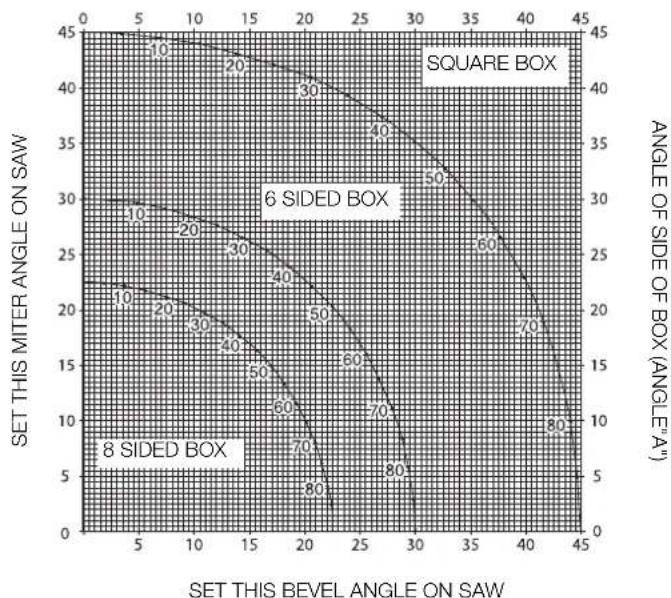
- The chart shown below will assist you in selecting the proper bevel and litre settings for common compound litre cuts. To use the chart, select the desired angle "A" (fi g. T4) of your project and locate that angle on the appropriate arc in the chart. From that point follow the chart straight down to find the correct bevel angle and straight across to find the correct litre angle.
- Set your saw to the prescribed angles and make a few trial cuts.
Practice fitting the cut pieces together.
- Example: To make a 4 sided box with 25^ exterior angles (angle "A") (fi g. T4), use the upper right arc. Find 25^ on the arc scale. Follow the horizontal intersecting line to either side to get the mitre angle setting on the saw (23^) . Likewise follow the vertical intersecting line to the top or bottom to get the bevel angle setting on the saw (40^) . Always try cuts on a few scrap pieces of wood to verify the settings on the saw.
Cutting base mouldings
The cutting of base moulding is performed at a 45^ bevel angle.
Always make a dry run without power before making any cuts.
- All cuts are made with the back of the moulding laying fl at on the saw.
Inside corner
-Right side
- Position the moulding with the bottom of the moulding against the fence.
- Save the left side of the cut.
Outside corner
Right side
- Position the moulding with top of the moulding against the fence.
- Save the right side of the cut.
Cutting crown mouldings
The cutting of crown moulding is performed in a compound litre. In order to achieve extreme accuracy, your saw has pre-set angle positions at 35.3^ litre and 30^ bevel. These settings are for standard crown mouldings with 45^ angles at the top and 45^ angles at the bottom.
- Make test cuts using scrap material before doing the final cuts.
- All cuts are made in a left bevel and with the back of the moulding against the base.
Inside corner
- Left side
- Top of the moulding against the fence.
- Mitre right.
- Save the left side of the cut.
-Right side
- Bottom of the moulding against the fence.
- Mitre left.
- Save the left side of the cut.
Outside corner
- Left side
- Bottom of the moulding against the fence.
- Mitre left.
- Save the right side of the cut.
-Right side
- Top of the moulding against the fence.
- Mitre right.
- Save the right side of the cut.
Sawing in the bench mode
Always use the riving knife.
Always ensure that the riving knife and blade guard are correctly aligned.
Always ensure that the litre saw is set and locked in 0^ litre.

WARNING: Do not cut metal in this mode.
Ripping (fi g. U1 & U3)
- Set the bevel angle to 0^ .
- Adjust the saw blade height.
- Set the parallel fence to the required distance.
- Hold the workpiece fl at on the table and against the fence. Keep the workpiece approx. 25 mm away from the saw blade.
- Keep both hands away from the path of the saw blade.
- Switch the machine on and allow the saw blade to reach full speed.
- Slowly feed the workpiece underneath the upper blade guard, keeping it firmly pressed against the fence. Allow the teeth to cut, and do not force the workpiece through the saw blade. The saw blade speed should be kept constant.
-
Remember to use the push stick (23) when close to the blade.
-
After completing the cut, switch the machine off, allow the saw blade to stop and remove the workpiece.

WARNING: Never push or hold the free or cut-off side of the workpiece.
WARNING: Always use a push stick when ripping small workpieces.
Bevel cuts (fi g. U2)
- Set the required bevel angle.
- Proceed as for ripping.
Cross-cutting (fig.V1)
- Set the bevel angle to 0^ .
- Adjust the saw blade height.
- Set the metre fence to 0^ .
- Proceed as for ripping, only use the mitre fence to push the workpiece through the blade.
Bevel cross-cutting
- Set the required bevel angle.
- Proceed as for cross-cutting.
Mitre cuts (fi g. V2)
- Set the metre fence to the required angle.
- Proceed as for cross-cutting.
Optional attachments

WARNING: Prior to assembling any accessories always unplug the machine.

WARNING! This machine is provided with two dust extraction points for use in each mode.

WARNING! Whenever possible, connect a dust extraction device designed in accordance with the relevant regulations regarding dust emission.

WARNING! When sawing wood, connect a dust extraction device designed in accordance with the relevant regulations regarding dust emission.
Connect a dust collection device designed in accordance with the relevant regulations. The air velocity of externally connected systems shall be 20m / s ± 2m / s . Velocity to be measured in the connection tube at the point of connection, with the tool connected but not running.
Connecting - litre saw position (fi g. W1)
- Connect the one end of the first hose to the dust extraction adaptor (13).
- Insert the other end of the hose into the middle inlet port of the manifold (128).
- Connect the one end of the other hose to the under-table guard (63).
- Insert the other end of the hose into the outer inlet port of the manifold.
Connecting - saw bench position (fi g. W2)
- Proceed as for litre saw position, only connect the hose from the under-table guard to the saw blade guard (21).
The extra support and length stop can be mounted on the left-hand side or on the right-hand side, or with two sets on either side.
- Fit the items 31 - 39 onto the two guide rails (32 & 33).
- Use the inclinable support (34) for cross-cutting 210mm wide boards (15 mm thick).
Roller support table (fi g. A6)
The roller support table (40) is used to support long workpieces. In mitre saw mode, the roller support table can be mounted on the left-hand side or on the right-hand side, or with two sets on either side. In saw bench mode, it can also be mounted in front or at the rear of the saw table.
Side extension table (fi g. A8)
The side extension table (42) increases the distance from the rip fence to the blade to 600~mm or more, depending on the rod length fitted to the machine and the clamped position of the table. The side extension table must be used in conjunction with guide rails (32) (option). The adjustable table is equipped with an engraved scale along its front edge and mounted on a sturdy base which clamps to the guide rods.
- Fit the extension table to the right-hand side of the machine for continuity of the distance scale on both tables.
Sliding table (fi g. A9)
This sliding table (43) allows for board sizes to the left of the blade up to 1200 × 900 mm .
The guide rods are mounted on a sturdy alloy extrusion which is quickly detachable from the machine and yet fully adjustable is all planes.
The fence incorporates a full length measuring tape for quick positioning of an adjustable stop and an adjustable support for narrow workpieces.
Transporting (fi g. X)

WARNING: Always transport the machine in saw bench mode with the upper blade guard fitted.
The castor wheels provide an easier transport of the machine.
- Put the machine on the right base side.
- Fold the rear legs into the base
- Fold the front legs out of the base
- Turn the machine straight up.
- Lift the machine by the front legs up to the wheels are in contact with the floor.

WARNING: When carrying the machine, always seek assistance.
MAINTENANCE
Your DEWALT power tool has been designed to operate over a long period of time with a minimum of maintenance. Continuous satisfactory operation depends upon proper tool care and regular cleaning.

WARNING: To reduce the risk of injury, turn unit off and disconnect machine from power source before installing and removing accessories, before adjusting or changing set-ups or when making repairs. Be sure the trigger switch is in the OFF position. An accidental start-up can cause injury.

Lubrication
The bearings of the motor are pre-lubricated and watertight.
- Slightly oil the rotating table bearing surface where it slides on the lip of the fixed table at regular intervals.
Periodically lubricate the depth of cut screwthread.
- Clean the parts subject to accumulation of sawdust and chips periodically with a dry brush.
Cam adjustment (fi g. Y1 - Y3)
To take out the clearance between the two tables, proceed as follows:
- Rotate the machine into saw bench mode.
- Remove the screws (138) and the retainer plate (139).
- Loosen the screw (140) of the adjustment cam (141).
- Rotate the adjustment cam using a pair of needle nose pliers.
- Hold the adjustment cam with the pliers and tighten the screw.
- Replace the retainer plate and tighten the screws.
- Rotate the machine into litre saw mode. Check the force that is needed to litre the saw. Repeat the above steps if the force needed is too high.

Cleaning
Before use, carefully check the upper blade guard, movable lower blade guard as well as the dust extraction tube to determine that it will operate properly. Ensure that chips, dust or workpiece particle cannot lead to blockage of one of the functions.
In case of workpiece fragments jammed between saw blade and guards disconnect the machine from the power supply and follow the instructions given in section Mounting the Saw Blade. Remove the jammed parts and reassembling the saw blade.

WARNING: Blow dirt and dust out of the main housing with dry air as often as dirt is seen collecting in and around the air vents. Wear approved eye protection and approved dust mask when performing this procedure.

WARNING: Never use solvents or other harsh chemicals for cleaning the non-metallic parts of the tool. These chemicals may weaken the materials used in these parts. Use a cloth dampened only with water and mild soap. Never let any liquid get inside the tool; never immerse any part of the tool into a liquid.

WARNING: To reduce the risk of injury, regularly clean the table top.

WARNING: To reduce the risk of injury, regularly clean the dust collection system.
Optional Accessories

WARNING: Since accessories, other than those offered by DEWALT, have not been tested with this product, use of such accessories with this tool could be hazardous. To reduce the risk of injury, only DEWALT, recommended accessories should be used with this product.
SAW BLADES: ALWAYS USE 305 mm SAW BLADES WITH 30 mm ARBOUR HOLES. SPEED RATING MUST BE AT LEAST 4000/min.
Never use a smaller or greater diameter blade. It will not be guarded properly. Use crosscut blades only! Do not use blades designed for ripping, combination blades or blades with hook angles in excess of 10^ .
| BLADE DESCRIPTIONS |
| Application Diameter (mm) Teeth | | |
| Construction Saw Blades (for all purpose cutting) |
| General Purpose 305 36 | | |
| Woodworking Saw Blades (provide smooth, clean cuts) |
| Fine crosscuts 305 60 | | |
Consult your dealer for further information on the appropriate accessories.
Protecting the Environment

Separate collection. This product must not be disposed of with normal household waste.
Should you find one day that your DEWALT product needs replacement, or if it is of no further use to you, do not dispose of it with household waste. Make this product available for separate collection.

Separate collection of used products and packaging allows materials to be recycled and used again. Re-use of recycled materials helps prevent environmental pollution and reduces the demand for raw materials.
Local regulations may provide for separate collection of electrical products from the household, at municipal waste sites or by the retailer when you purchase a new product.
DEWALT provides a facility for the collection and recycling of DEWALT products once they have reached the end of their working life. To take advantage of this service please return your product to any authorised repair agent who will collect them on our behalf.
You can check the location of your nearest authorised repair agent by contacting your local DEWALT office at the address indicated in this manual. Alternatively, a list of authorised DEWALT repair agents and full details of our after-sales service and contacts are available on the Internet at: www.2helpU.com.
GUARANTEE
DEWALT is confident of the quality of its products and offers an outstanding guarantee for professional users of the product.
This guarantee statement is in addition to and in no way prejudices your contractual rights as a professional user or your statutory rights as a private non-professional user. The guarantee is valid within the territories of the Member States of the European Union and the European Free Trade Area.
30 DAY NO RISK SATISFACTION GUARANTEE
If you are not completely satisfied with the performance of your DEWALT tool, simply return it within 30 days, complete with all original components, as purchased, to the point of purchase, for a full refund or exchange. The product must have been subject to fair wear and tear and proof of purchase must be produced.
ONE YEAR FREE SERVICE CONTRACT
If you need maintenance or service for your DEWALT tool, in the 12 months following purchase, you are entitled to one service free of charge. It will be undertaken free of charge at an authorised DEWALT repair agent. Proof of purchase must be produced. Includes labour. Excludes accessories and spare parts unless failed under warranty.
ONE YEAR FULL WARRANTY
If your DEWALT product becomes defective due to faulty materials or workmanship within 12 months from the date of purchase, DEWALT guarantees to replace all defective parts free of charge or - at our discretion - replace the unit free of charge provided that:
The product has not been misused;
The product has been subject to fair wear and tear;
- Repairs have not been attempted by unauthorised persons;
Proof of purchase is produced;
The product is returned complete with all original components.
If you wish to make a claim, contact your seller or check the location of your nearest authorised DEWALT repair agent in the DEWALT catalogue or contact your DEWALT office at the address indicated in this manual. A list of authorised DEWALT repair agents and full details of our after-sales service is available on the Internet at: www.2helpU.com.
SIERRA DE DOBLE MODALIDAD D27107, D27107XPS
Enhorabuena!
SCIE CULBUTABLE D27107, D27107XPS
Felicitations!
L'emballage contient:
(Isolation double)-outils
| L_F1 (pressione sonora) | dB(A) | 95,0 | 95,0 |
| K_F1 (incerlezza pressione sonora) | dB(A) | 3,0 | 3,0 |
| L_w1 (potenza sonora) | dB(A) | 106,0 | 106,0 |
| K_w1 (incerlezza potenza sonora) | dB(A) | 3,0 | 3,0 |
Identify additional safety measures to protect the operator from the effects of vibration such as: maintain the tool and the accessories, keep the hands warm, organisation of work patterns.
Zekeringen:
230 V machines 10 A
Vice President Engineering and Product Development
POSITIE DATUMCODE [AFB. (FIG.) A1]
De datumcode (143), die ook het一年多 van fabricage bevat, is binnen in de behuizing geprint.
Voorbeeld:
2012 XX XX
Jaar van fabricage
- Len deg seks for mye over.
SERRA “FLIP-OVER” D27107, D27107XPS
Parabéns!
Vice President Engineering and Product Development
DEWALT, Richard-Klinger-Strasse 11,
D-65510, Idstein, Germany
01.12.2011
Turvaohjeet

DATUMKODPLACERING (FIG.A1)
vanster gering, avsagning at hoger.
COK AMAÇLITESTERE D27107, D27107XPS
Tebrikler!
144 LED Calisma Lambasi Sistemi
KULLANIM AMACI
A10
44 ZouTMua EaywmyoKovm TpiWv oWv (D271054)
A11