
WX445.1 - Saw WORX - Free user manual and instructions
Find the device manual for free WX445.1 WORX in PDF.



Frequently Asked Questions - WX445.1 WORX
User questions about WX445.1 WORX
0 question about this device. Answer the ones you know or ask your own.
Ask a new question about this device
Download the instructions for your Saw in PDF format for free! Find your manual WX445.1 - WORX and take your electronic device back in hand. On this page are published all the documents necessary for the use of your device. WX445.1 by WORX.
USER MANUAL WX445.1 WORX
- Not all the accessories illustrated or described are included in standard delivery.
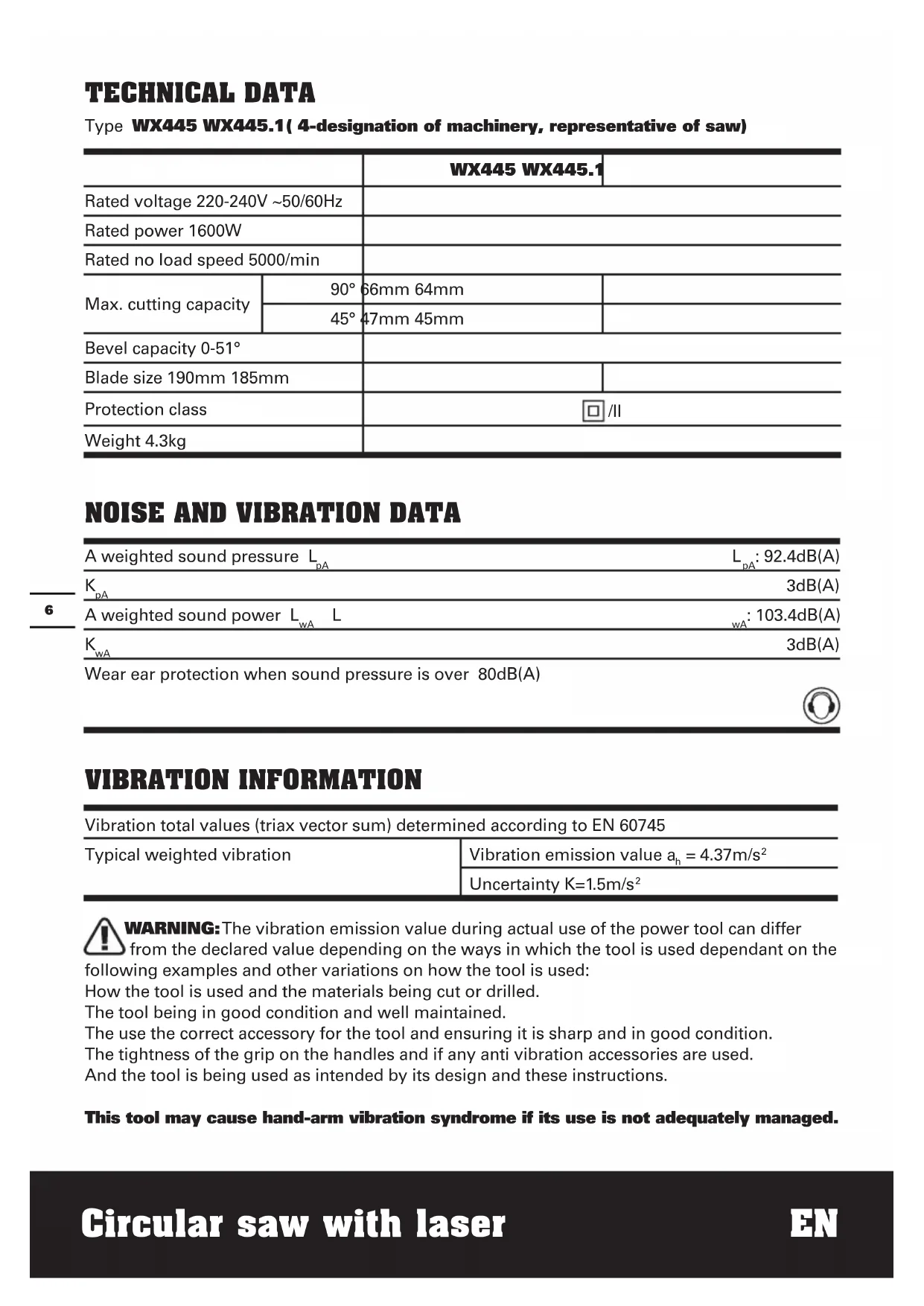
TECHNICAL DATA
Type WX445 WX445.1( 4-designation of machinery, representative of saw)
| WX445 WX445.1 | |||
| Rated voltage 220-240V ~50/60Hz | |||
| Rated power 1600W | |||
| Rated no load speed 5000/min | |||
| Max. cutting capacity | 90° | 66mm 64mm | |
| 45° | 47mm 45mm | ||
| Bevel capacity 0-51° | |||
| Blade size 190mm 185mm | |||
| Protection class | ☐ /II | ||
| Weight 4.3kg | |||
NOISE AND VIBRATION DATA
6
| A weighted sound pressure LpA | LpA: 92.4dB(A) |
| KpA | 3dB(A) |
| A weighted sound power LwA L | wA: 103.4dB(A) |
| KwA | 3dB(A) |
Wear ear protection when sound pressure is over 80dB(A)

VIBRATION INFORMATION
| Vibration total values (triax vector sum) determined according to EN 60745 | |
| Typical weighted vibration | Vibration emission value ah = 4.37m/s2 |
| Uncertainty K=1.5m/s2 | |

WARNING:The vibration emission value during actual use of the power tool can differ
to from the declared value depending on the ways in which the tool is used dependant on the
following examples and other variations on how the tool is used:
How the tool is used and the materials being cut or drilled.
The tool being in good condition and well maintained.
The use the correct accessory for the tool and ensuring it is sharp and in good condition.
The tightness of the grip on the handles and if any anti vibration accessories are used.
And the tool is being used as intended by its design and these instructions.
This tool may cause hand-arm vibration syndrome if its use is not adequately managed.
WARNING: To be accurate, an estimation of exposure level in the actual conditions of use should also take account of all parts of the operating cycle such as the times when the tool is switched off and when it is running idle but not actually doing the job. This may significantly reduce the exposure level over the total working period.
Helping to minimise your vibration exposure risk.
ALWAYS use sharp chisels, drills and blades
Maintain this tool in accordance with these instructions and keep well lubricated (where appropriate) If the tool is to be used regularly then invest in anti vibration accessories.
Avoid using tools in temperatures of 10^ or less
Plan your work schedule to spread any high vibration tool use across a number of days.
ACCESSIONS
Vacuum adaptor 1
Parallel guide 1
Hex key 1
Blade: 190mmx30mmx24T (only for WX445) 1
Blade: 185mmx16mmx24T (only for WX445.1) 2
We recommend that you purchase your accessories from the same store that sold you the tool. Use good quality accessories marked with a well-known brand name. Choose the type according to the work you intend to undertake. Refer to the accessory packaging for further details. Store personnel can assist you and offer advice.
SAFETY WARNINGS FOR ALL SAWS
a) DANGER: Keep hands away from cutting area and the blade. Keep your second hand on auxiliary handle, or motor housing. If both hands are holding the saw, they cannot be cut by the blade.
b) Do not reach underneath the workpiece. The guard cannot protect you from the blade below the workpiece.
c) Adjust the cutting depth to the thickness of the workpiece. Less than a full tooth of the blade teeth should be visible below the workpiece.
d) Never hold piece being cut in your hands or across your leg. Secure the workpiece to a stable platform. It is important to support the work properly to minimize body exposure, blade binding, or loss of control.
e) Hold power tool by insulated gripping surfaces when performing an operation where the cutting tool may contact hidden wiring or its own cord. Contact with a "live" wire will also make exposed metal parts of the power tool "live" and shock the operator.
f) When ripping always use a rip fence or straight edge guide. This improves the accuracy of cut and reduces the chance of blade binding.
g) Always use blades with correct size and shape (diamond versus round) of arbour holes. Blades that do not match the mounting hardware of the saw will run eccentrically, causing loss of control.
h) Never use damaged or incorrect blade washers or bolt. The blade washers and bolt were specially designed for your saw, for optimum performance and safety of operation.
FURTHER SAFETY INSTRUCTIONS FOR ALL SAWS
KICKBACK CAUSES AND RELATED
WARNING
- kickback is a sudden reaction to a pinched, bound or misaligned saw blade, causing an uncontrolled saw to lift up and out of the workpiece toward the operator;
- when the blade is pinched or bound tightly by the kerf closing down, the blade stalls and the motor reaction drives the unit rapidly back toward the operator;
- if the blade becomes twisted or misaligned in the cut, the teeth at the back edge of the blade can dig into the top surface of the wood causing the blade to climb out of the kerf and jump back toward the operator. Kickback is the result of saw misuse and/or incorrect operating procedures or conditions and can be avoided by taking proper precautions as given below.
a) Maintain a firm grip with both hands on the saw and position your arms to resist kickback forces. Position your body to either side of the blade, but not in line with the blade. Kickback could cause the saw to jump backwards, but kickback forces can be controlled by the operator, if proper precautions are taken.
b) When blade is binding, or when interrupting a cut for any reason, release the trigger and hold the saw motionless in the material until the blade comes to a complete stop. Never attempt to remove the saw from the work or pull the saw backward while the blade is in motion or kickback may occur. Investigate and take corrective actions to eliminate the cause of blade binding.
c) When restarting a saw in the workpiece, centre the saw blade in the kerf and check that saw teeth are not engaged into the material. If saw blade is binding, it may walk up or kickback from the workpiece as the saw is restarted.
d) Support large panels to minimise the risk of blade pinching and kickback. Large panels tend to sag under their own weight. Supports must be placed under the panel on both sides, near the line of cut and near the edge of the panel.
e) Do not use dull or damaged blades.
Unsharpened or improperly set blades produce narrow kerf causing excessive friction, blade binding and kickback.
f) Blade depth and bevel adjusting locking levers must be tight and secure before making cut. If blade adjustment shifts while cutting, it may cause binding and kickback.
g) Use extra caution when making a "plunge cut" into existing walls or other blind areas. The protruding blade may cut objects that can cause kickback.
SAFETY INSTRUCTIONS FOR SAWS WITH INNER PENDULUM GUARD
LOWER GUARD FUNCTION
a) Check lower guard for proper closing before each use. Do not operate the saw if lower guard does not move freely and close instantly. Never clamp or tie the lower guard into the open position. If saw is accidentally dropped, lower guard may be bent. Raise the lower guard with the retracting handle and make sure it moves freely and does not touch the blade or any other part, in all angles and depths of cut.
b) Check the operation of the lower guard spring. If the guard and the spring are not operating properly, they must be serviced before use. Lower guard may operate sluggishly due to damaged parts, gummy deposits, or a build-up of debris.
c) Lower guard may be retracted manually only for special cuts such as "plunge cuts" and "compound cuts." Raise lower guard by retracting handle and as soon as blade enters the material, the lower guard must be released. For all other sawing, the lower guard should operate automatically.
d) Always observe that the lower guard is covering the blade before placing saw down on bench or floor. An unprotected, coasting blade will cause the saw to walk backwards, cutting whatever is
in its path. Be aware of the time it takes for the blade to stop after switch is released.
ADDITIONAL SAFETY RULES FOR CIRCULAR SAW
- Always wear a dust mask, hearing protection and eye protection.
- Only use saw blades recommended in the specification.
- Do not use any abrasive wheels.
- Use only blade diameter(s) in accordance with the markings.
GENERAL SAFETY WARNINGS FOR YOUR LASER
WARNING: Read all safety warnings and all instructions. Failure to follow
the warnings and instructions may result in serious injury.
Save all warnings and instructions for future reference.
These lasers do not normally present an optical hazard although staring at the beam may cause flash blindness.
Do not stare directly at the laser beam. A hazard may exist if you deliberately stare into the beam, please observe all safety rules as follows:
- The laser shall be used and maintained in accordance with the manufacturer's instructions.
- Never aim the beam at any person or an object other than the work piece.
- The laser beam shall not be deliberately aimed at another person and shall be prevented from being directed towards the eye of a person for longer than 0.25 seconds area.
- Always ensure the laser beam is aimed at a sturdy work piece without reflective surfaces, e.g. wood or rough-coated surfaces are acceptable. Bright shiny reflective sheet steel or similar is not suitable for laser applications as the reflective surface may direct the laser beam
back at the operator.
- Do not change the laser device with a different type. The manufacturer or an authorized agent must carry out repairs.
- CAUTION: Use of controls or adjustments other than those specified herein may result in hazardous radiation exposure.
ADDITIONAL SAFETY WARNING FOR CLASS 2 LASER
The laser device fitted to this tool is CLASS 2 with a maximum radiation of 1mW and 650nm wavelength.
CLASS 2 LASER RADIATION, DO NOT STARE INTO BEAM
SYMBOLS

To reduce the risk of injury, user must read instruction manual

Warning

Double insulation

Wear eye protection

Wear ear protection

Wear dust mask

Laser radiation

Do not stare into beam
OPERATING INSTRUCTIONS

NOTE: Before using the tool, read the instruction book carefully.
INTENDED USE:
The machine is intended for lengthways and crossways cutting of wood with straight cutting lines as well as bevel angles to 51^ while resting firmly on the work piece.
1. DEPTH OF CUT ADJUSTMENT (See Fig.A)
Lift the depth of cut lock lever and raise the saw body away from the base plate. Set the depth of cut with the scale and push the lever down to lock. Always add 3mm to your depth of cut so that the blade can cut through the material.
2. BASE PLATE ANGLE ADJUSTMENT (See Fig.B1 & B2)
Turn the base plate bevel lock (6) in anticlockwise direction to loosen the angle scale. Tilt the base plate away from the machine until the required cutting angle is adjusted on the angle scale (5). Tighten the bevel lock (6) by turning it in clockwise direction.
USING THE CIRCULAR SAW
1. SAFETY ON/OFF SWITCH (See Fig. C)
Your switch is locked off to prevent accidental starting. Depress the lock off button then the on/off switch and release the lock off button. Your switch is now on. To switch off, just release the on/off switch. You can depress the lock-off button from either side of the button.
2. PARALLEL GUIDEADJUSTMENT (SeeFig.D)
It is used for making cuts parallel to a workpiece edge at a chosen distance. Slide the parallel guide arm through the fixture to achieve the required cutting distance then tighten the lock knob to clamp. It can be used from both sides of the base plate. For straight cuts, use the 0^ guide mark to align with your parallel guide scale. For a 45^ bevel cut, use the 45^ guide mark to align with your parallel
guide scale. Securely clamp the parallel guide. NOTE: It is best to carry out a trial cut.
3. CHANGING THE SAW BLADE (See Fig. E, F, G)
Before any work on the machine itself, pull the mains plug.
- Wear protective gloves when mounting the saw blade. Danger of injury when touching the saw blade.
- Only use saw blades that correspond with the characteristic data given in the operating instructions.
- Do not under any circumstances use grinding discs as the cutting tool.
For changing the cutting tool, it is best to place the machine on the face side of the motor housing.
REMOVING
Press the spindle lock button (10) and keep it depressed.
The spindle lock button (10) may be actuated only when the saw blade is at a standstill.
Loosen the blade bolt (15) with the hex key (20). Remove the outer flange (12). Tilt back the lower blade guard (13) and hold it firmly with the lower guard lever (16). Remove the saw blade (14).
MOUNTING
Clean the saw blade and all the clamping parts to be assembled. Tilt back the lower blade guard (13) and hold it firmly with the lower guard lever (16). Place the saw blade onto the inner flange (22). Assemble the outer flange (12) and the blade bolt (15). Use the hex key (20) to tighten the bolt (15) with 1/4 turn, more than finger tight.
Take care that the mounting positions of the inner flange (22) and outer flange (12) are correct.
- When mounting: Ensure that the cutting direction of the teeth (direction of arrow on saw blade) and the direction-of-rotation arrow on the blade guard match.
4. DUST/CHIP EXTRACTION (See Fig. H)
Fasten the vacuum adapter (17) onto the dust extraction outlet until it latches. Additionally
fasten the vacuum adapter (17) to the fixed guard with the two screws. Directly connect a suitable vacuum hose to the adapter.
- The vacuum adapter must not be mounted when no external dust extraction is connected. Otherwise there is danger of the extraction system becoming clogged.
Clean the vacuum adapter regularly to ensure optimum dust extraction. The vacuum cleaner must be suitable for the material to be worked.
5. HEX KEY STORAGE (See Fig. I)
The hex key is stored at the rear of the circular saw. Put the key back when not in use.
6. USING THE LASER GUIDE (See Fig. J)
WARNING: Never stare directly into the laser beam and never point the beam at anybody. The laser beam energy is extremely harmful to human eyes. Push the laser on/off switch (3) to 'I' to turn the laser on. The laser device can provide a beam in the same plane as the blade, which projects onto the workpiece to generate a line. The saw blade can be directed to follow the line in order to align the cut. Either straight cutting or bevel cutting, it will make more precise movement during operation.
Push the laser on/off switch (3) to 0^ to turn the laser off.
NOTE: Clean the laser generator periodically.
7. ACCESSIBLE MOTOR BRUSH REPLACEMENT (See Fig. K)
There are two replaceable motor brushes which can be easily accessed on either the front or back of the motor housing.
WARNING: Disconnect the plug from the power source before making any adjustments, changing accessories, or storing power tools. Such preventative safety measures reduce the risk of starting the power tool accidentally.
ATTENTION: When servicing a tool, always use only genuine replacement parts
-
Locate the plastic motor brush access caps on either the front or back of the motor housing.
-
Remove the threaded access cap using a flat head screwdriver and turn in a counterclockwise rotation to loosen. Do not apply excessive force as this may damage the access plug.
- Remove the old motor brush.
- Insert the new motor brush making sure that it is completing inserted into the brush holder.
- Replace the access cap with the flat-head screwdriver turning clockwise to tighten.
WORKING HINTS FOR YOUR CIRCULAR SAW
If your power tool becomes too hot, please run your circular saw no load for 2-3 minutes to cool the motor. Avoid prolonged usage at very low speeds.
Protect saw blades against impact and shock. Excessive feed significantly reduces the performance capability of the machine and reduces the service life of the saw blade.
Sawing performance and cutting quality depend essentially on the condition and the tooth form of the saw blade. Therefore, use only sharp saw blades that are suited for the material to be worked.
MAINTENANCE
Remove the plug from the socket before carrying out any adjustment, servicing or maintenance.
Your tool requires no additional lubrication or maintenance. There are no user serviceable parts in your tool. Never use water or chemical cleaners to clean your tool. Wipe clean with a dry cloth. Always store your tool in a dry place. Keep the motor ventilation slots clean. Occasionally you may see sparks through the ventilation slots. This is normal and will not damage your power tool.
If the supply cord is damaged, it must be replaced by the manufacturer, its service agent or similarly qualified persons in order to avoid a hazard.
ENVIRONMENTAL PROTECTION

Waste electrical products should not be disposed of with household waste. Please recycle where facilities exist.
Check with your local authorities or retailer for recycling advice.
PLUG REPLACEMENT (UK & IRELAND ONLY)
If you need to replace the fitted plug then follow the instructions below.
IMPORTANT
The wires in the mains lead are colored in accordance with the following code:
BLUE =NEUTRAL BROWN =LIVE
As the colors of the wires in the mains lead of this appliance may not correspond with the colored markings identifying the terminals in your plug, proceed as follows. The wire which is colored blue must be connected to the terminal which is marked with N. The wire which is colored brown must be connected to the terminal which is marked with L.

WARNING! Never connect live or neutral wires to the earth terminal of the plug. Only
fit an approved 13ABS1363/A plug and the correct rated fuse.
NOTE: If a moulded plug is fitted and has to be removed take great care in disposing of the plug and severed cable, it must be destroyed to prevent engaging into a socket.

DECLARATION OF CONFORMITY
We,
POSITEC Germany GmbH
Declare that the product,
Description WORX Electric circular saw
Type WX445 WX445.1(4-designation of machinery, representative of saw)
Function Cutting various materials with a rotating toothed blade
Complies with the following directives,
2006/42/EC, 2004/108/EC, 2011/65/EU
Standards conform to:
EN 55014-1
EN 55014-2
EN 61000-3-2
EN 61000-3-3
EN 60745-1
EN 60745-2-5
The person authorized to compile the technical file,
Name Russell Nicholson
Address Positec Power Tools (Europe)
Ltd, PO Box 152, Leeds, LS10 9DS, UK


2014/05/12
LeoYue
POSITEC Quality Manager
PO Box 152, Leeds, LS10 9DS, UK


2014/05/12
Leo Yue
INFORMATIONS RELATIVES AU BRUIT
INFORMATIONS RELATIVES AUX VIBRATIONS
DECLARATION CONFORMITE
Responsible qualite POSITEC
- TASTO DI BROCCO SU SPEGNIMENTO
- INTERRUPTORE DI AVVIO/ARRESTO
- INTERRUPTORE D'ACCENSIONE/SPEGNIMENTO LASER
- IMPUGNATURA SUPPLEMENTARE
- SCALA ANGOLARE DELLA PIASTRA
- BLOCCO INCLINAZIONE PASTRA DELLA BASE
- GUIDA PARALLELA
- PIASTA
- VITE BLOC CAGGIO GUIDA PARALLELA
- TASTO DI BLOCCAGGIO DELL'ALBERINO
- DISPOSITIVO LASER
- FLANGIA ESTERNA
- PROTEZIONELAMA INFERiore
- LAMA *
- BULLONE LAMA
- LEVA PROTEZIONE INFERIORE
- ADATTATORE ASPIRAZIONE
- IMPUGNATURA POSTERIORE
- SCALA DI PROFONDITÀ DI TAGLIO
- CHIAVE
- PROFONDITA' DELLA LEVA PER IL BLOCCO TAGLIO
- FLANGIA INTERNA (Vedere Figura G)
Lama: 185mmx16mmx24T (solo per WX445.1) 2
Ltd, PO Box 152, Leeds, LS10 9DS, UK


2014/05/12
Leo Yue
2.AJUSTE DA GUIA PARALELA (Ver Fig.D)
Cumpre as seguintes directivas 2006/42/EC, 2004/108/EC, 2011/65/EU
PO Box 152, Leeds, LS10 9DS, UK


2014/05/12
Leo Yue
Type WX445 WX445.1 (4-udpegning af maskiner, representant for Saw)
| WX445 WX445.1 | |||
| Spænding 220-240V ~50/60Hz | |||
| Indgangseffekt 1600W | |||
| Ubelastet motorhastighed 5000/min | |||
| Skærekapacitet | 90° | 66mm 64mm | |
| 45° | 47mm 45mm | ||
| Vinkelfunktion 0-51° | |||
| Klinged diameter 190mm 185mm | |||
| Dobbeltisolering | ☐ /II | ||
| Maskinens vægt | 4.3kg | ||
STOJINFORMATION
WX445 WX445.1 (4-udpegning af maskiner, representant for Saw)
Funktion Skaing forsellige materialer med en roterende tandede savklinge
Ltd, PO Box 152, Leeds, LS10 9DS, UK


2014/05/12
Leo Yue
Ltd, PO Box 152, Leeds, LS10 9DS, UK

2014/05/12
LeoYue
Sagblad: 185mmx16mmx24T (Endast WX445.1) 2
1
1
When servicing a tool, DAIMA ojinal
WX445 WX445.1 (4-makine aciklamasi, testere gosterimi)
PO Box 152, Leeds, LS10 9DS, UK


2014/05/12
Leo Yue
IIAHPOΦOPIEΣ KPAΔAΣMΩN
(Europe)Ltd, PO Box 152, Leeds, LS10 9DS, UK


2014/05/12
Leo Yue
POSITEC Noiotntac
- KHONKA BLOKINPOBKN BbIKIIOYATEJIa
- BbIKJIIOUATEJIb ПNTAHNIA
- BbIKJIIOUATEJIb JIA3EPA
- ДОПОЛНТЕNBHApyKOrTKA
- UKANA YrJa HAKJIOHA PJIITbI OCHOBAHnA
6.ФИКCATOP HAKLOHA ПЛNTы OCHOBAHЯ - NAPAJIELbHbIyNOp
- ПЛITA OCHOBAHNY
- NAPALJIENbHbI 3AMOK HANPABJIOUeRO BbICTyIa
- KHONKA BLOKINPOBKN UHNDEJI
- JIA3EP
- WAIBA PIPKIMHAR
- NOdBHXHbI KOxUx
- ПИльные ДИСК*
- ПИХимhoe BOITДИСКА
- Pbyar IOdBnKHO KOKyXA
- AДАNTEP ПьИЕOTВОДA
- 3AДнЯpyKОТKA
- UKAJA JIyBnHbI IPOONJIa
- TAEHbI KJIou
21.PbIyAFΦHKCAUINIJIYBENHbI NPOPNIJA - WAIBA ONOPHAR(CM.Pnc.G)
TEXHNUECKNE XAPAKTEPNUCTUKN
Moenei WX445 WX445.1 (4-xaapktnpiooos nxaavmaot, avinpooipoviu)
ycTpOncTb. Hnke nepeuNCHeHbI HeKOToPbI yCNoBn, OT KOToPbIX 3aBNCIT INHTeHCNBHOCTb Bn6paun:
Cnocob nCnoB3OBAHnI INCTpymeHTa n CBOIcTBa 6pa6aTbIbAemoro MaTePnIaJI.
CocToHHe INHcTpymeHTa I ypoBeHb Texo6cIyXnBaHnA
TINNCIOJIb3yEmbIX pINHaIeXHOCTeN INxTexHnueCKoe COCTOHNHe.
Cnla ydepkaHn pykortk n Hauuue npOTNB0Bn6paunOHhIx cpeCTB.
IcnoJIb3yemblpe pa6OuHne IHCTpyMeHTbl, COOTBeTCTBnE npIMHeHnIHCTpyMeHTOB IX Ha3HaueHIO.
OtdaayraBnareTcpe3yIbTaTOM He npabunbHoro
obpaueHna CnnloN/nnn HnePabunbHbIX
npemOB pa6oTbI, n6o ycNoBn pa6oTbI.
Ee moXHO n36exKaTb, npMeHra Mepbl
npedocTopoxKHOCTN, ONcaHHbIe HNXe.
a) Kpenko ydepknBaTe nny dBym pykamn npacnonaraTe pykn TaK, 706bl npotnBOCTOaTb cIne OTdaun. PacnonaraAteCb c OndHcTOpOHbI DnCKa,a He B JINHHIO C DNCKOM. OTdaua Moket npnbecTN K OTbpacsbIBAHIO nNbl Ha3aD, HO cnly OTdaun OpeaTop MOket KOHTPOJnPoBaTb, eCNI pInHrTbI COOTBETCTBYUcne MepbI PpeoCTOpOXHOCTN.
b) EcIn nck 3aklnnHbaet INo60 ecIn no liobO npuHpe3aHne pekpaaeTc, OTyCTte BbIKIOUateJIb uyePknBaIte Nny 6e3 DnHexe H MaTePnaIe, NOka INCK PONHOCTbIO He OCTaHOBTc. HnkOrda He nbTAHTecb N3BLeuy Nny n3NdeJn Hn OTTauntb Nny Ha3ad, NOka INck BpauaeTc JNo6 cyueCTByET BO3MOXHOCTb OTdauH. Pa36epNTecb IN BHeCITE KOPPEKTHBbl dnn yctpaHeHn npuHHbl 3aklnHBAHn NOLOTHa.
c)Припенистуке пины,
HaxoJueeB H3deJnH,
yCTaHOBHTe NINbHbI DNCK NO CEHTpy
npOnHa NPOBepbTe, YTO6bl 3y6b8
NInbI He HaxOuINCb B CcENJIeHN
c MaTePnaIOM. EcnPiNbHbI DNCK
3aKnHnIO, PnI nepe3anYcke NInbI OH MOKeT
BbIPBaTcB BBePx INI CO3DaTb OTdauy.
d)ПОДЕРЖИВАТБОЛБШЕпаHEЛ
ДЯ MHHMn3aциOnаCHOCTN
ЗAKINHBAHЯДСКА N OTDAЧ.
БОЛБшЕ панEHи IMeIOT TEнDEHцИю K
ПЮВИСАHIO NOД CBOIM CO6CTBeHHbIM BECOM.
СледуET yctahOBITь NOДCTaBKN NO OБe
СТОPOНы панEHи, В6ЛиЗИ ПИнИ pa3pe3a И
В6Ли3N Края панEHи.
e) He nCnoJb3yIte TynIbe Nn6o NOBpeKdEHHbIe DNCKn. He 3aToUeHHbIe Nn6o HnPaBnJIbHO 3aToUeHHbIe DNCKN DeLaIoT y3Kn IpnN, npINBOJa K Ype3MepHOMy TpeHIO, 3akInHBAHIO DNCKa N OTdaYe.
f)Фнксчуошпpepbicarngny6nhbl
DnCKa n peylnpOBKn HaKNoHa
doJxHbI 6bITb NnotHO HApExKHO
3aTHyTb I nepeBbINOnHeHem
nponna.EcnpeylnpoBOUHbIe
npncnocO6JIeHnCMeuaOTcBO BpeM
pacnIOBKn,3TO MoKeT npNBecTN K
3akNINHBaHnO n OTdaue.
g) Bydte Upe3BbIaHNo octopoKhbI, BblIOJIHra "Bpe3aHHe" BCyUeCTByIOUcne CTeHbI Nb6O HbIe CInIbe 3OHbI. BbICTyNaIOUsn DnCK MoKeT HaToIKNHyTbcr Ha npEmdTebl, YTO npINBeDeT K OTdaue.
MHCTPYKUH NTOTEXHNI KE30PACHOCTN IJIaCUPKUYAPHOI INbICIOBnKHBIM KOJyXOM
HNXEФYHKUN3AUHTbI
a) Npeed KaKdbIM HcNoJb3OBaHHe m npOBepbTe, npabNlbHo Jn 3akpbIT noDbNxHbI KoxyX. He pa6oTaIte c nnIO, ecIn NOBxHbI KoxyX He nepemeuaetc Cbo6oJHO n He 3akpbBaetc 6bIcTpo. HnkOrda
He 3axmamTe H He 3akpenIte NOBnKbIKoKyx B OTKpbITOM NIOXeHN. Pn cnyaHOM naDeHNIINbI NOBnKbIKoKyx MOxET NOrHyTbcra. IOnHMnTE NOBnKbIKoKyx C NOMOuBBO3BpaTHo pyKOATKn y6eINTecb, YTO OH nepemeUaETcCBO6oHO n He 3aDeBaet 3a INCK INN 3a INHbIe DeTaJI npn BCEx yrJax n rIy6hHex paCnINOBKN.
b) PpOBepbTe pa60Tu npyXnHbI NOdBxKHOro Koxyxa. EcJn Koxyx N npyXnHa He pa6oTaIoT, KaK CNeJeYeTHx Heo6xOaHMo NouHHNb NepeNcNoB3ObaHem Nnbl. IOnBnKbI KOxyx MoKeT pa6oTaTb MeDJIeHNO IOpUHHe NOBpeKdEHNr DeTaIeN, B83Knx OTIOKeHIn NIN HAKONJIeHNr OTXODB pe3AHn.
c)ПОДВИЖньI KOKyX MoKHO BO3BpaaTb O6paTHO BpyHyIO TOJIbKO npn Oco6bIX npoNJaX, TAKNX KAK "Bpe3aHne". ПОДHMNTe NOДВИЖньI KOKyX BO3BpaTHO pyKoYrTKoN H, KaK ToJIbKO nCK BOiDeT B MaTePnaJ, NOdVBIXHBI KOKyX CJIeDyET OTNyCTNTb. Пр Вces INbIX BnIax IpOPINoB NOdVBIXHBI KOKyX DoJIxeh pa60TaTb aBTOMaTnueckn.
d) Bcerda obpaaTe BVHMaHne, yTo6bl noDBNXhBIO KoxyN pOKpbIbA IINCK nepeTcM, KaK CTABNTb Nnly Ha BepCTaK HnHa nol. He3aunueHHbI, DBNXUncrNo INHePcUN DNCK npNBeDeT K DVBXKeHNIO Nnbl Ha3ad, paCNIJIbBaB ACe Ha CBOEm NytN. YuHTbIbAte Bpem, Heo6xOJIMoe dIra OCTaHOBKn NnblI NocJe OTnyckaHn BvIKIIOUaTeJIa.
ДОПОЛНТЕЛБHBIE ПРавиJA TEXнКИ БЕЗОПACHEСТN ПРИ PABOTE C ЦИРКУЛЯР"HОЛ"
- Bcerda HaideBaIte pecnnpaTOp, 3aunTHbIe HayuHnKIn 3aunTHbIe OCHN.
2.ИсполььзуйTeТолъкоПильньдяДИСКИ, peKOMeHДоваHHьEВИНСТPyKЦИ.
3.He nCnoB3yTe a6pa3nBbXkpyrOB. - Исторыдемпдеметра (деметров), указааньх на маркуровке.
HCTPyKUJIaIO E3OJACHOCTN IPN PABOTE C JIA3EPOM
IpeynpeXeHne! BnMaTeIbHo 03HaKoMbTeCb c HNCTpyKznaMn.
HeBbINOJIHeHne BcEx HIXKeIpNBeDeHHbIX INHCTpyKcN I peKOMeHdaCNI MOKeT pINBeCTN K IopaxeHNIO 3JIeKTPnueCKIM TOKOM, NOXApY N cepBe3HbIM TpaBMam.
COXPAHNTE 3TN INHCTPYKUN.
3TN Ia3epbI O6bUHNo He npeDCTabJIOT
ONaCHOCtI dIy 3peHn. He cmOTpITe
HeNOCpeDCTBeHHo Ha lyu Ia3epa.CyuEcTByeT
ONaCHOCt bBpeMeHHoro ocIeJIeHn,ecNI
BbI cMOPTpe npA Mo B lyu. PoXaJyIcTa,
co6IIOdaIte CneDuOuIe npaBnla no 6e3
ONaCHOCtI:
1.Ja3epdoJxKeHNCIOJIb3OBaTbcraN 06cnyKINBaTbcRA COOTBETCTBNC INHCTpyKUJMAH N3ROTOBNTeJIa.
2. He haçeɪnBaɪTe lyu Ia3epa Ha IIOdeɪ n ἀργπε πρεπMeTbɪ KpOme o6pa6aTbIbAemOI NOBepxHOCtN.
3. He donyckaite nonadahne lyua na3epa B rna3a, 6oJee yem Ha 0,25 cek.
4. Y6eIntecb, yTO BO Bpemr pa6oTbI Lyu na3epa He IonaJaet Ha CBeTOOtpaxKaIOUne IOBepxHOCTN, NOTOMy yTO JyM MoKcET 6bITb Otpaxhen o6paTHo Ha onepaTopa.
5. He BVOCHTe HUKAKne N3MeHEny B KOHCTpyKcNIO Ja3epHOro ycTpoiCtBa.Ero peMOHT DOJKeH 6bITb OCyUeCTBNeH TOJbKO BAETOpN3OBaHHOM cepBnCHOM ueHTpe.
6. INPENEYNPEXKDEHNE: NcnoJIb3OBAHne HbIX CpeIcTB ynpaBHeHn IIN peRyIpOBKN KpOME yKa3aHHbIX MOKeT pInBeCTN K ONaCHOMy JIyHeBOMy BO3dEeCTBIO.
Ja3epHoe yCTpOINCTBO, yCTaHOBnEHHOe Ha 3TOT INHCTpyMeHT COOTBeTCTByET KNaCCy 2 c MaKcImaJIbHOm MOUHOCTbIO N3IyuYeHnA 1 MBT n IINHHoBOLHbI 650 Hm.
KJIACC JIA3EPA 2, HE CMOTPNTE B JIyU
UCIOBhbIE OBO3HAUeHnIa

JyuHa3epa Ha JIOeN IpyrIe npedMeTbI
Kpome 6pa6aTbIbAeMoN IOBepxHocTN.
Ja3epHbI Nyu KpaHHe BpeDeH dJa 3peHnA.ДЯ BKnUoyehnla3epa yCTaHOBtE BKNIOyateNb Ja3epa (3)В noJoxeHne 'I'.Ja3epHoe ycTPOINCTBO CO3daet Lyu B ToJxke PNOCKOCTN, YTO NINbHbI DNCK, KOToPbI NpOeUnpyeTc H 3arOTOBky B BVde JINHN. 3TO No3BOInT DeNaTb 6oJee ToCHbIe DnIXKeHnprn NInJeHnNo npraMoN nNn NOd Yrnom.
He BCE npHaJNeJXHOCTN, INJIHOCTpnpoBaHHbIE INI ONICAHHbIE BKJIIOUeHbIB CTaHdApTHyIOCTaBky.
3AHTA OKPXXAOUeN CPeIbI

OTXOdbI 3JIeKTPoTeXHnueCKoINPOdykUHHe CJIeDyET yTNIIN3NpOBaTBc6bITOBbIMN OTXODAMN. OHN DOnJXHBI
6bItbIOCTaBnHeHb B MeCThBi CEHTp TINN3aunn IJn HAnEJauee Nepepa60TKn.
ДЕКЛAPALA COOTBETCTBЯ
you've got the power
Copyright © 2014, Positec. All Rights Reserved.
2SSC009PK11000A2