
KGV200 - Boiler GORENJE - Free user manual and instructions
Find the device manual for free KGV200 GORENJE in PDF.
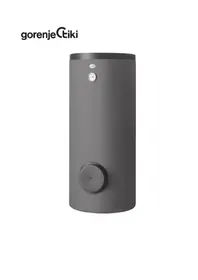



| Product type | Domestic hot water tank with heat exchanger |
| Brand | Gorenje |
| Model | KGV200 (KGV 200-1) |
| Volume | 200 liters |
| Dimensions (height x width x depth) | 1550 x 740 x 560 mm |
| Weight empty / full | 82 kg / 282 kg |
| Anti-corrosion protection | Enamel coating + magnesium anode |
| Heat exchanger surface (lower) | 1.05 m² |
| Heat exchanger volume (lower) | 6.6 liters |
| Insulation thickness | 57 mm |
| Protection class | IP21 |
| Connections | Cold water inlet (HV) and hot water outlet (TV): G 1"; Circulation (CV): G 3/4"; Heat exchanger (IM/VM): G 1" |
| Maximum operating pressure | 0.6 MPa (6 bar) |
| Compatible energy sources | Central heating boiler, solar energy, heat pump, optional electric heating element (type R or SH) |
| Main functions | Storage and production of domestic hot water via heat exchanger, possibility of electric backup |
| Routine maintenance | Check safety valve every 14 days, clean exterior with mild detergent |
| Periodic maintenance | Technical inspection by professional after 2 years (check anode, descaling if necessary) |
| Safety | Mandatory safety valve, drain if frost risk |
| Spare parts and repairability | Magnesium anode, electric heating element, safety valve; internal repairs reserved for authorized after-sales service |
Frequently Asked Questions - KGV200 GORENJE
User questions about KGV200 GORENJE
0 question about this device. Answer the ones you know or ask your own.
Ask a new question about this device
Download the instructions for your Boiler in PDF format for free! Find your manual KGV200 - GORENJE and take your electronic device back in hand. On this page are published all the documents necessary for the use of your device. KGV200 by GORENJE.
USER MANUAL KGV200 GORENJE
Dear customer, thank you for purchasing our products.
PLEASE READ THE INSTRUCTIONS CAREFULLY PRIOR TO THE INSTALLATION AND FIRST USE OF THE WATER HEATER.
The water heater has been manufactured in compliance with the relevant standards. Basic technical characteristics of the product are listed on the label attached to the protective cover.
The installation of the water heater must be carried out by qualified staff only. All repairs and maintenance work in the interior of the water heater as well as limestone removal or testing/replacement of the corrosion protection anode may only be carried out by an approved maintenance service provider.
The hot water tank is designed in a manner which allows using the following heating sources, via heat exchanger:
INSTALLATION
The heater should be installed in a dry room that is not subject to freezing conditions, preferably in the vicinity of other sources of heating (e.g. boiler room).
TECHNICAL CHARACTERISTICS
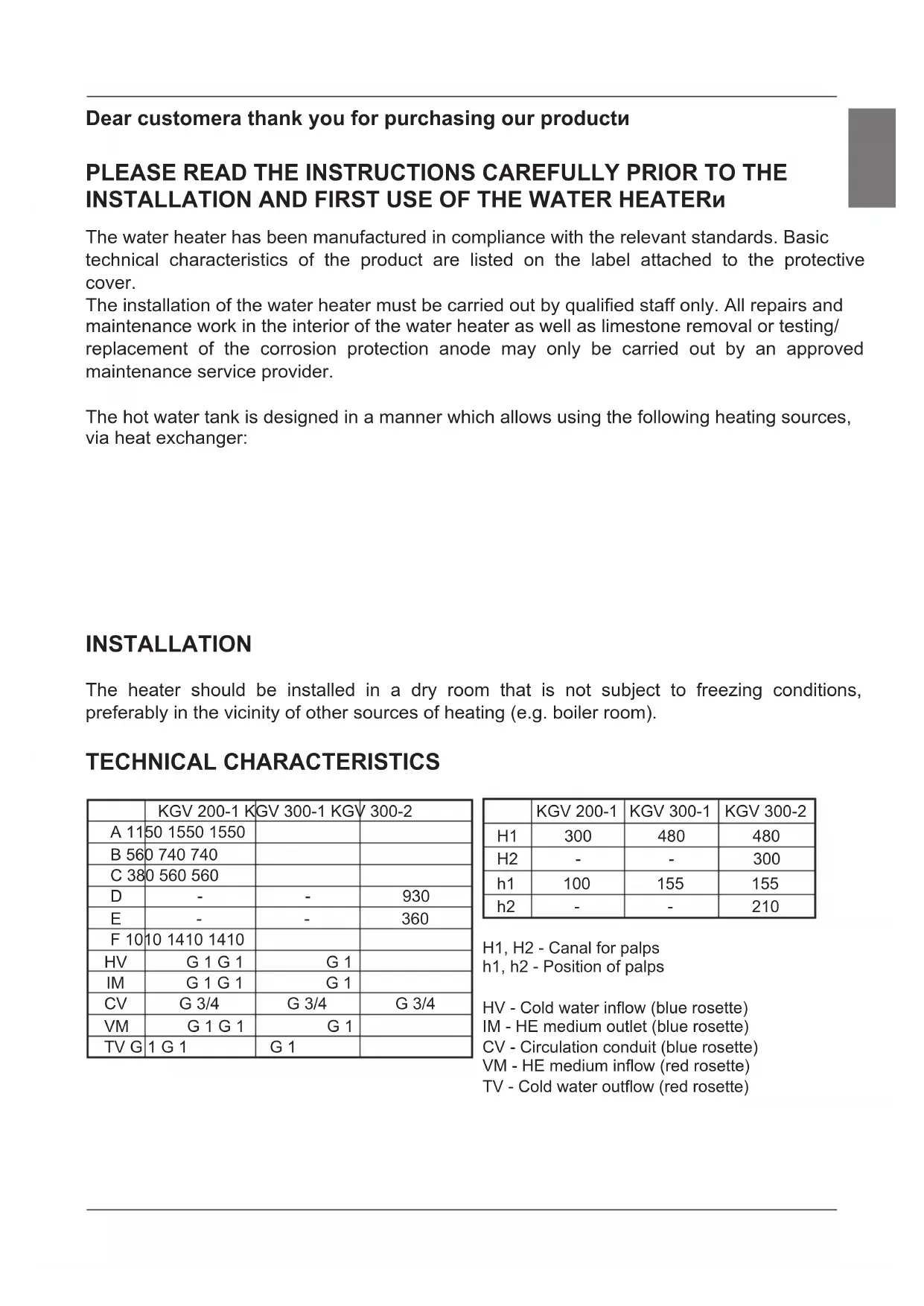
| KGV 200-1 KGV 300-1 KGV 300-2 | |||
| A 11 | 50 1550 1550 | ||
| B 56 | 0 740 740 | ||
| C 38 | 0 560 560 | ||
| D | - | - | 930 |
| E | - | - | 360 |
| F 10 | 10 1410 1410 | ||
| HV | G 1 G 1 | G 1 | |
| IM | G 1 G 1 | G 1 | |
| CV | G 3/4 | G 3/4 | G 3/4 |
| VM | G 1 G 1 | G 1 | |
| TV G | 1 G 1 | G 1 | |
| KGV 200-1 | KGV 300-1 | KGV 300-2 | |
| H1 | 300 | 480 | 480 |
| H2 | - | - | 300 |
| h1 | 100 | 155 | 155 |
| h2 | - | - | 210 |
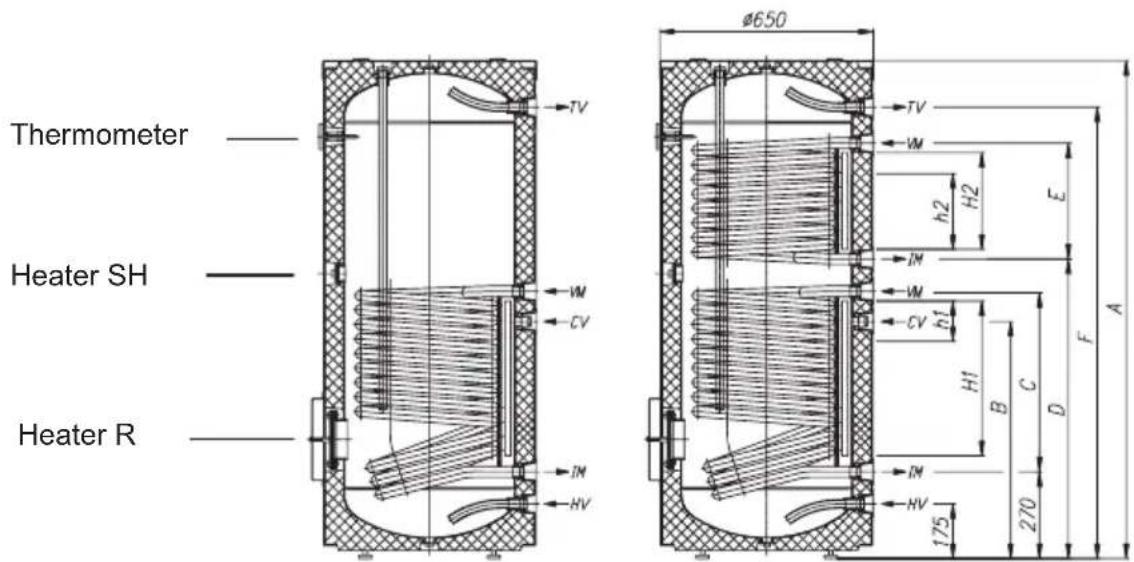
H1, H2 - Canal for palps
h1, h2 - Position of palps
HV - Cold water inflow (blue rosette)
IM - HE medium outlet (blue rosette)
VM - HE medium inflow (red rosette)
TV - Cold water outflow (red rosette)
| Type KGV 200-1 KGV 300-1 KGV 300-2 | |||
| Volume [l] 200 285 280 | |||
| Rated pressure [MPa] 0,6 | |||
| Weight / Filled with water [kg] 82 / 282 112 / 397 | 134 / 414 | ||
| Anti-corrosion protection of tank Enameled/Mg Anode | |||
| HE heated surface - lowe [m2] | 1,05 | 1,6 | 1,6 |
| HE heated surface - upper [m2] | - | - | 1,09 |
| HE volume - lower [l] | 6,6 | 10 | 10 |
| HE volume - upper [l] | - | - | 6,8 |
| insulation thickness [mm] 57 | |||
| Degree of protection IP 21 | |||
HE - Heat exchanger
On the rear side of the hot water tank there are special channels (H1, H2) for mounting the feelers for regulation of the system connection of the hot water tank to other heating sources. Access to the channels is under the covering joint of the protective covering, approximately in the middle of the tank height.
Insert the feeler into the channel and fix it with the enclosed rubber tap. Recommended position (h1, h2) of the feeler is marked on the drawing:
- If the feeler is mounted higher than recommended, the thermostat will react too fast, the operating time of the circular pump will be shorter and the difference between the temperature in the hot water tank and heating media after the thermostat switch off will be higher. This means that the quantity of water in the hot water tank and its temperature will be lower.
- If the feeler is mounted lower than recommended, the operating time of the circular pump will be longer and the difference between the temperature in the hot water tank and heating media after the thermostat switch off will be lower. This means that the quantity of water in the hot water tank and its temperature will be little higher.
CONNECTION TO THE WATER SUPPLY
Before connecting the hot water tank, install the protective covering. Take off the top cover and insert the covering, make sure the slots on the covering match the connections on the hot water tank. Zip the zipper from top to bottom and tighten the tapes on the top edge of the covering. Replace the top cover. Insert the thermometer into the prefabricated sleeve on the front of the hot water tank; make sure to cut the opening for the sleeve into the covering. The connection to water supply network and fastening of the coloured rosettes shall be made according to the markings defined in previous Section.
For safety reasons the supply pipe must be fitted with a return safety valve that prevents the pressure in the tank from exceeding nominal pressure by more than 0.1 MPa. The heating of water in the heater causes the pressure in the tank to increase to the level set by the safety valve. As the water cannot return to the water supply system, this can result in dripping from the outflow of the safety valve. The drip can be piped into the drain by installing a catching unit just below the safety valve. The drainpipe fitted under the safety valve outflow must be piped down in a straight vertical line and located in an environment free from the onset of freezing conditions.
In case the existing plumbing does not enable you to pipe the dripping water from the return safety valve into the drain, you can avoid the dripping by installing expansion tank on the inlet water pipe of the boiler. The volume of the expansion vessel shall be at least 3% of the volume of the hot water tank.
Key:
- Return safety valve
- Test valve
- Non-return valve
- Pressure-reducing valve
- Stop valve
- Test unit
- Funnel outlet to the drain
- Drain valve
H - Cold water T - Hot water
![graph TD A["Truck"] --> B["Volume Tank"] B --> C["Pump"] C --> D["Control Unit"] D --> E["1"] D --> F["2"] D --> G["3"] D --> H["4"] D --> I["5"] style A fill:#f9f,stroke:#333 style B fill:#ccf,stroke:#333 style C fill:#cfc,stroke:#333 style D fill:#fcc,stroke:#333 style E fill:#ffc,stroke:#333 styl…](/content/2026/02/411162/images/d4440ab984ab8335ac1ee5de251d781b88a0385420fa1d2b93c1621127312ea1.jpg)
The water heater may be connected to the household water supply system without a pressure-reducing valve provided the supply mains pressure is less than 0.5 MPa.
In case of the mains pressure exceeding 0.5 MPa, a pressure-reducing valve must be installed to ensure that the pressure on the supply side of the heater does not rise above the nominal value.
CONNECTION TO ALTERNATIVE SOURCES OF HEATING
The heaters enable the water for sanitary use to be heated by alternative sources of energy (e.g. central heating, solar power, ...) by installing one or two heat exchangers.
Additionally, a heating pump may also be fitted to the side flange of the tank.
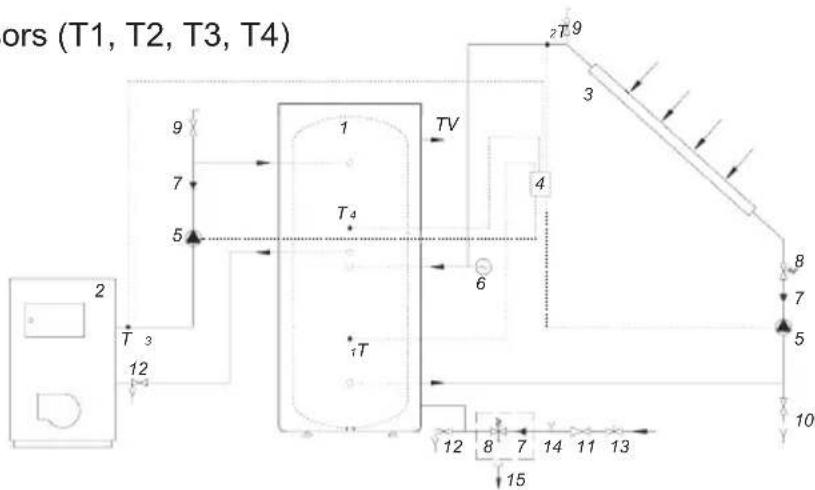
Options for connecting the water heater to various sources of heating are shown in the drawings below.
Connection to solar panels
Connection to the
central heating hot-water system
![graph TD A["1"] --> B["T1"] B --> C["6"] C --> D["T2"] D --> E["9"] D --> F["3"] D --> G["4"] G --> H["8"] G --> I["7"] G --> J["5"] G --> K["10"] L["12"] --> M["8"] M --> N["17"] N --> O["1134"] P["15"] --> Q["12"] Q --> R["17"]](/content/2026/02/411162/images/4e3ca83eda8cbcdd42253d0bee493bc866da0bddf52e7c1b071b0960ec7a0ef5.jpg)
![graph TD A["2"] --> B["T3"] B --> C["5"] C --> D["1"] D --> E["1T"] C --> F["7"] F --> G["8"] G --> H["12"] H --> I["13"] I --> J["14"] J --> K["15"] K --> L["9"] L --> M["4"]](/content/2026/02/411162/images/cead5eab872388875599228b70a1c44c3af83097576f2925e51c7790f085b37a.jpg)
- Water heater
- Central heating hot-water system
- Solar panel
- Differential thermostat with sensors (T1, T2, T3, T4)
- Bypass pump
- Expansion tank
- Non-return valve
- Safety valve
- Air relief valve
- Fill/drain valve
- Reduction valve
- Drain valve
- Stop valve
- Test unit
- Funnel outlet to the drain
Connection to solar panels and central heating hot-water system
The water heater is ready for use once it has been connected to water and other sources of heating.
The usual main sources of heating of water for sanitary use are central heating or solar power; in this case any regulation of water heating is performed in the heating system.
- If you need higher temperature of water than assured by other heating sources,
- If due to seasonal or other conditions there are no main heating sources.
In case of exposure to sub-zero temperatures, the water should be thoroughly drained from the heater before the onset of freezing conditions.
Once that is done, open the hot water tap on one of the mixer taps connected to the water heater. The water from the water heater drains by way of the drain valve on the inlet pipe.
External parts of the water heater may be cleaned with a mild detergent solution. Do not use solvents and abrasive cleaners.
Regular preventive maintenance inspections ensure faultless performance and long life of your heater. The first of these inspections should be carried out by an authorised maintenance service provider about two years from the date of installation in order to inspect the wear of the corrosion protection anode and to remove any limestone as required. Build-up of limestone is a product of quality, quantity and temperature of water flowing through the water heater. While inspecting the heater, the maintenance service provider will also recommend the date of the next inspection.
Wear of the corrosion protection anode is carried out visually. Replacement is required when the inspection reveals that the anode diameter has been substantially reduced or worn all the way to the steel core.
Tank warranty is subject to regular inspections of the protective anode.
In the event of the water heater breaking down, you are kindly requested to contact the authorised maintenance service provider located closest to you! Please do not attempt to repair the unit yourself.
| Tip KGV 200-1 KGV 300-1 KGV 300-2 | |||
| Korisni volumen [l] 200 285 | 280 | ||
| Nominalni tlak [MPa] 0,6 | |||
| Masa grijalice/napunjene vodom [kg] 82 / 282 | 112 / 397 134 | / 414 | |
| Zaštita kotla od korozije emajlirano / Mg anoda | |||
| Grijana površina IT-gornji [m2] | 1,05 | 1,6 | 1,6 |
| Grijana površina IT-dolnji [m2] | - | - | 1,09 |
| Obujam IT-donji [l] | 6,6 | 10 | 10 |
| Obujam IT-gornji [l] | - | - | 6,8 |
| Debljina izolacije [mm] 57 | |||
| Stupanj zaštite IP 21 | |||
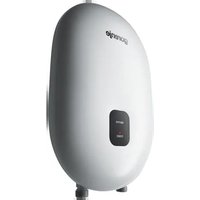


Brand : GORENJE
Model : KGV200
Category : Boiler