BM101 - Blood pressure monitor ELTA - Free user manual and instructions
Find the device manual for free BM101 ELTA in PDF.



Frequently Asked Questions - BM101 ELTA
User questions about BM101 ELTA
0 question about this device. Answer the ones you know or ask your own.
Ask a new question about this device
Download the instructions for your Blood pressure monitor in PDF format for free! Find your manual BM101 - ELTA and take your electronic device back in hand. On this page are published all the documents necessary for the use of your device. BM101 by ELTA.
USER MANUAL BM101 ELTA
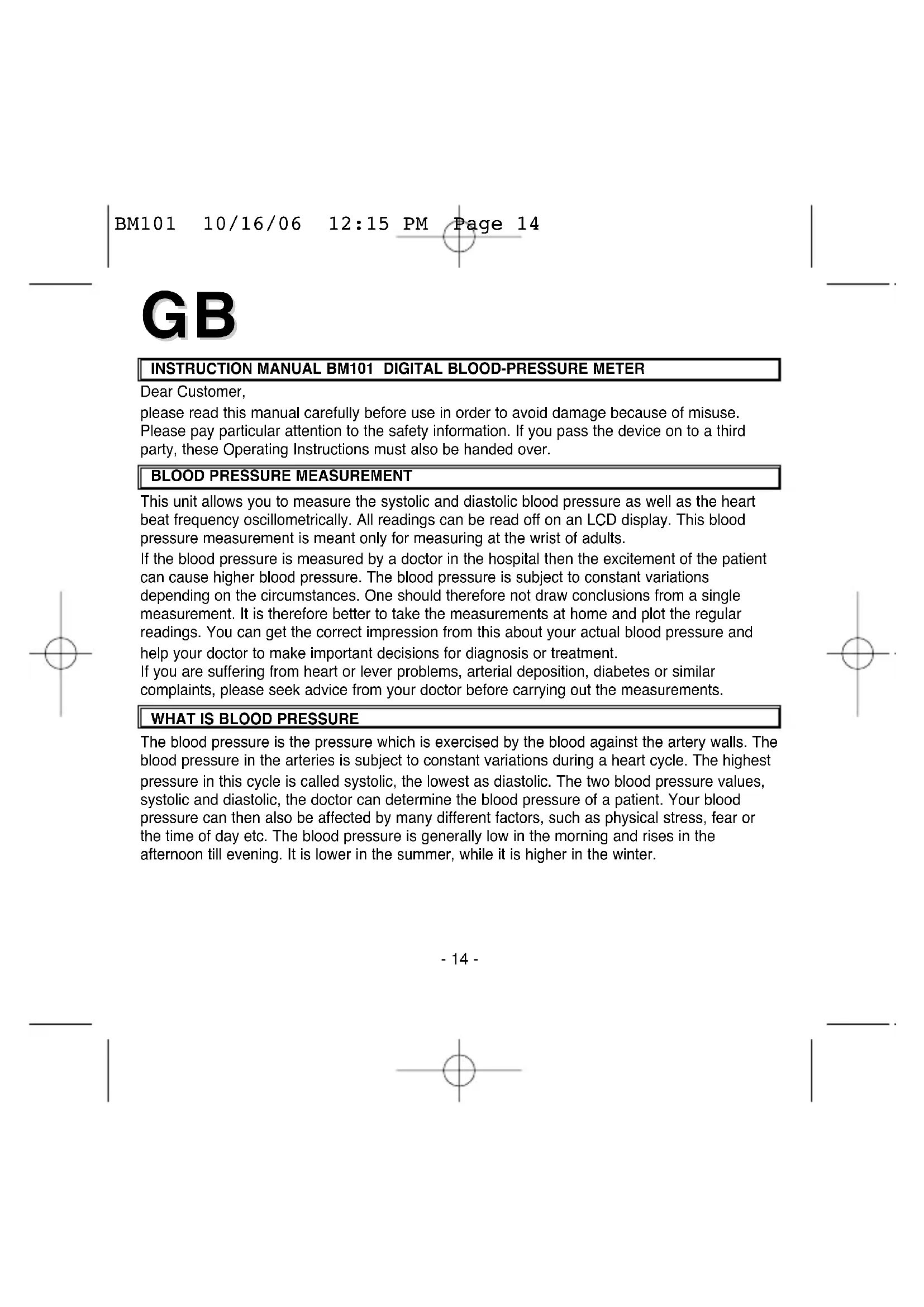
please read this manual carefully before use in order to avoid damage because of misuse. Please pay particular attention to the safety information. If you pass the device on to a third party, these Operating Instructions must also be handed over.
BLOOD PRESSURE MEASUREMENT
This unit allows you to measure the systolic and diastolic blood pressure as well as the heart beat frequency oscillometrically. All readings can be read off on an LCD display. This blood pressure measurement is meant only for measuring at the wrist of adults.
If the blood pressure is measured by a doctor in the hospital then the excitement of the patient can cause higher blood pressure. The blood pressure is subject to constant variations depending on the circumstances. One should therefore not draw conclusions from a single measurement. It is therefore better to take the measurements at home and plot the regular readings. You can get the correct impression from this about your actual blood pressure and help your doctor to make important decisions for diagnosis or treatment.
If you are suffering from heart or lever problems, arterial deposition, diabetes or similar complaints, please seek advice from your doctor before carrying out the measurements.
The blood pressure is the pressure which is exercised by the blood against the artery walls. The blood pressure in the arteries is subject to constant variations during a heart cycle. The highest pressure in this cycle is called systolic, the lowest as diastolic. The two blood pressure values, systolic and diastolic, the doctor can determine the blood pressure of a patient. Your blood pressure can then also be affected by many different factors, such as physical stress, fear or the time of day etc. The blood pressure is generally low in the morning and rises in the afternoon till evening. It is lower in the summer, while it is higher in the winter.
GB
WHAT IS THE PURPOSE OF MEASURING THE BLOOD PRESSURE AT HOME ?
Measuring the blood pressure as well examination by a doctor in the hospital or in a clinic tends to an increase in the nervousness in many patients, which causes higher blood pressure. The blood pressure can also vary under various circumstances and therefore an objective judgment on the basis of a single measurement is not possible.
The blood pressure measured in the morning or after getting up and before having breakfast of a patient sitting still is defined as the fundamental blood pressure. Therefore a blood pressure measurement at home is advisable, because the blood pressure in this state is the nearest to it.
A. Blood pressure classification of WHO
The standards for defining the high and low blood pressures, irrespective of the age have defined by the World Health Organization (WHO) as shown in Fig.1
B. Variations in the blood pressure
The individual blood pressure is subject to variations on a daily basis or according to the season. These variations are more distinct in patients with high blood pressure. Normally, the blood pressure rises during work while it is at its
lowest at night during sleep.
The variations of the blood pressure during the day are shown in Fig. 2, the readings having been taken every 5 minutes.
The thick line shows the sleeping period. The rise in the blood pressure at 4 o'clock in the morning (shown as A in the figure) and at 12 o'clock noon (shown in the figure as B) shows an attack of pain.
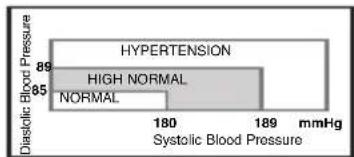
Fig. 1
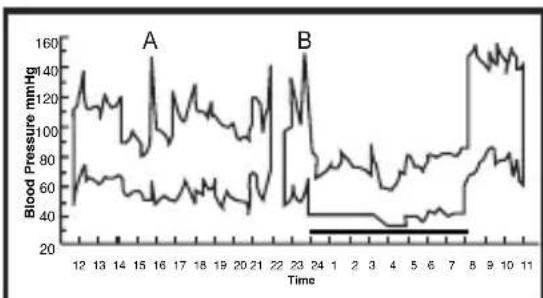
Fig. 2
GB
TIPS TO BE REMEMBERED BEFORE USING THE MEASURING INSTRUMENT UNIT
- The blood pressure should be taken by a doctor or an expert who knows your illness history. By making a regular use of the blood pressure measuring unit and plotting the readings, you keep the doctor up-to-date with the tendencies of your blood pressure.
- Tie the sleeve well around your wrist. The sleeve should be at the same height as your heart.
- Do not move or shake the measuring unit during measurement, because that would render the readings inaccurate.
- Carry out the measurement while you are at rest and unstressed.
- Do not wind the sleeve around the sleeve of your jacket or shirt, otherwise measuring the blood pressure is not possible.
- Please remember that the blood pressure changes according to nature and the time of the day and also depends upon several factors such as smoking, alcohol consumption, medication consumption and physical stress and strain.
- In case of persons with a state caused by circulation problems (diabetes, kidney problems, calcification of arteries or circulation problems) the readings on this monitor can appear lower than in a blood pressure monitor, which measures the blood pressure on the upper arm. Please consult your doctor, to ensure whether the blood pressure measurement on your wrist will give correct readings.
- The readings obtained with this measuring unit correspond to those of a trained person, who carried out measurement with a sleeve or by listening through a stethoscope. The readings are within the limits defined by the National Standardization for electronic and automated Sphygmomanometer of the United Nations.
GB
DESCRIPTION OF THE UNIT
A. Names of the parts
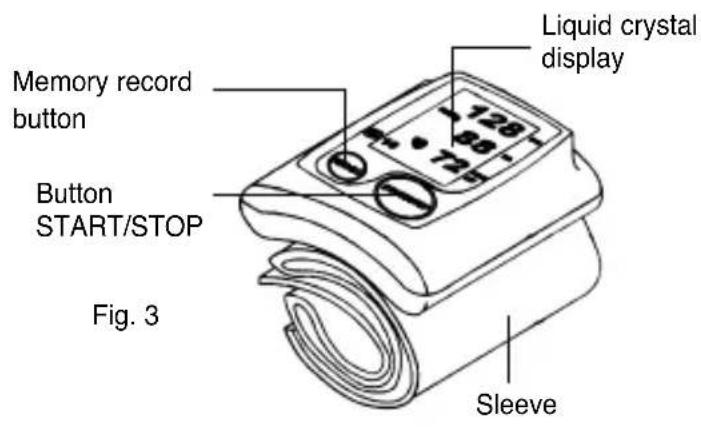
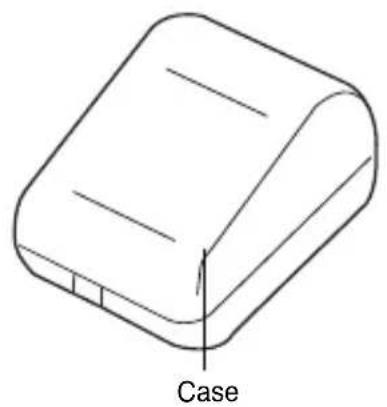
B. Description of the indication symbols
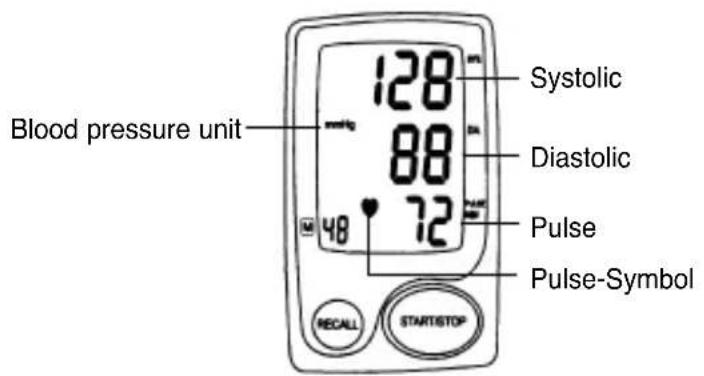
GB
CHANGING THE BATTERIES
- Remove the protective film from the screen.
- Remove the lid from the battery compartment on the underside of the measuring unit and insert the batteries into the battery compartment as shown. Always observe the correct polarity + and - of the batteries. Please only use alkaline batteries!
Important note: It can be a little difficult to take out the batteries from the compartment. Please use a hard and accessible object such as a ball point pen.
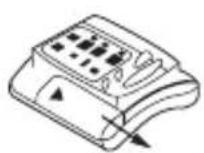
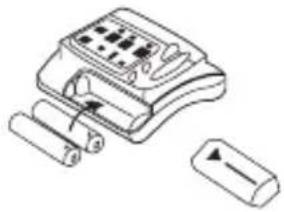
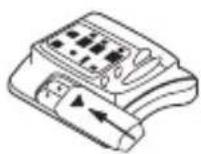
Fig. 4
- Wind the sleeve around the wrist
- The display of the measuring unit must be on the palm side of the wrist.
The wrist must be free.
- Tighten the sleeve around the wrist. Do not pull forcefully on the sleeve. Do not tighten the sleeve too much.

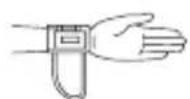
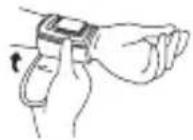
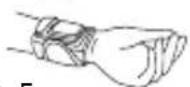
Fig. 5
GB
CORRECT BODY POSTURE DURING MEASUREMENT
To obtain as accurate readings as possible, always remember to hold the sleeve at the same height as the heart. If the sleeve is higher or lower than the heart this causes deviations from the actual blood pressure.
Measuring blood pressure while sitting:
- Support the elbow on a table surface or other surfaces (such as the bag pocket).
- Place the arm on the arm rest for correct positioning such that the sleeve is at the same height as the heart as far as possible.
- Relax your hand, the palm must face upwards.
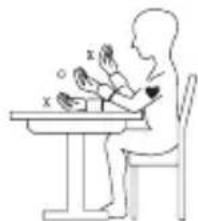
Abb. 6
DESCRIPTION OF THE SYMBOLS IN THE DISPLAY
Symbol in the display Condition/ Cause Corrective measures

This symbol appears during the Do not move or talk during the measurement and blinks when the measurement. pulse is detected.
Battery Change this symbol appears, if the battery Replace both batteries by new is going to be completely ones. Always observe the correct exhausted soon, or the polarity + and - of the batteries batteries have been inserted while inserting them wrongly
Measuring error This symbol appears if the blood Press the "START/STOP"-button pressure cannot be measured again and measure again. The correctly. sleeve must be wound around the
wrist as given in the instructions. Relax the hand. Do not move or talk during the measurement. See that the posture is correct.
GB
Symbol in the display Condition/ Cause Corrective measures
Measuring the Appears till the measurement is blood pressure over

INSTRUCTIONS FOR MEASUREMENT
- Inserting the batteries
a. Remove the cover of the battery compartment.
b. Observe the correct polarity while inserting the batteries. Fig. 4
c. All the LCD segments are activated in the display in 3 seconds.
d.Display: Month 1, Date 1, Hour 12, Minute 0.
Steps to measure the blood pressure:
a) Wind the sleeve around the wrist (see section „ Winding the sleeve around the wrist“, as shown in Fig. 5).
b) Sit on a chair and assume an erect body position (see section "Correct posture", as shown in Fig. 6).
c) Press the key START/STOP. The number "888" appears in the display for 3 seconds. The blood pressure measurement symbol blinks in the display and the air pressure is raised automatically to 195mmHg . In case of a tendency to high blood pressure the air pressure is raised for the necessary level for measurement automatically. *Do not move or talk during the measurement.
d) After raising the air pressure the air is let out slowly. On detecting the pulse, the HEARTBEAT symbol starts blinking.
e) After measuring the blood pressure the systolic, diastolic and the pulse rate figures appear for a minute blinking in the display and then go off automatically.
GB
- Storing, calling up and deleting the readings:
a. Storing the data:
After every blood pressure measurement the data of the systolic, diastolic and pulse rate are stored automatically. The memory can store the latest 48 readings. If there are more than 48 readings, the oldest ones are deleted automatically.
b. Recalling data:
(1) On pressing the RECALL button, there are no data on display, if no data have been stored. If data are stored, the display shows the last measured readings for the systolic, diastolic and heart beat rates and go off after one minute (60 seconds).
(2) To read the next line of the stored readings, press the button RECALL. The readings recalled in the display are numbered appropriately. After reading the stored readings, which appear in the cycle of 48 readings.
(3) To cancel reading during the display of the readings, the START/ STOP button must be pressed.
c. Deleting data
(1) Remove the batteries and then re-insert the 2 batteries.
(2) To check if the data are deleted, press RECALL button. If so, the display will not show any data.
- Changing the batteries
If " appears in the display, the battery is consumed.
Replace the batteries otherwise no further blood pressure measurements are possible.
MAINTENANCE
- To clean the housing, use a lightly moistened cloth with a little cleaning medium and then dry it with a dry piece of cloth. Use dry cloth to clean the sleeve if it is dirty.
- Do not use any spray cleaners or strong cleaning media.
- If the unit is not going to be used for some time, remove the batteries. (*Expired batteries can damage the unit.)
GB
STORAGE
- Always store the sleeve in its tray after use.
- Protect the measuring unit with its accessories from direct sunlight, high temperatures, humidity and dust.
- Do not subject it to extremely low (below -20^ ) or high (over 60^ ) temperatures.
PREVENTION OF MALFUNCTIONING:
- Do not twist the sleeve.
- Do not pump air into the sleeve, unless it is wound around the wrist.
- Do not try to disassemble the unit or to change the components of the monitor.
- Do not let the measuring unit fall down or suffer heavy impacts.
TO BE OBSERVED
- Use the unit only to measure blood pressure of adults.
- Do not use the measuring unit if your wrist is injured.
- If the sleeve is pumped up and would not stop, open it immediately.

TECHNICAL DATA
Model No. BM 101
Measurement method Oscillometric
Measurement range Pressure 0-300 mmHg, Pulse 40-199 beats per
minute
Measuring accuracy Pressure +/- 3mmHg, Pulse +/- 5%
Rough pressure Automatic re-pumping system
Pumping up Automatic pumping up (air pump)
Air venting Automatic vent valve
Display Digital Liquid Crystal Display
Memory 48 readings
Dimensions L70 x W72 x H29 mm
Weight Approx. 130g incl. batteries
Sleeve size For a wrist perimeter of about 135 to 195mm
Permitted operating temperature +10^ to +40^ , 30-85% relative humidity
Permissible storage temperature -20°C to 50°C, 10-95% relative humidity
Power supply 3V 2x1,5 V LR3/AAA Alkaline-Batteries
Battery operating life For about 250 measurements
Accessories Bag, Instruction Manual, Batteries
GB
NOTE
Important!
Read the operating instructions.
Classification:
- Internally powered equipment
BF type applied part - IPX0
- Not suitable for use in presence of flammable anaesthetic mixture with air or with oxygen or nitrous oxide
- Continuous operation with short-time loading
This Blood Pressure Monitor complies with the EC Directives and bears the CE Mark "CE 0197".
The quality of the device has been verified and is in line with the provisions of the EC council directive 93/42/EEC (EN IEC60601-1 - General requirements for safety, EN IEC 60601-1-2:2001 - Electromagnetic compatibility-Requirements and tests) dated 14 June 1993 concerning medical devices and the EN performance standards as follow:
EN 1060-1:
Non-invasive sphygmomanometers - General requirements
EN 1060-3:
Non-invasive sphygmomanometers - Supplementary requirements for electromechanical blood pressure measuring systems.
EN 1060-4:
Non-invasive sphygmomanometers - Test procedures to determine the overall system accuracy of automated non-invasive sphygmomanometers.
GB
INSTRUCTIONS ON ENVIRONMENT PROTECTION

Do not dispose of this product in the usual household garbage at the end of its life cycle; hand it over at a collection point for the recycling of electrical and electronic appliances. The symbol on the product, the instructions for use or the packing will inform about the methods for disposal.
The materials are recyclable as mentioned in its marking. By recycling, material
recycling or other forms of re-utilization of old appliances, you are making an important contribution to protect our environment.
Please inquire at the community administration for the authorized disposal location.
GUARANTEE AND CUSTOMER SERVICE
Before delivery our devices are subjected to rigorous quality control. If, despite all care, damage has occurred during production or transportation, please return the device to your dealer. In addition to statutory legal rights, the purchaser has an option to claim under the terms of the following guarantee:
For the purchased device we provide 2 years guarantee, commencing from the day of sale. During this period we will remedy all defects free of charge, which can be demonstrably attributed to material or manufacturing defects, by repair or exchange.
Defects which arise due to improper handling of the device and malfunctions due to interventions and repairs by third parties or the fitting of non-original parts, are not covered by this guarantee.

0197
ELTA GmbH
Carl-Zeiss-Str. 8
D-63322 Rodermark/
Ober-Roden, Germany

MODE D'EMPLOI BM101 TENSIOMETRE
Chere Cilente, cher Client
COS'É LA PRESSIONE SANGUIGNA
POSTURA CORPORAL CORRECTA A MANTER DURANTE A MEDICAO
OWINIECIE MANKIETU WOKÖL NADGARSTKA
GWARANCJA I ZAKLADY USLUGOWE
BESCHRIJVING VAN HET APPARAAT
POPIS SYMBOLU NA DISPLEJI
Symbol na displeji Podminka/Princina Napraná opatrení