 ManualGo.com
 PS 420 EBQPlus - Scie FESTOOL - Free user manual and instructions
Find the device manual for free PS 420 EBQPlus FESTOOL in PDF.


Download the instructions for your Scie in PDF format for free! Find your manual PS 420 EBQPlus - FESTOOL and take your electronic device back in hand. On this page are published all the documents necessary for the use of your device. PS 420 EBQPlus by FESTOOL.
USER MANUAL PS 420 EBQPlus FESTOOL
S 105/4 FSG FSG ADT-PS 400
EC-Declaration of Conformity. We declare
under our sole responsibility that this product is in
conformity with all relevant provisions of the fol-
lowing directives including their amendments and
complies with the following standards:
Head of Product Development
Head of Product Conformity
EPTA‑Procedure 01:2014
8 Working with the electric power tool20
9 Service and maintenance21
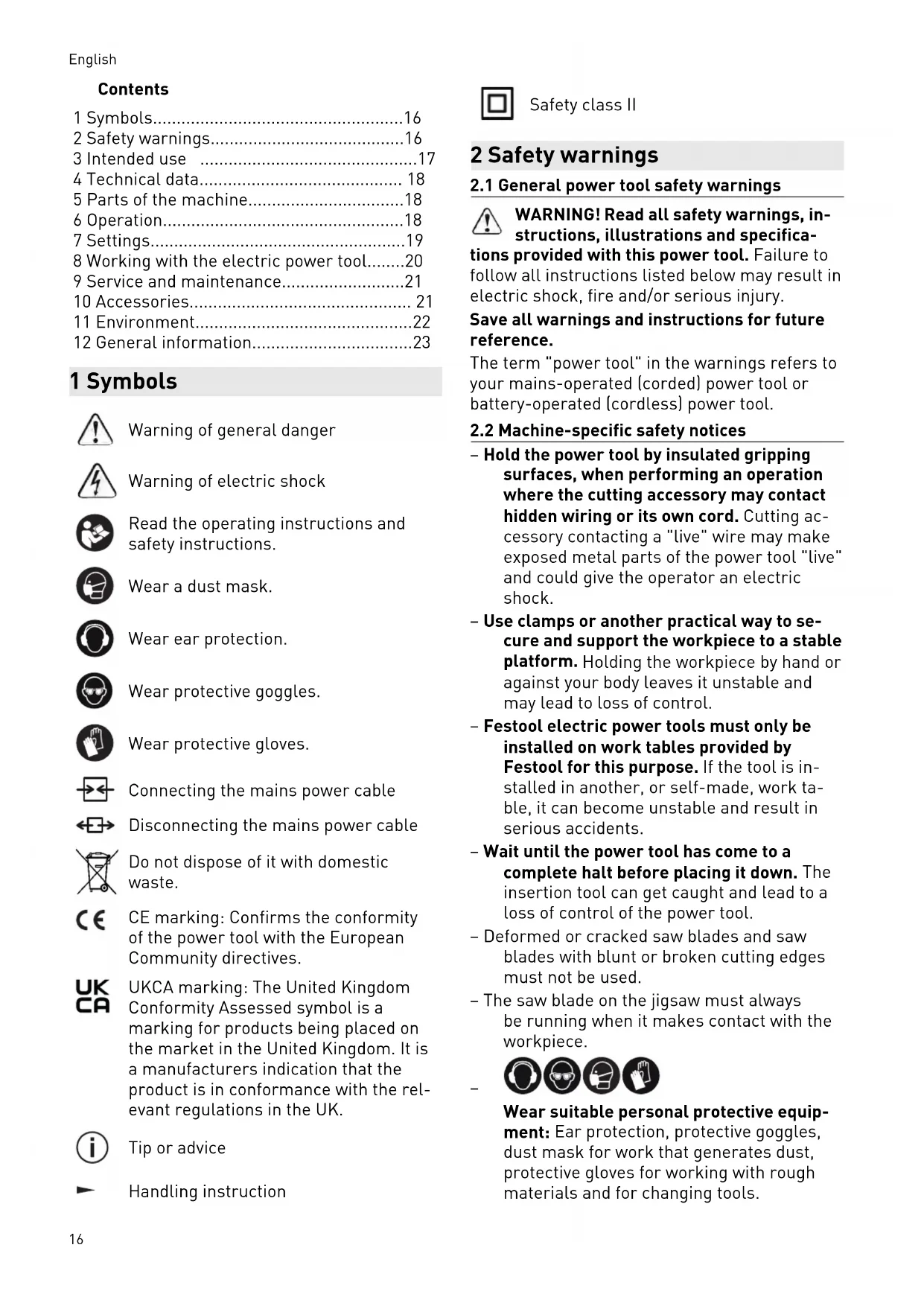
Warning of general danger
Warning of electric shock
Read the operating instructions and
safety instructions.
Wear ear protection.
Wear protective goggles.
Wear protective gloves.
Connecting the mains power cable
Disconnecting the mains power cable
Do not dispose of it with domestic
CE marking: Confirms the conformity
of the power tool with the European
Community directives.
UKCA marking: The United Kingdom
Conformity Assessed symbol is a
marking for products being placed on
the market in the United Kingdom. It is
a manufacturers indication that the
product is in conformance with the rel
evant regulations in the UK.
2.1 General power tool safety warnings
Read all safety warnings, in
structions, illustrations and specifica
tions provided with this power tool. Failure to
follow all instructions listed below may result in
electric shock, fire and/or serious injury.
Save all warnings and instructions for future
The term "power tool" in the warnings refers to
your mains-operated (corded) power tool or
battery-operated (cordless) power tool.
2.2 Machine-specific safety notices
– Hold the power tool by insulated gripping
surfaces, when performing an operation
where the cutting accessory may contact
hidden wiring or its own cord. Cutting ac
cessory contacting a "live" wire may make
exposed metal parts of the power tool "live"
and could give the operator an electric
– Use clamps or another practical way to se
cure and support the workpiece to a stable
Holding the workpiece by hand or
against your body leaves it unstable and
may lead to loss of control.
– Festool electric power tools must only be
installed on work tables provided by
Festool for this purpose. If the tool is in
stalled in another, or self-made, work ta
ble, it can become unstable and result in
– Wait until the power tool has come to a
complete halt before placing it down.
insertion tool can get caught and lead to a
loss of control of the power tool.
– Deformed or cracked saw blades and saw
blades with blunt or broken cutting edges
– The saw blade on the jigsaw must always
be running when it makes contact with the
Ear protection, protective goggles,
dust mask for work that generates dust,
protective gloves for working with rough
materials and for changing tools.
16– Harmful/poisonous dust may be produced
when working (e.g. paint products con
taining lead and some types of wood).
Contact with or inhalation of this dust may
pose a risk for the operating personnel or
persons in the vicinity. Comply with the
safety regulations that apply in your coun
try. Connect the power tool to a suitable
– Always connect the machine to a dust ex
tractor when performing work that gener
– Check the plug and the cable regularly and
should either become damaged, in order to
avoid a hazard, have them replaced by an
authorised after-sales service workshop.
– Stroboscopic light can cause epileptic
seizures. Do not use this machine if you
are susceptible to epileptic seizures.
– Do not look into the stroboscope light.
Looking into the light source can damage
The tool shall always be
supplied via residual current device with a
rated residual current of 30 mA or less.
2.3 Metal processing
When processing metal, the following
measures must be taken for safety rea
– Install an upstream residual-current circuit
breaker (RCD, PRCD).
– Connect the machine to a suitable dust ex
– Regularly remove dust deposits from the
– Use a metal saw blade.
– Close the chip guard.
Wear protective goggles.
The levels determined in accordance with
PS 420 EBQ Sound pressure level L PA
Sound power level L WA
Uncertainty K = 5 dB PSB 420 EBQ Sound pressure level L PA
Sound power level L WA
Uncertainty K = 5 dB CAUTION Noise generated when working
Risk of damage to hearing
► Use ear protection.
three directions) and uncertainty K measured in
accordance with EN 62841:
PS 420 EBQ PSB 420 EBQ Sawing wood a
The specified emission levels (vibration, noise)
– are used to compare machines.
– They are also used for making preliminary
estimates regarding vibration and noise
load during operation.
– They represent the primary applications of
CAUTION The emission values may deviate from the
specified values. This is dependent on how
the tool is used and the type of workpiece
► The actual load during the entire operating
cycle must be evaluated.
► Depending on the actual load, suitable pro
tective measures must be defined in order
to protect the operator.
Jigsaws are designed for sawing wood and ma
terials similar to wood. With the special saw
blades offered by Festool, these machines can
also be used for sawing plastic, steel, alumini
um, non-ferrous metal and ceramic plates.
The user is liable for improper or non-in
110 V version 400 W Stroke rate
Pendulum stroke 4 settings
Max. inclination (only with accessory WT-PS 400 angle table) 45° to both sides
Max. cutting depth (depending on saw blade) Wood 120 mm
Weight (without cable, with extractor connector) as per EPTA-
5 Parts of the machine
Variable speed trigger (only PSB 420
Safety lock (only PSB 420 EBQ)
Adjusting wheel for stroke rate con
Swivel plug it connection (only PS 420
Replaceable saw table
Chip ejection opening
The specified illustrations appear at the begin
ning of the Operating Instructions.
WARNING Unauthorised voltage or frequency.
► The mains voltage and the frequency of the
power source must correspond to the
specifications on the name plate.
► In North America, only Festool machines
with the voltage specifications 120 V/60 Hz
CAUTION Heating of the Plug it connection if bayonet
fitting is not completely locked
► Before switching on the power tool, make
sure that the bayonet fitting at the mains
cable is closed fully and locked.
Connecting and detaching the mains power ca
[1-8] see figure [2].
6.1 Switching on/off
The power tool features a switch [1-2] on both
sides to turn it on and off.
PSB 420 EBQ also has a variable speed
with a safety lock [1-5]. For con
tinuous operation, use the button [1-2].
WARNING Risk of injury, electric shock
► Always disconnect the mains plug from the
socket before performing any work on the
CAUTION Risk of injury from hot and sharp insertion
Selecting the saw blade
Only use saw blades with a T-shank. The
saw blade should not be longer than that
required for the intended cut. To ensure safe
guidance, during the cut the saw blade should
emerge at the bottom of the workpiece at every
Only use cross-set saw blades when using
angle tables and base adapters. We rec
ommend the S 105/4 FSG Festool saw
Festool saw blades for jigsaws are colour-co
ded. The colour represents the material for
which the saw blade is suited.
Green Building materials
More information can be found on the packag
ing, in your Festool catalogue or at
Inserting the saw blade
Always disconnect the power tool from
the power supply before changing
[3-2] as far as the stop with its teeth in the
► Turn the saw blade [3-4] clockwise by ap
prox. 30° until it engages.
Check that the saw blade is secure. A
loose saw blade can fall out and cause an
If the saw blade is very short, it is advisa
ble to remove the saw table (see sec
7.4) before inserting the saw blade.
Adjust the saw blade guide after every saw
The saw blade guide was designed to improve
guidance of the saw blade.
► Remove the saw table (see section 7.4
► Tighten the screw [3-6]
until the jaws are almost touching
NOTICE Damage to the machine or saw blade
► Do not tighten the screw [3-6] too much. It
must be possible to move the saw blade
Ejecting the saw blade
When ejecting the saw blade, hold the
power tool such that no persons or ani
mals can be injured.
► Push the saw blade ejection [3-3] forwards
Saw blade ist thrust out mechanically.
A tool change is only possible when the
tool holder is located in the upper position.
When changing the saw blade is not possible:
Let the jigsaw run at a high speed for 3–10 sec
onds. Actuate the saw blade ejection [3-3]
7.2 Using the chip guard
The chip guard [3-1] prevents chips from flying
away and improves the efficiency of the chip ex
► Apply slight pressure to push the chip
guard [3-1] downwards.
7.3 Inserting the splinterguard
The splinterguard prevents the edges of the
material from splintering during the cut, even
at the end where the saw blade exits the mate
► Switch off the machine and slide the splin
► On a level surface, slide in the splinterguard
(not using your hand!) while the machine is
operating until it is flush with the front edge
of the saw table (speed setting 5). This cuts
into the splinterguard.
When it is worn, push the splinterguard
approx. 3 mm further to the rear and con
To guarantee reliable operation of the
splinterguard, it must seal tightly on both
sides of the saw blade. A new splinter
guard should therefore be fitted after ev
ery saw blade change to guarantee splint
7.4 Changing the saw table
► Open the change lever [1-10].
► Remove the saw table downwards.
Assembly is performed in reverse se
quence to removal. Ensure that the saw
table is firmly seated in the guide.
Instead of the saw table, the WT-PS 400 angle
table or ADT-PS 400 base adapter can be instal
Never saw without the saw table, or one
of the other tables or adapters offered in
the Festool accessories range.
WARNING Health risk due to dust
► Always work with an extractor.
► Comply with national regulations.
The extraction adapter [5-3] allows jigsaws to
be connected to a dust extractor (hose diameter
► Insert the extraction adapter in the rear
opening of the saw table so that the
hook [5-2] engages in the recess [5-1]
Due to the low power consumption of the
machine (low energy consumption), dust
extractors with an automatic switch-on
function will sometimes only start up when
the actual cut is made.
► Set the dust extractor to continuous opera
The pendulum stroke on pendulum jigsaws can
be adjusted to machine different materials with
the correct rate of advance. Select the required
setting using the pendulum stroke switch
Position 0 = pendulum stroke off
Position 3 = maximum pendulum stroke
Recommended pendulum stroke setting
Hardwood, softwood, chipboard, wood fi
Blockboard, plywood, plastic 1–2
Aluminium, non-ferrous metals 0–2
7.7 Stroke rate control
Using the adjusting wheel [1-6], the stroke rate
can be continuously adjusted between 1500 and
(PSB 420 EBQ: 1000–3800
enables you to optimise the cutting speed to
suit the respective material.
Automatic load detection is activated in posi
tion A: The stroke rate drops when idling and is
adjusted to the highest setting when the work
piece is introduced.
Recommended stroke rate (position of the ad
Hard and soft wood, blockboard, ply
A Fibreboard 4–A Plastic 3–A Ceramic, aluminium, non-ferrous met
8 Working with the electric
CAUTION Materials which produce a lot of dust
Damage to the machine due to the ingress of
dust, risk of injury
► Do not work overhead.
When working on small or thin workpieces, al
20When working, hold the electric power tool by
the handle and guide it along the desired cut
ting line. For precise cuts and smooth running,
use two hands to guide the electric power tool.
8.1 Free saw guidance along a scribe mark
The triangular pointer on the splinterguard
[4-1] indicates the cutting line of the saw blade.
This facilitates sawing along a scribe mark.
WARNING Stroboscopic light could lead to misjudge
ment of the saw blade position
► Ensure the work area is well illuminated.
A steady light or stroboscopic light is installed
to illuminate the cutting line:
Up to approx. 2100 rpm: Steady light
From approx. 2100 rpm upwards: Stroboscopic
In the overhead position (+/- 45°), the
lighting is switched off completely.
If required, you can adjust the lighting:
► Plug in the electric power tool.
► Press both buttons [1-2] simultaneously
and hold for approx. 10 s until a beep
► Release both buttons [1-2].
► Press the left button (on the pendulum
stroke side) the specified number of times
to set the desired mode:
Behaviour during op
1 Light flashes With stroboscope
2 Light on Steady light without
3 Light off Light switched off
► Press the right button to save the setting.
9 Service and maintenance
WARNING Risk of injury, electric shock
► Always pull the mains plug from the socket
before performing any servicing and main
► All maintenance and repair work which re
quires the motor housing to be opened
should always be carried out by an author
ised service workshop.
Customer service and repairs
only be carried out by the manufac
turer or service workshops. Find the
www.festool.co.uk/service
Always use original Festool spare
parts. Order no. at:
www.festool.co.uk/service
9.1 Observe the following information
► Check the guidance roller regularly for
► Regularly remove dust deposits from the
► Regularly clean the base runner to prevent
scratches and cores on the surface.
► Damaged safety devices and components
must be repaired or replaced in a recog
nised specialist workshop, unless otherwise
indicated in the operating instructions.
► To ensure constant air circulation, always
keep the cooling air openings in the motor
housing clean and free of blockages.
► Keep the contacts on the power tool, charg
er and battery pack clean.
9.2 Cleaning the chip ejection opening
Clean the chip ejection opening [1-15] regularly
to prevent blockages:
► Remove the chip guard.
► Use a brush or vacuum cleaner to clean the
chip ejection opening.
► Reinsert the chip guard.
The order numbers of the accessories and tools
can be found in the Festool catalogue or on the
Internet at "www.festool.com".
10.1 Saw blades, other accessories
In order to saw different materials quickly and
cleanly, Festool offers saw blades for all appli
21cations that are specially designed for your
10.2 Sawing with special base runners
The special base runners protect high-quality
surfaces against scratches and scores.
► Press in the base runner at position [6-1].
► At the same time, push the base runner for
► Mount another base runner and push it to
the rear until it engages.
10.3 Sawing with the angle table
The WT-PS 400 angle table is used for
cutting pipes or interior and exterior an
Dust extraction is not possible when sawing
with the angle table!
Installing the angle table
► Remove the saw table [1-12] (see section
► Position the angle table against the saw
► Close the lever [1-10].
Ensure that the angle table is firmly seated in
► Turn the adjusting wheel [7-1] to select the
You can select the angles -45°, 0° and +45° on
WARNING Sawing cutting depths
► Select the saw blade length and cutting
depth so that the saw blade remains
plunged in the workpiece.
For 0° cuts, we recommend setting the an
gle table to a small negative angle to guar
antee smooth operation.
10.4 Sawing with the base adapter
The ADT-PS 400 base adapter is used for at
taching your jigsaw to the Festool guide rail and
the KS-PS 400 core maker.
With guide rail and core maker:
the max. material thickness of 20 mm
and only use cross-set saw blades (FSG).
Installing the base adapter
► Remove the saw table [1-12] (see section
► Position the base adapter [8-1] against the
► Close the lever [1-10]
Ensure that the base adapter is firmly seated in
Also use the extractor connector [1-9]
with the base adapter.
Adaptation to the FS 2 guide rail
The FS 2 Festool guide system (Fig. [9]
it much easier to produce straight and precise
► Place the jigsaw with attached base adapter
[8-1] on the guide rail.
Adaptation to the core maker
The core maker can be used to create circular
cuts with a diameter between 120 and
3000 mm. The core maker can be installed from
both sides on the base adapter.
► Place the jigsaw with attached base adapter
on the adapter [10-1] on the core maker.
► Insert the centring mandrel [10-2] in the
on the core maker aligned with
► Clamp the measuring tape to the core mak
► Work at a slow rate of advance.
► Set the pendulum stroke [1-13]
► Set the stroke rate [1-6] to 1–5.
Store the centring mandrel in the depot
Semi-stationary sawing with the Festool CMS
When combined with the Festool CMS system,
the jigsaw becomes a semi-stationary bench
saw for profiled cuts. See the CMS brochure for
► Install your jigsaw with base adapter in the
CMS as described in the operating manual
Do not dispose of the device in the
household waste! Recycle devices, ac
cessories and packaging. Observe appli
cable national regulations.
EU only: In accordance with the European Di
rective on waste electrical and electronic
22equipment and implementation in national law,
used power tools must be collected separately
and handed in for environmentally friendly re
Information on REACH: www.festool.com/reach
Imported into the UK by
procedura EPTA 01:2014
Inschakelvergrendeling (alleen PSB
2.3 Metallbearbeiding
EPTA‑Procedure 01:2014