 ManualGo.com
 TS 55 REBQPlusFS - Scie FESTOOL - Free user manual and instructions
Find the device manual for free TS 55 REBQPlusFS FESTOOL in PDF.


Download the instructions for your Scie in PDF format for free! Find your manual TS 55 REBQPlusFS - FESTOOL and take your electronic device back in hand. On this page are published all the documents necessary for the use of your device. TS 55 REBQPlusFS by FESTOOL.
USER MANUAL TS 55 REBQPlusFS FESTOOL
en Original Instructions - Plunge-cut saw 16
EC-Declaration of Conformity. We declare
under our sole responsibility that this product is in
conformity with all relevant provisions of the fol-
lowing directives including their amendments and
complies with the following standards:
Head of Product Development
Head of Product Conformity
5 Parts of the machine19
8 Working with the machine 21
9 Service and maintenance22
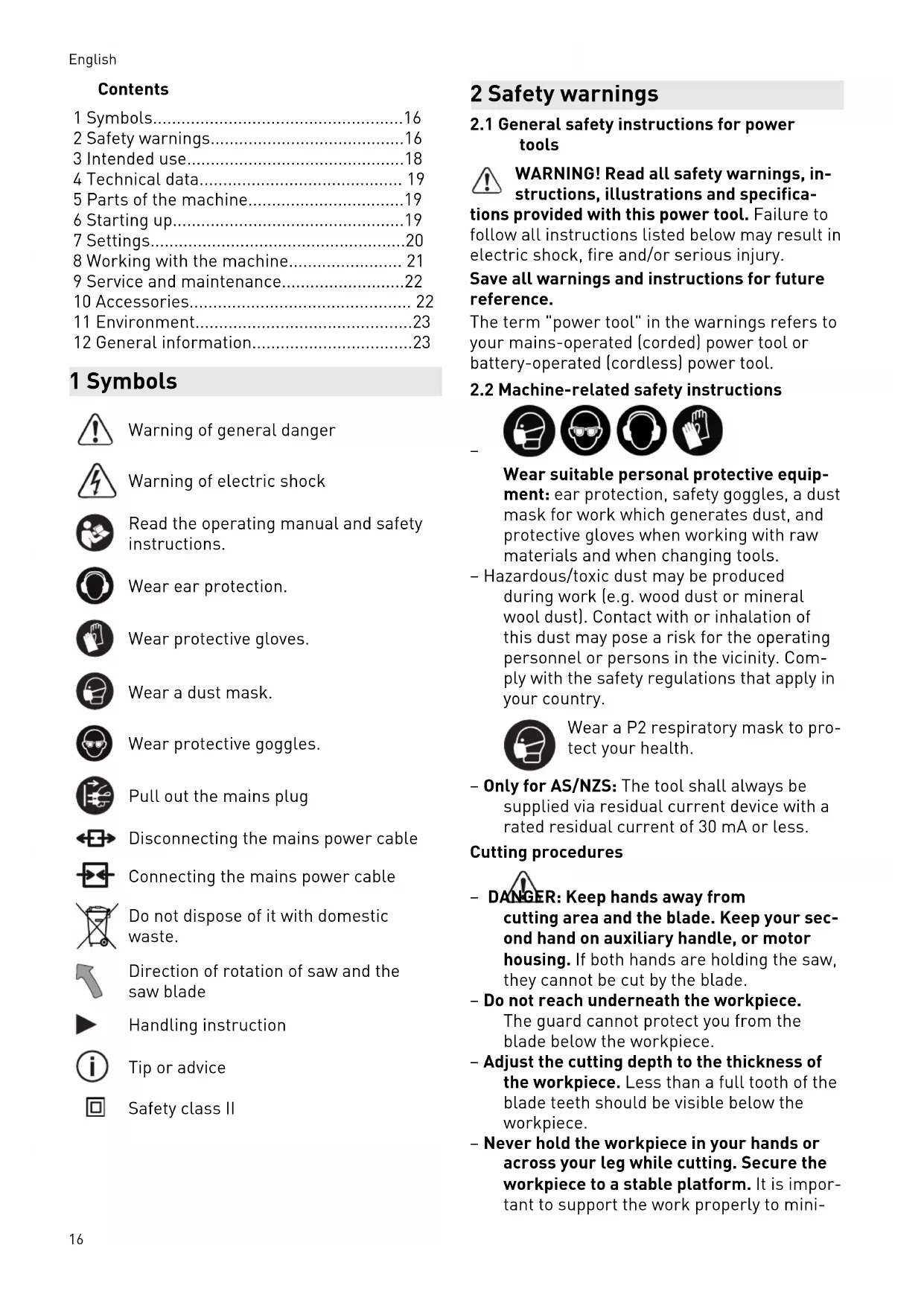
Warning of general danger
Warning of electric shock
Read the operating manual and safety
Wear ear protection.
Pull out the mains plug
Disconnecting the mains power cable
Connecting the mains power cable
Do not dispose of it with domestic
Direction of rotation of saw and the
2.1 General safety instructions for power
WARNING! Read all safety warnings, in
structions, illustrations and specifica
tions provided with this power tool. Failure to
follow all instructions listed below may result in
electric shock, fire and/or serious injury.
Save all warnings and instructions for future
The term "power tool" in the warnings refers to
your mains-operated (corded) power tool or
battery-operated (cordless) power tool.
2.2 Machine-related safety instructions
Wear suitable personal protective equip
ment: ear protection, safety goggles, a dust
mask for work which generates dust, and
protective gloves when working with raw
materials and when changing tools.
– Hazardous/toxic dust may be produced
during work (e.g. wood dust or mineral
wool dust). Contact with or inhalation of
this dust may pose a risk for the operating
personnel or persons in the vicinity. Com
ply with the safety regulations that apply in
Wear a P2 respiratory mask to pro
– Only for AS/NZS: The tool shall always be
supplied via residual current device with a
rated residual current of 30 mA or less.
– DANGER: Keep hands away from
cutting area and the blade. Keep your sec
ond hand on auxiliary handle, or motor
housing. If both hands are holding the saw,
they cannot be cut by the blade.
– Do not reach underneath the workpiece.
The guard cannot protect you from the
blade below the workpiece.
– Adjust the cutting depth to the thickness of
the workpiece. Less than a full tooth of the
blade teeth should be visible below the
– Never hold the workpiece in your hands or
across your leg while cutting. Secure the
workpiece to a stable platform. It is impor
tant to support the work properly to mini
16mise body exposure, blade binding, or loss
– Hold the power tool by insulated gripping
surfaces, when performing an operation
where the cutting tool may contact hidden
wiring or its own cord. Contact with a "live"
wire will also make exposed metal parts of
the power tool "live" and could give the op
erator an electric shock.
– When ripping, always use a rip fence or
straight edge guide. This improves the ac
curacy of cut and reduces the chance of
– Always use blades with correct size and
shape (diamond versus round) of arbour
holes. Blades that do not match the mount
ing hardware of the saw will run off-centre,
causing loss of control.
– Never use damaged or incorrect blade
washers or bolt. The blade washers and
bolt were specially designed for your saw,
for optimum performance and safety of op
Kickback causes and related warnings
– kickback is a sudden reaction to a pinched,
jammed or misaligned saw blade, causing
an uncontrolled saw to lift up and out of the
workpiece toward the operator;
– when the blade is pinched or jammed tight
ly by the kerf closing down, the blade stalls
and the motor reaction drives the unit rap
idly back toward the operator;
– if the blade becomes twisted or misaligned
in the cut, the teeth at the back edge of the
blade can dig into the top surface of the
wood causing the blade to climb out of the
kerf and jump back toward the operator.
Kickback is the result of saw misuse and/or in
correct operating procedures or conditions and
can be avoided by taking proper precautions as
– Maintain a firm grip with both hands on
the saw and position your arms to resist
kickback forces. Position your body to ei
ther side of the blade, but not in line with
the blade. Kickback could cause the saw to
jump backwards, but kickback forces can
be controlled by the operator, if proper pre
– When blade is binding, or when interrupt
ing a cut for any reason, release the trig
ger and hold the saw motionless in the
material until the blade comes to a com
plete stop. Never attempt to remove the
saw from the work or pull the saw back
ward while the blade is in motion or kick
back may occur. Investigate and take cor
rective actions to eliminate the cause of
– When restarting a saw in the workpiece,
centre the saw blade in the kerf so that
the saw teeth are not engaged into the
material. If a saw blade binds, it may walk
up or kickback from the workpiece as the
– Support large panels to minimise the risk
of blade pinching and kickback. Large pan
els tend to sag under their own weight.
Supports must be placed under the panel
on both sides, near the line of cut and near
the edge of the panel.
– Do not use dull or damaged blades. Un
sharpened or improperly set blades pro
duce narrow kerf causing excessive fric
tion, blade binding and kickback.
– Blade depth and bevel adjusting locking
levers must be tight and secure before
making the cut. If blade adjustment shifts
while cutting, it may cause binding and
– Use extra caution when sawing into exist
ing walls or other blind areas. The pro
truding blade may cut objects that can
Lower guard function
– Check the lower guard for proper closing
before each use. Do not operate the saw if
the lower guard does not move freely and
close instantly. Never clamp or tie the
lower guard into the open position. If the
saw is accidentally dropped, the lower
guard may be bent. Raise the lower guard
with the retracting handle and make sure it
moves freely and does not touch the blade
or any other part, in all angles and depths
– Check the operation of the lower guard
spring. If the guard and the spring are not
operating properly, they must be serviced
before use. Lower guard may operate slug
gishly due to damaged parts, gummy de
posits, or a build-up of debris.
– The lower guard may be retracted man
ually only for special cuts such as "plunge
cuts" and "compound cuts". Raise the low
er guard by the retracting handle and as
soon as the blade enters the material, the
lower guard must be released. For all oth
17er sawing, the lower guard should operate
– Always observe that the lower guard is
covering the blade before placing the saw
down on bench or floor. An unprotected,
coasting blade will cause the saw to walk
backwards, cutting whatever is in its path.
Be aware of the time it takes for the blade
to stop after switch is released.
Function of the guide wedge [5-4]
a. Use the correct saw blade for the guide
wedge. To ensure that the guide wedge
functions properly, make sure the blade
core of the saw blade is thinner than the
guide wedge and that the tooth width is
greater than the thickness of the guide
b. Do not operate the saw if the guide wedge
is bent. Even the slightest problem can
cause the guard to close more slowly.
Aluminium processing
When sawing aluminium, the following
measures must be taken for safety reasons:
– Install an upstream residual-current circuit
breaker (RCD, PRCD).
– Connect the machine to a suitable dust ex
– Regularly remove dust deposits from the
– Use an aluminium saw blade.
– Close the viewing window/chip guard.
Wear protective goggles.
– When sawing panels, they must be lubrica
ted with petroleum, although thin-walled
profiles (up to 3 mm) can be sawed without
The levels determined in accordance with
EN 62841 are typically:
Sound pressure level L PA
Sound power level L WA
Uncertainty K = 3 dB CAUTION Noise generated when working
Risk of damage to hearing
► Use ear protection.
three directions) and uncertainty K measured in
accordance with EN 62841:
The specified emission levels (vibration, noise)
– are used to compare machines.
– They are also used for making preliminary
estimates regarding vibration and noise
load during operation.
– They represent the primary applications of
CAUTION The emission values may deviate from the
specified values. This is dependent on how
the tool is used and the type of workpiece
► The actual load during the entire operating
cycle must be evaluated.
► Depending on the actual load, suitable pro
tective measures must be defined in order
to protect the operator.
Only use saw blades with the following
– Saw blade according to EN 847-1
– Saw blade diameter 160 mm
– cutting width 2,2 mm
– location hole 20 mm
– standard blade thickness max. 1,8 mm
– suitable for speeds of up to 9500 min
Do not use abrasive discs.
This power tool may only be used by experts or
The user is liable for damage and acci
dents caused by improper and non-inten
Inclination -1° to 47° -1° to 47°
Cutting depth at 0° 0–55 mm 0–55 mm
Cutting depth at 45° 0–43 mm 0–43 mm
Saw blade measurement 160 x 2.2 x 20 mm 160 x 2.2 x 20 mm
Weight (without power cable) 4.5 kg 4.4 kg
5 Parts of the machine
Rotary knobs for adjusting the angle
Lever for changing the tool
Unlocking devices for undercuts -1°
Split scale for the cutting depth stop
(with/without a guide rail)
Cutting depth adjusting screw for re
conditioned saw blades
Viewing window/chip guard
The illustrations specified are located at the be
ginning and end of the operating instructions.
Accessories shown or described are not always
included in the scope of delivery.
WARNING Unauthorised voltage or frequency.
► The mains voltage and the frequency of the
power source must correspond to the
specifications on the machine's name
► In North America, only Festool machines
with the voltage specifications 120 V/60 Hz
CAUTION Heating of the Plug it connection if bayonet
fitting is not completely locked
► Before switching on the power tool, make
sure that the bayonet fitting at the mains
cable is closed fully and locked.
Always switch off the machine before
connecting and disconnecting the mains
Connecting and detaching the mains power ca
ble [1-11] see Fig. [2].
Slide the safety lock [1-6] upwards and
press the on/off switch [1-7] (press =
ON / release = OFF).
Actuating the safety lock unlocks the plunging
mechanism. The saw unit can then be moved
downwards. This causes the saw blade to
emerge from the guard.
WARNING Risk of injury, electric shock
► Always disconnect the mains plug from the
socket before performing any work on the
with full-wave electronics with the following
The electronically controlled smooth start-up
function ensures that the power tool starts up
The motor speed is electronically kept con
stant. This ensures a uniform cutting speed
even when under load.
You can continuously adjust the speed within
the speed range using the adjusting
wheel [1-10] (see Technical data). This enables
you to optimise the cutting speed to suit specific
surfaces (see Section
When exceeding a certain engine temperature
level, the machine power supply and speed are
capped. The power tool continues operating at
reduced power to allow the ventilator to cool
the motor rapidly. The power tool resumes to
full performance automatically once the motor
has cooled sufficiently.
Current limiting prevents excessive current
consumption under extreme overload, which
can lead to a decrease in the motor speed. The
motor immediately restarts after the load is re
The TS 55 REBQ comes with an electronic
brake. The saw blade is stopped electronically
within approximately two seconds of switching
7.2 Adjusting the cutting depth
The cutting depth can be set at 0–55 mm at the
cutting depth stop [3-1].
The saw unit can now be pushed downwards as
far as the cutting depth that is set.
Cutting depth without guide rail
+FS Cutting depth with FS guide rail
7.3 Setting the cutting angle
► Unscrew the rotary knobs [4-1].
► Swivel the saw unit to the desired cutting
► Tighten the rotary knobs [4-1].
Both positions (0° and 45°) are set at
the factory and can be readjusted by
the customer service team.
When making angled cuts, slide the view
ing window/splinter guard to the highest
To undercut -1° and 47°:
► Swivel the saw unit to the end position (0°/
45°) as described above.
► Pull out the release button [4-3] slightly.
► For -1° undercuts, also pull the release
The saw unit engages in the -1°/47° position.
► Tighten the rotary knobs [4-1].
7.4 Changing the saw blade
CAUTION Risk of injury from hot and sharp tool
► Do not use any blunt or faulty tools.
► Wear protective gloves.
► Swivel the machine to 0° before replacing
the saw blade and adjust the maximum cut
► Turn the lever [5-2]as far as the stop.
► Slide the safety lock [5-1] upwards and
push the saw unit downwards until it clicks
► Insert a new saw blade.
The direction of rotation of the saw
blade [5-8] and machine [5-6] must match.
► Insert the outer flange [5-9] so that the pin
engages in the recess on the inner flange.
► Pull the lever [5-2]back.
207.5 Fitting the viewing window/splinter
The viewing window (transparent) [6-1] pro
vides a view of the saw blade and optimises
With 0° cuts, the splinter guard (green) [6-2]
also improves the quality of the cutting edge of
the sawn-off workpiece on the upper side.
► Insert the splinter guard [6-2].
► Screw the rotary knob [6-3] through the
long hole in the splinter guard.
Make sure that the nut [6-4] is seated
securely in the splinter guard.
Only use the rotary knob supplied with
your plunge-cut saw. The rotary knob of
another saw may be too long and jam the saw
You must bed in the splinter guard before using
► Set the machine to maximum cutting depth.
► Set the machine speed to 6.
WARNING Health risk due to dust
► Always work with an extractor.
► Comply with national regulations.
A Festool mobile dust extractor with an extrac
tor hose diameter of 27 mm or 36 mm (36 mm
recommended due to the reduced risk of clog
ging) can be connected to the extractor connec
8 Working with the machine
When working on the machine, observe
all of the initial safety notes and the fol
– Only guide the power tool towards the
workpiece when it is switched on.
– Check the mounting fixture prior to use and
do not use the machine if it does not work
– Always secure the workpiece in such a way
that it cannot move during machining.
– When working, always hold the power tool
with both hands on the handles [1-4]. This
reduces the risk of injury and is a prerequi
site for precise work.
– Always push the saw forwards[9-2], and
never towards yourself.
– Adapt the infeed speed to prevent the cut
ters on the saw blade from overheating and
prevent plastic materials from melting dur
– Make sure that all rotary knobs [4-1] are
tightened before starting work.
– Do not work with the machine if the elec
tronics are defective, because this may lead
to excessive speeds. You can tell if the
electronics are defective if there is no
smooth start-up or if it is not possible to
When carrying out work that produces
dust, wear a breathing mask.
8.1 Sawing along the scribe mark
The gauge marker [7-2] displays the cutting
line for 0° and 45° cuts (without a guide rail).
8.2 Cutting sections
Position the machine with the front part of the
saw table on the workpiece, switch on the ma
chine, push it down to the set cutting depth and
push it forward in the cutting direction.
8.3 Sawing cut-outs (plunge cuts)
In order to avoid kickbacks, the following
instructions must always be followed
when plunge cutting:
– Always position the machine with the rear
edge of the saw table against a fixed stop.
– When working with the guide rail, position
the machine at the FS-RSP kickback stop
(accessory) [9-4], which is clamped to the
► Place the machine on the workpiece and
position it at a stop (kickback stop).
► Switch on the machine.
► Slowly push the machine down to the set
cutting depth and push it forward in the cut
The marks [7-1]indicate the absolute front and
rear cutting points of the saw blade (160 mm di
ameter) when using the saw at maximum cut
ting depth with the guide rail.
8.4 Gypsum and cement-bound fibreboards
Due to the high volume of dust, it is recommen
ded to use the cover ABSA-TS55 (accessories)
which can be mounted at the side at the protec
tive cover and a Festool mobile dust extractor.
218.5 Speed setting for each material
Material Speed range
Solid wood (hard, soft)
Chipboard and hardboard
Laminated wood, blockboard, veneered and laminated panels
Plastics, fibre-reinforced plastics (FRP), paper and mesh
Gypsum and cement-bonded fibreboard 1–3
Aluminium panels and profiles up to 15 mm 4–6
9 Service and maintenance
WARNING Risk of injury, electric shock
► Always pull the mains plug from the socket
before performing any servicing and main
► All maintenance and repair work which re
quires the motor housing to be opened
should always be carried out by an author
ised service workshop.
Customer service and repairs
must only be carried out by the
manufacturer or service work
shops. Find the nearest address
at: www.festool.co.uk/service
Always use original Festool
spare parts. Order no. at:
www.festool.co.uk/service
The tool is equipped with special self-discon
necting carbon brushes. If they wear out, the
power supply is disconnected automatically and
Follow the instructions below
► To ensure constant air circulation, always
keep the cooling air openings in the housing
clean and free of blockages.
► Use an extractor on all openings of the pow
er tool to remove wood chips and splinters.
► Damaged safety devices and components
must be repaired or replaced in a recog
nised specialist workshop, unless otherwise
indicated in the operating manual.
► The guard must close smoothly.
► When working with plaster- and cement-
bonded fibreboards, clean the tool particu
larly thoroughly. Clean the vents of the
power tool and on/off switch using dry, oil-
free compressed air. Otherwise, gypsum
dust deposits may build up inside the power
tool's housing and on the on/off switch and
harden when exposed to humidity. This may
impair the switching mechanism
9.1 Reconditioned saw blades
You can use the adjusting screw [8-1] to pre
cisely set the cutting depth for reconditioned
► Set the cutting depth stop [8-2] to 0 mm
► Unlock the saw unit and push it downwards
► Screw the adjusting screw [8-1] in until the
saw blade comes into contact with the
9.2 Saw table wobbles
The saw table must be on an even
surface when adjusting the cutting
If the saw table wobbles, the setting must be
implemented again (Section
The PO numbers of the accessories and tools
can be found in the Festool catalogue or on the
Internet at "www.festool.com".
In addition to the accessories described,
Festool also provides a comprehensive range of
system accessories that allow you to use your
machine more effectively and in diverse appli
• Parallel side fence, extension table PA-
• Side-mounted cover, false joint ABSA-TS
• Kickback stop FS-RSP English
10.1 Saw blades, other accessories
In order to saw different materials quickly and
cleanly, Festool offers saw blades for all appli
cations and these are specially designed for
your Festool portable circular saw.
The guide rail enables you to make clean, accu
rate cuts while simultaneously protecting the
surface of the workpiece from damage.
In conjunction with the extensive range of ac
cessories, exact angled cuts, mitre cuts and fit
ting work can be completed with the guide sys
tem. The option of attaching the guide rail se
curely using clamps [9-5] ensures safer work
► Adjust the guide play between the saw table
and the guide rail using the two adjustable
Bed in the splinter guard [9-3] before using
the guide rail for the first time:
► Set the machine speed to 6.
► Place the machine at the rear end of the
guide rail together with the complete guide
► Switch on the machine.
► Push down the machine slowly to the max.
preset cutting depth and cut along the full
length of the splinter guard without stop
The edge of the splinter guard now corresponds
exactly to the cutting edge.
Do not dispose of the device in the
household waste! Recycle devices, ac
cessories and packaging. Observe appli
cable national regulations.
EU only: In accordance with the European Di
rective on waste electrical and electronic
equipment and implementation in national law,
used power tools must be collected separately
and handed in for environmentally friendly re
12.1 Information on data protection
The power tool contains a chip which automati
cally stores machine and operating data. The
data saved cannot be traced back directly to an
The data can be read using special (contactless)
devices and shall only be used by Festool for
fault diagnosis, repair and warranty processing
and for quality improvement or enhancement of
the power tool. The data shall not be used in
any other way without the express consent of
ves/toxiques peuvent se former (par ex.
Sagaggregatet faller i –1°/47°-stilling.