USER MANUAL Jet 802 AL-KO
natural_image
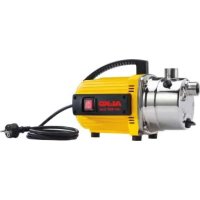
Exterior view of a white and black Alko Jet 601 pump with attached cable (no visible text or symbols on body)
natural_image
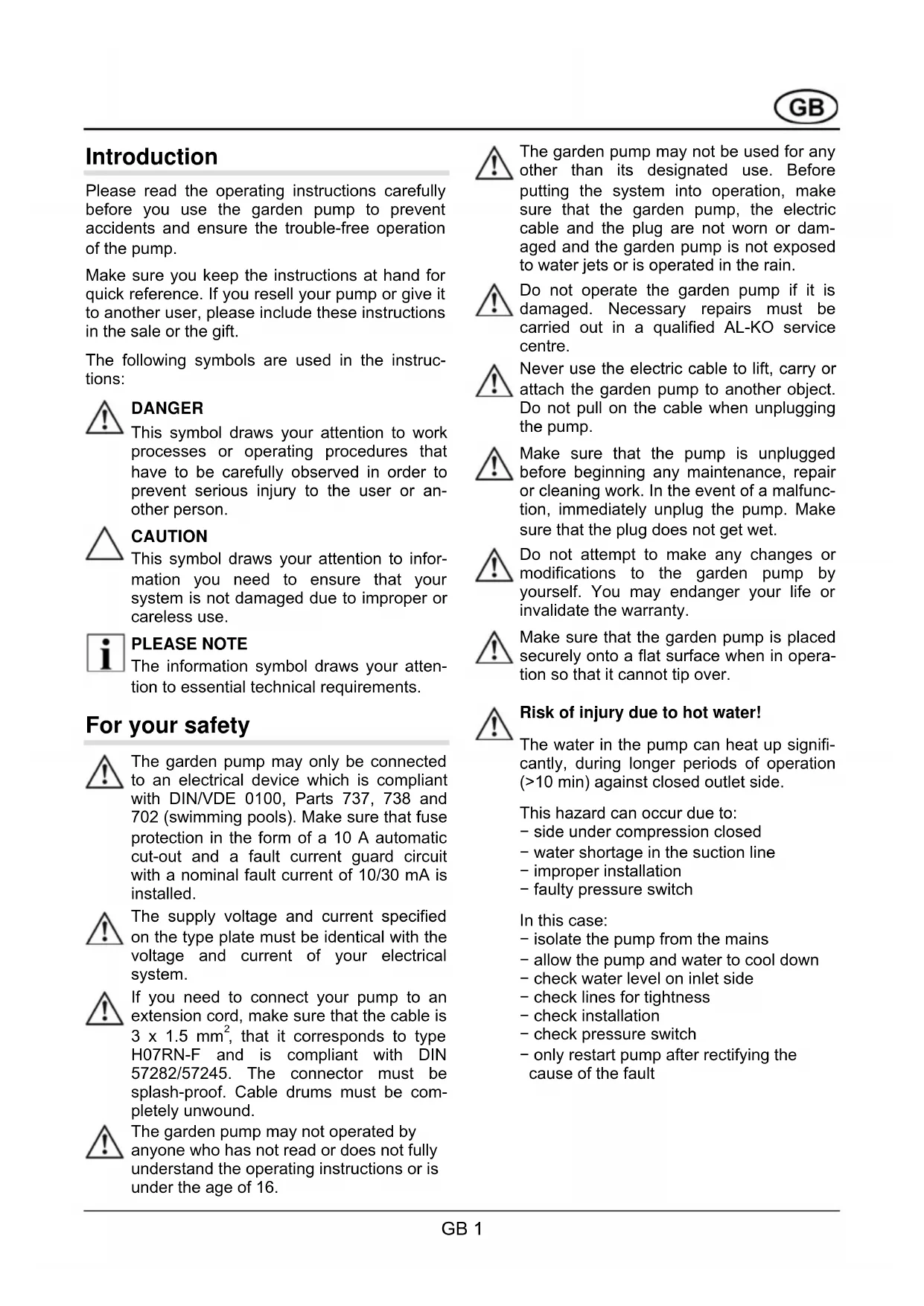
Exterior view of a modern industrial pump with metallic casing and control panel (no visible text or symbols)
D GB
F I
E NI
DK S
FIN oz
SK H
PI ruS
ua SIO
Hr Tr
P)
INFOrmation I maNuaIS I SErVIcE
JET 601 / 802
JET 601 INOX / JET 802 INOX
JET 1002 INOX





Please read the operating instructions carefully before you use the garden pump to prevent accidents and ensure the trouble-free operation of the pump.
Make sure you keep the instructions at hand for quick reference. If you resell your pump or give it to another user, please include these instructions in the sale or the gift.
The following symbols are used in the instructions:

DANGER
This symbol draws your attention to work processes or operating procedures that have to be carefully observed in order to prevent serious injury to the user or another person.

CAUTION
This symbol draws your attention to information you need to ensure that your system is not damaged due to improper or careless use.

PLEASE NOTE
The information symbol draws your attention to essential technical requirements.
For your safety

The garden pump may only be connected to an electrical device which is compliant with DIN/VDE 0100, Parts 737, 738 and 702 (swimming pools). Make sure that fuse protection in the form of a 10 A automatic cut-out and a fault current guard circuit with a nominal fault current of 10/30 mA is installed.

The supply voltage and current specified on the type plate must be identical with the voltage and current of your electrical system.

If you need to connect your pump to an extension cord, make sure that the cable is 3 × 1.5 mm^2 , that it corresponds to type H07RN-F and is compliant with DIN 57282/57245. The connector must be splash-proof. Cable drums must be completely unwound.

The garden pump may not operate by anyone who has not read or does not fully understand the operating instructions or is under the age of 16.

The garden pump may not be used for any other than its designated use. Before putting the system into operation, make sure that the garden pump, the electric cable and the plug are not worn or damaged and the garden pump is not exposed to water jets or is operated in the rain.

Do not operate the garden pump if it is damaged. Necessary repairs must be carried out in a qualified AL-KO service centre.

Never use the electric cable to lift, carry or attach the garden pump to another object. Do not pull on the cable when unplugging the pump.

Make sure that the pump is unplugged before beginning any maintenance, repair or cleaning work. In the event of a malfunction, immediately unplug the pump. Make sure that the plug does not get wet.

Do not attempt to make any changes or modifications to the garden pump by yourself. You may endanger your life or invalidate the warranty.

Make sure that the garden pump is placed securely onto a flat surface when in operation so that it cannot tip over.

Risk of injury due to hot water!
The water in the pump can heat up significantly, during longer periods of operation (>10 min) against closed outlet side.
This hazard can occur due to:
- side under compression closed
- water shortage in the suction line
- improper installation
- faulty pressure switch
In this case:
- isolate the pump from the mains
- allow the pump and water to cool down
- check water level on inlet side
- check lines for tightness
- check installation
- check pressure switch
- only restart pump after rectifying the cause of the fault
Use
Designated use
The garden pump is designed for home use in your house or garden. Please observe the technical data given in the instructions before putting the pump into operation.
Your garden pump has been designed for use in the following applications:
- irrigation and watering, e.g. of your lawn or flower and vegetable gardens,
- emptying containers or pumping liquid from one container into another (e.g. swimming pools),
- pumping water from wells, rain drums or cisterns.
The system is designed to pump only the following liquids:
- clear water,
- rain water,
– chlorine water (pool water).
Prohibited use
Your garden pump is not intended for permanent operation. The pump may not be used to pump the following liquids:
- drinking water
- saltwater,
– beverages or liquid foods,
– corrosives or chemicals,
- acids or combustible, explosive or gas-forming liquids,
– liquids with a temperature above 35 ^ ,
– sandy water or water containing abrasives.
Description of the pump
Garden pump/accessories (Figs. A, B,C)
1 Pump inlet/suction hose connector
2 Filler screw
3 Pump outlet/pressure hose connector
4 Motor housing
5 Electric cable
6 On/Off switch
7 Suction body
8 Pump chamber
9 Draining screw
10 Elbow nipple with washer (accessories)
11 Threaded connector (accessories)
12 AL-KO suction kit (accessories)
13 Filter (accessories)
Function
The garden pump sucks the liquid to be pumped into the pump through the suction hose (1) and pumps it out at the outlet (3).
Use the On/Off switch (6) to switch the garden pump on or off as desired.
Thermal protection
Your pump is equipped with a thermal protection switch, which switches the pump off if it overheats. The pump will remain off until it has cooled down. After about 15 - 20 minutes, the pump will automatically switch on.
Setting up and operating the sys- tem
- Place the garden pump onto a hard, flat surface so that it cannot tip over and so that it will not be near the flow of water.
- Make sure that the pump is protected from rain and any direct exposure to water.
Attaching the suction hose
Choose a hose which is long enough so that the pump will not suck in air and run dry. The hose should be at least 30 cm under the surface of the liquid to be pumped while the pump is in operation.
- Attach the suction hose. Make sure to screw it in tightly, but take care not to damage the threads.
If the liquid to be pumped is deeper than 4 m, you should use a suction hose which is larger than 1" in diameter for the best performance. We recommend our AL-KO suction set (12), which consists of a suction hose, strainer and non-return valve. The suction set is available at your local retailer's.
Before pumping sandy water, you must insert a filter (13) between the suction hose and the pump inlet or you will damage your garden pump. The filter is available at your local retailer's.
- When laying the suction hose, make sure that it is lower than the pump.
If the suction hose is laid so that it is higher than the pump, bubbles will be- come trapped in the line and the pump will suck air.
- Fill the suction hose.
Attaching the pressure hose
- Screw the threaded connector (11) into the pump outlet (3).
- Attach the elbow nipple (10) to the connector and turn the nipple so that it points in the desired direction.
- Attach a hose to the elbow nipple. The nipple can be cut to fit the size of the hose used.
- Clear the pressure line (open valves, sprayers, etc.).
Filling the garden pump

Before putting your garden pump into operation, you must fill it with water until it overflows to achieve full suction power. Do not operate the pump while it is dry because this will cause serious damage to the pump.
- Remove the filler screw (2).
- Pour water into the opening until the chamber of the pump (8) is full.
- Replace the filler screw (2) and tighten it.
Switching the pump on and off
- Plug the electric cable into the socket.

Make sure that the pump does not run on a blocked or closed pressure hose.
- Clear the pressure line (open valves, sprayers, etc.).
- Switch the pump on by pushing the switch (6) to On.
- Switch the pump off by pushing the switch (6) to Off.
Switching off the system
- Switch the system off by unplugging the electric cable from the socket.
Maintenance and Cleaning

Before beginning any maintenance or cleaning work, make sure that the garden pump has been unplugged and take precautions to ensure that it cannot be switched on during work!
Cleaning the pump
If you have used your garden pump to pump chlorine water (swimming pool water) or liquids which leave a residue, flush your pump out with clear water after use.
Clearing blockages
If your garden pump should become blocked so that it does not suction or pump out liquid, remove the obstruction as follows:
- Remove the suction hose from the pump inlet (1).
- Attach the pressure hose to the water tap and spray water into the pump chamber until the blockage is flushed out.
- Check to see that the obstruction has been cleared entirely by switching on the pump for a short time. Do not let the pump suck air.
- If the pump runs trouble-free, put it into operation as described in the instructions.
Frost protection
Store your pump so that it is protected from frost. Remember to empty it of any remaining liquid before storing it by removing the filler screw (9) and dumping out any water.
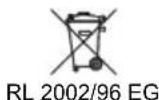
Do not dispose of worn-out units through the household garbage!
The appliance, its packaging and accessories are all produced from recyclable materials and must be disposed of accordingly.
Malfunctions

Before you attempt to remedy any malfunction of your pump, pull the plug to prevent injury or death due to electrocution!
| What is wrong? | What is the possible reason? | How to remedy the malfunction: |
| Motor does not run. | Impeller is blocked. | Remove blockage in inlet area. Clean the impeller with a jet of water. |
| Thermal switch has switched off. | Wait until the thermal switch has automatically switched the pump on again. Check the temperature of the liquid. Have the pump checked. |
| No power. | Check the fuses. Have a qualified electrician check the power supply. |
| Garden pump runs but is not pumping out liquid. | Water level too low. Lower the hose further underwater. |
| Air is trapped in the pump chamber. Fill the pump chamber with water. |
| Suction hose is blocked. DANGER! | Risk of injury due to hot water!Clear blockage in suction hose. |
| Pressure line is blocked. DANGER! | Risk of injury due to hot water!Clear blockage in pressure line. |
| Pressure hose is bent. Straighten out pressure hose. |
| Garden pump is only pumping out liquid very slowly or weakly. | Pressure hose is bent. Straighten out pressure hose. |
| Hose diameter is too small. | Attach a hose with a larger diameter. |
| Pump sucks air | Check all connections and the cover for tightness |
| Suction hose is blocked. Clear blockage in suction hose. |
| Pumping height is too great. | Lower pumping height (see technical data). |
| Suction height is too great. | Lower suction height (see technical data). |

If you are unable to remedy a malfunction, please call the AL-KO service centre nearest you.
Introduction
Antonio De Filippo, Managing Director
Garantie
We hereby declare that this product, in the form in which it is marketed, meets the requirements of the harmonised EU guidelines, EU safety standards, and the product-specific standards.
| Product | | Manufacturer | Executive Officer |
| Garden pump, electric | | AL-KO Geräte GmbH | Anton Eberle |
| Serial number | | Ichenhauser Str. 14 | Ichenhauser Str. 14 |
| G3013015 | | 89359 KOETZ | 89359 KOETZ |
| DEUTSCHLAND | DEUTSCHLAND |
| Model | | EU directives | Harmonised standards |
| JET601, JET601 INOX | | 2006/95/EG | EN 60335-1; VDE 0700-1:2007-02 |
| JET802, JET802 INOX | | 2004/108/EG | EN 60335-2-41; VDE 0700-41:2004-12 |
| JET1002 INOX | | 2000/14/EG (13) | EN 60335-2-41/A2; VDE 0700-41/A2:2009-02 |
| | EN 55014-1; VDE 0875-14-1:2007-06 |
| | EN 55014-1/A1; VDE 0875-14-1/A1:2008-12 |
| | EN 55014-2; VDE 0875-14-2:2009-06 |
| | EN 61000-3-2; VDE 0838-2:2006-10 |
| Sound power level | | Conformity evaluation | EN 61000-3-2/A1; VDE 0838-2/A1:2007-05 |
| measured / guaranteed | | | EN 61000-3-2/A7; VDE0838-2/A7:2007-06 |
| JET601, JET601 INOX | 74/76 dB(A) | 2000/14/EG | EN 61000-3-2/A4; VDE 0838-2/A4:2007-06 |
| JET802, JET802 INOX | 74/77 dB(A) | Appendix V | EN 61000-3-3; VDE 0838-3:2009-06 |
| JET1002 INOX | 83/86 dB(A) | | |
Kötz, 2010-08-30
Antonio De Filippo, Managing Director
Warranty
If any material or manufacturing defects are found during the statutory customer protection period, we will either repair or replace the equipment, whichever we consider the more appropriate. This statutory period may vary according to the legislation in force in the country where the equipment was purchased.
Our warranty is valid only if: The warranty is no longer valid if:
■ The equipment has been used properly
■ The operating instructions have been followed
■ Genuine replacement parts have been used
■ The equipment has been tampered with
■ Technical modifications have been made
The trimmer was not used for its intended purpose (for example, used for commercial or communal applications)
The following are not covered by warranty:
■ Paint damage due to normal wear
■ Wear parts identified by a border XXXXX(X) on the spare parts list
Combustion motors – these are covered by a separate warranty from the manufacturer concerned
To make a claim under warranty, please take this statement of warranty and proof of purchase to the nearest authorised customer service centre. This warranty does not affect the usual statutory rights of the customer relative to the seller.
Antonio De Filippo, Managing Director
Garantie
Antonio De Filippo, Managing Director
Garanzia
Antonio De Filippo, Managing Director
Garantía
Antonio De Filippo, Managing Director
Garantie
Antonio De Filippo, Managing Director
Garanti
Antonio De Filippo, Managing Director
Garanti
Antonio De Filippo, Managing Director
Takuu
Antonio De Filippo, Managing Director
Záruka
Antonio De Filippo, Managing Director
Záruka
Antonio De Filippo, Managing Director
Garancia
Antonio De Filippo, Managing Director
Gwarancja
Antonio De Filippo, Managing Director
Гарантия
Antonio De Filippo, Managing Director
Гарантія
Antonio De Filippo, Managing Director
Garancija
Antonio De Filippo, Managing Director
Jamstvo
Eventualne greške na materijalu ili greške pri proizvodnji koje se pojave na uređaju otklanjamo za vrijeme zakonskog jamstvenog roka za zahtjeve u slučaju nedostatak po našem izboru u vidu popravke ili zamjenske isporuke. Jamstveni rok određuje se prema zakonu zemlje u kojoj je uređaj kupljen.
Naše jamstvo vrijedi samo u slučaju: Pravo na jamstvo gubi se u slučaju:
Antonio De Filippo, Managing Director
Garanti
Antonio De Filippo, Managing Director
Garantia
Country Company Telephone Fax
| A | AL-KO Kober Ges.m.b.H. | (+43) 3578/2515227 | (+43) 3578/251538 |
| AUS | AL-KO International PTY. LTD | (+61) 3/9767-3700 | (+61) 3/9767-3799 |
| B/L | Eurogarden NV | (+32) 16/805427 | (+32) 16/805425 |
| BG | Valerii S&M Group SJ | (+359) 2 942 34 02 | (+359) 2 942 34 10 |
| CH | AL-KO Kober AG | (+41) 56/4183150 | (+41) 56/4183160 |
| CZ | AL-KO Kober Spol.sr.o. | (+420) 382/210381 | (+420) 382/212782 |
| D | AL-KO Geräte GmbH | (+49) 8221/203-0 | (+49) 8221/203-138 |
| DK | AL-KO Ginge A/S | (+45) 98821000 | (+45) 98825454 |
| EST/LT/LV | AL-KO Kober SIA | (+371) 67409330 | (+371) 67807018 |
| F | AL-KO S.A.S. | (+33) 3/85-763540 | (+33) 3/85-763588 |
| GB | Rochford Garden Machinery Ltd. | (+44) 1963/828050 | (+44) 1963/828052 |
| H | AL-KO KFT | (+36) 29/537050 | (+36) 29/537051 |
| HR | Brun.ko.-prom d.o.o. | (+385) 1 3096 567 | (+385) 1 3096 567 |
| I | AL-KO Kober GmbH / SRL | (+39) 039/9329311 | (+39) 039/9329390 |
| IN | AGRO-COMMERCIAL | (+91) 3322874206 | (+91) 3322874139 |
| IQ | Gulistan Com | (+946) 750 450 80 64 | |
| IRL | Cyril Johnston & Co. Ltd. | (+44) 2890813121 | (+44) 2890914220 |
| LY | ASHOFAN FOR AGRICULT. ACC. | (+218) 512660209 | (+218) 512660209 |
| MA | BADRA Sarl | (+212) 022447128 | (+212) 022447130 |
| MK | Techno Geneks | (+389) 2 2551801 | (+389) 2 2520175 |
| N | AL-KO GINGE A/S | (+47) 64862550 | (+47) 64862554 |
| NL | O.DE LEEUW GROENTECHNIEK | (+31) 38/444 6160 | (+31) 38/444 6358 |
| PL | AL-KO Kober z.o.o. | (+48) 61/816 1925 | (+48) 61/816 1980 |
| RO | OMNITECH Technology SRL | (+4) 021 326 36 72 | (+4) 021 326 36 79 |
| RUS | OOO AL-KO Kober | (+7) 499/168 8718 | (+7) 499/96600-00 |
| RUS | AL-KO St. Petersburg GmbH | (+7) 812/4461075 | (+7) 812/4461075 |
| S | AL-KO Ginge Svenska AB | (+46) (0) 31573580 | (+46) (0) 31575620 |
| SK | AL-KO Kober Slovakia Spol.s.r.o. | (+421) 2/45994112 | (+421) 2/45648117 |
| SLO | DARKO OPARA S.P. | (+386) 17225858 | (+386) 17225851 |
| SRB | Agromarket doo | (+381) 34/30800 | (+381) 34/30816 |
| TR | ZIMAS A.S. | (+90) 232 4580586 | (+90) 232 4572697 |
| UA | TOV AL-KO Kober | (+380) 44/4923396 | (+380) 44/4923397 |