ManualGo.com
 SJM 021,MV - Kettle KENWOOD - Free user manual and instructions
Find the device manual for free SJM 021,MV KENWOOD in PDF.


Download the instructions for your Kettle in PDF format for free! Find your manual SJM 021,MV - KENWOOD and take your electronic device back in hand. On this page are published all the documents necessary for the use of your device. SJM 021,MV by KENWOOD.
USER MANUAL SJM 021,MV KENWOOD
w∂¸´ HEAD OFFICE: Kenwood Limited, 1-3 Kenwood Business Park, New Lane, Havant, Hampshire PO9 2NH
Read these instructions carefully and retain for future reference.
Remove all packaging and any labels. To prevent damage to the kettle: G Avoid contact with hard surfaces and objects; G Avoid knocking the glass body against the tap when filling. Do not use the kettle if it has been dropped or damaged i.e. glass cracked or chipped. Never use a damaged appliance. Get it checked or repaired: see ‘service and customer care’. Always use the filter and never overfill boiling water may splash out. Avoid contact with steam coming out of the spout area when pouring and out of the lid or spout area when refilling. Beware: the glass body of the kettle will get hot during operation. Never let the cord hang down where a child could grab it. Always unplug your kettle when not in use. Never put the kettle, powerbase, cord or plug in liquid. Caution: Do not operate the kettle on an inclined surface. Only use the powerbase supplied and keep it clean and dry. Make sure the lid is secure before switching the kettle on.
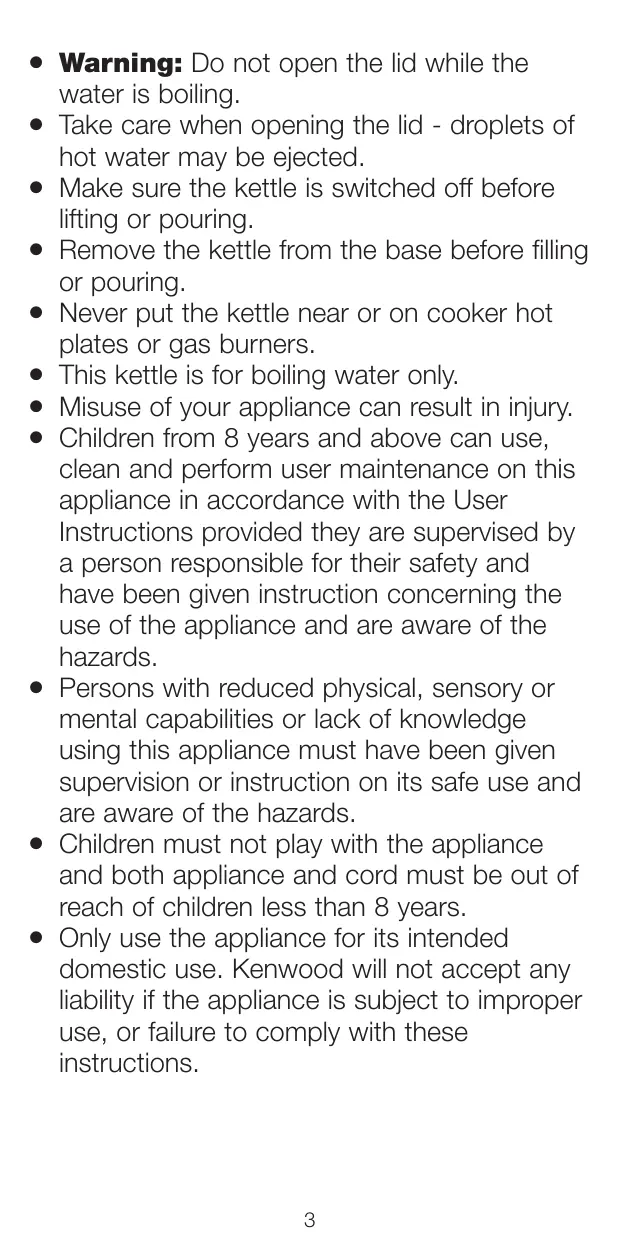
G G G G G G G G G G G G G G G G G G G Warning: Do not open the lid while the water is boiling.
Take care when opening the lid - droplets of hot water may be ejected. Make sure the kettle is switched off before lifting or pouring. Remove the kettle from the base before filling or pouring. Never put the kettle near or on cooker hot plates or gas burners. This kettle is for boiling water only. Misuse of your appliance can result in injury. Children from 8 years and above can use, clean and perform user maintenance on this appliance in accordance with the User Instructions provided they are supervised by a person responsible for their safety and have been given instruction concerning the use of the appliance and are aware of the hazards. Persons with reduced physical, sensory or mental capabilities or lack of knowledge using this appliance must have been given supervision or instruction on its safe use and are aware of the hazards. Children must not play with the appliance and both appliance and cord must be out of reach of children less than 8 years. Only use the appliance for its intended domestic use. Kenwood will not accept any liability if the appliance is subject to improper use, or failure to comply with these instructions.
Make sure your electricity supply is the same as the one shown on the underside of your kettle.
G WARNING: THIS APPLIANCE MUST BE EARTHED.
This appliance conforms to EC directive 2004/108/EC on Electromagnetic Compatibility and EC regulation no. 1935/2004 of 27/10/2004 on materials intended for contact with food.
before using for the first time
1 Wrap any excess cord around the bracket 햸 on the underside of the powerbase. 2 Fill to ‘MAX’, boil, then pour the water away. Repeat 2 to 3 times.
spout flip top lid lid release button on/off switch with indicator light water level guage
360° powerbase cord wrap filter
Note - To interrupt the boiling ensure that the switch is in the off position before removing from the powerbase.
If you experience problems with your kettle switching on and off during use or switching off before boiling, check that the flat element is free from scale - see “descaling”. Your kettle is fitted with a filter to hold back limescale particles. If you find drops of water under your kettle, don’t worry - it is just condensation. boil-dry protection If you switch on with too little water, your kettle will cut out automatically. Switch off, remove from the powerbase and let it cool down before re-filling. When it has cooled down, the switch will reset itself.
1 Press the lid release button 햴 to open the lid, then fill the kettle. The water level must be between ‘MAX’ and 1 cup (250mls). G If you live in a hard water area we recommend that you use filtered water in order to maintain the appearance and efficiency of your kettle. G Be economical: do not boil more water than you need. G To improve the quality of your drinks always use fresh water. G Empty the kettle after each use. 2 Close the lid – ensuring it is latched down correctly. 3 Plug in and switch on. 4 Your kettle will boil and switch off automatically. To re-boil, wait a few seconds - the on/off switch needs time to reset.
G G Before cleaning, unplug your kettle and let it cool down. the outside and powerbase
Wipe with a damp cloth, then dry. Do not use abrasives - they will scratch the glass, metal and plastic surfaces. the inside Wipe with bicarbonate of soda on a damp cloth. Rinse thoroughly. Even though your kettle comes with a filter, you still need to clean the inside (and the filter) regularly.
1 Open the lid. 2 Unclip the filter by pushing down on the arrow graphic then lift the filter out away from the spout area . 3 either rinse under the tap or use a soft brush. or when descaling your kettle, drop the filter in too. Rinse thoroughly. 4 To refit – line the filter up with the spout and slide the filter back into the slot , then push forward and clip securely into place. Note: the lid cannot be closed if the filter is not fitted correctly.
Regular descaling of the flat element will improve the performance of your kettle. If the kettle is not descaled regularly the build up of limescale may result in the following: G problems may be experienced with the kettle switching on and off during use or switching off before boiling. G the kettle may take longer to boil. G the flat element may be damaged.
IMPORTANT INFORMATION FOR CORRECT DISPOSAL OF THE PRODUCT IN ACCORDANCE WITH EC DIRECTIVE
2002/96/EC. At the end of its working life, the product must not be disposed of as urban waste. It must be taken to a special local authority differentiated waste collection centre or to a dealer providing this service. Disposing of a household appliance separately avoids possible negative consequences for the environment and health deriving from inappropriate disposal and enables the constituent materials to be recovered to obtain significant savings in energy and resources. As a reminder of the need to dispose of household appliances separately, the product is marked with a crossed-out wheeled dustbin.
Please note: Failure to descale your kettle may invalidate your guarantee.
G When limescale starts to build up on the heating element, buy a suitable descaler and descale your kettle. After descaling, boil with fresh water several times and discard. Clean any descaler off the kettle - it can damage the parts. G Some regions of the country have chalky water. This makes boiled water look cloudy and leaves a deposit on the side of the kettle. This is normal but can be removed with regular cleaning. G Alternatively, to reduce limescale build up, use filtered water to fill your kettle.
service and customer care
G If the cord is damaged it must, for safety reasons, be replaced by
KENWOOD or an authorised KENWOOD repairer. If you experience any problems with the operation of the kettle, before calling for assistance refer to the troubleshooting guide.
G G G G G If you need help with: using your appliance or servicing or repairs
Contact the shop where you bought your appliance. Designed and engineered by Kenwood in the UK. Made in China.
troubleshooting guide
Problem Kettle not operating.
No Power. Kettle unplugged.
Kettle not switching off automatically after boiling/Long switch off time.
Water splashing out of spout area.
Lid will not close correctly.
Filter not fitted and clipped securely in place.
Kettle switching on and off during use or switching off before water boiled.
Kettle stopped working during operation.
Limescale/mineral build up on element affecting operation.
Filter not fitted in spout area.
Boil dry protection operated due to insufficient water in the kettle.
White deposit building up on glass body.
Check kettle is plugged in. Check kettle is correctly located to the powerbase. Check water level is not above the Max level. Check lid is closed correctly. Always use the filter and do not overfill above the Max level. Check that the filter is located correctly - refer to “the filter” section under “care and cleaning”. Check that the element is free from scale. Refer to “descaling” section under care and cleaning. Switch off and remove from the powerbase. Allow to cool down before refilling. When the kettle has cooled down the switch will reset itself. Check the water level is above the minimum level. If you live in a hard water area we recommend that you use filtered water in order to maintain the appearance and efficiency of your kettle. Descale your kettle - Refer to the “descaling” section.
Some regions of the country have chalky water. This makes boiled water look cloudy and leaves a deposit on the side of the kettle. This is normal but can be removed with regular cleaning.
If none of the above solve the problem see “Service & Customer Care”.
G G G G G G G G G G G G G G G G G G G G G G G G G G G G G G G G G G G G G G G G G G G G G G G G HSHQBFJVJ VXOE^N\P
0XWB J VXVMHXB VXOORTY`PHWDL OH WJP RGJFCD WJU 47 2004/108/47
VZHWLM@ OH WJP 5NHMWTRODFPJWLMB VXOEDW^WJWD MDL WRP MDPRPLVO^ 47 XS’ DTLKO^P 1935/2004 WJU 27/10/2004 VZHWLM@ OH WD XNLM@ SRX STRRTCIRPWDL PD ATKRXP VH HSDYB OH WT^YLOD.
S`U ZTJVLORSRLHCWDL R ETDVWBTDU
5 WDMWLMB DYDCTHVJ W\P DN@W\P DS^ WR KHTODPWLM^ VWRLZHCR EHNWL`PHL WJP DS^GRVJ WRX ETDVWBTD. 4@P R ETDVWBTDU GHP MDKDTCIHWDL WDMWLM@ DS^ WD @NDWD, J VXFMAPWT\VJ DN@W\P HPGAZHWDL PD STRMDNAVHL WD DM^NRXKD STRENBODWD: G R ETDVWBTDU HPGAZHWDL PD DP@EHL MDL PD VEBPHL MDW@ WJ GL@TMHLD WJU NHLWRXTFCDU B PD VEBPHL STRWR_ ET@VHL WR PHT^. G WR PHT^ HPGAZHWDL PD ZTHL@IHWDL SHTLVV^WHTR ZT^PR FLD PD ET@VHL. G WR KHTODPWLM^ VWRLZHCR HPGAZHWDL PD XSRVWHC EN@EJ. =JOHC\VJ: 4@P GHP MDKDTCIHWH WR ETDVWBTD DS^ WD @NDWD, J HFF_JVB VDU HPGAZHWDL PD DMXT\KHC. G /WDP VXVV\THXWR_P @NDWD DVEHVWCRX S@P\ VWJ KHTODPWLMB ORP@GD WRX ETDVWBTD, DFRT@VWH APD MDW@NNJNR MDKDTLVWLM^ MDL MDKDTCVWH WR ETDVWBTD VDU. /WDP XS@TZRXP VXVV\THXOAPD @NDWD, R ETDVWBTDU ZTHL@IHWDL SHTLVV^WHTR ZT^PR FLD PD ET@VHL WR PHT^ MDL HCPDL SLKDP^ PD MDHC DM^OD MDL J KHTODPWLMB ORP@GD. 8HW@ WRP MDKDTLVO^ DS^ WD @NDWD, FHOCVWH DTMHWAU YRTAU OH MDKDT^ PHT^ MDL ET@VWH MDL OHW@ SHW@QWH WR PHT^. 0YDLTAVWH XSRNHCOODWD WRX MDKDTLVWLMR_ DN@W\P DS^ WR ETDVWBTD - OSRTHC PD STRMDNAVRXP YKRT@ VWD OATJ WJU VXVMHXBU. G 8HTLMAU SHTLRZAU WJU Z`TDU AZRXP PHT^ OH X[JNB SHTLHMWLM^WJWD VH @NDWD (VMNJT^ PHT^). 0XW^ M@PHL WR ETDVOAPR PHT^ PD GHCZPHL KRN^ MDL DYBPHL HPDSRKAVHLU DN@W\P VWD WRLZ`ODWD WRX ETDVWBTD. 0XW^ HCPDL YXVLRNRFLM^, ^O\U RL HPDSRKAVHLU STASHL PD DSRODMT_PRPWDL OH WDMWLM^ MDKDTLVO^. G 4PDNNDMWLMB N_VJ, FLD PD SHTLRTCVHWH WJ VXVV`THXVJ DN@W\P VWR ETDVWBTD VDU, HCPDL PD ZTJVLORSRLHCWH YLNWTDTLVOAPR PHT^.
4@P ZTHL@IHVWH ERBKHLa VZHWLM@ OH:
WJ ZTBVJ WJU VXVMHXBU B WR VATELU B WLU HSLVMHXAU HSLMRLP\PBVWH OH WR MaW@VWJOa aS^ WR RSRCR aFRT@VaWH WJ VXVMHXB VaU. =ZHGL@VWJMH MDL DPDSW_ZKJMH DS^ WJP Kenwood VWR 5P\OAPR 1DVCNHLR. 7DWDVMHX@VWJMH VWJP 7CPD.