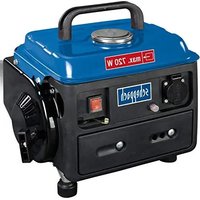
SG950 - Generator SCHEPPACH - Free user manual and instructions
Find the device manual for free SG950 SCHEPPACH in PDF.


| Product type | Synchronous generator |
| Brand | Scheppach |
| Model | SG950 |
| Continuous power (S1) | 650 VA / 650 W |
| Maximum power (S2, 2 min) | 720 VA / 720 W |
| Rated voltage | 230 V~ |
| Rated current | 2.8 A |
| Frequency | 50 Hz |
| Protection type | IP23M |
| Engine | 2-stroke air-cooled, 63 cm³, 1.2 kW / 2.0 HP |
| Fuel | Unleaded petrol (octane 90) and 2-stroke oil mixture (1:40) |
| Tank capacity | 4.0 L |
| Consumption (at 3/4 load) | Approx. 0.8 L/h |
| Weight | 17 kg |
| Sound pressure level (LpA) | 71 dB(A) |
| Sound power level (LWA) | 94 dB(A) |
| Spark plug | F6TC |
| Max. operating temperature | 40°C |
| Max. installation altitude | 1000 m |
| Max. relative humidity | 90% (non-condensing) |
| Socket type | 1 socket 230 V~ (womelle type) |
| Overload protection | Yes (resettable circuit breaker) |
| Main functions | Power supply for power tools and lighting at 230 V~ |
| Maintenance and cleaning | Regular cleaning, air filter every 30 h, spark plug every 50 h |
| Safety | Emergency stop, thermal protection, grounding possible |
| Wear parts | Spark plug, air filter |
Frequently Asked Questions - SG950 SCHEPPACH
User questions about SG950 SCHEPPACH
0 question about this device. Answer the ones you know or ask your own.
Ask a new question about this device
Download the instructions for your Generator in PDF format for free! Find your manual SG950 - SCHEPPACH and take your electronic device back in hand. On this page are published all the documents necessary for the use of your device. SG950 by SCHEPPACH.
USER MANUAL SG950 SCHEPPACH
- Introduction 40
- Layout 40
- Scope of delivery 41
- Intended use 41
- Safety information 41
- Technical data 44
- Before putting the machine into operation 44
- Operation 46
- Cleaning, maintenance and storage 47
- Disposal and recycling 48
- Troubleshooting 49
- Declaration of conformity 147
Explanation of the symbols on the equipment
The use of symbols in this manual is intended to draw your attention to possible risks. The safety symbols and the explanations that accompany them must be perfectly understood. The warnings in themselves do not remove the risks and cannot replace correct actions for preventing accidents.
| Read operator manual. Before any use, refer to the corresponding section in this user manual. | |
| Important. Hot parts. Keep your distance. | |
| Important. Switch off the engine before refueling. Not refuel when operating. | |
| Important. Exhaust gas is poisonous, do not operate in an unventilated area. | |
| Wear hearing protection. Wear protective gloves. | |
| Conform to applicable safety standards. | |
| Recycle unwanted materials instead of disposing of them. All appliances and packaging should be sorted and tendered at a regional recycling centre into to be processed in an ecological manner. | |
| Take care when handling fuel and lubricants! | |
| Remove the ignition cable before all maintenance work, and read the instructions for use. | |
| Don't expose to rain. | |
| Starting engine creates sparking. Sparking can ignite nearby flammable gases. | |
| Strictly no naked flames or smoking near the appliance! |
1. INTRODUCTION
Read through the complete text in the operating instructions before installing and commissioning the device. The operating instructions are intended to help the user to become familiar with the machine and take advantage of its application possibilities in accordance with the recommendations. The operating instructions contain important information on how to operate the machine safely, professionally and economically, how to avoid danger, costly repairs, reduce downtimes and how to increase reliability and service life of the machine.
In addition to the safety regulations in the operating instructions, you have to meet the applicable regulations that apply for the operation of the machine in your country. Keep the operating instructions package with the machine at all times and store it in a plastic cover to protect it from dirt and moisture. Read the instruction manual each time before operating the machine and carefully follow its information. The machine can only be operated by persons who were instructed concerning the operation of the machine and who are informed about the associated dangers. The minimum age requirement must be complied with.
According to the applicable product liability laws, the manufacturer of the device does not assume liability for damages to the product or damages caused by the product that occurs due to:
- Improper handling,
- Non-compliance of the operating instructions,
- Repairs by third parties, not by authorized service technicians,
- Installation and replacement of non-original spare parts,
Application other than specified,
2. LAYOUT (Fig. 1,2)

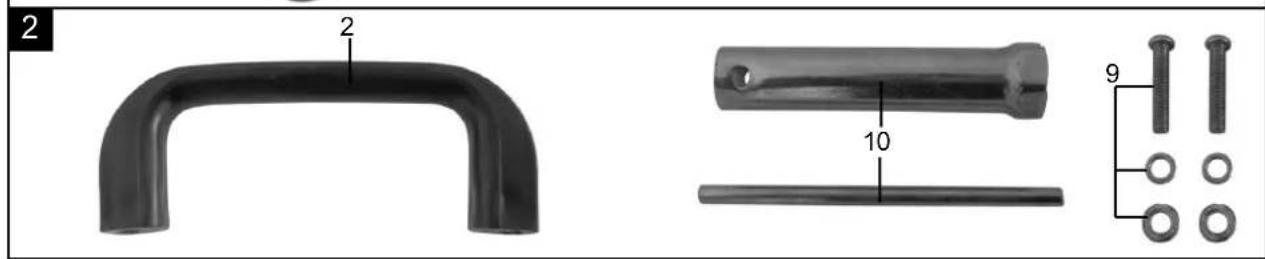
| 1. Tank cover | 5. ON/OFF switch 9. Set | of screws for fitting the carry handle |
| 2. Carry handle 6. Socket 230 V ~ 10. Spark plug wrench | ||
| 3. Safety tripping element 7. | Reversing starter 11. ignit | on cable |
| 4. Choke lever 8. Petrol cock | 12. exhaust | |
3. SCOPE OF DELIVERY
- Open the packaging and remove the device carefully.
- Remove the packaging material.
- Check that the delivery is complete.
- Check the device and accessory parts for transport damage.
ATTENTION
The device and packaging materials are not toys!
Children must not be allowed to play with plastic bags, film and small parts! There is a risk of swallowing and suffocation!
4. INTENDED USE
The device is designed for applications operated with a 230V alternating current source. Be sure to observe the restrictions in the safety instructions. The generator is intended to provide electric tools and light sources with electricity.
When using the device with household appliances, please check their suitability in accordance with the relevant manufacturer's instructions. In case of doubt, ask an authorized dealer of the respective appliance.
The machine is to be used only for its prescribed purpose. Any other use is deemed to be a case of misuse. The user / operator and not the manufacturer will be liable for any damage or injuries of any kind caused as a result of this.
Please note that our equipment has not been designed for use in commercial, trade or industrial applications. Our warranty will be voided if the machine is used in commercial, trade or industrial businesses or for equivalent purposes.
5. SAFETY INSTRUCTIONS
The generator shall always be used in accordance with the manufacturer's instructions laid down in the instruction handbook.
The manufacturer will not be liable in cases of inappropriate use or modifications of the appliance. Also, follow the safety advice, the installation and operation manual and also to the valid accident prevention regulations.
Appliances with incorrect or missing parts or without a security case are not to be operated. The service centre provides you with information concerning replacement parts.
1. Training
b) Read the instruction carefully. Be familiar with the controls and proper use of the equipment.
c) Never allow children or people unfamiliar with these instructions to use the machine. Local regulations can restrict the age of the operator.
d) Never work while people, especially children, or pets are nearby.
e) Keep in mind that the operator or user is responsible for accidents or hazards occurring to other people or their property.
f) Major repair work shall be carried out only by specifically trained personnel.
2.Preparation
a) WARNING-Petrol is highly flammable:
- store fuel in containers specifically designed for this purpose;
- refuel outdoors only and do not smoke while refueling;
- add fuel before starting the engine. Never remove the cap of fuel tank or add petrol while the engine is running or when the engine is hot;
- if petrol is spilled, do not attempt to start the engine but move the machine away from the area of spillage and avoid creating any source of ignition until petrol vapours have dissipated;
- replace all fuel tank and container caps securely.
b) Replace faulty silencers;
c) Before using, always visually inspect to see that the tools are not worn or damaged. Replace worn or damaged elements and bolts in sets to preserve balance.
d) Do not smoke near the generator.
e) Do not wear loose clothing, jewellery, or similar items that could be caught in the starter or other moving parts.
f) Never put any items into the ventilation openings. This applies even when the generator is switched off. Non-observation may lead to injury, or damage to the generator.
g) Generating sets may only be loaded up to their rated power under the rated ambient condition. If generating set use is under conditions which do not conform to the reference conditions as stipulated in ISO 8528-8 and if cooling of the engine or alternator is impaired, e.g. as a result of operation in restricted areas, a reduction in power is necessary.
h) It is necessary reduction in power due to use in higher temperatures, altitudes and humidity as below conditions.
Max Working Temperature: 40^
Max altitudes: 1000m
Max humidity: 90%
3. Operation
a) Do not operate the engine in a confined space where dangerous carbon monoxide fumes can collect
b) Keep the generator free of oil, dirt and other impurities.
c) Please always place the appliance on even and stable surfaces.
d) Never operate the appliance inside buildings or in an environment without proper ventilation, like collieries, caves, excavations and bilges. Pay attention to air flow and temperature.
e) Ensure that extension cords, power cords and all electric components are in proper condition. Never operate electric tools with damaged or defective cords.
f) Do not operate or store the appliance in wet or humid surroundings or on highly conductive surfaces such as metal coatings or steel constructions.
g) Ensure the sound absorber and air filter work properly. These parts serve as flame protection in case of misfire.
h) Before connecting electric leads, the appliance must reach its full speed. Disconnect leads before switching off the motor.
i) To prevent injury by electric shock, ensure the fuel tank is not completely empty while electric leads are connected.
j) The load must not exceed the power marked on the rating label of the generator. Overloading may result in damage to, or a shorter life of the appliance.
k) To avoid possible burn injuries, do not touch the exhaust system or other parts of the motor or generator that become hot during operation. Pay attention to the warnings on the generating set.
1) Do not connect the appliance to household outlets. The generating set must not be connected to other power sources, such as the power company supply mains. In special cases where stand-by connection to existing electrical systems is intended, it shall only be performed by a qualified electrician who has to consider the differences between operating equipment using the public electrical supply network and operating the generating set.
m) The motor must not be operated with excessive rotary speed. The operation of the motor with excessive rotary speed raises the risk of injury. Parts which affect the rotary speed must not be altered or replaced.
n) Regularly check for leakage or traces of abrasion in the fuel system, such as porous pipes, loose or missing clamps and damage to the tank or tank cap. Before use all defects must be repaired.
o) Work only in daylight or in good artificial light.
p) Never pick up or carry a machine while the engine is running
q) Stop the engine:
whenever you leave the machine
- before refueling
r) Before checking or adjusting the generator or the motor, the ignition plug and the ignition wire respectively must be removed to prevent accidental starting.
4. Maintenance and storage
a) Keep all nuts, bolts and screws tight to be sure the equipment is in safe working condition.
b) Never store the equipment with petrol in the tank inside a building where fumes can reach an open flame or spark.
c) Allow the engine to cool before storing in any enclosure.
d) To reduce the fire hazard, keep the engine, silencer, battery compartment and petrol storage area free of vegetative material and excessive grease.
e) Replace worn or damaged parts for safety.
f) If the fuel tank has to be drained, this should be done outdoors.
ADDITIONAL SAFETY WARNINGS
- No changes may be made to the generator.
- Only original parts may be used for maintenance and accessories. Important: Danger of poisoning, do not inhale emissions.
Children are to be kept away from the generator. - Important: Risk of burns. Do not touch the exhaust system or drive unit.
- Wear suitable ear protection when in the vicinity of the equipment.
- Important: Petrol and petrol fumes are highly combustible or explosive.
- Never operate the generator in non-ventilated rooms or in easily inflammable adjacency. When operating the generator in rooms with good ventilation, the exhaust gases must be channeled directly outdoors through an exhaust hose. Important: Toxic exhaust gases can escape despite the exhaust hose. Due to the fire hazard, never direct the exhaust hose towards inflammable materials.
- Risk of explosion: Never operate the generator in rooms with combustible materials.
- The speed preset by the manufacturer is not allowed to be changed. The generator or connected equipment may be damaged.
- Secure the generator against shifting and toppling during transport.
- Place the generator at least 1m away from buildings and the equipment connected to it.
- Place the generator in a secure, level position. Do not turn, tip or change the generator's position while it is working.
- Always switch off the engine when transporting and refueling the generator.
- Make sure that when you refuel the generator no fuel is spilt on the engine or exhaust pipe.
- Never operate the generator in rain or snow.
- Never touch the generator with wet hands.
- Guard against electric danger. When working outdoors, use only extension cables that are approved for outdoor use and which are marked accordingly (H07RN..).
- The overall length of the extension cables used may not exceed 50m for 1.5mm^2 and 100m for 2.5m^2 .
- No changes may be made to the settings of the motor or generator.
- Repairs and adjustment work may only be carried out by authorized trained personnel.
- Do not refuel or empty the tank near open lights, fire or sparks. Do not smoke!
- Do not touch any mechanically driven or hot parts. Do not remove the safety guards.
- Do not expose the tools to damp or dust. Permissible ambient temperature - 10 to +40 °C, max. altitude above sea level 1000 m, relative humidity: 90 % (non-condensing)
- The generator is driven by a combustion engine, which produces heat in the area of the exhaust (on the opposite side of the sockets) and the exhaust outlet. You should therefore keep clear of these surfaces because of risk of skin burns.
- The values quoted in the technical data for sound power level (LWA) and sound pressure level (LPA) are emission values and not necessarily reliable workplace values. As there is a correlation between emission and immission levels, the values are not a reliable basis for deciding on any additional precautions which may be needed.
Factors influencing the actual user immission level include the properties of the work area, other sound sources etc., the number of machines and other processes in the vicinity, as well as the time span in which the operator is subjected to the noise. Also, the permitted emission level can vary from country to country. Nevertheless, with this information the user is able to make a better assessment of the dangers and risks involved.
- Never use a faulty or damaged electrical equipment (this also applies to extension cables and plug connections).
CAUTION!
Read all safety regulations and instructions.
Any errors made in following the safety regulations and instructions may result in an electric shock, fire and/or serious injury.
Keep all safety regulations and instructions in a safe place for future use.
6. TECHNICAL DATA
| Model SG950 | |
| Generator Synchronous | |
| IP class: IP23M | |
| Continuous power S1 (RPR): 650VA / 650W | |
| Maximum power S2, 2 min.: 720VA / 720W | |
| Rated voltage: 230V~ | |
| Rated current: 3,0A ~ | |
| Frequency: 50 Hz | |
| Drive engine design 2-stroke, air-cooled | |
| Quality class Class B | |
| Performance class G1 | |
| Displacement | 63cm³ |
| Max. power: | 1,2 kW / 2,0 PS |
| Fuel: | mix 1:40 |
| Tank capacity: | 4,0 l |
| Consumption at 3/4 load | ca. 0,8 l/h |
| Weight: | 17 kg |
| Sound pressure level LpA: | 71 dB(A) |
| LWA guaranteed sound power level/K uncertainty | 94 dB(A) / 2 dB(A) |
| Max altitude | 1000 m |
| Max working temperature | 40°C |
| Type of spark plug | LD F6TC |
| Type of fuel | Unleaded Gasoline, or 90 Octane (E5) |
Operating mode S1 (continuous operation)
The machine can be continuously operated with the quoted power output.
Operating mode S2 (temporary operation)
The machine may be temporarily operated with the quoted power output. Afterwards the machine must be stopped for a while to prevent it from overheating.
7. BEFORE PUTTING THE MACHINE INTO OPERATION
7.1 Electrical safety:
- Electric supply cables and connected equipment must be in perfect condition.
- The generator is to be operated only with equipment whose voltage specifications conform with the generator's output voltage.
- Never connect the generator to the power supply (socket-outlet).
- Keep the cable length to the consumer as short as possible.
7.2 Environmental protection
- Dispos of soiled maintenance material and operating materials at the appropriate collection point.
Recycle packaging material, metal and plastics.
7.3 Assembly
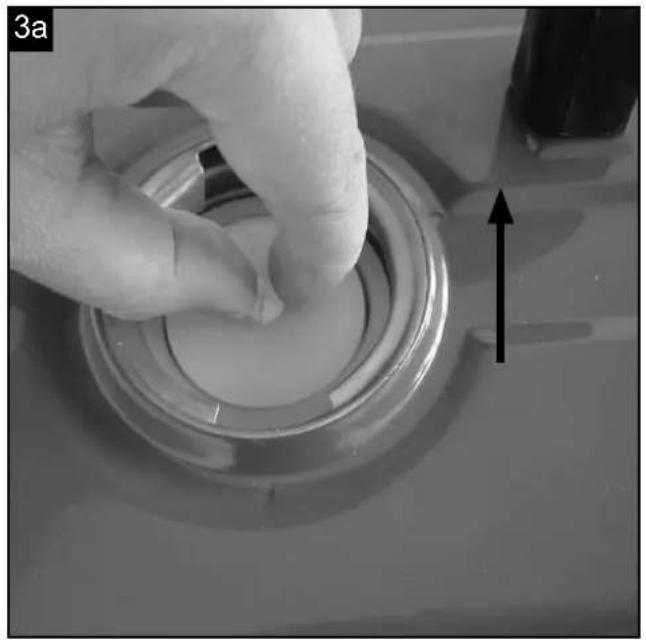
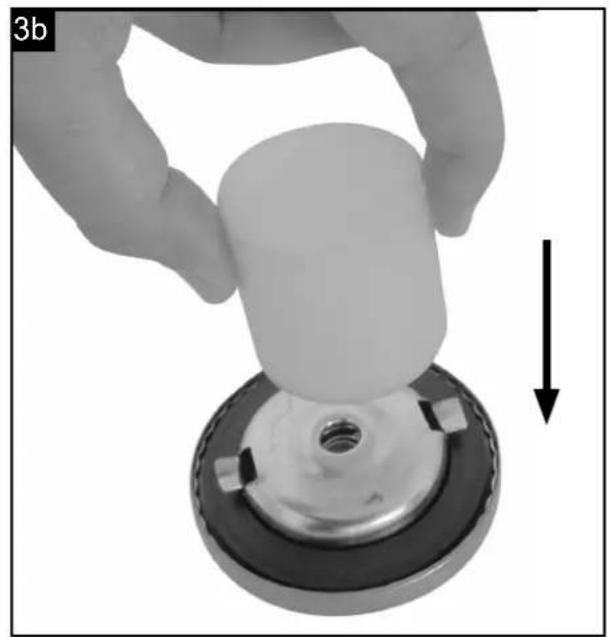
Take the measuring jug out of the tank (Fig. 3a) and fit into the recess on the bottom of the tank cover (Figure 3b).
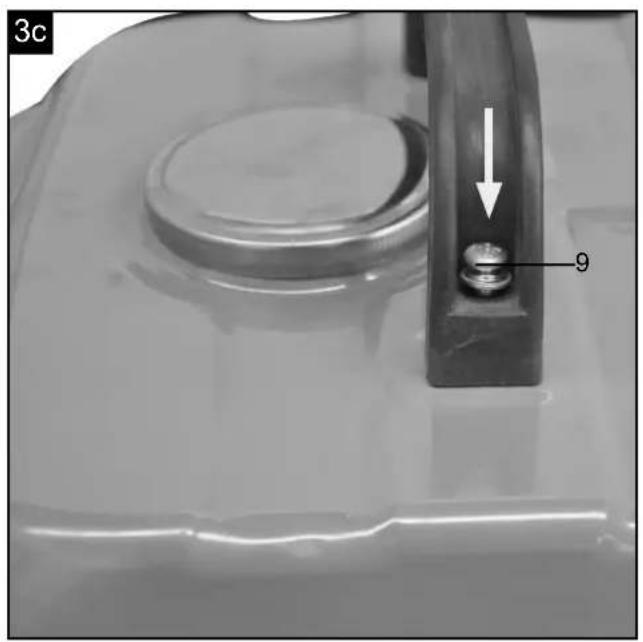
Use on both sides 1 screw and 1 washer (9) to fast the carry handle (2) onto the tank (Fig.3)
7.4 Connecting to earth
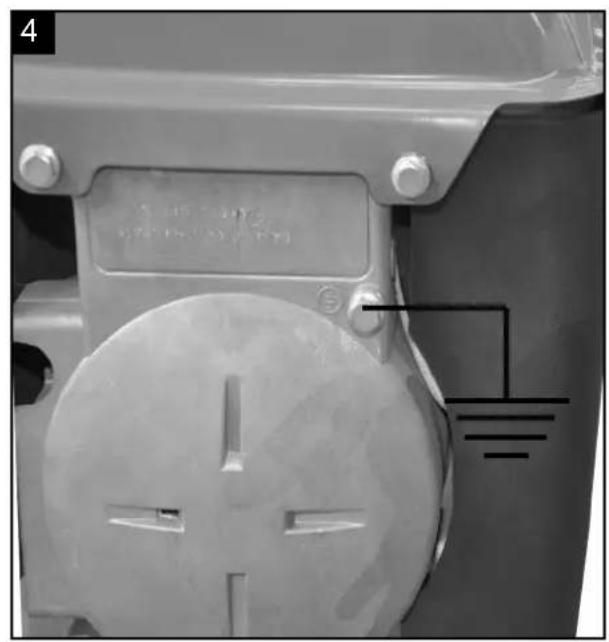
The housing is allowed to be connected to earth in order to discharge static electricity. To do this, connect one end of a cable to the earth connection on the generator (Fig. 4) and the other end to an external earth (for example an earthing rod).
8. OPERATION
Important! Before using the appliance for the first time the tank must be filled with a petrol mixture in a mixing ratio of 1:40. To do so, use the measuring jug inside the tank (Fig. 3b) (Important: One increment of the scale equals 20ml ). Shake the petrol mixture before filling into the tank.
- Check the fuel level and top it up if necessary
- Make sure that the generator has sufficient ventilation
- Make sure that the ignition cable is secured to the spark plug
- Inspect the immediate vicinity of the generator
- Disconnect any electrical equipment which may already be connected to the generator
| Mixture Regular unleaded Petrol 2- stroke - oil | ||
| 1:40 | 1I 25 ml | |
| 2I 50 ml | ||
| 3I 75 ml | ||
| 4I 100 ml | ||
8.1 Starting the engine
- Before starting, ensure that no applicance has been connected to the generator.
- Open the petrol cock (8) by turning it down
- Move the ON/OFF switch (5) to position "ON" with the key.
- Move the choke lever (4) to position IØI.
- Start the engine with the reversing starter (7) by pulling the handle forcefully. Return the reversing starter gently and slowly to the original position by hand. If the engine does not start, pull the handle again. Note: when the motor is started for the very first time. It will require a number of attempts to start until the fuel has travelled from the tank to the motor.
- Push the choke lever (4) back again after the engine has started.
Important!
When starting with the reserve starter, the motor may recoil suddenly as it starts up, resulting in hand injuries. Wear protective gloves when starting the equipment.
8.2 Connecting consumers to the generator
- Checking the start switch oft he appliance is on off before connecting it tot he generator.
- Connect the appliance you want to use to the 230V socket.
Important: This socket may be loaded continuously (S1) with 650W and temporarily (S2) for a maximum of 2 minutes with 720W.
- The generator is suitable for 230V a.c. appliances.
- Do not connect the generator to the household network as this may result in damage to the generator itself or to other electrical appliances in your home.
Note: Some electrical appliances (power jigsaws, drills, etc.) may have a higher level of power consumption when used in difficult conditions.
8.3 Switching off the engine
- Before you switch off the generator, allow it to run briefly with no consumers so that it can "cool down"
- Move the ON/OFF switch (5) to position "OFF" with the key.
- Close the petrol cock
Important: The generator is equipped with an overload cut-out.
This shuts down the socket (6). You can reactivate the socket (6) by pressing the overload cutout (3).
Important! If this happens, reduce the electric power you are taking from the generator or remove any defective connected appliances.
9. CLEANING, MAINTENANCE, STORAGE AND TRANSPORT
Switch off the motor and pull the spark plug boot from the spark plug before doing any cleaning and maintenance work on the equipment.
Important: Switch off the machine immediately and contact your service station:
- In the event of unusual vibrations or noise
- If the engine appears to be overloaded or misfires
9.1 Cleaning
- Keep all safety devices, air vents and the motor housing free of dirt and dust as far as possible. Wipe the equipment with a clean cloth or blow it with compressed air at low pressure.
We recommend that you clean the device immediately each time you have finished using it. - Clean the equipment regularly with a moist cloth and some soft soap. Do not use cleaning agents or solvents; these could attack the plastic parts of the equipment. Ensure that no water can seep into the device.
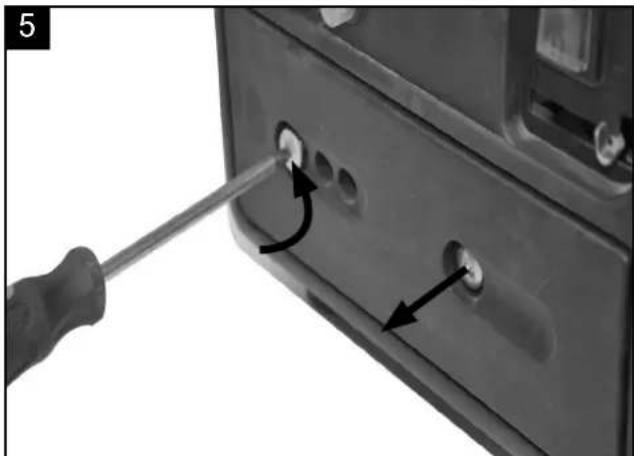
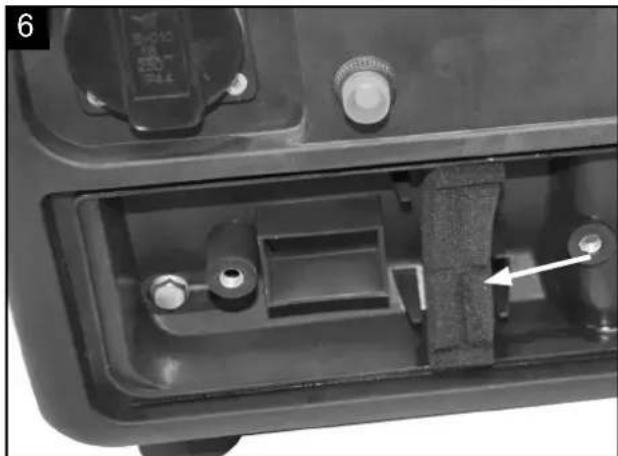
9.2. Air filter (Fig. 5/6)
The air filter should be cleaned after every 30 hours of operation.
- Remove the air filter cover (Fig. 5).
- Remove the filter element (Fig. 6).
- Clean the filter element with soapy water, rinse with clear water and leave to dry well before reinstalling.
- Assemble in reverse order
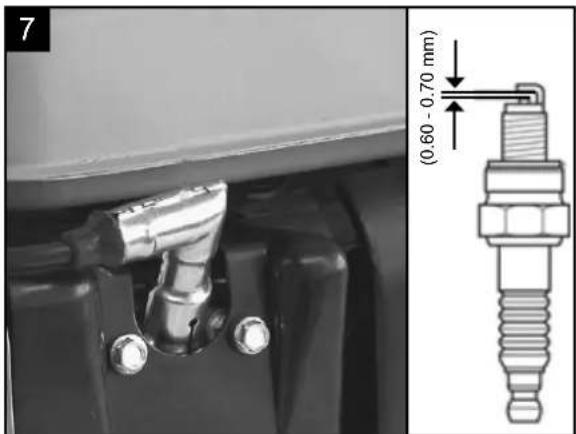
9.3. Spark plug (Fig. 7)
Check the spark plug for dirt and grime after 10 hours of operation and if necessary clean with a copper wire brush. Thereafter service the spark plug after every 50 hours of operation.
- Remove the spark plug cap.
- Clean any dirt from around the spark plug base.
- Use the wrench to remove the spark plug.
- Visually inspect the spark plug. Remove carbon deposits using a wire brush.
- Check for discoloration on the top of the spark plug. The standard color should be a tan color.
- Check the spark plug gap. The acceptable gap should be between 0.6-0.7mm
- Install /reinstall the spark plug carefully by hand
- Once the spark plug has been seated tighten with the spark plug wrench.
- Reinstall the spark plug cap on top of the spark plug.
9.4 Maintenance
There are no parts inside the equipment which require additional maintenance.
9.5 Storage
Please note: If you fail to follow these instructions correctly, deposits may form on the interior of the carburetor which may result in the engine being more difficult to start or the machine suffering permanent damage.
- Carry out all the maintenance work.
- Drain the fuel out of the tank (use a conventional plastic petrol pump from a DIY store for this purpose).
- When the fuel has been drained, start the engine.
- Allow the engine to run at idling speed until it stops. This will clean the remainder of the fuel out of the carburetor.
- Leave the machine to cool (approx. 5 minutes).
- Remove the spark plug (see point 7.3).
- Place a teaspoon full of 2-stroke engine oil into the combustion chamber. Pull the starter cable several times carefully to wet the internal components with the oil. Fit the spark plug again.
- Clean the exterior housing of the machine.
- Store the machine in a cold, dry place where it is out of the reach of ignition sources and inflammable substances.
Fertilizers and other chemical garden products often contain substances that accelerate the rate of corrosion of metals. Do not store the machine on or near fertilizers or other chemicals.
Restarting
- Remove the spark plug.
- Pull the starter cable several times to clean the oil residue out of the combustion chamber.
- Clean the spark plug contacts or fit a new spark plug.
- Fill the tank.
Transport
To transport the machine, first empty the petrol tank as described in section 2 in the section entitled "Storage". Clean coarse dirt off the machine with a brush or hand brush.
Service information
Please note that the following parts of this product are subject to normal or natural wear and that the following parts are therefore also required for use as consumables.
Wear parts*: spark plug
- Not necessarily included in the scope of delivery!
10. DISPOSAL AND RECYCLING
The unit is supplied in packaging to prevent its being damaged in transit. This packaging is raw material and can therefore be reused or can be returned to the raw material system.
The unit and its accessories are made of various types of material, such as metal and plastic. Defective components must be disposed of as special waste. Ask your dealer or your local council.
11. TROUBLESHOOTING
| Fault Possible cause | Remedy | |
| Engine does not start | Automatic oil cut-out has not responded | Check the oil level, top up with engine oil |
| No fuel | Refuel | |
| Generator has too little or no voltage | Controller or capacitor defective | Contact your dealer |
| Overcurrent circuit-breaker has triggered | Actuate the circuit-breaker and reduce the consumers | |
| Air filter dirty | Clean or replace the filter |
Obsah:
Strana:
10.LIKVIDACE A RECYKLACE
TAIENDAVAD OHUTUSALASED HOIATUSJUHISED
X 2000/14/EC_2005/88/EC
2004/22/EC
Annex V
1999/5/EC
Annex VI
Noise: measured LNA = 91 dB(A); guaranteed LNA = 94 dB(A) Notified Body: TÜV SÜD Industrie Service GmbH
Westendslasse 199
Apparent defects must be notified within 8 days from the receipt of the goods. Otherwise, the buyer's rights of claim due to such defects are invalidated. We guarantee for our machines in case of proper treatment for the time of the statutory warranty period from delivery in such a way that we replace any machine part free of charge which provably becomes unusable due to faulty material or defects of fabrica
tion within such period of time. With respect to parts not manufactured by us we only warrant insofar as we are entitled to warranty claims against the upstream suppliers. The costs for the installation of the new parts shall be borne by the buyer. The cancellation of sale or the reduction of purchase price as well as any other claims for damages shall be excluded.