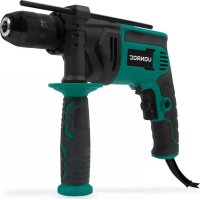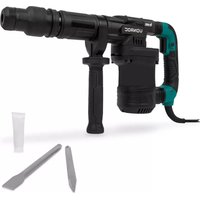
DH501AC - Drill Vonroc - Free user manual and instructions
Find the device manual for free DH501AC Vonroc in PDF.


| Product type | Rotary hammer |
| Brand | Vonroc |
| Model | DH501AC |
| Supply voltage | 220-240 V ~ |
| Frequency | 50 Hz |
| Power consumption | 1 200 W |
| Impact rate | 3 100 blows/min |
| Number of chisel positions | 12 |
| Weight | 6.22 kg |
| Chuck type | SDS Max |
| Protection class | Class II (double insulation) |
| Sound pressure level | 94 dB(A) (K=3 dB(A)) |
| Sound power level | 105 dB(A) (K=3 dB(A)) |
| Vibration (concrete drilling) | 12.55 m/s² (K=1.5 m/s²) |
| Vibration (chiseling) | 15.876 m/s² (K=1.5 m/s²) |
| Auxiliary handle | Adjustable (included) |
| Switch with lock-on | Yes |
| Power supply | Mains (cable) |
| Intended use | Demolition, chiseling, grooving of concrete |
| Maintenance | Clean with a soft cloth; do not use solvents |
| Recommended safety equipment | Hearing protection, safety glasses, dust mask, gloves |
| Warranty | Legal warranty (depending on country) |
Frequently Asked Questions - DH501AC Vonroc
User questions about DH501AC Vonroc
0 question about this device. Answer the ones you know or ask your own.
Ask a new question about this device
Download the instructions for your Drill in PDF format for free! Find your manual DH501AC - Vonroc and take your electronic device back in hand. On this page are published all the documents necessary for the use of your device. DH501AC by Vonroc.
USER MANUAL DH501AC Vonroc
natural_image
Abstract white geometric shape on black background, resembling a stylized 'V' or chevron (no text or symbols)VONROC®
BUILD YOUR FUTURE
Read the enclosed safety warnings, the additional safety warnings and the instructions. Failure to follow the safety warnings and the instructions may result in electric shock, fire and/or serious injury. Save the safety warnings and the instructions for future reference.
The following symbols are used in the user manual or on the product:

Read the user manual.

Denotes risk of personal injury, loss of life or damage to the tool in case of non-observance of the instructions in this manual.
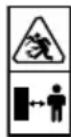
Risk of flying objects. Keep bystanders away from the work area.

Risk of electric shock.

Immediately remove the mains plug from the mains if the mains cable becomes damaged and during cleaning and maintenance.

Variable electronic speed.

Wear safety goggles. Wear hearing protection.

Wear a dust mask.

Wear safety gloves.

Class II machine - Double insulation - You don't need any earthed plug.

Do not dispose of the product in unsuitable containers.

The product is in accordance with the applicable safety standards in the European directives.
GENERAL POWER TOOL SAFETY WARNINGS
WARNING! Read all safety warnings and all instructions. Failure to follow the warnings and instructions may result in electric shock, fire and/or serious injury.
Save all warnings and instructions for future reference.
The term “power tool” in the warnings refers to your mains-operated (corded) power tool or battery-operated (cordless) power tool.
1) Work area safety
a) Keep work area clean and well lit. Cluttered or dark areas invite accidents.
b) Do not operate power tools in explosive atmospheres, such as in the presence of flammable liquids, gases or dust. Power tools create sparks which may ignite the dust or fumes.
c) Keep children and bystanders away while operating a power tool. Distractions can cause you to lose control.
2) Electricalsafety
a) Power tool plugs must match the outlet. Never modify the plug in any way. Do not use any adapter plugs with earthed (grounded) power tools. Unmodified plugs and matching outlets will reduce risk of electric shock.
b) Avoid body contact with earthed or grounded surfaces, such as pipes, radiators, ranges and refrigerators. There is an increased risk of electric shock if your body is earthed or grounded.
c) Do not expose power tools to rain or wet conditions. Water entering a power tool will increase the risk of electric shock.
d) Do not abuse the cord. Never use the cord for carrying, pulling or unplugging the power tool. Keep cord away from heat, oil, sharp edges or moving parts. Damaged or entangled cords increase the risk of electric shock.
e) When operating a power tool outdoors, use an extension cord suitable for outdoor use. Use of a cord suitable for outdoor use reduces the risk of electric shock.
f) If operating a power tool in a damp location is unavoidable, use a residual current device (RCD) protected supply. Use of an RCD reduces the risk of electric shock.
3) Personalsafety
a) Stay alert, watch what you are doing and use common sense when operating a power tool. Do not use a power tool while you are tired or under the influence of drugs, alcohol or medication. A moment of inattention while operating power tools may result in serious personal injury.
b) Use personal protective equipment. Always wear eye protection. Protective equipment such as dust mask, non-skid safety shoes, hard hat, or hearing protection used for appropriate conditions will reduce personal injuries.
c) Prevent unintentional starting. Ensure the switch is in the off-position before connecting to power source and/or battery pack, picking up or carrying the tool. Carrying power tools with your finger on the switch or energising power tools that have the switch on invites accidents.
d) Remove any adjusting key or wrench before turning the power tool on. A wrench or a key left attached to a rotating part of the power tool may result in personal injury.
e) Do not overreach. Keep proper footing and balance at all times. This enables better control of the power tool in unexpected situations.
f) Dress properly. Do not wear loose clothing or jewellery. Keep your hair, clothing and gloves away from moving parts. Loose clothes, jewellery or long hair can be caught in moving parts.
g) If devices are provided for the connection of dust extraction and collection facilities, ensure these are connected and properly used. Use of dust collection can reduce dust related hazards.
h) Do not let familiarity gained from frequent use of tools allow you to become complacent and ignore tool safety principles. A careless action can cause severe injury within a fraction of a second.
4) Power tool use and care
a) Do not force the power tool. Use the correct power tool for your application. The correct power tool will do the job better and safer at the rate for which it was designed.
b) Do not use the power tool if the switch does not turn it on and off. Any power tool that cannot be controlled with the switch is dangerous and must be repaired.
c) Disconnect the plug from the power source and/or the battery pack from the power tool be-
fore making any adjustments, changing accessories, or storing power tools. Such preventive safety measures reduce the risk of starting the power tool accidentally.
d) Store idle power tools out of the reach of children and do not allow persons unfamiliar with the power tool or these instructions to operate the power tool. Power tools are dangerous in the hands of untrained users.
e) Maintain power tools. Check for misalignment or binding of moving parts, breakage of parts and any other condition that may affect the power tool's operation. If damaged, have the power tool repaired before use. Many accidents are caused by poorly maintained power tools.
f) Keep cutting tools sharp and clean. Properly maintained cutting tools with sharp cutting edges are less likely to bind and are easier to control.
g) Use the power tool, accessories and tool bits etc. in accordance with these instructions, taking into account the working conditions and the work to be performed. Use of the power tool for operations different from those intended could result in a hazardous situation.
h) Keep handles and grasping surfaces dry, clean and free from oil and grease. Slippery handles and grasping surfaces do not allow for safe handling and control of the tool in unexpected situations.
5)Service
a) Have your power tool serviced by a qualified repair person using only identical replacement parts. This will ensure that the safety of the power tool is maintained.
b) If the supply cord is damaged, it must be replaced by the manufacturer, its service agent or similarly qualified persons in order to avoid a hazard.
ADDITIONAL SAFETY WARNINGS FOR DEMOLITION HAMMERS
a) Wear ear protectors. Exposure to noise can cause hearing loss.
b) Use auxiliary handle(s), if supplied with the tool. Loss of control can cause personal injury.
c) Hold power tool by insulated gripping surfaces, when performing an operation where the cutting accessory may contact hidden wiring or its own cord. Cutting accessory contacting a "live"
wire may make exposed metal parts of the power tool "live" and could give the operator an electric shock.
Electrical safety
When using electric machines always observe the safety regulations applicable in your country to reduce the risk of fire, electric shock and personal injury. Read the following safety instructions and also the enclosed safety instructions.

Always check that the power supply corresponds to the voltage on the rating plate.

Class II machine - Double insulation - You don't need any earthed plug.
- Do not use the machine if the mains cable or the mains plug is damaged.
- Only use extension cables that are suitable for the power rating of the machine with a minimum thickness of 1.5 mm ^2 . If you use an extension cable reel, always fully unroll the cable.
2.MACHINEINFORMATION
Intended use
The demolition hammer is intended for demolishing concrete, chiseling off concrete, grooving and bar cutting.

Not suitable for construction site usage
TECHNICAL SPECIFICATIONS
| Model No. DH501AC | |
| Mains voltage 220-240 V ~ | |
| Mains frequency 50Hz | |
| Power input 1.200W | |
| Impact rate 3.100/min | |
| Number of chisel positions 12 | |
| Weight 6.22 kg | |
| Sound pressure (LPA) 94 dB(A) K=3 dB(A) | |
| Acoustic power (LWA) | 105 dB(A) K=3 dB(A) |
| Guaranteed (LWA) 105 dB(A) |
| Vibration | |
| Hammer drilling concrete ah,HD | 12.550 m/s ^2 K=1.5m/s ^2 |
| Chiseling ah,Cheq | 15.876 m/s ^2 K=1.5m/s ^2 |

Wear hearing protection.
Vibration level
The vibration emission level stated in this instruction manual has been measured in accordance with a standardized test given in EN 60745; it may be used to compare one tool with another and as= a preliminary assessment of exposure to vibration when using the tool for the applications mentioned.
- Using the tool for different applications, or with different or poorly maintained accessories, may significantly increase the exposure level.
- The times when the tool is switched off or when it is running but not actually doing the job, may significantly reduce the exposure level.
Protect yourself against the effects of vibration by maintaining the tool and its accessories, keeping your hands warm, and organizing your work patterns.
DESCRIPTION
The numbers in the text refer to the diagrams on page 2.
- On/off switch
- Power indicator
- Lock-button
- Chuck
- Locking sleeve
- Main grip
- Auxiliary grip
- Chisel position lock ring
- Lubrication point
3.ASEMBLY

Before assembly, always switch off the machine and remove the mains plug from the mains.
Mounting and removing the accessory (Fig. B)

Caution: chisels can get very hot.

Do not use blunt chisels. Immediately sharpen or replace blunt chisels.

This machine is fitted with an SDS Max chuck.
Mounting
- Apply a few drops of oil to the shaft of the accessory.
- Slide the locking sleeve (5) to the rear.
- Insert the accessory into the chuck (4).
- Release the locking sleeve (5).
- Push the lock ring (8) forward and turn to desired position. Make sure the ring locks back in place before using the machine.
Removing
- Slide the locking sleeve (5) to the rear.
- Remove the accessory from the chuck (4).
- Release the locking sleeve (5).
Setting the auxiliary handle (Fig. A)
- Loosen the auxiliary grip (7) by turning it counterclockwise.
- Turn the auxiliary grip (7) to the required position.
- Tighten the auxiliary grip (7) by turning it clockwise.

Do not remove the axiliary handle from the machine!
4. OPERATION

Demolition hammers require very little operator pressure. Excessive pressure on the tool can lead to unnecessary overheating of the motor, and burning of the driven tool. It also may happen the chisel deforms and cannot be removed from the machine again.
Switching on and off (Fig. A)
- To switch on the machine, press the on/off switch (1).
- To switch off the machine, release the on/off switch (1).
Lock-on Button (Fig. A)
- You can lock the On/Off switch (1) by pressing the On/Off switch (1) and then pressing the lock-on button (3).
- To release the switch-lock; shortly press the On/Off switch (1) again.
Hints for optimum use
- Clamp the workpiece. Use a clamping device for small workpieces.
- Firmly hold the machine by the grip.
- Switch on the machine.
- Do not apply too much pressure on the machine. Let the machine do the work.
- Switch off the machine and wait for the machine to come to a complete standstill before putting the machine down.
5.MAINTENANCE

Before cleaning and maintenance, always switch off the machine and remove the mains plug from the mains.
Clean the machine casings regularly with a soft cloth, preferably after each use. Make sure that the ventilation openings are free of dust and dirt. Remove very persistent dirt using a soft cloth moistened with soapsuds. Do not use any solvents such as gasoline, alcohol, ammonia, etc. Chemicals such as these will damage the synthetic components.
ENVIRONMENT

Faulty and/or discarded electrical or electronic apparatus have to be collected at the appropriate recycling locations.
Only for EC countries
Do not dispose of power tools into domestic waste. According to the European Guideline 2012/19/EC for Waste Electrical and Electronic Equipment and its implementation into national right, power tools that are no longer usable must be collected separately and disposed of in an environmentally friendly way.
WARRANTY
VONROC products are developed to the highest quality standards and are guaranteed free of defects in both materials and workmanship for the period lawfully stipulated starting from the date of original purchase. Should the product develop any failure during this period due to defective material and/or workmanship then contact VONROC directly.
- Repairs and or alterations have been made or attempted to the machine by unauthorized service centers;
- Normal wear and tear;
- The tool has been abused, misused or improperly maintained;
- Non-original spare parts have been used.
This constitutes the sole warranty made by company either expressed or implied. There are no other warranties expressed or implied which extend beyond the face hereof, herein, including the implied warranties of merchantability and fitness for a particular purpose. In no event shall VONROC be liable for any incidental or consequential damages. The dealers remedies shall be limited to repair or replacement of nonconforming units or parts.
The product and the user manual are subject to change. Specifications can be changed without further notice.