
POWXG3020 - Multitools PowerPlus - Free user manual and instructions
Find the device manual for free POWXG3020 PowerPlus in PDF.




| Product type | 4-in-1 multi-function tool (brush cutter, grass trimmer, hedge trimmer, chainsaw) |
| Brand | PowerPlus |
| Model | POWXG3020 |
| Power supply | Corded electric, 230-240 V ~50 Hz |
| Motor power | 1000 W |
| Motor type | Brushed |
| Shaft length | 600 mm |
| Power cable length | 0.35 m |
| Cutting width (grass trimmer) | 380 mm |
| Cutting width (brush cutter) | 230 mm |
| Cutting length (hedge trimmer) | 410 mm |
| Max cutting thickness (hedge trimmer) | 20 mm |
| Blade type (hedge trimmer) | Double action, laser cut, 33 teeth |
| Guide bar length | 200 mm (8") |
| Cutting bar capacity (saw) | 180 mm |
| Oil tank capacity (saw) | 100 ml |
| Sound pressure level | 86 dB(A) |
| Sound power level | 103 dB(A) |
| Vibration (aw) | 7.7 m/s², K=1.5 m/s² |
| Protection class | II (Double insulation) |
| Warranty | 36 months |
Frequently Asked Questions - POWXG3020 PowerPlus
User questions about POWXG3020 PowerPlus
0 question about this device. Answer the ones you know or ask your own.
Ask a new question about this device
Download the instructions for your Multitools in PDF format for free! Find your manual POWXG3020 - PowerPlus and take your electronic device back in hand. On this page are published all the documents necessary for the use of your device. POWXG3020 by PowerPlus.
USER MANUAL POWXG3020 PowerPlus
natural_image
Product display of power tools including a diagonal cutting tool and a yellow powerizer, with no visible text or symbols on the main components.
NL NEDERLANDS VERTAALDE VERSIE VAN DE ORIGINELE HANDLEIDING
FR FRANÇAIS TRADUCTION DU MODE D'EMPLOI D'ORIGINE
EN ENGLISH ORIGINAL INSTRUCTION MANUAL
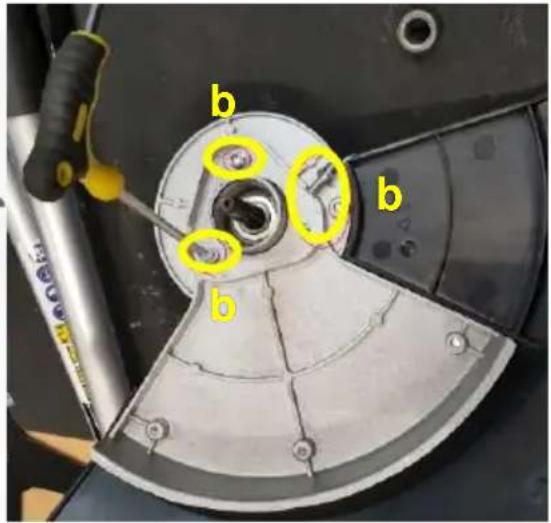
FIG. C

FIG. D


natural_image
Mechanical device with lever and base components, labeled 'b' (no text or symbols on the device itself)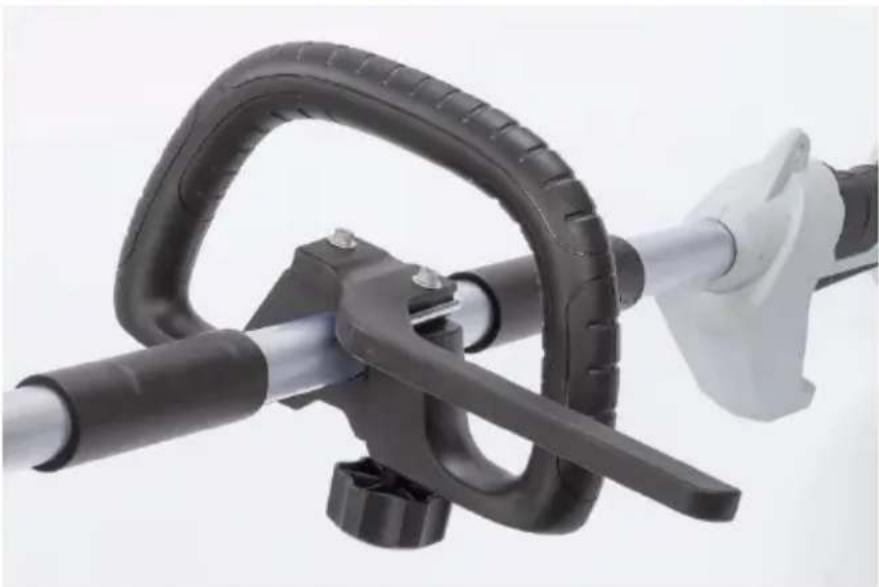
natural_image
Close-up of a black and white bicycle tire clamp mechanism (no text or symbols visible)FIG. E

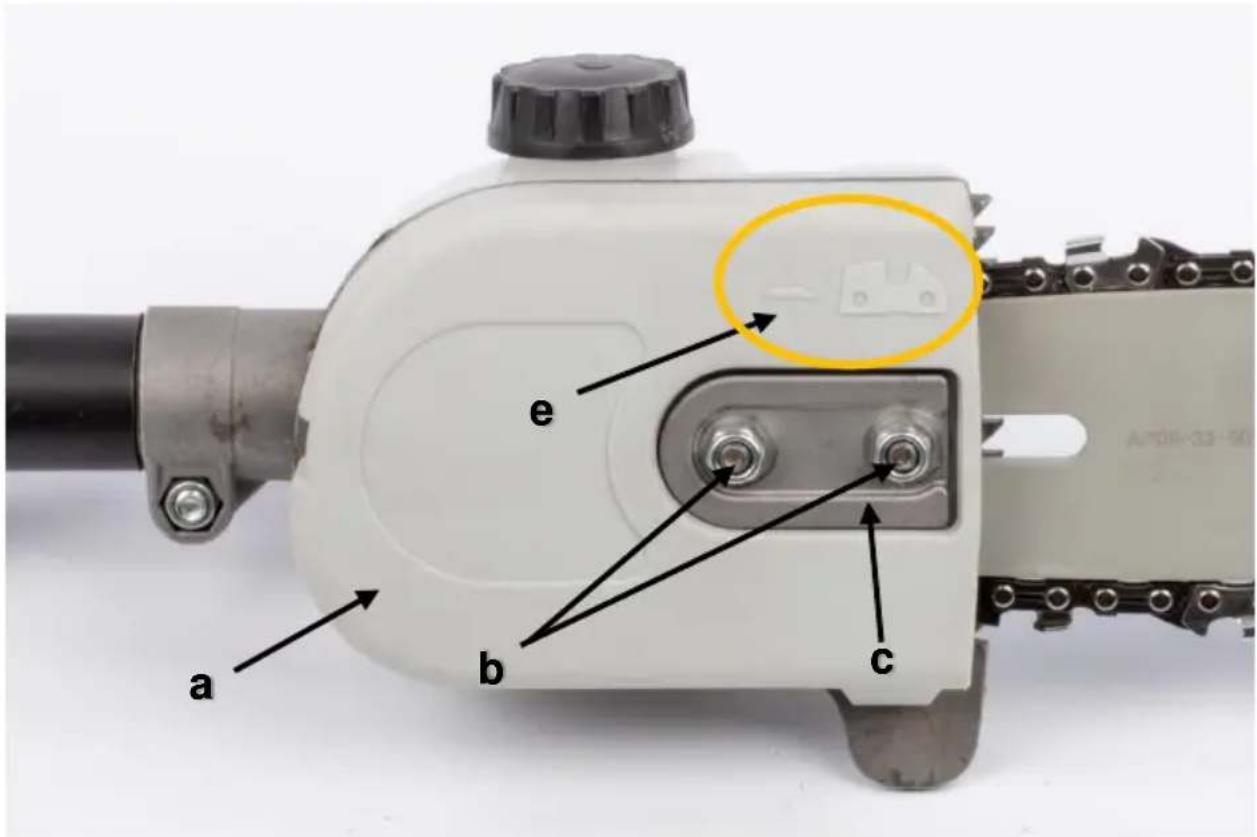
FIG. F

natural_image
Close-up of a mechanical assembly with a white component and black textured parts, labeled 'j' with an arrow pointing to a small feature (no readable text or symbols beyond the label)FIG. F
POWERPLUS®
HIGH QUALITY TOOLS

natural_image
Close-up of a mechanical component with labeled parts (c, d) and a central circular feature, no readable text or symbols beyond labels.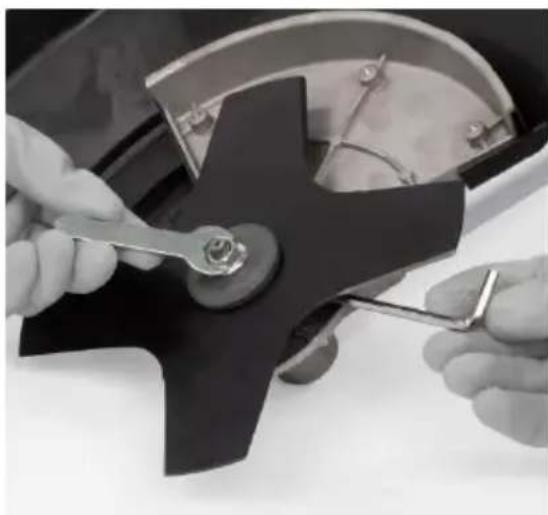
natural_image
Close-up of hands assembling a mechanical component with a wrench tool (no visible text or symbols)FIG. G

natural_image
Close-up of a gloved hand adjusting a mechanical component with orange arrows indicating rotation (no text or symbols)FIG. H

natural_image
Close-up of a power tool with orange arrow indicating rotation, no visible text or symbols on the device itself.FIG. H 1

FIG. I

natural_image
Close-up of a hand using a pliers to adjust a mechanical component, with an orange arrow indicating rotation (no text or symbols visible)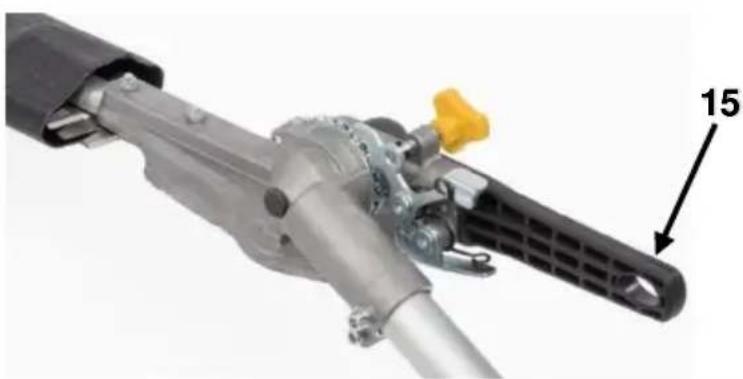
natural_image
Close-up of a mechanical device with a yellow component and numbered label (15), no readable text or symbols beyond the number.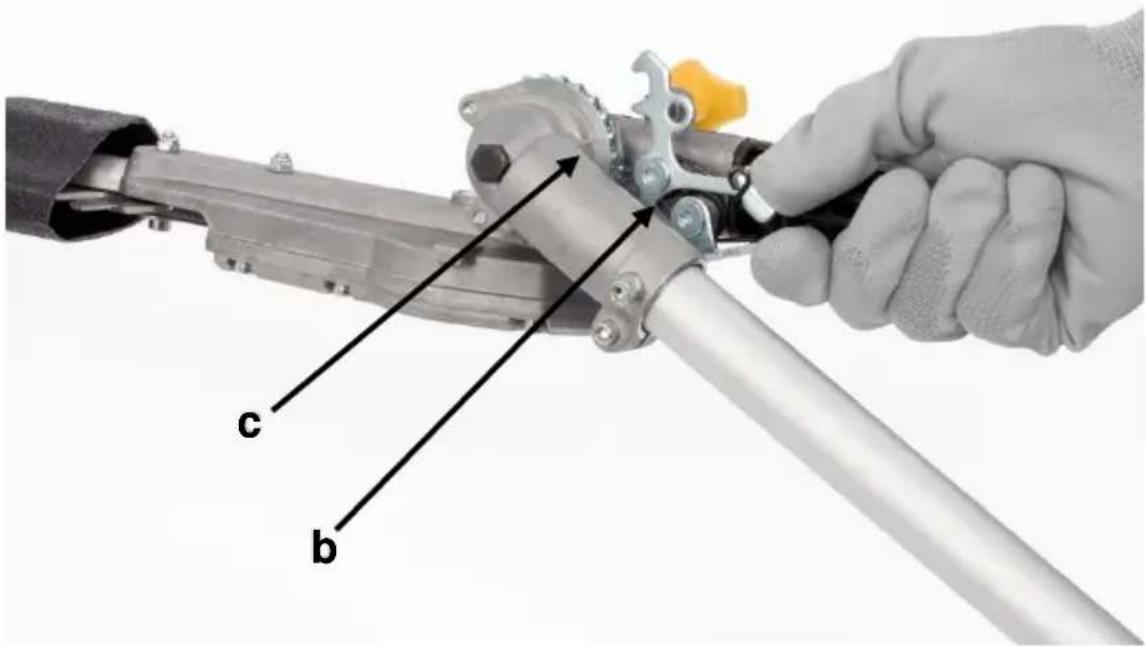
FIG. J

FIG. K
1 BEOOGD GEBRUIK 4
2 BESCHRIJVING (FIG. A) 4
3 INHOUD....4
4 TOELICHTING VAN DE SYMBOLEN 5
5 ALGEMENE VEILIGHEIDSVOORSCHRIFTEN .... 5
5.1 Werkplaats....5
5.2 Elektrische veiligheid 6
10 PROBLEEMOPLOSSING 19
2 BESCHRIJVING (FIG. A)
10 PROBLEEMOPLOSSING
Product: Multitool tuin 4-in-1 1000 W
Handelsmerk: POWERplus
Model: POWXG3020
natural_image
Simple hand-drawn outline of a rounded rectangular shape with no text or symbolsPhilippe Vankerkhove, MSc.EE.
Regelgevings- en compliance manager
11/05/2022, Lier - Belgium
1 UTILISATION PREVUE 4
2 DESCRIPTION (FIG. A) 4
3 LISTE DES PIÈCES CONTENUES DANS L'EMBALLAGE......4
4 PICTOGRAMMES....5
5 CONSIGNES DE SÉCURITÉ GÉNÉRALES .... 5
7.1 Ensemble arbre (Fig. A&B)....12
7.2 Montage du capot de protection (Fig. A&C)....12
7.3 Fixation de la sangle de transport (Fig. A&D) 12
16 DÉCLARATION DE CONFORMITÉ ....23
MULTI-OUTIL DE JARDIN 4-EN-1 1000 W POWXG3020
1 UTILISATION PREVUE
2006/42/EC Annex IV Notified Body
TuV Sud - DE
2014/30/EU
2000/14/EC Annex VI LwA
Measured
94dB(A) 103dB(A)
Guaranteed
96dB(A) 107dB(A)
Notified Body
TuV Sud - DE
natural_image
Simple hand-drawn sketch of a rounded rectangular shape with no text or symbolsPhilippe Vankerkhove, MSc.EE.
5.3 Personal safety .... 5
5.4 Power tool use and care....5
5.5 Service....6
6 ADDITIONAL SAFETY RULES FOR GARDEN MULTITOOLS .....6
6.1 Brush cutter....6
6.2 Hedge trimmer....7
6.3 Chain saw....7
6.4 Trimmer 9
6.5 Always use common sense....10
7 ASSEMBLY....10
7.1 Mounting the shaft (Fig. A&B).... 10
7.2 Installing the protection guard (Fig. A & C)....10
7.3 Attaching the carrying belt (Fig. A & D)....10
7.4 Mounting the round handle (Fig. A & E)....10
7.5 Mounting the saw chain (Fig. F)....11
7.6 Replace the cutter blade and spool (Fig. A, G & H) 11
7.6.1 Removing the cutter blade. (Fig. A & G)....11
7.6.2 Mounting the cutter blade. (Fig. A & G) 11
7.6.3 Mounting the spool (Fig. A & H) 12
8 OPERATION....12
8.1 Chain lubrication (Fig. I)....12
8.1.1 Filling with chain oil : 12
8.2 Swivelling out the Hedge trimmer (Fig. A & J)....12
8.3 Starting the machine (Fig. K)....12
POWERPLUS® HIGH QUALITY TOOLS
POWXG3020 EN
8.4 Stopping the machine (Fig. K)....13
8.5 Working with the hedge trimmer....13
8.6 Working with the chain saw 13
8.7 Working using the thread spool....13
8.8 Working with the 4-tooth blade....14
8.9 Trimming procedures 14
8.9.1 Trimming / mowing....14
8.9.2 Closer trimming....14
8.9.3 Fence / foundation trimming....14
8.9.4 Trimming around trees 15
8.9.5 Scalping 15
8.10 Cutting techniques using the hedge trimmer....15
8.10.1 Cutting Shaped Hedges: 15
8.11 Cutting techniques using chain saw....16
8.11.1 Sawing off small branches:....16
8.11.2 Sawing off larger branches:....16
8.11.3 Sawing in sections: 16
9 CLEANING AND MAINTENANCE....16
9.1 Cleaning the chain saw....16
9.2 Cleaning the hedge trimmer....17
9.3 Cleaning the trimmer and brush cutter attachment....17
10 TROUBLE SHOOTING 17
11 TECHNICAL DATA 17
12 NOISE....18
13 MAINTENANCE INTERVALS....18
13.1 Chain saw....18
13.2 Hedge trimmer....18
14 WARRANTY....19
15 ENVIRONMENT 19
16 DECLARATION OF CONFORMITY 20
GARDEN MULTITOOL 4-IN-1 1000W POWXG3020
1 INTENDED USE
- This appliance is designed for the following applications:
- Brush cutter (when fitted with metal circular blade): The brush cutter is intended to cut weed and climbing plants. Do not use it for other purposes, never use it for
- cutting wood. Never cut objects with a diameter exceeding 13 mm.
- Grass trimmer (when fitted with nylon line cutting head): The grass trimmer is intended for trimming grass. Do not use it for other purposes.
- Hedge trimmer (when fitted with reciprocating blade): The trimmer is intended to be used for trimming hedges and bushes with diameter not more than 24 mm.
- Chain saw: this appliance is intended for trimming branches in trees.
- Do not use this appliance for other purpose than those described in this manual. Not suitable for professional use.

WARNING! For your own safety, read this manual and the general safety instructions carefully before using the appliance. Your power tool should only be given to other users together with these instructions.
2 DESCRIPTION
- Drive shaft assembly
- Brush cutter/grass trimmer attachment
- Hedge trimmer attachment
- Chain saw attachment
- Cutter blade
- Protection guard
- Shaft locking knob
- Locking pin
-
Drive shaft assembly coupling
-
Carrying belt
- Round handle
- Wire spool
- Oil tank
- Cutter bar
- Cutter bar handle
- Chain bar
- Cutter bar sheath
- Chain bar sheath
3 PACKAGE CONTENT LIST
■ Remove all packaging materials.
- Remove remaining packaging and packing inserts (if included).
- Check that the package contents are complete.
- Check the appliance, the power cord, the power plug and all accessories for transportation damage.
- Keep the packaging materials as far as possible until the end of the warranty period. Then take it to your local waste disposal system.

WARNING Packaging materials are not toys! Children must not play with plastic bags! There is a danger of suffocation!
1x Drive shaft assembly
1x Brush cutter/grass trimmer attachment
1x Hedge trimmer attachment
1x Chain saw attachment
1x Protection guard base cover aluminum
1x Protection guard large cover plastic
1x Round handle
1x Carrying belt
1x Wire spool
1x Cutter blade
1x Hex key (in round handle)
1x Multi key (in chain bar sheath)
1x Spanner 14mm
1x Chain 8"
1x Chain bar 8"
1x Chain bar sheath
1x Cutter bar sheath
1x Nut 14mm
1x Black washer
1x Manual

If any parts are missing or damaged, please contact your dealer.
4 SYMBOLS
The following symbols are used in this manual and/or on the machine:
 | Denotes risk of personal injury or damage to the tool. |  | Wearing of protective shoes advised. |
 | Read instructions carefully. |  | Wear gloves. |
[WAT3A] | Wear safety glasses and ear protection. | 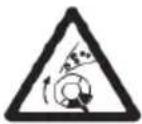 | Watch out for thrown objects and ricochets |
 | Never operate the machine in the rain or in damp or wet condition.Moisture is a shock hazard. |  | Keep a minimum distance of 15m between the machine and third parties during use. |
 | "Class II - The machine is double insulated; Earthing wire is therefore not necessary |  | In accordance with essential requirements of the European directive(s). |
 | Wear a maskIn dusty conditions |  | Electrical products must not be disposed with the domestic waste. |
 | Important information |  | Kickback safety warning |
5 GENERAL POWER TOOL SAFETY WARNINGS
Read all safety warnings and instructions. Failure to heed warnings and follow instructions may result in electric shock, fire and/or serious injury. Keep safety warnings and instructions for future reference. The term "power tool" in the safety warnings refers to your mains-operated (corded) power tool or battery-operated (cordless) power tool.
5.1 Working area
- Keep working area clean and well lit. Untidy and dark areas can lead to accidents.
- Do not operate power tools in potentially explosive surroundings, for example, in the presence of inflammable liquids, gases or dust. Power tools create sparks which may ignite the dust or fumes.
- Keep children and bystanders at a distance when operating a power tool. Distractions can cause you to lose control of it.
5.2 Electrical safety

Always check that the power supply corresponds to the voltage on the rating plate.
- Power tool plugs must match the outlet. Never modify the plug in any way. Do not use adapter plugs with earthed power tools. Unmodified plugs and matching outlets will reduce the risk of a lethal electric shock.
- Avoid body contact with earthed surfaces such as pipes, radiators, kitchen ranges and refrigerators. There is an increased risk of a lethal electric shock if your body is earthed.
- Do not expose power tools to rain or wet conditions. If water gets inside a power tool, it will increase the risk of a lethal electric shock.
- Do not damage the cord. Never use the cord for carrying, pulling or unplugging the power tool. Keep the cord away from heat, oil, sharp edges or moving parts. Damaged or entangled cords increase the risk of a lethal electric shock.
- When operating a power tool outdoors, use an extension cable suitable for outdoor use. Using a cord suitable for outdoor use reduces the risk of a lethal electric shock.
- If operating a power tool in a damp location is unavoidable, use a power supply protected by a residual current device (RCD). Using an RCD reduces the risk of a lethal electric shock.
5.3 Personal safety
- Stay alert, watch what you are doing and use common sense when operating a power tool. Do not use a power tool when you are tired or under the influence of drugs, alcohol or medication. A moment of inattention when operating a power tool may result in serious personal injury.
- Use safety equipment. Always wear eye protection. Using safety equipment such as a dust mask, non-skid safety shoes, a hard hat, or hearing protection whenever it is needed will reduce the risk of personal injury.
- Avoid accidental starts. Ensure the switch is in the off position before inserting the plug. Carrying power tools with your finger on the switch or plugging in power tools when the switch is in the on position makes accidents more likely.
- Remove any adjusting keys or spanners before turning on the power tool. A spanner or key left attached to a rotating part of the power tool may result in personal injury.
- Do not reach out too far. Keep your feet firmly on the ground at all times. This will enable you to retain control over the power tool in unexpected situations.
- Dress properly. Do not wear loose clothing or jewelry. Keep your hair, clothing and gloves away from the power tool. Loose clothes, jewelry or long hair can become entangled in the moving parts.
If there are devices for connecting dust extraction and collection facilities, please ensure that they are attached and used correctly. Using such devices can reduce dust-related hazards.
5.4 Power tool use and care
- Do not expect the power tool to do more than it can. Use the correct power tool for what you want to do. A power tool will achieve better results and be safer if used in the context for which it was designed.
- Do not use the power tool if the switch cannot turn it on and off. A power tool with a broken switch is dangerous and must be repaired.
-
Disconnect the plug from the power source before making adjustments, changing accessories, or storing power tools. Such preventive safety measures reduce the risk of starting the power tool accidentally.
-
Store power tools, when not in use, out of the reach of children and do not allow people who are not familiar with the power tool or these instructions to operate it. Power tools are potentially dangerous in the hands of untrained users.
- Maintenance. Check for misalignment or jammed moving parts, breakages or any other feature that might affect the operation of the power tool. If it is damaged, the power tool must be repaired. Many accidents are caused by using poorly maintained power tools.
- Keep cutting tools sharp and clean. Properly maintained cutting tools with sharp cutting edges are less likely to jam and are easier to control.
- Use the power tool, accessories and cutting tools, etc., in accordance with these instructions and in the manner intended for the particular type of power tool, taking into account the working conditions and the work which needs to be done. Using a power tool in ways for which it was not intended can lead to potentially hazardous situations.
5.5 Service
Your power tool should be serviced by a qualified specialist using only standard spare parts. This will ensure that it meets the required safety standards.
6 ADDITIONAL SAFETY RULES FOR GARDEN MULTITOOLS
6.1 Brush cutter
- FOLLOW ALL WARNINGS and instructions regarding operation and blade installation.
THE BLADE CAN RECOIL VIOLENTLY FROM MATERIAL IT CANNOT CUT – The blade can cause you to lose arms or legs. Keep people and animals 50 feet (15 meters) away in all directions. If the blade contacts foreign objects during operation, turn off the engine and allow the blade to come to a halt. Then check the blade for damage. Always discard the blade if it is warped or cracked.
- INSPECT YOUR BRUSH CUTTER AND ATTACHMENTS BEFORE USE - Never use unless all blade attachment hardware has been properly installed.
- THE BLADE COASTS AFTER THE THROTTLE IS RELEASED - A coasting blade can injure you or bystanders. Before servicing the blade, always turn off the engine, and be sure the coasting blade has stopped.
- DO NOT OPERATE UNIT IN AWKWARD POSITIONS, off balance, with outstretched arms, or with one hand. Always use two hands when operating unit, with thumbs and fingers encircling the handles.
- DO NOT RAISE THE BLADE HEAD above ground level while unit is operating. Injury to operator could result.
DO NOT USE UNIT FOR ANY PURPOSES OTHER than brush cutting.
- DO NOT OPERATE UNIT FOR PROLONGED PERIODS. Rest periodically.
- DO NOT OPERATE UNIT WHILE UNDER THE INFLUENCE OF ALCOHOL OR DRUGS.
- DO NOT OPERATE UNIT UNLESS DEBRIS SHIELD AND/OR GUARD IS INSTALLED AND IN GOOD CONDITION.
- DO NOT ADD, REMOVE OR ALTER ANY COMPONENTS OF THIS PRODUCT. Doing so could cause personal injury and/or damage the unit, and void the manufacturer's warranty.
- DO NOT operate your unit near or around inflammable liquids or gases whether in or out of doors. An explosion and/or fire may result.
- DO NOT USE ANY OTHER CUTTING ATTACHMENT. Only use our replacement parts and accessories, which are designed specifically to enhance the performance and maximize the safe operation of our products. Failure to do so may cause poor performance and possible injury.
- Use only the blade supplied with this product. Do not use any other cutting attachment. Use of such attachments will void your factory warranty and may result in serious bodily injury.
6.2 Hedge trimmer

Caution! Notice overhead power lines.
- Use of the hedge trimmer should be avoided when people, especially children, are nearby.
If the cutting unit contacts a foreign body or if the operating noises increase or the hedge trimmer vibrates with unusually high force, turn off the motor and let the hedge trimmer come to a standstill. Pull the mains plug or remove the battery and take the following measures:
- check for damages;
- check for loose parts and fasten all loose parts;
- replace damaged parts with equivalent parts or have them repaired.
- Switch the appliance off and remove the mains plug or battery before:
▪ cleaning or removing a blockage;
- inspection, servicing or work on the hedge trimmer;
- adjusting the working position of the cutting unit;
- leaving the hedge trimmer unattended.
- Always ensure that the hedge trimmer is properly placed in one of the indicated working positions before the motor is started.
- Do not use the hedge trimmer with a defective or strongly worn-out cutting unit.
- To avoid the risk of fire, ensure that the motor is free from deposits and leaves.
■ Always ensure that all handles and safety devices are mounted when you use the hedge trimmer. Never try to use an incomplete hedge trimmer or a hedge trimmer with impermissible modifications.
■ Always use both hands when the hedge trimmer is equipped with two handles.
- Always familiarise with your surroundings and pay attention to potential dangers that you cannot hear because of the noise the hedge trimmer makes.
- Keep cable away from cutting area. During operation the cable may be hidden in shrubs and can be accidentally cut by the blade.
- Keep all parts of the body away from the cutter blade. Do not remove cut material or hold material to be cut when blades are moving. Make sure the switch is off when clearing jammed material. A moment of inattention while operating the hedge trimmer may result in serious personal injury.
■ Children must never use the hedge trimmer.
- If the hedge trimmer is taken out of operation for purposes of maintenance, inspection or storage, turn off the motor, unplug the mains plug or remove the battery and make absolutely sure that all rotating parts have come to a standstill. Let the machine cool down before you check or adjust it, etc.
- Carry the hedge trimmer by the handle with the cutter blade stopped. When transporting or storing the hedge trimmer always fit the cutting device cover. Proper handling of the hedge trimmer will reduce possible personal injury from the cutter blades.
6.3 Chain saw
- DO NOT operate a chain saw with one hand! Serious injury to the operator, helpers, bystanders, or any combination of these persons may result from one-handed operation. A chain saw is intended for two-handed use.
- DO NOT operate a chain saw when you are fatigued, under the influence of drugs, alcohol or medication.
- Use safety footwear, snug-fitting clothing, protective gloves, and eye, hearing and head protection devices.
- DO NOT allow other persons to be near when starting or cutting with the chain saw. Keep bystanders and animals out of the work area.
POWXG3020 EN
- DO NOT start cutting until you have a clear work area, secure footing, and a planned retreat path from the falling tree.
- Keep all parts of your body away from the saw chain when the engine is running.
■ Before you start the engine, make sure that the saw chain is not contacting anything.
- Carry the chain saw with the engine stopped, the guide bar and saw chain to the rear, and the muffler away from your body.
- DO NOT operate a chain saw that is damaged, improperly adjusted, or not completely and securely assembled. Be sure that the saw chain stops moving when the throttle control trigger is released.
- Shut off the engine before setting the chain saw down.
- Use extreme caution when cutting small size brush and saplings because slender material may catch the saw chain and be whipped toward you or pull you off balance.
- When cutting a limb that is under tension, be alert for spring back so that you will not be struck when the tension in the wood fibres is released.
- Keep the handles dry, clean, and free of oil or fuel mixture.
- Operate the chain saw only in well-ventilated areas.
■ DO NOT operate a chain saw in a tree unless you have been specifically trained to do so.
- All chain saw service, other than the items listed in the user manual safety and maintenance instructions, should be performed by competent chain saw service personnel.
- When transporting your chain saw, use the appropriate guide bar scabbard.
- DO NOT operate your chain saw near or around flammable liquids or gases whether in or out of doors. An explosion and/or fire may result.
- USE THE RIGHT TOOL: Cut wood only. Do not use the chain saw for purposes for which it was not intended. For example, do not use the chain saw for cutting plastic, masonry, or non-building materials.
- The first time user should have practical instruction in the use of chainsaw and the protective equipment from an experienced operator.
- Do not attempt to hold the saw with one hand only. You cannot control reactive forces and you may lose control of the saw, which can result in the skating or bouncing of the bar and chain along the limb or log.
- Never run the chainsaw indoors. Your chainsaw produces poisonous exhaust as soon as the combustible engine is started, which may be colorless and odorless. To use this product can generate dust, mists and fumes containing chemicals known to cause reproductive harm. Be aware of harmful dust, mist (such as saw dust or oil mist from chain lubrication) and protect yourself properly.
- Wear gloves and keep your hand warm. Prolonged use of chainsaws exposing the operator to vibrations may produce white finger disease. In order to reduce the risk of white finger disease, please wear gloves and keep your hand warm. If any of the white finger symptoms appear, seek medical advice immediately.
- Drive in the spiked bumper of the chainsaw directly behind the intended hinge and pivot the saw around this point. The spiked bumper rolls against the trunk.
- Only chain, guide bar and spark plug can be replaced by the user himself. Always make sure you replace with correct material as stated in the specifications of the manual.
Kickback safety precautions

- KICKBACK may occur when the NOSE or TIP of the guide bar touches an object, or when wood closes in and pinches the saw chain in the cut.
- Tip contact in some cases may cause a lightning-fast reverse reaction, kicking the guide bar up and back toward the operator.
- PINCHING the saw chain along the BOTTOM of the guide bar may PULL the saw forward away from the operator.
- PINCHING the saw chain along the TOP of the guide bar may PUSH the guide bar rapidly back toward the operator.
- Any of these reactions may cause you to lose control of the saw, which could result in serious personal injury.
- With a basic understanding of kickback, you can reduce or eliminate the element of surprise. Sudden surprise contributes to accidents.
- Keep a good firm grip on the saw with both hands, the right hand on the rear handle, and the left hand on the front handle, when the engine is running. Use a firm grip with thumbs and fingers encircling the chain saw handles. A firm grip will help you reduce kickback and maintain control of the saw. Don't let go.
■ Make sure that the area in which you are cutting is free from obstructions. Do not let the nose of the guide bar contact a log, branch, or any other obstruction which could be hit while you are operating the saw. - Cut at high engine speeds.
- Do not overreach or cut above shoulder height.
■ Follow manufacturer's sharpening and maintenance instructions for the saw chain. - Only use replacement bars and chains specified by the manufacturer or the equivalent.

NOTE: Low-kickback saw chain is chain that has met the kickback performance.

WARNING: Kickback can lead to dangerous loss of control of the chain saw and result in serious or fatal injury to the saw operator or to anyone standing close by. Always be alert. Rotational kickback and pinch-kickback are major chain saw operational dangers and the leading cause of most accidents.
6.4 Trimmer

Only connect the appliance to an electric circuit which is protected by an earth leakage switch (30 mA).
- Check the appliance before use. If it is damaged, it must not be used.
■ If the unit is damaged, have the damage repaired by an authorized repair agent. - Do not use the appliance if the mains cable is damaged or worn.
■ Before use check the extension cord for possible wear and tear. In case of damage, immediately remove the mains cable from the wall socket. Do not touch the cable before the mains cable has been removed from the wall socket. - Do not use the appliance in the presence of children and/or animals.
- Only use the appliance in daylight or with good lighting.
■ Never use the appliance without the guard in place. - Before using the appliance, remove sticks, stones, wire and other obstacles from the surface on which you intend to work.
- Only use the appliance in an upright position, with the cutting line pointing to the ground. Never switch on the appliance in another position.
■ Always keep your hands and feet away from the cutting line. - Avoid touching the cutting line.
■ Make sure that the mains cable does not touch the cutting line.
Before putting the appliance down, switch it off and wait for the cutting line to come to a complete standstill. Never attempt to bring the cutting line to a standstill yourself.

Beware. After switching off the appliance it continues to rotate for a short time.
- Only use the type of cutting line recommended by the manufacturer. Never use a metal cutting line or fishing line.
- Remove the plug from the wall socket when you have finished, before servicing, or when the appliance is not being used.
■ After use, always store the appliance safely and out of the reach of children. - Do not cut against hard objects. This could cause injury or damage the trimmer.
- Do not use the trimmer to cut grass which is not in contact with the ground, for example, do not cut grass which is on walls or rocks etc.
6.5 Always use common sense
It is not possible to cover every conceivable situation you can face. Always exercise care and use your common sense. Avoid all situations which you consider to be beyond your capability. If you still feel uncertain about operating procedures after reading these instructions, you should consult an expert before continuing.
7 ASSEMBLY
7.1 Mounting the shaft (Fig. A&B)
■ Loosen the knob (7).
- Slide the front tubular shaft (either shaft 2,3 or 4) into the tubular shaft of the drive shaft assembly (1).
■ Make sure the locking pin (8) snaps in the hole of the coupling (9).
- Fix the tubular shaft in place with the knob (7).
7.2 Installing the protection guard (Fig. A & C)
■ Fit the protection guard (6) to the head of the brush cutter/grass trimmer attachment (2).
- Fasten the protection guard (6) with the 4 hex bolts (a).
- Fit the complete protection guard (6) with 3 hex bolts (b) from the lower side to the brush cutter/grass trimmer attachment (2).
7.3 Attaching the carrying belt (Fig. A & D)
- Put the carrying belt (10) over your shoulder and adjust it for comfortable use.
- Clip the hook (a) on to the eye (b) located in front of the main handle (1).
7.4 Mounting the round handle (Fig. A & E)

The round handle must be mounted with a spacing of at least 25 cm to the device handle! The leg protection must always be mounted on the operator side!
- Place the round handle (11) onto the tubular shaft of the drive shaft assembly (1) in a suitable position with the round handle on top.
- Fasten it to the tubular shaft with the locking knob (a).
■ Next fasten the leg support (b) to the round handle using the 2 hex bolts. - The leg support (b) can be fitted for left or right handed use, on the left for right handed and on the right for left handed use.
7.5 Mounting the saw chain (Fig. F)

Pay attention to the correct rotation direction of the saw chain. This is indicated on the chain wheel cover (a) and above the bar bolt (i). Tension the saw chain in accordance with the instructions below.

CAUTION: Always wear heavy-duty work gloves when handling and installing a saw chain.
- Place the device on a level surface.
- Remove the chain wheel cover (a) and the metal mounting block (c) by loosening the nuts (b) with the mounting key (d).
- Lay out the new saw chain in a loop and straighten any kinks. The cutters should face in the direction of chain rotation, as marked (e) on the chain wheel cover (a). If they face backwards, turn the loop over.
- Place the saw chain (f) into the blade groove. Position the chain so there is a loop at the back of the bar.
- Hold the chain in position on the bar and place the loop around the sprocket (g).
Place the chain bar (16) over the bar tab (i) and the chain tension pin (k). - Pre-tension the saw chain (f) by turning the screw (j) in a clockwise direction with the mounting key (b).
- Put the chain wheel cover (a) back in position. Make the final adjustment to the chain tension with the tensioning screw (j).
- Tighten the chain wheel cover and metal mounting block (c) with the 2 nuts (b).
7.6 Replace the cutter blade and spool (Fig. A, G & H)

CAUTION: NEVER use the unit if the blade is warped or has teeth that are chipped or missing. Replace a damaged blade immediately.
CAUTION: Always wear heavy-duty work gloves when handling and installing a blade.
7.6.1 Removing the cutter blade. (Fig. A & G)
- Turn the tool upside down so that you can replace the cutter blade (5) easily.
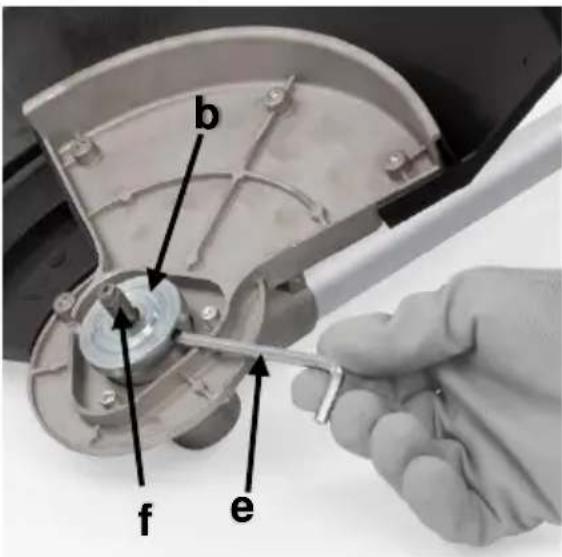
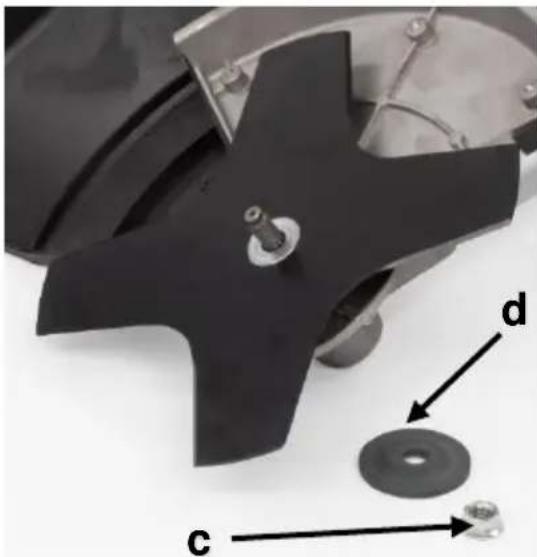
- To dismount the cutter blade (5), insert the hex wrench through the hole of the machine body under the cutter blade and into the receive washer (b).
■ Rotate the cutter blade (5) until it is locked with the hex wrench (e). - Loosen the hex nut (c) clockwise (left-hand thread) with the hex socket wrench and remove the nut (c), cup (d), cutter blade (5), and hex wrench.
7.6.2 Mounting the cutter blade. (Fig. A & G)
- Make sure the receive washer (b) is slotted over the axle nut (f) with the open side facing down.
- Mount the cutter blade (5) onto the shaft so that the guide of the receive washer fits in the mounting hole in the cutter blade (5). Install the upper washer (d), and secure the cutter blade (5) with the hex nut (c) holding the receive washer (b) with the hex wrench (e), rotate the hex nut counter clockwise.
7.6.3 Mounting the spool (Fig. A & H)
■ Remove the cutter blade as described in paragraph 7.5.1
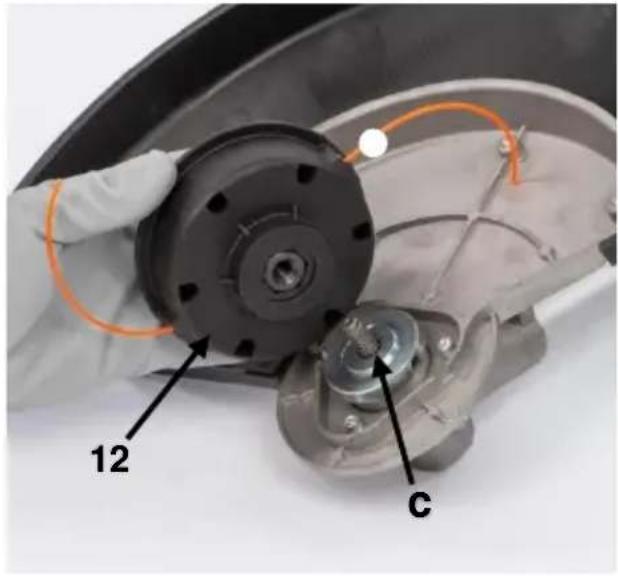
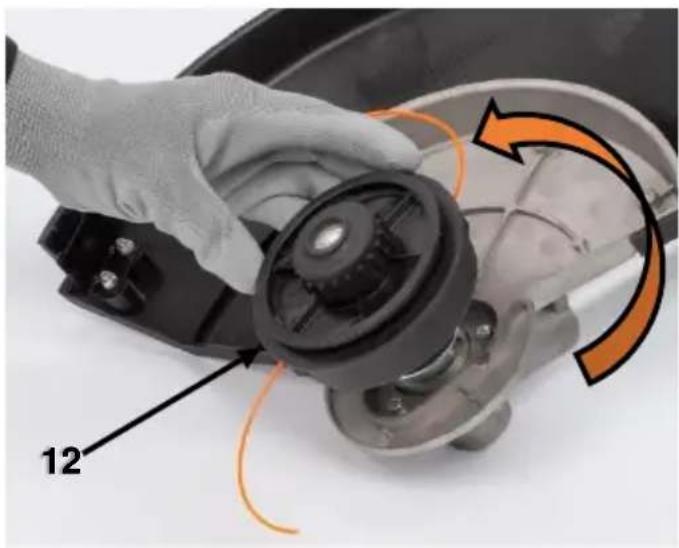
- Hold the trimmer head (a), insert the hex (b) wrench through the hole on the receive washer (c).
- Screw the spool (12) anticlockwise onto the shaft and tighten.
- To remove the spool do so in reverse order.

If the line is too long when you use the equipment for the first time, the surplus end of it will be cut by the blade on the guard hood.
8 OPERATION

Connect the power plug to the coupling of an appropriate extension cord.
From a loop, push it through the opening in the rear handle and hook over the cable holder (Fig. H 1)
8.1 Chain lubrication (Fig. I)
- The blade bar and saw chain must never be operated without oil. If the pole-mounted pruner is used with too little oil, the cutting performance and lifespan of the saw chain will decrease as the saw chain will become blunt more quickly.
- You can identify when there is too little oil if smoke develops or the blade bar changes color. The oil flows to the blade bar as soon as the motor starts working.
8.1.1 Filling with chain oil :
- Check the oil level indicator on the oil tank (13) regularly and top-up the oil if the minimum mark „MIN“ (a) is reached on the oil level indicator. The oil tank holds about 100 ml of oil.
■ Empty the oil tank if it will not be used for a prolonged period of time (6-8 weeks).
8.2 Swivelling out the Hedge trimmer (Fig. A & J)

The hedge trimmer bar must be checked regularly for wear and reground. A blunt blade bar causes the device to overload. Any damage that results is not covered by the warranty.
■ Unscrew the locking bolt (a) to allow swivelling of the cutter bar (14).
■ Only use the cutter bar handle (15) to swivel, do not touch the cutter blade.
■ Squeeze the locking clamp (b) to release it from the toothed edge (c).
- The cutter bar (14) can now be swivelled out. Use the stop stages and allow the stop lever to click back in.
- You can choose 9 stop stages, between 0^ and 90^ .
- Screw in the locking bolt (a) to secure the cutter bar.
8.3 Starting the machine (Fig. K)
To start the appliance push the lock off switch (a) forward and then squeeze the trigger switch (b).
8.4 Stopping the machine (Fig. K)
To switch the appliance off, release the trigger switch.
8.5 Working with the hedge trimmer

While cutting, make sure that you do not touch any objects, such as wire fences or plant supports. This can cause damage to the cutter bar.
- To avoid eye injuries, always wear safety goggles while working with the hedge trimmer.
- Always hold the device tightly with both hands, with one hand on the rear handle and the other hand on the front round handle (A6). Your thumb and fingers must tightly clasp the handles.
- Check the carrying harness (A 51B) for comfortable positioning which facilitates holding the hedge trimmer.
- If the blades become jammed with solid objects, switch the device off immediately, pull the mains plug, and remove the object.
- Avoid over-stressing the device while working.
8.6 Working with the chain saw

If the saw chain gets stuck, do not attempt to pull out the pruner with force. There is a risk of injury. Turn the motor off and use a lever arm or wedge to release the pruner.
- You will have better control over the device if you saw using the lower edge of the blade bar (saw chain in pulling direction) and not using the upper edge of the blade bar (saw chain in pushing direction).
- The saw chain must not touch the ground or any object while sawing through the material or thereafter.
- Ensure that the saw chain does not get stuck while sawing. The log must not break or splinter.
- Please also observe the precautionary measures to protect against kickback (see the safety information).
■ Remove branches hanging downwards by sawing from the top of the branch. - Twisted branches must be individually cut down to size.
8.7 Working using the thread spool
- In small grass areas hold the device at an angle of about 30^ and swing the cutting head evenly to the right and left with a semi-circular movement.
The best results are obtained with a maximum grass length of 15 cm. If the grass is taller, it is recommended to mow several times. - To cut around trees, fence posts or other obstacles, slowly move the device around the obstacle and cut with the thread ends.
- Avoid any contact with fixed obstacles (rocks, walls, picket fences, etc.). The thread would wear out quickly. Use the edge of the protective cover to keep the device at the correct distance.

Attention! Do not lay the cutting head on the ground during operation!
8.8 Working with the 4-tooth blade

Always wear the harness and suitable protection clothing when working with the device. Wear eye, hearing and head protection. Ensure that the blade is installed correctly. Replace damaged or blunt tool parts. There is a risk of injury.
- Only use the blade to work on open, even areas. Carefully inspect the area to be cut and remove all foreign bodies. Avoid hitting stones, metal or other obstacles. The blade can be damaged and there is a risk of kickback by the machine.
- When working, hold the cutter above the ground and slowly swivel the device back and forth like a scythe in an equal arch.
- Do not hold the cutting head at an angle.
- Do not use the device to cut wild growth or brushwood.
- Regularly check the blades for damage and replace as needed.
8.9 Trimming procedures
- When properly equipped with a debris shield and string head, your unit will trim unsightly weeds and tall grass in those hard-to-reach areas - along fences, walls, foundations and around trees.
- It can also be used for scalping to remove vegetation down to the ground for easier preparation of a garden or to clean out a particular area.

Do not sweep with trimmer. Sweeping refers to tilting head to sweep away debris from walkways, etc. Your trimmer is a powerful tool and small stones or other such debris may be hurled 50 feet (15 metres) or more, causing injury or damage to nearby property such as automobiles, homes and windows.

NOTE: Even if you are careful, trimming around foundations, brick or stone walls, curves, etc., will result in above-normal string wear. To renew the wire, press the lower spool knob against the ground with rotating trimmer.
8.9.1 Trimming / mowing
- Swing trimmer with a sickle-like motion from side to side. Do not tilt the head during the procedure.
- Test area to be trimmed for proper cutting height. Keep head at same level for even depth of cut.
8.9.2 Closer trimming
- Position trimmer straight ahead with a slight tilt so bottom of head is above ground level and string contact occurs at proper cutting point.
■ Always cut away from operator. Do not pull trimmer in towards operator.
8.9.3 Fence / foundation trimming
- Approach trimming around chain link fences, picket fences, rock walls and foundations slowly to cut close without whipping string against the barrier.
If the string comes in contact with rock, brick walls, or foundations, it will break or fray. If string hits fencing, it will snap off.
8.9.4 Trimming around trees
- Trim around tree trunks slowly so string does not contact bark. Walk around the tree trimming from left to right.
■ Approach grass or weeds with the tip of the string and tilt head slightly forward
8.9.5 Scalping

WARNING: Use extreme caution when SCALPING. Keep a distance of 30 meters (100 feet) between operator, other people and animals during these operations.
- Scalping refers to removal of all vegetation down to the ground. To do this, tilt the head to about a 30 degree angle to the right.
- By adjusting the handle you will have better control during this operation.
- Do not attempt this procedure if there is any chance that flying debris could injure the operator, other people, or cause damage to property

Avoid kickout, kickout refers to the reaction of a moving blade if it contacts a strong tree, brush or a solid object. The force that results violently pushes the blade away in an arc. Kickout may cause loss of control resulting in injury to the operator or bystanders. Do not use a blade near a chain link fence, metal stakes, landscape borders or building foundations.

Do not cut with dull, cracked or damaged metal blade. Before cutting growth, inspect for obstructions such as boulders, metal stakes or strands of wire from broken fences. If an obstruction can not be removed, mark its location so that you can avoid it with the blade. Rocks and metal will dull or damage a blade. Wire can catch on the blade head and flap around or be thrown into the air.

Do not use a brush cutter for cutting trees.
8.10 Cutting techniques using the hedge trimmer
- Cut thick branches beforehand using a branch clippers.
- The double-sided cutter bar enables cutting in both directions or, with a swinging action, from one side to the other.
- In case of vertical cutting, move the hedge trimmer uniformly forward or up and down in an arc movement.
- In case of horizontal cutting, move the hedge trimmer in a sickle-shaped movement to the edge of the hedge, so that cut branches fall to the ground.
- In order to achieve long straight lines, the placing of tensioned guiding cords is recommended.
8.10.1 Cutting Shaped Hedges:
It is recommended that hedges be cut in a trapezoidal shape, in order to prevent stripping off of the lower branches. This corresponds to the natural plant growth and allows the hedge to thrive optimally. During cutting, only the new annual growths are reduced and thus a dense branching and a good screen will develop.
- Cut the sides of a hedge first. To do this, move the hedge trimmer in the direction of growth from bottom to top. If you cut down from the top, the thinner branches will move out, which may result in some areas having sparse growth or holes.
- Cut the top edge, according to taste, in a flat shape, roof shape or rounded shape
- Trim young plants to the required shape. The main growth should remain undamaged until the hedge has reached the planned height. All other shoots are lopped off to half size.
■ Care of Free-Growing Hedges: - Free-growing hedges are not shaped when cut, although they must be regularly maintained so the hedge does not become too high.
8.11 Cutting techniques using chain saw

Be aware of the risk of kickback as well as falling branches and branches on the ground.
8.11.1 Sawing off small branches:
- Place the locating surface of the saw against the branch in order to prevent jerky movements of the saw when you begin to cut it.
- Guide the saw with light pressure from the top to the bottom through the branch. Watch out for premature breakage of the branch if you have misjudged the size and weight.
8.11.2 Sawing off larger branches:
- In the case of larger branches, select a relief cut first of all to ensure that the sawing process is controlled.
- To do this, saw an incision into the bottom third of the branch (with the upper side of the blade). Then saw from top to bottom towards the first cut (with the underside of the blade)
8.11.3 Sawing in sections:
■ Saw off large or long branches in sections so that you have control over the place where the branch section lands.
- Saw the lower branches of the tree off first in order to make it easier for the branches that have been cut off to fall to the ground.
■ After the cut is completed, the weight of the saw increases abruptly for the operator, as the saw is no longer supported on the branch. There is a danger that you will lose control of the device.
- You should only pull the saw out of the cut with the saw chain running in order to avoid jamming.
- Do not saw with the tip of the cutting equipment.
- Do not saw the bulge at the base of the branch because this will prevent the tree from healing.
9 CLEANING AND MAINTENANCE
- Your tool has been designed to operate over a long period of time with a minimum of maintenance. Continuous satisfactory operation depends upon proper tool care and regular cleaning.
■ Regularly clean the ventilation slot in your tool using a soft brush or dry cloth. - Regularly clean the cutting line and spool using a soft brush or dry cloth.
- Regularly use a blunt scraper to remove grass and dirt from the underneath of the guard.
9.1 Cleaning the chain saw
■ The chain saw must be cleaned of saw dust at regular intervals.
■ Remove the sprocket cover.
■ Remove the saw chain from the bar and clean the guide rail.
- Keep the saw chain sharp and check the tension, check the oil level and the oil supply.
9.2 Cleaning the hedge trimmer
- Check the hedge trimmer for loose screws on the cutter bar and tighten these if necessary.
■ Remove stuck cuttings. - Maintain the cutter bar using an oil spray or an oil can.
9.3 Cleaning the trimmer and brush cutter attachment
■ Remove stuck cuttings.
- Keep the cutting blade sharp to facilitate your work.
10 TROUBLE SHOOTING
| PROBLEM | POSSIBLE CAUSE | SOLUTION |
| Line will not advance | Line is welded to itselfNot enough line on the spoolLine has worn too shortLine is tangled on the spool | Lubricate with a silicone sprayReplace the spoolRemove the spool and feed line outRemove line from spool and rewind |
| Cutting head is hard to turn | Grass wrapped or built up around head | Clean the effected parts of the machine |
| Grass continually wraps around the shaft and trimmer head assembly | Cutting tall grass at ground level | Cut tall grass from the top down |
| The machine stops and will not start | The machine is defectivePlug is damaged | Contact dealer to check damageCheck the plug |
11 TECHNICAL DATA
| Type | POWXG3020 |
| Voltage | 230-240 V ~50Hz |
| Motor capacity | 1000W |
| Motor type | Brushed |
| Shaft length | 600mm |
| Electric plug type | VDE |
| Power cable length | 0,35m |
| Grass trimmer | |
| Cutting width | 380 mm |
| Wire diameter | 2,0 mm |
| Wire length | 5m |
| Wire feeding type | Tap & go |
| Spool type | Double threaded |
| Brush cutter | |
| Cutting width | 230mm |
| Protection | Metal cover + plastic guard |
| Number of teeth | 4 |
| Hedge trimmer | |
| Cutting length | 410 mm |
| Cutting thickness | 20 mm |
| Blade type | Laser cut, double action |
| Cutting head type | Rotary |
| Number of teeth | 33 |
| Chain saw | |
| Chain and bar brand | Chinese |
| Bar length | 200 mm |
| Bar cutting capacity | 180 mm |
| Chain oiler | Automatic |
| Oil tank capacity | 100 ml |
| Chain gauge | 1,27 mm |
| Chain pitch | 9,525 mm |
12 NOISE
Noise emission values measured according to relevant standard. (K=3)
| Acoustic pressure level LpA | 86 dB (A) |
| Acoustic power level LwA | 103 db (A) |

ATTENTION! Wear hearing protection when sound pressure is over 85 dB(A).
aw (Vibration)
7,7 m/s2
K = 1,5 ~m / s^2
13 MAINTENANCE INTERVALS
13.1 Chain saw
The figures given here are based on normal operating conditions. In the event of more difficult conditions, such as strong dust generation and longer daily operating hours, the given intervals are to be reduced correspondingly.
| Appliance part | Action | Before starting work | After 10hours of use |
| Complete machine | Check condition, replace damaged parts as needed | X | |
| Accessible screws and nuts | Tighten | X | |
| Chain wheel | Check, replace as needed | X | |
| Saw chain | Check, apply oil, reground or replace | X | |
| Blade bar | Check, rotate, clean, apply oil | X | X |
| Cutter head | Check correct installation | X | |
| Gears | Lubrication | X |
13.2 Hedge trimmer
The figures given are based on normal operating conditions. In the event of more difficult conditions, such as strong dust generation and longer daily operating hours, the given intervals are to be reduced correspondingly.
14 WARRANTY
- This product is warranted for a 36-month period effective from the date of purchase by the first user.
- This warranty covers all material or production flaws excluding : batteries, chargers, defective parts subject to normal wear & tear such as bearings, brushes, cables, and plugs, or accessories such as drills, drill bits, saw blades, etc. ; damage or defects resulting from maltreatment, accidents or alterations; nor the cost of transportation.
- Damage and/or defects resulting from inappropriate use also do not fall under the warranty provisions.
We also disclaim all liability for any bodily injury resulting from inappropriate use of the tool.
- Repairs may only be carried out by an authorised customer service centre for Powerplus tools
- You can always obtain more information at the number 00 32 3 292 92 90.
- Any transportation costs shall always be borne by the customer, unless agreed otherwise in writing.
- At the same time, no claim can be made on the warranty if the damage of the device is the result of negligent maintenance or overload.
- Definitely excluded from the warranty is damage resulting from fluid permeation, excessive dust penetration, intentional damage (on purpose or by gross carelessness), inappropriate usage (use for purposes for which the device is not suitable), incompetent usage (e.g. not following the instructions given in the manual), inexpert assembly, lightning strike, erroneous net voltage. This list is not exhaustive.
- Acceptance of claims under warranty can never lead to the prolongation of the warranty period nor commencement of a new warranty period in case of a device replacement.
- Devices or parts which are replaced under the warranty therefore remain the property of Varo NV
We reserve the right to reject a claim whenever the purchase cannot be verified or when it is clear that the product has not been properly maintained. (Clean ventilation slots, carbon brushes serviced regularly, etc.).
■ Your purchase receipt must be kept as proof of date of purchase.
- Your appliance must be returned undismantled to your dealer in an acceptably clean state, (in its original blow-moulded case if applicable to the unit), accompanied by proof of purchase.
15 ENVIRONMENT
Should your appliance need replacement after extended use, do not throw it away with the household rubbish, but dispose of it in an environmentally safe way. Waste produced by electrical machine items should not be handled like normal household rubbish. Please recycle where recycling facilities exist. Check with your local authority or retailer for recycling advice.
16 DECLARATION OF CONFORMITY


VARO – Vic. Van Rompuy N.V. – Joseph Van Instraat 9 – 2500 Lier – Belgium, declares that,
Product: Multi-function garden machine
trade mark: POWERplus
model: POWXG3020
is in conformity with the essential requirements and other relevant provisions of the applicable European Directives, based on the application of European harmonized standards.
Any unauthorized modification of the apparatus voids this declaration.
European Directives / Regulations (including, if applicable, their amendments up to the date of signature);
2011/65/EU
2006/42/EC Annex IV Notified Body TuV Sud - DE
2014/30/EU
2000/14/EC Annex VI LwA
Measured
94dB(A) 103dB(A)
Guaranteed 96dB(A) 107dB(A)
Notified Body TuV Sud - DE
European harmonized standards (including, if applicable, their amendments up to the date of signature):
EN60335-1:2012
EN50636-2-91:2014
EN62841-1:2015
EN62841-4-2:2019
The undersigned acts on behalf of the company CEO,
natural_image
Simple hand-drawn sketch of a rounded rectangular shape with no text or symbolsPhilippe Vankerkhove
Regulatory Affairs – Compliance Manager
11/05/2022, Lier - Belgium
7.1 Rohrmontage (Abb. A&B)....13
7.2 Schutzabdeckung anbringen (Abb. A&C)....13
7.3 Tragegurt anlegen (Abb. A&D)....13
natural_image
Simple hand-drawn sketch of a rounded rectangular shape with no text or symbolsPhilippe Vankerkhove, MSc.EE.
11/05/2022, Lier - Belgium
1 USO PREVISTO 4
CÓMO EVITAR SACUDIDAS
2006/42/EC Annex IV Notified Body
TuV Sud - DE
2014/30/EU
2000/14/EC Annex VI LwA
Measured 94dB(A) 103dB(A)
Guaranteed 96dB(A) 107dB(A)
Notified Body TuV Sud - DE
natural_image
Simple hand-drawn sketch of a rounded rectangular shape with no text or symbolsPhilippe Vankerkhove, MSc.EE. Asuntos reglamentarios - Director de conformidad 11/05/2022, Lier - Belgium
1 USO PREVISTO 4
natural_image
Simple hand-drawn sketch of a rounded rectangular shape with no text or symbolsPhilippe Vankerkhove, MSc.EE.
Regulatory Affairs – Compliance Manager
11/05/2022, Lier - Belgium
natural_image
Simple hand-drawn sketch of a rounded rectangular shape with no text or symbolsPhilippe Vankerkhove, MSc.EE.
11/05/2022, Lier - Belgium
1 TILTENKT BRUK 4
2 BESKRIVELSE (FIG. A) 4
3 PAKKENS INNHOLD 4
4 SYMBOLER....5
5 GENERELLE SIKKERHETSFORSKRIFTER....5
13 VEDLIKEHOLDSINTERVALLER 19
13.1 Motorsag....19
13.2 Hekktrimmer....19
14 GARANTI....20
POWERPLUS® HIGH QUALITY TOOLS
POWXG3020 NO
15 MILJ∅ 20
16 SAMSVARSERKLÆRING....21
4-I-1 KOMBI-REDSKAP MED LANG REKKEVIDDE: KRATTKUTTER, GRESSTRIMMER, HEKKTRIMMER OG MOTORSAG 1000 W POWXG3020
1 TILTENKT BRUK
13 VEDLIKEHOLDSINTERVALLER
13.1 Motorsag
natural_image
Simple hand-drawn sketch of a rounded rectangular shape with no text or symbolsPhilippe Vankerkhove, MSc.EE.
Regulatoriske saker – Samsvarsleder
11/05/2022, Lier - Belgium
1 TILSIGTET BRUG....4
2 BESKRIVELSE......4
3 MEDF∅LGENDE INDHOLD 4
4 SYMBOLER....5
5 GENERELLE SIKKERHEDSFORSKRIFTER .... 5
2006/42/EC Annex IV Notified Body
TuV Sud - DE
2014/30/EU
2000/14/EC Annex VI LwA
Measured
94dB(A) 103dB(A)
Guaranteed
96dB(A) 107dB(A)
Notified Body
TuV Sud - DE
11/05/2022, Lier - Belgium
1 ZAMÝŠLENÉ POUŽITÍ ...... 4
2 POPIS (OBRÁZEK A) 4
3 OBSAH BALENÍ......4
4 SYMBOLY 5
5 OBECNÁ BEZPEČNOSTNÍ UPOZORNĚNÍ PRO ELEKTRICKÉ STROJE....5
natural_image
Simple hand-drawn sketch of a rounded rectangular shape with no text or symbolsPhilippe Vankerkhove, MSc.EE.
11/05/2022, Lier - Belgium
1 UTILIZARE PREVĂZUTĂ 4
2 DESCRIERE (FIG. A) 4
3 CONTINUTUL PACHETULUI 4
4 SIMBOLURI....5
5 AVERTISMENTE GENERALE DE SIGURANTĂ PRIVIND APARATELE ELECTRICE .... 5
5.1 Zona de lucru 6
natural_image
Simple hand-drawn sketch of a rounded rectangular shape with no text or symbolsPhilippe Vankerkhove, MSc.EE.
Divizia de reglementare – Director de conformitate
11/05/2022, Lier - Belgium
1 ПРЕДНАЗНАЧЕНИЕ НА УПОТРЕБАТА....4
2 ОПИСАНИЕ (ФИГ. А) 4
3 СПИСЪК НА СЪДЪРЖАНИЕТО НА ОПАКОВКАТА....4
4 СИМВОЛИ .... 5
natural_image
Simple line drawing of a rounded rectangular shape with no text or symbolsPhilippe Vankerkhove, MSc.EE.
11/05/2022, Lier - Belgium

natural_image
Product display of various metal tools including a flat shaver, chain-linking, and power tools (no text or symbols visible)varo
WWW.VARO.COM
DESIGNED AND MARKETED BY VARO
©copyright by varo
VARO - VIC. VAN ROMPUY nv
JOSEPH VAN INSTRAAT 9 - 2500 LIER - BELGIUM




- BESCHRIJVING (FIG. A)
- MULTI-OUTIL DE JARDIN 4-EN-1 1000 W POWXG3020
- UTILISATION PREVUE
- POWERPLUS® HIGH QUALITY TOOLS
- POWXG3020 EN
- GARDEN MULTITOOL 4-IN-1 1000W POWXG3020
- INTENDED USE
- WARNING! For your own safety, read this manual and the general safety instructions carefully before using the appliance. Your power tool should only be given to other users together with these instructions.
- DESCRIPTION
- PACKAGE CONTENT LIST
- WARNING Packaging materials are not toys! Children must not play with plastic bags! There is a danger of suffocation!
- SYMBOLS
- GENERAL POWER TOOL SAFETY WARNINGS
- Working area
- Electrical safety
- Always check that the power supply corresponds to the voltage on the rating plate.
- Personal safety
- Power tool use and care
- Service
- ADDITIONAL SAFETY RULES FOR GARDEN MULTITOOLS
- Brush cutter
- Hedge trimmer
- Caution! Notice overhead power lines.
- Chain saw
- Trimmer
- Beware. After switching off the appliance it continues to rotate for a short time.
- Always use common sense
- ASSEMBLY
- Mounting the shaft (Fig. A&B)
- Installing the protection guard (Fig. A & C)
- Attaching the carrying belt (Fig. A & D)
- Mounting the round handle (Fig. A & E)
- The round handle must be mounted with a spacing of at least 25 cm to the device handle! The leg protection must always be mounted on the operator side!
- Mounting the saw chain (Fig. F)
- Replace the cutter blade and spool (Fig. A, G & H)
- Removing the cutter blade. (Fig. A & G)
- Mounting the cutter blade. (Fig. A & G)
- Mounting the spool (Fig. A & H)
- OPERATION
- Chain lubrication (Fig. I)
- Filling with chain oil :
- Swivelling out the Hedge trimmer (Fig. A & J)
- Starting the machine (Fig. K)
- Stopping the machine (Fig. K)
- Working with the hedge trimmer
- While cutting, make sure that you do not touch any objects, such as wire fences or plant supports. This can cause damage to the cutter bar.
- Working with the chain saw
- If the saw chain gets stuck, do not attempt to pull out the pruner with force. There is a risk of injury. Turn the motor off and use a lever arm or wedge to release the pruner.
- Working using the thread spool
- Attention! Do not lay the cutting head on the ground during operation!
- Working with the 4-tooth blade
- Trimming procedures
- Trimming / mowing
- Closer trimming
- Fence / foundation trimming
- Trimming around trees
- Scalping
- Cutting techniques using the hedge trimmer
- Cutting Shaped Hedges:
- Cutting techniques using chain saw
- Be aware of the risk of kickback as well as falling branches and branches on the ground.
- Sawing off small branches:
- Sawing off larger branches:
- Sawing in sections:
- CLEANING AND MAINTENANCE
- Cleaning the chain saw
- Cleaning the hedge trimmer
- Cleaning the trimmer and brush cutter attachment
- NOISE
- MAINTENANCE INTERVALS
- Chain saw
- Hedge trimmer
- WARRANTY
- ENVIRONMENT
- DECLARATION OF CONFORMITY
- POWXG3020 NO
- 4-I-1 KOMBI-REDSKAP MED LANG REKKEVIDDE: KRATTKUTTER, GRESSTRIMMER, HEKKTRIMMER OG MOTORSAG 1000 W POWXG3020
- TILTENKT BRUK
- VEDLIKEHOLDSINTERVALLER
- Motorsag
Brand : PowerPlus
Model : POWXG3020
Category : Multitools