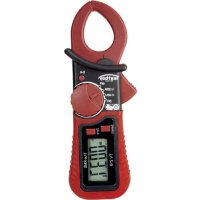
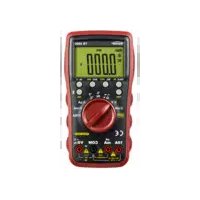
TV 218 - Multimeter Testboy - Free user manual and instructions
Find the device manual for free TV 218 Testboy in PDF.



| Product Type | Digital Clamp Meter |
| Brand | Testboy |
| Model | TV 218 |
| Dimensions (L x H x D) | 155 x 50 x 25 mm |
| Weight (with batteries) | Approx. 95 g |
| Power Supply | 2 button cells 1.5 V (SR44 / LR44) |
| Display | LCD 3 3/4 digits, max. 4000 |
| Sampling Rate | ~3 Hz |
| Clamp Opening | ∅ 20 to 23 mm |
| AC Current Measurement Ranges (True-RMS) | 40 A (0.01 A) / 200 A (0.1 A) |
| DC Current Measurement Ranges | 40 A (0.01 A) / 200 A (0.1 A) |
| Main Functions | AC/DC Measurement, Data-Hold, Zero Adjust |
| Safety | CAT III 300 V, overvoltage protection |
| Protection Rating | IP30 |
| Working Temperature | 0 to 40 °C, <80% RH non-condensing |
| Storage Temperature | -10 to 60 °C, <70% RH (without batteries) |
| Max. Operating Altitude | < 2,000 m |
| Standards | IEC/EN 61010-1 (DIN VDE 0411) |
| Included Accessories | User manual, carrying pouch |
| Maintenance | Clean with a dry cloth; replace batteries when battery icon appears |
Frequently Asked Questions - TV 218 Testboy
User questions about TV 218 Testboy
0 question about this device. Answer the ones you know or ask your own.
Ask a new question about this device
Download the instructions for your Multimeter in PDF format for free! Find your manual TV 218 - Testboy and take your electronic device back in hand. On this page are published all the documents necessary for the use of your device. TV 218 by Testboy.
USER MANUAL TV 218 Testboy
Testboy® TV 218
Version 1.5

Table of Contents 19
Notes 20
Safety notes 20
General safety notes 21
Operations 26
Operating 26
Safety information for this product 28
Maintenance and cleaning 29
Changing the batteries 30
Explanation of the buttons 31
Operating Instructions 32
Measuring AC currents 32
Measuring DC currents 32
Technical specifications
Measuring instructions 34
33
Notes
Safety notes

WARNING
An additional source of danger is posed my mechanical parts which can cause severe personal injury.
Objects can also be damaged (e.g., the instrument itself can be damaged).
WARNING
An electric shock can result in death or severe injury. It can also lead to property damage and damage to this instrument.

WARNING
Never point the laser beam directly or indirectly (on reflective surfaces) towards the eyes. Laser radiation can cause irreparable damage to the eyes. You must first deactivate the laser beam when measuring close to people.
General safety notes

WARNING
Unauthorized changes or modifications of the instrument are forbidden – such changes put the approval (CE) and safety of the instrument at risk. In order to operate the instrument safely, you must always observe the safety instructions, warnings and the information in the "Proper and Intended Use" Chapter.

WARNING
Please observe the following information before using the instrument:
Do not operate the instrument in the proximity of electrical welders, induction heaters and other electromagnetic fields.
After an abrupt temperature fluctuation, the instrument should be allowed to adjust to the new temperature for about 30 minutes before using it. This helps to stabilize the IR sensor.
Do not expose the instrument to high temperatures for a long period of time.
Avoid dusty and humid surroundings.
Measurement instruments and their accessories are not toys. Children should never be allowed access to them!
In industrial institutions, you must follow the accident prevention regulations for electrical facilities and equipment, as established by your employer's liability insurance organization.
Proper and intended use
This instrument is intended for use in applications described in the operation manual only. Any other usage is considered improper and non-approved us-age and can result in accidents or the destruction of the instrument. Any misuse will result in the expiry of all guarantee and warranty claims on the part of the operator against the manufacturer.

Remove the batteries during longer periods of inactivity in order to avoid damaging the instrument.

We assume no liability for damages to property or personal injury caused by improper handling or failure to observe safety instructions. Any warranty claim expires in such cases. An exclamation mark in a triangle indicates safety notices in the operating instructions. Read the instructions completely before beginning the initial commissioning. This instrument is CE approved and thus fulfils the required guidelines.
All rights reserved to alter specifications without prior notice © Testboy GmbH, Germany.
Disclaimer and exclusion of liability

The warranty claim expires in cases of damages caused by failure to observe the instruction! We assume no liability for any resulting damage!
Testboy is not responsible for damage resulting from:
failure to observe the instructions,
changes in the product that have not been approved by Testboy,
the use of replacement parts that have not been approved or manufactured by Testboy,
the use of alcohol, drugs or medication.
Correctness of the operating instructions
These operating instructions have been created with due care and attention. No claim is made nor guarantee given that the data, illustrations and drawings are complete or correct. All rights are reserved in regards to changes, print failures and errors.
Disposal
For Testboy customers: Purchasing our product gives you the opportunity to return the instrument to collection points for waste electrical equipment at the end of its lifespan.
The WEEE directive regulates the return and recycling of electrical appliances. Manufacturers of electrical appliances are obliged to take back and recycle all electrical appliances free of charge.
Electrical devices may then no longer be disposed of through conventional waste disposal channels.
Electrical appliances must be recycled and disposed of separately. All equipment subject to this directive is marked with this logo.
Disposing of used batteries
As an end user, you are legally obliged (by the relevant laws concerning battery disposal) to return all used batteries. Disposal with normal household waste is prohibited!
Contaminant-laden batteries are labelled with the adjacent symbol which indicates the prohibition of disposal with normal household waste.
The abbreviations used for heavy metals are:
Cd = Cadmium, Hg = mercury, Pb = lead.
You can return your used batteries for no charge to collection points in your community or everywhere where batteries are sold!
Certificate of quality
All aspects of the activities carried out by Testboy GmbH relating to quality during the manufacturing process are monitored permanently within the framework of a Quality Management System. Furthermore, Testboy GmbH confirms that the testing equipment and instruments used during the calibration process are subject to a permanent inspection process.
Declaration of Conformity
The product conforms to the present directives. For more detailed information, go to www.testboy.de
Operations
Thank you for choosing the Testboy ® TV 218.
The Testboy ® TV 218 should be used in CAT-III systems for measuring voltages that do not exceed 300 V (AC or DC) in relation to the earthing.
Operating
This meter should be allowed to acclimate with the surroundings before measuring.
The user of this clamp meter must comply with all relevant safety regulations.
The meter may display false readings when used in the vicinity of devices which are generating noise or interference.
This meter should only be used as described in these instructions. Any other use could affect this device's safety system.
To avoid damaging the meter, never exceed the maximum input values listed in the technical specifications.
Always make sure that the mode selection switch is in the proper position before starting each measurement.
You must use extra caution when working around uninsulated wires or busbars.
Any accidental contact with a conductor can cause an electrical shock.
Be careful when working with voltages over 60 VDC or over 30 VAC RMS. Such voltages pose a risk of electric shock.
The clamping jaws must always be taken off the test circuit before switching to another function.
Keep your fingers behind the protective ring while measuring.
To avoid false readings: Change the batteries whenever the icon appears.
Before each measurement, make sure that the clamp meter is in perfect condition. Test the meter on a known current source to make sure it is functioning properly before actual use.
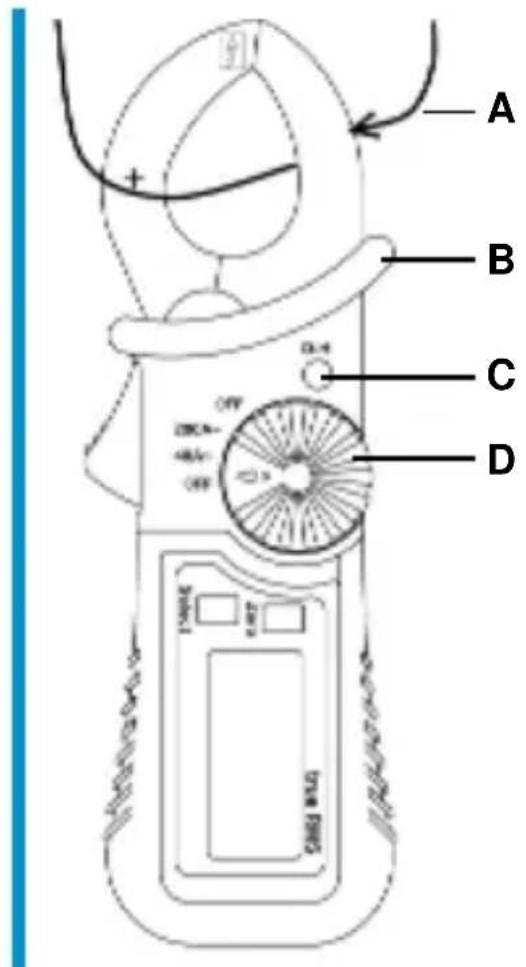
The "+" sign on the clamping jaws indicates the direction of current flow during DC mode (as shown in the illustration).
A Direction of current
B Protective ring
C Data Hold
D Mode selector switch
Safety information for this product
Before opening the meter, always disconnect all electrical power sources. Also make sure to discharge yourself since static electricity could destroy internal components.
Only qualified technicians who are familiar with these instructions are permitted to adjust, service or repair the clamp meter.
A person is considered qualified when he understands the setup, design and functionality of the facility and comprehends the associated risks. A qualified operator is an experienced professional who is authorized to switch the power on or off to circuits within the electrical facility.
When working with opened devices, remember that internal capacitors can retain life-threatening voltage levels even after they have been switched off.
Stop using the meter if you experience any errors or unusual operations. Make sure that the meter cannot be used until it has passed an inspection.
Remove the batteries if you do not plan on using the meter for an extended period of time. Do not store the meter in a room that is overly humid or warm.
Operate with extreme caution when working around uninsulated wires and busbars. Touching such components and wires can lead to electric shock! Make sure that you are using the appropriate protective mechanisms!
Maintenance and cleaning

In order to reduce the risk of electric shock, do not permit any moisture to penetrate inside the housing.
Clean the housing periodically with a dry cloth. Do not use cleaning agents. Do not use abrasive cleansers or solvents.
Changing the batteries

Minimize the risk of electric shock. Remove the clamping jaws from the test circuit and switch off the meter before you remove the rear housing.
Procedure
If the battery voltage is too low, the battery icon will appear on the LCD screen. Replace the battery when this icon appears.
Set the range switch in the OFF position.
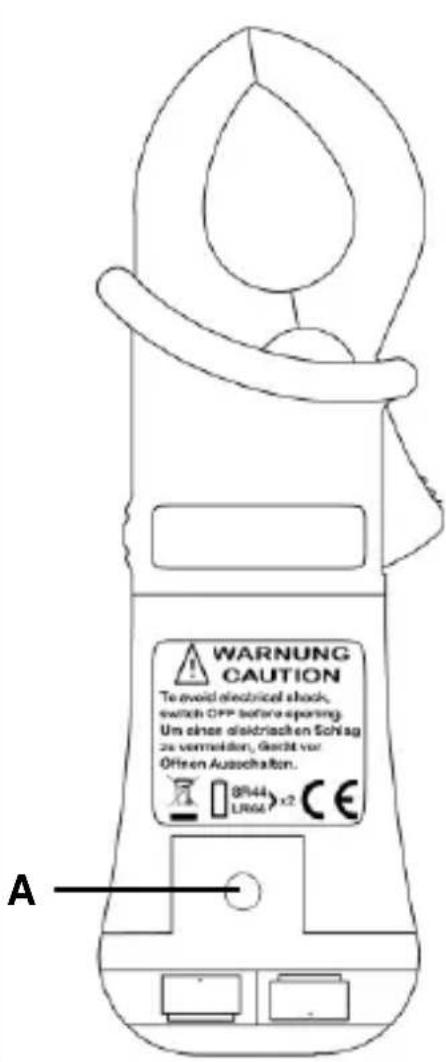
Remove the rubber holster. Unscrew the screw (A) on the rear side with a screwdriver. Remove the used batteries and replace with two new 1.5-V button cell batteries (type SR 44/LR 44).
Screw on the battery cover and replace the rubber holster.

Do not dispose of batteries in normal household rubbish! Use an authorised local collection point!
Explanation of the buttons
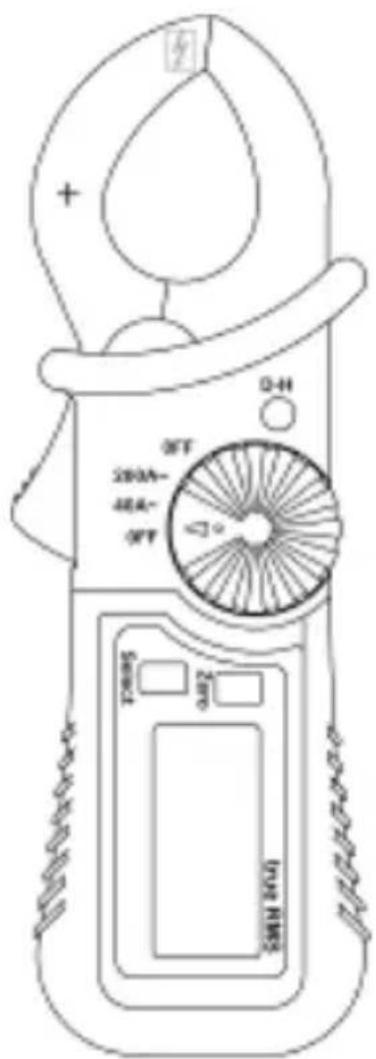
Select
Switch between DC (default) or AC mode.
Zero
Press the Zero key to zero-out the display reading.
D-H
Data Hold button (also referred to as the measurement save button).
Press this button in order to save and display the current measured value. The H-D icon on the display confirms the active function.
The measurement process is interrupted during the data-hold function!
Function select switch
The function select switch is used for selecting the measurement range and for switching off the meter.
Operating Instructions
If the measured current exceeds the set value over a long period of time then the meter can heat up. This can impair the functional reliability of the internal circuitry.
To avoid discharges or inaccurate readings, do not measure currents on high-voltage lines (over 300 V).
The meter has been set at the factory for DC mode.
Measuring AC currents
Set the function switch as needed.
Use the Select button to choose the AC current range "AC T-rms".
Encircle one of the wires being measured with the current transformer (the clamping jaws) Make sure that the clamp is completely closed.
Read the measured value displayed in the "True-RMS" field.
Measuring DC currents
Set the function switch as needed.
Encircle the wire being measured with the current transformer (the clamping jaws). Make sure that the clamp is completely closed. Make sure the polarity indicator is correct!
Read the measured value.
It may be necessary to zero-calibrate before measuring. To calibrate, open the close the clamps repeatedly (with no wire inside). Then wait until the displayed value has steadied and press the ZERO button. The value in the display should change to about 0.00 and ZERO appears in the display.
Technical specifications
| Operating temperature | 0 – 40 °C, < 80% rel. hum., non-condensing |
| Protected against external voltages | CAT III 300 V ~ |
| Power supply | Two 1.5 V, type SR44 / LR44 batteries |
| Protection degree | IP 30 |
| Overvoltage surge category | CAT III 300 V |
| Testing standard | IEC/EN 61010-1 (DIN VDE 0411) |
| Working height | < 2000 m |
| Storage temperature | -10 – 60 °C, < 70% rel. hum., without batteries |
| Sampling rate | ~3 Hz |
| Display and indication | 3 3/4-digit LCD, with max. display 4000 |
| Battery level display | Battery icon is displayed for low battery voltage levels |
| Clamping jaw opening | Cable ∅ 20 – 23 mm |
| Dimensions | 155 x 50 x 25 mm (WxHxD) |
| Weight | Approx. 95 g (with batteries) |
| Accessories | Operating Instructions, pouch |
Measuring instructions
For optimal measuring precision: position the cable precisely at the point inside the clamping jaws where the marker lines intersect.
If the cable is positioned improperly, the measurement error will be no greater than 1.5%.
Accuracy: ± (% of measured reading + number of digits) at 18 °C to 28 °C (64 °F to 74°F) and relative humidity < 75%.
AC current measurements (True RMS)
| Range | Resolution | Tolerance |
| 40 A | 0.01 A | ± 3.0 % +5 digits |
| 200 A | 0.1 A |
DC current measurements
| Range | Resolution | Tolerance |
| 40 A | 0.01 A | ± 2.5 % +8 digits |
| 200 A | 0.1 A |
(Max: 300 ADC)
Sommaire
Sommaire 35
Remarques 36
Cd = cadmium, Hg = mercure, Pb = plomb.
Meting DC-stroom 113
Cd = cadmium, Hg = kwik, Pb = lood.
Cd = Kadmium, Hg = Elohopea, Pb = Lyijy.
Testboy GmbH Tel: 0049 (0)4441 / 89112-10
Germany info@testboy.de


- TABLE OF CONTENTS 19
- NOTES 20
- OPERATIONS 26
- TECHNICAL SPECIFICATIONS
- NOTES
- SAFETY NOTES
- WARNING
- GENERAL SAFETY NOTES
- PROPER AND INTENDED USE
- DISCLAIMER AND EXCLUSION OF LIABILITY
- CORRECTNESS OF THE OPERATING INSTRUCTIONS
- DISPOSAL
- DISPOSING OF USED BATTERIES
- CERTIFICATE OF QUALITY
- DECLARATION OF CONFORMITY
- OPERATIONS
- OPERATING
- SAFETY INFORMATION FOR THIS PRODUCT
- MAINTENANCE AND CLEANING
- CHANGING THE BATTERIES
- PROCEDURE
- EXPLANATION OF THE BUTTONS
- SELECT
- ZERO
- D-H
- FUNCTION SELECT SWITCH
- OPERATING INSTRUCTIONS
- MEASURING AC CURRENTS
- MEASURING DC CURRENTS
- MEASURING INSTRUCTIONS
- SOMMAIRE
- SOMMAIRE 35
- REMARQUES 36
Brand : Testboy
Model : TV 218
Category : Multimeter