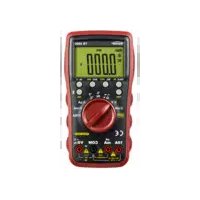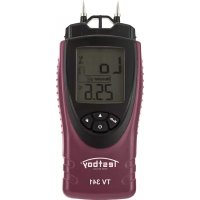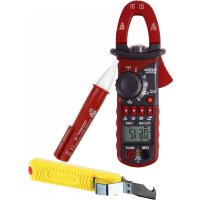
Jubi-Box 316 - Multimeter Testboy - Free user manual and instructions
Find the device manual for free Jubi-Box 316 Testboy in PDF.



| Product Type | Digital Multimeter |
| Brand | Testboy |
| Model | Jubi-Box 316 |
| Measurement Category | CAT III 600 V |
| Display | Digital with Backlight |
| True RMS | Yes |
| DC Voltage Range | 0 V to 600 V |
| AC Voltage Range | 0 V to 600 V (10 Hz - 1.2 kHz) |
| DC Current Range | 0 A to 10 A |
| AC Current Range | 0 A to 10 A (10 Hz - 1.2 kHz) |
| Resistance Range | 0 Ω to 60 MΩ |
| Capacitance Range | 0 nF to 60 mF |
| Frequency Range | 0 Hz to 10 MHz |
| Temperature Range | -20 °C to 1000 °C / -4 °F to 1832 °F |
| Continuity Test | Yes (threshold < 50 Ω) |
| Diode Test | Yes |
| Hold Function | Yes |
| Auto Power Off | Yes (15 minutes) |
| Power Supply | 2 AA 1.5 V batteries |
| Fuses | F 600 mA (self-resetting) and F 10 A (10.3 x 38 mm) |
| Dimensions | 183 × 95 × 50 mm |
| Weight | 410 g (with batteries) |
| Cleaning | Damp cloth and mild detergent |
| Battery Replacement | When battery symbol appears |
| Fuse Replacement | 10A fuse, battery compartment |
Frequently Asked Questions - Jubi-Box 316 Testboy
User questions about Jubi-Box 316 Testboy
0 question about this device. Answer the ones you know or ask your own.
Ask a new question about this device
Download the instructions for your Multimeter in PDF format for free! Find your manual Jubi-Box 316 - Testboy and take your electronic device back in hand. On this page are published all the documents necessary for the use of your device. Jubi-Box 316 by Testboy.
USER MANUAL Jubi-Box 316 Testboy
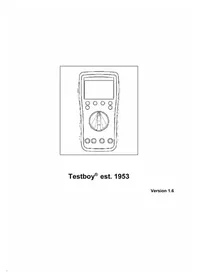
natural_image
Line drawing of a digital multimeter with control buttons and display screen (no text or symbols)Testboy® est. 1953
Version 1.6

Operating instructions

Sources of danger include for example, mechanical parts, which may cause serious personal injury.
Objects are also at risk (e.g. damage to the instrument).
WARNING
An electric shock can result in death or serious personal injury and endanger the function of objects (e.g. damage to the instrument).

WARNING
Never point the laser beam towards eyes directly or indirectly via reflective surfaces. Laser radiation can cause irreparable damage to the eyes. The laser beam must be deactivated when conducting measurements close to people.
General safety notes

WARNING
Unauthorised modification and / or changes to the instrument are not permitted, for reasons of safety and approval (CE). In order to ensure safe and reliable operation using the instrument, you must always comply with the safety instructions, warnings and the information contained in the section "Intended use".

WARNING
Comply with the following specifications before using the instrument:
Avoid operating the instrument near to electric welding equipment, induction heaters or other electromagnetic fields.
After abrupt temperature fluctuations, the instrument must be allowed to adjust to the new ambient temperature for approx. 30 minutes before using it, in order to stabilise the IR sensor.
Do not expose the instrument to high temperatures for a long period of time.
Avoid dusty and humid environments.
Measuring instruments and their accessories are not toys, and must be kept out of the reach of children!
When working in commercial facilities, comply at all times with the specifications of the accident prevention regulations for electrical systems and equipment as established by the employer's liability insurance association.

Comply with the five safety rules:
1 Disconnect
2 Ensure that the instrument cannot be switched back on again
3 Ensure isolation from the power supply (check that there is no voltage on both poles)
4 Earth and short-circuit
5 Cover adjacent live parts
Intended use
The instrument is intended strictly for use in applications described in the operating instructions. Any other usage is forbidden, and may result in accidents or destruction of the instrument. Any such usage will result in the immediate expiry of all guarantee and warranty claims on the part of the operator against the manufacturer.

Remove the batteries if the instrument is not in use for a long period of time, in order to protect the instrument from damage.

We assume no liability for damage to property or personal injury resulting from improper handling or non-compliance with the safety instructions. Any warranty claim expires in such cases. An exclamation mark in a triangle indicates safety instructions in the operating instructions. Read the instructions through before beginning initial commissioning. This instrument is CE-approved and thus ful-fils the required guidelines.
We reserve the right to alter specifications without prior notice
© 2017 Testboy GmbH, Germany.
Disclaimer

The warranty claim expires in cases of damage caused by failure to comply with the instructions! We assume no liability for any resulting damage!
Testboy is not responsible for damage resulting from
failure to observe the instructions, changes to the product that have not been approved by Testboy or the use of spare parts that have not been manufactured or approved by Testboy the use of alcohol, drugs or medication.
Accuracy of the operating instructions
These operating instructions have been compiled with due care and attention. No guarantee is given that the data, illustrations and drawings are complete or correct. All rights reserved with regard to changes, printing mistakes and errors.
Disposal
Dear Testboy customer: purchasing our product gives you the option of returning the instrument to suitable collection points for waste electrical equipment at the end of its lifespan.

The WEEE directive regulates the return and recycling of electrical appliances. Manufacturers of electrical appliances are obliged to take back and recycle all electrical appliances free of charge. Electrical devices may then no longer be disposed of through conventional waste disposal channels. Electrical appliances must be recycled and disposed of separately. All equipment subject to this directive is marked with this logo.
Disposal of used batteries

As an end user, you are legally obliged (battery law) to return all used batteries; disposal in the normal domestic waste is prohibited.
Batteries containing contaminant material are labelled with this symbol indicating that they may not be disposed of in normal domestic waste.
The abbreviations used for the crucial heavy metals are:
Cd = cadmium, Hg = mercury, Pb = lead.
You can return your used batteries free of charge to municipal collection points or anywhere where batteries are sold.
Certificate of quality
All quality-relevant activities and processes carried out within Testboy GmbH are subject to ongoing monitoring within the framework of a Quality Management System. Furthermore, Testboy GmbH confirms that the testing equipment and instruments used during the calibration process are subject to an ongoing inspection process.
Declaration of conformity
The product conforms to the most recent directives. For more information, go to www.test-boy.de
Operation
Introduction
The Testboy ^® est. 1953 is a universal multimeter. This measuring instrument has been manufactured to the latest safety specifications, and guarantees safe and reliable operation. The multimeter is a valuable aid for all standard measurement tasks in trade and industry as well as for electronics hobbyists.
Safety precautions
The est. 1953 left the factory with its safety features in perfect operating condition. In order to maintain this condition, the user must comply with the specifications of the safety notes contained in this manual.

Caution!
Only use the enclosed safety test leads or equivalent test leads that meet the same measurement category.
In order to avoid an electric shock, comply with the precautions when working with voltages greater than 120 V (60 V) DC or 50 V (25 V) eff. AC. These values represent the limits of safe-to-touch voltages in accordance with DIN VDE. (Values given in brackets apply e.g. to medical or agricultural areas)
Before taking each measurement, ensure that the test leads and the test instrument are in perfect working order
The test leads and probes must only be handled using the grips provided. Avoid touching the probes under any circumstances.

The test instrument must only be used for the measurement ranges specified.

Attention!
Before using the instrument, check for its correct function (e.g. using a known power source, see: DIN VDE 0105, part 1).
Explanation of switches, buttons and jacks
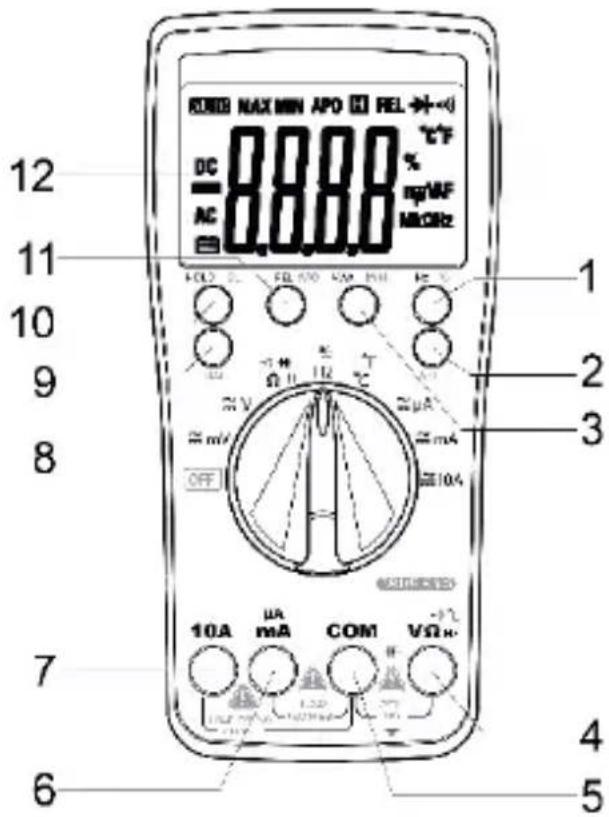
(1) Hz/%
For switching between frequency measurement and duty cycle
(2) SEL button
Actuating the button switches the current measurement function, e.g. From DC to AC
(3) MAX/MIN
Depending on the function, actuation displays the maximum value or the minimum value of the measurement.
(4) Input jack V/Ω
Red test lead for all types of signals supported by the instrument.
(5) Earth jack COM
Black test lead for all types of signals supported by the instrument.
(6) μA/mA jack
For current measurements up to 600 mA.
(7) 10 A jack
The 10 A jack must be used for current measurements above 600 mA.
(8) ON/OFF switch / measurement function selection switch
Switches the instrument on. The measurement function is selected depending on the switch position.
(9) RAN
Actuation of the button selects the measurement range manually.
(10) Hold/BL
Actuation of the button saves the measured value in the display. Prolonged actuation of the button switches on the display lighting.
(11) REL/APO
Actuation of the button activates relative measurement. Prolonged actuation of the button switches the Auto Power-Off function on and off.
(12) Display
For reading off the measured values.
DC voltage measurement / V=
Set the appropriate range using the selector switch. Connect the black test lead to the "COM" jack and the red test lead to the "V/Ω" jack. Connect test leads to the test object. Read off measurement result from the display. The voltage polarity is also displayed.
| Measurement range | Resolution | Input resistance | Overvoltage protection | Accuracy |
| 600 mV | 0.1 mV | >1000 MΩ | 250 Vrms | ±0.7 % of the measurement range + 2 digit |
| 6 V | 1 mV | >10 MΩ | 750 Vrms | |
| 60 V | 10 mV | |||
| 600 V | 100 mV |
AC voltage measurement / V\~
Set the appropriate range using the selector switch. Actuate the "SEL button" and select AC. Connect the black test lead to the "COM" jack and the red test lead to the "V/Ω" jack. Connect test leads to the test object. Read off measurement result from the display.
| Measurement range | Resolution | Input resistance | Overvoltage protection | Accuracy |
| 600 mV | 0.1 mV | >1000 MΩ | 250 Vrms | ±0.8 % of the measurement range + 3 digit |
| 6 V | 1 mV | >10 MΩ | 750 Vrms | |
| 60 V | 10 mV | |||
| 600 V | 100 mV |
Frequency range: 10 Hz - 1.2 kHz
DC current measurement / A=
Set the appropriate range using the selector switch. Connect the black test lead to the "COM" jack and the red test lead to the "mA" or "10 A" jack. Connect the test leads with the test object and read off the measurement result from the display. The current direction is indicated by the sign.

You must use the "10 A" jack when measuring currents above 600 mA!
| Measurement range | Resolution | Overvoltage protection | Accuracy |
| 600 μA | 0.1 μA | 600 mA/250 VSelf-resetting fuse | ±1.2 % of the measurement range + 3 digit |
| 6000 μA | 1 μA | ||
| 60 mA | 10 mA | ||
| 600 mA | 100 μA | ||
| 10 A | 10 mA | 10 A/1000 V | ±2.0 % of the measurement range + 10 digit |
In the 10 A range observe the maximum duty cycles!
AC current measurement / A\~
Set the appropriate range using the selector switch. Actuate the "SEL" button and select AC. Connect the black test lead to the "COM" jack and the red test lead to the "mA" or "10 A" jack. Connect the test leads with the test object and read off the measurement result from the display.

You must use the "10 A" jack when measuring currents above 600 mA!
| Measurement range | Resolution | Overvoltage protection | Accuracy |
| 600 μA | 0.1 μA | 600 mA/250 V | ±1.5 % of the measurement range + 3 digit |
| 6000 μA | 1 μA | Self-resetting fuse | |
| 60 mA | 10 mA | ||
| 600 mA | 100 μA | ||
| 10 A | 10 mA | 10 A/1000 V | ±3.0 % of the measurement range + 10 digit |
Frequency range: 10 Hz - 1.2 kHz
Resistance measurement / Ω
Set the appropriate range using the selector switch. Connect the black test lead to the "COM" jack and the red test lead to the "V/Ω" jack. Connect the test leads with the test object and read off the measurement result from the display.
| Measurement range | Resolution | Accuracy |
| 600 Ω | 0.1 Ω | ±1.2 % + 5 digit |
| 6 KΩ | 1 Ω | |
| 60 KΩ | 10 Ω | |
| 600 KΩ | 100 Ω | |
| 6 MΩ | 1 KΩ | |
| 60 MΩ | 10 KΩ | ± 2.0 %+ 10 digit |
Overvoltage protection: 250 V RMS
Off-load voltage: 1.2 V
Diode test
Set the selector switch to "▶ / ▶". Actuate the "SEL" button x 2. Connect the black test lead with the "COM" jack and the red test lead with the "V/Ω" jack. Connect the test leads with the test object (red test lead = anode, black test lead = cathode). The forward voltage is displayed.
| Measurement range | Resolution | Display |
 | 1 mV | Forward voltage |
Overvoltage protection: 250 V RMS
Off-load voltage: 3.2 V
Continuity test
Set to "▶ / " using the selector switch. Actuate the "SEL" button. Connect the black test lead to the "COM" jack and the red test lead to the "V/Ω" jack. Connect test leads to the test circuit.
| Measurement range | Function |
| The integrated buzzer signals continuity less than 50 Ω |
Off-load voltage: 1.0 V
Temperature
Set the selector switch to "°C". Connect a type-K temperature sensor (nickel-chrome / nickel) to the "V/Ω" and "COM" jacks. Read off measurement result from the display.
| Measurement range | Resolution | Accuracy |
| -20 to 0 °C | 1 °C | ±2 % + 3 digit |
| 0 to 400 °C | ±1 % + 2 digit | |
| 400 to 1000 °C | ±2 % + 2 digit | |
| -4 to 32 °F | 1 °F | ±2 % + 6 digit |
| 32 to 752 °F | ±1 % + 4 digit | |
| 752 to 1832 °F | ±2 % + 4 digit |
Frequency
Set the selector switch to "Hz". Connect the black test lead to the "COM" jack and the red test lead to the "V/Ω" jack. Connect the test leads with the test object and read off the measurement result from the display.
| Measurement range | Resolution | Accuracy |
| 10 Hz | 0.001 Hz | ±1 % + 5 digit |
| 100 Hz | 0.01 kHz | |
| 1 kHz | 0.1 Hz | |
| 10 kHz | 1 Hz | |
| 100 kHz | 10 Hz | |
| 1 MHz | 100 Hz | |
| 10 MHz | 1 kHz |
Overvoltage protection: 250 V RMS
Duty cycle
Set the selector switch to "%/Hz". Actuate the "Hz/%" button. Connect the black test lead to the "COM" jack and the red test lead to the "V/Ω" jack. Connect the test leads with the test object and read off the measurement result from the display.
| Measurement range | Resolution | Accuracy |
| 0 – 99 % | 0.1 % | ±3 % + 2 digit |
Overvoltage protection: 250 V RMS
Capacitance measurement / F
Set the selector switch to "▶/". Actuate the "SEL" button x 3. Connect the black test lead to the "COM" jack and the red test lead to the "V/Ω" jack. Connect the test leads with the test object and read off the measurement result from the display.
| Measurement range | Resolution | Accuracy |
| 60 nF | 10 pF | ± 4 % + 3 digits |
| 600 nF | 100 pF | |
| 6 μF | 1 nF | |
| 60 μF | 10 nF | |
| 600 μF | 100 nF | |
| 6 mF | 1 μF | |
| 60 mF | 10 μF |

Discharge the capacitors before every measurement!
Automatic switch-off
The instrument switches off after c. 15 minutes (APO). Continuous actuation of the "APO" button switches the Auto Power Off function on or off.
Backlighting
Continuous pressing of the "HOLD" button switches on the backlighting.
The illumination switches off automatically after c. 1 minute.
Saving function (HOLD)
At difficult measurement positions, the display cannot perhaps be read correctly.
Pressing the "HOLD" button freezes the current measured value which can then be read in comfort.
Repeated pressing of the "HOLD" button returns to normal measuring mode.
True RMS
If measuring non-sinus wave forms, low measurement errors can occur if using the True RMS function, in comparison to using traditional measurement procedures.
Sinus-form and non-sinus form signals can be accurately measured using the True RMS function.
Maintenance
The instrument does not require special maintenance when used as specified in these operating instructions.
Cleaning
Use a damp cloth and mild household detergent to clean the instrument should it become soiled through daily use. Never use aggressive cleaning agents or solvents to clean the instrument.
Replacing the battery
Replace the batteries when the battery symbol appears on the display. Remove the test leads from the instrument before changing the batteries!
Remove the three screws on the rear, open the battery compartment and remove the discharged battery. Insert new batteries (2 x 1.5 V AA). Replace the battery compartment and screw tight.

Only use the batteries specified!
Batteries must not be disposed of with normal domestic waste! Observe the statutory regulations pertaining to disposal!
Changing the fuse
Remove the three screws on the rear, open the battery compartment and remove the fuse. Insert a new fuse (F 10A). Replace the battery compartment and screw tight.

Only use the fuses specified!
The following measurement categories have been defined in accordance with EN 61010-1:
Measurement category CAT II
Measurements on circuits that are directly electrically connected to the network, via plugs in the home, office and laboratory.
Measurement category CAT III
Measurements on building installations: fixed consumer units, distributor connection, equipment fitted permanently to the distributor
Measurement category CAT IV
Measurements at the source of the low voltage installation: meters, primary surge protection, mains connection.
Technical data
| DC V measurement | 0 V ~ 600 V |
| AC V measurement | 0 V ~ 600 V |
| DC measurement | 0 A ~ 10 A |
| AC measurement | 0 A ~ 10 A |
| Resistance measurement | 0 Ω ~ 60 MΩ |
| Continuity test | 0 Ω ~ 50 Ω |
| Temperature measurement | -20 °C ~ 1000 °C-4 °F ~ 1832 °F |
| Frequency measurement | 0 Hz ~10 MHz |
| Fuses | F 600 mA self-resetting(maintenance-free) andF 10 A (10.3 x 38 mm) |
| Polarity indicator | Automatic |
| Over-range indicator | "OL" is indicated |
| Overvoltage category | CAT III 600 V |
| Battery status | Battery icon is displayed |
| Power supply | 2 x 1.5 V AA |
| Operating temperature | 0 °C to 40 °C |
| Storage temperature | -10 °C to 50 °C |
| Dimensions | 183 × 95 × 50 mm |
| Weight | 410 g inc. battery |
Consignes
Cd = Cadmium, Hg = mercure, Pb = plomb.
Cd = cadmium, Hg = kwikzilver, Pb = lood.