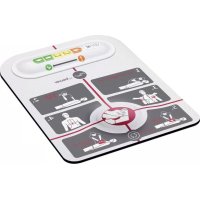
Lifepad RH 112 - Defibrillator BEURER - Free user manual and instructions
Find the device manual for free Lifepad RH 112 BEURER in PDF.



| Product type | Resuscitation aid (medical device) |
| Brand | Beurer |
| Model | LifePad RH 112 |
| Dimensions (pad) | 210 x 160 x 3 mm |
| Dimensions (housing) | 15 mm (thickness) |
| Weight | Approx. 130 g |
| Power supply | 1 CR2032 battery (3V) |
| Battery life | Approx. 1 hour of continuous operation |
| Compression rate | 100 compressions per minute (guided by audible signal) |
| Feedback system | LED (orange, yellow, green) and audible signal |
| Indications | Sudden cardiac arrest in persons over 12 years |
| Contraindications | Obvious fatal injury, normal breathing, under 12 years |
| Target group | Adults and adolescents (12+); use by non-professionals |
| Usage | Single use, non-reusable |
| Operating conditions (temperature) | 5 °C to 40 °C |
| Operating conditions (relative humidity) | 15 to 93 % |
| Operating conditions (ambient pressure) | 700 to 1060 hPa |
| Storage conditions (temperature) | 5 °C to 35 °C |
| Storage conditions (relative humidity) | 45 to 85 % |
| Storage conditions (ambient pressure) | 700 to 1060 hPa |
| Protection class | IP44 (protected against splashing water) |
| Expiration date | 5 years after production (see rating plate) |
| Warranty | See the included warranty card |
| Package contents | 1 LifePad, 1 instruction manual, 1 quick guide |
Frequently Asked Questions - Lifepad RH 112 BEURER
User questions about Lifepad RH 112 BEURER
0 question about this device. Answer the ones you know or ask your own.
Ask a new question about this device
Download the instructions for your Defibrillator in PDF format for free! Find your manual Lifepad RH 112 - BEURER and take your electronic device back in hand. On this page are published all the documents necessary for the use of your device. Lifepad RH 112 by BEURER.
USER MANUAL Lifepad RH 112 BEURER
EN Unfold page 3 before reading the instructions for use.
Read these instructions for use carefully. Observe the warnings and safety notes. Keep these instructions for use for future reference. Make the instructions for use accessible to other users. If the device is passed on, provide the instructions for use to the next user as well.
Table of contents
- Included in delivery 14
- Signs and symbols 14
-
Intended use 15
4.Warnings and safety notes.. 16
5.Storage 18 -
Device description.. 18
7.What to do in an emergency? 18
8.Disposal. 19 - Technical specifications 20
- Warranty/Service 20
1. INCLUDED IN DELIVERY
Check that the exterior of the cardboard delivery packaging is intact and make sure that all contents are present. Before use, ensure that the device and accessories have no visible damage and all packaging material is removed. If you have any doubts, do not use the device and contact your retailer or the specified Customer Services address.
1xLifePad®
1x these instructions for use
1x brief instructions
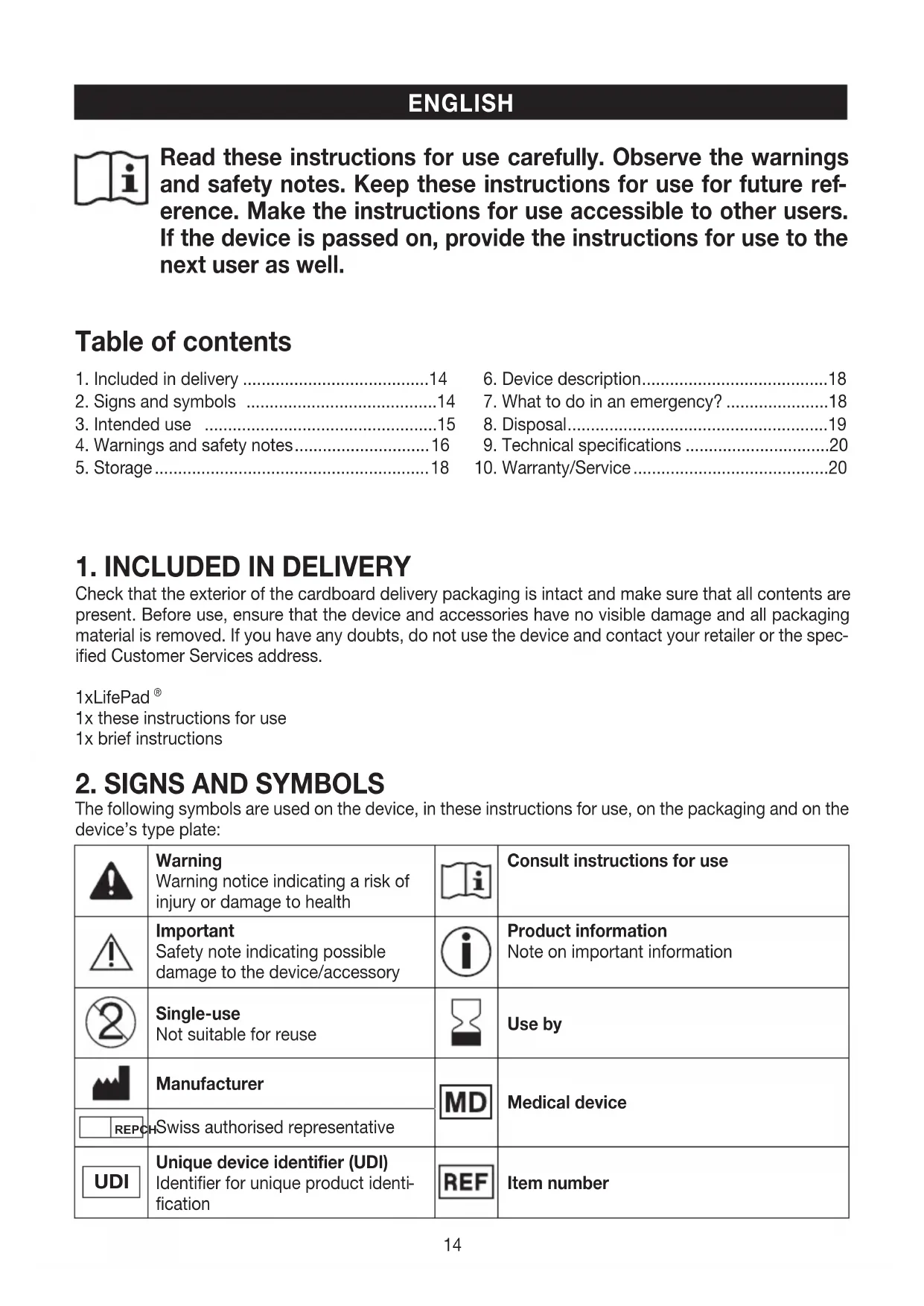
2. SIGNS AND SYMBOLS
The following symbols are used on the device, in these instructions for use, on the packaging and on the device's type plate:
| Warning Warning notice indicating a risk of injury or damage to health | i | Consult instructions for use |
| Important Safety note indicating possible damage to the device/accessory | i | Product information Note on important information |
| Single-use Not suitable for reuse | 2 | Use by |
| Manufacturer | MD | Medical device |
| Swiss authorised representative | ||
| Unique device identifier (UDI) Identifier for unique product identification | REF | Item number |
| SN | Serial number Batch designation | LOT | |
| IP44 | Protection classProtected against solid foreign objects ≥ 1 mm in diameter and against splashing water. | ❤●● | Defibrillation-proof type CF applied part |
| Temperature limitThe temperature limit values to which the medical device can safely be exposed are indicated | CE | CE labellingThis product satisfies the requirements of the applicable European and national directives | |
| Humidity, limitIndicates the humidity range to which the medical device can safely be exposed | Atmospheric pressure, limitIndicates the range of atmospheric pressures to which the medical device can be safely exposed | ||
| DisposalDisposal in accordance with the Waste Electrical and Electronic Equipment EC Directive – WEEE | Pb Cd Hg | Battery disposalDo not dispose of batteries containing harmful substances with household waste | |
| Direct currentThe device is suitable for use with direct current only | A | Marking to identify the packaging material.A = Material code, B = Material number:1-7 = Plastics, 20-22 = Paper and cardboard | |
| Disposition of packaging in an environmentally friendly manner | |||
| Separate the product and packaging elements and dispose of them in accordance with local regulations. |
3. INTENDEDUSE
Use the LifePad for the purpose it was developed for only and in the manner specified in these instructions for use.
Intended use
TheLifePad® motivates and supports first-aiders in cardiopulmonary resuscitation (CPR) of individuals over 12 years of age after a sudden cardiac arrest (SCA) through an acoustic and visual feedback system to evaluate the compressions performed. The LifePad is intended for single use only and must not be used multiple times under any circumstances.
Intended users
TheLifePad® is intended for use by adults and adolescents over the age of 12 and has been specially designed for use by lay persons. Therefore, no specific knowledge or professional ability is required to use the LifePad®.
Clinical benefit
TheLifePad® is not only intended to motivate more people to provide first aid, but also to support inexperienced first-aiders in performing cardiopulmonary resuscitation.
Indications
TheLifePad® should be used once the first-aider has identified that the patient is experiencing a cardiac arrest.

Contraindications
- Do not use the LifePad if the patient has suffered an obviously fatal injury.
- Do not use the LifePad if you are sure that the patient is breathing normally - even if they are not responding.
- Do not use the LifePad on people under the age of 12.
4. WARNINGS AND SAFETY NOTES

General warnings
- Even if resuscitation is initiated immediately, this does not guarantee that the patient will survive, even if it is performed optimally. In some cases, the underlying problem causing the cardiac arrest means that the patient will not survive, despite the best care.
- Patients with serious injuries should not be moved. Without using the LifePad, the layperson (user) should also not move the patient on another ground.
- Cardiac massage with and without LifePad® is less effective for people lying on soft ground.
- Rib fractures and other injuries are common, but acceptable consequences of resuscitation given that the alternative is death due to cardiac arrest. After resuscitation, all patients should be assessed for injuries caused during resuscitation.
- In addition to the above-mentioned consequences, skin abrasions, bruises and wounds on the chest can often occur during resuscitation. Despite this, do not stop performing the compressions, but continue CPR until professional help arrives.
Other undesirable side effects of CPR can be:
- Rib fractures
- Sternum fractures
- Atelectasis
- Collapse of the lung
- Hemothorax
- Pleural effusion
-
Infection of the lung
-
Never delay treatment to find out the exact age of the patient.
- Check the LifePad surface for integrity before starting resuscitation to prevent sharp edges or dangerous areas.
- In the event of a defect, perform the cardiac massage without the assistance of the LifePad. Do not delay or interrupt the start of first aid measures to rectify the defect. Continue to follow the instructions for carrying out CPR illustrated by the pictograms.
- Even if the device fails, continue cardiac massage at a pressure frequency of at least 100 per minute until clear signs of life are once again perceptible or the emergency doctor takes over. The pressure must be high enough to achieve a pressure depth on the chest of 50mm to 60mm .
- TheLifePad® is only intended to support the emergency services (which have been alerted) and cannot completely replace them.
- TheLifePad® is not intended to replace possible training measures in the field of first aid. Prior knowledge is a benefit, but not absolutely necessary for use.
- Keep packaging material away from children. There is a risk of suffocation.
- TheLifePad® is not a toy. Store the LifePad® out of the reach of children.
-
To reduce the risks associated with strong electromagnetic fields, such as device failure, do not use the LifePad near strong high-frequency signals or portable and/or mobile HF devices.
-
The use of accessories, converters and cables other than those intended for the LifePad may result in increased HF emissions or decreased immunity of the LifePad.
- To avoid unnecessarily shortening the service life of the LifePad, only switch it on when treating a patient.
- If you pull out the battery strip prematurely, the battery life can no longer be guaranteed.
- If the LifePad is used in combination with a defibrillator follow the safety instructions of the defibrillator.
- Please report any unexpected operation or events to the manufacturer.
- Device not suitable for use in presence of anaesthetic mixtures inflammable with air, oxygen or nitrogen protoxide.
- The device does not have an ECG function.

General precautions
-
TheLifePad® is intended for single use only and is therefore not suitable for reuse:
-
After a single use and the associated closing of the circuit through pulling the battery strip, the supplied battery is discharged, meaning that it can no longer be ensured that the product can be used again at a later time.
-
Furthermore, the product cannot be used on different people for hygienic reasons, as it cannot be disinfected or cleaned.
-
Protect the LifePad against impacts, moisture, dust, chemicals, strong temperature fluctuations, direct sunlight, water, sand and sources of heat that are too close to it (ovens or heaters), as faultless functionality of the LifePad® can no longer be guaranteed thereafter.
- Under no circumstances should you open or repair the LifePad, as faultless functionality can no longer be guaranteed thereafter and you may receive an electric shock. The LifePad cannot be maintained and/or calibrated.
- Do not use additional parts that are not recommended by the manufacturer or offered as accessories.
- If you see or suspect damage to the LifePad, you must replace it with a new LifePad.
- TheLifePad® is protected against splashes. Never submerge the LifePad® in water.

Notes on handling batteries
- If your skin or eyes come into contact with battery fluid, wash the affected area with water and seek medical assistance.
- Choking hazard! Small children may swallow and choke on batteries. Therefore, batteries should be stored out of the reach of small children.
- Observe the plus (+) and minus (-) polarity signs.
- If a battery has leaked, put on protective gloves and clean the battery compartment with a dry cloth.
- Protect batteries from excessive heat.
- Risk of explosion! Do not throw batteries into a fire.
- Do not charge or short-circuit the batteries.
- Do not use rechargeable batteries.
- Do not disassemble, open or crush the batteries.
- Battery must comply with IEC 60086-4.
5. STORAGE

Possible damage due to incorrect storage
- Store the LifePad in a dry environment with no external stresses.
- Make sure to store the product in a place that is quick and easy to access in case of an emergency.
- TheLifePad® must not be bent or subjected to other external stresses during storage, as this could damage the pressure sensor.
- Regularly check that the printed use-by date has not been exceeded when the LifePad is in storage. In this case, replace the product immediately with a new one.
6. DEVICE DESCRIPTION
The device is shown on the fold-out page.
1 ON/OFF button (with battery strip removed: short press -> ON / long press -> OFF) / mute button (short press again after switching on -> muted)
2 LED feedback system
3 Battery strip
4 Pressure sensor
7. WHAT TO DO IN AN EMERGENCY?
The associated drawings are shown on the fold-out page.

Check for consciousness and breathing
Check if the person that has collapsed is responsive. To do this, shake them lightly by their shoulders and ask loudly: "Is everything OK?" If they respond, try to find out what the problem is with them and get help if necessary. Regularly check their condition.
If they do not respond, check their breathing using sight, hearing and touch. To do this, turn the patient onto their back. Inspect the oral cavity for objects or foreign bodies and remove them if necessary. Place your hand on their forehead and gently tilt their head backwards using your other hand's fingertips in order to clear the airways. If you are unsure whether breathing is normal, work on the basis that it is not normal and start resuscitation. Gasping, wheezing or shallow breathing should not be regarded as normal breathing.

Make an emergency call
If the patient is not responsive and is not breathing normally, immediately alert the emergency services (the number for Europe, for example, is 112).

Expose the upper body
As far as possible, ensure that the patient is lying on a firm and level surface. Expose the patient's upper body. The LifePad must be able to rest directly on bare skin.

Place the LifePad
Place the LifePad on the patient's bare upper body as shown. Align the product using the red reference lines. The LifePad should be positioned on the patient's upper body so that the vertical red line is in the middle of the body and the lower edge of the product is in line with the sternum/ breastbone so that the pressure sensor 4 is in the lower half of the sternum.
E Pull out the battery strip
Then pull the battery strip 3 completely out of the housing to activate the LifePad. An acoustic signal begins to sound on the LifePad.
F Place your hands on the patient
Kneel next to the patient. Place the ball of one hand on the raised part of the LifePad pressure sensor 4. Place the ball of your other hand on the first hand and interlace your fingers. Make sure that they do not press on the patient's ribs and do not put any pressure on the upper abdomen.
G Perform the compressions
Place your shoulders vertically over the patient's chest and extend your arms. Now start the cardiac massage in the rhythm of the acoustic signal. Each time the beep sounds, press the sternum down by at least 5cm , but not more than 6cm .
The coloured LED feedback system 2 will tell you whether you are applying enough pressure. You are applying sufficient pressure to the chest if you make all of the LEDs light up one after the other in ascending order from orange to green.
If you only light up the orange or the two yellow LEDs, you are not applying enough pressure. Increase the pressure for the subsequent compressions until all LEDs light up.
H Release the chest again
Completely release the chest after each compression you perform without losing contact between your hands and the LifePad.
Here, too, the LED feedback system 2 helps you to assess this.
After each compression, release the chest until the LEDs go out one after the other in descending order from green to orange until only the orange LED lights up.
If the green and yellow LEDs do not go out completely, the chest has not been released sufficiently. During subsequent compression, release the chest even more until all LEDs except the orange LEDs go out.
Repeat steps G and H in the rhythm of the acoustic signal to ensure a frequency of 100 compressions per minute. Perform cardiac massage until there are clear signs of life again or until the emergency doctor takes over.
(Clear signs of life: opening eyes, waking up, moving and starting to breathe normally)
If you are trained to do so, you can give 2 rescue breaths after 30 compressions.
1 Deactivate acoustic signal (optional)
You can deactivate the acoustic signal at any time when the product is activated by pressing the ON/OFF button again. This can be useful, for example, if a defibrillator is being used at the same time, as it also emits acoustic signals. Please note, however, that in this case you can no longer receive feedback on the frequency required for the compressions to be carried out.
8. DISPOSAL
Disposal of the device
For environmental reasons, do not dispose of the LifePad with your household waste after a single use. Dispos of the device at a suitable collection point in your country. Dispos of the LifePad in accordance with EC Directive - WEEE (Waste Electrical and Electronic Equipment). If you have any questions, please contact the local authorities responsible for waste disposal. When disposing of the LifePad, ensure that the battery has been removed and dispose of it separately.
Disposal of the batteries
- Batteries must not be disposed of in the household waste. They may contain poisonous heavy metals and are subject to special refuse treatment.
- The codes below are printed on batteries containing harmful substances:
Pb = Battery contains lead,
Cd = Battery contains cadmium,
Hg = Battery contains mercury.
9. TECHNICAL SPECIFICATIONS
| Model LifePad | ® |
| Type RH 112 | |
| Dimensions 210 x 160 x 3 mm (pad) / 15 mm (housing) | |
| Weight Approx. 130 g | |
| Volume ≥37 (max. 66) dB | |
| Permissible operating conditions 5°C to 40°C,15 to 93% relative humidity700 -1060 hPa ambient pressure | |
| Permissible storage and transport conditions | 5°C to 35°C,45-85% relative humidity700 -1060 hPa ambient pressure |
| Protection class IP44 | |
| Power supply 1x CR2032 (3 V) | ———— |
| Battery life Approx. 1 hour in continuous operation | |
| Frequency of the acoustic signal 100 bpm | |
| Use-by date See type plate | (5 years after production) |
| Expected useful life | Single-use product |
| Classification | Internal supply, continuous operation, application part defibrillation-proof type CF (back side of device is considered as defibrillation-proof type CF applied part) |
The technical data is subject to change without notice, as updates are possible.
The serial number is located on the device or in the battery compartment.
- The device complies with the Regulation (EU) 2017/745 of the European Parliament and of the Council on medical devices, as well as the respective national provisions.
- This device complies with European standards EN 60601-1 and EN 60601-1-2 (in compliance with CISPR 11, IEC 61000-4-2, IEC 61000-4-3, IEC 61000-4-8) and is subject to special precautionary measures with regard to electromagnetic compatibility. Please note that portable and mobile HF communication systems may interfere with this device. Further information can be obtained from the Customer Services address provided.
10. WARRANTY/SERVICE
Further information on the warranty and warranty conditions can be found in the warranty leaflet supplied.
For users/patients in the European Union and identical regulation systems (EU Medical Device Regulation (MDR) 2017/745), the following applies: If during or through use of the product a major incident occurs, notify the manufacturer and/or their representative of this as well as the respective national authority of the member state in which the user/patient is located.
FRANÇAIS

KpaTkay HnCTpyKzna, 1 wT.
2. ПОЯСHEняк СИМBOЛAM
Ha npibope, B nHctpyKuIN no npimHeHHo, Ha ynaKOBKe i fnpMeHHo Ta6nUKe npbopa nCnoB3yIOTc cJeDyUOJIe CmMBOJIb.
9. TEXHnueCKne DAHHbIE
10. GWARANCJA/SERWIS
4. WAARSCHUWINGEN EN VEILIGHEIDSRICHTLIJNEN

6. BESCHRIJVING VAN HET APPARAAT


- TABLE OF CONTENTS
- INCLUDED IN DELIVERY
- SIGNS AND SYMBOLS
- INTENDEDUSE
- INTENDED USE
- INTENDED USERS
- CLINICAL BENEFIT
- INDICATIONS
- CONTRAINDICATIONS
- WARNINGS AND SAFETY NOTES
- GENERAL WARNINGS
- GENERAL PRECAUTIONS
- NOTES ON HANDLING BATTERIES
- STORAGE
- POSSIBLE DAMAGE DUE TO INCORRECT STORAGE
- DEVICE DESCRIPTION
- WHAT TO DO IN AN EMERGENCY
- CHECK FOR CONSCIOUSNESS AND BREATHING
- MAKE AN EMERGENCY CALL
- EXPOSE THE UPPER BODY
- PLACE THE LIFEPAD
- E PULL OUT THE BATTERY STRIP
- F PLACE YOUR HANDS ON THE PATIENT
- G PERFORM THE COMPRESSIONS
- H RELEASE THE CHEST AGAIN
- 1 DEACTIVATE ACOUSTIC SIGNAL (OPTIONAL)
- DISPOSAL
- DISPOSAL OF THE DEVICE
- DISPOSAL OF THE BATTERIES
- TECHNICAL SPECIFICATIONS
- WARRANTY/SERVICE
- FRANÇAIS
- ПОЯСHEНЯК СИМBOЛAM
- TEXHNUECKNE DAHHBIE
- GWARANCJA/SERWIS
- WAARSCHUWINGEN EN VEILIGHEIDSRICHTLIJNEN
- BESCHRIJVING VAN HET APPARAAT
Brand : BEURER
Model : Lifepad RH 112
Category : Defibrillator